Teacher  Training Class Session 1
What is Consciousness? Thus the wise living entity's pure consciousness becomes covered by his eternal enemy in the form of lust, which is never satisfied and which burns like fire. The difference between matter and spirit is that matter has no consciousness like the living entity; therefore this consciousness is supreme and eternal. Consciousness cannot be produced by a combination of matter.
What is Consciousness? Consciousness is the symptom of the soul.   Even if one does not find the soul within the heart, where he is situated, one can still understand the presence of the soul simply by the presence of consciousness.
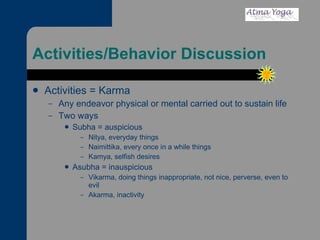
Activities/Behavior Discussion Activities = Karma  Any endeavor physical or mental carried out to sustain life Two ways Subha = auspicious Nitya, everyday things Naimittika, every once in a while things Kamya, selfish desires Asubha = inauspicious Vikarma, doing things inappropriate, not nice, perverse, even to evil Akarma, inactivity
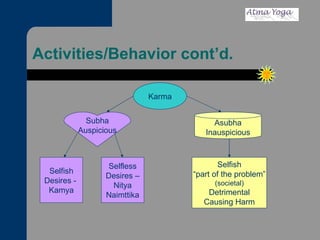
Activities/Behavior cont’d. Karma Subha Auspicious Asubha Inauspicious Selfish Desires -  Kamya Selfless Desires – Nitya Naimttika Selfish “ part of the problem” (societal) Detrimental Causing Harm
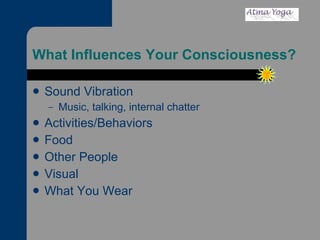
What Influences Your Consciousness? Sound Vibration Music, talking, internal chatter Activities/Behaviors Food Other People Visual What You Wear
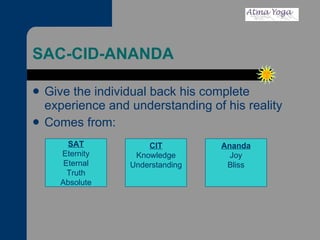
SAC-CID-ANANDA Give the individual back his complete experience and understanding of his reality Comes from: SAT Eternity Eternal Truth Absolute CIT Knowledge Understanding Ananda Joy Bliss
Atma Yoga Fundamentals Be honest about where you are starting Be honest about where your student is starting Very important for a teacher
Vedas Purpose Vedas = Truth Purpose is to move you towards your true nature Lord Krishna to Arjun yo yo yäà yäà tanuà bhaktaù çraddhayärcitum icchati tasya tasyäcaläà çraddhäà täm eva vidadhämy aham TRANSLATION I am in everyone's heart as the Supersoul. As soon as one desires to worship some demigod, I make his faith steady so that he can devote himself to that particular deity. Like Virtual Reality or Video Game, it must respond to the individual Machinery of reality has to respond to the desires of the player You are not actually doing anything Another example would be dreaming
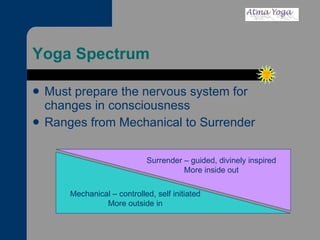
Yoga Spectrum Must prepare the nervous system for changes in consciousness Ranges from Mechanical to Surrender Mechanical – controlled, self initiated More outside in Surrender – guided, divinely inspired More inside out
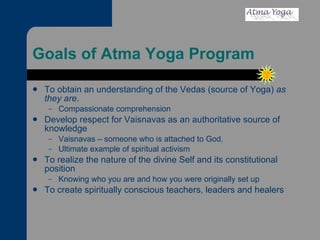
Goals of Atma Yoga Program To obtain an understanding of the Vedas (source of Yoga)  as they are . Compassionate comprehension Develop respect for Vaisnavas as an authoritative source of knowledge Vaisnavas – someone who is attached to God.  Ultimate example of spiritual activism To realize the nature of the divine Self and its constitutional position Knowing who you are and how you were originally set up To create spiritually conscious teachers, leaders and healers
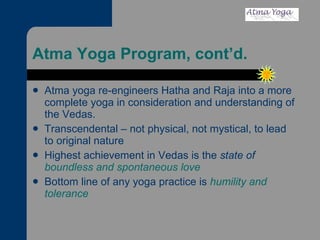
Atma Yoga Program, cont’d. Atma yoga re-engineers Hatha and Raja into a more complete yoga in consideration and understanding of the Vedas. Transcendental – not physical, not mystical, to lead to original nature Highest achievement in Vedas is the  state of  boundless and spontaneous love Bottom line of any yoga practice is  humility and tolerance
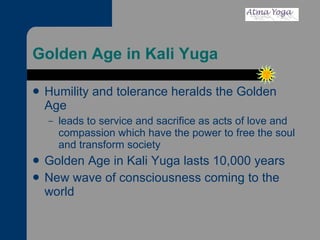
Golden Age in Kali Yuga Humility and tolerance heralds the Golden Age  leads to service and sacrifice as acts of love and compassion which have the power to free the soul and transform society Golden Age in Kali Yuga lasts 10,000 years  New wave of consciousness coming to the world
Teacher Training Class Session 2
Opening Chant Om Namo Bhagavate Vasudevaya Translation: I humbly offer my respects to the personality and source of pure consciousness.
Homework Expectations Workbook Daily Sadhana (3 kriyas) Reading Memorizing Teacher Mantras Silent Teacher chant Opening Class Chant Savasana Relaxation Sequence Ending Chant Extreme familiarity with the Power Yoga class Enable you to focus on the class
Required Reading 4 Main Texts (in order of reading) Searching for Vedic India – Due 4/18 Human Devolution – Due 5/15 Spiritual Warrior III – Due 5/23 Leadership for Higher Consciousness - Due 6/5 Write 100 word chapter reviews for first 3 books.  Also write a short review of each book (250-500 words)
Supplemental Texts Asana, Pranayama, Mudra, Bandha – Bihar Press Yoga Pradipika – Svatmarama Hidden Glory of India – Satyaraja Dasa Isopanisad – Vedic text translation
Atma Yoga  Three styles of yoga Kundalini (most powerful) Slow Deep Stretch (second most powerful) Power Yoga (third most powerful) **power rating is based on transformation aspect
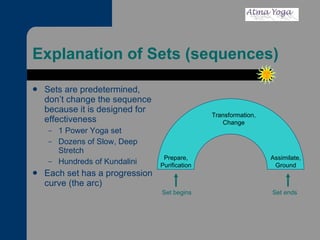
Explanation of Sets (sequences) Sets are predetermined, don’t change the sequence because it is designed for effectiveness 1 Power Yoga set Dozens of Slow, Deep Stretch Hundreds of Kundalini Each set has a progression curve (the arc) Prepare, Purification Set begins Set ends Transformation, Change Assimilate, Ground
Factors of Protection for a Set Teacher mantra Opening class invocation Sets may have sound vibration in them Structual integrity of the sets Systematic relaxation Reading of applicable stories Call outs of love Prasadam – distribution of sanctified food, sweets, salties (raisins, nuts)
Vedas Purpose to Life Inquire into the nature of truth Why are you here? Some reason dissatisfied with spirit world  Or we were given the opportunity to experience it
Studying the Vedas Vedas  are the original knowledge As conditioned souls, we are subject to deficiencies 1. Must commit mistakes 2. Prone to illusion “you are not this body”  3. Cheating Propensity 4. Senses are imperfect
Studying the Vedas, cont’d. ‘ Hindu’ designation does not appear in the Vedas We are VARNASRAMA Denotes followers of the Vedas VARNA = 4 divisions of society ASRAMA = 4 divisions of spiritual life 4 Divisions of Society are: 1.  Spiritual leader = Brahmana 2.  Administrative/Warrior = Ksatriya 3.  Merchant or Agriculturalist = Vaisya 4.  Artisan or Craftsperson = Sudra Nothing in the Vedas says there is a birth right to a division.  You must  earn  your right.
Studying the Vedas, cont’d. Age of Kali Yuga – degraded the divisions of society into an actual lineage Vedas are SRUTI (acquired by hearing).  Brahma = first living creature to get knowledge handed down by succession Three kinds of evidence 1. Pratyaksa = direct evidence, collect with senses 2. Anumana = inductive knowledge, theory then prove 3. Sabda-Praman = authoritative source beyond this world
Studying the Vedas, cont’d. Two classes of transcendentalists 1.  Impersonal = sectarian 2.  Personal = universal, Vaisnava Knowledge acquired: Inductive = facts to general conclusions, research then prove Deductive = general conclusion to specific Transcendental Energy Sounds outside the material plane which begin to undo karma (both good and bad) Speed of the mind is so swift – like a “split second”
Studying the Vedas, Cont’d Spiritual Master Rightly heard from the authoritative source Practically established in Brahman (truth) Originally there was 1 Veda.  Didn’t have to read it because beings were able to comprehend and remember upon hearing.  5,000 years ago Vyasadeva wrote down the Vedas because of the start of Kali Yoga and society’s degradation Rig Sama Atharva Yajur
Teacher Training Overview of the Vedas Session 3
Contents The Vedas Supplemental Text s Supplemental Information
The Vedas Vedas = “knowledge” From the root vid which means “to know” The Vedas were composed in Sanskrit The “multitude of diverse desires” is one reason why the Vedas are explaining things in different ways The Vedas don’t have an age 5,000 years ago Vyasadeya put down the Vedas in writing because of the start of Kali Yuga and societies degradation
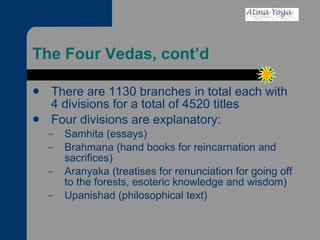
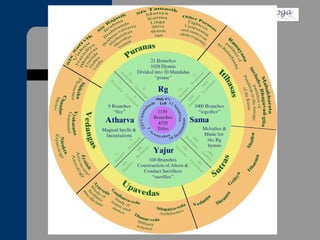
The Four Vedas Rg Sama Yajur Atharva When someone refers to the “three Vedas”, they are referring to the first three on the list.  The Atharva is sometimes considered separately.  These four are also referred to as the Karma Kanda
The Four Vedas, cont’d There are 1130 branches in total each with 4 divisions for a total of 4520 titles Four divisions are explanatory: Samhita (essays) Brahmana (hand books for reincarnation and sacrifices)  Aranyaka (treatises for renunciation for going off to the forests, esoteric knowledge and wisdom) Upanishad (philosophical text)
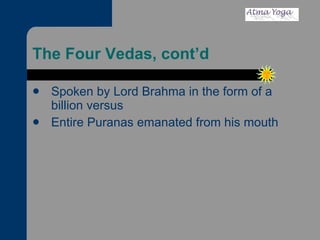
The Four Vedas, cont’d Spoken by Lord Brahma in the form of a billion versus Entire Puranas emanated from his mouth
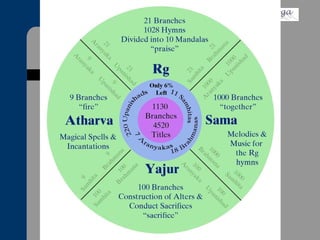
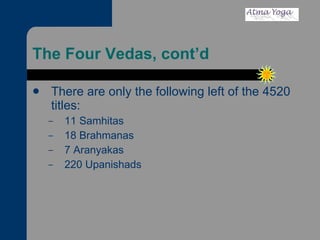
The Four Vedas, cont’d There are only the following left of the 4520 titles: 11 Samhitas 18 Brahmanas 7 Aranyakas 220 Upanishads
Rg Veda Meaning = “praise”  Contains 1028 hymns praising the demigods for victory in war It is divided into 10 mandalas (concentric circles) It is the most famous of the Vedas 21 branches
Sama Veda Meaning = “together” Contains the melodies and music for the changes that are in the Rg Veda.  1000 branches
Yajur Veda Meaning = “sacrifice” It explains how to construct alters and conduct sacrifies Specific texts are:  Krsna (black) Sukla (white) This Veda later became the source of corruption for the priest craft 100 branches
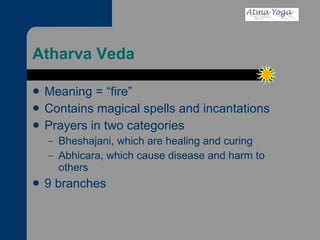
Atharva Veda Meaning = “fire” Contains magical spells and incantations Prayers in two categories Bheshajani, which are healing and curing Abhicara, which cause disease and harm to others 9 branches
 
Supplemental  Texts
Supplementary Texts Puranas (stories and history) Traditionally called the fifth Veda 18 Mahapuranas Itihasas (epics) Ramayana Mahabharata  (includes the Bhagavad-gita) Sutras (aphorisms) Upavedas Vedangas
Puranas Mahapuranas Six Sattvic Puranas Vishnu, Naradiya, Bhagavat, Garuda, Padma, Varaha Six Rajasic Puranas Brahma, Brahmanda, Brahma-viavarta, Markandeya, Bhavishya, Vamana Six Tamasic Puranas Matsya, Kurma, Linga, Shiva, Skanda, Agni Eighteen Upapuranas  Numerous sthala (regional)
Itihasas Meaning = “histories” Ramayana – the epic of Lord Rama and Sita Mahabharata – mainly the story of Lord Krishna, the Pandavas and the battle of Kurukshetra Includes the Bhagavad-gita
Sutras “ Books of concise truths” Vedanta-sutras Shrauta-sutras Grihya-sutras Shulba-sutras Dharma-sutras
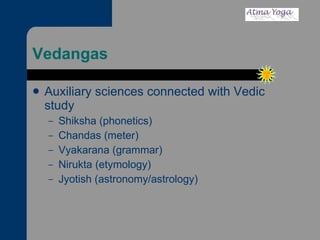
Vedangas Auxiliary sciences connected with Vedic study Shiksha (phonetics) Chandas (meter) Vyakarana (grammar) Nirukta (etymology) Jyotish (astronomy/astrology)
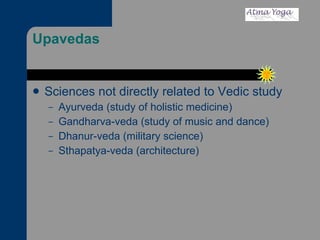
Upavedas Sciences not directly related to Vedic study Ayurveda (study of holistic medicine) Gandharva-veda (study of music and dance) Dhanur-veda (military science) Sthapatya-veda (architecture)
 
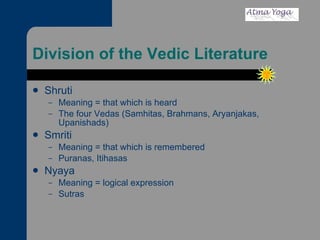
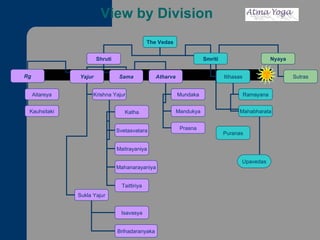
Division of the Vedic Literature Shruti Meaning = that which is heard The four Vedas (Samhitas, Brahmans, Aryanjakas, Upanishads) Smriti Meaning = that which is remembered Puranas, Itihasas Nyaya Meaning = logical expression Sutras
View by Division The Vedas Shruti Smriti Nyaya Rg Yajur Sama Atharva Krishna Yajur Sukla Yajur Katha Svetasvatara Maitrayaniya Mahanarayaniya Taittiriya Isavasya Brihadaranyaka Aitareya Kauhsitaki Mundaka Mandukya Prasna Itihasas Puranas Sutras Upavedas Ramayana Mahabharata
Supplemental Information
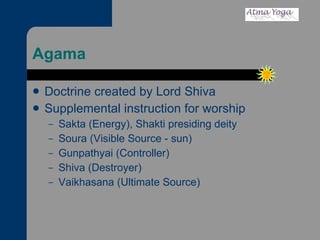
Agama Doctrine created by Lord Shiva Supplemental instruction for worship  Sakta (Energy), Shakti presiding deity Soura (Visible Source - sun) Gunpathyai (Controller) Shiva (Destroyer) Vaikhasana (Ultimate Source)
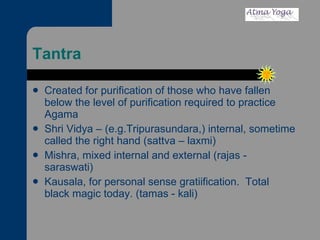
Tantra Created for purification of those who have fallen below the level of purification required to practice Agama Shri Vidya – (e.g.Tripurasundara,) internal, sometime called the right hand (sattva – laxmi) Mishra, mixed internal and external (rajas - saraswati) Kausala, for personal sense gratiification.  Total black magic today. (tamas - kali)
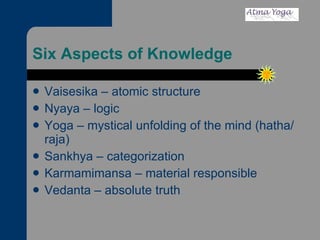
Six Aspects of Knowledge Vaisesika – atomic structure Nyaya – logic Yoga – mystical unfolding of the mind (hatha/raja) Sankhya – categorization Karmamimansa – material responsible Vedanta – absolute truth
Three Schools or Approaches Karma Kanda – materially responsible experience Jnana Kanda – spiritual knowledge knowledge Yoga Kanda– (surrender) Mystical or devotional
Social Harmony in the Vedas Varnasrama system The ideal: spiritual advancement  (service) The collapse: self aggrandizement (exploitation)
Social Harmony in the Vedas Satya – Ideal (no caste-no class division) Undivided Veda is expressed by the syllable oà, and God is worshipped as Lord Haàsa through the process of meditation. The people of Satya-yuga are for the most part self-satisfied, merciful, friendly to all, peaceful, sober and tolerant. They take their pleasure from within, see all things equally and always endeavor diligently for spiritual perfection.
Social Harmony in the Vedas Treta –  at the beginning of Tretä-yuga Vedic knowledge appeared from the original source of prana; in three divisions—as Åg, Säma and Yajur. Then from that knowledge God is worshipped as the threefold sacrifice. In Tretä-yuga each leg of religion is gradually reduced by one quarter by the influence of the four pillars of irreligion—lying, violence, dissatisfaction and quarrel. They are not excessively violent or very lusty after sensual pleasure. Their interest lies primarily in religiosity, economic development and regulated sense gratification, and they achieve prosperity by following the prescriptions of the three Vedas. Although in this age society evolves into four separate classes  In Tretä-yuga the four social orders were manifested.  The brähmaëas appeared were like the head (intelligence) of society. The kñatriyas were like the strong arms (or protection) of society The vaiçyas were like the thighs (or forward movement) of society The laborer & artisan were like the feet (or support) of society These categories are classified in terms of one's work and qualification and not by birth.
Social Harmony in the Vedas Dvapara – In Dväpara-yuga the virtuous qualities of austerity, truth, mercy and charity are reduced to one half by their irreligious counterparts—dissatisfaction, untruth, violence and enmity. In the Dväpara age people are interested in glory and are very noble. They devote themselves to the study of the Vedas, possess great opulence, support large families and enjoy life with vigor. Of the four classes, the kñatriyas and brähmaëas are most numerous.
Social Harmony in the Vedas Kali – In the age of Kali only one fourth of the principles of virtue remains. That last remnant will continuously be decreased by the ever-increasing principles of irreligion and will finally be destroyed. In the Kali age people tend to be greedy, ill-behaved and merciless, and they fight one another without good reason. Unfortunate and obsessed with material desires, the people of Kali-yuga are almost all members of the exploited class.
Social Harmony in the Vedas Kali continued… Cities will be dominated by thieves, the Vedas will be contaminated by speculative interpretations of atheists, political leaders will virtually consume the citizens, and the so-called priests and intellectuals will be devotees of their bellies and genitals. The brahmacärés (students) will fail to execute their vows and become generally unclean, the householders will become beggars, the vänaprasthas (retired class) will live in the villages, and the sannyäsés (renunciates) will become greedy for wealth.
Social Harmony in the Vedas Kali continued… Above all the age will be marked by conflict between the common people and those in power and the three way struggle between the materialist, the politico and the pseudo -spiritualist “ O learned one, in this iron age of Kali men have but short lives. They are quarrelsome, lazy, misguided, unlucky and, above all, always disturbed.” Srimad Bhagavatam
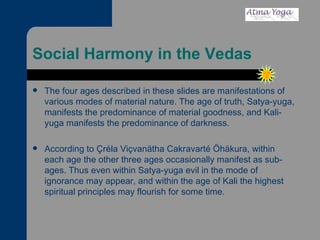
Social Harmony in the Vedas The four ages described in these slides are manifestations of various modes of material nature. The age of truth, Satya-yuga, manifests the predominance of material goodness, and Kali-yuga manifests the predominance of darkness.  According to Çréla Viçvanätha Cakravarté Öhäkura, within each age the other three ages occasionally manifest as sub-ages. Thus even within Satya-yuga evil in the mode of ignorance may appear, and within the age of Kali the highest spiritual principles may flourish for some time.
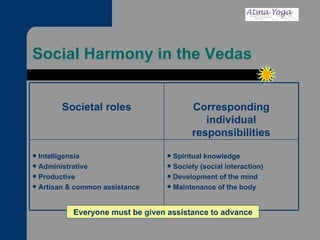
Social Harmony in the Vedas Everyone must be given assistance to advance Spiritual knowledge Society (social interaction) Development of the mind Maintenance of the body Intelligensia Administrative Productive Artisan & common assistance Corresponding individual responsibilities Societal roles
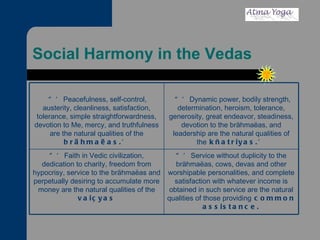
Social Harmony in the Vedas “‘ Service without duplicity to the brähmaëas, cows, devas and other worshipable personalities, and complete satisfaction with whatever income is obtained in such service are the natural qualities of those providing  common assistance. “‘ Faith in Vedic civilization, dedication to charity, freedom from hypocrisy, service to the brähmaëas and perpetually desiring to accumulate more money are the natural qualities of the  vaiçyas “‘ Dynamic power, bodily strength, determination, heroism, tolerance, generosity, great endeavor, steadiness, devotion to the brähmaëas, and leadership are the natural qualities of the  kñatriyas.’ “‘ Peacefulness, self-control, austerity, cleanliness, satisfaction, tolerance, simple straightforwardness, devotion to Me, mercy, and truthfulness are the natural qualities of the  brähmaëas.’
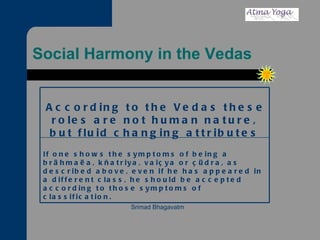
Social Harmony in the Vedas If one shows the symptoms of being a brähmaëa, kñatriya, vaiçya or çüdra, as described above, even if he has appeared in a different class, he should be accepted according to those symptoms of classification. Srimad Bhagavatm According to the Vedas these roles are not human nature, but fluid changing attributes
Social Harmony in the Vedas Those out of harmony populate jails and social institutions “‘ Uncleanliness, dishonesty, thievery, faithlessness, useless quarrel, lust, anger, and hankering constitute the nature of those in the lowest position outside the varëäçrama system.’ Those in harmony stay in society “‘ Nonviolence, truthfulness, honesty, desire for the happiness and welfare of all others and freedom from lust, anger, and greed constitute duties for all members of society.’
Social Harmony in the Vedas Student Householder Retired Devotional Life roles
Social Harmony in the Vedas Living out the nature of the soul and fulfilling your mission This over rides all divisions The Soul’s role (above even social roles)
Teacher  Training Class Session 4
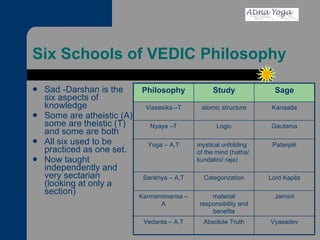
Six Schools of VEDIC Philosophy Sad -Darshan is the six aspects of knowledge Some are atheistic (A) some are theistic (T) and some are both All six used to be practiced as one set.  Now taught independently and very sectarian (looking at only a section) Kanaada atomic structure Viasesika –T Vyasadev Absolute Truth Vedanta – A,T Jaimini material responsibility and benefits Karmamimansa – A Lord Kapila Categorization Sankhya – A,T Patanjali mystical unfolding of the mind (hatha/kundalini/ raja) Yoga – A,T Gautama Logic Nyaya –T Sage Study Philosophy
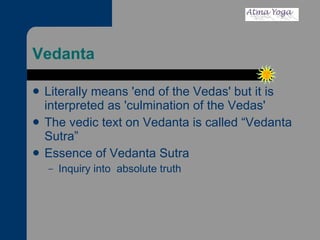
Vedanta Literally means 'end of the Vedas' but it is interpreted as 'culmination of the Vedas'  The vedic text on Vedanta is called “Vedanta Sutra” Essence of Vedanta Sutra Inquiry into  absolute truth
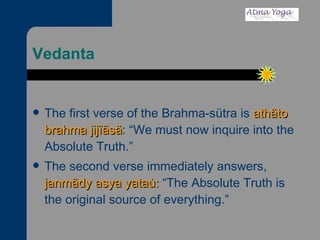
Vedanta The first verse of the Brahma-sütra is  athäto brahma jijïäsä : “We must now inquire into the Absolute Truth.”  The second verse immediately answers,  janmädy asya yataù:  “The Absolute Truth is the original source of everything.”
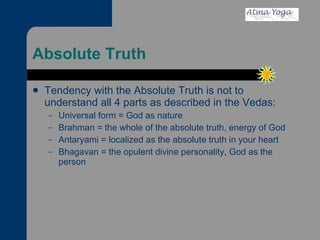
Absolute Truth Tendency with the Absolute Truth is not to understand all 4 parts as described in the Vedas: Universal form = God as nature Brahman = the whole of the absolute truth, energy of God Antaryami = localized as the absolute truth in your heart Bhagavan = the opulent divine personality, God as the person
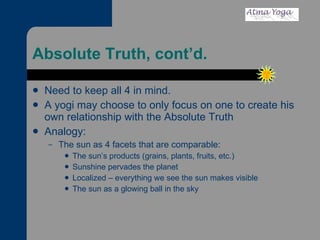
Absolute Truth, cont’d. Need to keep all 4 in mind.  A yogi may choose to only focus on one to create his own relationship with the Absolute Truth Analogy: The sun as 4 facets that are comparable: The sun’s products (grains, plants, fruits, etc.) Sunshine pervades the planet Localized – everything we see the sun makes visible The sun as a glowing ball in the sky
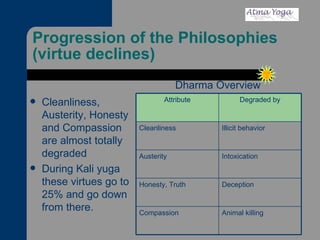
Progression of the Philosophies (virtue declines) Dharma Overview Cleanliness, Austerity, Honesty and Compassion are almost totally degraded During Kali yuga these virtues go to 25% and go down from there. Intoxication  Austerity Animal killing Compassion Deception Honesty, Truth Illicit behavior Cleanliness Degraded by Attribute
Progression of the Philosophies (a history of spiritual revolutions) It is the evidence of history that at a certain time every society attains its manhood, when a strong conflict ensues between the ruling power and the common people.  The life of society, its expansion and civilization, depend on its victory or defeat in this conflict.
Progression of the Philosophies The Beginning of the Triangular Fight between Ceremonialism, Philosophy and Materialism The Charvaka, the Jain, the Buddhist, Shankara, Ramanuja, Kabir, Nanak, Chaitanya, the Brahmo-Samaj… of all of these, and similar sects, the wave of religion, foaming, thundering, surging, breaks in the front, while in the rear follows the filling-up of social wants. If all desires can be accomplished by the mere utterance of some meaningless syllables, then who will exert himself to go through difficulties to work out the fulfillment of his desires? [A cheaters paradise…]   From REVOLUTION to FASHION: a pattern of tamasic cooptation
Progression of the Philosophies The Charvakas, Who Upheld Materialism as the Highest Goal of Life The Charvaka, or materialist, basing his doctrine on the first part - the sacrificial portion - of the Vedas, believed that all was matter and that there is neither a heaven nor a hell, neither a soul nor a God.  [The Charvaka movement] was the beginning of that caste question, and that triangular fight in India between ceremonials, philosophy and materialism which has come down unsolved to our own days.
Progression of the Philosophies Hence, the slashing sarcasm of the Charvakas, who believed only in the reality of sense-perceptions and nothing beyond.  What could have saved Indian society from the ponderous burden of omniferous ritualistic ceremonialism with its animal and other sacrifices, which all but crushed the very life out of it, except the Jain revolution which took its strong stand exclusively on chaste morals and philosophical truth?  Or without the Buddhist revolution what could have delivered the suffering millions of the lower classes from the violent tyrannies of the influential higher castes?  When, in course of time, Buddhism declined and its extremely pure and moral character gave place to equally bad, unclean and immoral practices, when Indian society trembled under the infernal dance of the various races of barbarians who were allowed into the Buddhistic fold by virtue of its all-embracing Spirit of equality –  then Shankara, and later Ramanuja, appeared on the scene and tried their best to bring society back to its former days of glory and to re-establish its lost status.
Progression of the Philosophies The Teaching of Motiveless Work Brought a Momentary Lull in the Struggle between the Priests and the Kings The tug of war [between the brahmins and the kshatriyas had begun] in the earliest periods of the history of the [Indian race], and throughout the Shrutis it can be distinctly traced. A momentary lull came when Sri Krishna, leading the faction of kshatriya power and of jnana, showed the way to reconciliation. The result was the teachings of the Gita - the essence of philosophy, of liberality, of religion.
Progression of the Philosophies The Jains  were very moral atheists who, while rejecting the idea of a God, believed that there is a soul, striving for more perfect development.  Objecting to the killing of cows and bulls, killing of goats and all sorts of animals… "Now", declared the Jains, "that is no work at all, because injuring others can never be any good work." And they said, "This is the proof that your Vedas are false Vedas, manufactured by the priests
Progression of the Philosophies The Social Wants at the Time of Buddha Buddhism was the rebellion of the newly formed kshatriyas against Vedic priestcraft.  [After the lull cause by the reconciliation effected by Sri Krishna], the ambition of the two classes - brahmin and kshatriya - to be the masters of the poor and ignorant was [still] there, and the strife once more became fierce.
Progression of the Philosophies Buddhism Combated Not Only Priestcraft and Animal Sacrifice: It was the First to Break Down the Barriers of Caste   These different social divisions developed or degenerated into iron-bound castes and an organized and crystallized priestcraft stood upon the necks of the nation. At this time Buddha was born and his teaches were the revolution .
Progression of the Philosophies Original Buddhism ... was but an attempt to combat caste and priestcraft; it was the first in the world to stand as champion of dumb animals, the first to break down caste, standing between human beings. Buddhism... broke the chains of the masses. All castes and creeds alike became equal in a minute. Brahmanya power was almost effaced from its field of work in Indian during the Jain and Buddhist revolutions;
Progression of the Philosophies Buddha Broke the Mental and Spiritual Bonds of Men by Preaching Vedanta to the Whole World   India was full of witchcraft in Buddha's day. There were the masses of the people, and they were debarred from all knowledge. If just a word of the Vedas entered the ears of a man, terrible punishment was visited upon him. The priests had made a secret of the Vedas - the Vedas that contained the spiritual truths discovered by the ancient Hindus!  What Buddha did was to break wide open the gates of that very religion which was confined in the Upanishads and to a particular caste.
Progression of the Philosophies Buddha preached the most tremendous truths.  He taught the very gist of the philosophy of the Vedas to one and all without distinction; he taught it to the world at Large, because one of his great messages was the equality of humanity.  Human beings are all equal. No concession there to anybody!  Buddha was the great preacher of equality. Every man and woman has the same right to attain spirituality - that was his teaching.  The difference between the priests and the other castes he abolished.
Progression of the Philosophies The Reasons Why Buddhism Had to Die a Natural Death in India To Break the Tyranny of Priestcraft Buddhism Swept Away the Idea of the Personal God The aim of Buddhism was reform of the Vedic religion, by standing against ceremonials requiring offerings of animals, against hereditary caste and exclusive priesthood, and against belief in permanent souls. It never attempted to destroy that religion, or to overturn the social order.
Progression of the Philosophies The Reasons Why Buddhism Had to Die a Natural Death in India Buddha is said to have denied the Vedas because there was so much killing.  Buddha wanted no pandering to the priests, the powerful, the kings. No bowing before superstitious traditions, however hoary; no respect for forms and books just because they came down from the distant past. He rejected all scriptures, all forms of religious practice.  Even the very language, Sanskrit, in which religions had traditionally been taught in India, he rejected, so that his followers would not have any chance to imbibe the superstitions that were associated with it.
Progression of the Philosophies The Reasons Why Buddhism Had to Die a Natural Death in India A lack of practicality (original Buddhism eventually required monasticism) and the lack of virtue in this age… within a century Buddhism splintered into a mass of superstition and ceremonialism.  In this state neither the priestly class nor the administrative class emerged as the clear ruling class india was in disaray and modified vedic tantric rituals began to remerge.
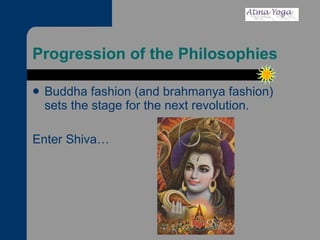
Progression of the Philosophies Buddha fashion (and brahmanya fashion) sets the stage for the next revolution. Enter Shiva…
Progression of the Philosophies “ My dear sir, always remember this: … çaìkaraù çaìkaraù säkñäd… ‘Çré Çaìkaräcärya is Lord Çiva himself.’   Çré Çaìkaräcärya is the spiritual preceptor of all the Vaiñëavas and for this reason Çré Caitanya has acclaimed him as an äcärya, great preceptor. Çré Çaìkaräcärya is a perfect Vaiñëava.   Bhakti Vinode Thakura
Progression of the Philosophies About 800 AD Lord Adi Sankaracarya (Shiva) delivered the philosophy of Nirvisesa Advaitam (Advaita Vedanta) Reintroduced the validity and importance of the Vedas Focused the philosophy on suddha monism Idea of oneness without variety or identity 1 with God, all beyond that is illusion (false) Everything including God is false, only the  concept of God  is 1 without variety and is real It was a “veiled” Buddhism, meant to mislead the atheists (Mayavadi)
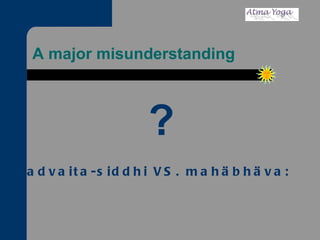
A major misunderstanding advaita-siddhi VS. mahäbhäva: ?
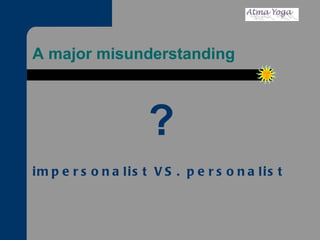
A major misunderstanding impersonalist VS. personalist ?
Progression of the Philosophies FANATICISM leads to misunderstanding: Fanatism + Fashion = Fascism Their theory is that as long as Brahman, the non-dual transcendental truth, remains singular, He is transcendental to mäyä. They propose that when He accepts form and becomes the jéva, He acquires diverse shapes and is thus afflicted by mäyä
Progression of the Philosophies This notion was rejected by Çaìkaräcärya who said, “ He  always remains separate.  “ näräyaëaù paro 'vyaktät,”  or Näräyaëa exists separately, apart from the impersonal creative energy.
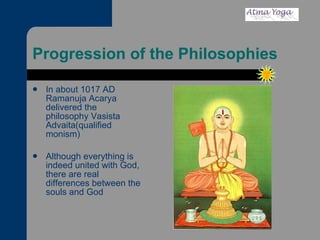
Progression of the Philosophies In about 1017 AD Ramanuja Acarya delivered the philosophy Vasista Advaita(qualified monism) Although everything is indeed united with God, there are real differences between the souls and God
Progression of the Philosophies Ramanuja established philosophy by using the 7 impossible tenants to Advaita Vedanta Nature of Avidya (ignorance, real or unreal) Incomprehensiveness  of Avidya (ignorance is neither real or unreal) Grounds of knowledge of Avidya (obscuring layer, positive darkness) Location of Avidya (enter point) Avidyas obscuration of Brahman (it’s an impossibility) Removal of Avidya by Brahma-vidya (god knowledge, whatever exists has attributes) Removal of Avidya (discloses bondage as real because knowledge indicates it)
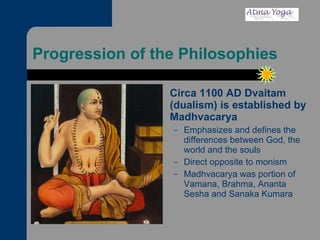
Progression of the Philosophies Circa 1100 AD Dvaitam (dualism) is established by Madhvacarya  Emphasizes and defines the differences between God, the world and the souls Direct opposite to monism Madhvacarya was portion of Vamana, Brahma, Ananta Sesha and Sanaka Kumara
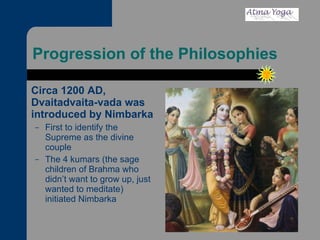
Progression of the Philosophies Circa 1200 AD, Dvaitadvaita-vada was introduced by Nimbarka First to identify the Supreme as the divine couple The 4 kumars (the sage children of Brahma who didn’t want to grow up, just wanted to meditate) initiated Nimbarka
Progression of the Philosophies Vishnuswami was the founder-acharya of the Rudra sampradaya and is the oldest of the four recognized sampradayas  Born in 3,000 BC, recorded teachings in 300 BC, 900 AD and 1300 AD In 1300 AD taught Visuddhadvaita  God is Vishnu Note:  Vallabhacarya was the son of a student of Vishnuswami He taught Suddha Veda = everything is one with personal god Krishna
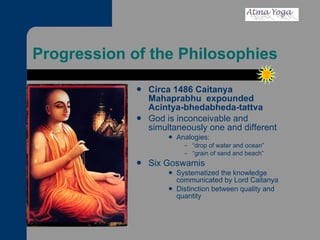
Progression of the Philosophies Circa 1486 Caitanya Mahaprabhu  expounded Acintya-bhedabheda-tattva  God is inconceivable and simultaneously one and different Analogies: “ drop of water and ocean” “ grain of sand and beach” Six Goswamis Systematized the knowledge communicated by Lord Caitanya  Distinction between quality and quantity
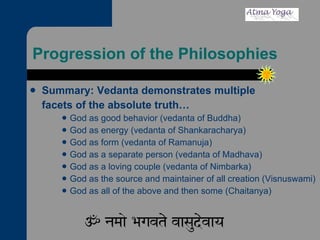
Progression of the Philosophies Summary: Vedanta demonstrates multiple  facets of the absolute truth… God as good behavior (vedanta of Buddha) God as energy (vedanta of Shankaracharya) God as form (vedanta of Ramanuja) God as a separate person (vedanta of Madhava) God as a loving couple (vedanta of Nimbarka) God as the source and maintainer of all creation (Visnuswami) God as all of the above and then some (Chaitanya)
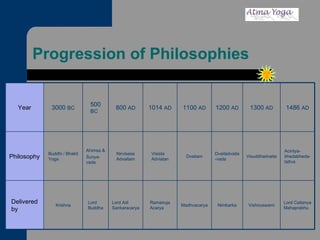
Progression of Philosophies Lord Adi Sankaracarya Nirvisesa Advaitam 800  AD Lord Caitanya Mahaprabhu Vishnuswami Nimbarka Madhvacarya Ramanuja Acarya Lord Buddha Krishna Delivered by Acintya-bhedabheda-tattva Visuddhadvaita Dvaitadvaita-vada Dvaitam Visista Adviatan Ahimsa & Sunya-vada Buddhi / Bhakti Yoga Philosophy 1486  AD 1300  AD 1200  AD 1100  AD 1014  AD 500  BC 3000  BC Year
Teacher Training Class Session  5
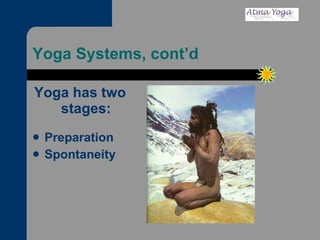
Yoga Systems, cont’d Yoga has two stages: Preparation Spontaneity
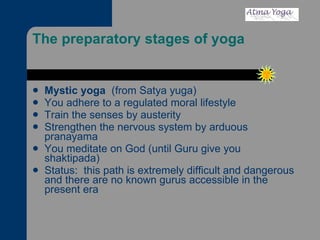
The preparatory stages of yoga  Mystic yoga   (from Satya yuga) You adhere to a regulated moral lifestyle Train the senses by austerity Strengthen the nervous system by arduous pranayama You meditate on God (until Guru give you shaktipada) Status:  this path is extremely difficult and dangerous and there are no known gurus accessible in the present era
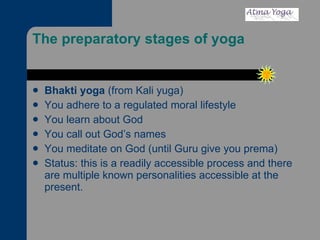
The preparatory stages of yoga  Bhakti yoga  (from Kali yuga) You adhere to a regulated moral lifestyle You learn about God You call out God’s names You meditate on God (until Guru give you prema) Status: this is a readily accessible process and there are multiple known personalities accessible at the present.
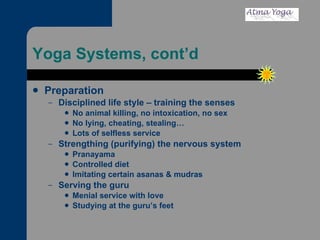
Yoga Systems, cont’d Preparation Disciplined life style – training the senses No animal killing, no intoxication, no sex  No lying, cheating, stealing… Lots of selfless service Strengthing (purifying) the nervous system Pranayama Controlled diet Imitating certain asanas & mudras Serving the guru Menial service with love Studying at the guru’s feet
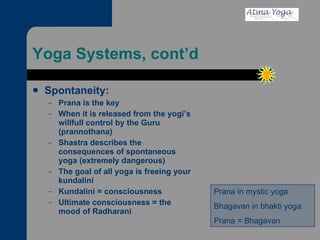
Yoga Systems, cont’d Spontaneity: Prana is the key When it is released from the yogi’s willfull control by the Guru ( prannothana ) Shastra describes the consequences of spontaneous yoga (extremely dangerous) The goal of all yoga is freeing your kundalini  Kundalini = consciousness Ultimate consciousness = the mood of Radharani Prana in mystic yoga Bhagavan in bhakti yoga Prana = Bhagavan
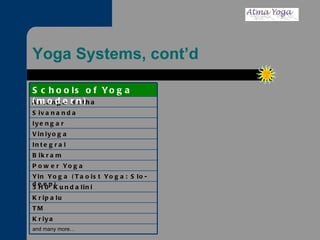
Yoga Systems, cont’d and many more… Kriya TM Kripalu 3H0 Kundalini Yin Yoga (Taoist Yoga: Slo-deep) Power Yoga Bikram Integral Viniyoga Iyengar Sivananda Astanga Hatha Schools of Yoga (modern)
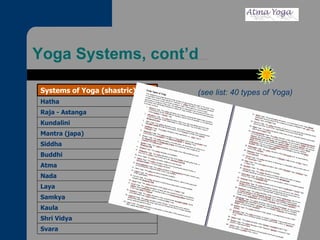
Yoga Systems, cont’d (see list: 40 types of Yoga) Svara Shri Vidya Kaula Samkya Laya Nada Atma  Buddhi Siddha Mantra (japa) Kundalini Raja - Astanga Hatha  Systems of Yoga (shastric)
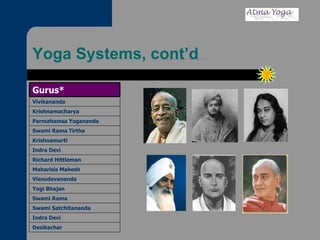
Yoga Systems, cont’d Desikachar Indra Devi Swami Satchitananda Swami Rama Yogi Bhajan Visnudevananda Maharisis Mahesh Richard Hittleman Indra Devi Krishnamurti Swami Rama Tirtha Parmahamsa Yogananda Krishnamacharya Vivikananda Gurus*
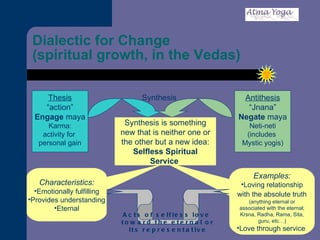
Dialectic for Change  Dialectic means comparison between opposites Change as in spiritual growth There are two extremes predominate in the Vedas Concept behind dialectic in philosophy is that it should be a solution to the contradictions
Dialectic for Change  (spiritual growth, in the Vedas) Examples: Loving relationship with the absolute truth   (anything eternal or associated with the eternal; Krsna, Radha, Rama, Sita, guru, etc…) Love through service   Thesis “ action” Engage  maya Karma: activity for  personal gain Antithesis “ Jnana” Negate  maya Neti-neti (includes  Mystic yogis) Synthesis is something new that is neither one or the other but a new idea: Selfless Spiritual Service   Characteristics: Emotionally fulfilling Provides understanding Eternal Synthesis Acts of selfless love  toward the eternal or Its representative
Yoga is a Technology! When you do devotional service in the material world to the eternal and you are happy, you are making everybody happy because God’s Soul is in everyone Can be used in any platform
Teacher  Training Class Session 6
Discussion on the Mind Bhagavad-Gita 6:5 –  Mind is a friend and an enemy One can use the mind to either help or degrade oneself Bhagavad-Gita 6:6 –  If one conquers the mind it will become the best of friends, otherwise it will remain an enemy
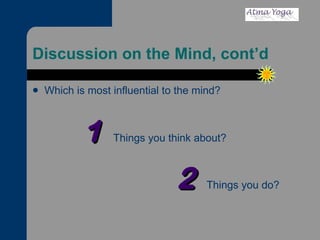
Discussion on the Mind, cont’d Which is most influential to the mind? 1  Things you think about? 2  Things you do?
Discussion on the Mind cont’d You can act your way into a new way of thinking faster than you can think your way into a new way of acting… Things you do! 1
Discussion on the Mind cont’d Atma Yoga teaches activities and practices that will influence the mind in positive ways By habits (behavior), environment and association, you can train the mind to be your friend The Power of the mind is its  adaptability :  Meaning its ability to changing according to circumstances
Habits – vrrtis (atmarama) Cleanliness – two showers a day am & pm Austerity – give up certain sense pleasures Humility – offer respect to others Mercy/compassion - vegetarian Honesty – admitting when you don’t know Reading (listening to) spiritual material
Environment of yogi Simple (not overly luxurious) Spiritual – music, pictures Smells nice (incense…mode of goodness smells) Sattivic food and drink Owning spiritual material – books
Association  Always talk to sages, holy people, real yogis, Read vedic texts Listen to spiritual lectures (technology makes it easy) Visit spiritual places According to all the yogas, association is the most important aspect of spiritual life.
Sanga = Association Types of association External (circle of people) Internal (environment of the mind) Need a pragmatic and systematic way to address internal aspect Important we first establish a relationship with the mind Tool for this is ‘Internal Dialog’
Sanga = Association, cont’d If the mind becomes a positive influence (trained to become good association) it will act to heal you, as it becomes more spiritually inclined Internal Dialogue improves your relationship with and the character of your mind, making it more receptive to spiritual guidance.
“As a man thinketh so is he…” This bit of western conventional wisdom is true. (cf. James Allen) It is based on a Vedic fact: yaà yaà väpi smaran bhävaà tyajaty ante kalevaram taà taà evaiti kaunteya sadä tad-bhäva-bhävitaù "Whatever state of being one remembers when he quits his body, that state he will attain without fail.“
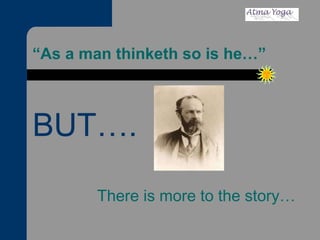
“As a man thinketh so is he…” BUT…. There is more to the story…
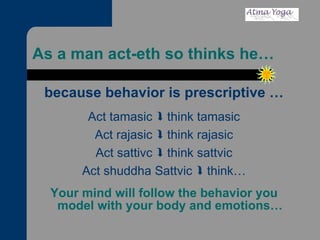
As a man act-eth so thinks he… because behavior is prescriptive … Act tamasic  –  think tamasic Act rajasic  –  think rajasic Act sattivc  –  think sattvic Act shuddha Sattvic  –  think… Your mind will follow the behavior you model with your body and emotions…
Sankya Yoga
Sankya Yoga Definition : that which describes in detail by counting or enumerating Sankya (or samkya) offers  a detailed analysis of the nature and creation of the material world
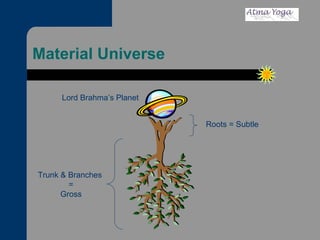
Material Universe Lord Brahma’s Planet Roots = Subtle Trunk & Branches  = Gross
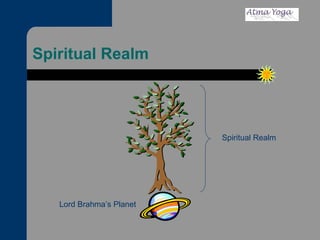
Spiritual Realm Lord Brahma’s Planet Spiritual Realm
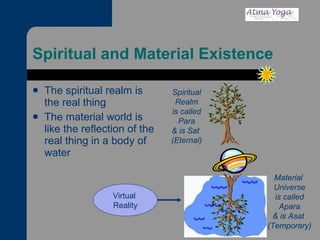
Spiritual and Material Existence The spiritual realm is the real thing  The material world is like the reflection of the real thing in a body of water Spiritual Realm is called Para & is Sat  (Eternal) Material  Universe is called Apara & is Asat  (Temporary) Virtual  Reality
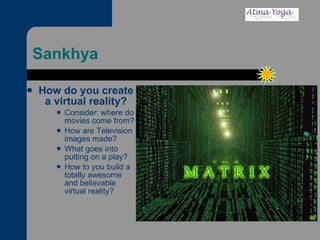
Sankhya How do you create a virtual reality? Consider: where do movies come from? How are Television images made? What goes into putting on a play? How to you build a totally awesome and believable virtual reality?
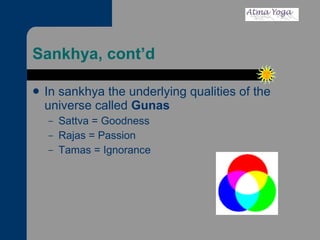
Sankhya, cont’d In sankhya the underlying qualities of the universe called  Gunas Sattva = Goodness Rajas = Passion Tamas = Ignorance
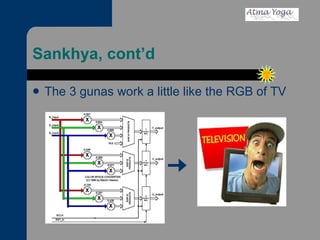
Sankhya, cont’d The 3 gunas work a little like the RGB of TV
Evolution Process The material progression begins when Vishnu projects his superior consciousness (internal potency), the living entities (us) and time (external potency) into the Mahat Tattva (material nature.) This is similar to impregnating (Visnu remains distant - the actual contact is lord Shiva) Womb is the intermediate place where the baby grows (Maha Tattva) Delivery of the baby is similar to the creation of Prakrti
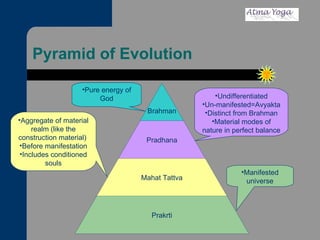
Pyramid of Evolution Undifferentiated Un-manifested=Avyakta Distinct from Brahman Material modes of nature in perfect balance Pure energy of God Aggregate of material realm (like the construction material)  Before manifestation Includes conditioned souls Manifested universe Brahman Pradhana Mahat Tattva Prakrti
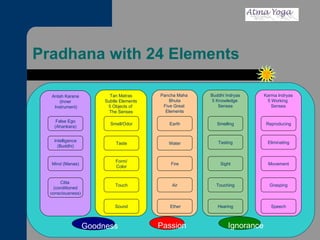
Pradhana with 24 Elements Tan Matras Subtle Elements 5 Objects of  The Senses Smell/Odor Taste Form/ Color Touch Sound Antah Karana (Inner Instrument) False Ego (Ahankara) Intelligence (Buddhi) Mind (Manas) Citta  (conditioned consciousness) Pancha Maha  Bhuta Five Great  Elements Earth Water Fire Air Ether Buddhi Indryas 5 Knowledge  Senses Karma Indryas 5 Working  Senses Goodness Passion Ignorance Sight Hearing Smelling Touching Tasting Speech Movement Grasping Eliminating Reproducing
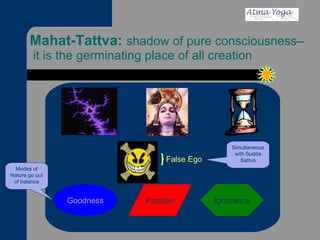
Mahat-Tattva:  shadow of pure consciousness–  it is the germinating place of all creation   False Ego Goodness Passion Ignorance Modes of Nature go out of balance Simultaneous with Sudda Sattva
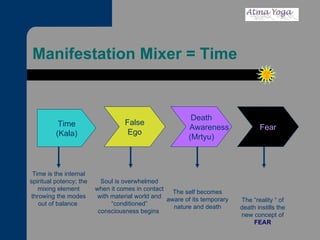
Manifestation Mixer = Time Time (Kala) False Ego Death Awareness (Mrtyu) Fear Time is the internal spiritual potency; the mixing element throwing the modes out of balance  Soul is overwhelmed when it comes in contact with material world and “conditioned” consciousness begins  The self becomes aware of its temporary nature and death The “reality “ of death instills the new concept of  FEAR
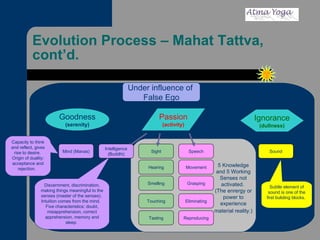
Evolution Process – Mahat Tattva, cont’d. Goodness (serenity) Passion (activity) Ignorance (dullness) Capacity to think and reflect, gives rise to desire.  Origin of duality: acceptance and rejection.  Subtle element of sound is one of the first buliding blocks.  Discernment, discrimination, making things meaningful to the senses (master of the senses).  Intuition comes from the mind.  Five characteristics: doubt, misapprehension, correct apprehension, memory and sleep.  5 Knowledge and 5 Working Senses not activated.  (The enrergy or power to experience material reality.)   Sound Intelligence (Buddhi) Mind (Manas) Under influence of  False Ego Sight Hearing Smelling Touching Tasting Speech Movement Grasping Eliminating Reproducing
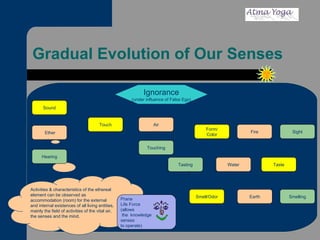
Gradual Evolution of Our Senses Activities & characteristics of the ethereal element can be observed as accommodation (room) for the external and internal existences of all living entities, mainly the field of activities of the vital air, the senses and the mind.  Ignorance (under influence of False Ego) Air Ether Touching Fire Sight Taste Water Tasting Smell/Odor Earth Smelling Form/ Color Hearing Touch Sound Prana Life Force  (allows the  knowledge senses  to operate)
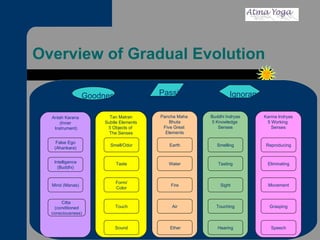
Overview of Gradual Evolution Tan Matran Subtle Elements 5 Objects of  The Senses Smell/Odor Taste Form/ Color Touch Sound Antah Karana (Inner Instrument) False Ego (Ahankara) Intelligence (Buddhi) Mind (Manas) Citta  (conditioned consciousness) Pancha Maha  Bhuta Five Great  Elements Earth Water Fire Air Ether Buddhi Indryas 5 Knowledge  Senses Sight Hearing Smelling Touching Tasting Karma Indryas 5 Working  Senses Speech Movement Grasping Eliminating Reproducing Goodness Passion Ignorance
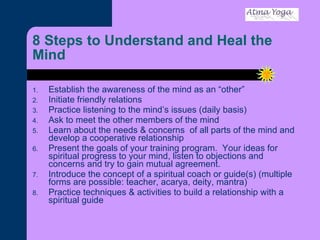
8 Steps to Understand and Heal the Mind Establish the awareness of the mind as an “other” Initiate friendly relations Practice listening to the mind’s issues (daily basis) Ask to meet the other members of the mind Learn about the needs & concerns  of all parts of the mind and develop a cooperative relationship Present the goals of your training program.  Your ideas for spiritual progress to your mind, listen to objections and concerns and try to gain mutual agreement.  Introduce the concept of a spiritual coach or guide(s) (multiple forms are possible: teacher, acarya, deity, mantra) Practice techniques & activities to build a relationship with a spiritual guide
Teacher Training Clinic: The nervous system
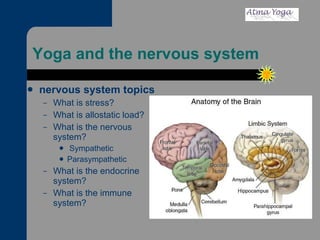
Yoga and the nervous system  nervous system topics  What is stress? What is allostatic load? What is the nervous system? Sympathetic Parasympathetic What is the endocrine system? What is the immune system?
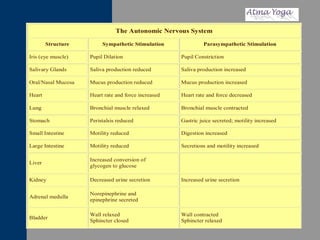
The Autonomic Nervous System  The ANS is most important in two situations:  In emergencies that cause stress and require us to "fight" or take "flight" (run away)  And in non-emergencies that allow us to "rest" and "digest". The ANS regulates:  Muscles  in the skin (around hair follicles; smooth muscle)  around blood vessels (smooth muscle)  in the eye (the iris; smooth muscle)  in the stomach, intestines and bladder (smooth muscle)  of the heart (cardiac muscle)  Glands  The ANS is divided into three parts:  The sympathetic nervous system  The parasympathetic nervous system  The enteric nervous system.
The Sympathetic Nervous System  You are taking a nice walk in the woods. Suddenly, an angry wolf appears in your path…! These are "Fight or Flight" responses. In these types of situations, your sympathetic nervous system is called into action - it uses energy - your blood pressure increases, your heart beats faster, and digestion slows down.  Notice in the picture below  (Figure 1)  that the sympathetic nervous system originates in the spinal cord.
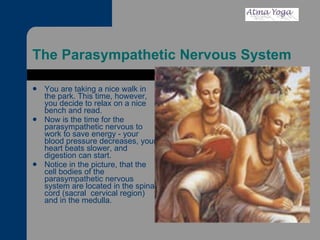
The Parasympathetic Nervous System You are taking a nice walk in the park. This time, however, you decide to relax on a nice bench and read. Now is the time for the parasympathetic nervous to work to save energy - your blood pressure decreases, your heart beats slower, and digestion can start.  Notice in the picture, that the cell bodies of the parasympathetic nervous system are located in the spinal cord (sacral  cervical region) and in the medulla.
 
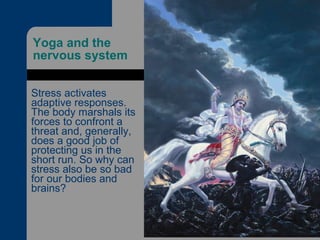
Yoga and the nervous system  Stress activates adaptive responses. The body marshals its forces to confront a threat and, generally, does a good job of protecting us in the short run. So why can stress also be so bad for our bodies and brains?
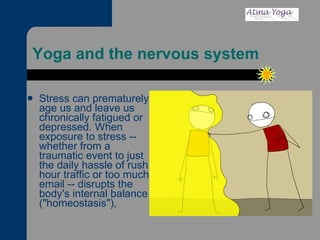
Yoga and the nervous system  Stress can prematurely age us and leave us chronically fatigued or depressed. When exposure to stress -- whether from a traumatic event to just the daily hassle of rush hour traffic or too much email -- disrupts the body's internal balance ("homeostasis"),
Yoga and the nervous system  What is allostatic load? All of these adaptive responses are described by the term "allostasis" which means " maintaining stability,  or homeostasis,  through change .“ The body actively copes with a challenge by expending energy and attempting to put things right. Most of the time it succeeds but the real problems arise when the systems involved in allostasis don't shut off when not needed or don't become active when they are needed.
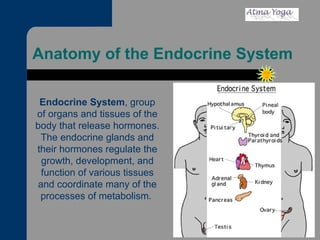
Anatomy of the Endocrine System  Endocrine System , group of organs and tissues of the body that release hormones. The endocrine glands and their hormones regulate the growth, development, and function of various tissues and coordinate many of the processes of metabolism.
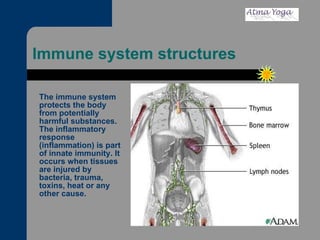
Immune system structures  The immune system protects the body from potentially harmful substances. The inflammatory response (inflammation) is part of innate immunity. It occurs when tissues are injured by bacteria, trauma, toxins, heat or any other cause.
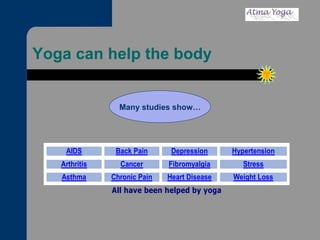
Yoga can help the body Many studies show…
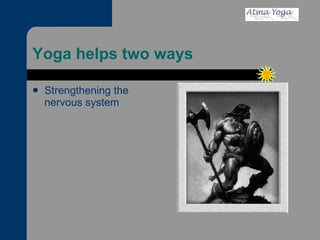
Yoga helps two ways Strengthening the nervous system
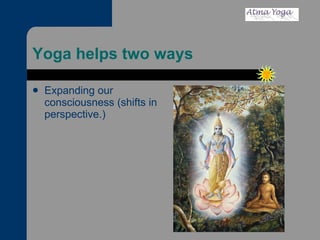
Yoga helps two ways Expanding our consciousness (shifts in perspective.)
Teacher Training June, 2004  Class Session 7
Important elements of a Yoga Class! Giving permission to progress along their spiritual path  Creating a safe space  Laxman Reiki circle of protection Preparing people for shifts in consciousness Providing knowledge for realization of the true self (not the body) Giving a body, mind and spirit/soul experience Prasadam
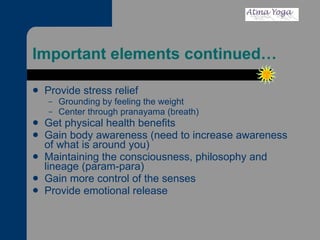
Important elements continued… Provide stress relief Grounding by feeling the weight Center through pranayama (breath) Get physical health benefits  Gain body awareness (need to increase awareness of what is around you) Maintaining the consciousness, philosophy and lineage (param-para) Gain more control of the senses Provide emotional release
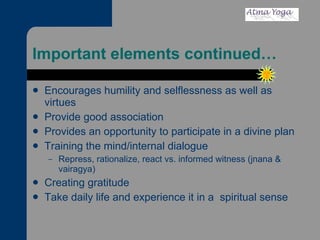
Important elements continued… Encourages humility and selflessness as well as virtues Provide good association Provides an opportunity to participate in a divine plan Training the mind/internal dialogue  Repress, rationalize, react vs. informed witness (jnana & vairagya) Creating gratitude Take daily life and experience it in a  spiritual sense
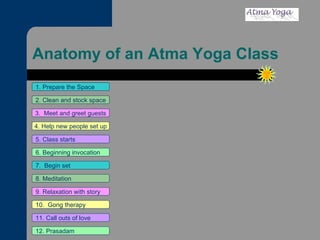
Anatomy of an Atma Yoga Class 1. Prepare the Space 2. Clean and stock space 3.  Meet and greet guests 4. Help new people set up 5. Class starts 6. Beginning invocation 7.  Begin set 9. Relaxation with story 11. Call outs of love 12. Prasadam 10.  Gong therapy 8. Meditation
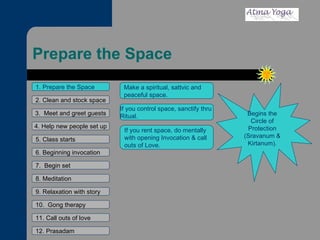
Prepare the Space 1. Prepare the Space 2. Clean and stock space 3.  Meet and greet guests 4. Help new people set up 5. Class starts 6. Beginning invocation 7.  Begin set 9. Relaxation with story 11. Call outs of love 12. Prasadam 10.  Gong therapy 8. Meditation If you control space, sanctify thru  Ritual. If you rent space, do mentally  with opening Invocation & call  outs of Love. Begins the Circle of Protection (Sravanum & Kirtanum). Make a spiritual, sattvic and peaceful space.
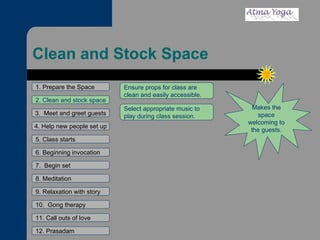
Clean and Stock Space 1. Prepare the Space 2. Clean and stock space 3.  Meet and greet guests 4. Help new people set up 5. Class starts 6. Beginning invocation 7.  Begin set 9. Relaxation with story 11. Call outs of love 12. Prasadam 10.  Gong therapy 8. Meditation Makes the space welcoming to the guests. Ensure props for class are clean and easily accessible. Select appropriate music to play during class session.
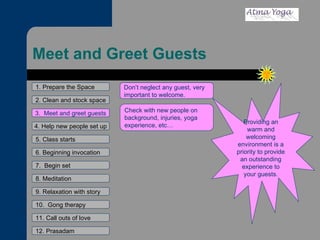
Meet and Greet Guests 1. Prepare the Space 2. Clean and stock space 4. Help new people set up 5. Class starts 6. Beginning invocation 7.  Begin set 9. Relaxation with story 11. Call outs of love 12. Prasadam 10.  Gong therapy 8. Meditation 3.  Meet and greet guests Providing an warm and welcoming environment is a priority to provide an outstanding experience to your guests. Don’t neglect any guest, very important to welcome. Check with new people on background, injuries, yoga experience, etc…
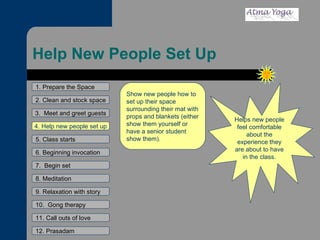
Help New People Set Up 1. Prepare the Space 2. Clean and stock space 3.  Meet and greet guests 4. Help new people set up 5. Class starts 6. Beginning invocation 7.  Begin set 9. Relaxation with story 11. Call outs of love 12. Prasadam 10.  Gong therapy 8. Meditation Helps new people feel comfortable about the experience they are about to have in the class. Show new people how to set up their space surrounding their mat with props and blankets (either show them yourself or have a senior student show them).
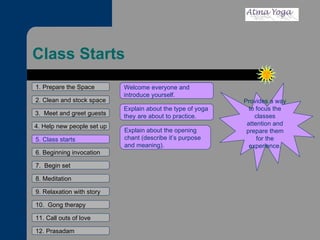
Class Starts 1. Prepare the Space 2. Clean and stock space 3.  Meet and greet guests 4. Help new people set up 5. Class starts 6. Beginning invocation 7.  Begin set 9. Relaxation with story 11. Call outs of love 12. Prasadam 10.  Gong therapy 8. Meditation Provides a way to focus the classes attention and prepare them for the experience. Welcome everyone and introduce yourself. Explain about the type of yoga they are about to practice. Explain about the opening chant (describe it’s purpose and meaning).
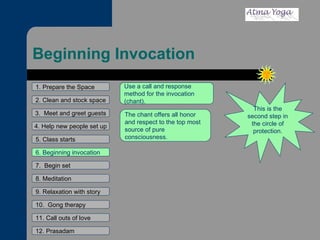
Beginning Invocation 1. Prepare the Space 2. Clean and stock space 3.  Meet and greet guests 4. Help new people set up 5. Class starts 6. Beginning invocation 7.  Begin set 9. Relaxation with story 11. Call outs of love 12. Prasadam 10.  Gong therapy 8. Meditation This is the second step in the circle of protection. Use a call and response method for the invocation (chant). The chant offers all honor and respect to the top most source of pure consciousness.
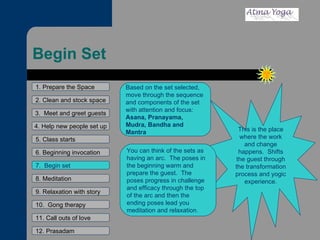
Begin Set 1. Prepare the Space 2. Clean and stock space 3.  Meet and greet guests 4. Help new people set up 5. Class starts 6. Beginning invocation 7.  Begin set 9. Relaxation with story 11. Call outs of love 12. Prasadam 10.  Gong therapy 8. Meditation This is the place where the work and change happens.  Shifts the guest through the transformation process and yogic experience. Based on the set selected, move through the sequence and components of the set with attention and focus:  Asana, Pranayama, Mudra, Bandha and Mantra You can think of the sets as having an arc.  The poses in the beginning warm and prepare the guest.  The poses progress in challenge and efficacy through the top of the arc and then the ending poses lead you meditation and relaxation.
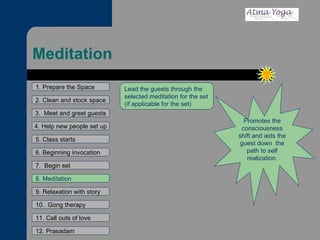
Meditation 1. Prepare the Space 2. Clean and stock space 3.  Meet and greet guests 4. Help new people set up 5. Class starts 6. Beginning invocation 7.  Begin set 9. Relaxation with story 11. Call outs of love 12. Prasadam 10.  Gong therapy 8. Meditation Promotes the consciousness shift and aids the guest down  the path to self realization. Lead the guests through the selected meditation for the set (if applicable for the set)
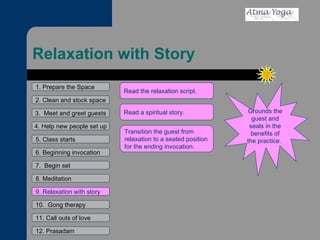
Relaxation with Story 1. Prepare the Space 2. Clean and stock space 3.  Meet and greet guests 4. Help new people set up 5. Class starts 6. Beginning invocation 7.  Begin set 9. Relaxation with story 11. Call outs of love 12. Prasadam 10.  Gong therapy 8. Meditation Grounds the guest and seals in the benefits of the practice.  Read the relaxation script.  Read a spiritual story.  Transition the guest from relaxation to a seated position for the ending invocation.
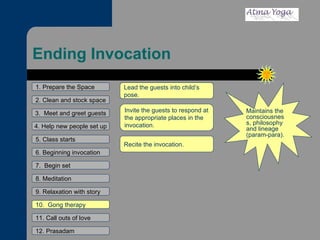
Ending Invocation 1. Prepare the Space 2. Clean and stock space 3.  Meet and greet guests 4. Help new people set up 5. Class starts 6. Beginning invocation 7.  Begin set 9. Relaxation with story 11. Call outs of love 12. Prasadam 10.  Gong therapy 8. Meditation Maintains the consciousness, philosophy and lineage (param-para). Lead the guests into child’s pose.  Invite the guests to respond at the appropriate places in the invocation.  Recite the invocation.
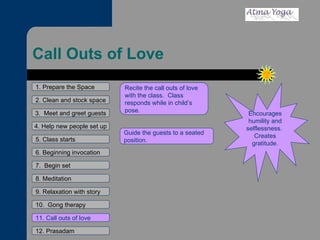
Call Outs of Love 1. Prepare the Space 2. Clean and stock space 3.  Meet and greet guests 4. Help new people set up 5. Class starts 6. Beginning invocation 7.  Begin set 9. Relaxation with story 11. Call outs of love 12. Prasadam 10.  Gong therapy 8. Meditation Encourages humility and selflessness.  Creates gratitude. Recite the call outs of love with the class.  Class responds while in child’s pose.  Guide the guests to a seated position.
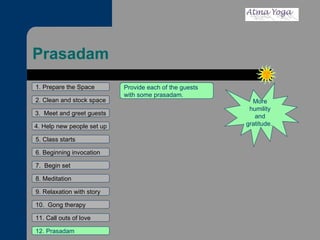
Prasadam 1. Prepare the Space 2. Clean and stock space 3.  Meet and greet guests 4. Help new people set up 5. Class starts 6. Beginning invocation 7.  Begin set 9. Relaxation with story 11. Call outs of love 12. Prasadam 10.  Gong therapy 8. Meditation More humility and gratitude.  Provide each of the guests with some prasadam.
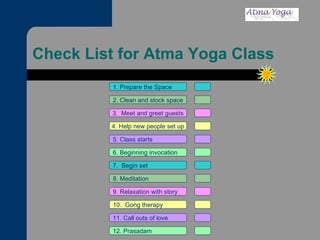
Check List for Atma Yoga Class 1. Prepare the Space 2. Clean and stock space 3.  Meet and greet guests 4. Help new people set up 5. Class starts 6. Beginning invocation 7.  Begin set 9. Relaxation with story 11. Call outs of love 12. Prasadam 10.  Gong therapy 8. Meditation
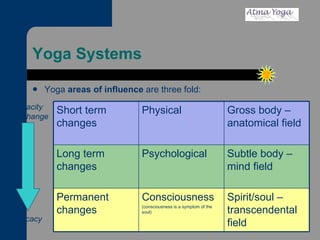
Yoga Systems Yoga  areas of influence  are three fold: Capacity  For change Efficacy Spirit/soul – transcendental field Consciousness (consciousness is a symptom of the soul) Permanent changes Subtle body – mind field Psychological Long term changes Gross body – anatomical field Physical Short term changes
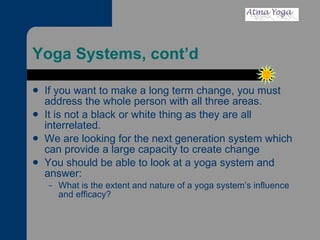
Yoga Systems, cont’d If you want to make a long term change, you must address the whole person with all three areas.  It is not a black or white thing as they are all interrelated.  We are looking for the next generation system which can provide a large capacity to create change You should be able to look at a yoga system and answer: What is the extent and nature of a yoga system’s influence and efficacy?
Missing graphic slide Attention housekeeping: An image has been taken from this space. Please notify management.

Introducing Atma yoga teacher training

  • 1.
    Teacher TrainingClass Session 1
  • 2.
    What is Consciousness?Thus the wise living entity's pure consciousness becomes covered by his eternal enemy in the form of lust, which is never satisfied and which burns like fire. The difference between matter and spirit is that matter has no consciousness like the living entity; therefore this consciousness is supreme and eternal. Consciousness cannot be produced by a combination of matter.
  • 3.
    What is Consciousness?Consciousness is the symptom of the soul. Even if one does not find the soul within the heart, where he is situated, one can still understand the presence of the soul simply by the presence of consciousness.
  • 4.
    Activities/Behavior Discussion Activities= Karma Any endeavor physical or mental carried out to sustain life Two ways Subha = auspicious Nitya, everyday things Naimittika, every once in a while things Kamya, selfish desires Asubha = inauspicious Vikarma, doing things inappropriate, not nice, perverse, even to evil Akarma, inactivity
  • 5.
    Activities/Behavior Discussion Activities= Karma Any endeavor physical or mental carried out to sustain life Two ways Subha = auspicious Nitya, everyday things Naimittika, every once in a while things Kamya, selfish desires Asubha = inauspicious Vikarma, doing things inappropriate, not nice, perverse, even to evil Akarma, inactivity
  • 6.
    Activities/Behavior cont’d. KarmaSubha Auspicious Asubha Inauspicious Selfish Desires - Kamya Selfless Desires – Nitya Naimttika Selfish “ part of the problem” (societal) Detrimental Causing Harm
  • 7.
    What Influences YourConsciousness? Sound Vibration Music, talking, internal chatter Activities/Behaviors Food Other People Visual What You Wear
  • 8.
    SAC-CID-ANANDA Give theindividual back his complete experience and understanding of his reality Comes from: SAT Eternity Eternal Truth Absolute CIT Knowledge Understanding Ananda Joy Bliss
  • 9.
    Atma Yoga FundamentalsBe honest about where you are starting Be honest about where your student is starting Very important for a teacher
  • 10.
    Vedas Purpose Vedas= Truth Purpose is to move you towards your true nature Lord Krishna to Arjun yo yo yäà yäà tanuà bhaktaù çraddhayärcitum icchati tasya tasyäcaläà çraddhäà täm eva vidadhämy aham TRANSLATION I am in everyone's heart as the Supersoul. As soon as one desires to worship some demigod, I make his faith steady so that he can devote himself to that particular deity. Like Virtual Reality or Video Game, it must respond to the individual Machinery of reality has to respond to the desires of the player You are not actually doing anything Another example would be dreaming
  • 11.
    Yoga Spectrum Mustprepare the nervous system for changes in consciousness Ranges from Mechanical to Surrender Mechanical – controlled, self initiated More outside in Surrender – guided, divinely inspired More inside out
  • 12.
    Goals of AtmaYoga Program To obtain an understanding of the Vedas (source of Yoga) as they are . Compassionate comprehension Develop respect for Vaisnavas as an authoritative source of knowledge Vaisnavas – someone who is attached to God. Ultimate example of spiritual activism To realize the nature of the divine Self and its constitutional position Knowing who you are and how you were originally set up To create spiritually conscious teachers, leaders and healers
  • 13.
    Atma Yoga Program,cont’d. Atma yoga re-engineers Hatha and Raja into a more complete yoga in consideration and understanding of the Vedas. Transcendental – not physical, not mystical, to lead to original nature Highest achievement in Vedas is the state of boundless and spontaneous love Bottom line of any yoga practice is humility and tolerance
  • 14.
    Golden Age inKali Yuga Humility and tolerance heralds the Golden Age leads to service and sacrifice as acts of love and compassion which have the power to free the soul and transform society Golden Age in Kali Yuga lasts 10,000 years New wave of consciousness coming to the world
  • 15.
  • 16.
    Opening Chant OmNamo Bhagavate Vasudevaya Translation: I humbly offer my respects to the personality and source of pure consciousness.
  • 17.
    Homework Expectations WorkbookDaily Sadhana (3 kriyas) Reading Memorizing Teacher Mantras Silent Teacher chant Opening Class Chant Savasana Relaxation Sequence Ending Chant Extreme familiarity with the Power Yoga class Enable you to focus on the class
  • 18.
    Required Reading 4Main Texts (in order of reading) Searching for Vedic India – Due 4/18 Human Devolution – Due 5/15 Spiritual Warrior III – Due 5/23 Leadership for Higher Consciousness - Due 6/5 Write 100 word chapter reviews for first 3 books. Also write a short review of each book (250-500 words)
  • 19.
    Supplemental Texts Asana,Pranayama, Mudra, Bandha – Bihar Press Yoga Pradipika – Svatmarama Hidden Glory of India – Satyaraja Dasa Isopanisad – Vedic text translation
  • 20.
    Atma Yoga Three styles of yoga Kundalini (most powerful) Slow Deep Stretch (second most powerful) Power Yoga (third most powerful) **power rating is based on transformation aspect
  • 21.
    Explanation of Sets(sequences) Sets are predetermined, don’t change the sequence because it is designed for effectiveness 1 Power Yoga set Dozens of Slow, Deep Stretch Hundreds of Kundalini Each set has a progression curve (the arc) Prepare, Purification Set begins Set ends Transformation, Change Assimilate, Ground
  • 22.
    Factors of Protectionfor a Set Teacher mantra Opening class invocation Sets may have sound vibration in them Structual integrity of the sets Systematic relaxation Reading of applicable stories Call outs of love Prasadam – distribution of sanctified food, sweets, salties (raisins, nuts)
  • 23.
    Vedas Purpose toLife Inquire into the nature of truth Why are you here? Some reason dissatisfied with spirit world Or we were given the opportunity to experience it
  • 24.
    Studying the VedasVedas are the original knowledge As conditioned souls, we are subject to deficiencies 1. Must commit mistakes 2. Prone to illusion “you are not this body” 3. Cheating Propensity 4. Senses are imperfect
  • 25.
    Studying the Vedas,cont’d. ‘ Hindu’ designation does not appear in the Vedas We are VARNASRAMA Denotes followers of the Vedas VARNA = 4 divisions of society ASRAMA = 4 divisions of spiritual life 4 Divisions of Society are: 1. Spiritual leader = Brahmana 2. Administrative/Warrior = Ksatriya 3. Merchant or Agriculturalist = Vaisya 4. Artisan or Craftsperson = Sudra Nothing in the Vedas says there is a birth right to a division. You must earn your right.
  • 26.
    Studying the Vedas,cont’d. Age of Kali Yuga – degraded the divisions of society into an actual lineage Vedas are SRUTI (acquired by hearing). Brahma = first living creature to get knowledge handed down by succession Three kinds of evidence 1. Pratyaksa = direct evidence, collect with senses 2. Anumana = inductive knowledge, theory then prove 3. Sabda-Praman = authoritative source beyond this world
  • 27.
    Studying the Vedas,cont’d. Two classes of transcendentalists 1. Impersonal = sectarian 2. Personal = universal, Vaisnava Knowledge acquired: Inductive = facts to general conclusions, research then prove Deductive = general conclusion to specific Transcendental Energy Sounds outside the material plane which begin to undo karma (both good and bad) Speed of the mind is so swift – like a “split second”
  • 28.
    Studying the Vedas,Cont’d Spiritual Master Rightly heard from the authoritative source Practically established in Brahman (truth) Originally there was 1 Veda. Didn’t have to read it because beings were able to comprehend and remember upon hearing. 5,000 years ago Vyasadeva wrote down the Vedas because of the start of Kali Yoga and society’s degradation Rig Sama Atharva Yajur
  • 29.
    Teacher Training Overviewof the Vedas Session 3
  • 30.
    Contents The VedasSupplemental Text s Supplemental Information
  • 31.
    The Vedas Vedas= “knowledge” From the root vid which means “to know” The Vedas were composed in Sanskrit The “multitude of diverse desires” is one reason why the Vedas are explaining things in different ways The Vedas don’t have an age 5,000 years ago Vyasadeya put down the Vedas in writing because of the start of Kali Yuga and societies degradation
  • 32.
    The Four VedasRg Sama Yajur Atharva When someone refers to the “three Vedas”, they are referring to the first three on the list. The Atharva is sometimes considered separately. These four are also referred to as the Karma Kanda
  • 33.
    The Four Vedas,cont’d There are 1130 branches in total each with 4 divisions for a total of 4520 titles Four divisions are explanatory: Samhita (essays) Brahmana (hand books for reincarnation and sacrifices) Aranyaka (treatises for renunciation for going off to the forests, esoteric knowledge and wisdom) Upanishad (philosophical text)
  • 34.
    The Four Vedas,cont’d Spoken by Lord Brahma in the form of a billion versus Entire Puranas emanated from his mouth
  • 35.
    The Four Vedas,cont’d There are only the following left of the 4520 titles: 11 Samhitas 18 Brahmanas 7 Aranyakas 220 Upanishads
  • 36.
    Rg Veda Meaning= “praise” Contains 1028 hymns praising the demigods for victory in war It is divided into 10 mandalas (concentric circles) It is the most famous of the Vedas 21 branches
  • 37.
    Sama Veda Meaning= “together” Contains the melodies and music for the changes that are in the Rg Veda. 1000 branches
  • 38.
    Yajur Veda Meaning= “sacrifice” It explains how to construct alters and conduct sacrifies Specific texts are: Krsna (black) Sukla (white) This Veda later became the source of corruption for the priest craft 100 branches
  • 39.
    Atharva Veda Meaning= “fire” Contains magical spells and incantations Prayers in two categories Bheshajani, which are healing and curing Abhicara, which cause disease and harm to others 9 branches
  • 40.
  • 41.
  • 42.
    Supplementary Texts Puranas(stories and history) Traditionally called the fifth Veda 18 Mahapuranas Itihasas (epics) Ramayana Mahabharata (includes the Bhagavad-gita) Sutras (aphorisms) Upavedas Vedangas
  • 43.
    Puranas Mahapuranas SixSattvic Puranas Vishnu, Naradiya, Bhagavat, Garuda, Padma, Varaha Six Rajasic Puranas Brahma, Brahmanda, Brahma-viavarta, Markandeya, Bhavishya, Vamana Six Tamasic Puranas Matsya, Kurma, Linga, Shiva, Skanda, Agni Eighteen Upapuranas Numerous sthala (regional)
  • 44.
    Itihasas Meaning =“histories” Ramayana – the epic of Lord Rama and Sita Mahabharata – mainly the story of Lord Krishna, the Pandavas and the battle of Kurukshetra Includes the Bhagavad-gita
  • 45.
    Sutras “ Booksof concise truths” Vedanta-sutras Shrauta-sutras Grihya-sutras Shulba-sutras Dharma-sutras
  • 46.
    Vedangas Auxiliary sciencesconnected with Vedic study Shiksha (phonetics) Chandas (meter) Vyakarana (grammar) Nirukta (etymology) Jyotish (astronomy/astrology)
  • 47.
    Upavedas Sciences notdirectly related to Vedic study Ayurveda (study of holistic medicine) Gandharva-veda (study of music and dance) Dhanur-veda (military science) Sthapatya-veda (architecture)
  • 48.
  • 49.
    Division of theVedic Literature Shruti Meaning = that which is heard The four Vedas (Samhitas, Brahmans, Aryanjakas, Upanishads) Smriti Meaning = that which is remembered Puranas, Itihasas Nyaya Meaning = logical expression Sutras
  • 50.
    View by DivisionThe Vedas Shruti Smriti Nyaya Rg Yajur Sama Atharva Krishna Yajur Sukla Yajur Katha Svetasvatara Maitrayaniya Mahanarayaniya Taittiriya Isavasya Brihadaranyaka Aitareya Kauhsitaki Mundaka Mandukya Prasna Itihasas Puranas Sutras Upavedas Ramayana Mahabharata
  • 51.
  • 52.
  • 53.
    Agama Doctrine createdby Lord Shiva Supplemental instruction for worship Sakta (Energy), Shakti presiding deity Soura (Visible Source - sun) Gunpathyai (Controller) Shiva (Destroyer) Vaikhasana (Ultimate Source)
  • 54.
    Tantra Created forpurification of those who have fallen below the level of purification required to practice Agama Shri Vidya – (e.g.Tripurasundara,) internal, sometime called the right hand (sattva – laxmi) Mishra, mixed internal and external (rajas - saraswati) Kausala, for personal sense gratiification. Total black magic today. (tamas - kali)
  • 55.
    Six Aspects ofKnowledge Vaisesika – atomic structure Nyaya – logic Yoga – mystical unfolding of the mind (hatha/raja) Sankhya – categorization Karmamimansa – material responsible Vedanta – absolute truth
  • 56.
    Three Schools orApproaches Karma Kanda – materially responsible experience Jnana Kanda – spiritual knowledge knowledge Yoga Kanda– (surrender) Mystical or devotional
  • 57.
    Social Harmony inthe Vedas Varnasrama system The ideal: spiritual advancement (service) The collapse: self aggrandizement (exploitation)
  • 58.
    Social Harmony inthe Vedas Satya – Ideal (no caste-no class division) Undivided Veda is expressed by the syllable oà, and God is worshipped as Lord Haàsa through the process of meditation. The people of Satya-yuga are for the most part self-satisfied, merciful, friendly to all, peaceful, sober and tolerant. They take their pleasure from within, see all things equally and always endeavor diligently for spiritual perfection.
  • 59.
    Social Harmony inthe Vedas Treta – at the beginning of Tretä-yuga Vedic knowledge appeared from the original source of prana; in three divisions—as Åg, Säma and Yajur. Then from that knowledge God is worshipped as the threefold sacrifice. In Tretä-yuga each leg of religion is gradually reduced by one quarter by the influence of the four pillars of irreligion—lying, violence, dissatisfaction and quarrel. They are not excessively violent or very lusty after sensual pleasure. Their interest lies primarily in religiosity, economic development and regulated sense gratification, and they achieve prosperity by following the prescriptions of the three Vedas. Although in this age society evolves into four separate classes In Tretä-yuga the four social orders were manifested. The brähmaëas appeared were like the head (intelligence) of society. The kñatriyas were like the strong arms (or protection) of society The vaiçyas were like the thighs (or forward movement) of society The laborer & artisan were like the feet (or support) of society These categories are classified in terms of one's work and qualification and not by birth.
  • 60.
    Social Harmony inthe Vedas Dvapara – In Dväpara-yuga the virtuous qualities of austerity, truth, mercy and charity are reduced to one half by their irreligious counterparts—dissatisfaction, untruth, violence and enmity. In the Dväpara age people are interested in glory and are very noble. They devote themselves to the study of the Vedas, possess great opulence, support large families and enjoy life with vigor. Of the four classes, the kñatriyas and brähmaëas are most numerous.
  • 61.
    Social Harmony inthe Vedas Kali – In the age of Kali only one fourth of the principles of virtue remains. That last remnant will continuously be decreased by the ever-increasing principles of irreligion and will finally be destroyed. In the Kali age people tend to be greedy, ill-behaved and merciless, and they fight one another without good reason. Unfortunate and obsessed with material desires, the people of Kali-yuga are almost all members of the exploited class.
  • 62.
    Social Harmony inthe Vedas Kali continued… Cities will be dominated by thieves, the Vedas will be contaminated by speculative interpretations of atheists, political leaders will virtually consume the citizens, and the so-called priests and intellectuals will be devotees of their bellies and genitals. The brahmacärés (students) will fail to execute their vows and become generally unclean, the householders will become beggars, the vänaprasthas (retired class) will live in the villages, and the sannyäsés (renunciates) will become greedy for wealth.
  • 63.
    Social Harmony inthe Vedas Kali continued… Above all the age will be marked by conflict between the common people and those in power and the three way struggle between the materialist, the politico and the pseudo -spiritualist “ O learned one, in this iron age of Kali men have but short lives. They are quarrelsome, lazy, misguided, unlucky and, above all, always disturbed.” Srimad Bhagavatam
  • 64.
    Social Harmony inthe Vedas The four ages described in these slides are manifestations of various modes of material nature. The age of truth, Satya-yuga, manifests the predominance of material goodness, and Kali-yuga manifests the predominance of darkness. According to Çréla Viçvanätha Cakravarté Öhäkura, within each age the other three ages occasionally manifest as sub-ages. Thus even within Satya-yuga evil in the mode of ignorance may appear, and within the age of Kali the highest spiritual principles may flourish for some time.
  • 65.
    Social Harmony inthe Vedas Everyone must be given assistance to advance Spiritual knowledge Society (social interaction) Development of the mind Maintenance of the body Intelligensia Administrative Productive Artisan & common assistance Corresponding individual responsibilities Societal roles
  • 66.
    Social Harmony inthe Vedas “‘ Service without duplicity to the brähmaëas, cows, devas and other worshipable personalities, and complete satisfaction with whatever income is obtained in such service are the natural qualities of those providing common assistance. “‘ Faith in Vedic civilization, dedication to charity, freedom from hypocrisy, service to the brähmaëas and perpetually desiring to accumulate more money are the natural qualities of the vaiçyas “‘ Dynamic power, bodily strength, determination, heroism, tolerance, generosity, great endeavor, steadiness, devotion to the brähmaëas, and leadership are the natural qualities of the kñatriyas.’ “‘ Peacefulness, self-control, austerity, cleanliness, satisfaction, tolerance, simple straightforwardness, devotion to Me, mercy, and truthfulness are the natural qualities of the brähmaëas.’
  • 67.
    Social Harmony inthe Vedas If one shows the symptoms of being a brähmaëa, kñatriya, vaiçya or çüdra, as described above, even if he has appeared in a different class, he should be accepted according to those symptoms of classification. Srimad Bhagavatm According to the Vedas these roles are not human nature, but fluid changing attributes
  • 68.
    Social Harmony inthe Vedas Those out of harmony populate jails and social institutions “‘ Uncleanliness, dishonesty, thievery, faithlessness, useless quarrel, lust, anger, and hankering constitute the nature of those in the lowest position outside the varëäçrama system.’ Those in harmony stay in society “‘ Nonviolence, truthfulness, honesty, desire for the happiness and welfare of all others and freedom from lust, anger, and greed constitute duties for all members of society.’
  • 69.
    Social Harmony inthe Vedas Student Householder Retired Devotional Life roles
  • 70.
    Social Harmony inthe Vedas Living out the nature of the soul and fulfilling your mission This over rides all divisions The Soul’s role (above even social roles)
  • 71.
    Teacher TrainingClass Session 4
  • 72.
    Six Schools ofVEDIC Philosophy Sad -Darshan is the six aspects of knowledge Some are atheistic (A) some are theistic (T) and some are both All six used to be practiced as one set. Now taught independently and very sectarian (looking at only a section) Kanaada atomic structure Viasesika –T Vyasadev Absolute Truth Vedanta – A,T Jaimini material responsibility and benefits Karmamimansa – A Lord Kapila Categorization Sankhya – A,T Patanjali mystical unfolding of the mind (hatha/kundalini/ raja) Yoga – A,T Gautama Logic Nyaya –T Sage Study Philosophy
  • 73.
    Vedanta Literally means'end of the Vedas' but it is interpreted as 'culmination of the Vedas' The vedic text on Vedanta is called “Vedanta Sutra” Essence of Vedanta Sutra Inquiry into absolute truth
  • 74.
    Vedanta The firstverse of the Brahma-sütra is athäto brahma jijïäsä : “We must now inquire into the Absolute Truth.” The second verse immediately answers, janmädy asya yataù: “The Absolute Truth is the original source of everything.”
  • 75.
    Absolute Truth Tendencywith the Absolute Truth is not to understand all 4 parts as described in the Vedas: Universal form = God as nature Brahman = the whole of the absolute truth, energy of God Antaryami = localized as the absolute truth in your heart Bhagavan = the opulent divine personality, God as the person
  • 76.
    Absolute Truth, cont’d.Need to keep all 4 in mind. A yogi may choose to only focus on one to create his own relationship with the Absolute Truth Analogy: The sun as 4 facets that are comparable: The sun’s products (grains, plants, fruits, etc.) Sunshine pervades the planet Localized – everything we see the sun makes visible The sun as a glowing ball in the sky
  • 77.
    Progression of thePhilosophies (virtue declines) Dharma Overview Cleanliness, Austerity, Honesty and Compassion are almost totally degraded During Kali yuga these virtues go to 25% and go down from there. Intoxication Austerity Animal killing Compassion Deception Honesty, Truth Illicit behavior Cleanliness Degraded by Attribute
  • 78.
    Progression of thePhilosophies (a history of spiritual revolutions) It is the evidence of history that at a certain time every society attains its manhood, when a strong conflict ensues between the ruling power and the common people. The life of society, its expansion and civilization, depend on its victory or defeat in this conflict.
  • 79.
    Progression of thePhilosophies The Beginning of the Triangular Fight between Ceremonialism, Philosophy and Materialism The Charvaka, the Jain, the Buddhist, Shankara, Ramanuja, Kabir, Nanak, Chaitanya, the Brahmo-Samaj… of all of these, and similar sects, the wave of religion, foaming, thundering, surging, breaks in the front, while in the rear follows the filling-up of social wants. If all desires can be accomplished by the mere utterance of some meaningless syllables, then who will exert himself to go through difficulties to work out the fulfillment of his desires? [A cheaters paradise…] From REVOLUTION to FASHION: a pattern of tamasic cooptation
  • 80.
    Progression of thePhilosophies The Charvakas, Who Upheld Materialism as the Highest Goal of Life The Charvaka, or materialist, basing his doctrine on the first part - the sacrificial portion - of the Vedas, believed that all was matter and that there is neither a heaven nor a hell, neither a soul nor a God. [The Charvaka movement] was the beginning of that caste question, and that triangular fight in India between ceremonials, philosophy and materialism which has come down unsolved to our own days.
  • 81.
    Progression of thePhilosophies Hence, the slashing sarcasm of the Charvakas, who believed only in the reality of sense-perceptions and nothing beyond. What could have saved Indian society from the ponderous burden of omniferous ritualistic ceremonialism with its animal and other sacrifices, which all but crushed the very life out of it, except the Jain revolution which took its strong stand exclusively on chaste morals and philosophical truth? Or without the Buddhist revolution what could have delivered the suffering millions of the lower classes from the violent tyrannies of the influential higher castes? When, in course of time, Buddhism declined and its extremely pure and moral character gave place to equally bad, unclean and immoral practices, when Indian society trembled under the infernal dance of the various races of barbarians who were allowed into the Buddhistic fold by virtue of its all-embracing Spirit of equality – then Shankara, and later Ramanuja, appeared on the scene and tried their best to bring society back to its former days of glory and to re-establish its lost status.
  • 82.
    Progression of thePhilosophies The Teaching of Motiveless Work Brought a Momentary Lull in the Struggle between the Priests and the Kings The tug of war [between the brahmins and the kshatriyas had begun] in the earliest periods of the history of the [Indian race], and throughout the Shrutis it can be distinctly traced. A momentary lull came when Sri Krishna, leading the faction of kshatriya power and of jnana, showed the way to reconciliation. The result was the teachings of the Gita - the essence of philosophy, of liberality, of religion.
  • 83.
    Progression of thePhilosophies The Jains were very moral atheists who, while rejecting the idea of a God, believed that there is a soul, striving for more perfect development. Objecting to the killing of cows and bulls, killing of goats and all sorts of animals… "Now", declared the Jains, "that is no work at all, because injuring others can never be any good work." And they said, "This is the proof that your Vedas are false Vedas, manufactured by the priests
  • 84.
    Progression of thePhilosophies The Social Wants at the Time of Buddha Buddhism was the rebellion of the newly formed kshatriyas against Vedic priestcraft. [After the lull cause by the reconciliation effected by Sri Krishna], the ambition of the two classes - brahmin and kshatriya - to be the masters of the poor and ignorant was [still] there, and the strife once more became fierce.
  • 85.
    Progression of thePhilosophies Buddhism Combated Not Only Priestcraft and Animal Sacrifice: It was the First to Break Down the Barriers of Caste These different social divisions developed or degenerated into iron-bound castes and an organized and crystallized priestcraft stood upon the necks of the nation. At this time Buddha was born and his teaches were the revolution .
  • 86.
    Progression of thePhilosophies Original Buddhism ... was but an attempt to combat caste and priestcraft; it was the first in the world to stand as champion of dumb animals, the first to break down caste, standing between human beings. Buddhism... broke the chains of the masses. All castes and creeds alike became equal in a minute. Brahmanya power was almost effaced from its field of work in Indian during the Jain and Buddhist revolutions;
  • 87.
    Progression of thePhilosophies Buddha Broke the Mental and Spiritual Bonds of Men by Preaching Vedanta to the Whole World India was full of witchcraft in Buddha's day. There were the masses of the people, and they were debarred from all knowledge. If just a word of the Vedas entered the ears of a man, terrible punishment was visited upon him. The priests had made a secret of the Vedas - the Vedas that contained the spiritual truths discovered by the ancient Hindus! What Buddha did was to break wide open the gates of that very religion which was confined in the Upanishads and to a particular caste.
  • 88.
    Progression of thePhilosophies Buddha preached the most tremendous truths. He taught the very gist of the philosophy of the Vedas to one and all without distinction; he taught it to the world at Large, because one of his great messages was the equality of humanity. Human beings are all equal. No concession there to anybody! Buddha was the great preacher of equality. Every man and woman has the same right to attain spirituality - that was his teaching. The difference between the priests and the other castes he abolished.
  • 89.
    Progression of thePhilosophies The Reasons Why Buddhism Had to Die a Natural Death in India To Break the Tyranny of Priestcraft Buddhism Swept Away the Idea of the Personal God The aim of Buddhism was reform of the Vedic religion, by standing against ceremonials requiring offerings of animals, against hereditary caste and exclusive priesthood, and against belief in permanent souls. It never attempted to destroy that religion, or to overturn the social order.
  • 90.
    Progression of thePhilosophies The Reasons Why Buddhism Had to Die a Natural Death in India Buddha is said to have denied the Vedas because there was so much killing. Buddha wanted no pandering to the priests, the powerful, the kings. No bowing before superstitious traditions, however hoary; no respect for forms and books just because they came down from the distant past. He rejected all scriptures, all forms of religious practice. Even the very language, Sanskrit, in which religions had traditionally been taught in India, he rejected, so that his followers would not have any chance to imbibe the superstitions that were associated with it.
  • 91.
    Progression of thePhilosophies The Reasons Why Buddhism Had to Die a Natural Death in India A lack of practicality (original Buddhism eventually required monasticism) and the lack of virtue in this age… within a century Buddhism splintered into a mass of superstition and ceremonialism. In this state neither the priestly class nor the administrative class emerged as the clear ruling class india was in disaray and modified vedic tantric rituals began to remerge.
  • 92.
    Progression of thePhilosophies Buddha fashion (and brahmanya fashion) sets the stage for the next revolution. Enter Shiva…
  • 93.
    Progression of thePhilosophies “ My dear sir, always remember this: … çaìkaraù çaìkaraù säkñäd… ‘Çré Çaìkaräcärya is Lord Çiva himself.’ Çré Çaìkaräcärya is the spiritual preceptor of all the Vaiñëavas and for this reason Çré Caitanya has acclaimed him as an äcärya, great preceptor. Çré Çaìkaräcärya is a perfect Vaiñëava. Bhakti Vinode Thakura
  • 94.
    Progression of thePhilosophies About 800 AD Lord Adi Sankaracarya (Shiva) delivered the philosophy of Nirvisesa Advaitam (Advaita Vedanta) Reintroduced the validity and importance of the Vedas Focused the philosophy on suddha monism Idea of oneness without variety or identity 1 with God, all beyond that is illusion (false) Everything including God is false, only the concept of God is 1 without variety and is real It was a “veiled” Buddhism, meant to mislead the atheists (Mayavadi)
  • 95.
    A major misunderstandingadvaita-siddhi VS. mahäbhäva: ?
  • 96.
    A major misunderstandingimpersonalist VS. personalist ?
  • 97.
    Progression of thePhilosophies FANATICISM leads to misunderstanding: Fanatism + Fashion = Fascism Their theory is that as long as Brahman, the non-dual transcendental truth, remains singular, He is transcendental to mäyä. They propose that when He accepts form and becomes the jéva, He acquires diverse shapes and is thus afflicted by mäyä
  • 98.
    Progression of thePhilosophies This notion was rejected by Çaìkaräcärya who said, “ He always remains separate. “ näräyaëaù paro 'vyaktät,” or Näräyaëa exists separately, apart from the impersonal creative energy.
  • 99.
    Progression of thePhilosophies In about 1017 AD Ramanuja Acarya delivered the philosophy Vasista Advaita(qualified monism) Although everything is indeed united with God, there are real differences between the souls and God
  • 100.
    Progression of thePhilosophies Ramanuja established philosophy by using the 7 impossible tenants to Advaita Vedanta Nature of Avidya (ignorance, real or unreal) Incomprehensiveness of Avidya (ignorance is neither real or unreal) Grounds of knowledge of Avidya (obscuring layer, positive darkness) Location of Avidya (enter point) Avidyas obscuration of Brahman (it’s an impossibility) Removal of Avidya by Brahma-vidya (god knowledge, whatever exists has attributes) Removal of Avidya (discloses bondage as real because knowledge indicates it)
  • 101.
    Progression of thePhilosophies Circa 1100 AD Dvaitam (dualism) is established by Madhvacarya Emphasizes and defines the differences between God, the world and the souls Direct opposite to monism Madhvacarya was portion of Vamana, Brahma, Ananta Sesha and Sanaka Kumara
  • 102.
    Progression of thePhilosophies Circa 1200 AD, Dvaitadvaita-vada was introduced by Nimbarka First to identify the Supreme as the divine couple The 4 kumars (the sage children of Brahma who didn’t want to grow up, just wanted to meditate) initiated Nimbarka
  • 103.
    Progression of thePhilosophies Vishnuswami was the founder-acharya of the Rudra sampradaya and is the oldest of the four recognized sampradayas Born in 3,000 BC, recorded teachings in 300 BC, 900 AD and 1300 AD In 1300 AD taught Visuddhadvaita God is Vishnu Note: Vallabhacarya was the son of a student of Vishnuswami He taught Suddha Veda = everything is one with personal god Krishna
  • 104.
    Progression of thePhilosophies Circa 1486 Caitanya Mahaprabhu expounded Acintya-bhedabheda-tattva God is inconceivable and simultaneously one and different Analogies: “ drop of water and ocean” “ grain of sand and beach” Six Goswamis Systematized the knowledge communicated by Lord Caitanya Distinction between quality and quantity
  • 105.
    Progression of thePhilosophies Summary: Vedanta demonstrates multiple facets of the absolute truth… God as good behavior (vedanta of Buddha) God as energy (vedanta of Shankaracharya) God as form (vedanta of Ramanuja) God as a separate person (vedanta of Madhava) God as a loving couple (vedanta of Nimbarka) God as the source and maintainer of all creation (Visnuswami) God as all of the above and then some (Chaitanya)
  • 106.
    Progression of PhilosophiesLord Adi Sankaracarya Nirvisesa Advaitam 800 AD Lord Caitanya Mahaprabhu Vishnuswami Nimbarka Madhvacarya Ramanuja Acarya Lord Buddha Krishna Delivered by Acintya-bhedabheda-tattva Visuddhadvaita Dvaitadvaita-vada Dvaitam Visista Adviatan Ahimsa & Sunya-vada Buddhi / Bhakti Yoga Philosophy 1486 AD 1300 AD 1200 AD 1100 AD 1014 AD 500 BC 3000 BC Year
  • 107.
  • 108.
    Yoga Systems, cont’dYoga has two stages: Preparation Spontaneity
  • 109.
    The preparatory stagesof yoga Mystic yoga (from Satya yuga) You adhere to a regulated moral lifestyle Train the senses by austerity Strengthen the nervous system by arduous pranayama You meditate on God (until Guru give you shaktipada) Status: this path is extremely difficult and dangerous and there are no known gurus accessible in the present era
  • 110.
    The preparatory stagesof yoga Bhakti yoga (from Kali yuga) You adhere to a regulated moral lifestyle You learn about God You call out God’s names You meditate on God (until Guru give you prema) Status: this is a readily accessible process and there are multiple known personalities accessible at the present.
  • 111.
    Yoga Systems, cont’dPreparation Disciplined life style – training the senses No animal killing, no intoxication, no sex No lying, cheating, stealing… Lots of selfless service Strengthing (purifying) the nervous system Pranayama Controlled diet Imitating certain asanas & mudras Serving the guru Menial service with love Studying at the guru’s feet
  • 112.
    Yoga Systems, cont’dSpontaneity: Prana is the key When it is released from the yogi’s willfull control by the Guru ( prannothana ) Shastra describes the consequences of spontaneous yoga (extremely dangerous) The goal of all yoga is freeing your kundalini Kundalini = consciousness Ultimate consciousness = the mood of Radharani Prana in mystic yoga Bhagavan in bhakti yoga Prana = Bhagavan

  • 113.
    Yoga Systems, cont’dand many more… Kriya TM Kripalu 3H0 Kundalini Yin Yoga (Taoist Yoga: Slo-deep) Power Yoga Bikram Integral Viniyoga Iyengar Sivananda Astanga Hatha Schools of Yoga (modern)
  • 114.
    Yoga Systems, cont’d(see list: 40 types of Yoga) Svara Shri Vidya Kaula Samkya Laya Nada Atma Buddhi Siddha Mantra (japa) Kundalini Raja - Astanga Hatha Systems of Yoga (shastric)
  • 115.
    Yoga Systems, cont’dDesikachar Indra Devi Swami Satchitananda Swami Rama Yogi Bhajan Visnudevananda Maharisis Mahesh Richard Hittleman Indra Devi Krishnamurti Swami Rama Tirtha Parmahamsa Yogananda Krishnamacharya Vivikananda Gurus*
  • 116.
    Dialectic for Change Dialectic means comparison between opposites Change as in spiritual growth There are two extremes predominate in the Vedas Concept behind dialectic in philosophy is that it should be a solution to the contradictions
  • 117.
    Dialectic for Change (spiritual growth, in the Vedas) Examples: Loving relationship with the absolute truth (anything eternal or associated with the eternal; Krsna, Radha, Rama, Sita, guru, etc…) Love through service Thesis “ action” Engage maya Karma: activity for personal gain Antithesis “ Jnana” Negate maya Neti-neti (includes Mystic yogis) Synthesis is something new that is neither one or the other but a new idea: Selfless Spiritual Service Characteristics: Emotionally fulfilling Provides understanding Eternal Synthesis Acts of selfless love toward the eternal or Its representative
  • 118.
    Yoga is aTechnology! When you do devotional service in the material world to the eternal and you are happy, you are making everybody happy because God’s Soul is in everyone Can be used in any platform
  • 119.
    Teacher TrainingClass Session 6
  • 120.
    Discussion on theMind Bhagavad-Gita 6:5 – Mind is a friend and an enemy One can use the mind to either help or degrade oneself Bhagavad-Gita 6:6 – If one conquers the mind it will become the best of friends, otherwise it will remain an enemy
  • 121.
    Discussion on theMind, cont’d Which is most influential to the mind? 1 Things you think about? 2 Things you do?
  • 122.
    Discussion on theMind cont’d You can act your way into a new way of thinking faster than you can think your way into a new way of acting… Things you do! 1
  • 123.
    Discussion on theMind cont’d Atma Yoga teaches activities and practices that will influence the mind in positive ways By habits (behavior), environment and association, you can train the mind to be your friend The Power of the mind is its adaptability : Meaning its ability to changing according to circumstances
  • 124.
    Habits – vrrtis(atmarama) Cleanliness – two showers a day am & pm Austerity – give up certain sense pleasures Humility – offer respect to others Mercy/compassion - vegetarian Honesty – admitting when you don’t know Reading (listening to) spiritual material
  • 125.
    Environment of yogiSimple (not overly luxurious) Spiritual – music, pictures Smells nice (incense…mode of goodness smells) Sattivic food and drink Owning spiritual material – books
  • 126.
    Association Alwaystalk to sages, holy people, real yogis, Read vedic texts Listen to spiritual lectures (technology makes it easy) Visit spiritual places According to all the yogas, association is the most important aspect of spiritual life.
  • 127.
    Sanga = AssociationTypes of association External (circle of people) Internal (environment of the mind) Need a pragmatic and systematic way to address internal aspect Important we first establish a relationship with the mind Tool for this is ‘Internal Dialog’
  • 128.
    Sanga = Association,cont’d If the mind becomes a positive influence (trained to become good association) it will act to heal you, as it becomes more spiritually inclined Internal Dialogue improves your relationship with and the character of your mind, making it more receptive to spiritual guidance.
  • 129.
    “As a manthinketh so is he…” This bit of western conventional wisdom is true. (cf. James Allen) It is based on a Vedic fact: yaà yaà väpi smaran bhävaà tyajaty ante kalevaram taà taà evaiti kaunteya sadä tad-bhäva-bhävitaù "Whatever state of being one remembers when he quits his body, that state he will attain without fail.“
  • 130.
    “As a manthinketh so is he…” BUT…. There is more to the story…
  • 131.
    As a manact-eth so thinks he… because behavior is prescriptive … Act tamasic – think tamasic Act rajasic – think rajasic Act sattivc – think sattvic Act shuddha Sattvic – think… Your mind will follow the behavior you model with your body and emotions…
  • 132.
  • 133.
    Sankya Yoga Definition: that which describes in detail by counting or enumerating Sankya (or samkya) offers a detailed analysis of the nature and creation of the material world
  • 134.
    Material Universe LordBrahma’s Planet Roots = Subtle Trunk & Branches = Gross
  • 135.
    Spiritual Realm LordBrahma’s Planet Spiritual Realm
  • 136.
    Spiritual and MaterialExistence The spiritual realm is the real thing The material world is like the reflection of the real thing in a body of water Spiritual Realm is called Para & is Sat (Eternal) Material Universe is called Apara & is Asat (Temporary) Virtual Reality
  • 137.
    Sankhya How doyou create a virtual reality? Consider: where do movies come from? How are Television images made? What goes into putting on a play? How to you build a totally awesome and believable virtual reality?
  • 138.
    Sankhya, cont’d Insankhya the underlying qualities of the universe called Gunas Sattva = Goodness Rajas = Passion Tamas = Ignorance
  • 139.
    Sankhya, cont’d The3 gunas work a little like the RGB of TV
  • 140.
    Evolution Process Thematerial progression begins when Vishnu projects his superior consciousness (internal potency), the living entities (us) and time (external potency) into the Mahat Tattva (material nature.) This is similar to impregnating (Visnu remains distant - the actual contact is lord Shiva) Womb is the intermediate place where the baby grows (Maha Tattva) Delivery of the baby is similar to the creation of Prakrti
  • 141.
    Pyramid of EvolutionUndifferentiated Un-manifested=Avyakta Distinct from Brahman Material modes of nature in perfect balance Pure energy of God Aggregate of material realm (like the construction material) Before manifestation Includes conditioned souls Manifested universe Brahman Pradhana Mahat Tattva Prakrti
  • 142.
    Pradhana with 24Elements Tan Matras Subtle Elements 5 Objects of The Senses Smell/Odor Taste Form/ Color Touch Sound Antah Karana (Inner Instrument) False Ego (Ahankara) Intelligence (Buddhi) Mind (Manas) Citta (conditioned consciousness) Pancha Maha Bhuta Five Great Elements Earth Water Fire Air Ether Buddhi Indryas 5 Knowledge Senses Karma Indryas 5 Working Senses Goodness Passion Ignorance Sight Hearing Smelling Touching Tasting Speech Movement Grasping Eliminating Reproducing
  • 143.
    Mahat-Tattva: shadowof pure consciousness– it is the germinating place of all creation False Ego Goodness Passion Ignorance Modes of Nature go out of balance Simultaneous with Sudda Sattva
  • 144.
    Manifestation Mixer =Time Time (Kala) False Ego Death Awareness (Mrtyu) Fear Time is the internal spiritual potency; the mixing element throwing the modes out of balance Soul is overwhelmed when it comes in contact with material world and “conditioned” consciousness begins The self becomes aware of its temporary nature and death The “reality “ of death instills the new concept of FEAR
  • 145.
    Evolution Process –Mahat Tattva, cont’d. Goodness (serenity) Passion (activity) Ignorance (dullness) Capacity to think and reflect, gives rise to desire. Origin of duality: acceptance and rejection. Subtle element of sound is one of the first buliding blocks. Discernment, discrimination, making things meaningful to the senses (master of the senses). Intuition comes from the mind. Five characteristics: doubt, misapprehension, correct apprehension, memory and sleep. 5 Knowledge and 5 Working Senses not activated. (The enrergy or power to experience material reality.) Sound Intelligence (Buddhi) Mind (Manas) Under influence of False Ego Sight Hearing Smelling Touching Tasting Speech Movement Grasping Eliminating Reproducing
  • 146.
    Gradual Evolution ofOur Senses Activities & characteristics of the ethereal element can be observed as accommodation (room) for the external and internal existences of all living entities, mainly the field of activities of the vital air, the senses and the mind. Ignorance (under influence of False Ego) Air Ether Touching Fire Sight Taste Water Tasting Smell/Odor Earth Smelling Form/ Color Hearing Touch Sound Prana Life Force (allows the knowledge senses to operate)
  • 147.
    Overview of GradualEvolution Tan Matran Subtle Elements 5 Objects of The Senses Smell/Odor Taste Form/ Color Touch Sound Antah Karana (Inner Instrument) False Ego (Ahankara) Intelligence (Buddhi) Mind (Manas) Citta (conditioned consciousness) Pancha Maha Bhuta Five Great Elements Earth Water Fire Air Ether Buddhi Indryas 5 Knowledge Senses Sight Hearing Smelling Touching Tasting Karma Indryas 5 Working Senses Speech Movement Grasping Eliminating Reproducing Goodness Passion Ignorance
  • 148.
    8 Steps toUnderstand and Heal the Mind Establish the awareness of the mind as an “other” Initiate friendly relations Practice listening to the mind’s issues (daily basis) Ask to meet the other members of the mind Learn about the needs & concerns of all parts of the mind and develop a cooperative relationship Present the goals of your training program. Your ideas for spiritual progress to your mind, listen to objections and concerns and try to gain mutual agreement. Introduce the concept of a spiritual coach or guide(s) (multiple forms are possible: teacher, acarya, deity, mantra) Practice techniques & activities to build a relationship with a spiritual guide
  • 149.
    Teacher Training Clinic:The nervous system
  • 150.
    Yoga and thenervous system nervous system topics What is stress? What is allostatic load? What is the nervous system? Sympathetic Parasympathetic What is the endocrine system? What is the immune system?
  • 151.
    The Autonomic NervousSystem The ANS is most important in two situations: In emergencies that cause stress and require us to "fight" or take "flight" (run away) And in non-emergencies that allow us to "rest" and "digest". The ANS regulates: Muscles in the skin (around hair follicles; smooth muscle) around blood vessels (smooth muscle) in the eye (the iris; smooth muscle) in the stomach, intestines and bladder (smooth muscle) of the heart (cardiac muscle) Glands The ANS is divided into three parts: The sympathetic nervous system The parasympathetic nervous system The enteric nervous system.
  • 152.
    The Sympathetic NervousSystem You are taking a nice walk in the woods. Suddenly, an angry wolf appears in your path…! These are "Fight or Flight" responses. In these types of situations, your sympathetic nervous system is called into action - it uses energy - your blood pressure increases, your heart beats faster, and digestion slows down. Notice in the picture below (Figure 1) that the sympathetic nervous system originates in the spinal cord.
  • 153.
    The Parasympathetic NervousSystem You are taking a nice walk in the park. This time, however, you decide to relax on a nice bench and read. Now is the time for the parasympathetic nervous to work to save energy - your blood pressure decreases, your heart beats slower, and digestion can start. Notice in the picture, that the cell bodies of the parasympathetic nervous system are located in the spinal cord (sacral cervical region) and in the medulla.
  • 154.
  • 155.
    Yoga and thenervous system Stress activates adaptive responses. The body marshals its forces to confront a threat and, generally, does a good job of protecting us in the short run. So why can stress also be so bad for our bodies and brains?
  • 156.
    Yoga and thenervous system Stress can prematurely age us and leave us chronically fatigued or depressed. When exposure to stress -- whether from a traumatic event to just the daily hassle of rush hour traffic or too much email -- disrupts the body's internal balance ("homeostasis"),
  • 157.
    Yoga and thenervous system What is allostatic load? All of these adaptive responses are described by the term "allostasis" which means " maintaining stability, or homeostasis, through change .“ The body actively copes with a challenge by expending energy and attempting to put things right. Most of the time it succeeds but the real problems arise when the systems involved in allostasis don't shut off when not needed or don't become active when they are needed.
  • 158.
    Anatomy of theEndocrine System Endocrine System , group of organs and tissues of the body that release hormones. The endocrine glands and their hormones regulate the growth, development, and function of various tissues and coordinate many of the processes of metabolism.
  • 159.
    Immune system structures The immune system protects the body from potentially harmful substances. The inflammatory response (inflammation) is part of innate immunity. It occurs when tissues are injured by bacteria, trauma, toxins, heat or any other cause.
  • 160.
    Yoga can helpthe body Many studies show…
  • 161.
    Yoga helps twoways Strengthening the nervous system
  • 162.
    Yoga helps twoways Expanding our consciousness (shifts in perspective.)
  • 163.
    Teacher Training June,2004 Class Session 7
  • 164.
    Important elements ofa Yoga Class! Giving permission to progress along their spiritual path Creating a safe space Laxman Reiki circle of protection Preparing people for shifts in consciousness Providing knowledge for realization of the true self (not the body) Giving a body, mind and spirit/soul experience Prasadam
  • 165.
    Important elements continued…Provide stress relief Grounding by feeling the weight Center through pranayama (breath) Get physical health benefits Gain body awareness (need to increase awareness of what is around you) Maintaining the consciousness, philosophy and lineage (param-para) Gain more control of the senses Provide emotional release
  • 166.
    Important elements continued…Encourages humility and selflessness as well as virtues Provide good association Provides an opportunity to participate in a divine plan Training the mind/internal dialogue Repress, rationalize, react vs. informed witness (jnana & vairagya) Creating gratitude Take daily life and experience it in a spiritual sense
  • 167.
    Anatomy of anAtma Yoga Class 1. Prepare the Space 2. Clean and stock space 3. Meet and greet guests 4. Help new people set up 5. Class starts 6. Beginning invocation 7. Begin set 9. Relaxation with story 11. Call outs of love 12. Prasadam 10. Gong therapy 8. Meditation
  • 168.
    Prepare the Space1. Prepare the Space 2. Clean and stock space 3. Meet and greet guests 4. Help new people set up 5. Class starts 6. Beginning invocation 7. Begin set 9. Relaxation with story 11. Call outs of love 12. Prasadam 10. Gong therapy 8. Meditation If you control space, sanctify thru Ritual. If you rent space, do mentally with opening Invocation & call outs of Love. Begins the Circle of Protection (Sravanum & Kirtanum). Make a spiritual, sattvic and peaceful space.
  • 169.
    Clean and StockSpace 1. Prepare the Space 2. Clean and stock space 3. Meet and greet guests 4. Help new people set up 5. Class starts 6. Beginning invocation 7. Begin set 9. Relaxation with story 11. Call outs of love 12. Prasadam 10. Gong therapy 8. Meditation Makes the space welcoming to the guests. Ensure props for class are clean and easily accessible. Select appropriate music to play during class session.
  • 170.
    Meet and GreetGuests 1. Prepare the Space 2. Clean and stock space 4. Help new people set up 5. Class starts 6. Beginning invocation 7. Begin set 9. Relaxation with story 11. Call outs of love 12. Prasadam 10. Gong therapy 8. Meditation 3. Meet and greet guests Providing an warm and welcoming environment is a priority to provide an outstanding experience to your guests. Don’t neglect any guest, very important to welcome. Check with new people on background, injuries, yoga experience, etc…
  • 171.
    Help New PeopleSet Up 1. Prepare the Space 2. Clean and stock space 3. Meet and greet guests 4. Help new people set up 5. Class starts 6. Beginning invocation 7. Begin set 9. Relaxation with story 11. Call outs of love 12. Prasadam 10. Gong therapy 8. Meditation Helps new people feel comfortable about the experience they are about to have in the class. Show new people how to set up their space surrounding their mat with props and blankets (either show them yourself or have a senior student show them).
  • 172.
    Class Starts 1.Prepare the Space 2. Clean and stock space 3. Meet and greet guests 4. Help new people set up 5. Class starts 6. Beginning invocation 7. Begin set 9. Relaxation with story 11. Call outs of love 12. Prasadam 10. Gong therapy 8. Meditation Provides a way to focus the classes attention and prepare them for the experience. Welcome everyone and introduce yourself. Explain about the type of yoga they are about to practice. Explain about the opening chant (describe it’s purpose and meaning).
  • 173.
    Beginning Invocation 1.Prepare the Space 2. Clean and stock space 3. Meet and greet guests 4. Help new people set up 5. Class starts 6. Beginning invocation 7. Begin set 9. Relaxation with story 11. Call outs of love 12. Prasadam 10. Gong therapy 8. Meditation This is the second step in the circle of protection. Use a call and response method for the invocation (chant). The chant offers all honor and respect to the top most source of pure consciousness.
  • 174.
    Begin Set 1.Prepare the Space 2. Clean and stock space 3. Meet and greet guests 4. Help new people set up 5. Class starts 6. Beginning invocation 7. Begin set 9. Relaxation with story 11. Call outs of love 12. Prasadam 10. Gong therapy 8. Meditation This is the place where the work and change happens. Shifts the guest through the transformation process and yogic experience. Based on the set selected, move through the sequence and components of the set with attention and focus: Asana, Pranayama, Mudra, Bandha and Mantra You can think of the sets as having an arc. The poses in the beginning warm and prepare the guest. The poses progress in challenge and efficacy through the top of the arc and then the ending poses lead you meditation and relaxation.
  • 175.
    Meditation 1. Preparethe Space 2. Clean and stock space 3. Meet and greet guests 4. Help new people set up 5. Class starts 6. Beginning invocation 7. Begin set 9. Relaxation with story 11. Call outs of love 12. Prasadam 10. Gong therapy 8. Meditation Promotes the consciousness shift and aids the guest down the path to self realization. Lead the guests through the selected meditation for the set (if applicable for the set)
  • 176.
    Relaxation with Story1. Prepare the Space 2. Clean and stock space 3. Meet and greet guests 4. Help new people set up 5. Class starts 6. Beginning invocation 7. Begin set 9. Relaxation with story 11. Call outs of love 12. Prasadam 10. Gong therapy 8. Meditation Grounds the guest and seals in the benefits of the practice. Read the relaxation script. Read a spiritual story. Transition the guest from relaxation to a seated position for the ending invocation.
  • 177.
    Ending Invocation 1.Prepare the Space 2. Clean and stock space 3. Meet and greet guests 4. Help new people set up 5. Class starts 6. Beginning invocation 7. Begin set 9. Relaxation with story 11. Call outs of love 12. Prasadam 10. Gong therapy 8. Meditation Maintains the consciousness, philosophy and lineage (param-para). Lead the guests into child’s pose. Invite the guests to respond at the appropriate places in the invocation. Recite the invocation.
  • 178.
    Call Outs ofLove 1. Prepare the Space 2. Clean and stock space 3. Meet and greet guests 4. Help new people set up 5. Class starts 6. Beginning invocation 7. Begin set 9. Relaxation with story 11. Call outs of love 12. Prasadam 10. Gong therapy 8. Meditation Encourages humility and selflessness. Creates gratitude. Recite the call outs of love with the class. Class responds while in child’s pose. Guide the guests to a seated position.
  • 179.
    Prasadam 1. Preparethe Space 2. Clean and stock space 3. Meet and greet guests 4. Help new people set up 5. Class starts 6. Beginning invocation 7. Begin set 9. Relaxation with story 11. Call outs of love 12. Prasadam 10. Gong therapy 8. Meditation More humility and gratitude. Provide each of the guests with some prasadam.
  • 180.
    Check List forAtma Yoga Class 1. Prepare the Space 2. Clean and stock space 3. Meet and greet guests 4. Help new people set up 5. Class starts 6. Beginning invocation 7. Begin set 9. Relaxation with story 11. Call outs of love 12. Prasadam 10. Gong therapy 8. Meditation
  • 181.
    Yoga Systems Yoga areas of influence are three fold: Capacity For change Efficacy Spirit/soul – transcendental field Consciousness (consciousness is a symptom of the soul) Permanent changes Subtle body – mind field Psychological Long term changes Gross body – anatomical field Physical Short term changes
  • 182.
    Yoga Systems, cont’dIf you want to make a long term change, you must address the whole person with all three areas. It is not a black or white thing as they are all interrelated. We are looking for the next generation system which can provide a large capacity to create change You should be able to look at a yoga system and answer: What is the extent and nature of a yoga system’s influence and efficacy?
  • 183.
    Missing graphic slideAttention housekeeping: An image has been taken from this space. Please notify management.