
Yogasutra of Patanjali presentation
•Download as PPTX, PDF•
39 likes•19,688 views

Classical Yoga of Patanjali in the Yogasutra

Recommended
More Related Content
What's hot
What's hot (20)
Viewers also liked
Viewers also liked (20)
Similar to Yogasutra of Patanjali presentation
Similar to Yogasutra of Patanjali presentation (20)
Recently uploaded
Recently uploaded (20)
Yogasutra of Patanjali presentation
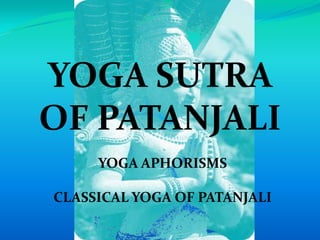
- 1. YOGA SUTRA OF PATANJALI YOGA APHORISMS CLASSICAL YOGA OF PATANJALI
- 2. WHO WAS PATANJALI? •Little is known about the author of the Yoga Sutra •Lived between the third and the fourth century CE •Traditional Indian literature, especially the Padma Purana, includes brief references to Patanjali, •he was born in Illavrita Varsha. •said to be the son of Angira and Sati, to have married Lolupa, •whom he discovered in the hollow of a tree on the northern slope of Mount Sumeru, •Some identify the author of the Yoga Sutras with the Patanjali who wrote the Mahabhashya or Great Commentary on Panini’s famous treatise on Sanskrit grammar
- 3. WHAT IS YOGA SUTRA? • Text written by Patanjali on the theory and practice of Yoga with greater emphasis on practice • Written in the SUTRA - Aphoristic form of short, sharp and clear statements • Consists of FOUR chapters and 195 aphorisms or ‘sutra’s • Samadhi Pada – chapter on Meditation • Sadhana Pada – chapter on Practice • Vibhooti Pada – chapter on Powers or ‘Siddhi’s • Kaivalya Pada – chapter on Realisation/Liberation • It is considered as a compilation or codification of the Yoga practices by Patanjali into a systematic framework
- 4. WHAT IS YOGA? • The answer to this question is given by Patanjali at the very beginning the text. ‘yogascittavritti nirodhah’ - 1.2 •‘Yoga is the cessation of the modifications of the mind’ • The word Yoga is derived from Sanskrit root ‘yuj’ which means to ‘bind’ or ‘yoke’ • We can think of three levels of ‘binding’: •Body-mind •Mind-consciousness •Individual consciousness with ultimate consciousness
- 5. WHAT IS YOGA? •‘Yoga is the cessation of the modifications of the mind’ • When the modifications of the mind cease: ‘Tada drstuh swarupe avasthanam’ 1.3 ‘Then the Seer abides in its own nature’ • In other words the whole purpose of Yoga is to re-establish the true identity of the Seer (Self) which results in liberation from the false identity and the cycle of birth and death (samsara)
- 6. WHAT IS YOGA PHILOSOPHY? ‘Then the Seer abides in its own nature’ • Yoga metaphysic is based on the dualist principles of • PURUSA: The primordial Consciousness principle • PRAKRTI: The primordial Matter principle • The Seer is the Purusa principle which enlivens and brings awareness to the inert Prakrti principle and its evolutes in matter such as the body and mind • At the conjunction (‘samyoga’) of the Purusa and Prakrti arises the conscious individual who mistakes her(him)self as this limited identity
- 7. SO WHAT IS THE GOAL OF YOGA? ‘Then the Seer abides in its own nature’ • Yoga is a coherent system of practices which seeks to re-establish the true identity of the Seer who has become entangled with the Matter principle • The immediate goal of Yoga is: ‘cessation of the modifications (‘vrtti’s )of the mind’ (‘cittavrtti nirodhah’)
- 8. WHAT ARE THE MODIFICATIONS OF THE MIND? Patanjali lists five categories of ‘VRTTI’s or modification in Sutra 1.5 – 1.11 •PRAMANA – correct cognitive process •VIPARYAYA – cognitive process of misconception •VIKALPA – process of conceptualising - abstraction •NIDRA – the state of sleep • SMRTI – processes of memory reproduction of previous impression
- 9. HOW ARE THE MODIFICATIONS TO BE CEASED? TWO REQUIREMENTS FOR NIRODHA OR CESSATION OF MODIFICATIONS: • ‘ABHYASA’: PRACTICE • consisting of austerity, discipline, knowledge and faith • done with intense effort, without break, with devotion • ‘VAIRAGYA’: DETACHMENT • losing desire for things seen and things unseen • through a process of discriminative clarity
- 10. WHAT HAPPENS TO THE MIND WITH PRACTICE AND DETACHMENT? IT GOES FROM NON-YOGIC TO YOGIC STATES OF MIND: • NON - YOGIC • KSIPTA: state of agitation • MUDHA: state of dullness/stupefication • VIKSIPTA: state of distraction • YOGIC • EKAGRA: state of single pointedness • NIRUDDHA: state of no modification
- 11. WHAT IS THE PRACTICE? THERE ARE TWO SETS OF PRACTICES WHICH PATANJALI SETS OUT: • KRIYA YOGA consisting of • TAPAS – Austerity, self –discipline, renunciation • SVADHYAYA – study of scriptures, chanting of mantra • ISVARA PRANIDHANA – complete surrender to God • ASHTANGA YOGA consisting of the eight limbs • YAMA, NIYAMA, ASANA, PRANAYAMA • PRATYAHARA, DHARNA, DHYANA, SAMADHI
- 12. WHAT DOES KRIYA YOGA DO? THERE ARE TWO OUTCOMES OF KRIYA YOGA PRACTICE THROUGH THE FIRE OF DISCRIMINATIVE KNOWLEDGE: • LEADS TO SAMADHI or absorption consisting of • SAMPRAJNATA SAMADHI– Absorption with cognition • ASAMPRAJNATA SAMADHI – Absorption without cognition • MINIMIZES THE ‘KLESA’s or afflictions consisting : • AVIDYA – Ignorance of the Truth • ASMITA – ‘I – ness’ or ‘sense of individuality’ • RAGA – Attraction towards things • DVESA – Repulsion from things • ABHINIVESA – Fear of annhilation
- 13. WHAT DOES ASHTANGA YOGA DO? THERE ARE EIGHT OUTCOMES OF ASHTANGA YOGA PRACTICE: • YAMA AND NIYAMA: DO’S AND DON’T’S: Leads towards a structured moral life • ASANA: PHYSICAL POSTURES: Leads towards balance in the body through stillness and pleasantness • PRANAYAMA: BREATHING EXERCISES: Lead towards stillness of the mind and prepares mind for internalising • PRATYAHARA: INTROVERSION: Lead towards control of senses and prepares for next step - • DHARANA: CONCENTRATION: Leads towards one pointedness of the mind • DHYANA: CONTEMPLATION: Leads towards absorption in object of contemplation • SAMADHI: ABSORPTION OR MEDITATION: Leads towards complete absorption in the Seer or Pure Consciousness
- 14. WHAT HAPPENS WITH PRACTICE OF SAMAYAMA? SAMAYAMA = DHARANA + DHYANA + SAMADHI: WITH INTENSE PRACTICE VARIOUS ‘SIDDHI’S OR POWERS DEVELOP IN THE PRACTITIONER: FOR EXAMPLE: • KAYAVYHAJNANAM: Knowledge of the body • STHAIRYAM: Steadiness of body and calmness of mind • SIDDHADARSANA: Vision of the ‘Siddha’s • PRATIBHA : Heightened perceptions and intuitions PATANJALI warns against getting attached to the powers and they become an obstacle to liberation of Kaivalya
- 15. SO WHAT IS YOGA ACCORDING TO PATANJALI? YOGA IS THE CESSATION OF THE MODIFICATIONS OF THE MIND BY PRACTICE AND DETACHMENT PRACTICE CONSISTS OF KRIYA YOGA AND ASHTANGA YOGA (EIGHT LIMBS YOGA) THIS LEADS TO THE MIND BECOMING LIKE A CLEAR JEWEL REFLECTING THE ‘PURUSA’ IN ITS BRILLIANCE THIS IS WHEN THE SEER ‘DRSTUH’ RESTS IN ITS OWN NATURE WITHOUT ANY ENTANGLEMENT OF ‘PRAKRTI’ (MATERIALITY)
Editor's Notes
- There is also the legend that Patanjali was the incarnation of AdiseshaIn the Indian tradition, Patanjali is said to be self-born, swayambhu. He was a highly-evolved soul who incarnated of his own will in a human form to help humanity.He is also considered an incarnation of Ananta, the source of all wisdom (Jnana) and of Shesha, the thousand-headed ruler of the serpent race, which is thought to guard the hidden treasures of the earth. Ananta depicts a couch on which God Vishnu reclines. He is the Lord of serpents and his many heads symbolize Infinity or Omnipresence.
- Literally it means a thread or line that holds things together and is derived from the verbal root siv-, meaning to sew[1] (these words, including Latinsuere and English to sew, all ultimately deriving from PIE *siH-/syuH-'to sew'), as does the medical term "suture.“In ancient Indian literature, sutra denotes a distinct type of literary composition, based on short aphoristic statements, generally using various technical terms. This literary form was designed for concision, as the texts were intended to be memorized by students in some of the formal methods of scriptural and scientific study (Sanskrit: svādhyāya). Since each line is highly condensed, another literary form arose in which commentaries (Sanskrit: bhāṣya) on the sutras were added, to clarify and explain them.[2]the VayuPurana:alpākṣaraṃasandigdhaṃsāravadviśvatomukhamastobhaṃanavadyaṃ ca sūtramsūtravidoviduḥOf minimal syllabary, unambiguous, pithy, comprehensive,continuous, and without flaw: who knows the sūtra knows it to be thus.SAMADHI PADA: This chapter is an exploration of the different aspects of Samadhi and gives us a clue about the process of introspective contemplation. SADHANA PADA: This chapter lays out the path of Yoga Sadhana in the form of a Bahiranga Sadhana though the first five limbs of Ashtanga Yoga. VIBHUTI PADA: This chapter deals with the Antaranga Yoga and details the Siddhis or psychic accomplishments that may be attained through the practice of Samyama on various aspects of the Universe. KAIVALYA PADA: This chapter deals with the attainment of the highest state of Kaivalya (liberation) that ensues when we finally go beyond the Kleshas (afflictions) and Karmas (action-reaction entwinement) to ultimately become ‘ONE WITH THE DIVINE’.