Yoga: History and Tradition Approximate outline of the History of Yoga
“Long before the word yoga acquired its customary meaning of spirituality or spiritual discipline, the sages of India had developed a body of knowledge and techniques that aimed at the transformation and transcendence of ordinary consciousness. This stock of ideas and practices formed the matrix out of which grew the complex historical phenomenon that later came to be called Yoga.” -The Yoga Tradition, Georg Feuerstein, PH.D.
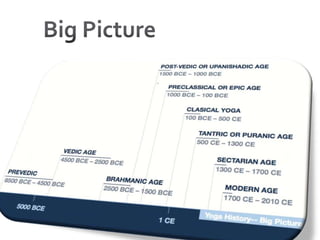
Big Picture
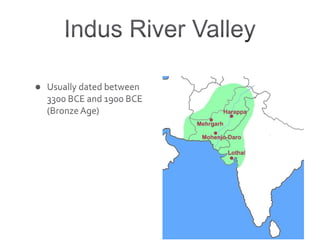
Indus River ValleyUsually dated between 3300 BCE and 1900 BCE (Bronze Age)
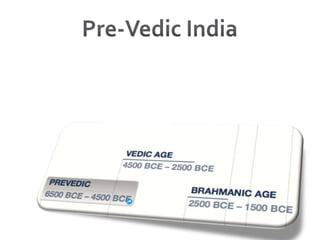
Pre-Vedic India
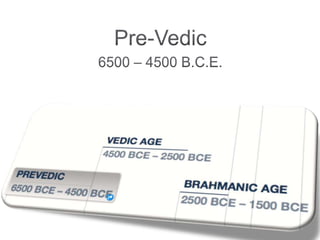
Pre-Vedic6500 – 4500 B.C.E.
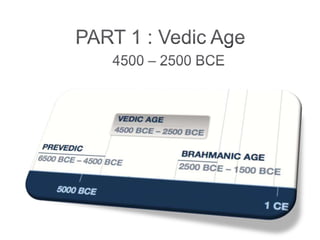
PART 1 : Vedic Age4500 – 2500 BCE
The Vedas4500 BCE - 2000 BCEVedas - written by Rishis, or “divinely inspired seers” or sagesPresents a loose structure of ideas and practices that become a seed to what is now known as “Yoga”4 Vedic texts become the central texts of India covering ritual, sacrifice, mantra and devotionThese are Rig Veda, Atharva-Veda,  Yajur Veda and Sama Veda
Origin of the VedasMehrgarh and the Sarasvati River CivilizationThe fertile region surrounding the Sarasvati River  provided became the location Neolithic nomads would settle down and become what we know as the Vedic people. Social and cultural elements become established creating the groundwork for a self-identifying community.Eventually, over the course of 100’s of years, the Sarasvati River dries up resulting from a geologic phenomenon causing the Vedic people to migrate to the banks of the Ganges.This was a tremulous period causing serious cultural shifts to take place including the formation of a  priestly order.
Sacrificial Mysticism: The Seeds of YogaIn response to chaos, 2 practices materializedRitualized ShamanismTapas  practices on one side and
SacrificeThe essence of Vedic yoga is in Sacrifice. Sacrifice in its original sense did not mean “giving up” or “going without”IInstead, sacrifice is an act that makes “Sacred.”Vedic yoga focused on a practice where the longing one has to experience the divine or sacred
Tapas (austerity)Personal austerity became the main form of sacrifice when the individual practice of the “forest dwellers” came known as yoga. Tapas brought merit and attainments, showing that yogic practice was bearing fruit. Tapas was the ”heat “ that cooked out “ the impurities and obstacles” to our experience of God
Tapas (in the Vedas)A Key element of practice that became a point of emphasisTapas is “heat” or “glow” but also of the heat created by trial and tribulation Asceticism… Explained as the endurance of extremesTapas as a practice became a testing of oneself and a testament toward ones spiritual power.(Later, recognized by Patanjali as one of the three “Kriya-yoga” and in the Niyamas signifies “self-discipline”)
Prana प्राण, prāṇaConcept of Prana enters the Picture.For the Vedic people, Prana (or Life Force) was seen as so closely linked to the Divine that understanding it became the basis for union with the Divine and the key to realizing immortality. Exploration of Prana became the basis for understanding the functions of life – or the ‘Vayus’- as well as the means for the transmigration of the soul from  life to life.Later Prana will
Legacy of Vedas“Middle Way”Priests performed sacrifice as a “pay-for-service” and Tapas Veins performed austere acts as a way to show spiritual prowess. Both “Outward Expressions”Rishis respond by traveling a Middle Path… or choosing neither one extreme or another by instead choosing an inwardly moving practice being devoted to discovering inner truth and the chasm between the human and the divine.Buddhism is understood by some as being born here
Prana (प्राण, prāṇa) “Life Force” or simply  “Life”It is the notion of a vital, life-sustaining force of living beings and vital energyIts most subtle material form is the breath, but is also to be found in blood, and its most concentrated form is semen in men and vaginal fluid in women.Prana becomes  a central concept in Ayurveda and Yoga where it is believed to flow through nadis, a network of fine subtle channels . Prana was first expounded in the Upanishads, where it is part of the worldly, physical realm, sustaining the body and the mother of thought and thus also of the mind. Prana suffuses all living forms but is not itself the Atman or individual soul. In the Ayurveda, the Sun and sunshine are held to be a source of Prana.
 Prana VayusWhen the Prana operates in the body, it divides into five major flows called Vayus. These 5 Vayus are somewhat like ocean currents, while there are 5 major currents, there may be thousands of smaller currents. The 5 major includePrana VayuApana VayuSamanaUdanaVyanaReversing Prana and Apana Vayu is a significant notion behind the Hatha Yoga practice
5 VayusPrana Vayu operates from the heart area, and is an upward flowing energy, having to do with vitalizing life forces. Apana Vayu operates from the base of the torso, in the rectum area, is a downward flowing energy, and has to do with eliminating or throwing off what is no longer needed. Samana Vayu operates from the navel area, deals with digestion, and allows the mental discrimination between useful and not useful thoughts. Udana Vayu operates from the throat and drives exhalation, operating in conjunction with Prana Vayu, which deals with inhalation.Vyana Vayu operates throughout the whole body, having no particular center, and is a coordinating energy throughout the various systems.
Real quick…Some scholars will say that the  Vedic age ends with  the beginning of the  Kali-yuga and the war that would later be remembered in the Mahabharata What is the Kali-yuga?
Upanishads and the Brahmanic Period 2500 – 1000 BCE
Post-Vedic UpanishadsWhile the Vedas are more poetic and mythic and lyrical in nature, the Upanishads are more expository in nature. In addition, the Upanishads begin a new course of thought that is expresses a yearning for “unveiling of the divine”Upanishads - wisdom learned at the feet of guru ‘or’ good news. Many consider this is the primary source of the Yogic TraditionBrahman priest formalized rituals and create orthodox religionNew concepts include “internalized sacrifice” which provides a basis for what some call “India’s  psycho spiritual “ technology
The Pre-Classical or Epic Age1000 – 100 BCE
The BhagavadGita1000 – 100 BC The BhagavadGitais part of the epic poem the Mahabharata EpicIt’s insertion in the Mahabharata is suspect. Some say it is most likely a later Upanishad.Focus on selfless actions (Karma Yoga), devotion (Bhakti Yoga), and wisdom (Jnana Yoga)
Jainism and Buddhism Various interpretations and expositions on the Vedas cause the creation of Jainism and BuddhismNear the end of the  Pre-classical ageCirca: 500 BCE …ish
 Evolution Through InvolutionClassical Yoga through Modern Yoga
Problem = Ignorance (Avidya)
Solution = Freedom (Moksha)
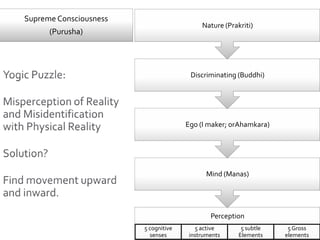
Problem = Ignorance (Avidya)Here’s the problem,MisperceptionOur ability to perceive the world is out of wackMisidentification with physical reality (prakriti) rather than transcendent reality (purusha)Prakriti is considered illusion or lower level of truth because it is subject to change while Purusha is considered unchanging Change = TemporaryUnchanging = Eternal
Yogic Puzzle:Misperception of Reality and Misidentification with Physical RealitySolution?Find movement upward and inward.
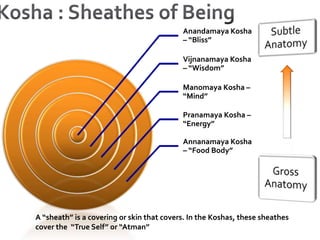
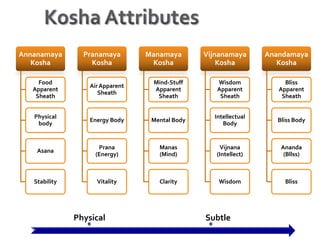
Kosha : Sheathes of Being	A “sheath” is a covering or skin that covers. In the Koshas, these sheathes cover the  “True Self” or “Atman”
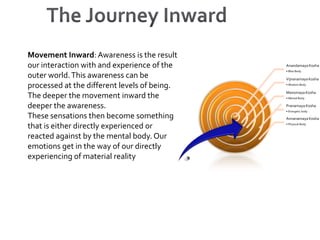
The Journey InwardMovement Inward: Awareness is the result our interaction with and experience of the outer world. This awareness can be processed at the different levels of being. The deeper the movement inward the deeper the awareness. These sensations then become something that is either directly experienced or reacted against by the mental body. Our emotions get in the way of our directly experiencing of material reality
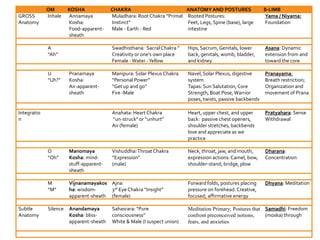
Kosha Attributes
The Classical Age100 BCE – 500 CE(Some will call this the age of Technology)
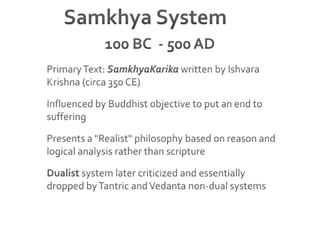
Samkhya System	100 BC  - 500 ADPrimary Text: SamkhyaKarika written by Ishvara Krishna (circa 350 CE)Influenced by Buddhist objective to put an end to sufferingPresents a "Realist" philosophy based on reason and logical analysis rather than scriptureDualist system later criticized and essentially dropped by Tantric and Vedanta non-dual systems
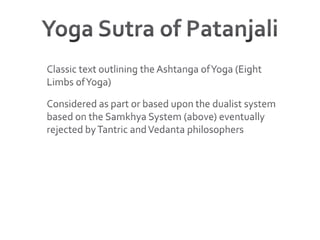
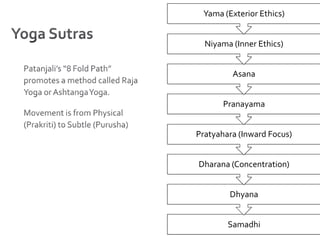
Yoga Sutra of PatanjaliClassic text outlining the Ashtanga of Yoga (Eight Limbs of Yoga)Considered as part or based upon the dualist system based on the Samkhya System (above) eventually rejected by Tantric and Vedanta philosophers
Yoga SutrasPatanjali’s “8 Fold Path”  promotes a method called Raja Yoga or Ashtanga Yoga. Movement is from Physical  (Prakriti) to Subtle (Purusha)
Post Classical500 – 1000 AD
Advaita Vedanta800 ADBridges Gap between the Yoga Sutras “Ashtanga” and and Hatha YogaShankara articulates non-dual philosophy rooted in VedasNon-dualist thought later adopted by most later forms of yoga and is shared with Tantra and Hatha Yoga
Hatha Yoga and TantraToward a contemporary practice
Founding of Hatha Yoga900 AD - 1000Siddha YogisTantric practitioners seeking enlightenment, immortality and paranormal powersNatha Yogis Matsyendra and student Goraksha are considered the founders of Hatha Yoga
Hatha Yoga, In shortHatha Yoga as preparatory stage of physical purification that the body practices for higher meditation. This practice is called shatkarma. The word Hatha is a compound of the words “Ha and Tha” meaning sun and moon referring to Prana and Apana, and also to the principal nadis (energy channels) of the subtle body that must be fully operational to attain a state of Dhyana or Samādhi.
Union and Yoga“Hatha” is a compound of the words “Ha” (sun) and Tha” (moon) and refers to the movement of “Prana” and “Apana” as they move through the nadis (energy channels) of the subtle body.“Ha" refers to the Solar (Pingala) and “Tha” to the Lunar (Ida) Channels (Nadis) within the subtle body.Thesemustbe fully operational to attain a state of Dhyana or Samādhi. However, when the two components of the word are placed together, "hatha" means "forceful", implying that powerful work must be done to purify the body.Hatha yoga is meant to join together sun or “Shiva” (masculine, active) energy with the moon or “Shakti”(feminine, receptive) energy, This union produces balance and greater power in an individual.
TantraMeaning: HiddenAssociations:Mantra: Chants that bring us to the immediate vibration of the present momentYantra: the use of geometry of visualization of form bringing us into the experience of the present moment
Origin and HistoryDifficult to explain the history of TantraViews that are on the boarder line. Represent the language that lies in between different schools of yogic thoughtWhere an exchange of differing ideas and thought takes placePractice and experience counts above historical reconciling these thoughts
Hatha Yoga Pradipika1350 AD – 1450 ADImportant early Hatha Yoga  text articulating 16 asanas along with information on pranayama, chakras, kundalini, bandhas, kriyas, shakti, nadis and mudras among other topics.Dedicated to Lord Adinath, a name for Lord Shiva, who is believed to have imparted the secret of Hatha Yoga to his divine consort Parvati
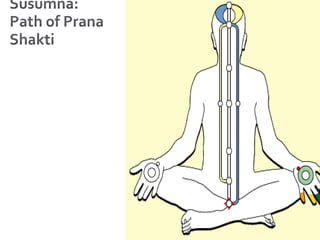
KundaliniAccording to Hindu tradition Kundalini yoga is a pure spiritual science that leads to means awakening of inner knowledge Enlightenment. Teachings of Hatha Yoga are TantricKundalini is the focus  physical and meditative discipline within Hatha Yoga.The awakening of the Kundalini, the practice associated to the rising of Pranic energy up the Susumna Nadi is the foundation
Prana (प्राण, prāṇa) Sanskrit for "breath”In Vedantic philosophy, it is the notion of a vital, life-sustaining force of living beings and vital energyPrana is a central concept in Ayurveda and Yoga where it is believed to flow through nadis, a network of fine subtle channels . Its most subtle material form is the breath, but is also to be found in blood, and its most concentrated form is semen in men and vaginal fluid in women.Pranamaya-kosha is one of the five Koshas or "sheaths" of Being.Prana was first expounded in the Upanishads, where it is part of the worldly, physical realm, sustaining the body and the mother of thought and thus also of the mind. Prana suffuses all living forms but is not itself the Atman or individual soul. In the Ayurveda, the Sun and sunshine are held to be a source of Prana.
 Prana VayusWhen the Prana operates in the body, it divides into five major flows called Vayus. These 5 Vayus are somewhat like ocean currents, while there are 5 major currents, there may be thousands of smaller currents. The 5 major includePrana VayuApana VayuSamanaUdanaVyanaReversing Prana and Apana Vayu is a significant notion behind the Hatha Yoga practice
5 VayusPrana Vayu operates from the heart area, and is an upward flowing energy, having to do with vitalizing life forces. Apana Vayu operates from the base of the torso, in the rectum area, is a downward flowing energy, and has to do with eliminating or throwing off what is no longer needed. Samana Vayu operates from the navel area, deals with digestion, and allows the mental discrimination between useful and not useful thoughts. Udana Vayu operates from the throat and drives exhalation, operating in conjunction with Prana Vayu, which deals with inhalation.Vyana Vayu operates throughout the whole body, having no particular center, and is a coordinating energy throughout the various systems.
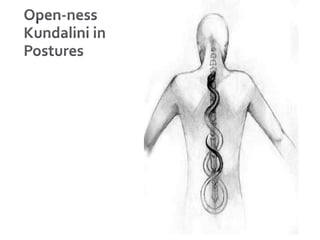
The Roll of Vayus in AwakeningPrana Vayu is an upward flowing energy and Apana Vayu is a downward flowing energy.Reversing Prana and Apana Vayu is a significant notion behind the Hatha Yoga practice One of the ways of describing the process of intentional Kundalini Awakening is that these two energies are intentionally reversed through a variety of practices. Reversing the energy causes the Kundalini at the base of the subtle spine to awaken, and to begin to arise.
The Secret of Tantra:The Present MomentThe Secret of Tantra is only secret only because the truth is by nature subtle and elusiveThe secret of Tantra, like the secret of yoga, is trapped in an experiential paradox where one’s attention and awareness of experience quickly gives way to theorizing and conceptualizing killing the experiencing itself The processes of Tantra and deep yoga practice
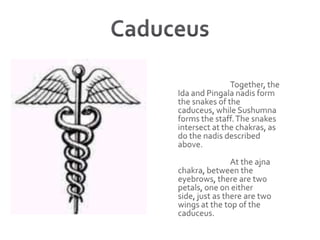
Caduceus 			Together, the Ida and Pingala nadis form the snakes of the caduceus, while Sushumna forms the staff. The snakes intersect at the chakras, as do the nadis described above.  			At the ajna chakra, between the eyebrows, there are two petals, one on either side, just as there are two wings at the top of the caduceus.
Susumna:Path of Prana Shakti
Open-nessKundalini in Postures
Chakra		Yoga and The Anatomy of Personal Evolution
IntroductionA chakra is a plexus of Pranic energy in the body that expresses our individual consciousness and energy in particular ways distinctive of our individuality. We are familiar withexpressions such as a ‘gut feeling,’ an ‘open heart,’ ‘fire in the belly’ and so on, all of which are colloquial expressions of the energy of the chakras.Our expressions also reflect our recognition that these energies can be ‘open’ – expansive, expressive, inclusive – or ‘closed’ – tight, narrow, self-absorbed. Our maturity and evolution as individuals and as spiritual beings depends upon how much these energies are ‘opened’ as we progress through life, bringing us into higher levels of harmony with the generous, inclusive and expansive energy of the universe, the creative Shakti.Doug Keller, Refining The Breath
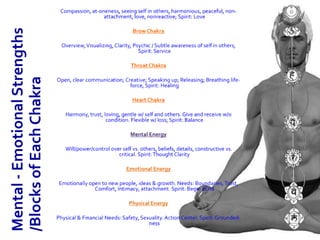
Crown ChakraCompassion, at-oneness, seeing self in others, harmonious, peaceful, non-attachment, love, nonreactive; Spirit: LoveBrow ChakraOverview, Visualizing, Clarity, Psychic / Subtle awareness of self in others; Spirit: ServiceThroat ChakraOpen, clear communication; Creative; Speaking up; Releasing; Breathing life-force, Spirit: HealingHeart ChakraHarmony, trust, loving, gentle w/ self and others. Give and receive w/o condition. Flexible w/ loss; Spirit: BalanceMental Energy Will/power/control over self vs. others, beliefs, details, constructive vs. critical. Spirit: Thought ClarityEmotional EnergyEmotionally open to new people, ideas & growth. Needs: Boundaries, Trust, Comfort, Intimacy, attachment. Spirit: Begin / EndPhysical EnergyPhysical & Financial Needs: Safety, Sexuality. Action Center. Spirit: Grounded-ness Mental - Emotional Strengths /Blocks of Each Chakra
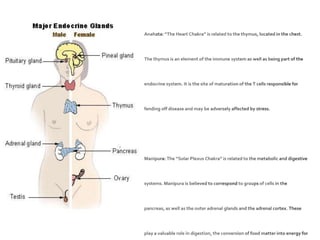
Sahasrara: “The Crown Chakra” may be seen similarly to the pituitary gland,  which secretes hormones to communicate to the rest of the endocrine system and connects to the central nervous system via the hypothalamus.  Ajna: “The Brow Chakra” (also known as the third eye chakra) is linked to the pineal gland which may inform a model of its envisioning. The pineal gland is a light sensitive gland that produces the hormone melatonin, which regulates sleep and waking up. Vishuddha: “The Throat Chakra” may be understood as relating to communication and growth through expression. This chakra is paralleled to the thyroid, a gland that is also in the throat and which produces thyroid hormone, responsible for growth and maturation. Anahata: “The Heart Chakra” is related to the thymus, located in the chest. The thymus is an element of the immune system as well as being part of the endocrine system. It is the site of maturation of the T cells responsible for fending off disease and may be adversely affected by stress.Manipura: The “Solar Plexus Chakra” is related to the metabolic and digestive systems. Manipura is believed to correspond to groups of cells in the pancreas, as well as the outer adrenal glands and the adrenal cortex. These play a valuable role in digestion, the conversion of food matter into energy for the body. Svadhisthana: “The Sacral Chakra” is located in the sacrum (hence the name) and is considered to correspond to the testes or the ovaries that produce the various sex hormones involved in the reproductive cycle. Svadhisthana is considered to be related to, more generally, the genitourinary system and the adrenals.Muladhara: “The Base Chakra” is related to instinct, security, survival and basic human potentiality. This centre is located in the region between the genitals and the anus. Although no endocrine organ is placed here, it is said to relate to the gonads and the adrenal medulla, responsible for the fight-or-flight response when survival is under threat.
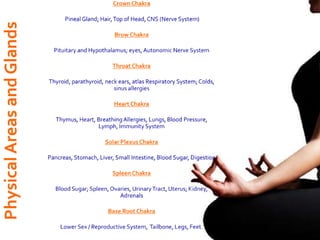
Crown Chakra Pineal Gland; Hair, Top of Head, CNS (Nerve System)Brow ChakraPituitary and Hypothalamus; eyes, Autonomic Nerve SystemThroat ChakraThyroid, parathyroid, neck ears, atlas Respiratory System; Colds, sinus allergiesHeart ChakraThymus, Heart, Breathing Allergies, Lungs, Blood Pressure, Lymph, Immunity SystemSolar Plexus ChakraPancreas, Stomach, Liver, Small Intestine, Blood Sugar, DigestionSpleen Chakra Blood Sugar; Spleen, Ovaries, Urinary Tract, Uterus; Kidney, AdrenalsBase Root ChakraLower Sex / Reproductive System,  Tailbone, Legs, Feet.Physical Areas and Glands
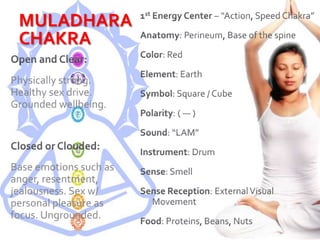
MULADHARACHAKRA1st Energy Center – “Action, Speed Chakra”Anatomy: Perineum, Base of the spineColor: RedElement: EarthSymbol: Square / CubePolarity: ( — )Sound: “LAM”Instrument: DrumSense: SmellSense Reception: External Visual MovementFood: Proteins, Beans, NutsOpen and Clear:Physically strong. Healthy sex drive. Grounded wellbeing.Closed or Clouded:Base emotions such as anger, resentment, jealousness. Sex w/ personal pleasure as focus. Ungrounded.
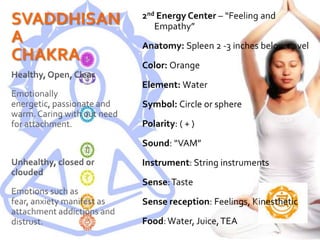
SVADDHISANA CHAKRA2nd Energy Center – “Feeling and Empathy”Anatomy: Spleen 2 -3 inches below navelColor: OrangeElement: WaterSymbol: Circle or spherePolarity: ( + )Sound: “VAM” Instrument: String instrumentsSense: Taste Sense reception: Feelings, Kinesthetic Food: Water, Juice, TEAHealthy, Open, ClearEmotionally energetic, passionate and warm. Caring with out need for attachment.Unhealthy, closed or cloudedEmotions such as fear, anxiety manifest as attachment addictions and distrust.
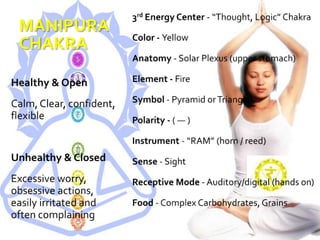
MANIPURA CHAKRA 3rd Energy Center - “Thought, Logic” ChakraColor - YellowAnatomy - Solar Plexus (upper stomach)Element - FireSymbol - Pyramid or Triangle Polarity - ( — )Instrument - “RAM” (horn / reed) Sense - Sight Receptive Mode - Auditory/digital (hands on)Food - Complex Carbohydrates, GrainsHealthy & OpenCalm, Clear, confident, flexibleUnhealthy & ClosedExcessive worry, obsessive actions,  easily irritated and often complaining
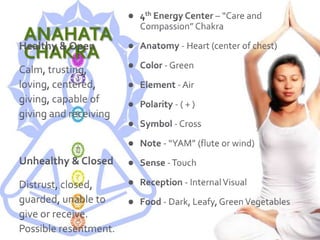
ANAHATA CHAKRA4th Energy Center – “Care and Compassion” ChakraAnatomy - Heart (center of chest)Color - GreenElement - Air Polarity - ( + )Symbol - CrossNote - “YAM” (flute or wind)Sense - TouchReception - Internal VisualFood - Dark, Leafy, Green Vegetables Healthy & OpenCalm, trusting, loving, centered, giving, capable of giving and receivingUnhealthy & ClosedDistrust, closed, guarded, unable to give or receive. Possible resentment.
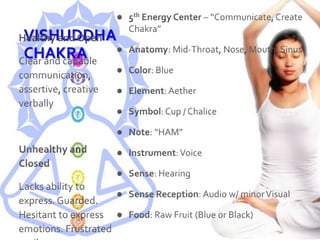
VISHUDDHACHAKRA5th Energy Center – “Communicate, Create Chakra”Anatomy: Mid-Throat, Nose, Mouth, SinusColor: BlueElement: AetherSymbol: Cup / ChaliceNote: “HAM”Instrument: VoiceSense: HearingSense Reception: Audio w/ minor VisualFood: Raw Fruit (Blue or Black) Healthy and OpenClear and capable communication, assertive, creative verballyUnhealthy and ClosedLacks ability to express. Guarded. Hesitant to express emotions. Frustrated easily
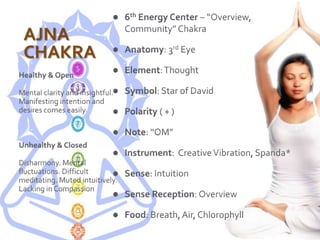
AJNACHAKRA6th Energy Center – “Overview, Community” ChakraAnatomy: 3rd EyeElement: ThoughtSymbol: Star of DavidPolarity ( + )Note: “OM”Instrument:  Creative Vibration, Spanda*Sense: IntuitionSense Reception: OverviewFood: Breath, Air, Chlorophyll Healthy & OpenMental clarity and insightful. Manifesting intention and desires comes easilyUnhealthy & ClosedDisharmony. Mental fluctuations. Difficult meditating. Muted intuitively. Lacking in Compassion
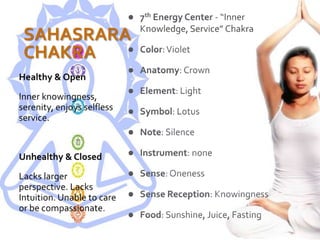
SAHASRARACHAKRA7th Energy Center - “Inner Knowledge, Service” ChakraColor: VioletAnatomy: CrownElement: LightSymbol: LotusNote: SilenceInstrument: noneSense: OnenessSense Reception: KnowingnessFood: Sunshine, Juice, FastingHealthy & OpenInner knowingness, serenity, enjoys selfless service.Unhealthy & ClosedLacks larger perspective. Lacks Intuition. Unable to care or be compassionate.
Contemporary YogaIn Hatha Yoga Pradipika, Hatha Yoga is described as relating to Kundalini Yoga. It also explains that the purpose of Hatha Yoga is Raja Yoga. Thus, we can easily see the relationship of Hatha Yoga and Kundalini Yoga as being parts or aspects of Raja Yoga, which is one of the traditional four paths of Yoga.
Modern Age1700 - Present
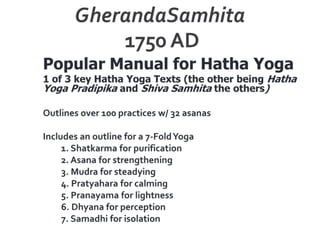
GherandaSamhita 1750 AD Popular Manual for Hatha Yoga1 of 3 key Hatha Yoga Texts (the other being Hatha Yoga Pradipika and Shiva Samhita the others)Outlines over 100 practices w/ 32 asanasIncludes an outline for a 7-Fold Yoga   1. Shatkarma for purification   2. Asana for strengthening   3. Mudra for steadying   4. Pratyahara for calming   5. Pranayama for lightness   6. Dhyana for perception   7. Samadhi for isolation
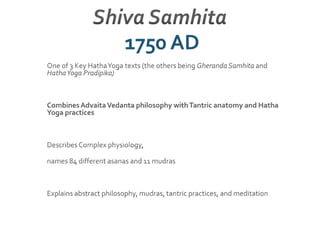
Shiva Samhita 1750 AD One of 3 Key Hatha Yoga texts (the others being Gheranda Samhita and Hatha Yoga Pradipika)Combines Advaita Vedanta philosophy with Tantric anatomy and Hatha Yoga practicesDescribes Complex physiology, names 84 different asanas and 11 mudrasExplains abstract philosophy, mudras, tantric practices, and meditation
Shiva Samhita…continued 1750 AD Emphasizes that even a common householder can practice and benefit from yoga. Describes the four types of aspirants and the importance of the guru  Methods and Obstacles of liberation and philosophical standpoints.The nadis, the internal fire, and the working of the Jiva.Describes five specific types of Prana, the four stages of the Yoga, the five elemental visualizationsIntroduces esoteric ideas such as: shadow gazing, the internal sound, the esoteric centers and energies in the body, the seven lotuses, the "king of kings of yogas", and a global mantra
Swami Vivekananda1893 ADDisciple of Sri Ramakrishna 1893 Presented Vedanta and Yoga philosophy at Chicago's Parliament of Religions marking the beginning of American yogaAuthor of Raja Yoga, Karma Yoga, Bhakti Yoga and Jnana Yoga key texts describing contemporary yoga tradition
Sri TirumalaiKrishnamacharya(November 18, 1888 – November 3, 1989)Indian Yoga teacher, healer and scholar.His students include:B.K.S. Iyengar,Sri K. Pattabhi Jois, the lateIndra DeviT.K.V. DesikacharSrivatsaRamaswami, A.G. Mohan, and Krishnamacharya’s own sons T.K. Srinivasan, and T.K. Sribhashyam.
http://www.youtube.com/watch?v=1FYtX7xsXxw&feature=related

Yoga philosophy talk 3

  • 1.
    Yoga: History andTradition Approximate outline of the History of Yoga
  • 2.
    “Long before theword yoga acquired its customary meaning of spirituality or spiritual discipline, the sages of India had developed a body of knowledge and techniques that aimed at the transformation and transcendence of ordinary consciousness. This stock of ideas and practices formed the matrix out of which grew the complex historical phenomenon that later came to be called Yoga.” -The Yoga Tradition, Georg Feuerstein, PH.D.
  • 3.
  • 4.
    Indus River ValleyUsuallydated between 3300 BCE and 1900 BCE (Bronze Age)
  • 5.
  • 6.
  • 7.
    PART 1 :Vedic Age4500 – 2500 BCE
  • 8.
    The Vedas4500 BCE- 2000 BCEVedas - written by Rishis, or “divinely inspired seers” or sagesPresents a loose structure of ideas and practices that become a seed to what is now known as “Yoga”4 Vedic texts become the central texts of India covering ritual, sacrifice, mantra and devotionThese are Rig Veda, Atharva-Veda, Yajur Veda and Sama Veda
  • 9.
    Origin of theVedasMehrgarh and the Sarasvati River CivilizationThe fertile region surrounding the Sarasvati River provided became the location Neolithic nomads would settle down and become what we know as the Vedic people. Social and cultural elements become established creating the groundwork for a self-identifying community.Eventually, over the course of 100’s of years, the Sarasvati River dries up resulting from a geologic phenomenon causing the Vedic people to migrate to the banks of the Ganges.This was a tremulous period causing serious cultural shifts to take place including the formation of a priestly order.
  • 10.
    Sacrificial Mysticism: TheSeeds of YogaIn response to chaos, 2 practices materializedRitualized ShamanismTapas practices on one side and
  • 11.
    SacrificeThe essence ofVedic yoga is in Sacrifice. Sacrifice in its original sense did not mean “giving up” or “going without”IInstead, sacrifice is an act that makes “Sacred.”Vedic yoga focused on a practice where the longing one has to experience the divine or sacred
  • 12.
    Tapas (austerity)Personal austeritybecame the main form of sacrifice when the individual practice of the “forest dwellers” came known as yoga. Tapas brought merit and attainments, showing that yogic practice was bearing fruit. Tapas was the ”heat “ that cooked out “ the impurities and obstacles” to our experience of God
  • 13.
    Tapas (in theVedas)A Key element of practice that became a point of emphasisTapas is “heat” or “glow” but also of the heat created by trial and tribulation Asceticism… Explained as the endurance of extremesTapas as a practice became a testing of oneself and a testament toward ones spiritual power.(Later, recognized by Patanjali as one of the three “Kriya-yoga” and in the Niyamas signifies “self-discipline”)
  • 14.
    Prana प्राण, prāṇaConceptof Prana enters the Picture.For the Vedic people, Prana (or Life Force) was seen as so closely linked to the Divine that understanding it became the basis for union with the Divine and the key to realizing immortality. Exploration of Prana became the basis for understanding the functions of life – or the ‘Vayus’- as well as the means for the transmigration of the soul from life to life.Later Prana will
  • 15.
    Legacy of Vedas“MiddleWay”Priests performed sacrifice as a “pay-for-service” and Tapas Veins performed austere acts as a way to show spiritual prowess. Both “Outward Expressions”Rishis respond by traveling a Middle Path… or choosing neither one extreme or another by instead choosing an inwardly moving practice being devoted to discovering inner truth and the chasm between the human and the divine.Buddhism is understood by some as being born here
  • 16.
    Prana (प्राण, prāṇa)“Life Force” or simply “Life”It is the notion of a vital, life-sustaining force of living beings and vital energyIts most subtle material form is the breath, but is also to be found in blood, and its most concentrated form is semen in men and vaginal fluid in women.Prana becomes a central concept in Ayurveda and Yoga where it is believed to flow through nadis, a network of fine subtle channels . Prana was first expounded in the Upanishads, where it is part of the worldly, physical realm, sustaining the body and the mother of thought and thus also of the mind. Prana suffuses all living forms but is not itself the Atman or individual soul. In the Ayurveda, the Sun and sunshine are held to be a source of Prana.
  • 17.
    Prana VayusWhenthe Prana operates in the body, it divides into five major flows called Vayus. These 5 Vayus are somewhat like ocean currents, while there are 5 major currents, there may be thousands of smaller currents. The 5 major includePrana VayuApana VayuSamanaUdanaVyanaReversing Prana and Apana Vayu is a significant notion behind the Hatha Yoga practice
  • 18.
    5 VayusPrana Vayuoperates from the heart area, and is an upward flowing energy, having to do with vitalizing life forces. Apana Vayu operates from the base of the torso, in the rectum area, is a downward flowing energy, and has to do with eliminating or throwing off what is no longer needed. Samana Vayu operates from the navel area, deals with digestion, and allows the mental discrimination between useful and not useful thoughts. Udana Vayu operates from the throat and drives exhalation, operating in conjunction with Prana Vayu, which deals with inhalation.Vyana Vayu operates throughout the whole body, having no particular center, and is a coordinating energy throughout the various systems.
  • 19.
    Real quick…Some scholarswill say that the Vedic age ends with the beginning of the Kali-yuga and the war that would later be remembered in the Mahabharata What is the Kali-yuga?
  • 20.
    Upanishads and theBrahmanic Period 2500 – 1000 BCE
  • 21.
    Post-Vedic UpanishadsWhile theVedas are more poetic and mythic and lyrical in nature, the Upanishads are more expository in nature. In addition, the Upanishads begin a new course of thought that is expresses a yearning for “unveiling of the divine”Upanishads - wisdom learned at the feet of guru ‘or’ good news. Many consider this is the primary source of the Yogic TraditionBrahman priest formalized rituals and create orthodox religionNew concepts include “internalized sacrifice” which provides a basis for what some call “India’s psycho spiritual “ technology
  • 22.
    The Pre-Classical orEpic Age1000 – 100 BCE
  • 23.
    The BhagavadGita1000 –100 BC The BhagavadGitais part of the epic poem the Mahabharata EpicIt’s insertion in the Mahabharata is suspect. Some say it is most likely a later Upanishad.Focus on selfless actions (Karma Yoga), devotion (Bhakti Yoga), and wisdom (Jnana Yoga)
  • 24.
    Jainism and BuddhismVarious interpretations and expositions on the Vedas cause the creation of Jainism and BuddhismNear the end of the Pre-classical ageCirca: 500 BCE …ish
  • 25.
    Evolution ThroughInvolutionClassical Yoga through Modern Yoga
  • 26.
  • 27.
  • 28.
    Problem = Ignorance(Avidya)Here’s the problem,MisperceptionOur ability to perceive the world is out of wackMisidentification with physical reality (prakriti) rather than transcendent reality (purusha)Prakriti is considered illusion or lower level of truth because it is subject to change while Purusha is considered unchanging Change = TemporaryUnchanging = Eternal
  • 29.
    Yogic Puzzle:Misperception ofReality and Misidentification with Physical RealitySolution?Find movement upward and inward.
  • 31.
    Kosha : Sheathesof Being A “sheath” is a covering or skin that covers. In the Koshas, these sheathes cover the “True Self” or “Atman”
  • 32.
    The Journey InwardMovementInward: Awareness is the result our interaction with and experience of the outer world. This awareness can be processed at the different levels of being. The deeper the movement inward the deeper the awareness. These sensations then become something that is either directly experienced or reacted against by the mental body. Our emotions get in the way of our directly experiencing of material reality
  • 33.
  • 34.
    The Classical Age100BCE – 500 CE(Some will call this the age of Technology)
  • 35.
    Samkhya System 100 BC - 500 ADPrimary Text: SamkhyaKarika written by Ishvara Krishna (circa 350 CE)Influenced by Buddhist objective to put an end to sufferingPresents a "Realist" philosophy based on reason and logical analysis rather than scriptureDualist system later criticized and essentially dropped by Tantric and Vedanta non-dual systems
  • 36.
    Yoga Sutra ofPatanjaliClassic text outlining the Ashtanga of Yoga (Eight Limbs of Yoga)Considered as part or based upon the dualist system based on the Samkhya System (above) eventually rejected by Tantric and Vedanta philosophers
  • 37.
    Yoga SutrasPatanjali’s “8Fold Path” promotes a method called Raja Yoga or Ashtanga Yoga. Movement is from Physical (Prakriti) to Subtle (Purusha)
  • 38.
  • 39.
    Advaita Vedanta800 ADBridgesGap between the Yoga Sutras “Ashtanga” and and Hatha YogaShankara articulates non-dual philosophy rooted in VedasNon-dualist thought later adopted by most later forms of yoga and is shared with Tantra and Hatha Yoga
  • 40.
    Hatha Yoga andTantraToward a contemporary practice
  • 41.
    Founding of HathaYoga900 AD - 1000Siddha YogisTantric practitioners seeking enlightenment, immortality and paranormal powersNatha Yogis Matsyendra and student Goraksha are considered the founders of Hatha Yoga
  • 42.
    Hatha Yoga, InshortHatha Yoga as preparatory stage of physical purification that the body practices for higher meditation. This practice is called shatkarma. The word Hatha is a compound of the words “Ha and Tha” meaning sun and moon referring to Prana and Apana, and also to the principal nadis (energy channels) of the subtle body that must be fully operational to attain a state of Dhyana or Samādhi.
  • 43.
    Union and Yoga“Hatha”is a compound of the words “Ha” (sun) and Tha” (moon) and refers to the movement of “Prana” and “Apana” as they move through the nadis (energy channels) of the subtle body.“Ha" refers to the Solar (Pingala) and “Tha” to the Lunar (Ida) Channels (Nadis) within the subtle body.Thesemustbe fully operational to attain a state of Dhyana or Samādhi. However, when the two components of the word are placed together, "hatha" means "forceful", implying that powerful work must be done to purify the body.Hatha yoga is meant to join together sun or “Shiva” (masculine, active) energy with the moon or “Shakti”(feminine, receptive) energy, This union produces balance and greater power in an individual.
  • 44.
    TantraMeaning: HiddenAssociations:Mantra: Chantsthat bring us to the immediate vibration of the present momentYantra: the use of geometry of visualization of form bringing us into the experience of the present moment
  • 45.
    Origin and HistoryDifficultto explain the history of TantraViews that are on the boarder line. Represent the language that lies in between different schools of yogic thoughtWhere an exchange of differing ideas and thought takes placePractice and experience counts above historical reconciling these thoughts
  • 46.
    Hatha Yoga Pradipika1350AD – 1450 ADImportant early Hatha Yoga text articulating 16 asanas along with information on pranayama, chakras, kundalini, bandhas, kriyas, shakti, nadis and mudras among other topics.Dedicated to Lord Adinath, a name for Lord Shiva, who is believed to have imparted the secret of Hatha Yoga to his divine consort Parvati
  • 47.
    KundaliniAccording to Hindutradition Kundalini yoga is a pure spiritual science that leads to means awakening of inner knowledge Enlightenment. Teachings of Hatha Yoga are TantricKundalini is the focus physical and meditative discipline within Hatha Yoga.The awakening of the Kundalini, the practice associated to the rising of Pranic energy up the Susumna Nadi is the foundation
  • 48.
    Prana (प्राण, prāṇa)Sanskrit for "breath”In Vedantic philosophy, it is the notion of a vital, life-sustaining force of living beings and vital energyPrana is a central concept in Ayurveda and Yoga where it is believed to flow through nadis, a network of fine subtle channels . Its most subtle material form is the breath, but is also to be found in blood, and its most concentrated form is semen in men and vaginal fluid in women.Pranamaya-kosha is one of the five Koshas or "sheaths" of Being.Prana was first expounded in the Upanishads, where it is part of the worldly, physical realm, sustaining the body and the mother of thought and thus also of the mind. Prana suffuses all living forms but is not itself the Atman or individual soul. In the Ayurveda, the Sun and sunshine are held to be a source of Prana.
  • 49.
    Prana VayusWhenthe Prana operates in the body, it divides into five major flows called Vayus. These 5 Vayus are somewhat like ocean currents, while there are 5 major currents, there may be thousands of smaller currents. The 5 major includePrana VayuApana VayuSamanaUdanaVyanaReversing Prana and Apana Vayu is a significant notion behind the Hatha Yoga practice
  • 50.
    5 VayusPrana Vayuoperates from the heart area, and is an upward flowing energy, having to do with vitalizing life forces. Apana Vayu operates from the base of the torso, in the rectum area, is a downward flowing energy, and has to do with eliminating or throwing off what is no longer needed. Samana Vayu operates from the navel area, deals with digestion, and allows the mental discrimination between useful and not useful thoughts. Udana Vayu operates from the throat and drives exhalation, operating in conjunction with Prana Vayu, which deals with inhalation.Vyana Vayu operates throughout the whole body, having no particular center, and is a coordinating energy throughout the various systems.
  • 51.
    The Roll ofVayus in AwakeningPrana Vayu is an upward flowing energy and Apana Vayu is a downward flowing energy.Reversing Prana and Apana Vayu is a significant notion behind the Hatha Yoga practice One of the ways of describing the process of intentional Kundalini Awakening is that these two energies are intentionally reversed through a variety of practices. Reversing the energy causes the Kundalini at the base of the subtle spine to awaken, and to begin to arise.
  • 52.
    The Secret ofTantra:The Present MomentThe Secret of Tantra is only secret only because the truth is by nature subtle and elusiveThe secret of Tantra, like the secret of yoga, is trapped in an experiential paradox where one’s attention and awareness of experience quickly gives way to theorizing and conceptualizing killing the experiencing itself The processes of Tantra and deep yoga practice
  • 53.
    Caduceus Together, theIda and Pingala nadis form the snakes of the caduceus, while Sushumna forms the staff. The snakes intersect at the chakras, as do the nadis described above. At the ajna chakra, between the eyebrows, there are two petals, one on either side, just as there are two wings at the top of the caduceus.
  • 54.
  • 55.
  • 56.
    Chakra Yoga and TheAnatomy of Personal Evolution
  • 57.
    IntroductionA chakra isa plexus of Pranic energy in the body that expresses our individual consciousness and energy in particular ways distinctive of our individuality. We are familiar withexpressions such as a ‘gut feeling,’ an ‘open heart,’ ‘fire in the belly’ and so on, all of which are colloquial expressions of the energy of the chakras.Our expressions also reflect our recognition that these energies can be ‘open’ – expansive, expressive, inclusive – or ‘closed’ – tight, narrow, self-absorbed. Our maturity and evolution as individuals and as spiritual beings depends upon how much these energies are ‘opened’ as we progress through life, bringing us into higher levels of harmony with the generous, inclusive and expansive energy of the universe, the creative Shakti.Doug Keller, Refining The Breath
  • 58.
    Crown ChakraCompassion, at-oneness,seeing self in others, harmonious, peaceful, non-attachment, love, nonreactive; Spirit: LoveBrow ChakraOverview, Visualizing, Clarity, Psychic / Subtle awareness of self in others; Spirit: ServiceThroat ChakraOpen, clear communication; Creative; Speaking up; Releasing; Breathing life-force, Spirit: HealingHeart ChakraHarmony, trust, loving, gentle w/ self and others. Give and receive w/o condition. Flexible w/ loss; Spirit: BalanceMental Energy Will/power/control over self vs. others, beliefs, details, constructive vs. critical. Spirit: Thought ClarityEmotional EnergyEmotionally open to new people, ideas & growth. Needs: Boundaries, Trust, Comfort, Intimacy, attachment. Spirit: Begin / EndPhysical EnergyPhysical & Financial Needs: Safety, Sexuality. Action Center. Spirit: Grounded-ness Mental - Emotional Strengths /Blocks of Each Chakra
  • 59.
    Sahasrara: “The CrownChakra” may be seen similarly to the pituitary gland, which secretes hormones to communicate to the rest of the endocrine system and connects to the central nervous system via the hypothalamus. Ajna: “The Brow Chakra” (also known as the third eye chakra) is linked to the pineal gland which may inform a model of its envisioning. The pineal gland is a light sensitive gland that produces the hormone melatonin, which regulates sleep and waking up. Vishuddha: “The Throat Chakra” may be understood as relating to communication and growth through expression. This chakra is paralleled to the thyroid, a gland that is also in the throat and which produces thyroid hormone, responsible for growth and maturation. Anahata: “The Heart Chakra” is related to the thymus, located in the chest. The thymus is an element of the immune system as well as being part of the endocrine system. It is the site of maturation of the T cells responsible for fending off disease and may be adversely affected by stress.Manipura: The “Solar Plexus Chakra” is related to the metabolic and digestive systems. Manipura is believed to correspond to groups of cells in the pancreas, as well as the outer adrenal glands and the adrenal cortex. These play a valuable role in digestion, the conversion of food matter into energy for the body. Svadhisthana: “The Sacral Chakra” is located in the sacrum (hence the name) and is considered to correspond to the testes or the ovaries that produce the various sex hormones involved in the reproductive cycle. Svadhisthana is considered to be related to, more generally, the genitourinary system and the adrenals.Muladhara: “The Base Chakra” is related to instinct, security, survival and basic human potentiality. This centre is located in the region between the genitals and the anus. Although no endocrine organ is placed here, it is said to relate to the gonads and the adrenal medulla, responsible for the fight-or-flight response when survival is under threat.
  • 60.
    Crown Chakra PinealGland; Hair, Top of Head, CNS (Nerve System)Brow ChakraPituitary and Hypothalamus; eyes, Autonomic Nerve SystemThroat ChakraThyroid, parathyroid, neck ears, atlas Respiratory System; Colds, sinus allergiesHeart ChakraThymus, Heart, Breathing Allergies, Lungs, Blood Pressure, Lymph, Immunity SystemSolar Plexus ChakraPancreas, Stomach, Liver, Small Intestine, Blood Sugar, DigestionSpleen Chakra Blood Sugar; Spleen, Ovaries, Urinary Tract, Uterus; Kidney, AdrenalsBase Root ChakraLower Sex / Reproductive System, Tailbone, Legs, Feet.Physical Areas and Glands
  • 61.
    MULADHARACHAKRA1st Energy Center– “Action, Speed Chakra”Anatomy: Perineum, Base of the spineColor: RedElement: EarthSymbol: Square / CubePolarity: ( — )Sound: “LAM”Instrument: DrumSense: SmellSense Reception: External Visual MovementFood: Proteins, Beans, NutsOpen and Clear:Physically strong. Healthy sex drive. Grounded wellbeing.Closed or Clouded:Base emotions such as anger, resentment, jealousness. Sex w/ personal pleasure as focus. Ungrounded.
  • 62.
    SVADDHISANA CHAKRA2nd EnergyCenter – “Feeling and Empathy”Anatomy: Spleen 2 -3 inches below navelColor: OrangeElement: WaterSymbol: Circle or spherePolarity: ( + )Sound: “VAM” Instrument: String instrumentsSense: Taste Sense reception: Feelings, Kinesthetic Food: Water, Juice, TEAHealthy, Open, ClearEmotionally energetic, passionate and warm. Caring with out need for attachment.Unhealthy, closed or cloudedEmotions such as fear, anxiety manifest as attachment addictions and distrust.
  • 63.
    MANIPURA CHAKRA 3rdEnergy Center - “Thought, Logic” ChakraColor - YellowAnatomy - Solar Plexus (upper stomach)Element - FireSymbol - Pyramid or Triangle Polarity - ( — )Instrument - “RAM” (horn / reed) Sense - Sight Receptive Mode - Auditory/digital (hands on)Food - Complex Carbohydrates, GrainsHealthy & OpenCalm, Clear, confident, flexibleUnhealthy & ClosedExcessive worry, obsessive actions, easily irritated and often complaining
  • 64.
    ANAHATA CHAKRA4th EnergyCenter – “Care and Compassion” ChakraAnatomy - Heart (center of chest)Color - GreenElement - Air Polarity - ( + )Symbol - CrossNote - “YAM” (flute or wind)Sense - TouchReception - Internal VisualFood - Dark, Leafy, Green Vegetables Healthy & OpenCalm, trusting, loving, centered, giving, capable of giving and receivingUnhealthy & ClosedDistrust, closed, guarded, unable to give or receive. Possible resentment.
  • 65.
    VISHUDDHACHAKRA5th Energy Center– “Communicate, Create Chakra”Anatomy: Mid-Throat, Nose, Mouth, SinusColor: BlueElement: AetherSymbol: Cup / ChaliceNote: “HAM”Instrument: VoiceSense: HearingSense Reception: Audio w/ minor VisualFood: Raw Fruit (Blue or Black) Healthy and OpenClear and capable communication, assertive, creative verballyUnhealthy and ClosedLacks ability to express. Guarded. Hesitant to express emotions. Frustrated easily
  • 66.
    AJNACHAKRA6th Energy Center– “Overview, Community” ChakraAnatomy: 3rd EyeElement: ThoughtSymbol: Star of DavidPolarity ( + )Note: “OM”Instrument: Creative Vibration, Spanda*Sense: IntuitionSense Reception: OverviewFood: Breath, Air, Chlorophyll Healthy & OpenMental clarity and insightful. Manifesting intention and desires comes easilyUnhealthy & ClosedDisharmony. Mental fluctuations. Difficult meditating. Muted intuitively. Lacking in Compassion
  • 67.
    SAHASRARACHAKRA7th Energy Center- “Inner Knowledge, Service” ChakraColor: VioletAnatomy: CrownElement: LightSymbol: LotusNote: SilenceInstrument: noneSense: OnenessSense Reception: KnowingnessFood: Sunshine, Juice, FastingHealthy & OpenInner knowingness, serenity, enjoys selfless service.Unhealthy & ClosedLacks larger perspective. Lacks Intuition. Unable to care or be compassionate.
  • 68.
    Contemporary YogaIn HathaYoga Pradipika, Hatha Yoga is described as relating to Kundalini Yoga. It also explains that the purpose of Hatha Yoga is Raja Yoga. Thus, we can easily see the relationship of Hatha Yoga and Kundalini Yoga as being parts or aspects of Raja Yoga, which is one of the traditional four paths of Yoga.
  • 69.
  • 70.
    GherandaSamhita 1750 ADPopular Manual for Hatha Yoga1 of 3 key Hatha Yoga Texts (the other being Hatha Yoga Pradipika and Shiva Samhita the others)Outlines over 100 practices w/ 32 asanasIncludes an outline for a 7-Fold Yoga 1. Shatkarma for purification 2. Asana for strengthening 3. Mudra for steadying 4. Pratyahara for calming 5. Pranayama for lightness 6. Dhyana for perception 7. Samadhi for isolation
  • 71.
    Shiva Samhita 1750AD One of 3 Key Hatha Yoga texts (the others being Gheranda Samhita and Hatha Yoga Pradipika)Combines Advaita Vedanta philosophy with Tantric anatomy and Hatha Yoga practicesDescribes Complex physiology, names 84 different asanas and 11 mudrasExplains abstract philosophy, mudras, tantric practices, and meditation
  • 72.
    Shiva Samhita…continued 1750AD Emphasizes that even a common householder can practice and benefit from yoga. Describes the four types of aspirants and the importance of the guru Methods and Obstacles of liberation and philosophical standpoints.The nadis, the internal fire, and the working of the Jiva.Describes five specific types of Prana, the four stages of the Yoga, the five elemental visualizationsIntroduces esoteric ideas such as: shadow gazing, the internal sound, the esoteric centers and energies in the body, the seven lotuses, the "king of kings of yogas", and a global mantra
  • 73.
    Swami Vivekananda1893 ADDiscipleof Sri Ramakrishna 1893 Presented Vedanta and Yoga philosophy at Chicago's Parliament of Religions marking the beginning of American yogaAuthor of Raja Yoga, Karma Yoga, Bhakti Yoga and Jnana Yoga key texts describing contemporary yoga tradition
  • 74.
    Sri TirumalaiKrishnamacharya(November 18,1888 – November 3, 1989)Indian Yoga teacher, healer and scholar.His students include:B.K.S. Iyengar,Sri K. Pattabhi Jois, the lateIndra DeviT.K.V. DesikacharSrivatsaRamaswami, A.G. Mohan, and Krishnamacharya’s own sons T.K. Srinivasan, and T.K. Sribhashyam.
  • 75.