Bhakti Yoga Course
Introduction
Bhakti Yoga Course
Basic
Basic Knowledge
There are 64 Bhakti Yoga practices given in NoD.
These 5 are considered the most important.
1.
2.
3.
4.
5.

Reading scripture regularly
Keep the company of mature devotees
Sankirtan
Worship the deity
Reside in a holy place like Vrndavan/Mathura
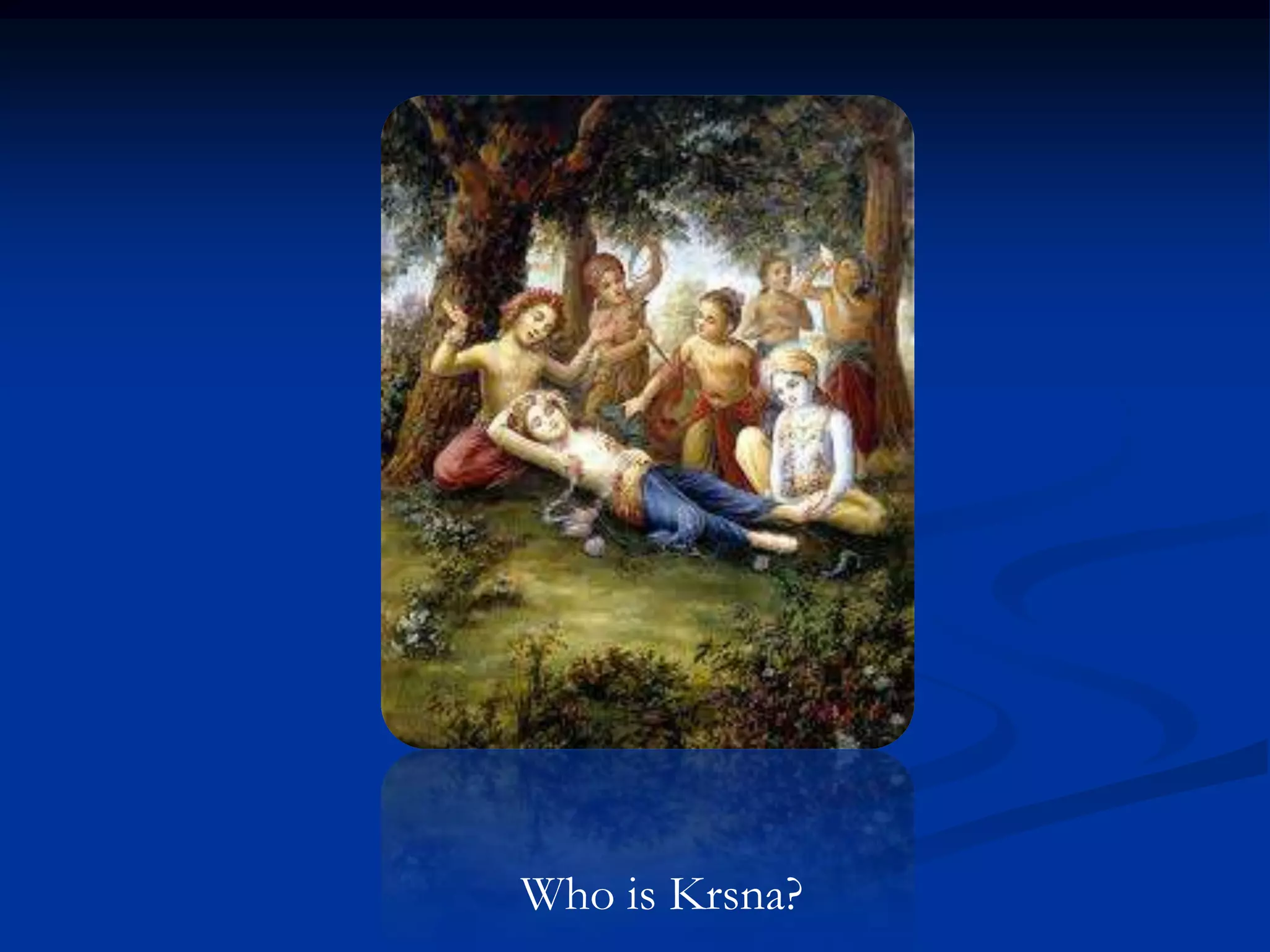
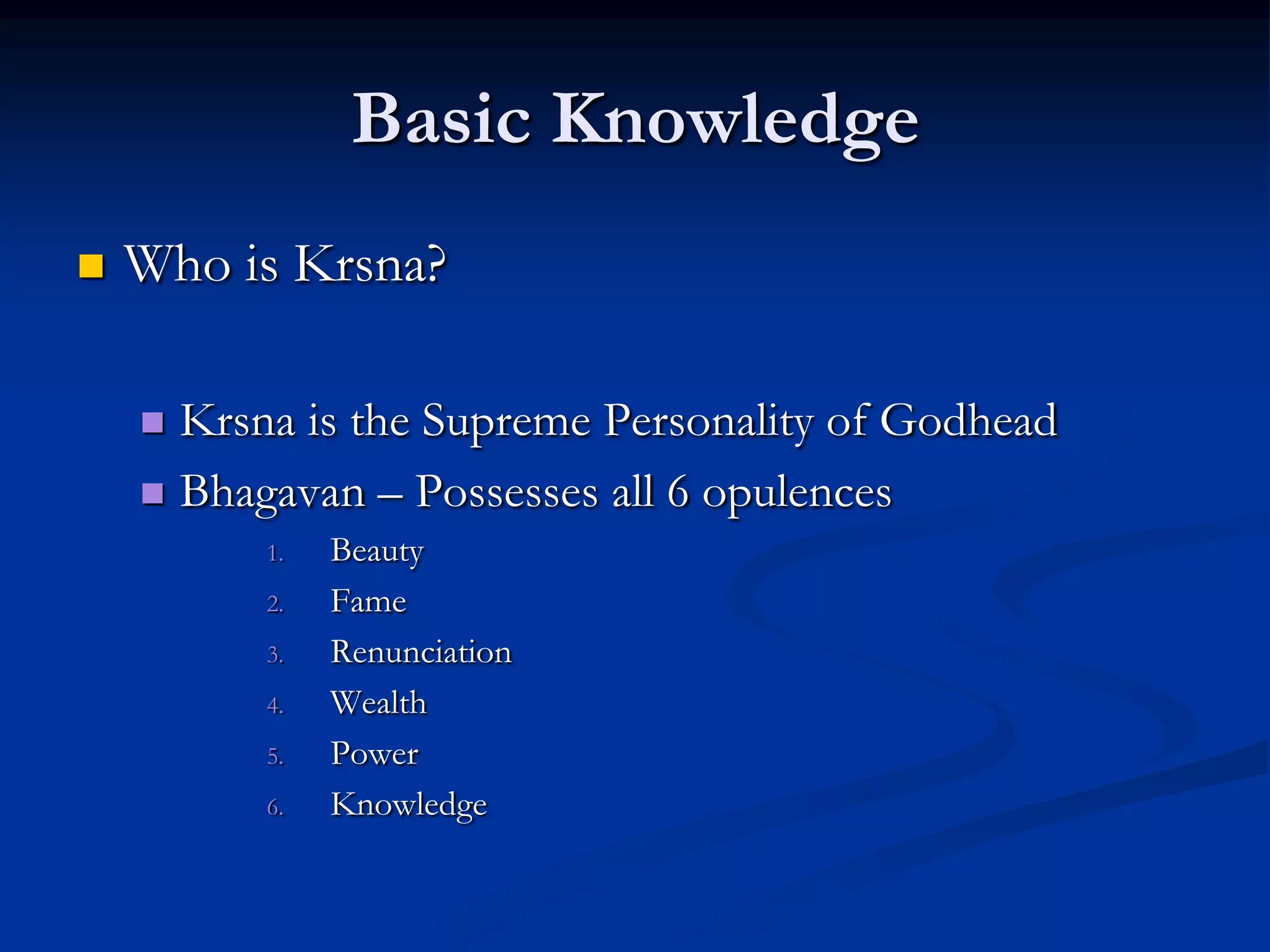
Who is Krsna?
Basic Knowledge


Who is Krsna?
Krsna is the Supreme Personality of Godhead
 Bhagavan – Possesses all 6 opulences


1.
2.
3.
4.
5.
6.

Beauty
Fame
Renunciation
Wealth
Power
Knowledge
Basic Knowledge


Who is Krsna?


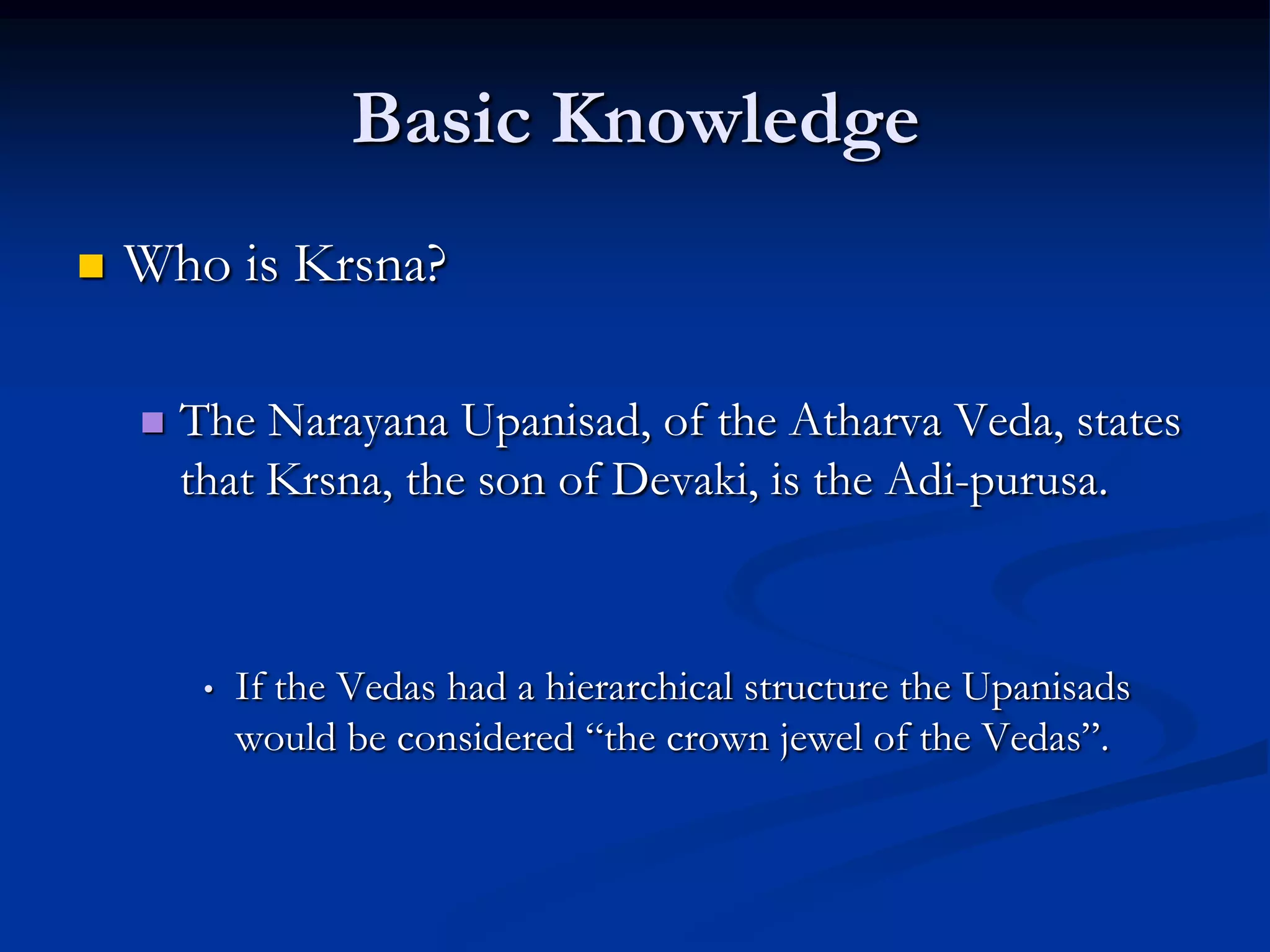
The Narayana Upanisad, of the Atharva Veda, states
that Krsna, the son of Devaki, is the Adi-purusa.

•

If the Vedas had a hierarchical structure the Upanisads
would be considered “the crown jewel of the Vedas”.
Basic Knowledge


Who is Krsna?
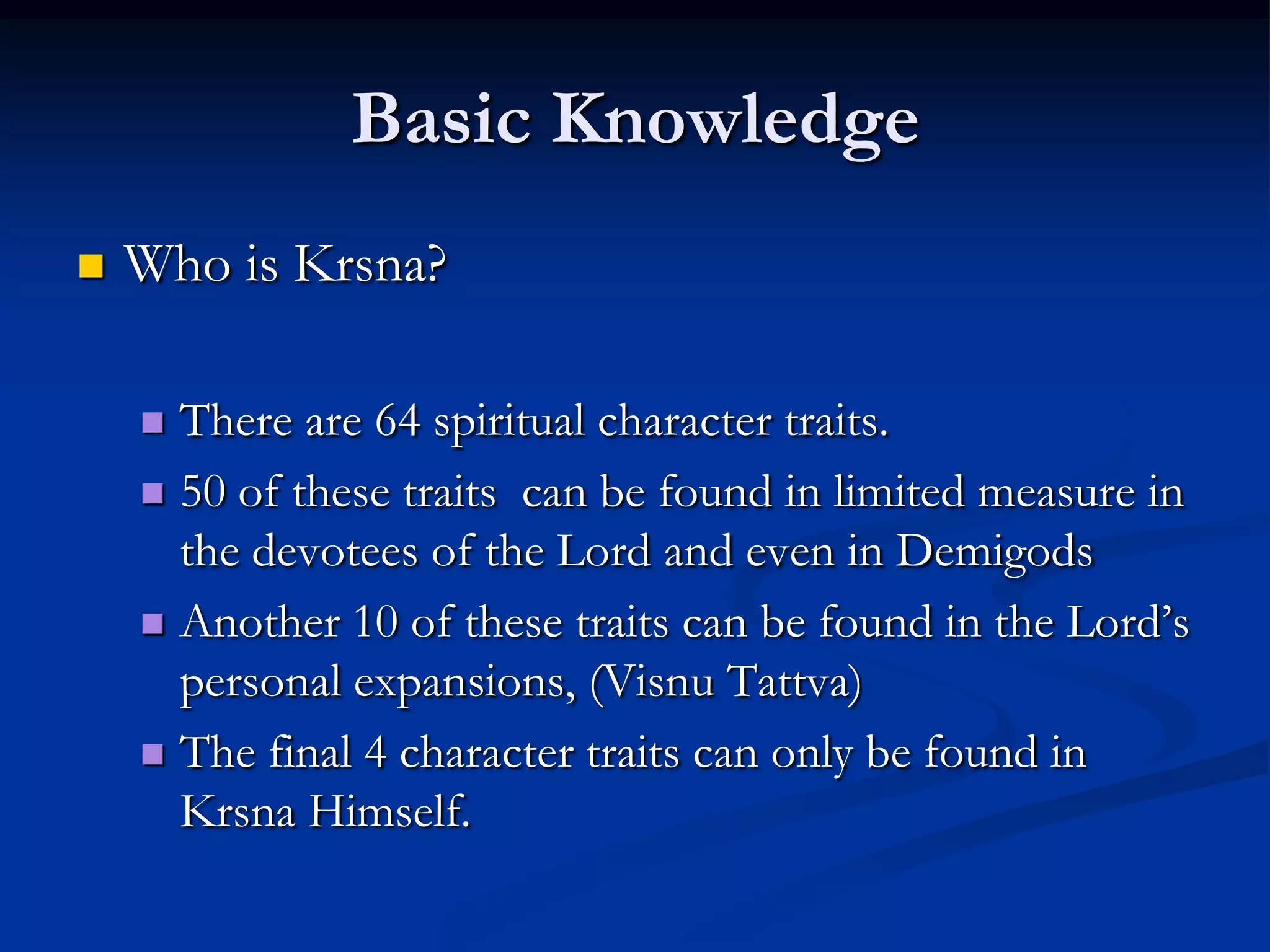
There are 64 spiritual character traits.
 50 of these traits can be found in limited measure in
the devotees of the Lord and even in Demigods
 Another 10 of these traits can be found in the Lord‟s
personal expansions, (Visnu Tattva)
 The final 4 character traits can only be found in
Krsna Himself.

Basic Knowledge


Who is Krsna?


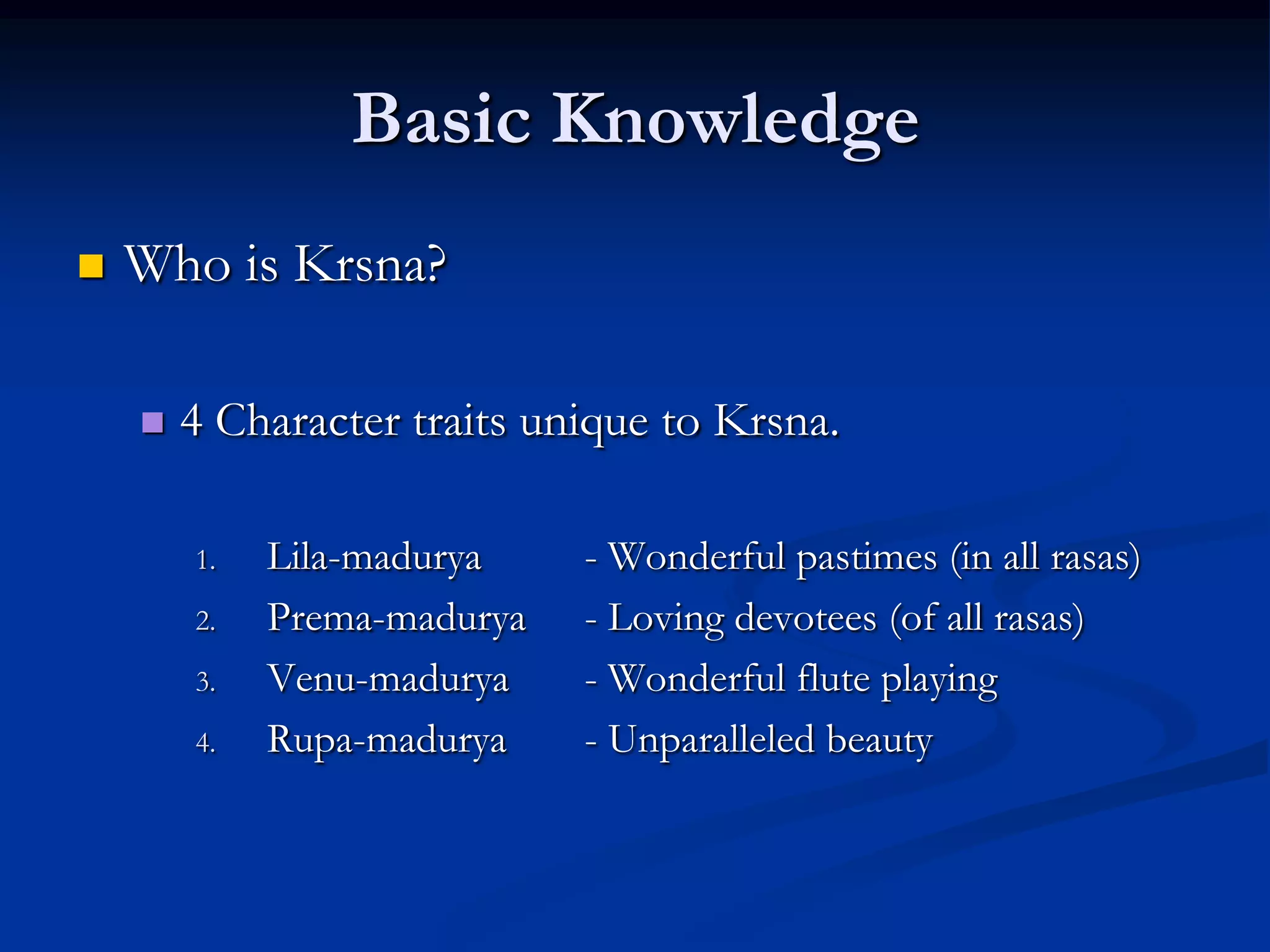
4 Character traits unique to Krsna.
1.
2.
3.
4.

Lila-madurya
Prema-madurya
Venu-madurya
Rupa-madurya

- Wonderful pastimes (in all rasas)
- Loving devotees (of all rasas)
- Wonderful flute playing
- Unparalleled beauty
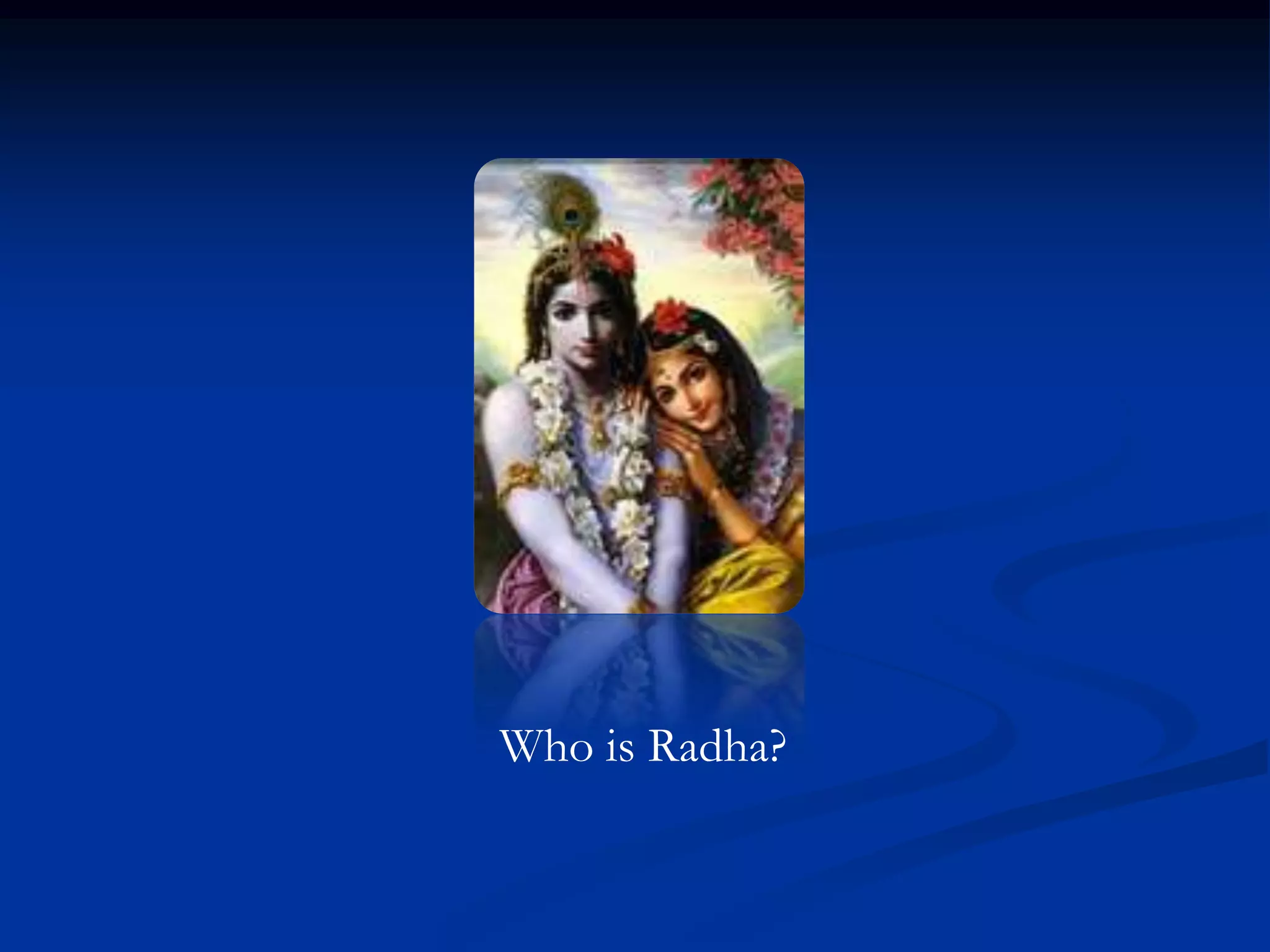
Who is Radha?
Basic Knowledge


Who is Radha?
Hinduism is the only major religion that recognizes
the feminine divinity.
 Radha is the female counterpart of Krsna. Even
though we say “Krsna Prema” it is impossible “to
get” Krsna without Radha.
 You cannot love and serve one without the other.

Basic Knowledge


Who is Srila Prabhupada?
Srila Prabhupada came to the US in 1965 and
founded ISKCON.
 He is a disciple of Srila Bhaktisiddhanta Saraswati
 He is the author of more English language books on
Bhakti Yoga than any other person in the world.

Basic Knowledge


What is the goal of life?
“Jivera svarupa haya / Krsnera nitya dasa”
 Freedom from the 4 basic miseries:


1.
2.
3.

4.

Birth
Old age
Disease
Death
Basic Knowledge


What is the goal of life?
The material body is the source of suffering
 Karma is the cause of our material body
 If we eliminate Karma we can exist in our spiritual
body in a spiritual realm devoid of material miseries.

Basic Knowledge


What is the goal of life?


Krsna is the only person with the ability to eradicate
both our Karma and our material inclination to
produce Karma.
Basic Knowledge


What is the goal of life?


By advancing in Bhakti Yoga from Sraddha to Krsna
Prema we can eradicate our karma and our
inclination to produce it.
Basic Knowledge


What is the goal of life?


Krsna Prema is to have a genuine and realized loving
relationship with Krsna.



By having that genuine relationship Krsna will
deliver us from all our karmic reactions. (BG 18.66)
Basic Knowledge


There are only 2 outcomes of a successful
spiritual practice.


Aham brahma „smi - I exist (Spiritual Realization)



Aham daso „smi

- I serve (Krsna Prema)
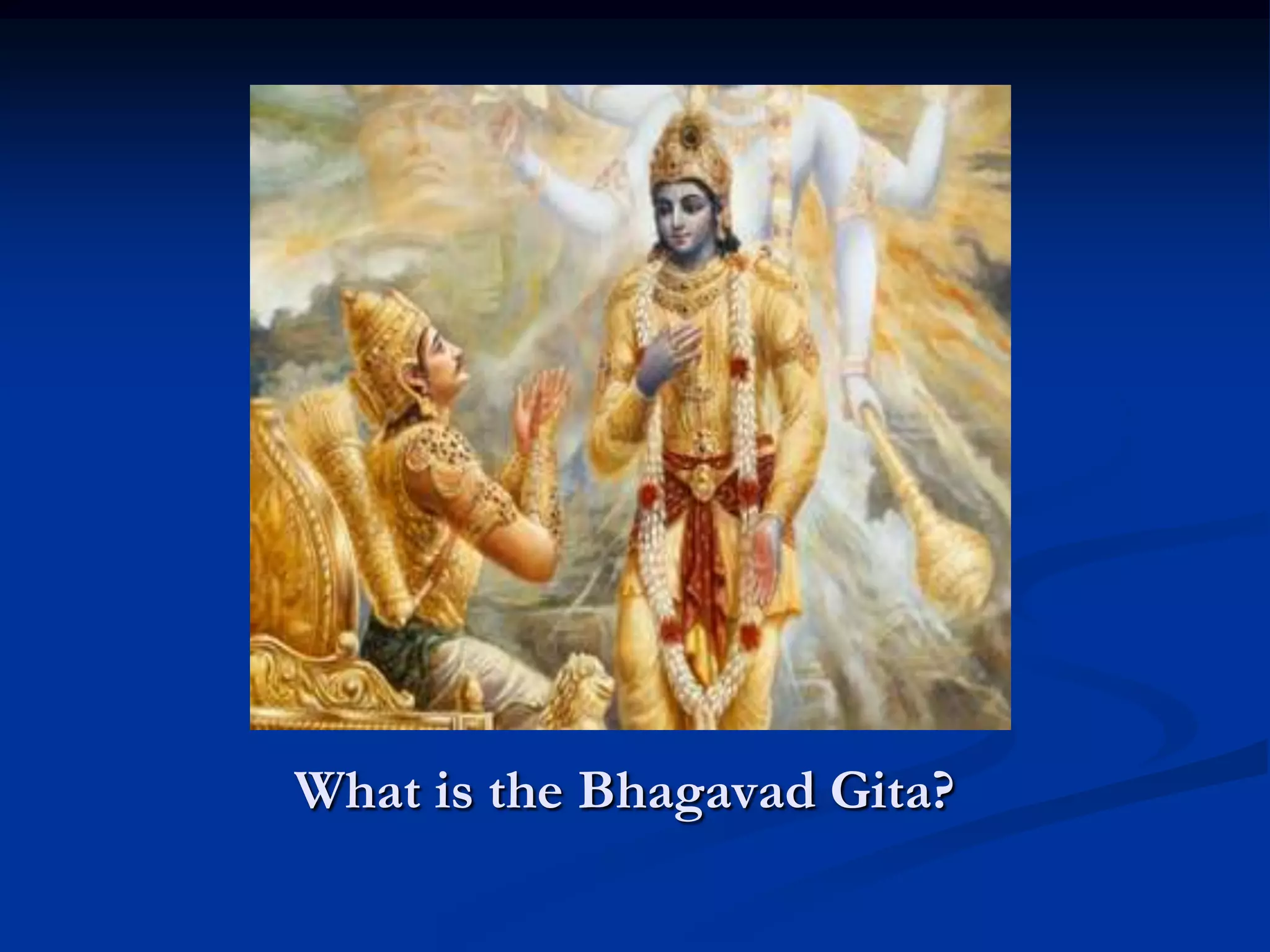
What is the Bhagavad Gita?
Basic Knowledge


What is the Bhagavad Gita?
The “Song of God” is spoken by Krsna to Arjuna
circa 3000 BCE.
 It is part of the Mahabharata , a Purana.
 Puranas are “to be considered the fifth Veda”




Chandogya Up. (one of the oldest Upanisads)
Basic Knowledge


What is the Bhagavad Gita?


The Gita covers 5 topics:
1.
2.
3.
4.
5.

Isvara
Jiva
Prakriti
Kala
Karma

- The Supreme Controller
- The living entities
- Material Nature
- Time
- Activities
Basic Knowledge


What is the Bhagavad Gita?


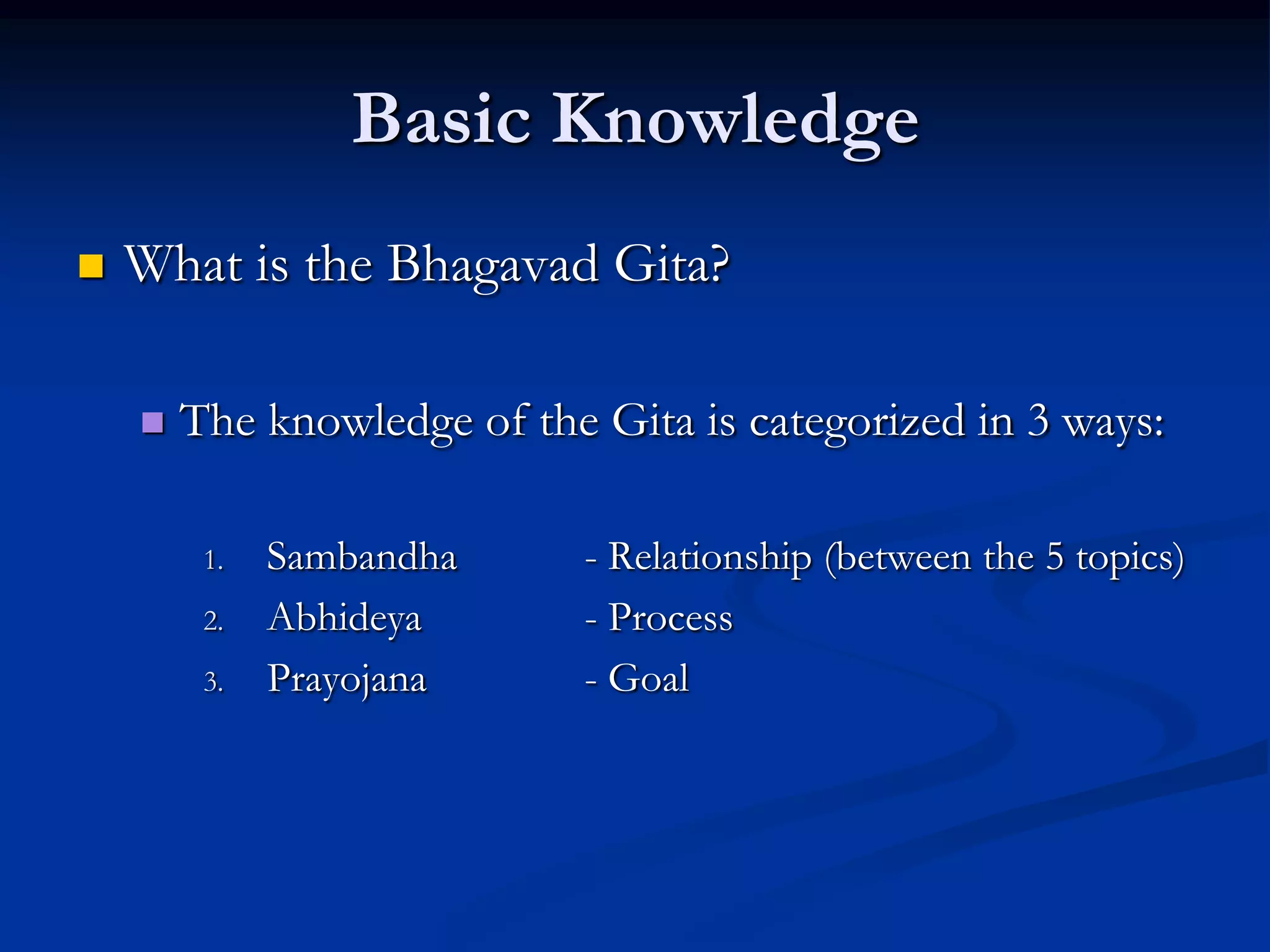
The knowledge of the Gita is categorized in 3 ways:
1.
2.
3.

Sambandha
Abhideya
Prayojana

- Relationship (between the 5 topics)
- Process
- Goal
Basic Knowledge


What is the Bhagavad Gita?


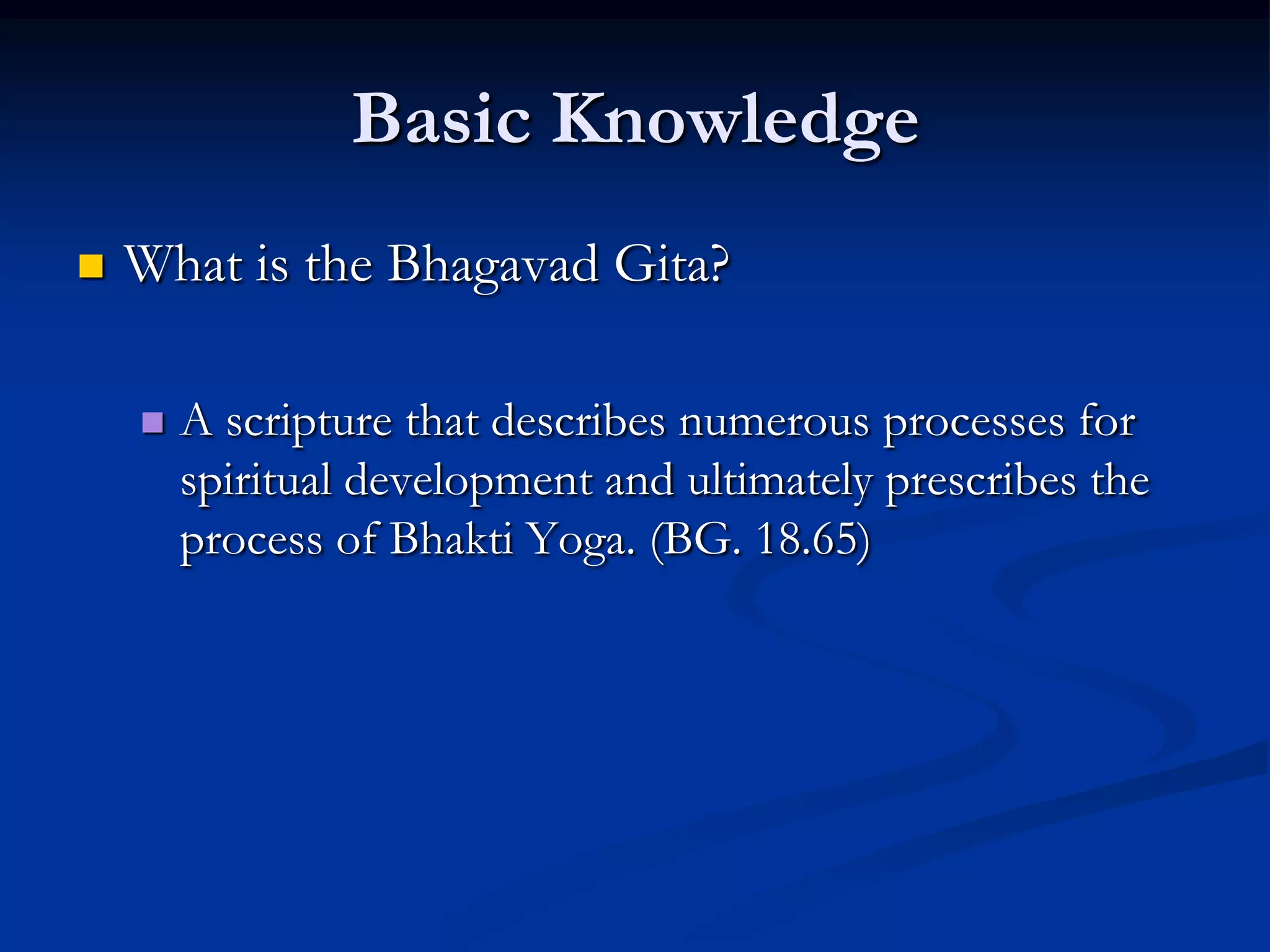
A scripture that describes numerous processes for
spiritual development and ultimately prescribes the
process of Bhakti Yoga. (BG. 18.65)
Basic Knowledge


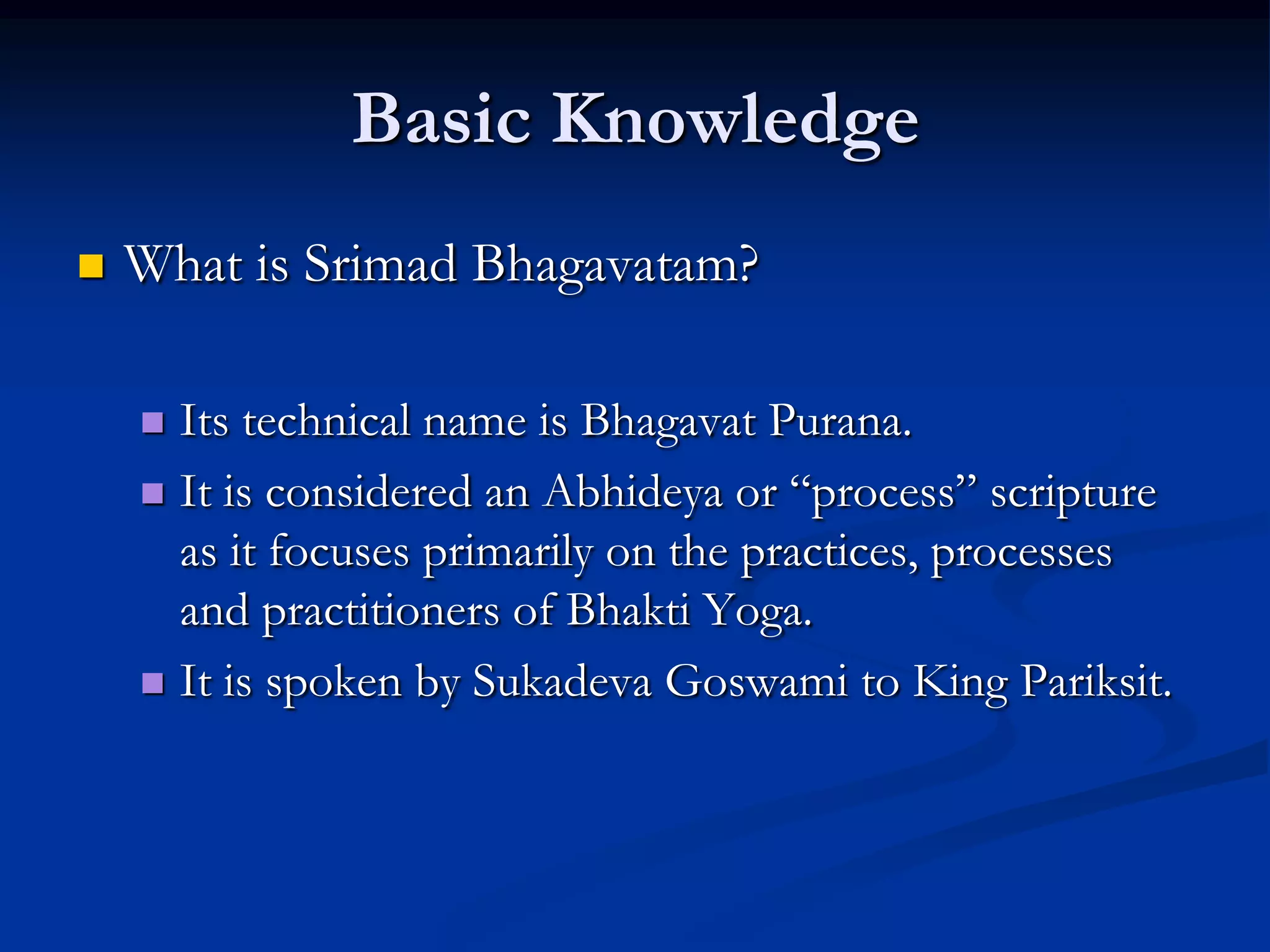
What is Srimad Bhagavatam?
Its technical name is Bhagavat Purana.
 It is considered an Abhideya or “process” scripture
as it focuses primarily on the practices, processes
and practitioners of Bhakti Yoga.
 It is spoken by Sukadeva Goswami to King Pariksit.

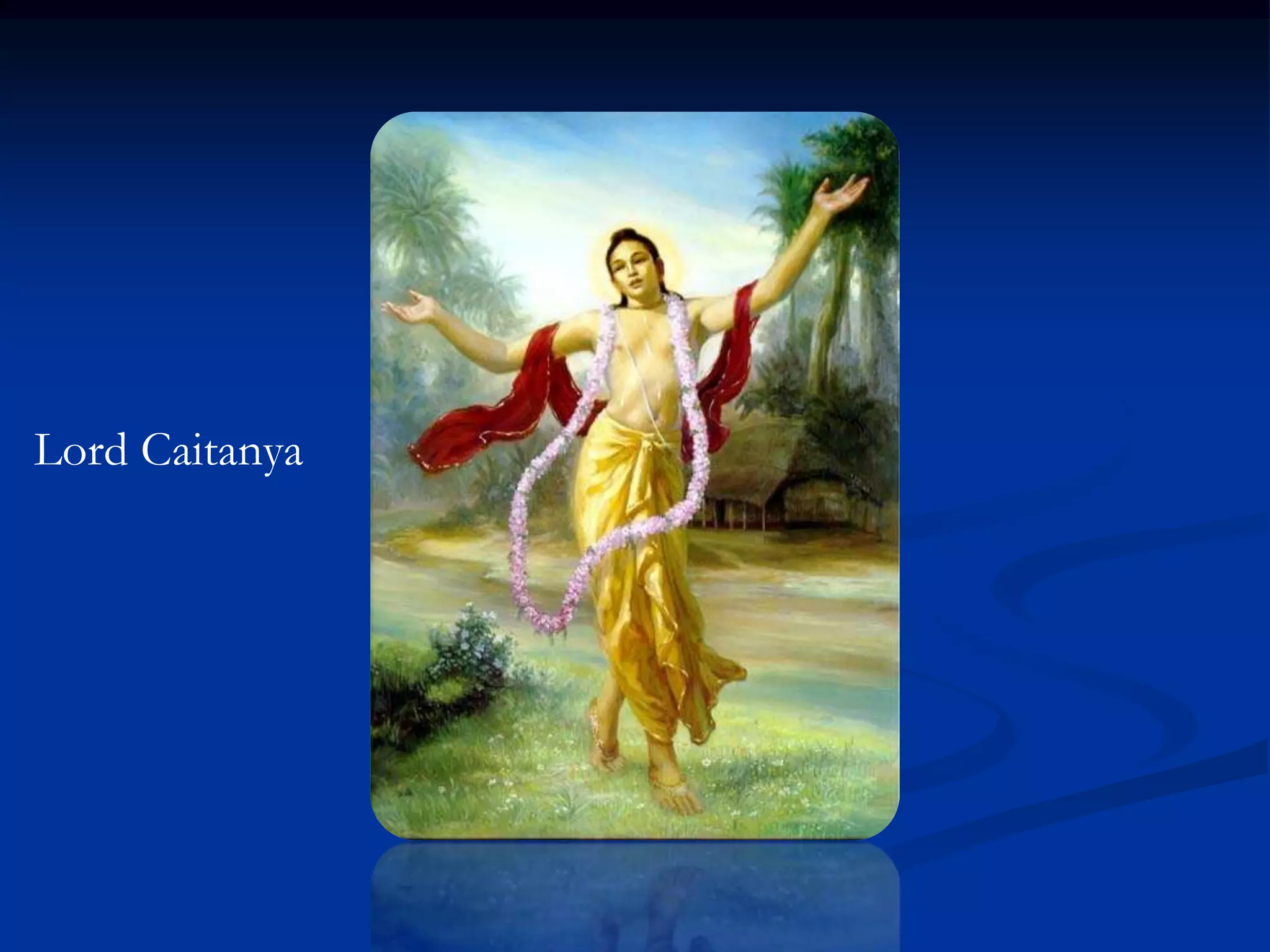
Lord Caitanya
Basic Knowledge


What is Chaitanya Caritamrita?


A devotional and philosophical biography of the
Lord Chaitanya written by Krsna das Kaviraja.



Lord Chaitanya is Krsna, He appeared 500 years ago
in the role of a devotee in order to experience
firsthand the bliss of Bhakti yoga
Basic Knowledge


What is the Nectar of Devotion?
Written by Sri Rupa Goswami it is one of the most
important texts on Bhakti Yoga.
 Its sanskrit name is Bhakti Rasamrita Sindhu




(We will study this book in detail in Levels 6 - 8)
Basic Knowledge


What is Vaisnavism?
Vaisnavism – Worship of Visnu
 Shaivism – Worship of Shiva
 Saktism – Worship of Durga/Kali

Basic Knowledge


What is Vaisnavism?


1.
2.
3.

4.

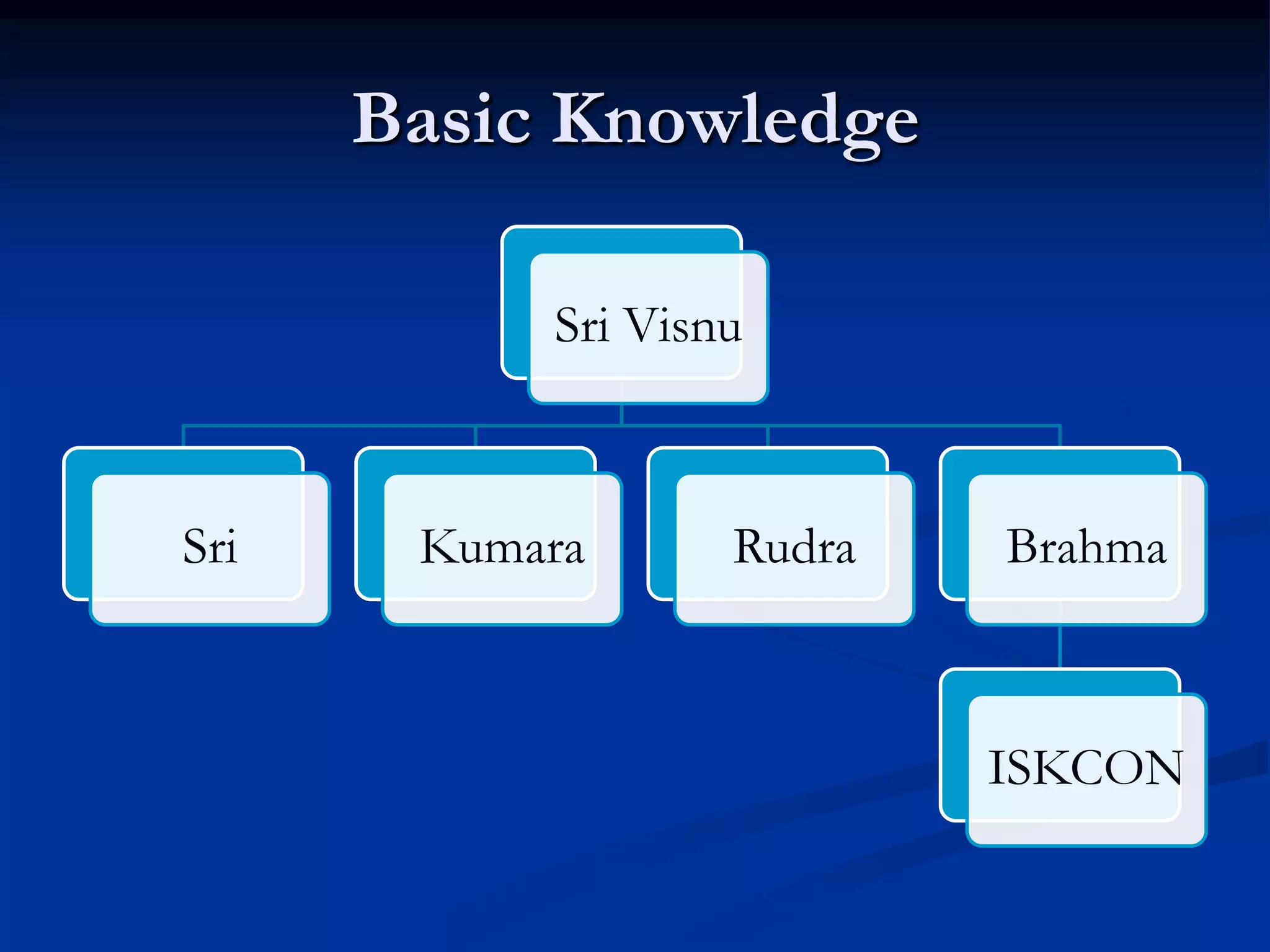
There are 4 Vaisnava Sampradayas (disciplines)

Sri Sampradaya
Kumara Sampradaya
Rudra Sampradaya
Brahma Sampradaya
Basic Knowledge


What is Vaisnavism?


ISKCON comes in the Brahma Sampradaya
which, since Lord Chaitanya, is more technically
known as the:



Brahma Madhva Gaudiya Sampradaya
Basic Knowledge
Sri Visnu

Sri

Kumara

Rudra

Brahma

ISKCON
Basic Knowledge


What is Vaisnavism?
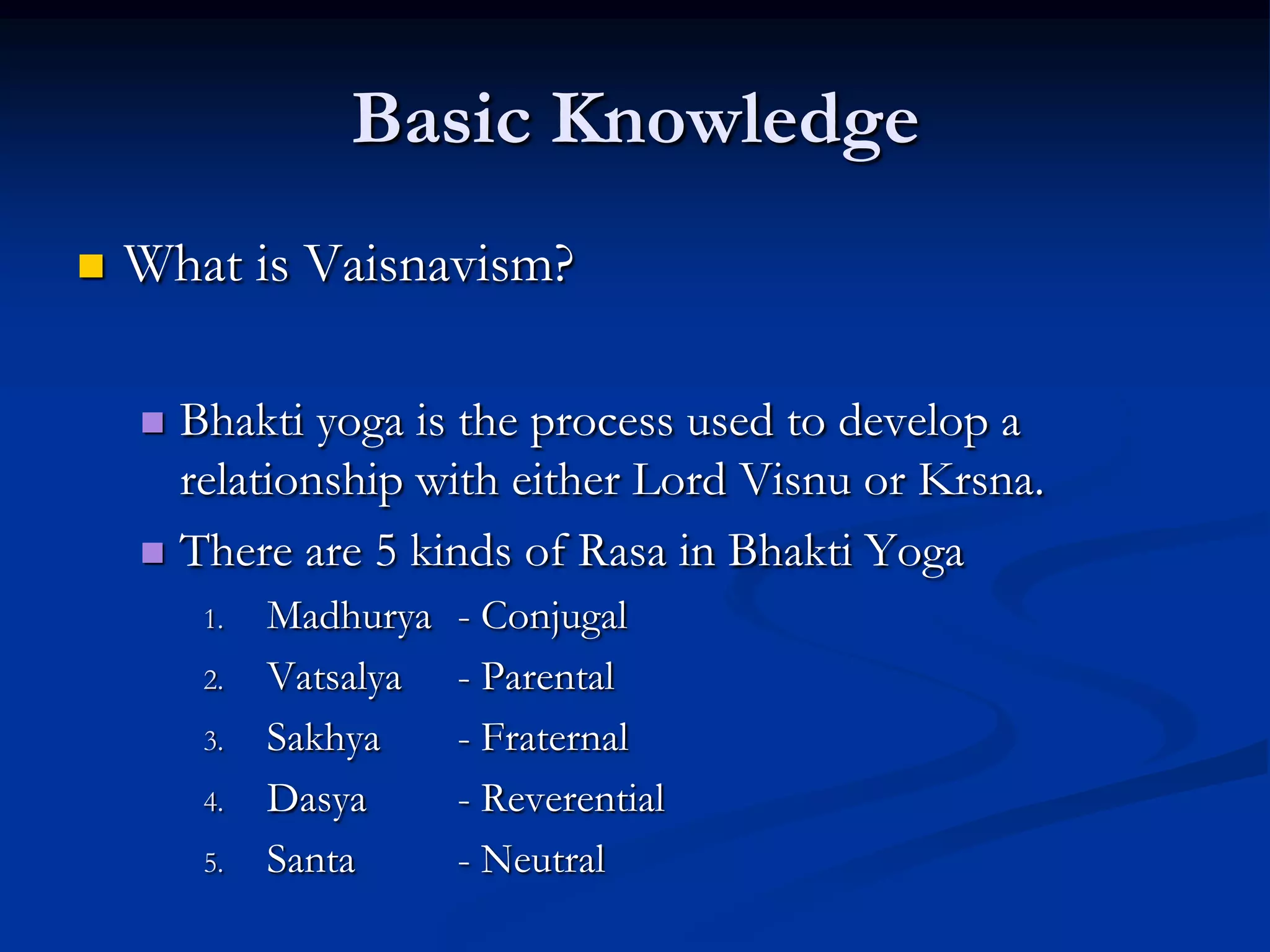
Bhakti yoga is the process used to develop a
relationship with either Lord Visnu or Krsna.
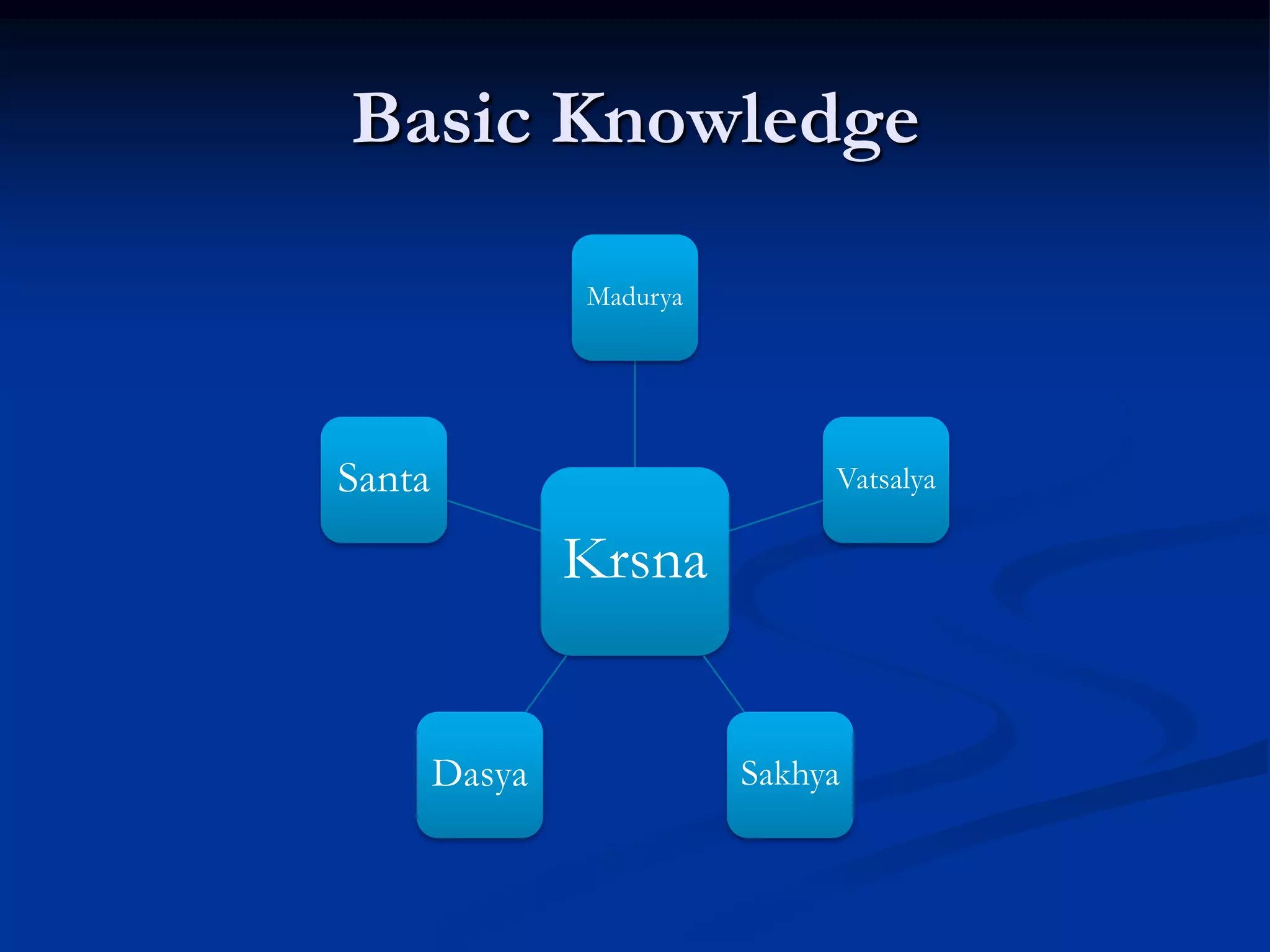
 There are 5 kinds of Rasa in Bhakti Yoga


1.
2.
3.
4.
5.

Madhurya
Vatsalya
Sakhya
Dasya
Santa

- Conjugal
- Parental
- Fraternal
- Reverential
- Neutral
Basic Knowledge
Madurya

Santa

Vatsalya

Krsna

Dasya

Sakhya
Basic Knowledge


What is Vaisnavism?


Vaisnavism is considered to be the most sought after
process as it is the only spiritual process where, out
of love, God allows himself to be subservient to the
devotee.



None of the Visnu expansions, Lord Brahma or
Lord Shiva or any of the 33 million demigods accept
subservient relationships with their devotees.
Basic Knowledge


What is Vaisnavism?
Visnu is Krsna‟s expansion that “manages” the
material creation.
 The difference between worship of Visnu and Krsna


1.

Only with Krsna can the devotee have a “superior” role
in the relationship where He, Krsna, is under the
control of the devotee.
Basic Knowledge


Why Mantra Meditation?
The energy and effects of various types of sound
vibration is well documented.
 Mantras are a unique collection of sanskrit syllables
designed to create a very specific effect.
 Mantras coupled, with Sankalpa (intention), are the
most powerful method of spiritual development in
this age.

Basic Knowledge


The Hare Krsna Mantra


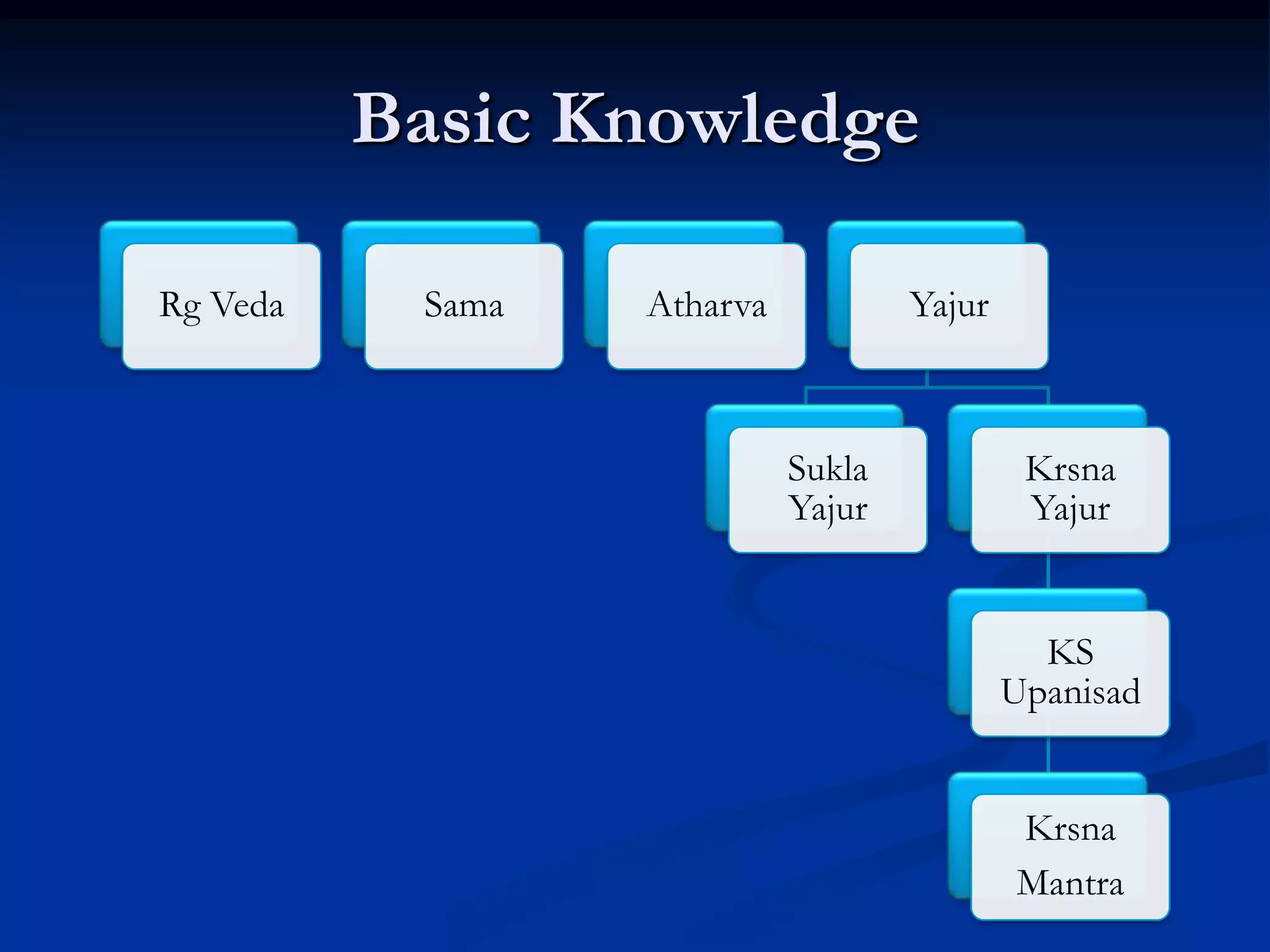
There are 4 Vedas:
1.
2.
3.
4.

Rg Veda
Sama Veda
Atharva Veda
Yajur Veda
Basic Knowledge


The Hare Krsna Mantra


The Yajur Veda, 4th Veda, has two parts (samhitas)
1.
2.

Shukla Yajur Veda
Krsna Yajur Veda
Basic Knowledge


The Hare Krsna Mantra


In The Krsna Yajur Veda is the Kali Santarana
Upanisad where the Hare Krsna Mantra is given.
Basic Knowledge


The Hare Krsna Mantra.

“These sixteen names composed of thirty-two syllables
are the only means of counteracting the evil effects of
Kali-yuga. After searching through all the Vedic
literature, one cannot find a method of religion for this
age so sublime as the chanting of the Hare Krishna
mantra”.
(Kali-Santarana Upanishad, Krsna Yajur Samhita of the Yajur Veda).
Basic Knowledge
Rg Veda

Sama

Atharva

Yajur

Sukla
Yajur

Krsna
Yajur

KS
Upanisad
Krsna
Mantra
Basic Knowledge


Why the bead bag?


We chant Hare Krsna aloud to purify
ourselves, others and the environment.



Initiated Bhakti Yogis cover the beads to prevent
negative energies or influences from effecting their
chanting
How to Chant
Basic Knowledge


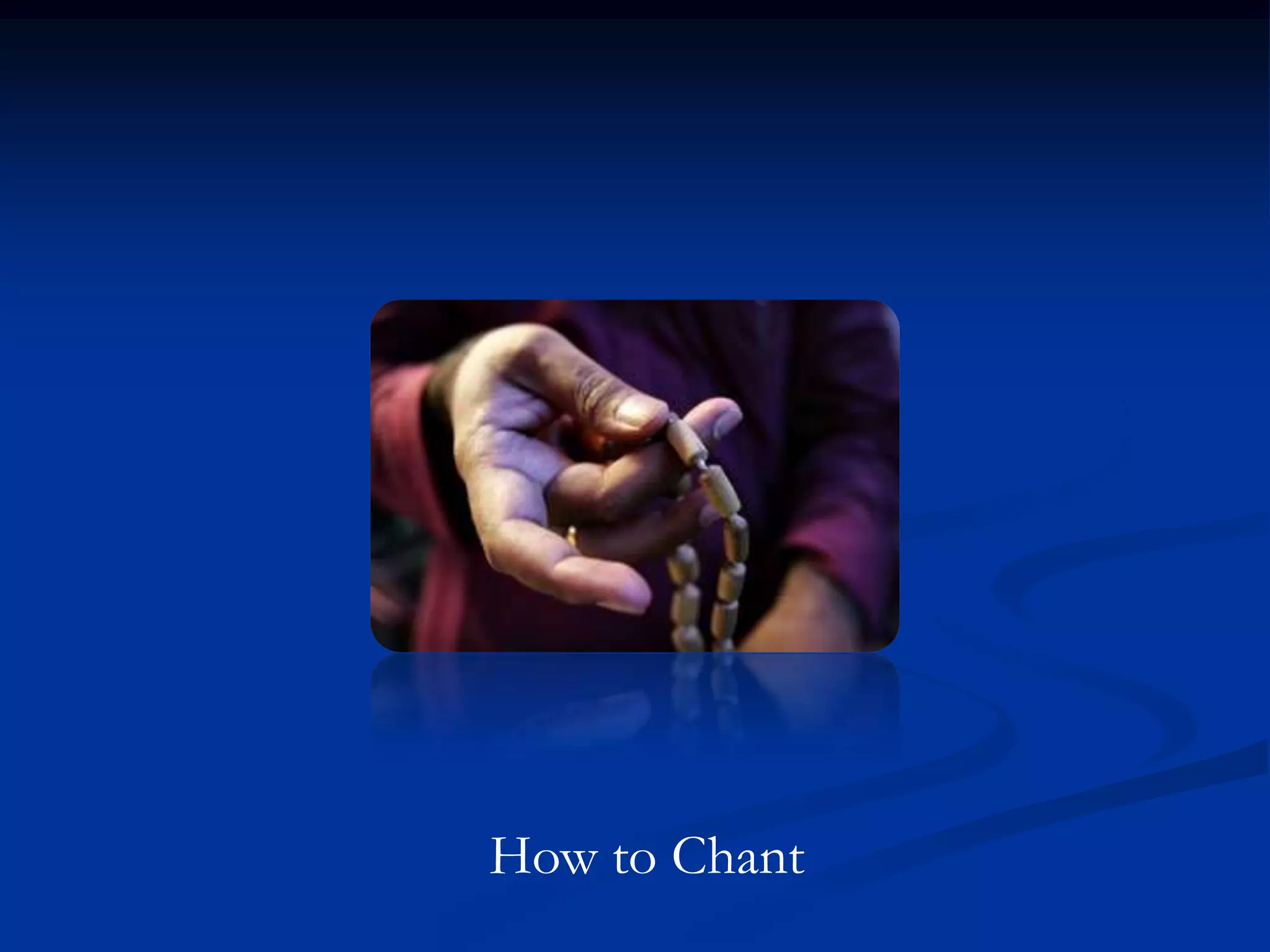
How to Chant
Hold the japa mala (chanting beads) between the
thumb and middle finger of the right hand.
 As you chant the mantra aloud gently roll the beads
between your fingers.
 Chant the mantra on all 108 beads.
 Do not skip over the “Krsna” bead, instead turn the
beads around and “go back the way you came.”

Basic Knowledge


How to Chant
Do not take your beads into the bathroom.
 Do not sit, walk or sleep on your beads.
 Do not lend your beads to others. (Rare exceptions)
 Do not use your bead bag as a pocket.
 Do not kick, throw or play soccer with your beads.

Basic Knowledge


How to Chant


There are 10 offenses we attempt to avoid once we
have begun a chanting sadhana.


Refer to Handout.
Basic Knowledge


Why neck beads?


Neck beads (Kanti mala) are made of Tulsi Devi, a
very dear devotee of Krsna.



Those who wear Kanti mala always have the
protection and attention of Krsna.



They are worn 3x around the neck to signify that our
body, mind and words are in relation to Krsna.
Basic Knowledge


Why “devotional” clothing?


In Vedic spirituality the integrity of the disciplic
succession is of extreme importance. This integrity
of practice prevents:
1.
2.
3.

The proliferation of fraudulent spiritual teachers
The abuse and cheating of sincere seekers
The proliferation of pseudo “religions” and harmful
cults
Basic Knowledge


Why “devotional” clothing?


While our spiritual development is uniquely personal
we worship Krsna by following the instructions
AND examples of those have attained Krsna Prema.



The pure and realized saints of Bhakti Yoga wore
“devotional” clothing during their worship and
instructed their disciples to do the same.
Basic Knowledge


Why Tilak?


The clay of Tilak comes from a place of
pilgrimage, generally Vrndavan or Mathura for
Vaisnavas.



It identifies the wearer as a temple of Vishnu



It is applied with a mantra requesting Vishnu to
reside with us always.
Basic Knowledge


Why Arati?
Arati is an expression of Bhakti
 The articles of worship represent:


1.
2.
3.
4.
5.
6.

Earth
Water
Fire
Air
Ether
Mind

– Flower
– Water/handkerchief
– Lamp
– Peacock fan
– Yak tail fan
– Incense
Basic Knowledge


Why the conch?


The conch represents Sri Laksmi, the consort of
Visnu.



The sound, a representation of Om, is purifying and
heralds the “coming” of an exalted person or event.

Basics of Bhakti Yoga

  • 1.
  • 2.
  • 3.
    Basic Knowledge There are64 Bhakti Yoga practices given in NoD. These 5 are considered the most important. 1. 2. 3. 4. 5. Reading scripture regularly Keep the company of mature devotees Sankirtan Worship the deity Reside in a holy place like Vrndavan/Mathura
  • 4.
  • 5.
    Basic Knowledge  Who isKrsna? Krsna is the Supreme Personality of Godhead  Bhagavan – Possesses all 6 opulences  1. 2. 3. 4. 5. 6. Beauty Fame Renunciation Wealth Power Knowledge
  • 6.
    Basic Knowledge  Who isKrsna?  The Narayana Upanisad, of the Atharva Veda, states that Krsna, the son of Devaki, is the Adi-purusa. • If the Vedas had a hierarchical structure the Upanisads would be considered “the crown jewel of the Vedas”.
  • 7.
    Basic Knowledge  Who isKrsna? There are 64 spiritual character traits.  50 of these traits can be found in limited measure in the devotees of the Lord and even in Demigods  Another 10 of these traits can be found in the Lord‟s personal expansions, (Visnu Tattva)  The final 4 character traits can only be found in Krsna Himself. 
  • 8.
    Basic Knowledge  Who isKrsna?  4 Character traits unique to Krsna. 1. 2. 3. 4. Lila-madurya Prema-madurya Venu-madurya Rupa-madurya - Wonderful pastimes (in all rasas) - Loving devotees (of all rasas) - Wonderful flute playing - Unparalleled beauty
  • 9.
  • 10.
    Basic Knowledge  Who isRadha? Hinduism is the only major religion that recognizes the feminine divinity.  Radha is the female counterpart of Krsna. Even though we say “Krsna Prema” it is impossible “to get” Krsna without Radha.  You cannot love and serve one without the other. 
  • 11.
    Basic Knowledge  Who isSrila Prabhupada? Srila Prabhupada came to the US in 1965 and founded ISKCON.  He is a disciple of Srila Bhaktisiddhanta Saraswati  He is the author of more English language books on Bhakti Yoga than any other person in the world. 
  • 12.
    Basic Knowledge  What isthe goal of life? “Jivera svarupa haya / Krsnera nitya dasa”  Freedom from the 4 basic miseries:  1. 2. 3. 4. Birth Old age Disease Death
  • 13.
    Basic Knowledge  What isthe goal of life? The material body is the source of suffering  Karma is the cause of our material body  If we eliminate Karma we can exist in our spiritual body in a spiritual realm devoid of material miseries. 
  • 14.
    Basic Knowledge  What isthe goal of life?  Krsna is the only person with the ability to eradicate both our Karma and our material inclination to produce Karma.
  • 15.
    Basic Knowledge  What isthe goal of life?  By advancing in Bhakti Yoga from Sraddha to Krsna Prema we can eradicate our karma and our inclination to produce it.
  • 16.
    Basic Knowledge  What isthe goal of life?  Krsna Prema is to have a genuine and realized loving relationship with Krsna.  By having that genuine relationship Krsna will deliver us from all our karmic reactions. (BG 18.66)
  • 17.
    Basic Knowledge  There areonly 2 outcomes of a successful spiritual practice.  Aham brahma „smi - I exist (Spiritual Realization)  Aham daso „smi - I serve (Krsna Prema)
  • 18.
    What is theBhagavad Gita?
  • 19.
    Basic Knowledge  What isthe Bhagavad Gita? The “Song of God” is spoken by Krsna to Arjuna circa 3000 BCE.  It is part of the Mahabharata , a Purana.  Puranas are “to be considered the fifth Veda”   Chandogya Up. (one of the oldest Upanisads)
  • 20.
    Basic Knowledge  What isthe Bhagavad Gita?  The Gita covers 5 topics: 1. 2. 3. 4. 5. Isvara Jiva Prakriti Kala Karma - The Supreme Controller - The living entities - Material Nature - Time - Activities
  • 21.
    Basic Knowledge  What isthe Bhagavad Gita?  The knowledge of the Gita is categorized in 3 ways: 1. 2. 3. Sambandha Abhideya Prayojana - Relationship (between the 5 topics) - Process - Goal
  • 22.
    Basic Knowledge  What isthe Bhagavad Gita?  A scripture that describes numerous processes for spiritual development and ultimately prescribes the process of Bhakti Yoga. (BG. 18.65)
  • 23.
    Basic Knowledge  What isSrimad Bhagavatam? Its technical name is Bhagavat Purana.  It is considered an Abhideya or “process” scripture as it focuses primarily on the practices, processes and practitioners of Bhakti Yoga.  It is spoken by Sukadeva Goswami to King Pariksit. 
  • 24.
  • 25.
    Basic Knowledge  What isChaitanya Caritamrita?  A devotional and philosophical biography of the Lord Chaitanya written by Krsna das Kaviraja.  Lord Chaitanya is Krsna, He appeared 500 years ago in the role of a devotee in order to experience firsthand the bliss of Bhakti yoga
  • 26.
    Basic Knowledge  What isthe Nectar of Devotion? Written by Sri Rupa Goswami it is one of the most important texts on Bhakti Yoga.  Its sanskrit name is Bhakti Rasamrita Sindhu   (We will study this book in detail in Levels 6 - 8)
  • 27.
    Basic Knowledge  What isVaisnavism? Vaisnavism – Worship of Visnu  Shaivism – Worship of Shiva  Saktism – Worship of Durga/Kali 
  • 28.
    Basic Knowledge  What isVaisnavism?  1. 2. 3. 4. There are 4 Vaisnava Sampradayas (disciplines) Sri Sampradaya Kumara Sampradaya Rudra Sampradaya Brahma Sampradaya
  • 29.
    Basic Knowledge  What isVaisnavism?  ISKCON comes in the Brahma Sampradaya which, since Lord Chaitanya, is more technically known as the:  Brahma Madhva Gaudiya Sampradaya
  • 30.
  • 31.
    Basic Knowledge  What isVaisnavism? Bhakti yoga is the process used to develop a relationship with either Lord Visnu or Krsna.  There are 5 kinds of Rasa in Bhakti Yoga  1. 2. 3. 4. 5. Madhurya Vatsalya Sakhya Dasya Santa - Conjugal - Parental - Fraternal - Reverential - Neutral
  • 32.
  • 33.
    Basic Knowledge  What isVaisnavism?  Vaisnavism is considered to be the most sought after process as it is the only spiritual process where, out of love, God allows himself to be subservient to the devotee.  None of the Visnu expansions, Lord Brahma or Lord Shiva or any of the 33 million demigods accept subservient relationships with their devotees.
  • 34.
    Basic Knowledge  What isVaisnavism? Visnu is Krsna‟s expansion that “manages” the material creation.  The difference between worship of Visnu and Krsna  1. Only with Krsna can the devotee have a “superior” role in the relationship where He, Krsna, is under the control of the devotee.
  • 35.
    Basic Knowledge  Why MantraMeditation? The energy and effects of various types of sound vibration is well documented.  Mantras are a unique collection of sanskrit syllables designed to create a very specific effect.  Mantras coupled, with Sankalpa (intention), are the most powerful method of spiritual development in this age. 
  • 36.
    Basic Knowledge  The HareKrsna Mantra  There are 4 Vedas: 1. 2. 3. 4. Rg Veda Sama Veda Atharva Veda Yajur Veda
  • 37.
    Basic Knowledge  The HareKrsna Mantra  The Yajur Veda, 4th Veda, has two parts (samhitas) 1. 2. Shukla Yajur Veda Krsna Yajur Veda
  • 38.
    Basic Knowledge  The HareKrsna Mantra  In The Krsna Yajur Veda is the Kali Santarana Upanisad where the Hare Krsna Mantra is given.
  • 39.
    Basic Knowledge  The HareKrsna Mantra. “These sixteen names composed of thirty-two syllables are the only means of counteracting the evil effects of Kali-yuga. After searching through all the Vedic literature, one cannot find a method of religion for this age so sublime as the chanting of the Hare Krishna mantra”. (Kali-Santarana Upanishad, Krsna Yajur Samhita of the Yajur Veda).
  • 40.
  • 41.
    Basic Knowledge  Why thebead bag?  We chant Hare Krsna aloud to purify ourselves, others and the environment.  Initiated Bhakti Yogis cover the beads to prevent negative energies or influences from effecting their chanting
  • 42.
  • 43.
    Basic Knowledge  How toChant Hold the japa mala (chanting beads) between the thumb and middle finger of the right hand.  As you chant the mantra aloud gently roll the beads between your fingers.  Chant the mantra on all 108 beads.  Do not skip over the “Krsna” bead, instead turn the beads around and “go back the way you came.” 
  • 44.
    Basic Knowledge  How toChant Do not take your beads into the bathroom.  Do not sit, walk or sleep on your beads.  Do not lend your beads to others. (Rare exceptions)  Do not use your bead bag as a pocket.  Do not kick, throw or play soccer with your beads. 
  • 45.
    Basic Knowledge  How toChant  There are 10 offenses we attempt to avoid once we have begun a chanting sadhana.  Refer to Handout.
  • 46.
    Basic Knowledge  Why neckbeads?  Neck beads (Kanti mala) are made of Tulsi Devi, a very dear devotee of Krsna.  Those who wear Kanti mala always have the protection and attention of Krsna.  They are worn 3x around the neck to signify that our body, mind and words are in relation to Krsna.
  • 47.
    Basic Knowledge  Why “devotional”clothing?  In Vedic spirituality the integrity of the disciplic succession is of extreme importance. This integrity of practice prevents: 1. 2. 3. The proliferation of fraudulent spiritual teachers The abuse and cheating of sincere seekers The proliferation of pseudo “religions” and harmful cults
  • 48.
    Basic Knowledge  Why “devotional”clothing?  While our spiritual development is uniquely personal we worship Krsna by following the instructions AND examples of those have attained Krsna Prema.  The pure and realized saints of Bhakti Yoga wore “devotional” clothing during their worship and instructed their disciples to do the same.
  • 49.
    Basic Knowledge  Why Tilak?  Theclay of Tilak comes from a place of pilgrimage, generally Vrndavan or Mathura for Vaisnavas.  It identifies the wearer as a temple of Vishnu  It is applied with a mantra requesting Vishnu to reside with us always.
  • 50.
    Basic Knowledge  Why Arati? Aratiis an expression of Bhakti  The articles of worship represent:  1. 2. 3. 4. 5. 6. Earth Water Fire Air Ether Mind – Flower – Water/handkerchief – Lamp – Peacock fan – Yak tail fan – Incense
  • 51.
    Basic Knowledge  Why theconch?  The conch represents Sri Laksmi, the consort of Visnu.  The sound, a representation of Om, is purifying and heralds the “coming” of an exalted person or event.