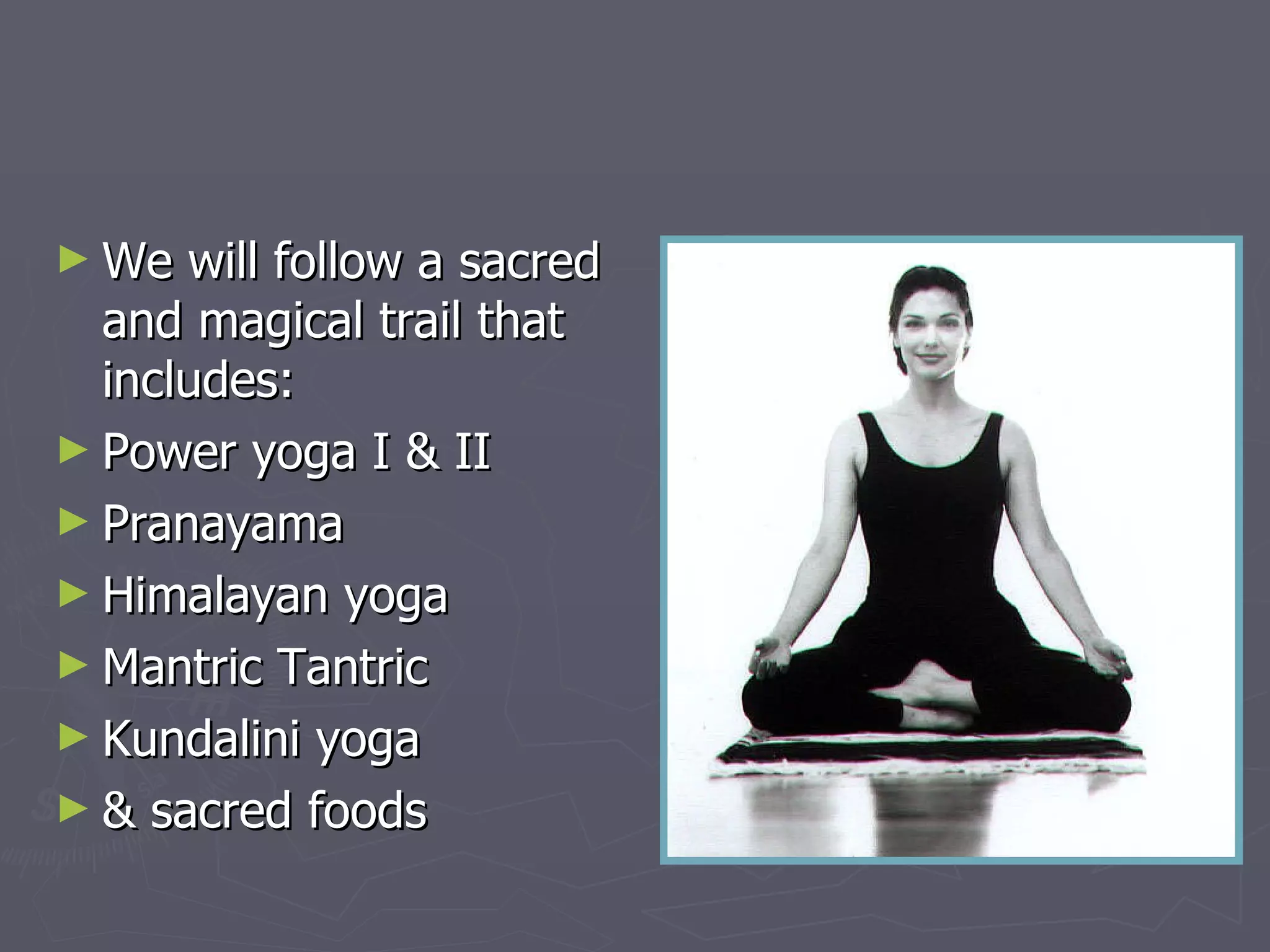
We will follow a sacred and magical trail that includes: Power yoga I & II Pranayama Himalayan yoga Mantric Tantric Kundalini yoga & sacred foods
The healing power of stress: transforming stress into sadhana
We begin by embracing: STRESS  FEAR EGOISM Can these three negatives be turned into positives? During our time together we will explore how Atma Yoga can turn each of these around.  Making them not only positives but powerful tools for self transformation.
The healing power of stress Attention is key to healing Rebuild your base Yoga, Weight, Breath, Bhastrika, 3-hold breath, Internal dialogue, fear hunting, desire churning, sound vibrating… Make the mind a friend Feel sound vibration Pursue your enemies The ROLE of confidence Head in to the battle
Internal dialog is deconstructing the human experience – so we can regain our spiritual nature. “ It is not enough to understand that you are not your body; you must also understand that you are not this mind.” One who restrains the senses of action but whose mind dwells on sense objects certainly deludes himself and is called a pretender. If we are still governed by sense gratification and unable to regulate our behavior at will then we have not understood that we are not this body or this mind.”
8 Steps to understand & heal the mind Establish the awareness of the mind as an “other” Initiate friendly relations Practice listening to the mind’s issues (daily basis) Ask to meet the other members of the mind Learn about the needs & concerns  of all parts of the mind and develop a cooperative relationship Present the goals of your training program.  Your ideas for spiritual progress to your mind, listen to objections and concerns and try to gain mutual agreement.  Introduce the concept of a spiritual coach or guide(s) (multiple forms are possible: teacher, acarya, deity, mantra) Practice techniques & activities to build a relationship with a spiritual guide
What is the hidden truth of yoga?
Secretive by nature Yoga in its truest, fullest form is, and always has been, a secret tradition… The truth is that there are qualities about the effects of the practices themselves that will always keep them hidden. Kavindra
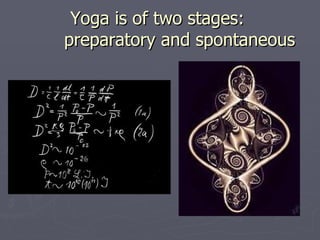
Yoga is of two stages:  preparatory and spontaneous
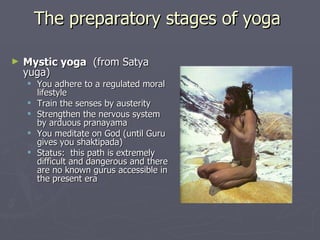
The preparatory stages of yoga  Mystic yoga   (from Satya yuga) You adhere to a regulated moral lifestyle Train the senses by austerity Strengthen the nervous system by arduous pranayama You meditate on God (until Guru gives you shaktipada) Status:  this path is extremely difficult and dangerous and there are no known gurus accessible in the present era
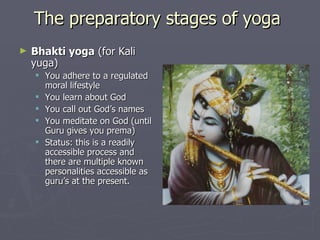
The preparatory stages of yoga  Bhakti yoga  (for Kali yuga) You adhere to a regulated moral lifestyle You learn about God You call out God’s names You meditate on God (until Guru gives you prema) Status: this is a readily accessible process and there are multiple known personalities accessible as guru’s at the present.
The beginning phase of Yoga can be broken down into three distinct stages: The first two are: 1) Prana prabalaya (strengthening of prana) 2) Nadi shodhana (purification of the nadis: restoring the nervous system )
Yoga Systems, cont’d Preparation training the senses = disciplined life style: No animal killing, no intoxication, no sex  No lying, cheating, stealing… Lots of selfless service Strengthing (purifying) the nervous system: Pranayama Controlled diet Imitating certain asanas & mudras Serving the guru Menial service with love Studying at the guru’s feet
Yoga Systems, cont’d Spontaneity: Prana is the key When it is released from the yogi’s willfull control by the Guru ( prannothana ) Shastra describes the consequences of spontaneous yoga (extremely dangerous) The goal of all yoga is freeing your kundalini  Kundalini = consciousness Ultimate consciousness = the mood of Radharani Prana in mystic yoga Bhagavan in bhakti yoga Prana = Bhagavan
Yoga: one with many forms “ The process of linking oneself with the Supreme is called yoga. It may be compared to a ladder for attaining the topmost spiritual realization.  This ladder begins from the lowest material condition of the living entity and rises up to perfect self-realization in pure spiritual life.  According to various elevations, different parts of the ladder are known by different names.  But all in all, the complete ladder is called yoga and may be divided into three parts, namely jïäna-yoga, dhyäna-yoga and bhakti-yoga.  The beginning of the ladder is called the yogärurukñu stage, and the highest rung is called yogärüòha.”  -acbsp
Misinformed  (consensus gentium) Contemporary yoga is approximately 2000 years old  Hatha yoga pradipika (500 years) Yoga Rahasya (1000 years) Gherad samhita  (1000 – 1500 years) Yoga Sutra of Patanjal (1700 – 1800 years)
Why Misunderstanding about human antiquity Influence of selfishness in this age Tendency to use religion or spirituality to exploit Tendency to seek out shortcuts Loss of authentic oral traditions leads to dependency on the senses Short lived and fearful modern humans are easily mislead about the nature of reality
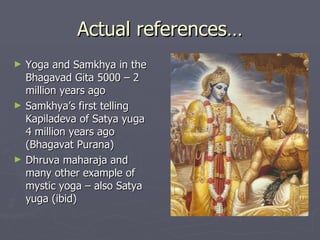
Actual references… Yoga and Samkhya in the Bhagavad Gita 5000 – 2 million years ago Samkhya’s first telling Kapiladeva of Satya yuga  4 million years ago (Bhagavat Purana) Dhruva maharaja and many other example of mystic yoga – also Satya yuga (ibid)
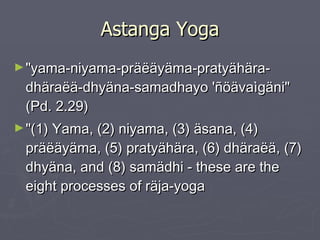
Astanga Yoga "yama-niyama-präëäyäma-pratyähära-dhäraëä-dhyäna-samadhayo 'ñöävaìgäni" (Pd. 2.29) "(1) Yama, (2) niyama, (3) äsana, (4) präëäyäma, (5) pratyähära, (6) dhäraëä, (7) dhyäna, and (8) samädhi - these are the eight processes of räja-yoga
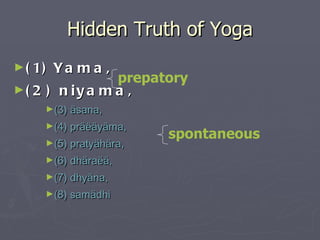
Hidden Truth of Yoga (1)   Yama,  (2) niyama,   (3) äsana,  (4) präëäyäma,  (5) pratyähära,  (6) dhäraëä,  (7) dhyäna,  (8) samädhi  prepatory spontaneous
Yama [things you control or destroy] ahiàsä-satyästeya-brahmacaryäparigrahä yamäù (Pd. 2.30) ahiàsä, nonviolence;  satya, truthfulness;  asteya, refraining from theft;  brahmacarya, celibacy & channeling desires  aparigraha, freedom from possessiveness -
Niyama [things you do NOT prevent or cultivate]  çauca-santoña-tapaù-svädhyäyeçvara-praëidhänäni niyamäù (Pd. 2.32) çauca, cleanliness;  santoña, satisfaction;  tapa, austerity;  svädhyäya, Vedic study; and  içvara-praëidhäna, surrender to the influence of the Supreme
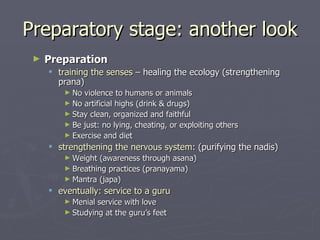
Preparatory stage: another look Preparation training the senses  – healing the ecology (strengthening prana) No violence to humans or animals  No artificial highs (drink & drugs) Stay clean, organized and faithful Be just: no lying, cheating, or exploiting others Exercise and diet strengthening the nervous system :  (purifying the nadis) Weight (awareness through asana) Breathing practices (pranayama) Mantra (japa) eventually: service to a guru Menial service with love Studying at the guru’s feet
Fear…
Rules of the game “ the only way to get smarter is by playing a smarter opponent…”
Rules of the game Your worst enemy will always hide in the last place you will ever look…”
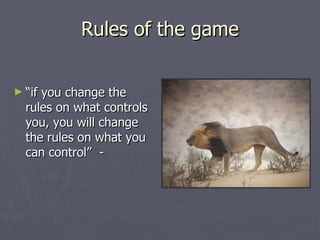
Rules of the game “ if you change the rules on what controls you, you will change the rules on what you can control”  -
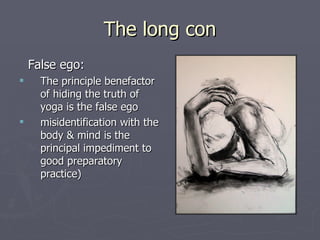
The long con False ego: The principle benefactor of hiding the truth of yoga is the false ego misidentification with the body & mind is the principal impediment to good preparatory  practice)
Yoga of confrontation The yoga of confidence is also the yoga of confrontation. The key to this yoga is ones relationship to pain. Of pain imagined pain is more powerful than experienced pain.
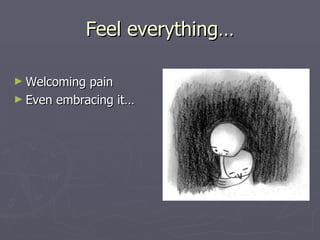
Feel everything… Welcoming pain Even embracing it…
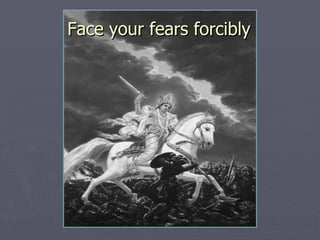
Face your fears forcibly
Sat-chit-ananda As the ego recedes, your true qualities begin to emerge: Confidence Wisdom Intoxicating happiness
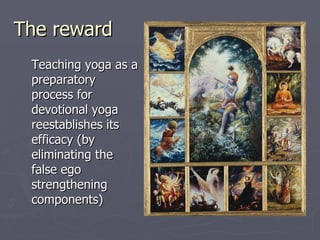
The reward Teaching yoga as a preparatory  process for devotional yoga reestablishes its efficacy (by eliminating the false ego strengthening components)

Stress into Strength Module for yoga teacher training

  • 1.
    We will followa sacred and magical trail that includes: Power yoga I & II Pranayama Himalayan yoga Mantric Tantric Kundalini yoga & sacred foods
  • 2.
    The healing powerof stress: transforming stress into sadhana
  • 3.
    We begin byembracing: STRESS FEAR EGOISM Can these three negatives be turned into positives? During our time together we will explore how Atma Yoga can turn each of these around. Making them not only positives but powerful tools for self transformation.
  • 4.
    The healing powerof stress Attention is key to healing Rebuild your base Yoga, Weight, Breath, Bhastrika, 3-hold breath, Internal dialogue, fear hunting, desire churning, sound vibrating… Make the mind a friend Feel sound vibration Pursue your enemies The ROLE of confidence Head in to the battle
  • 5.
    Internal dialog isdeconstructing the human experience – so we can regain our spiritual nature. “ It is not enough to understand that you are not your body; you must also understand that you are not this mind.” One who restrains the senses of action but whose mind dwells on sense objects certainly deludes himself and is called a pretender. If we are still governed by sense gratification and unable to regulate our behavior at will then we have not understood that we are not this body or this mind.”
  • 6.
    8 Steps tounderstand & heal the mind Establish the awareness of the mind as an “other” Initiate friendly relations Practice listening to the mind’s issues (daily basis) Ask to meet the other members of the mind Learn about the needs & concerns of all parts of the mind and develop a cooperative relationship Present the goals of your training program. Your ideas for spiritual progress to your mind, listen to objections and concerns and try to gain mutual agreement. Introduce the concept of a spiritual coach or guide(s) (multiple forms are possible: teacher, acarya, deity, mantra) Practice techniques & activities to build a relationship with a spiritual guide
  • 7.
    What is thehidden truth of yoga?
  • 8.
    Secretive by natureYoga in its truest, fullest form is, and always has been, a secret tradition… The truth is that there are qualities about the effects of the practices themselves that will always keep them hidden. Kavindra
  • 9.
    Yoga is oftwo stages: preparatory and spontaneous
  • 10.
    The preparatory stagesof yoga Mystic yoga (from Satya yuga) You adhere to a regulated moral lifestyle Train the senses by austerity Strengthen the nervous system by arduous pranayama You meditate on God (until Guru gives you shaktipada) Status: this path is extremely difficult and dangerous and there are no known gurus accessible in the present era
  • 11.
    The preparatory stagesof yoga Bhakti yoga (for Kali yuga) You adhere to a regulated moral lifestyle You learn about God You call out God’s names You meditate on God (until Guru gives you prema) Status: this is a readily accessible process and there are multiple known personalities accessible as guru’s at the present.
  • 12.
    The beginning phaseof Yoga can be broken down into three distinct stages: The first two are: 1) Prana prabalaya (strengthening of prana) 2) Nadi shodhana (purification of the nadis: restoring the nervous system )
  • 13.
    Yoga Systems, cont’dPreparation training the senses = disciplined life style: No animal killing, no intoxication, no sex No lying, cheating, stealing… Lots of selfless service Strengthing (purifying) the nervous system: Pranayama Controlled diet Imitating certain asanas & mudras Serving the guru Menial service with love Studying at the guru’s feet
  • 14.
    Yoga Systems, cont’dSpontaneity: Prana is the key When it is released from the yogi’s willfull control by the Guru ( prannothana ) Shastra describes the consequences of spontaneous yoga (extremely dangerous) The goal of all yoga is freeing your kundalini Kundalini = consciousness Ultimate consciousness = the mood of Radharani Prana in mystic yoga Bhagavan in bhakti yoga Prana = Bhagavan
  • 15.
    Yoga: one withmany forms “ The process of linking oneself with the Supreme is called yoga. It may be compared to a ladder for attaining the topmost spiritual realization. This ladder begins from the lowest material condition of the living entity and rises up to perfect self-realization in pure spiritual life. According to various elevations, different parts of the ladder are known by different names. But all in all, the complete ladder is called yoga and may be divided into three parts, namely jïäna-yoga, dhyäna-yoga and bhakti-yoga. The beginning of the ladder is called the yogärurukñu stage, and the highest rung is called yogärüòha.” -acbsp
  • 16.
    Misinformed (consensusgentium) Contemporary yoga is approximately 2000 years old Hatha yoga pradipika (500 years) Yoga Rahasya (1000 years) Gherad samhita (1000 – 1500 years) Yoga Sutra of Patanjal (1700 – 1800 years)
  • 17.
    Why Misunderstanding abouthuman antiquity Influence of selfishness in this age Tendency to use religion or spirituality to exploit Tendency to seek out shortcuts Loss of authentic oral traditions leads to dependency on the senses Short lived and fearful modern humans are easily mislead about the nature of reality
  • 18.
    Actual references… Yogaand Samkhya in the Bhagavad Gita 5000 – 2 million years ago Samkhya’s first telling Kapiladeva of Satya yuga 4 million years ago (Bhagavat Purana) Dhruva maharaja and many other example of mystic yoga – also Satya yuga (ibid)
  • 19.
    Astanga Yoga "yama-niyama-präëäyäma-pratyähära-dhäraëä-dhyäna-samadhayo'ñöävaìgäni" (Pd. 2.29) "(1) Yama, (2) niyama, (3) äsana, (4) präëäyäma, (5) pratyähära, (6) dhäraëä, (7) dhyäna, and (8) samädhi - these are the eight processes of räja-yoga
  • 20.
    Hidden Truth ofYoga (1) Yama, (2) niyama, (3) äsana, (4) präëäyäma, (5) pratyähära, (6) dhäraëä, (7) dhyäna, (8) samädhi prepatory spontaneous
  • 21.
    Yama [things youcontrol or destroy] ahiàsä-satyästeya-brahmacaryäparigrahä yamäù (Pd. 2.30) ahiàsä, nonviolence; satya, truthfulness; asteya, refraining from theft; brahmacarya, celibacy & channeling desires aparigraha, freedom from possessiveness -
  • 22.
    Niyama [things youdo NOT prevent or cultivate] çauca-santoña-tapaù-svädhyäyeçvara-praëidhänäni niyamäù (Pd. 2.32) çauca, cleanliness; santoña, satisfaction; tapa, austerity; svädhyäya, Vedic study; and içvara-praëidhäna, surrender to the influence of the Supreme
  • 23.
    Preparatory stage: anotherlook Preparation training the senses – healing the ecology (strengthening prana) No violence to humans or animals No artificial highs (drink & drugs) Stay clean, organized and faithful Be just: no lying, cheating, or exploiting others Exercise and diet strengthening the nervous system : (purifying the nadis) Weight (awareness through asana) Breathing practices (pranayama) Mantra (japa) eventually: service to a guru Menial service with love Studying at the guru’s feet
  • 24.
  • 25.
    Rules of thegame “ the only way to get smarter is by playing a smarter opponent…”
  • 26.
    Rules of thegame Your worst enemy will always hide in the last place you will ever look…”
  • 27.
    Rules of thegame “ if you change the rules on what controls you, you will change the rules on what you can control” -
  • 28.
    The long conFalse ego: The principle benefactor of hiding the truth of yoga is the false ego misidentification with the body & mind is the principal impediment to good preparatory practice)
  • 29.
    Yoga of confrontationThe yoga of confidence is also the yoga of confrontation. The key to this yoga is ones relationship to pain. Of pain imagined pain is more powerful than experienced pain.
  • 30.
    Feel everything… Welcomingpain Even embracing it…
  • 31.
  • 32.
    Sat-chit-ananda As theego recedes, your true qualities begin to emerge: Confidence Wisdom Intoxicating happiness
  • 33.
    The reward Teachingyoga as a preparatory process for devotional yoga reestablishes its efficacy (by eliminating the false ego strengthening components)