SORAN UNIVERSITY
School of Engineering
Department of Petroleum Engineering
Dr. Muhammad Amin
Well Stimulation
Prepared by:
Rebaz Abdulqadr Hamad
Aras Bahri Salim
Dlvin Taher Abdullah
Zhidar Jargis
Rawa Asaad
Omer Muhemmed
Well Stimulation
 Some, petroleum exists in a formation but is
unable to flow readily into the well because
the formation has very low permeability.
• Natural low permeability formation.
• Formation damage around the wellbore
caused by invasion of perforation
fluid and charge debris.
Well Stimulation
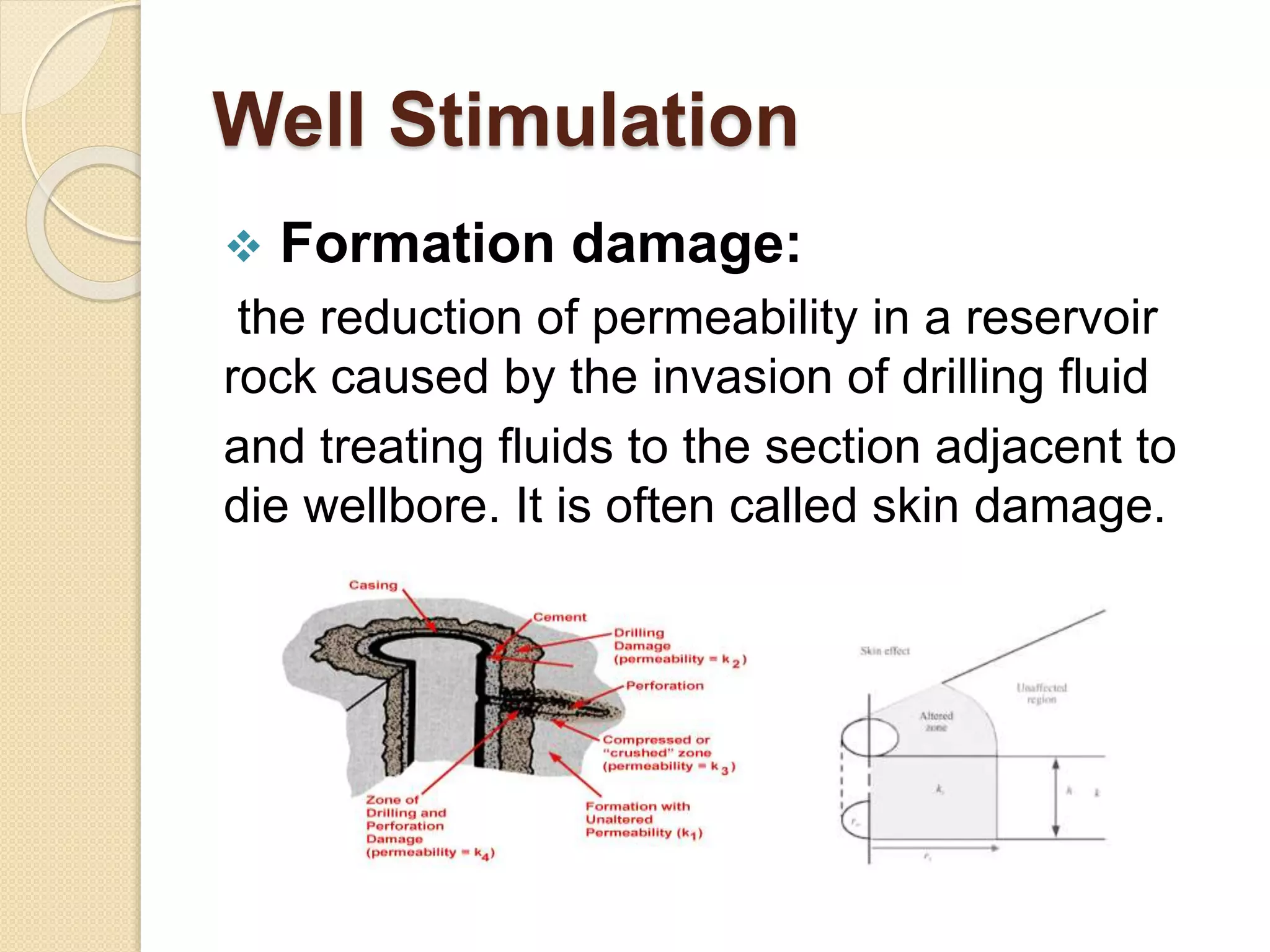
 Formation damage:
the reduction of permeability in a reservoir
rock caused by the invasion of drilling fluid
and treating fluids to the section adjacent to
die wellbore. It is often called skin damage.
Well Stimulation
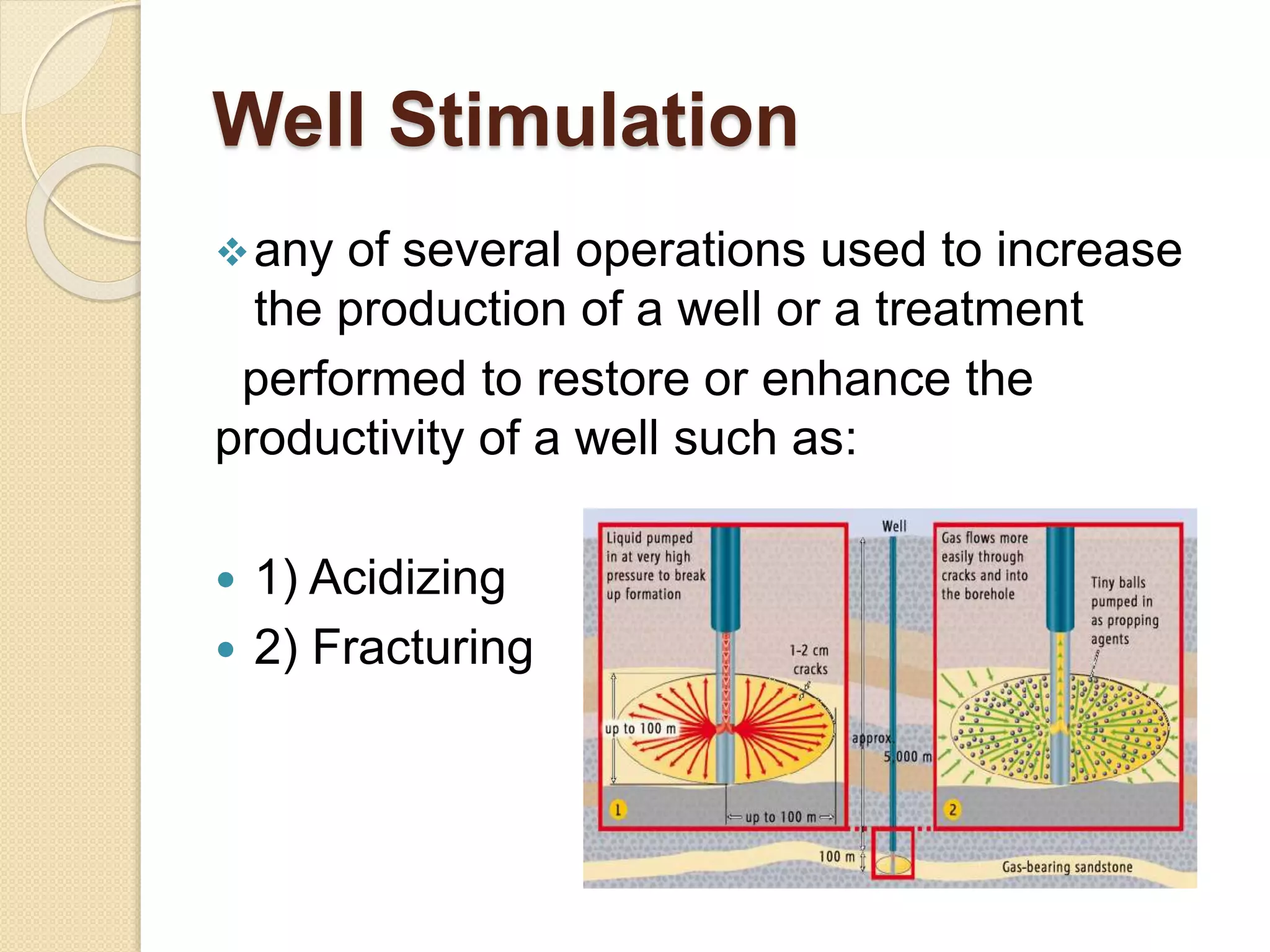
any of several operations used to increase
the production of a well or a treatment
performed to restore or enhance the
productivity of a well such as:
 1) Acidizing
 2) Fracturing
Well Stimulation
 Acidizing
• The pumping of acid into the wellbore to
remove near-well formation
damage and other damaging substances.
• This procedure commonly enhances production
by increasing the
effective well radius.
Well Stimulation
 The two basic types of acidizing are
characterized through injection rates and
pressures:
 Injection rates below fracture pressure are
termed Matrix acidizing.
 Injection rates above fracture pressure are
termed Fracture acidizing.
Well Stimulation
Matrix acidizing
 Matrix acidizing is applied primarily to remove skin
damage caused by drilling , completion, workover ,
well-killing, or injection fluids, and by precipitation
of scale deposits from produced or injected water.
 During matrix acidizing the acids dissolve the
sediments and mud solids within the pores that are
inhibiting the permeability of the rock.
 mostly used in sandstone formations.
 Due to the extremely large surface area contacted
by acid in a matrix treatment, spending time is very
short. Therefore, it is difficult to affect formation
more than a few feet from the wellbore.
Well Stimulation
 Fracture acidizing
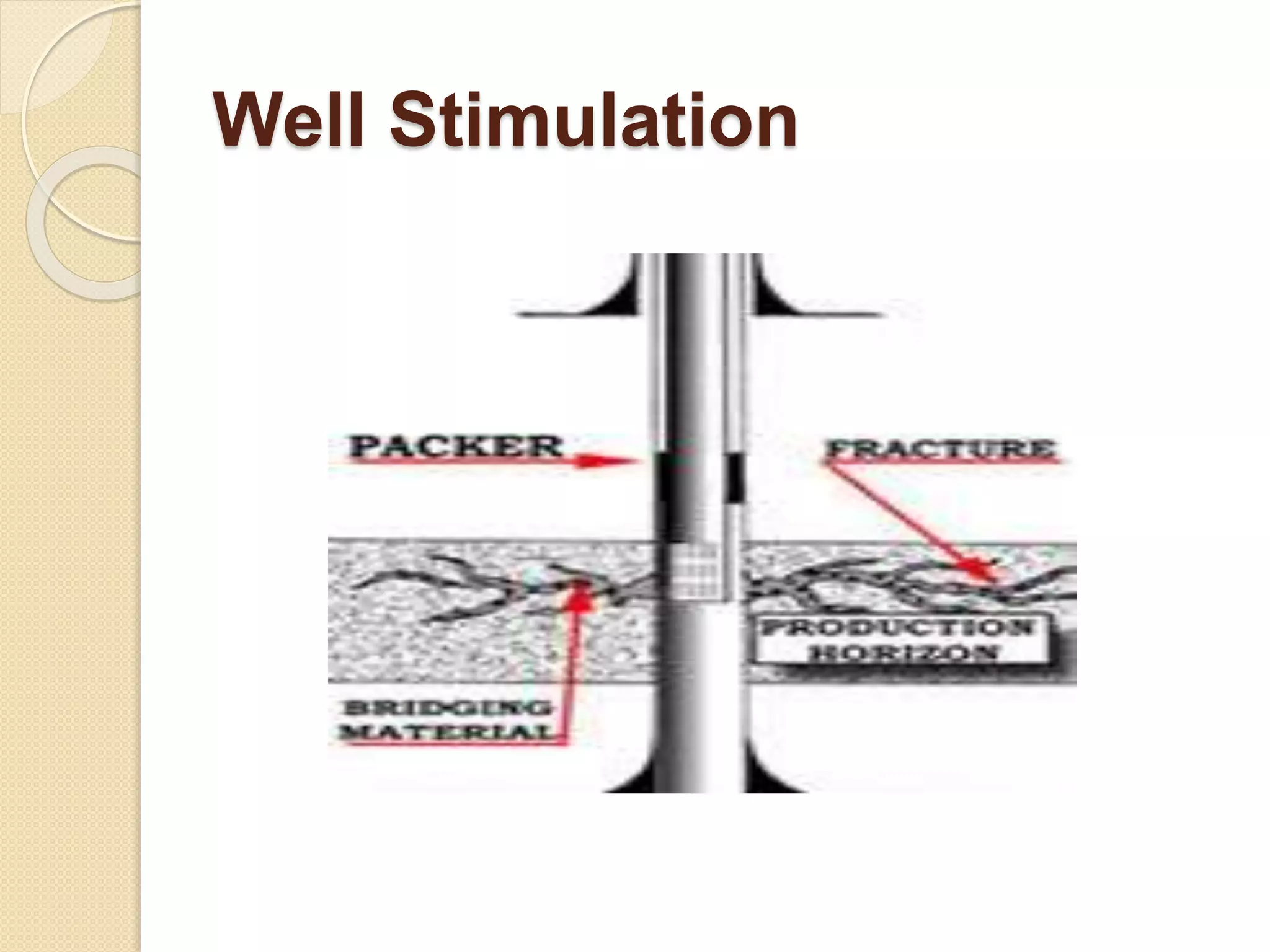
 Fracture acidizing is an alternative to hydraulic
fracturing and propping in carbonate reservoirs.
In fracture acidizing, the reservoir is
hydraulically fractured an then the fracture
faces are etched with acid to provide linear flow
channels to wellbore.
 As such, the application of acid fracturing is
confined to carbonate reservoirs and should
never be used to stimulate sandstone, shale, or
coal-seam reservoirs.
 Long etched fractures are difficult to obtain,
because of high leak off and rapid acid reaction
with the formation
Well Stimulation
Well Stimulation
WELL STIMULATION ACIDS
The basic types of acid used are:
• Hydrochloric
• Hydrochloric-Hydrofluoric
• Acetic
• Formic
• Sulfamic
• Fluoboric
 Also, various combinations of these acids are
employed in specific applications.
Well Stimulation
ACID ADDITIVES:
Acidizing can cause a number of well
problems. Acid may :
(1) release fines
(2) create precipitants
(3) form emulsions
(4) create sludge
(5) corrode steel
 Additives are available to correct these and
a number of other problems
Well Stimulation
• Surfactants should be used on all acid jobs to
reduce surface and interfacial tension, to prevent
emulsions, to water-wet the formation, and to
safeguard against other associated problems.
 Suspending Agents: Most carbonate formations
contain insolubles which can block formation pores
or fractures if fines released by acid are allowed to
settle and bridge.
Well Stimulation
 Suspension should be differentiated
from dispersion. Dispersed particles
usually settle in a short time.
 A suspending surfactant, such as
Halliburton's HC-2, in concentrations of
about five gallons per 1,000 gallons of
acid may suspend fines for more than 24
hours, and possibly as long as seven
days. Suspending agents are usually
polymers or surfactants
Well Stimulation
 Anti-Sludge Agents:
Some crudes, particularly heavy asphaltic crudes,
form an insoluble sludge when contacted with acid,
with greater problems experiences with high strength
acid. Dissolved Fe(III) in acid appreciably increases
the possibility of sludge.
 The primary ingredients of a sludge are usually
asphaltenes.
Well Stimulation
 Sludges may also contain resins and paraffin
waxes, high-molecular weight hydrocarbons,
formation fines, clays, and other materials.
 The addition of certain surfactants can prevent the
formation of sludge by keeping colloidal material
dispersed. These sludge-preventing surfactants
usually prevent an emulsion
Well Stimulation
 Corrosion inhibitors for acid are chemical
additives that reduce the rate of corrosion
of steel by acid.
There are two primary reasons for using
corrosion inhibitors:
(1) to protect the acid pumping and handling
equipment
(2) to protect well equipment.
Well Stimulation
 Factors that govern the degree of
acid attack on steel are:
1) type of steel including hardness
2) temperature
3) type of acid
4) acid concentration
5) acid contact time
Well Stimulation
 CARBONATE ACIDIZING
 The objective of acidizing limestone and dolomite
wells is to remove
damage near the wellbore or to create linear flow
channels by fracturing and
etching.
 Acid may also be used in sandstone wells to
dissolve carbonates in the form
of sand grain cementing materials, discrete particles,
and carbonate scale.
Well Stimulation
 The time required for a specified volume
and concentration of HCl acid to
spend to about 3.2% in a selected
formation under given conditions is
defined as Acid Reaction Time.
A major problem in fracture acidizing of
carbonate formations is that acids tend
to
react too fast with carbonates and spend
near the wellbore.
Well Stimulation
 Factors controlling the reaction rate of
acid are:
 area of contact per unit volume of acid
 formation temperature
 pressure
 acid concentration
 acid type
 physical and chemical properties of
formation rock
 flow velocity of acid
Well Stimulation
 Retardation of Acid:
To achieve deeper penetration in
fracture acidizing, it is often desirable to
retard
acid reaction rate. This can be done by
 gelling,
 Emulsifying
 chemically retarding the acid
Well Stimulation
Gelled Acid:
 The use of gelled acid for fracture
acidizing has increased to the point that
it is now the most used technique.
 The introduction of more temperature-
stable gelling agents with ready
application up to temperatures of about
400°F has been a major factor in
selecting gelled acid for acid fracturing.
Two types of gelling systems, polymers
and surfactants, are in common use.
Well Stimulation
Emulsified Acid:
 For many years the primary retarded acid for
fracture acidizing was an acid-in-oil emulsion. This
type retarded acid is very functional but is no
longer the primary fracture acid method used.
 It has limited temperature range and stability, with
high viscosity and high friction loss.
 It does, however, have the ability to restrict contact
between the acid and formation, to reduce fluid
loss, and to retain large quantities of the treating
fluid in the fracture.
Well Stimulation
Chemically-Retarded:
 Acid-Retardation of HCl is obtained by
the addition of unique surfactants to the
acid which form protective films on the
surface of limestone or dolomite.
 These films retard reaction rate in much
the same way that an acid corrosion
inhibitor protects metal.
 In addition to retarding acid reaction
rate, chemical retarders tend to promote
nonuniform etching of fracture faces,
thus increasing fracture conductivity.
Hydraulic Fracturing
 The objective of hydraulic fracturing for well
stimulation is to increase well productivity
by creating a highly conductive path
(compared to reservoir permeability) some
distance away from the wellbore into the
formation.
 Usually the conductivity is maintained by
propping with sand to hold the fracture
faces apart.
Hydraulic Fracturing
 Acid fracturing involves most of the
same considerations as hydraulic
fracturing except that conductivity is
generated by removing portions of the
fracture face with acid, leaving etched
channels after the fracture closes
Hydraulic Fracturing
 During a fracture job or hydraulic fracturing, a
service company injects large volumes of fracture
fluids under high pressure into the well to fracture
the reservoir rock . Fracture jobs are done either in
an open-hole or a cased well with perforations.
 Common fracture fluid is a gel formed by water
and polymers, long organic molecules that form a
thick liquid when mixed with water.
 Oil-based fracture fluid and foam-based fracture
fluids using bubbles of nitrogen, or carbon dioxide
can also be used to minimize formation damage.
 The fracture fluid is transported out to the fracture
job in large trailers
Hydraulic Fracturing
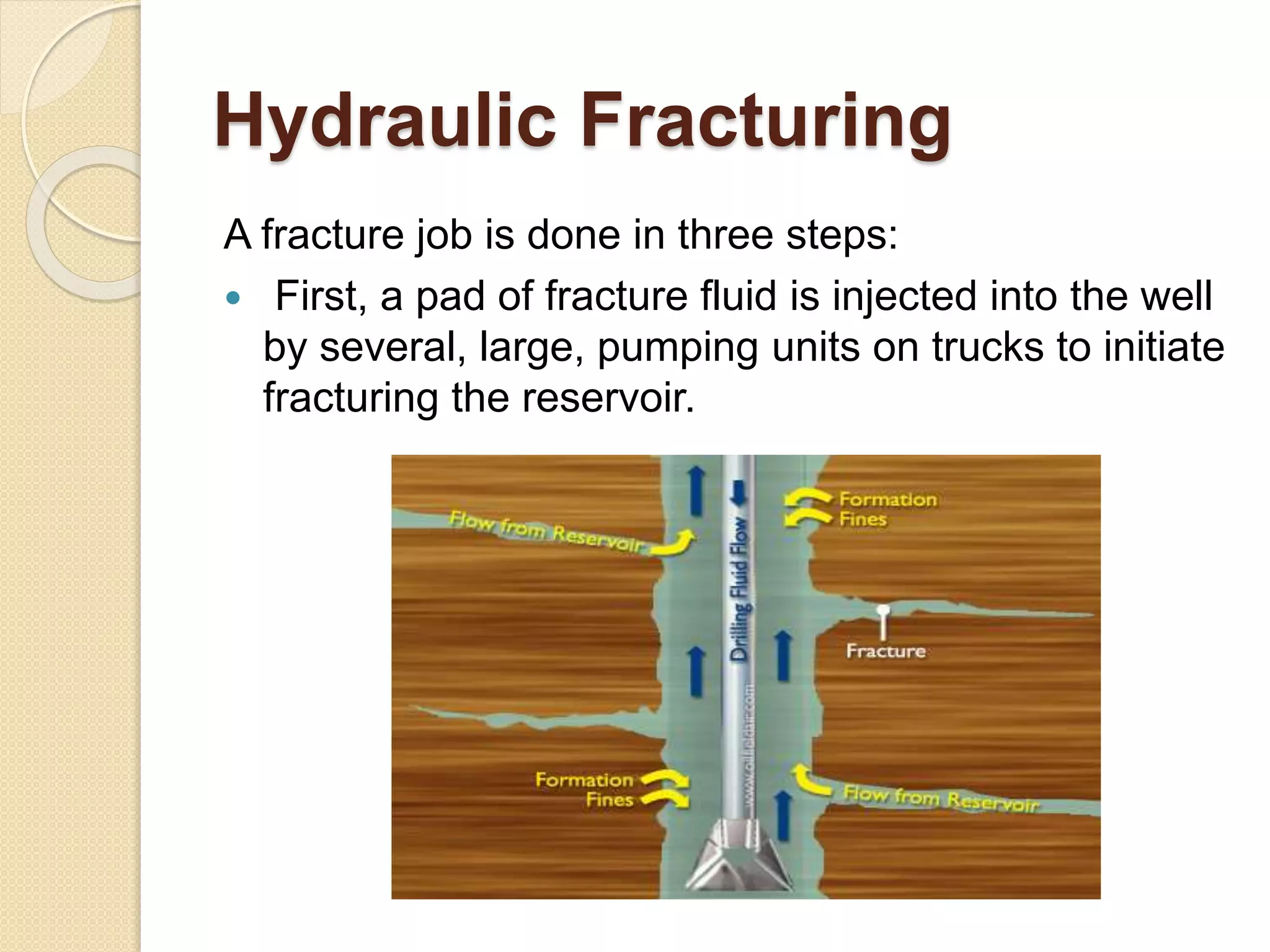
A fracture job is done in three steps:
 First, a pad of fracture fluid is injected into the well
by several, large, pumping units on trucks to initiate
fracturing the reservoir.
Hydraulic Fracturing
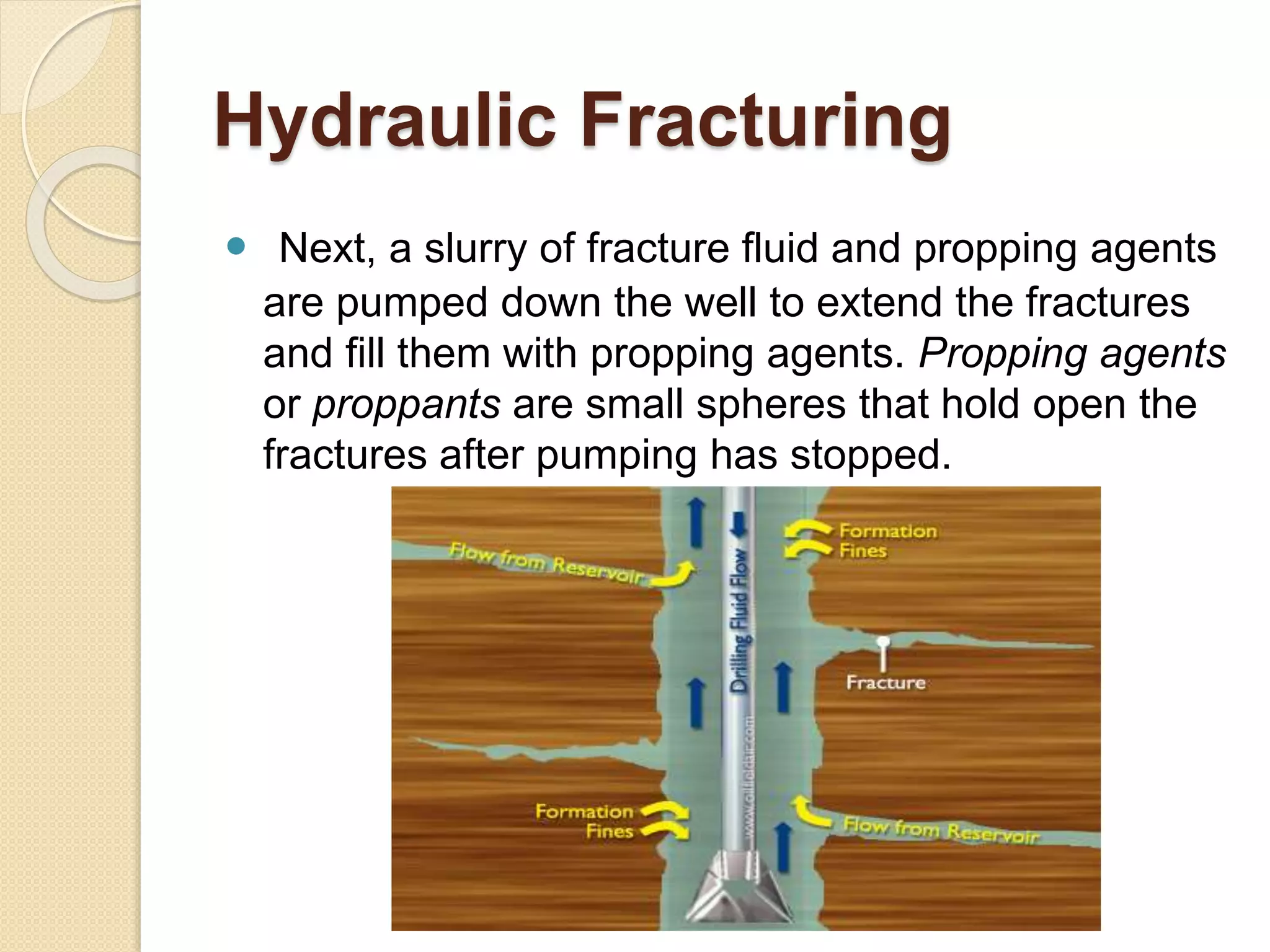
 Next, a slurry of fracture fluid and propping agents
are pumped down the well to extend the fractures
and fill them with propping agents. Propping agents
or proppants are small spheres that hold open the
fractures after pumping has stopped.
Hydraulic Fracturing
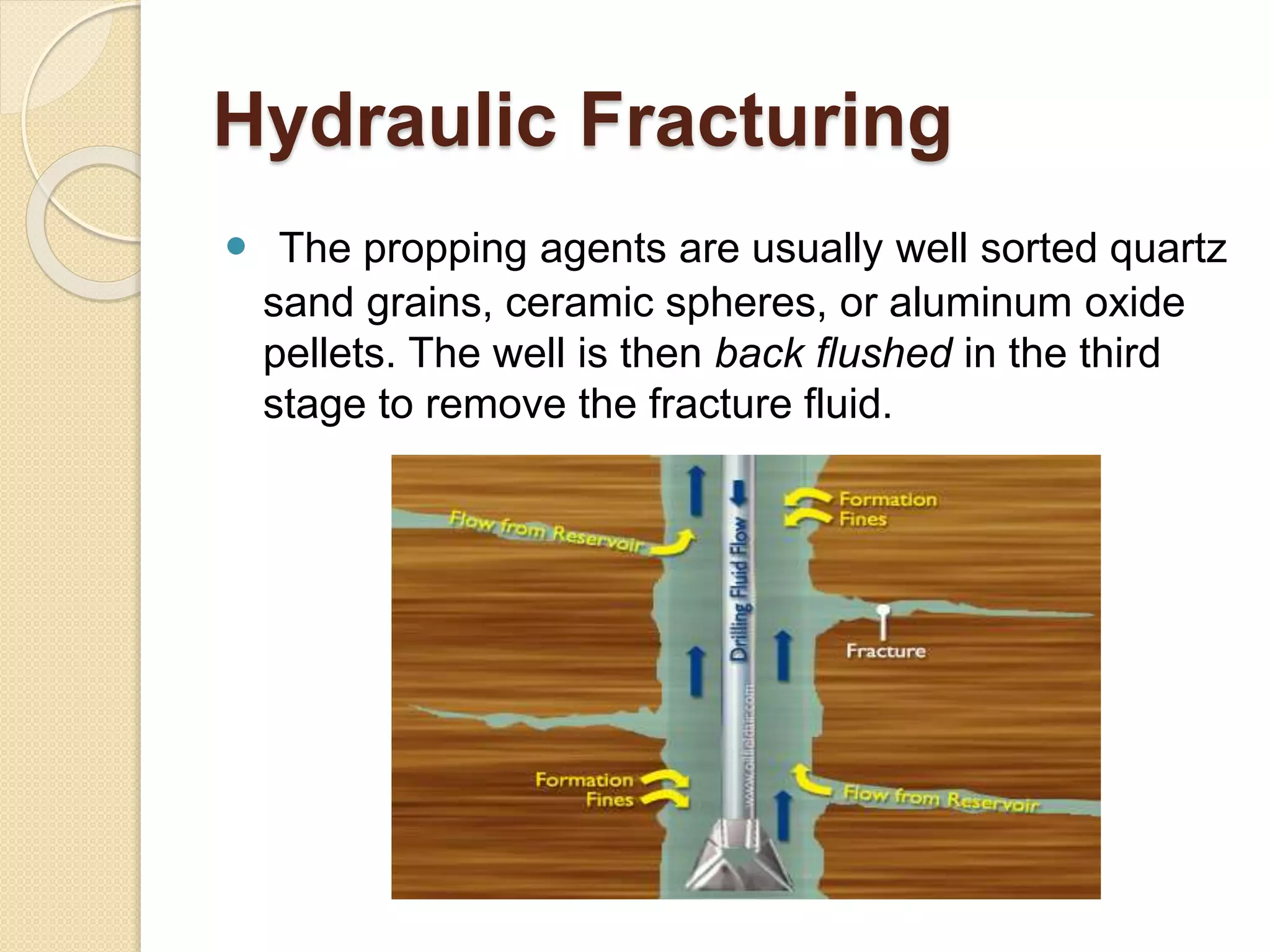
 The propping agents are usually well sorted quartz
sand grains, ceramic spheres, or aluminum oxide
pellets. The well is then back flushed in the third
stage to remove the fracture fluid.

Well stimulation - petroleum engineering

  • 1.
    SORAN UNIVERSITY School ofEngineering Department of Petroleum Engineering Dr. Muhammad Amin Well Stimulation Prepared by: Rebaz Abdulqadr Hamad Aras Bahri Salim Dlvin Taher Abdullah Zhidar Jargis Rawa Asaad Omer Muhemmed
  • 2.
    Well Stimulation  Some,petroleum exists in a formation but is unable to flow readily into the well because the formation has very low permeability. • Natural low permeability formation. • Formation damage around the wellbore caused by invasion of perforation fluid and charge debris.
  • 3.
    Well Stimulation  Formationdamage: the reduction of permeability in a reservoir rock caused by the invasion of drilling fluid and treating fluids to the section adjacent to die wellbore. It is often called skin damage.
  • 4.
    Well Stimulation any ofseveral operations used to increase the production of a well or a treatment performed to restore or enhance the productivity of a well such as:  1) Acidizing  2) Fracturing
  • 5.
    Well Stimulation  Acidizing •The pumping of acid into the wellbore to remove near-well formation damage and other damaging substances. • This procedure commonly enhances production by increasing the effective well radius.
  • 6.
    Well Stimulation  Thetwo basic types of acidizing are characterized through injection rates and pressures:  Injection rates below fracture pressure are termed Matrix acidizing.  Injection rates above fracture pressure are termed Fracture acidizing.
  • 7.
    Well Stimulation Matrix acidizing Matrix acidizing is applied primarily to remove skin damage caused by drilling , completion, workover , well-killing, or injection fluids, and by precipitation of scale deposits from produced or injected water.  During matrix acidizing the acids dissolve the sediments and mud solids within the pores that are inhibiting the permeability of the rock.  mostly used in sandstone formations.  Due to the extremely large surface area contacted by acid in a matrix treatment, spending time is very short. Therefore, it is difficult to affect formation more than a few feet from the wellbore.
  • 8.
    Well Stimulation  Fractureacidizing  Fracture acidizing is an alternative to hydraulic fracturing and propping in carbonate reservoirs. In fracture acidizing, the reservoir is hydraulically fractured an then the fracture faces are etched with acid to provide linear flow channels to wellbore.  As such, the application of acid fracturing is confined to carbonate reservoirs and should never be used to stimulate sandstone, shale, or coal-seam reservoirs.  Long etched fractures are difficult to obtain, because of high leak off and rapid acid reaction with the formation
  • 9.
  • 10.
    Well Stimulation WELL STIMULATIONACIDS The basic types of acid used are: • Hydrochloric • Hydrochloric-Hydrofluoric • Acetic • Formic • Sulfamic • Fluoboric  Also, various combinations of these acids are employed in specific applications.
  • 11.
    Well Stimulation ACID ADDITIVES: Acidizingcan cause a number of well problems. Acid may : (1) release fines (2) create precipitants (3) form emulsions (4) create sludge (5) corrode steel  Additives are available to correct these and a number of other problems
  • 12.
    Well Stimulation • Surfactantsshould be used on all acid jobs to reduce surface and interfacial tension, to prevent emulsions, to water-wet the formation, and to safeguard against other associated problems.  Suspending Agents: Most carbonate formations contain insolubles which can block formation pores or fractures if fines released by acid are allowed to settle and bridge.
  • 13.
    Well Stimulation  Suspensionshould be differentiated from dispersion. Dispersed particles usually settle in a short time.  A suspending surfactant, such as Halliburton's HC-2, in concentrations of about five gallons per 1,000 gallons of acid may suspend fines for more than 24 hours, and possibly as long as seven days. Suspending agents are usually polymers or surfactants
  • 14.
    Well Stimulation  Anti-SludgeAgents: Some crudes, particularly heavy asphaltic crudes, form an insoluble sludge when contacted with acid, with greater problems experiences with high strength acid. Dissolved Fe(III) in acid appreciably increases the possibility of sludge.  The primary ingredients of a sludge are usually asphaltenes.
  • 15.
    Well Stimulation  Sludgesmay also contain resins and paraffin waxes, high-molecular weight hydrocarbons, formation fines, clays, and other materials.  The addition of certain surfactants can prevent the formation of sludge by keeping colloidal material dispersed. These sludge-preventing surfactants usually prevent an emulsion
  • 16.
    Well Stimulation  Corrosioninhibitors for acid are chemical additives that reduce the rate of corrosion of steel by acid. There are two primary reasons for using corrosion inhibitors: (1) to protect the acid pumping and handling equipment (2) to protect well equipment.
  • 17.
    Well Stimulation  Factorsthat govern the degree of acid attack on steel are: 1) type of steel including hardness 2) temperature 3) type of acid 4) acid concentration 5) acid contact time
  • 18.
    Well Stimulation  CARBONATEACIDIZING  The objective of acidizing limestone and dolomite wells is to remove damage near the wellbore or to create linear flow channels by fracturing and etching.  Acid may also be used in sandstone wells to dissolve carbonates in the form of sand grain cementing materials, discrete particles, and carbonate scale.
  • 19.
    Well Stimulation  Thetime required for a specified volume and concentration of HCl acid to spend to about 3.2% in a selected formation under given conditions is defined as Acid Reaction Time. A major problem in fracture acidizing of carbonate formations is that acids tend to react too fast with carbonates and spend near the wellbore.
  • 20.
    Well Stimulation  Factorscontrolling the reaction rate of acid are:  area of contact per unit volume of acid  formation temperature  pressure  acid concentration  acid type  physical and chemical properties of formation rock  flow velocity of acid
  • 21.
    Well Stimulation  Retardationof Acid: To achieve deeper penetration in fracture acidizing, it is often desirable to retard acid reaction rate. This can be done by  gelling,  Emulsifying  chemically retarding the acid
  • 22.
    Well Stimulation Gelled Acid: The use of gelled acid for fracture acidizing has increased to the point that it is now the most used technique.  The introduction of more temperature- stable gelling agents with ready application up to temperatures of about 400°F has been a major factor in selecting gelled acid for acid fracturing. Two types of gelling systems, polymers and surfactants, are in common use.
  • 23.
    Well Stimulation Emulsified Acid: For many years the primary retarded acid for fracture acidizing was an acid-in-oil emulsion. This type retarded acid is very functional but is no longer the primary fracture acid method used.  It has limited temperature range and stability, with high viscosity and high friction loss.  It does, however, have the ability to restrict contact between the acid and formation, to reduce fluid loss, and to retain large quantities of the treating fluid in the fracture.
  • 24.
    Well Stimulation Chemically-Retarded:  Acid-Retardationof HCl is obtained by the addition of unique surfactants to the acid which form protective films on the surface of limestone or dolomite.  These films retard reaction rate in much the same way that an acid corrosion inhibitor protects metal.  In addition to retarding acid reaction rate, chemical retarders tend to promote nonuniform etching of fracture faces, thus increasing fracture conductivity.
  • 25.
    Hydraulic Fracturing Hydraulic Fracturing The objective of hydraulic fracturing for well stimulation is to increase well productivity by creating a highly conductive path (compared to reservoir permeability) some distance away from the wellbore into the formation.  Usually the conductivity is maintained by propping with sand to hold the fracture faces apart.
  • 26.
    Hydraulic Fracturing  Acidfracturing involves most of the same considerations as hydraulic fracturing except that conductivity is generated by removing portions of the fracture face with acid, leaving etched channels after the fracture closes
  • 27.
    Hydraulic Fracturing  Duringa fracture job or hydraulic fracturing, a service company injects large volumes of fracture fluids under high pressure into the well to fracture the reservoir rock . Fracture jobs are done either in an open-hole or a cased well with perforations.  Common fracture fluid is a gel formed by water and polymers, long organic molecules that form a thick liquid when mixed with water.  Oil-based fracture fluid and foam-based fracture fluids using bubbles of nitrogen, or carbon dioxide can also be used to minimize formation damage.  The fracture fluid is transported out to the fracture job in large trailers
  • 28.
    Hydraulic Fracturing A fracturejob is done in three steps:  First, a pad of fracture fluid is injected into the well by several, large, pumping units on trucks to initiate fracturing the reservoir.
  • 29.
    Hydraulic Fracturing  Next,a slurry of fracture fluid and propping agents are pumped down the well to extend the fractures and fill them with propping agents. Propping agents or proppants are small spheres that hold open the fractures after pumping has stopped.
  • 30.
    Hydraulic Fracturing  Thepropping agents are usually well sorted quartz sand grains, ceramic spheres, or aluminum oxide pellets. The well is then back flushed in the third stage to remove the fracture fluid.