OPERATIONS GEOLOGY
PRESENTATIONS
Presentation 1:
Drilling Rigs
16 September 2016Ali Trichelli
SUMMARY
 Drilling Rig Types
 Onshore (Land) Rigs
 Offshore Rigs
Drilling Rigs- The basics
 A drilling rig is a device used to drill, case and cement water, oil and gas
wells.
 The selection and sizing of a drilling rig depends on the following:
1. The well design.
2. The anticipated loads during drilling, tripping, casing and
ultimately testing and completing the well (The maximum hole
depth).
3. Comparison of the rating of the existing rigs with the well design
loads (Rig availability).
4. Selection of the appropriate rig and its components (Horse power
requirements & cost).
Rig Types
 2 Rig Types
• Onshore (Land) Rigs
Onshore (land) rigs are similar. Can drill from few to several thousand meters (1000-7500 m).
• Offshore Rigs
Offshore rigs are of five basic types; each type is designed to suit a specific offshore environment.
Rig Types- Onshore (Land) Rigs
RIG TYPES- OFFSHORE RIGS
 5 Types of Offshore Rigs
 Bottom Supported
 Barge
 Jack-Up
 Fixed Platform
 Floating
 Submersible & Semi-Submersible
 Drillship
Rig Types- Offshore Rigs: Barge
The barge is a shallow draft, flat-bottom vessel equipped as an offshore drilling unit,
used primarily in swampy areas and shallow water. This type of vessel can be found
operating in the swamps of river deltas in West Africa, in coastal areas, and in shallow
lakes. It can be towed to the location and then ballasted to rest on the bottom.
Rig Types- Offshore Rigs: Jack-Up
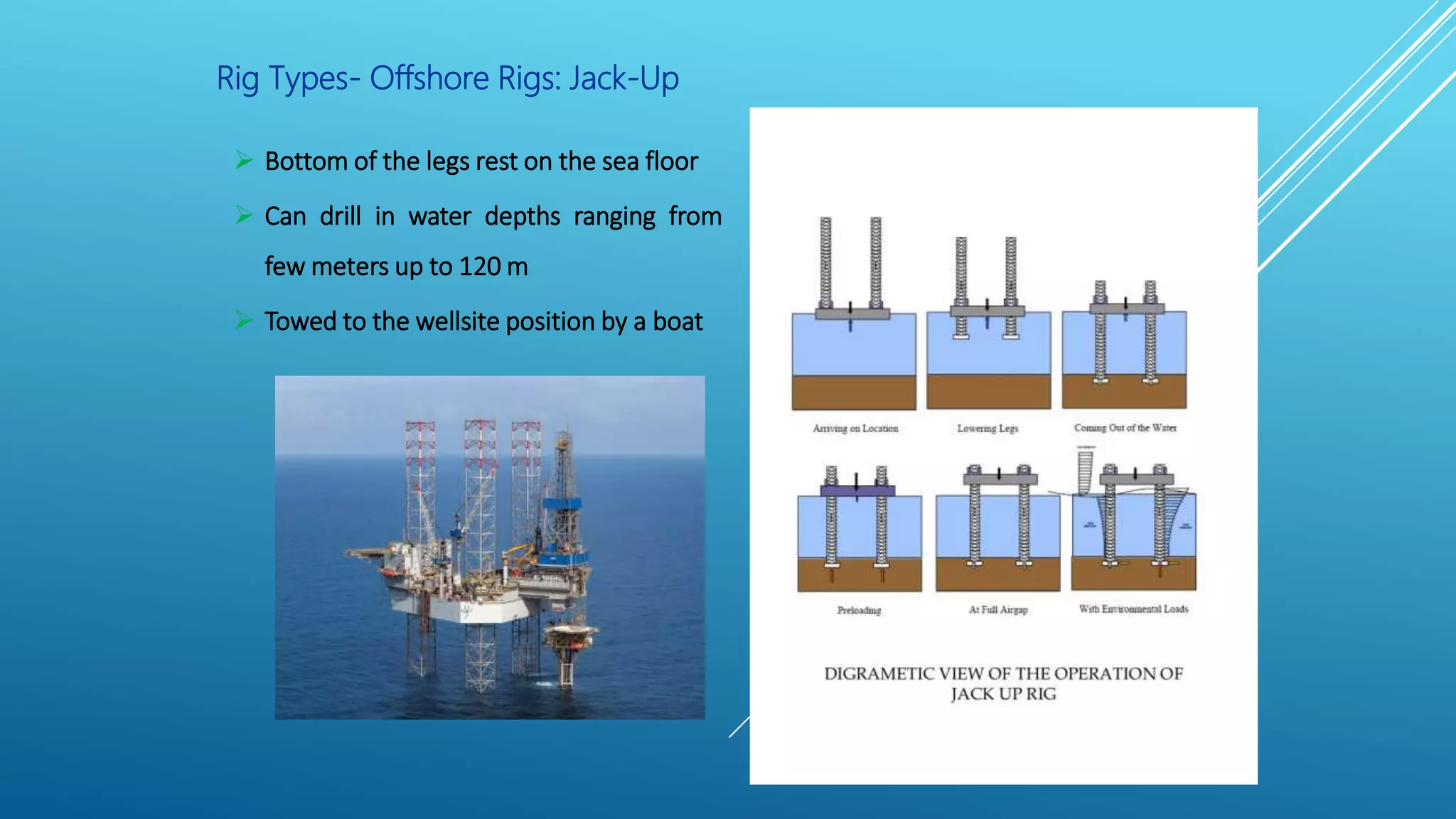
 Bottom of the legs rest on the sea floor
 Can drill in water depths ranging from
few meters up to 120 m
 Towed to the wellsite position by a boat
Rig Types- Offshore Rigs: Fixed Platform
 Fixed platforms are usually used in development drilling.
 Several wells can be drilled from the same platform through multiple conductors
 Most fixed platforms are located in water depths of 450 to 600 feet; some are even set in
waters 800 feet deep.
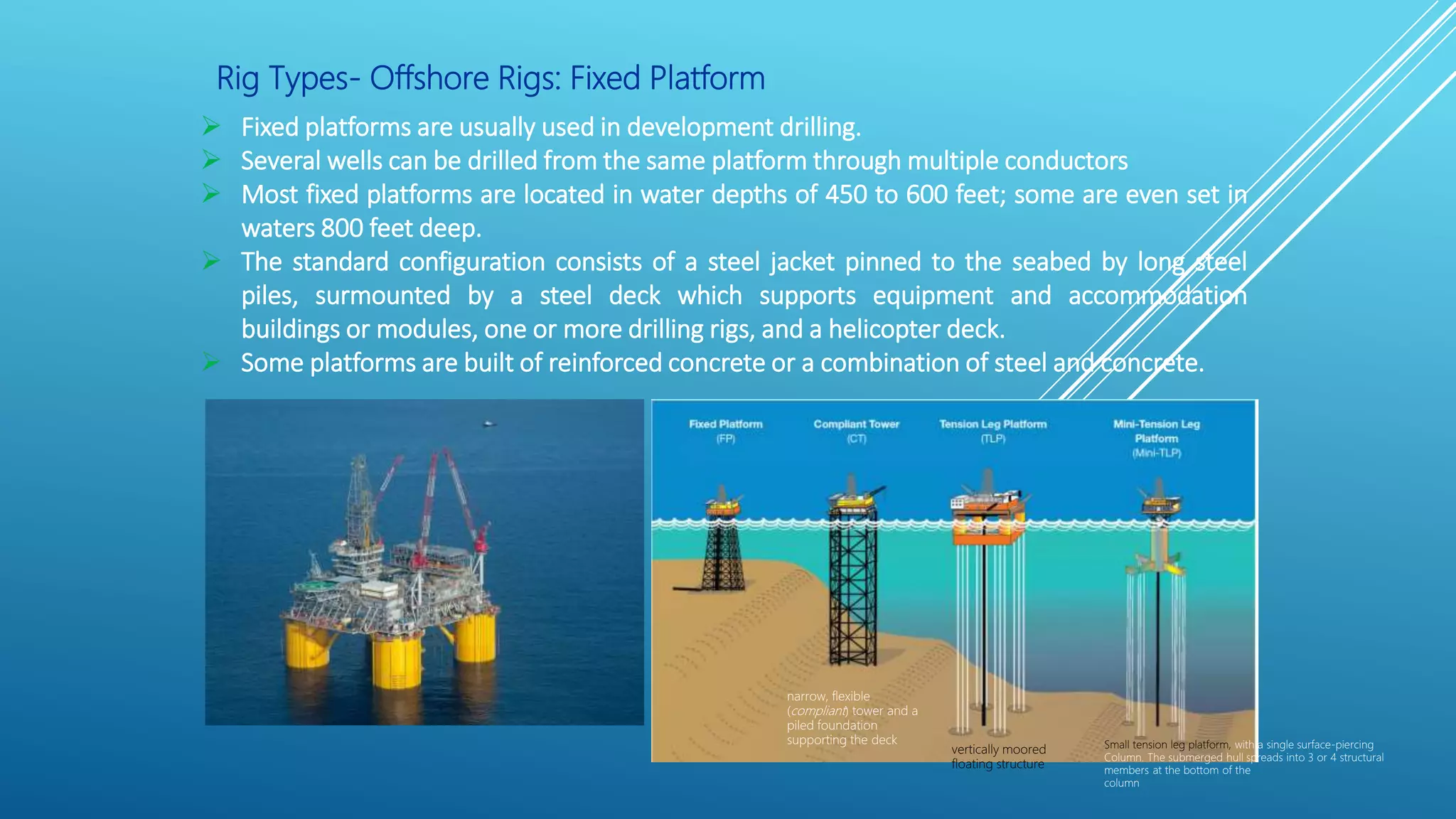
 The standard configuration consists of a steel jacket pinned to the seabed by long steel
piles, surmounted by a steel deck which supports equipment and accommodation
buildings or modules, one or more drilling rigs, and a helicopter deck.
 Some platforms are built of reinforced concrete or a combination of steel and concrete.
vertically moored
floating structure
Small tension leg platform, with a single surface-piercing
Column. The submerged hull spreads into 3 or 4 structural
members at the bottom of the
column
narrow, flexible
(compliant) tower and a
piled foundation
supporting the deck
Rig Types- Offshore Rigs: Submersible & Semi-submersible rigs
 The submersible rig is floated to the well location and rests on the sea floor when it is
drilling.
 Semi-submersible rigs are floating rigs that have pontoons and columns that can be
flooded with water to keep the rig stable.
 Semi- submersible rigs utilize a spread anchoring system of radially spaced anchors to
hold their position.
 Some semi-submersibles are capable of setting on the sea floor, in the same manner
as submersibles.
 Some semi-submersible rigs can drill in water depths over 2200 m.
Rig Types- Offshore Rigs: Drillship rigs
 These are ships or “floaters” specially constructed or converted for deep water
drilling.
 They offer greater mobility than jack-up or semisubmersible rigs, but they are not as
stable when drilling.
 They are capable of drilling in almost any depth of water.
 Modern ships are fitted with dynamic positioning equipment which enables them to
keep on-station above the borehole.
 They have greater storage capacity than other types of rigs.
 They are often able to drill deeper wells and operate independent of service and
supply ships.
NEXT PRESENTATION
 Drilling Rig Systems
 Power System
 Circulating System
 Rotary System
 Hoisting System
 Well Control System

Presentation 1 drilling rigs

  • 1.
  • 2.
    SUMMARY  Drilling RigTypes  Onshore (Land) Rigs  Offshore Rigs
  • 3.
    Drilling Rigs- Thebasics  A drilling rig is a device used to drill, case and cement water, oil and gas wells.  The selection and sizing of a drilling rig depends on the following: 1. The well design. 2. The anticipated loads during drilling, tripping, casing and ultimately testing and completing the well (The maximum hole depth). 3. Comparison of the rating of the existing rigs with the well design loads (Rig availability). 4. Selection of the appropriate rig and its components (Horse power requirements & cost).
  • 4.
    Rig Types  2Rig Types • Onshore (Land) Rigs Onshore (land) rigs are similar. Can drill from few to several thousand meters (1000-7500 m). • Offshore Rigs Offshore rigs are of five basic types; each type is designed to suit a specific offshore environment.
  • 5.
    Rig Types- Onshore(Land) Rigs
  • 6.
    RIG TYPES- OFFSHORERIGS  5 Types of Offshore Rigs  Bottom Supported  Barge  Jack-Up  Fixed Platform  Floating  Submersible & Semi-Submersible  Drillship
  • 7.
    Rig Types- OffshoreRigs: Barge The barge is a shallow draft, flat-bottom vessel equipped as an offshore drilling unit, used primarily in swampy areas and shallow water. This type of vessel can be found operating in the swamps of river deltas in West Africa, in coastal areas, and in shallow lakes. It can be towed to the location and then ballasted to rest on the bottom.
  • 8.
    Rig Types- OffshoreRigs: Jack-Up  Bottom of the legs rest on the sea floor  Can drill in water depths ranging from few meters up to 120 m  Towed to the wellsite position by a boat
  • 9.
    Rig Types- OffshoreRigs: Fixed Platform  Fixed platforms are usually used in development drilling.  Several wells can be drilled from the same platform through multiple conductors  Most fixed platforms are located in water depths of 450 to 600 feet; some are even set in waters 800 feet deep.  The standard configuration consists of a steel jacket pinned to the seabed by long steel piles, surmounted by a steel deck which supports equipment and accommodation buildings or modules, one or more drilling rigs, and a helicopter deck.  Some platforms are built of reinforced concrete or a combination of steel and concrete. vertically moored floating structure Small tension leg platform, with a single surface-piercing Column. The submerged hull spreads into 3 or 4 structural members at the bottom of the column narrow, flexible (compliant) tower and a piled foundation supporting the deck
  • 10.
    Rig Types- OffshoreRigs: Submersible & Semi-submersible rigs  The submersible rig is floated to the well location and rests on the sea floor when it is drilling.  Semi-submersible rigs are floating rigs that have pontoons and columns that can be flooded with water to keep the rig stable.  Semi- submersible rigs utilize a spread anchoring system of radially spaced anchors to hold their position.  Some semi-submersibles are capable of setting on the sea floor, in the same manner as submersibles.  Some semi-submersible rigs can drill in water depths over 2200 m.
  • 11.
    Rig Types- OffshoreRigs: Drillship rigs  These are ships or “floaters” specially constructed or converted for deep water drilling.  They offer greater mobility than jack-up or semisubmersible rigs, but they are not as stable when drilling.  They are capable of drilling in almost any depth of water.  Modern ships are fitted with dynamic positioning equipment which enables them to keep on-station above the borehole.  They have greater storage capacity than other types of rigs.  They are often able to drill deeper wells and operate independent of service and supply ships.
  • 12.
    NEXT PRESENTATION  DrillingRig Systems  Power System  Circulating System  Rotary System  Hoisting System  Well Control System