Curriculum Development
& Instructional Planning
Definition of Curriculum
originated from the
Greek word “curere”
meaning to “run a
course”
Curriculum
the planned educational
experiences offered by a school
which can take place anywhere
at any time in the multiple
context of the school, e.g.
public schools as caring
communities (Todd, 1965)
Curriculum
 is a set of learning content
and experiences that are
selected, organized and
implemented by the school
in pursuit of its institutional
purpose
Curriculum
 refers to the sum total of the organized
learning stated as educational ends,
school subjects, activities performed
inside the classroom and in the
immediate school surrounding, and/or
topics decided upon and provided within
the educational institution for the
attainment of all the learners under the
effective leadership of the school
officials and specifically, the teachers
(Sanchez, 1996)
Curriculum
any document or plan in a
school or school system that
defines the work of teachers, at
least to the extent of
identifying the content to be
taught to the children and the
methods to be used in the
process (English, 1992)
Conceptions of Curriculum
 As accumulation of organized knowledge
 As instructional plan
 As interaction process
 As cognitive process
 As praxis
 As boundary between formal and informal
education
 As a means for self-actualization
 As technological tool
 As a key towards social relevance
As accumulation of organized
knowledge
 curriculum comprises of the learning
experience, goals and objectives
formulated through the systematic
reconstruction of knowledge and
experiences, under school authorities
for the learner’s willful and continuous
growth in personal and social
competence, the cumulative tradition
of organized knowledge.
As instructional plan
curriculum is a plan for learning.
Plans are needed to serve as
guide in the curriculum so the
benefactors (the students) and
the educators would not get lost in
the way.
As interaction process
Curriculum is a vital, moving,
complex interaction of people
and things in a setting.
As cognitive process
 Curriculum intends to sharpen
students’ intellectual process
and develop cognitive skills for
studying virtually anything
(Eisner and Valance).
As praxis
The school curriculum
represents a special
environment that has been
systematized, edited and
simplified for a special
purpose. (habitual or
established practice; custom)
As boundary between formal
and informal education
The recognition that what
pupils learn is not limited to
the formal course of study but
is affected, directly or
indirectly, by the total school
environment which is
embedded by the curriculum
As a means for self-
actualization
Curriculum provides
personally satisfying
experiences for individual
learners.
As technological tool
Curriculum makes learning
systematic and efficient
thru programmed learning,
computer-assisted
instruction, etc.
As a key towards social
relevance
Curriculum prepares people
for living in an unstable,
changing world.
Components of Curriculum
A. Courses of study : This includes the
subject mater/syllabus that is taught
within the school, and also includes
the co-curricular activities.
Components of Curriculum
B. Social context : While interacting
within the family, community and
outside, one learns many things which
are not possible within the classroom.
The social context or situations include
one's thinking and contribute to one's
learning. This is more important for
children who grow up through the
process of socialization
Components of Curriculum
C. Learning experiences : Every time one
interacts with the social environment, one
learns from each encounter.
Activity-based teaching-learning leads to
generation of more experiences; so also
problem-based learning, especially if problems
are related to real-life situations. In case of
experiential learning, the present learning is
based on previous experiences, and also
leads/contributes to the repository of
experiences within the individual child
Components of Curriculum
D. Learning outcomes : This is the most
important aspect of the curriculum, i.e.
specification of what is to be achieved
Learning outcomes are expressed in terms of
achievements (and changes in the child due to
education) in knowledge, comprehension,
skills, attitude, values, etc.
Learning outcomes may be specified in broad
terms which can be achieved after certain
period of time (say, primary, elementary,
secondary, etc.), or year-wise for each grade,
or for each subject area per semester, etc.
Types of Curriculum
 Subject-centered curriculum
 breaks the school’s program into
discrete subjects or disciplines
 determines in advance what all
children will learn in various subjects
and grades (classes)
 focuses on the acquisition of the
subject matter and eventual mastery
of the subject area by the learner
Types of Curriculum
 Subject-centered curriculum
 corresponds mostly to the textbook
written for the specific subject
 emphasizes that a student who does
not meet the passing mark for a
subject is failed & is required to
repeat it
 has existed at all levels of schooling
Types of Curriculum
Subject-centered curriculum
 focuses on certain processes,
strategies, or life-skills
 is teacher-friendly because
the teachers’ training was
based on this method i.e.
specialization
Subject Centered Curriculum
1) Single subject - based on
one of the academic
disciplines or organized
subject matter areas
Subject Centered Curriculum
2) Correlated subjects –
multidisciplinary approach
is a plan by which learning
experiences in two or more
areas are related , but the
subject identities are kept
Subject Centered Curriculum
3) Broad-fields –
fused or integrated
curriculum; expands the fused
subjects approach by cutting
across an entire domain of
knowledge to provide an
integrated view of subject matter
(Sowell, 1996).
Subject Centered Curriculum
4) Spiral Curriculum
Topics are treated with
corresponding degree of
complexity across levels; provides
for widening horizontal
organization of scope, integration
and deepening of knowledge
(vertical sequence, continuation)
Types of Curriculum
 Learner-centered curriculum
 is organized around needs,
interests, abilities and
aspirations of students
 students help select and
organize the purposes of
learning
 subject areas become the means
by which students pursue problems
or topics from their interests
 allows students to be active and
acquire skills and procedures that
will be applicable to the outside
work
Learner Centered Curriculum
Child-centered – It is
anchored on the needs and
interests of the child. The
learner is very much engaged
with his/her environment;
therefore, learns by doing.
Learner-Centered Curriculum
Experience-centered
Experiences of the learner become
the starting point of the curriculum.
The learners are empowered to
shape their own learning from the
different opportunities given by the
teacher
Learner-Centered Curriculum
Activity-based
a curriculum that utilizes
activities. Students are not
subjects to rote memorization
or paper and pencil learning.
Learner-Centered Curriculum
 Social Processes and Life
Functions
It focused heavily on society & is
structured around the various aspects
of problems and processes of
community life. Cooperative planning
occurs more frequently. The
curriculum is more flexible. Skills
taught are skills students can apply to
everyday living.
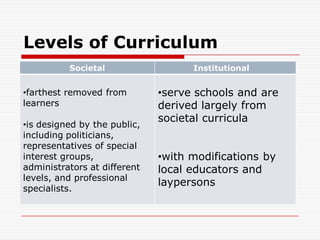
Levels of Curriculum
Societal Institutional
•farthest removed from
learners
•is designed by the public,
including politicians,
representatives of special
interest groups,
administrators at different
levels, and professional
specialists.
•serve schools and are
derived largely from
societal curricula
•with modifications by
local educators and
laypersons
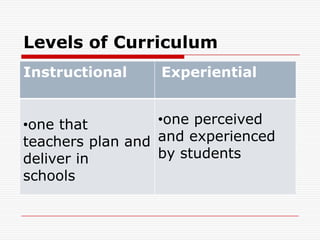
Levels of Curriculum
Instructional Experiential
•one that
teachers plan and
deliver in
schools
•one perceived
and experienced
by students

Intro to curriculum development

  • 1.
  • 2.
    Definition of Curriculum originatedfrom the Greek word “curere” meaning to “run a course”
  • 3.
    Curriculum the planned educational experiencesoffered by a school which can take place anywhere at any time in the multiple context of the school, e.g. public schools as caring communities (Todd, 1965)
  • 4.
    Curriculum  is aset of learning content and experiences that are selected, organized and implemented by the school in pursuit of its institutional purpose
  • 5.
    Curriculum  refers tothe sum total of the organized learning stated as educational ends, school subjects, activities performed inside the classroom and in the immediate school surrounding, and/or topics decided upon and provided within the educational institution for the attainment of all the learners under the effective leadership of the school officials and specifically, the teachers (Sanchez, 1996)
  • 6.
    Curriculum any document orplan in a school or school system that defines the work of teachers, at least to the extent of identifying the content to be taught to the children and the methods to be used in the process (English, 1992)
  • 7.
    Conceptions of Curriculum As accumulation of organized knowledge  As instructional plan  As interaction process  As cognitive process  As praxis  As boundary between formal and informal education  As a means for self-actualization  As technological tool  As a key towards social relevance
  • 8.
    As accumulation oforganized knowledge  curriculum comprises of the learning experience, goals and objectives formulated through the systematic reconstruction of knowledge and experiences, under school authorities for the learner’s willful and continuous growth in personal and social competence, the cumulative tradition of organized knowledge.
  • 9.
    As instructional plan curriculumis a plan for learning. Plans are needed to serve as guide in the curriculum so the benefactors (the students) and the educators would not get lost in the way.
  • 10.
    As interaction process Curriculumis a vital, moving, complex interaction of people and things in a setting.
  • 11.
    As cognitive process Curriculum intends to sharpen students’ intellectual process and develop cognitive skills for studying virtually anything (Eisner and Valance).
  • 12.
    As praxis The schoolcurriculum represents a special environment that has been systematized, edited and simplified for a special purpose. (habitual or established practice; custom)
  • 13.
    As boundary betweenformal and informal education The recognition that what pupils learn is not limited to the formal course of study but is affected, directly or indirectly, by the total school environment which is embedded by the curriculum
  • 14.
    As a meansfor self- actualization Curriculum provides personally satisfying experiences for individual learners.
  • 15.
    As technological tool Curriculummakes learning systematic and efficient thru programmed learning, computer-assisted instruction, etc.
  • 16.
    As a keytowards social relevance Curriculum prepares people for living in an unstable, changing world.
  • 17.
    Components of Curriculum A.Courses of study : This includes the subject mater/syllabus that is taught within the school, and also includes the co-curricular activities.
  • 18.
    Components of Curriculum B.Social context : While interacting within the family, community and outside, one learns many things which are not possible within the classroom. The social context or situations include one's thinking and contribute to one's learning. This is more important for children who grow up through the process of socialization
  • 19.
    Components of Curriculum C.Learning experiences : Every time one interacts with the social environment, one learns from each encounter. Activity-based teaching-learning leads to generation of more experiences; so also problem-based learning, especially if problems are related to real-life situations. In case of experiential learning, the present learning is based on previous experiences, and also leads/contributes to the repository of experiences within the individual child
  • 20.
    Components of Curriculum D.Learning outcomes : This is the most important aspect of the curriculum, i.e. specification of what is to be achieved Learning outcomes are expressed in terms of achievements (and changes in the child due to education) in knowledge, comprehension, skills, attitude, values, etc. Learning outcomes may be specified in broad terms which can be achieved after certain period of time (say, primary, elementary, secondary, etc.), or year-wise for each grade, or for each subject area per semester, etc.
  • 21.
    Types of Curriculum Subject-centered curriculum  breaks the school’s program into discrete subjects or disciplines  determines in advance what all children will learn in various subjects and grades (classes)  focuses on the acquisition of the subject matter and eventual mastery of the subject area by the learner
  • 22.
    Types of Curriculum Subject-centered curriculum  corresponds mostly to the textbook written for the specific subject  emphasizes that a student who does not meet the passing mark for a subject is failed & is required to repeat it  has existed at all levels of schooling
  • 23.
    Types of Curriculum Subject-centeredcurriculum  focuses on certain processes, strategies, or life-skills  is teacher-friendly because the teachers’ training was based on this method i.e. specialization
  • 24.
    Subject Centered Curriculum 1)Single subject - based on one of the academic disciplines or organized subject matter areas
  • 25.
    Subject Centered Curriculum 2)Correlated subjects – multidisciplinary approach is a plan by which learning experiences in two or more areas are related , but the subject identities are kept
  • 26.
    Subject Centered Curriculum 3)Broad-fields – fused or integrated curriculum; expands the fused subjects approach by cutting across an entire domain of knowledge to provide an integrated view of subject matter (Sowell, 1996).
  • 27.
    Subject Centered Curriculum 4)Spiral Curriculum Topics are treated with corresponding degree of complexity across levels; provides for widening horizontal organization of scope, integration and deepening of knowledge (vertical sequence, continuation)
  • 28.
    Types of Curriculum Learner-centered curriculum  is organized around needs, interests, abilities and aspirations of students  students help select and organize the purposes of learning
  • 29.
     subject areasbecome the means by which students pursue problems or topics from their interests  allows students to be active and acquire skills and procedures that will be applicable to the outside work
  • 30.
    Learner Centered Curriculum Child-centered– It is anchored on the needs and interests of the child. The learner is very much engaged with his/her environment; therefore, learns by doing.
  • 31.
    Learner-Centered Curriculum Experience-centered Experiences ofthe learner become the starting point of the curriculum. The learners are empowered to shape their own learning from the different opportunities given by the teacher
  • 32.
    Learner-Centered Curriculum Activity-based a curriculumthat utilizes activities. Students are not subjects to rote memorization or paper and pencil learning.
  • 33.
    Learner-Centered Curriculum  SocialProcesses and Life Functions It focused heavily on society & is structured around the various aspects of problems and processes of community life. Cooperative planning occurs more frequently. The curriculum is more flexible. Skills taught are skills students can apply to everyday living.
  • 34.
    Levels of Curriculum SocietalInstitutional •farthest removed from learners •is designed by the public, including politicians, representatives of special interest groups, administrators at different levels, and professional specialists. •serve schools and are derived largely from societal curricula •with modifications by local educators and laypersons
  • 35.
    Levels of Curriculum InstructionalExperiential •one that teachers plan and deliver in schools •one perceived and experienced by students