PHILIPPINE
EDUCATIONAL
SYSTEM DURING
THE JAPANESE
PERIOD
 Hi there!
Before we proceed…
 NOTE:
I intend to have an interactive presentation
so…
YOUR RECITATION WILL BE REWARDED!!!
 First three (3) persons to recite (3 times
also) will be given some sweet treats. ^o^
 WAIT! THERE’S
MORE!
 I don’t want to see any sleepy
heads today. Therefore, I
decided to intentionally place
blanks/spaces on the next
handouts.
Let’s start!!
OUTLINE
1. BRIEF HISTORY
2. MILITARY ORDER NO.2
3. CURRICULUM + 6 BASIC PRINCIPLES
4. MINISTRY OF EDUCATION AND THE
DEPARTMENT OF PUBLIC INSTRUCTION
5. EDUCATIONAL SYSTEM WITH REGARDS TO
THE FOUR PILLARS OF EDUCATION
SHORT
(OR BRIEF)
HISTORY
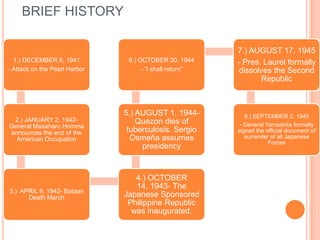
BRIEF HISTORY
1.) DECEMBER 8, 1941
- Attack on the Pearl Harbor
2.) JANUARY 2, 1942-
General Masaharu Homma
announces the end of the
American Occupation
3.) APRIL 9, 1942- Bataan
Death March
4.) OCTOBER
14, 1943- The
Japanese Sponsored
Philippine Republic
was inaugurated.
5.) AUGUST 1, 1944-
Quezon dies of
tuberculosis. Sergio
Osmeña assumes
presidency
6.) OCTOBER 20, 1944
- “I shall return”
7.) AUGUST 17, 1945
- Pres. Laurel formally
dissolves the Second
Republic
8.) SEPTEMBER 2, 1945
- General Yamashita formally
signed the official document of
surrender of all Japanese
Forces
SOME TERMS TO REMEMBER
Bataan Death March – from Bataan
to San Fernando, Pampanga roughly
105 kilometers
- 80,000 Filipino and American troops
- 10,00 died
- 13,000 surrendered on Corregidor
(May 6)
SOME TERMS TO REMEMBER
Puppet Republic – Second
Republic / Japanese
Sponsored-Republic
SOME TERMS TO REMEMBER
KALIBAPI – Kapisanan ng
Paglilingkod sa Bagong
Pilipinas/Organization in the Service of
the New Philippines was the only
Political Party allowed during this
period
SOME TERMS TO REMEMBER
Guerillas – 260,000 people were
reported to be part of these anti-
Japanese movements
SOME TERMS TO REMEMBER
HUKBALAHAP – Hukbo ng Bayan
Laban sa Hapon / People’s Anti-
Japanese Army (1942) lead by Luis
Taruc of Partido Komunnista ng
Pilipinas o PKP (1930)
- 30,000
SOME TERMS TO REMEMBER
Bureau of
Constabulary, MAKAPILI &
Kempeitai – opposed the
guerillas
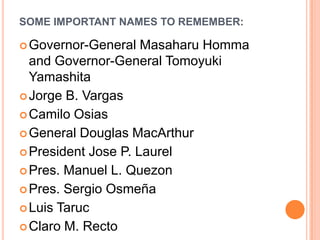
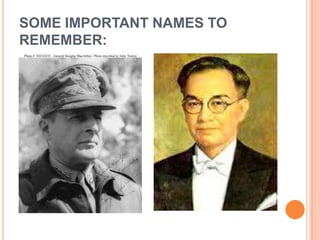
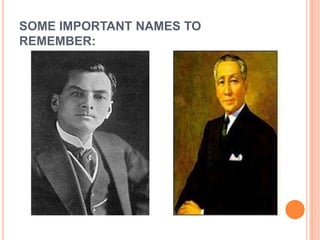
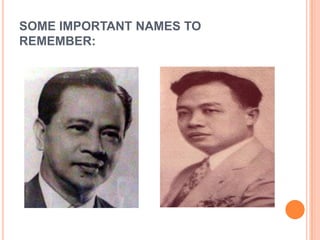
SOME IMPORTANT NAMES TO REMEMBER:
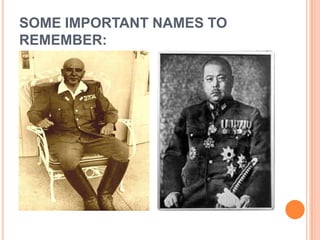
Governor-General Masaharu Homma
and Governor-General Tomoyuki
Yamashita
Jorge B. Vargas
Camilo Osias
General Douglas MacArthur
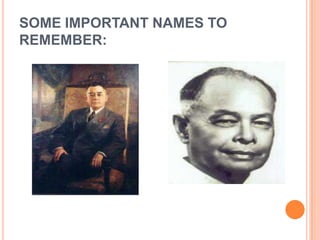
President Jose P. Laurel
Pres. Manuel L. Quezon
Pres. Sergio Osmeña
Luis Taruc
Claro M. Recto
SOME IMPORTANT NAMES TO
REMEMBER:
SOME IMPORTANT NAMES TO
REMEMBER:
SOME IMPORTANT NAMES TO
REMEMBER:
SOME IMPORTANT NAMES TO
REMEMBER:
SOME IMPORTANT NAMES TO
REMEMBER:
EDUCATION:
MILITARY
ORDER NO.2
(1942)
MILITARY ORDER NO.2 (1942)
Japanese educational policies
were embodied in the Military Order
No. 2. The Philippine Executive
Commission established the
Commission of Education, Health and
Public Welfare.
Schools were REOPENED in June
1942 with 300,000 students.
CURRICULUM AND
THE SIX
PRINCIPLES OF
THE JAPANESE
REPUBLIC
CURRICULUM
- TAGALOG, PHILIPPINE
HISTORY, and CHARACTER
EDUCATION were the focus.
- Love for WORK and DIGNITY FOR
LABOR was emphasized.
- There was the spread elementary
and VOCATIONAL education
- NIPPONGO was used and the
Japanese tried to stop the Filipino
people from using the English
Language.
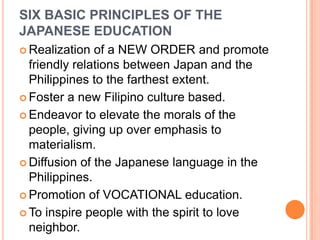
SIX BASIC PRINCIPLES OF THE
JAPANESE EDUCATION
 Realization of a NEW ORDER and promote
friendly relations between Japan and the
Philippines to the farthest extent.
 Foster a new Filipino culture based.
 Endeavor to elevate the morals of the
people, giving up over emphasis to
materialism.
 Diffusion of the Japanese language in the
Philippines.
 Promotion of VOCATIONAL education.
 To inspire people with the spirit to love
neighbor.
MINISTRY OF
EDUCATION AND
THE DEPARTMENT
OF PUBLIC
INSTRUCTION
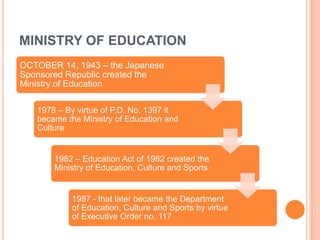
MINISTRY OF EDUCATION
OCTOBER 14, 1943 – the Japanese
Sponsored Republic created the
Ministry of Education
1978 – By virtue of P.D. No. 1397 it
became the Ministry of Education and
Culture
1982 – Education Act of 1982 created the
Ministry of Education, Culture and Sports
1987 - that later became the Department
of Education, Culture and Sports by virtue
of Executive Order no. 117
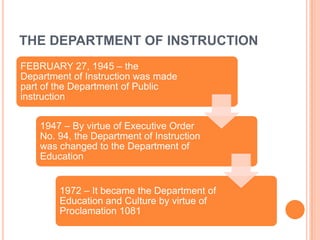
THE DEPARTMENT OF INSTRUCTION
FEBRUARY 27, 1945 – the
Department of Instruction was made
part of the Department of Public
instruction
1947 – By virtue of Executive Order
No. 94, the Department of Instruction
was changed to the Department of
Education
1972 – It became the Department of
Education and Culture by virtue of
Proclamation 1081
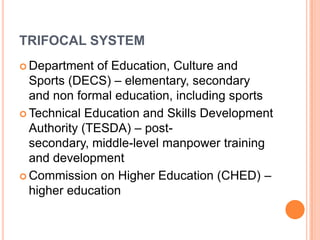
TRIFOCAL SYSTEM
 Department of Education, Culture and
Sports (DECS) – elementary, secondary
and non formal education, including sports
 Technical Education and Skills Development
Authority (TESDA) – post-
secondary, middle-level manpower training
and development
 Commission on Higher Education (CHED) –
higher education
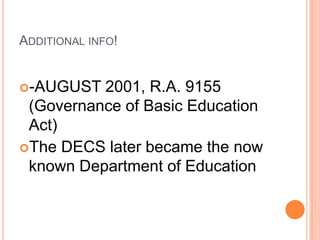
ADDITIONAL INFO!
-AUGUST 2001, R.A. 9155
(Governance of Basic Education
Act)
The DECS later became the now
known Department of Education
SUMMARY
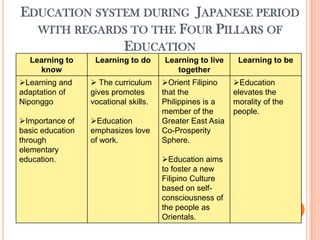
EDUCATION SYSTEM DURING JAPANESE PERIOD
WITH REGARDS TO THE FOUR PILLARS OF
EDUCATION
Learning to
know
Learning to do Learning to live
together
Learning to be
Learning and
adaptation of
Niponggo
Importance of
basic education
through
elementary
education.
 The curriculum
gives promotes
vocational skills.
Education
emphasizes love
of work.
Orient Filipino
that the
Philippines is a
member of the
Greater East Asia
Co-Prosperity
Sphere.
Education aims
to foster a new
Filipino Culture
based on self-
consciousness of
the people as
Orientals.
Education
elevates the
morality of the
people.

Philippine Educational System During the Japanese Occupation

  • 1.
  • 2.
     Hi there! Beforewe proceed…  NOTE: I intend to have an interactive presentation so… YOUR RECITATION WILL BE REWARDED!!!  First three (3) persons to recite (3 times also) will be given some sweet treats. ^o^
  • 3.
     WAIT! THERE’S MORE! I don’t want to see any sleepy heads today. Therefore, I decided to intentionally place blanks/spaces on the next handouts.
  • 4.
  • 5.
    OUTLINE 1. BRIEF HISTORY 2.MILITARY ORDER NO.2 3. CURRICULUM + 6 BASIC PRINCIPLES 4. MINISTRY OF EDUCATION AND THE DEPARTMENT OF PUBLIC INSTRUCTION 5. EDUCATIONAL SYSTEM WITH REGARDS TO THE FOUR PILLARS OF EDUCATION
  • 6.
  • 7.
    BRIEF HISTORY 1.) DECEMBER8, 1941 - Attack on the Pearl Harbor 2.) JANUARY 2, 1942- General Masaharu Homma announces the end of the American Occupation 3.) APRIL 9, 1942- Bataan Death March 4.) OCTOBER 14, 1943- The Japanese Sponsored Philippine Republic was inaugurated. 5.) AUGUST 1, 1944- Quezon dies of tuberculosis. Sergio Osmeña assumes presidency 6.) OCTOBER 20, 1944 - “I shall return” 7.) AUGUST 17, 1945 - Pres. Laurel formally dissolves the Second Republic 8.) SEPTEMBER 2, 1945 - General Yamashita formally signed the official document of surrender of all Japanese Forces
  • 8.
    SOME TERMS TOREMEMBER Bataan Death March – from Bataan to San Fernando, Pampanga roughly 105 kilometers - 80,000 Filipino and American troops - 10,00 died - 13,000 surrendered on Corregidor (May 6)
  • 9.
    SOME TERMS TOREMEMBER Puppet Republic – Second Republic / Japanese Sponsored-Republic
  • 10.
    SOME TERMS TOREMEMBER KALIBAPI – Kapisanan ng Paglilingkod sa Bagong Pilipinas/Organization in the Service of the New Philippines was the only Political Party allowed during this period
  • 11.
    SOME TERMS TOREMEMBER Guerillas – 260,000 people were reported to be part of these anti- Japanese movements
  • 12.
    SOME TERMS TOREMEMBER HUKBALAHAP – Hukbo ng Bayan Laban sa Hapon / People’s Anti- Japanese Army (1942) lead by Luis Taruc of Partido Komunnista ng Pilipinas o PKP (1930) - 30,000
  • 13.
    SOME TERMS TOREMEMBER Bureau of Constabulary, MAKAPILI & Kempeitai – opposed the guerillas
  • 14.
    SOME IMPORTANT NAMESTO REMEMBER: Governor-General Masaharu Homma and Governor-General Tomoyuki Yamashita Jorge B. Vargas Camilo Osias General Douglas MacArthur President Jose P. Laurel Pres. Manuel L. Quezon Pres. Sergio Osmeña Luis Taruc Claro M. Recto
  • 15.
  • 16.
  • 17.
  • 18.
  • 19.
  • 20.
  • 21.
  • 22.
    MILITARY ORDER NO.2(1942) Japanese educational policies were embodied in the Military Order No. 2. The Philippine Executive Commission established the Commission of Education, Health and Public Welfare. Schools were REOPENED in June 1942 with 300,000 students.
  • 23.
    CURRICULUM AND THE SIX PRINCIPLESOF THE JAPANESE REPUBLIC
  • 24.
    CURRICULUM - TAGALOG, PHILIPPINE HISTORY,and CHARACTER EDUCATION were the focus. - Love for WORK and DIGNITY FOR LABOR was emphasized. - There was the spread elementary and VOCATIONAL education - NIPPONGO was used and the Japanese tried to stop the Filipino people from using the English Language.
  • 25.
    SIX BASIC PRINCIPLESOF THE JAPANESE EDUCATION  Realization of a NEW ORDER and promote friendly relations between Japan and the Philippines to the farthest extent.  Foster a new Filipino culture based.  Endeavor to elevate the morals of the people, giving up over emphasis to materialism.  Diffusion of the Japanese language in the Philippines.  Promotion of VOCATIONAL education.  To inspire people with the spirit to love neighbor.
  • 26.
    MINISTRY OF EDUCATION AND THEDEPARTMENT OF PUBLIC INSTRUCTION
  • 27.
    MINISTRY OF EDUCATION OCTOBER14, 1943 – the Japanese Sponsored Republic created the Ministry of Education 1978 – By virtue of P.D. No. 1397 it became the Ministry of Education and Culture 1982 – Education Act of 1982 created the Ministry of Education, Culture and Sports 1987 - that later became the Department of Education, Culture and Sports by virtue of Executive Order no. 117
  • 28.
    THE DEPARTMENT OFINSTRUCTION FEBRUARY 27, 1945 – the Department of Instruction was made part of the Department of Public instruction 1947 – By virtue of Executive Order No. 94, the Department of Instruction was changed to the Department of Education 1972 – It became the Department of Education and Culture by virtue of Proclamation 1081
  • 29.
    TRIFOCAL SYSTEM  Departmentof Education, Culture and Sports (DECS) – elementary, secondary and non formal education, including sports  Technical Education and Skills Development Authority (TESDA) – post- secondary, middle-level manpower training and development  Commission on Higher Education (CHED) – higher education
  • 30.
    ADDITIONAL INFO! -AUGUST 2001,R.A. 9155 (Governance of Basic Education Act) The DECS later became the now known Department of Education
  • 31.
  • 32.
    EDUCATION SYSTEM DURINGJAPANESE PERIOD WITH REGARDS TO THE FOUR PILLARS OF EDUCATION Learning to know Learning to do Learning to live together Learning to be Learning and adaptation of Niponggo Importance of basic education through elementary education.  The curriculum gives promotes vocational skills. Education emphasizes love of work. Orient Filipino that the Philippines is a member of the Greater East Asia Co-Prosperity Sphere. Education aims to foster a new Filipino Culture based on self- consciousness of the people as Orientals. Education elevates the morality of the people.