FAMI, MARIA FAE L.
Focuses on the content of the curriculum which
corresponds mostly to the textbook written for
the specific subject.
Few curricularists who were firm believers of
this design:
Henry Morrison
William Harris
Schools with this type of curriculum design
aspire for excellence.
Common; oldest
Accdg. to the advocates, SCD has an advantage
because it is easy to deliver.
Teachers are familiar with the format
The content is taught as written in the subject’s
curriculum.
Learning is compartmentalized.
It forgets about the students’ interests, self-
learning, and experiences.
Students may only think inside the box.
Students become empty barrels that
receive information.
Focuses on academic disciplines
Discipline – specific knowledge learned by scholars to
study a specific content of their fields.
Often used in college, but not in the elementary or
secondary.
Becomes the degree program
Links separate subject designs in order to reduce
fragmentation
Subjects are related to one another but each remains its
identity
E.g. Filipino – Social Science; Mathematics – Science;
etc.
As the students study a subject, some of its topics are
also related in the other – making a connection. With this,
students are can learn better and see the importance of it.
A variation of the subject-centered design.
Made to prevent the compartmentalization of subjects
and integrate what are related to each other.
For example: Geography, Economics, Pol. Science,
Anthropology, Sociology, and History are fused into
one subject called Social Studies.
Every year the child/student encounters the same set
of subjects. But every year, the complexity of the
topics increases.
New learning has a relationship with old learning and
is put in context with the old information.
The information is reinforced and solidified each time
the student revisits the subject matter;
The spiral curriculum also allows a logical
progression from simplistic ideas to complicated
ideas; and
Students are encouraged to apply the early
knowledge to later course objectives
LANDAO, MARIA ROWENA D.
Among the progressive educational psychologist, the
learner is the center of the educative process.
The emphasis is very strong in the elementary level.
Although in high school, the subject/content is the
focus and the tertiary level are centered in discipline
still they recognize the importance of the learner.
Humanistic design
Child-centered design
Experience-centered design
In this design, the development of self is the ultimate
objective of learning. It stresses the whole person and the
integration of thinking, feeling and doing. It considers the
cognitive, affective and psychomotor domains to be
interconnected and must be addressed in the curriculum.
The key lead personalities in this design were Abraham
Maslow with his theory of self-actualization and Carl Rogers,
believing that a person can enhance self-directed learning by
improving self understanding.
The whole class are full of learners who lack of self-
esteem. The teacher would make activities that will
heighten their confidence (which is an intrinsic
reward) and outwardly, use rewards such as praise,
money, consumables, etc.
This design is influenced by John Dewey, Monroe
Rousseau, Johann Heinrich Pestallozi and Friedrich
Froebel.
The learner is not considered as a passive individual but
as one who learns by doing. They are actively construct
meaning and understanding (Constructivist).
The curriculum design is anchored on the needs and
interests of the child.
He believed that human being learn through ‘hands on’
approach. So, the ‘adult mind’ or the teacher has the duty to
bring the vast knowledge (including theories, studies,
philosophy, etc.) as an experiential learning to the learners.
In Dewey’s view, the learners should be allowed to explore
and engage in his environment.
 Rousseau proclaim that “…education finds its
purpose, its process, its means wholly within the child
life and the child experiences”.
He introduced two great principles in teaching:
a) learning through self-experience
b) learning by doing
Pestallozi advocated direct experience as a method of
teaching rather than using books as a mean to learn.
He advocated to use inductive method where a child first
learn to observe and analyze his/her own mistakes then after
that they can used their books.
 "The play of children is not recreation; it means earnest work.
Play is the purest intellectual production of the human being,
in this stage … for the whole man is visible in them, in his
finest capacities, in his innermost being.“
He believed that play is an engine of real learning where
children are free to discover how things work that will lead
them to make meaning from their experiences.
K to 12 program
It may be much more focus on the content but in
some point the learners are free to engage in their
environment and learned by doing.
This design is similar to the child-centered design.
Although the child remains to be the focus, this design
believes that the interests and needs of the learners cannot
be pre-planned.
Experience is the starting point of the curriculum, thus the
school environment is left open and free.
Learners are free to choose from various activities provided
by the teacher that will empower them to shape their own
learning.
If the whole class are born from families of fishermen. Then
the teacher can relate the subject to their experience. For
example in Mathematics, teaching them the basic math
operations by using the number/weight of fish. Also in social
studies, the current condition of fishermen in the Philippines.
ROSCANO, JANINE P.
Generally, the problem-centered design draws on social
problems, needs, interest, and abilities of the learners.
Various problems are given emphasis. There are those that
center on life situations, contemporary life problems, areas of
living and many others. In this curriculum, content cuts
across subject or boundaries and must be based on the
needs, concerns and abilities of the students.
A. Life-situations design
- What makes the design unique is that the contents are
organized in ways that allow students to clearly view problem
areas clearly. It used the past and the present experiences of
learners as a means to analyze the basic areas of living. As a
starting point, the pressing immediate problems of the society
and the students’ existing conerns are utilized.
B. Core design
- Another example of problem-centered design is core
design. It centers on general education and the
problems are based on common human activities.
The central focus of the core design includes
common needs, problems, concerns of the learners.
Nilson (2010, p. 190) lists learning outcomes
associated with PBL. A well-design PBL project
provides students with the opportunity to develop
skills related to:
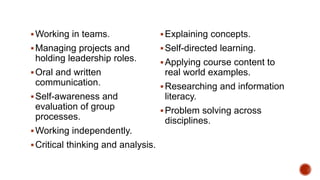
Working in teams.
Managing projects and
holding leadership roles.
Oral and written
communication.
Self-awareness and
evaluation of group
processes.
Working independently.
Critical thinking and analysis.
Explaining concepts.
Self-directed learning.
Applying course content to
real world examples.
Researching and information
literacy.
Problem solving across
disciplines.
Popularized by Faunce and Bossing in 1959, they
presented ways on how to proceed following a core
design of a curriculum as follows:
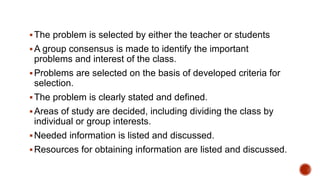
The problem is selected by either the teacher or students
A group consensus is made to identify the important
problems and interest of the class.
Problems are selected on the basis of developed criteria for
selection.
The problem is clearly stated and defined.
Areas of study are decided, including dividing the class by
individual or group interests.
Needed information is listed and discussed.
Resources for obtaining information are listed and discussed.
Information is obtained and organized.
Information is analyzed and interpreted.
Tentative conclusions are stated and tested.
A report is presented to the class on an individual or group
basis.
Conclusions are evaluated
New avenues of exploration toward further problem solving
are examined.
 Bilbao, P., Lucido, P., Iringan, T., & Javier, R. (2008). Curriculum
Development. Quezon City, Metro, Manila: Lorimar Publishing
 http://eric.ed.gov/?id=ED538282
 http://www.garysturt.free-online.co.uk/human.htm
 http://froebelgifts.com/method.htm
 http://study.com/academy/lesson/johann-heinrich-pestalozzi-theory-
impact-on-education.html
 http://iae-pedia.org/John_Dewey_-_The_Child_and_The_Curriculum
 http://www.cte.cornell.edu/teaching-ideas/engaging-students/problem-
based-learning.html

Group 4 curriculum_design

  • 1.
  • 2.
    Focuses on thecontent of the curriculum which corresponds mostly to the textbook written for the specific subject. Few curricularists who were firm believers of this design: Henry Morrison William Harris Schools with this type of curriculum design aspire for excellence.
  • 4.
    Common; oldest Accdg. tothe advocates, SCD has an advantage because it is easy to deliver. Teachers are familiar with the format The content is taught as written in the subject’s curriculum.
  • 5.
    Learning is compartmentalized. Itforgets about the students’ interests, self- learning, and experiences. Students may only think inside the box. Students become empty barrels that receive information.
  • 6.
    Focuses on academicdisciplines Discipline – specific knowledge learned by scholars to study a specific content of their fields. Often used in college, but not in the elementary or secondary. Becomes the degree program
  • 7.
    Links separate subjectdesigns in order to reduce fragmentation Subjects are related to one another but each remains its identity E.g. Filipino – Social Science; Mathematics – Science; etc. As the students study a subject, some of its topics are also related in the other – making a connection. With this, students are can learn better and see the importance of it.
  • 8.
    A variation ofthe subject-centered design. Made to prevent the compartmentalization of subjects and integrate what are related to each other. For example: Geography, Economics, Pol. Science, Anthropology, Sociology, and History are fused into one subject called Social Studies.
  • 9.
    Every year thechild/student encounters the same set of subjects. But every year, the complexity of the topics increases. New learning has a relationship with old learning and is put in context with the old information.
  • 10.
    The information isreinforced and solidified each time the student revisits the subject matter; The spiral curriculum also allows a logical progression from simplistic ideas to complicated ideas; and Students are encouraged to apply the early knowledge to later course objectives
  • 11.
  • 12.
    Among the progressiveeducational psychologist, the learner is the center of the educative process. The emphasis is very strong in the elementary level. Although in high school, the subject/content is the focus and the tertiary level are centered in discipline still they recognize the importance of the learner.
  • 13.
  • 14.
    In this design,the development of self is the ultimate objective of learning. It stresses the whole person and the integration of thinking, feeling and doing. It considers the cognitive, affective and psychomotor domains to be interconnected and must be addressed in the curriculum. The key lead personalities in this design were Abraham Maslow with his theory of self-actualization and Carl Rogers, believing that a person can enhance self-directed learning by improving self understanding.
  • 15.
    The whole classare full of learners who lack of self- esteem. The teacher would make activities that will heighten their confidence (which is an intrinsic reward) and outwardly, use rewards such as praise, money, consumables, etc.
  • 16.
    This design isinfluenced by John Dewey, Monroe Rousseau, Johann Heinrich Pestallozi and Friedrich Froebel. The learner is not considered as a passive individual but as one who learns by doing. They are actively construct meaning and understanding (Constructivist). The curriculum design is anchored on the needs and interests of the child.
  • 17.
    He believed thathuman being learn through ‘hands on’ approach. So, the ‘adult mind’ or the teacher has the duty to bring the vast knowledge (including theories, studies, philosophy, etc.) as an experiential learning to the learners. In Dewey’s view, the learners should be allowed to explore and engage in his environment.
  • 18.
     Rousseau proclaimthat “…education finds its purpose, its process, its means wholly within the child life and the child experiences”. He introduced two great principles in teaching: a) learning through self-experience b) learning by doing
  • 19.
    Pestallozi advocated directexperience as a method of teaching rather than using books as a mean to learn. He advocated to use inductive method where a child first learn to observe and analyze his/her own mistakes then after that they can used their books.
  • 20.
     "The playof children is not recreation; it means earnest work. Play is the purest intellectual production of the human being, in this stage … for the whole man is visible in them, in his finest capacities, in his innermost being.“ He believed that play is an engine of real learning where children are free to discover how things work that will lead them to make meaning from their experiences.
  • 21.
    K to 12program It may be much more focus on the content but in some point the learners are free to engage in their environment and learned by doing.
  • 22.
    This design issimilar to the child-centered design. Although the child remains to be the focus, this design believes that the interests and needs of the learners cannot be pre-planned. Experience is the starting point of the curriculum, thus the school environment is left open and free. Learners are free to choose from various activities provided by the teacher that will empower them to shape their own learning.
  • 23.
    If the wholeclass are born from families of fishermen. Then the teacher can relate the subject to their experience. For example in Mathematics, teaching them the basic math operations by using the number/weight of fish. Also in social studies, the current condition of fishermen in the Philippines.
  • 24.
  • 25.
    Generally, the problem-centereddesign draws on social problems, needs, interest, and abilities of the learners. Various problems are given emphasis. There are those that center on life situations, contemporary life problems, areas of living and many others. In this curriculum, content cuts across subject or boundaries and must be based on the needs, concerns and abilities of the students.
  • 26.
    A. Life-situations design -What makes the design unique is that the contents are organized in ways that allow students to clearly view problem areas clearly. It used the past and the present experiences of learners as a means to analyze the basic areas of living. As a starting point, the pressing immediate problems of the society and the students’ existing conerns are utilized.
  • 27.
    B. Core design -Another example of problem-centered design is core design. It centers on general education and the problems are based on common human activities. The central focus of the core design includes common needs, problems, concerns of the learners.
  • 28.
    Nilson (2010, p.190) lists learning outcomes associated with PBL. A well-design PBL project provides students with the opportunity to develop skills related to:
  • 29.
    Working in teams. Managingprojects and holding leadership roles. Oral and written communication. Self-awareness and evaluation of group processes. Working independently. Critical thinking and analysis. Explaining concepts. Self-directed learning. Applying course content to real world examples. Researching and information literacy. Problem solving across disciplines.
  • 30.
    Popularized by Faunceand Bossing in 1959, they presented ways on how to proceed following a core design of a curriculum as follows:
  • 31.
    The problem isselected by either the teacher or students A group consensus is made to identify the important problems and interest of the class. Problems are selected on the basis of developed criteria for selection. The problem is clearly stated and defined. Areas of study are decided, including dividing the class by individual or group interests. Needed information is listed and discussed. Resources for obtaining information are listed and discussed.
  • 32.
    Information is obtainedand organized. Information is analyzed and interpreted. Tentative conclusions are stated and tested. A report is presented to the class on an individual or group basis. Conclusions are evaluated New avenues of exploration toward further problem solving are examined.
  • 33.
     Bilbao, P.,Lucido, P., Iringan, T., & Javier, R. (2008). Curriculum Development. Quezon City, Metro, Manila: Lorimar Publishing  http://eric.ed.gov/?id=ED538282  http://www.garysturt.free-online.co.uk/human.htm  http://froebelgifts.com/method.htm  http://study.com/academy/lesson/johann-heinrich-pestalozzi-theory- impact-on-education.html  http://iae-pedia.org/John_Dewey_-_The_Child_and_The_Curriculum  http://www.cte.cornell.edu/teaching-ideas/engaging-students/problem- based-learning.html