Interviews Method
Muhammad Saleem
Allama Iqbal Open University Islamabad
Interviews
Interview
Data collection tool
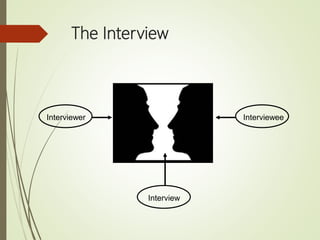
The Interview
Interviewer Interviewee
Interview
Interviews
 Unstructured
 Structured
 Semi-structured
Interviews
 Unstructured Interviews
 Researcher has a small set of self-prompts to help
investigate the research question, but questions are
not fixed. One question can lead to a number of
follow-up questions depending on the response.
They tend to be more like conversations than
interviews.
 Useful when exploring a new area.
Interviews
 Structured Interviews
 The questions are fixed and predetermined as is the
sequence of questions. No new questions can be
added during interview.
Interviews
 Semi-Structured Interviews
 Some interview questions are fully decided,
whereas others might not be fixed. The researcher
has leeway in asking follow-up questions.
 This is the ideal compromise, it gives a structure
to the interview, but also gives flexibility.
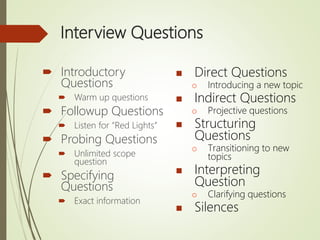
Interview Questions
 Introductory
Questions
 Warm up questions
 Followup Questions
 Listen for “Red Lights”
 Probing Questions
 Unlimited scope
question
 Specifying
Questions
 Exact information
 Direct Questions
 Introducing a new topic
 Indirect Questions
 Projective questions
 Structuring
Questions
 Transitioning to new
topics
 Interpreting
Question
 Clarifying questions
 Silences
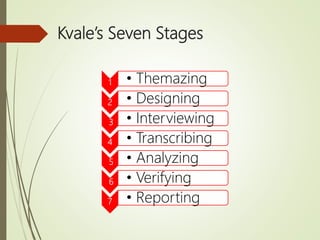
Kvale’s Seven Stages
1 • Themazing
2 • Designing
3 • Interviewing
4 • Transcribing
5 • Analyzing
6 • Verifying
7 • Reporting
1. Themazing
 What is the theme of the interview?
2. Designing
 How will the intended knowledge be obtained?
 Design your Interview Questions
3. Interviewing
 Conduct the interviews carefully
 Establish a rapport
 Treat interviewees with respect
 Think about your appearance
 Think about body language
 Maintain firm eye contact
 Don’t Invade their space
…Interviewing
 How are you going to record?
 Tape recorder
 Pen and paper – must be verbatim
 Video recorder
 But whichever you use, you must do a
verbatim recording of the interview, both
questions and answers.
4. Transcribing
 Converting interview into written text
 Must include everything said. Can be in appendix of
thesis or on a CD.
5. Analyzing
 Based on the appropriate type of
investigation
Simple Analysis
Analysing Text
Faced with the lack of organisation of
data and the sheer amount of rambling
can be somewhat overwhelming
With the best will in the world about
trying to avoid bias, when there is
multiple interpretations of data, selecting
the one that best matches your research
question becomes very tempting.
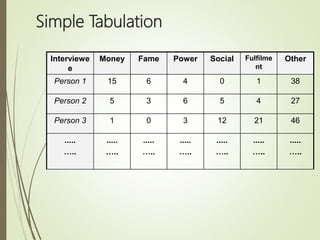
Simple Tabulation
Interviewe
e
Money Fame Power Social Fulfilme
nt
Other
Person 1 15 6 4 0 1 38
Person 2 5 3 6 5 4 27
Person 3 1 0 3 12 21 46
.....
…..
.....
…..
.....
…..
.....
…..
.....
…..
.....
…..
.....
…..
Choosing categories
 Use ones from the literature
 They will have validated the categories, and you
will have something to compare with.
 Use categories connected with your
research question
 Derive categories from data
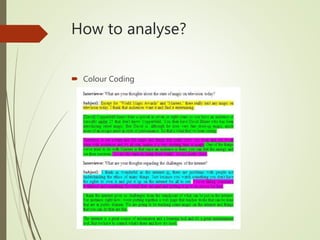
How to analyse?
 Colour Coding
Advanced Analysis
Meaning Analysis
 Meaning Coding
 Adding tags or keywords to text segments that
represent the main themes of the interviews
 Meaning Condensation
 Summarising larger sentences into short, simple
sentences.
 Meaning Interpretation
 Adding more details, background and context to
specific parts of the interview
Language Analysis
 Linguistic Analysis
 Looking at the linguistics and grammar
 Conversation Analysis
 Treating the interview as a conversation
 Narrative Analysis
 Treating the interview as a story
 Discourse Analysis
 Try to evaluate the truth of the responses
 Deconstruction
 Taking the interview apart and putting together
again
Eclectic Analysis
 Bricolage
 Using a collection of techniques as a collage
 Theoretical Reading
 Creating your own reading on the text
6. Verifying
 Checking that validity, reliability, and generalizibility of the findings
…Verifying
 Validity
 Can you check the truth of the statements? e.g.
number of employees in organisation, number of
customers
 Reliability
 Are there any internal contradictions? Did you
include the same question twice expressed in
different ways to check the truthfulness of the
responses?
 Generalizibility
 How do the answers agree with broader research
and other interview answers?
7. Reporting
 Communicate findings in a scientific and ethical
manner.
 In the dissertation document
Are there situations where I
shouldn’t use interviews?
 Yes, loads of situations, e.g. electoral voting
behaviour, or capturing a person’s attitudes
and interactions with their environments.
Are there software packages that
can help me ?
 Loads
 ATLAS.ti
 nVIVO
 MaxQDA
 NUD*IST
 HyperRESEARCH
 But, do not underestimate the power
of Excel, it’s a brilliant tool when used
well
Further Tips
 Decide on an order of questions that easily
flows one to the next
 Try to use language that is easy to
understand and relevant to the interviewee
 Avoid Leading questions
 Try to stop the interviewee using qualifiers
 Add a few control questions into the
interview for validation
 Avoid small talk during the interview
 LISTEN, LISTEN, LISTEN
Advantages
1. Opportunity for Feedback – Interviewer can provide direct
feedback to the respondent, give clarifications and help
alleviate any misconceptions or apprehensions over
confidentiality that the respondent may have in answering the
interviewer’s questions
2. Probing Complex Answers – Interviewers can probe if the
respondent’s answer is too brief or unclear. This gives
interviewers some flexibility in dealing with unstructured
questions and is especially suited for handling complex
questions
3. Length of Interview – If the questionnaire is very
lengthy, the personal interview is the best technique for
getting respondents to cooperate, without overtaxing
their patience
Cont..
4. Complete Questionnaires – Personal ensures ensure
that the respondent will answer all questions
asked, unlike in telephone interview where the
respondent may hang up or in mail questionnaire
where some questions may go unanswered
5. Props & Visual Aids – Interviewers have the
opportunity of showing respondents items such as
sample products, graphs ands sketches, which can
aid in their answers
6. High Participation – Interviewing respondents
personally can increase the likelihood of their
participation, as many people prefer to
communicate directly verbally and sharing
information and insights with interviewers
Disadvantages
1. Cost – Personal interviews are usually more expensive than
mail, telephone and internet surveys. Factors influencing the
cost of the interview include the respondents’ geographic
proximity, the length and complexity of the questionnaire,
and the number of non-respondents
2. Lack of Anonymity – Respondents are not anonymous in a
personal (face-to-face) interview and may be reluctant to
disclose certain information to the interviewer. Hence,
considerable must be expended by the interviewer when
dealing with sensitive questions to avoid bias effects on the
respondent’s part
3. Necessity for Callbacks – When a person selected for
interview cannot be reached the first time, a callback has to
be scheduled which result in extra cost and time spent
Cont..
4.Variance Effects – It has been shown that the
demographic characteristics of the interviewer can
influence the answers of the respondents. In one
study, male interviewers had a much larger variance
of answers than female interviewers in a sample of
most female individuals
5. Dishonesty – Interviewers cheat to make their life
easier and save time and effort
6. Personal Style – The interviewers individual
questioning style, techniques, approach and
demeanor may influence the respondents’ answers
7. Global Considerations – Cultural aspects may
influence peoples’ willingness to participate in an
interview (e.g. repressive Middle Eastern cultures
discourage females from being questioned by male
interviewers)
Conclusion
So we can use the interview technique
as one of the data collection methods
for the research.
It makes the researcher to feel that the
data what he collected is true and
honest and original by nature because
of the face to face interaction.
Resources
 Anything and everything by Steinar Kvale
 “Interpreting Qualitative Data” by David Silverman
 “Research Design” by John Creswell
Bibliography
 Kothari, C.R. (2009). Research methodology. New Delhi: New Age
International.
 Krishhnaswami, O.R., & Ranganatham, M. (2009). Methodology of
research in social sciences. Mumbai: Himalaya Publishing House.
 Panneerselvam, R. (2008). Research methodology. New Delhi:
Prentice Hall of India.
 Ramachandra.. Chandrashekara., & Shivakumar. (2006). Business
Research Methods. Mumbai: Himalaya Publishing House.
 Gupta, Shashi., & Rangi, Praneet. (2010). Business Research Methods.
New Delhi: Kalyani Publishers.
 http://www.public.asu.edu/~kroel/www500/Interview%20Fri.pdf

Interviews methods

  • 1.
    Interviews Method Muhammad Saleem AllamaIqbal Open University Islamabad
  • 2.
  • 3.
  • 4.
  • 5.
  • 6.
    Interviews  Unstructured Interviews Researcher has a small set of self-prompts to help investigate the research question, but questions are not fixed. One question can lead to a number of follow-up questions depending on the response. They tend to be more like conversations than interviews.  Useful when exploring a new area.
  • 7.
    Interviews  Structured Interviews The questions are fixed and predetermined as is the sequence of questions. No new questions can be added during interview.
  • 8.
    Interviews  Semi-Structured Interviews Some interview questions are fully decided, whereas others might not be fixed. The researcher has leeway in asking follow-up questions.  This is the ideal compromise, it gives a structure to the interview, but also gives flexibility.
  • 9.
    Interview Questions  Introductory Questions Warm up questions  Followup Questions  Listen for “Red Lights”  Probing Questions  Unlimited scope question  Specifying Questions  Exact information  Direct Questions  Introducing a new topic  Indirect Questions  Projective questions  Structuring Questions  Transitioning to new topics  Interpreting Question  Clarifying questions  Silences
  • 10.
    Kvale’s Seven Stages 1• Themazing 2 • Designing 3 • Interviewing 4 • Transcribing 5 • Analyzing 6 • Verifying 7 • Reporting
  • 11.
    1. Themazing  Whatis the theme of the interview?
  • 12.
    2. Designing  Howwill the intended knowledge be obtained?  Design your Interview Questions
  • 13.
    3. Interviewing  Conductthe interviews carefully  Establish a rapport  Treat interviewees with respect  Think about your appearance  Think about body language  Maintain firm eye contact  Don’t Invade their space
  • 14.
    …Interviewing  How areyou going to record?  Tape recorder  Pen and paper – must be verbatim  Video recorder  But whichever you use, you must do a verbatim recording of the interview, both questions and answers.
  • 15.
    4. Transcribing  Convertinginterview into written text  Must include everything said. Can be in appendix of thesis or on a CD.
  • 16.
    5. Analyzing  Basedon the appropriate type of investigation
  • 17.
  • 18.
    Analysing Text Faced withthe lack of organisation of data and the sheer amount of rambling can be somewhat overwhelming With the best will in the world about trying to avoid bias, when there is multiple interpretations of data, selecting the one that best matches your research question becomes very tempting.
  • 19.
    Simple Tabulation Interviewe e Money FamePower Social Fulfilme nt Other Person 1 15 6 4 0 1 38 Person 2 5 3 6 5 4 27 Person 3 1 0 3 12 21 46 ..... ….. ..... ….. ..... ….. ..... ….. ..... ….. ..... ….. ..... …..
  • 20.
    Choosing categories  Useones from the literature  They will have validated the categories, and you will have something to compare with.  Use categories connected with your research question  Derive categories from data
  • 21.
    How to analyse? Colour Coding
  • 22.
  • 23.
    Meaning Analysis  MeaningCoding  Adding tags or keywords to text segments that represent the main themes of the interviews  Meaning Condensation  Summarising larger sentences into short, simple sentences.  Meaning Interpretation  Adding more details, background and context to specific parts of the interview
  • 24.
    Language Analysis  LinguisticAnalysis  Looking at the linguistics and grammar  Conversation Analysis  Treating the interview as a conversation  Narrative Analysis  Treating the interview as a story  Discourse Analysis  Try to evaluate the truth of the responses  Deconstruction  Taking the interview apart and putting together again
  • 25.
    Eclectic Analysis  Bricolage Using a collection of techniques as a collage  Theoretical Reading  Creating your own reading on the text
  • 26.
    6. Verifying  Checkingthat validity, reliability, and generalizibility of the findings
  • 27.
    …Verifying  Validity  Canyou check the truth of the statements? e.g. number of employees in organisation, number of customers  Reliability  Are there any internal contradictions? Did you include the same question twice expressed in different ways to check the truthfulness of the responses?  Generalizibility  How do the answers agree with broader research and other interview answers?
  • 28.
    7. Reporting  Communicatefindings in a scientific and ethical manner.  In the dissertation document
  • 29.
    Are there situationswhere I shouldn’t use interviews?  Yes, loads of situations, e.g. electoral voting behaviour, or capturing a person’s attitudes and interactions with their environments.
  • 30.
    Are there softwarepackages that can help me ?  Loads  ATLAS.ti  nVIVO  MaxQDA  NUD*IST  HyperRESEARCH  But, do not underestimate the power of Excel, it’s a brilliant tool when used well
  • 31.
    Further Tips  Decideon an order of questions that easily flows one to the next  Try to use language that is easy to understand and relevant to the interviewee  Avoid Leading questions  Try to stop the interviewee using qualifiers  Add a few control questions into the interview for validation  Avoid small talk during the interview  LISTEN, LISTEN, LISTEN
  • 32.
    Advantages 1. Opportunity forFeedback – Interviewer can provide direct feedback to the respondent, give clarifications and help alleviate any misconceptions or apprehensions over confidentiality that the respondent may have in answering the interviewer’s questions 2. Probing Complex Answers – Interviewers can probe if the respondent’s answer is too brief or unclear. This gives interviewers some flexibility in dealing with unstructured questions and is especially suited for handling complex questions 3. Length of Interview – If the questionnaire is very lengthy, the personal interview is the best technique for getting respondents to cooperate, without overtaxing their patience
  • 33.
    Cont.. 4. Complete Questionnaires– Personal ensures ensure that the respondent will answer all questions asked, unlike in telephone interview where the respondent may hang up or in mail questionnaire where some questions may go unanswered 5. Props & Visual Aids – Interviewers have the opportunity of showing respondents items such as sample products, graphs ands sketches, which can aid in their answers 6. High Participation – Interviewing respondents personally can increase the likelihood of their participation, as many people prefer to communicate directly verbally and sharing information and insights with interviewers
  • 34.
    Disadvantages 1. Cost –Personal interviews are usually more expensive than mail, telephone and internet surveys. Factors influencing the cost of the interview include the respondents’ geographic proximity, the length and complexity of the questionnaire, and the number of non-respondents 2. Lack of Anonymity – Respondents are not anonymous in a personal (face-to-face) interview and may be reluctant to disclose certain information to the interviewer. Hence, considerable must be expended by the interviewer when dealing with sensitive questions to avoid bias effects on the respondent’s part 3. Necessity for Callbacks – When a person selected for interview cannot be reached the first time, a callback has to be scheduled which result in extra cost and time spent
  • 35.
    Cont.. 4.Variance Effects –It has been shown that the demographic characteristics of the interviewer can influence the answers of the respondents. In one study, male interviewers had a much larger variance of answers than female interviewers in a sample of most female individuals 5. Dishonesty – Interviewers cheat to make their life easier and save time and effort 6. Personal Style – The interviewers individual questioning style, techniques, approach and demeanor may influence the respondents’ answers 7. Global Considerations – Cultural aspects may influence peoples’ willingness to participate in an interview (e.g. repressive Middle Eastern cultures discourage females from being questioned by male interviewers)
  • 36.
    Conclusion So we canuse the interview technique as one of the data collection methods for the research. It makes the researcher to feel that the data what he collected is true and honest and original by nature because of the face to face interaction.
  • 37.
    Resources  Anything andeverything by Steinar Kvale  “Interpreting Qualitative Data” by David Silverman  “Research Design” by John Creswell
  • 38.
    Bibliography  Kothari, C.R.(2009). Research methodology. New Delhi: New Age International.  Krishhnaswami, O.R., & Ranganatham, M. (2009). Methodology of research in social sciences. Mumbai: Himalaya Publishing House.  Panneerselvam, R. (2008). Research methodology. New Delhi: Prentice Hall of India.  Ramachandra.. Chandrashekara., & Shivakumar. (2006). Business Research Methods. Mumbai: Himalaya Publishing House.  Gupta, Shashi., & Rangi, Praneet. (2010). Business Research Methods. New Delhi: Kalyani Publishers.  http://www.public.asu.edu/~kroel/www500/Interview%20Fri.pdf