GRAND ROUND
Dr. Yasir Jameel
Clinical Fellow Orthopadic Trauma
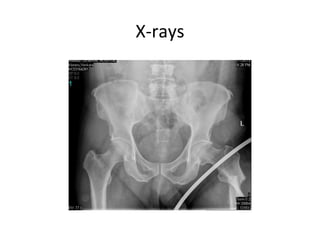
• 80 year old male sustaind fall at home and
presented with hip pain to A&E
• History
• Age, sex, occupation
• Presenting complain
• History of PC
• Past medical history
• Past surgical history
• Drugs, Allergies
• Social history
Investigations
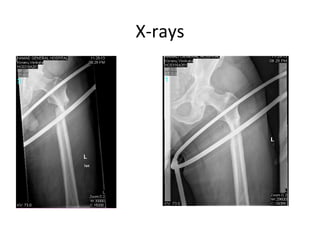
X-rays
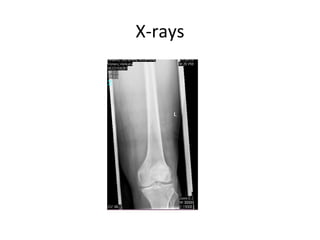
X-rays
X-rays
Subtrochenteric femur fracture
• Subtrochanteric area typically defined as area
from lesser trochanter to 5cm distal.
• fractures with an associated intertrochanteric
component may be called intertrochanteric
fracture with subtrochanteric extension or
peritrochanteric fracture
Epidemiology
• Younger patients with a high-energy
mechanism RTA
• may occur in elderly patients from a low-
energy mechanism
• Pathologic or atypical femur fracture
• Bisphosphonate use, particularly alendronate,
can be risk factor
• Preveious neck fixation with screws placed
with entry below lesser trochenter
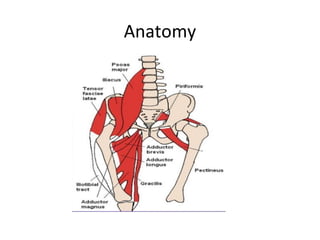
Anatomy
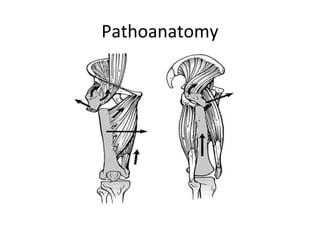
Pathoanatomy
• Deforming forces on the proximal fragment
• Abduction
gluteus medius and gluteus minimus
• Flexion
iliopsoas
• External rotation
short external rotators
• deforming forces on distal fragment
• Adduction
hip adductors
• Shortening
quads and hamstrings
Pathoanatomy
Biomechanics
• Posteriomedial femur undergoes compressive
forces
• Lateral femur undergoes tensile forces
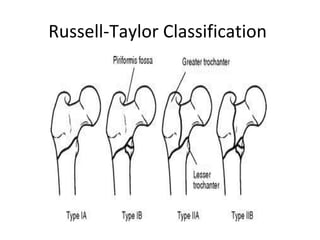
Russell-Taylor Classification
• Based on integrity of the piriformis fossa.
• Designed to guide treatment of intramedullary nails
using a piriformis fossa starting point.
Type I - intact piriformis fossa
A - lesser trochanter attached to proximal fragment
B - lesser trochanter detached from proximal fragment
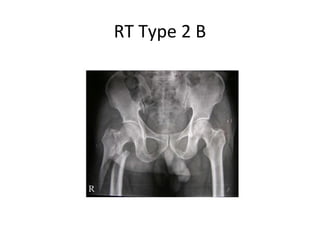
Type II - fracture extends into piriformis fossa
A - stable posterior-medial buttress
B - comminution of lesser trochanter
Russell-Taylor Classification
RT Type 2 B
Treatment
• Nonoperative
– observation with pain management
• indications
– non-ambulatory patients with medical co-morbidities not fit
for surgery
– limited role due to strong muscular forces displacing fracture
and inability to mobilize patients without surgical intervention
Treatment
• Operative
– intramedullary nailing (usually cephalomedullary)
• indications
– historically Russel-Taylor type I fractures
– newer design of intramedullary nails has expanded indications
– most subtrochanteric fractures treated with IM nail
– fixed angle plate
• indications
– surgeon preference
– associated femoral neck fracture
– narrow medullary canal
– pre-existing femoral shaft deformity
Complications
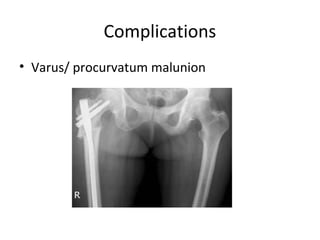
• Varus/ procurvatum malunion
Complications
• Nonunion
Incidence of 0-8% , continued inability to bear
weight at 4-6 months and continued pain.
Varus malreduction is an important predictor
of nonunion accompanied by implant failure.
Complications
• Malunion:
Coxa varus: Caused by uncorrected abduction
deformity, nail entry point that is too lateral, and
migration of hardware proximally in the femoral
head and neck
Shortening: Due to uncorrected shortening
intraoperatively and premature dynamization.
Rotational deformity: Do to uncorrected external
rotation of proximal fragment. This can be
assessed intraoperatively with visualization of the
lesser trochanter
Complications
• Fixation failure: Most common in osteoporotic
bone. Screw cutout in the femoral head;
backing out of locking screws.
• Failure of implant: Excessive motion at
fracture site leads to implant fatigue
• Do you have any question??????????????????
THANK YOU

Subtrochenteric femur fracture

  • 1.
    GRAND ROUND Dr. YasirJameel Clinical Fellow Orthopadic Trauma
  • 2.
    • 80 yearold male sustaind fall at home and presented with hip pain to A&E
  • 3.
  • 4.
    • Age, sex,occupation • Presenting complain • History of PC • Past medical history • Past surgical history • Drugs, Allergies • Social history
  • 5.
  • 6.
  • 7.
  • 8.
  • 9.
    Subtrochenteric femur fracture •Subtrochanteric area typically defined as area from lesser trochanter to 5cm distal. • fractures with an associated intertrochanteric component may be called intertrochanteric fracture with subtrochanteric extension or peritrochanteric fracture
  • 10.
    Epidemiology • Younger patientswith a high-energy mechanism RTA • may occur in elderly patients from a low- energy mechanism • Pathologic or atypical femur fracture • Bisphosphonate use, particularly alendronate, can be risk factor • Preveious neck fixation with screws placed with entry below lesser trochenter
  • 11.
  • 12.
    Pathoanatomy • Deforming forceson the proximal fragment • Abduction gluteus medius and gluteus minimus • Flexion iliopsoas • External rotation short external rotators • deforming forces on distal fragment • Adduction hip adductors • Shortening quads and hamstrings
  • 13.
  • 14.
    Biomechanics • Posteriomedial femurundergoes compressive forces • Lateral femur undergoes tensile forces
  • 15.
    Russell-Taylor Classification • Basedon integrity of the piriformis fossa. • Designed to guide treatment of intramedullary nails using a piriformis fossa starting point. Type I - intact piriformis fossa A - lesser trochanter attached to proximal fragment B - lesser trochanter detached from proximal fragment Type II - fracture extends into piriformis fossa A - stable posterior-medial buttress B - comminution of lesser trochanter
  • 16.
  • 17.
  • 18.
    Treatment • Nonoperative – observationwith pain management • indications – non-ambulatory patients with medical co-morbidities not fit for surgery – limited role due to strong muscular forces displacing fracture and inability to mobilize patients without surgical intervention
  • 19.
    Treatment • Operative – intramedullarynailing (usually cephalomedullary) • indications – historically Russel-Taylor type I fractures – newer design of intramedullary nails has expanded indications – most subtrochanteric fractures treated with IM nail – fixed angle plate • indications – surgeon preference – associated femoral neck fracture – narrow medullary canal – pre-existing femoral shaft deformity
  • 20.
  • 21.
    Complications • Nonunion Incidence of0-8% , continued inability to bear weight at 4-6 months and continued pain. Varus malreduction is an important predictor of nonunion accompanied by implant failure.
  • 22.
    Complications • Malunion: Coxa varus:Caused by uncorrected abduction deformity, nail entry point that is too lateral, and migration of hardware proximally in the femoral head and neck Shortening: Due to uncorrected shortening intraoperatively and premature dynamization. Rotational deformity: Do to uncorrected external rotation of proximal fragment. This can be assessed intraoperatively with visualization of the lesser trochanter
  • 23.
    Complications • Fixation failure:Most common in osteoporotic bone. Screw cutout in the femoral head; backing out of locking screws. • Failure of implant: Excessive motion at fracture site leads to implant fatigue
  • 24.
    • Do youhave any question??????????????????
  • 25.