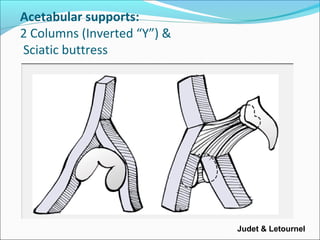
Acetabular supports:
2 Columns (Inverted “Y”) &
Sciatic buttress
Judet & Letournel
Judet & Letournel
Analysed inominate bone anatomy.
Plane of Ilium & Obturator foramen ~ 90o
450
to frontal plane
X rays at 45 oblique views.
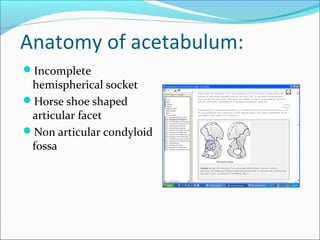
Anatomy of acetabulum:
Incomplete
hemispherical socket
Horse shoe shaped
articular facet
Non articular condyloid
fossa
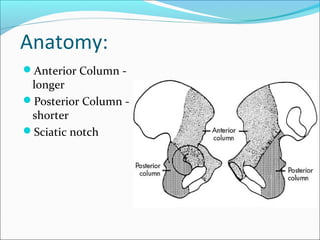
Anatomy:
Anterior Column -
longer
Posterior Column -
shorter
Sciatic notch
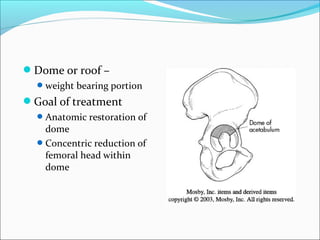
Dome or roof –
weight bearing portion
Goal of treatment
Anatomic restoration of
dome
Concentric reduction of
femoral head within
dome
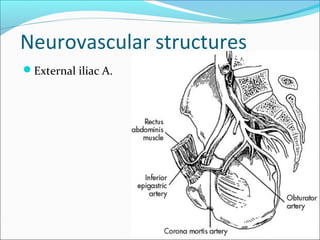
Neurovascular structures
External iliac A.
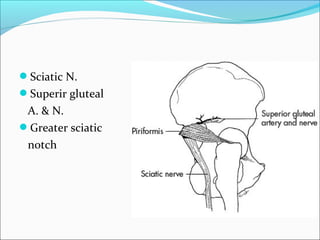
Sciatic N.
Superir gluteal
A. & N.
Greater sciatic
notch
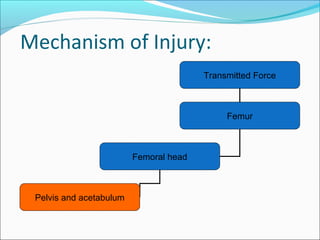
Mechanism of Injury:
Transmitted Force
Femur
Femoral head
Pelvis and acetabulum
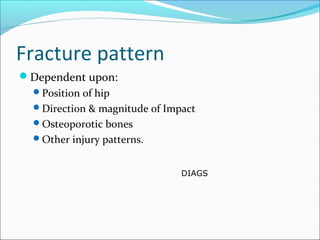
Fracture pattern
Dependent upon:
Position of hip
Direction & magnitude of Impact
Osteoporotic bones
Other injury patterns.
DIAGS
Hip flexed –Posterior wall # Dislocation
Internal rotation & adduction – Dislocate without
fracture.
Neutral hip - # posterior wall
Abducted position – Transverse # with posterior wall
Magnitude of force / displacement –
degree of comminution
Degree of articular impaction
Strength of the bone.
Clinical Evaluation:ABCD
Life threatening injuries
HEMODYNAMIC STABILITY
Superior gluteal A. or V.
Selective angeography
Head, chest, abdomen
57% have other associated injuries.
Secondary survey – knee, patella, ligaments.
Morel Lavalle lesion
Skin
Subcutaneous degloving, hematoma.
Fluid wave, fluctuent
Circumscribed area of anaesthesia / Echymosis
Culture
Significance in surgical treatment.
Neurological injuries
30% partial injuries to sciatic N.
More commonly peroneal division.
Superior gluteal N.
Impossible to assess abductor strength in acute
fractures.
Dislocation may be missed on examination
X rays needed
Dislocation – Urgently reduced
Osteonecrosis femoral head.
Wearing of head against intra articular fragments
Urgent skeletal traction.
Associated injuries:
Posterior pelvic ring disruption –
reduction and fixation prior to acetabular # treatment.
Recreate a stable posterior pelvis to reduce the
acetabulum to.
Contralateral rami #s
Intraop traction not used
Concurrent symphysis dislocations.
Radiographic evaluation:
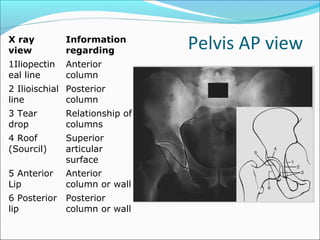
Pelvis AP view
Judet views – 45 degree oblique
Aid in classification
Identify # displacements.
OUT OF TRACTION
Painful – premedication.
Pelvic inlet / Outlet views – useful but not
mandatory
Pelvis AP viewX ray
view
Information
regarding
1Iliopectin
eal line
Anterior
column
2 Ilioischial
line
Posterior
column
3 Tear
drop
Relationship of
columns
4 Roof
(Sourcil)
Superior
articular
surface
5 Anterior
Lip
Anterior
column or wall
6 Posterior
lip
Posterior
column or wall
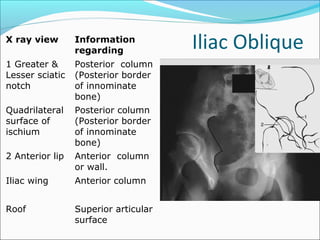
Iliac ObliqueX ray view Information
regarding
1 Greater &
Lesser sciatic
notch
Posterior column
(Posterior border
of innominate
bone)
Quadrilateral
surface of
ischium
Posterior column
(Posterior border
of innominate
bone)
2 Anterior lip Anterior column
or wall.
Iliac wing Anterior column
Roof Superior articular
surface
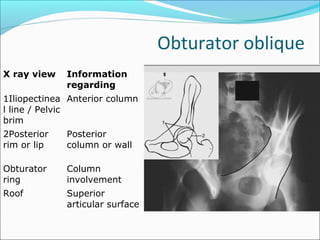
Obturator oblique
X ray view Information
regarding
1Iliopectinea
l line / Pelvic
brim
Anterior column
2Posterior
rim or lip
Posterior
column or wall
Obturator
ring
Column
involvement
Roof Superior
articular surface
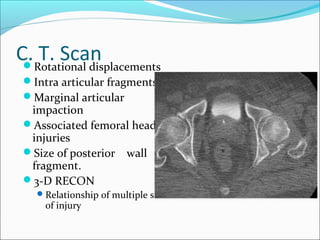
C. T. ScanRotational displacements
Intra articular fragments
Marginal articular
impaction
Associated femoral head
injuries
Size of posterior wall
fragment.
3-D RECON
Relationship of multiple sites
of injury
Dry bone model or Line drawing:
Fracture pattern
Drawing the fracture lines from X ray landmarks
Should be drawn always before surgery.
Fracture pattern truly appreciated.
Fracture Classification:
Judet and Letournel Classification
Orthopaedic Trauma Association Classification
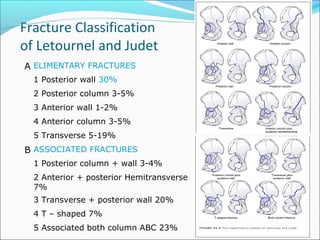
Fracture Classification
of Letournel and Judet
A ELIMENTARY FRACTURES
1 Posterior wall 30%
2 Posterior column 3-5%
3 Anterior wall 1-2%
4 Anterior column 3-5%
5 Transverse 5-19%
B ASSOCIATED FRACTURES
1 Posterior column + wall 3-4%
2 Anterior + posterior Hemitransverse
7%
3 Transverse + posterior wall 20%
4 T – shaped 7%
5 Associated both column ABC 23%
Treatment options:
Non surgical treatment
Operative treatment
Non-operative treatment
Unlike most articular #s having specific operative
indications acetabular #s are
generally considered requiring operative treatment
Unless certain non-operative criteria are met.
Other factors – fracture displacement and location,
stability of hip & patient related factors.
Criteria for Non-operative
Management (Four)
Roof arcs >45 degrees.
No fracture involvement in cranial 10 mm of joint on
CT (CT subchondral arc).
No femoral head subluxation on three x-rays, taken
out of traction.
For posterior wall fractures: less than 40% of width of
wall on CT .
Criteria by Olson & Matta
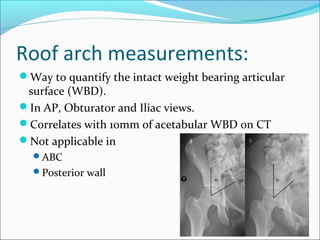
Roof arch measurements:
Way to quantify the intact weight bearing articular
surface (WBD).
In AP, Obturator and Iliac views.
Correlates with 10mm of acetabular WBD on CT
Not applicable in
ABC
Posterior wall
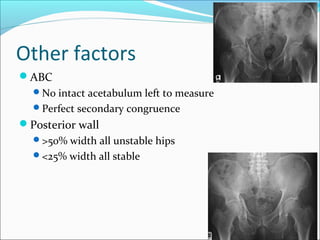
Other factors
ABC
No intact acetabulum left to measure
Perfect secondary congruence
Posterior wall
>50% width all unstable hips
<25% width all stable
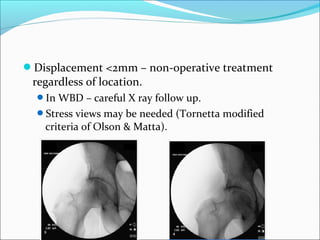
Displacement <2mm – non-operative treatment
regardless of location.
In WBD – careful X ray follow up.
Stress views may be needed (Tornetta modified
criteria of Olson & Matta).
Patient related factors
Age
Preinjury activity level
Functional demands
Medical comorbidities
Old patients
Planned arthroplasty once arthritis develops.
Operative Treatment:
Earlier the better once decided to operate.
After 3 wks – results not good.
Not an emergency except
Irreducible hip dislocation
Progressing neurological deficits
Open #s
Vascular injuries
Surgery
ORIF - treatment of choice
GOAL
Anatomic reduction of articular surface
Avoiding complications
Restoring congruent joint
Stable hip
Maximize the potential for long term survival of hip.
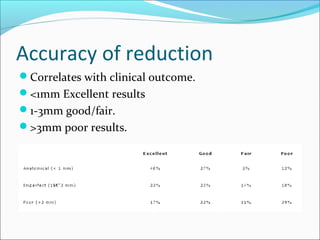
Accuracy of reduction
Correlates with clinical outcome.
<1mm Excellent results
1-3mm good/fair.
>3mm poor results.
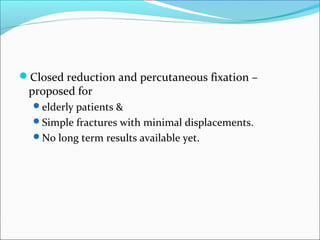
Closed reduction and percutaneous fixation –
proposed for
elderly patients &
Simple fractures with minimal displacements.
No long term results available yet.
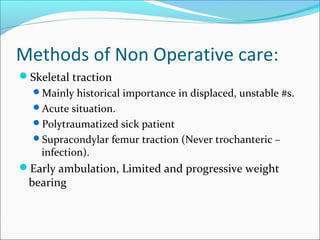
Methods of Non Operative care:
Skeletal traction
Mainly historical importance in displaced, unstable #s.
Acute situation.
Polytraumatized sick patient
Supracondylar femur traction (Never trochanteric –
infection).
Early ambulation, Limited and progressive weight
bearing
Early ambulation, Limited and progressive
weight bearing
Mobilization with protected wt bearing – 10-30Lb
TDWB
If bilateral – transferred in bed to chair manner.
Early CPM
Weight bearing at min 8 weeks
Certain of stability if any doubt – Dynamic stress
views.
Serial X-rays – late subluxation or loss of position
of articular fragments.
Surgical indications:
Loss of congruence (Subluxation) of hip on any
view (AP or Judet x-rays)
Displacement of >2 mm within the superior
articular surface (weightbearing dome)
Retained intraarticular fragments,
Greater than 25% of the width of the posterior wall
on CT or demonstrable instability.
Lack of secondary congruence for an associated
both column fracture.
Other factors favoring operative
intervention:
Sciatic N lesion developing
following closed reduction or
while in traction.
Associated fracture of femur
Traction not possible
Ipsilateral knee disruption
Patellar fracture or posterior ligamentous injuries.
Indications for Emergency ORIF
Irreducible dislocation, usually by
Large fragments of bone within the joint
Soft tissue interposition.
Head buttonholed through capsule.
Unstable hip following reduction
Increasing neurologic deficit
Before reduction–Urgent closed reduction
After reduction-Urgent Open reduction.
Associated Vascular injury – mc anterior column
fractures.
Open fractures.
Contraindications
In Patient
Very osteoporotic
Severe associated injuries
In Fracture
Very comminuted inoperable fracture
In Surgical team
Not experienced in such surgeries
No expert help available.
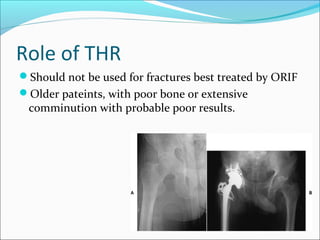
Role of THR
Should not be used for fractures best treated by ORIF
Older pateints, with poor bone or extensive
comminution with probable poor results.
Surgical approaches:
FRACTURE TYPE APPROACH
ELIMENTARY FRACTURES
1 Posterior wall Kocher-Langenbeck
2 Posterior column Kocher-Langenbeck
3 Anterior wall Ilioinguinal
4 Anterior column Ilioinguinal
5 Transverse
Infratectal/Juxtatectal
Transtectal
Kocher-Langenbeck
Extended iliofemoral
or Kocher-Langenbeck
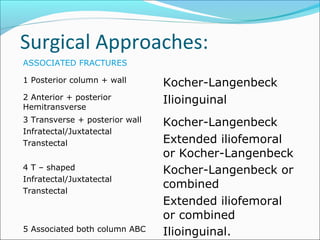
Surgical Approaches:
ASSOCIATED FRACTURES
1 Posterior column + wall Kocher-Langenbeck
2 Anterior + posterior
Hemitransverse
Ilioinguinal
3 Transverse + posterior wall
Infratectal/Juxtatectal
Transtectal
Kocher-Langenbeck
Extended iliofemoral
or Kocher-Langenbeck
4 T – shaped
Infratectal/Juxtatectal
Transtectal
Kocher-Langenbeck or
combined
Extended iliofemoral
or combined
5 Associated both column ABC Ilioinguinal.
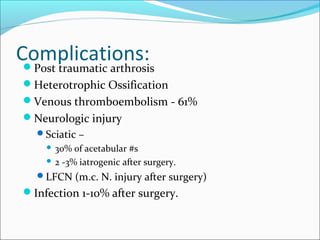
Complications:Post traumatic arthrosis
Heterotrophic Ossification
Venous thromboembolism - 61%
Neurologic injury
Sciatic –
 30% of acetabular #s
 2 -3% iatrogenic after surgery.
LFCN (m.c. N. injury after surgery)
Infection 1-10% after surgery.
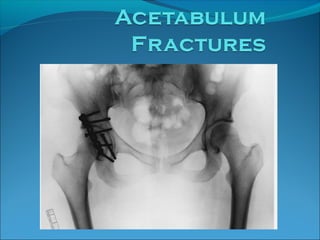
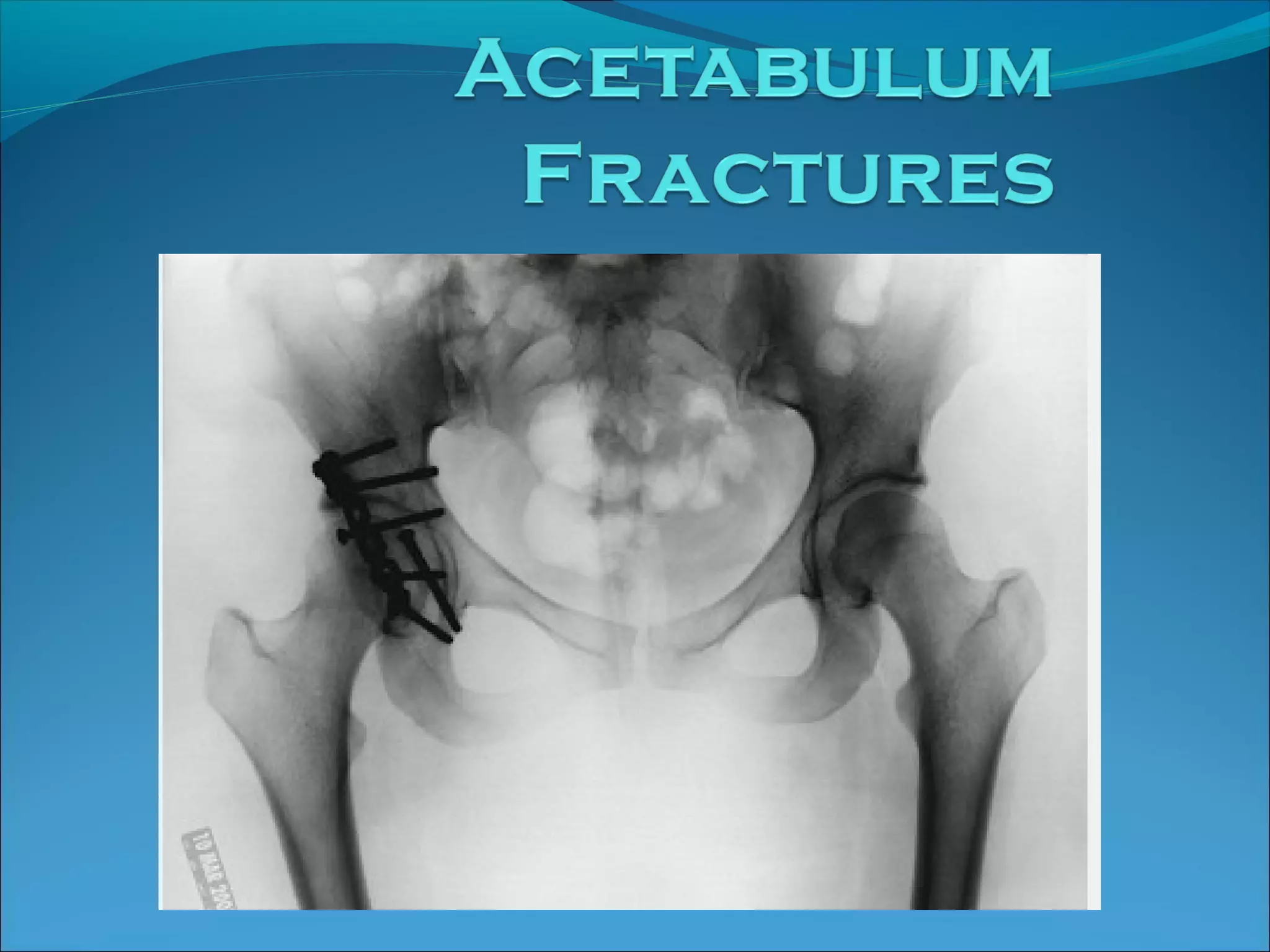
Acetabulum fractures

Acetabulum fractures

  • 2.
    Acetabular supports: 2 Columns(Inverted “Y”) & Sciatic buttress Judet & Letournel
  • 3.
    Judet & Letournel Analysedinominate bone anatomy. Plane of Ilium & Obturator foramen ~ 90o 450 to frontal plane X rays at 45 oblique views.
  • 4.
    Anatomy of acetabulum: Incomplete hemisphericalsocket Horse shoe shaped articular facet Non articular condyloid fossa
  • 5.
    Anatomy: Anterior Column - longer PosteriorColumn - shorter Sciatic notch
  • 6.
    Dome or roof– weight bearing portion Goal of treatment Anatomic restoration of dome Concentric reduction of femoral head within dome
  • 8.
  • 9.
    Sciatic N. Superir gluteal A.& N. Greater sciatic notch
  • 10.
    Mechanism of Injury: TransmittedForce Femur Femoral head Pelvis and acetabulum
  • 11.
    Fracture pattern Dependent upon: Positionof hip Direction & magnitude of Impact Osteoporotic bones Other injury patterns. DIAGS
  • 12.
    Hip flexed –Posteriorwall # Dislocation Internal rotation & adduction – Dislocate without fracture. Neutral hip - # posterior wall Abducted position – Transverse # with posterior wall
  • 13.
    Magnitude of force/ displacement – degree of comminution Degree of articular impaction Strength of the bone.
  • 14.
    Clinical Evaluation:ABCD Life threateninginjuries HEMODYNAMIC STABILITY Superior gluteal A. or V. Selective angeography Head, chest, abdomen 57% have other associated injuries. Secondary survey – knee, patella, ligaments.
  • 15.
    Morel Lavalle lesion Skin Subcutaneousdegloving, hematoma. Fluid wave, fluctuent Circumscribed area of anaesthesia / Echymosis Culture Significance in surgical treatment.
  • 16.
    Neurological injuries 30% partialinjuries to sciatic N. More commonly peroneal division. Superior gluteal N. Impossible to assess abductor strength in acute fractures.
  • 17.
    Dislocation may bemissed on examination X rays needed Dislocation – Urgently reduced Osteonecrosis femoral head. Wearing of head against intra articular fragments Urgent skeletal traction.
  • 18.
    Associated injuries: Posterior pelvicring disruption – reduction and fixation prior to acetabular # treatment. Recreate a stable posterior pelvis to reduce the acetabulum to. Contralateral rami #s Intraop traction not used Concurrent symphysis dislocations.
  • 19.
    Radiographic evaluation: Pelvis APview Judet views – 45 degree oblique Aid in classification Identify # displacements. OUT OF TRACTION Painful – premedication. Pelvic inlet / Outlet views – useful but not mandatory
  • 20.
    Pelvis AP viewXray view Information regarding 1Iliopectin eal line Anterior column 2 Ilioischial line Posterior column 3 Tear drop Relationship of columns 4 Roof (Sourcil) Superior articular surface 5 Anterior Lip Anterior column or wall 6 Posterior lip Posterior column or wall
  • 21.
    Iliac ObliqueX rayview Information regarding 1 Greater & Lesser sciatic notch Posterior column (Posterior border of innominate bone) Quadrilateral surface of ischium Posterior column (Posterior border of innominate bone) 2 Anterior lip Anterior column or wall. Iliac wing Anterior column Roof Superior articular surface
  • 22.
    Obturator oblique X rayview Information regarding 1Iliopectinea l line / Pelvic brim Anterior column 2Posterior rim or lip Posterior column or wall Obturator ring Column involvement Roof Superior articular surface
  • 23.
    C. T. ScanRotationaldisplacements Intra articular fragments Marginal articular impaction Associated femoral head injuries Size of posterior wall fragment. 3-D RECON Relationship of multiple sites of injury
  • 24.
    Dry bone modelor Line drawing: Fracture pattern Drawing the fracture lines from X ray landmarks Should be drawn always before surgery. Fracture pattern truly appreciated.
  • 25.
    Fracture Classification: Judet andLetournel Classification Orthopaedic Trauma Association Classification
  • 26.
    Fracture Classification of Letourneland Judet A ELIMENTARY FRACTURES 1 Posterior wall 30% 2 Posterior column 3-5% 3 Anterior wall 1-2% 4 Anterior column 3-5% 5 Transverse 5-19% B ASSOCIATED FRACTURES 1 Posterior column + wall 3-4% 2 Anterior + posterior Hemitransverse 7% 3 Transverse + posterior wall 20% 4 T – shaped 7% 5 Associated both column ABC 23%
  • 27.
    Treatment options: Non surgicaltreatment Operative treatment
  • 28.
    Non-operative treatment Unlike mostarticular #s having specific operative indications acetabular #s are generally considered requiring operative treatment Unless certain non-operative criteria are met. Other factors – fracture displacement and location, stability of hip & patient related factors.
  • 29.
    Criteria for Non-operative Management(Four) Roof arcs >45 degrees. No fracture involvement in cranial 10 mm of joint on CT (CT subchondral arc). No femoral head subluxation on three x-rays, taken out of traction. For posterior wall fractures: less than 40% of width of wall on CT . Criteria by Olson & Matta
  • 30.
    Roof arch measurements: Wayto quantify the intact weight bearing articular surface (WBD). In AP, Obturator and Iliac views. Correlates with 10mm of acetabular WBD on CT Not applicable in ABC Posterior wall
  • 31.
    Other factors ABC No intactacetabulum left to measure Perfect secondary congruence Posterior wall >50% width all unstable hips <25% width all stable
  • 32.
    Displacement <2mm –non-operative treatment regardless of location. In WBD – careful X ray follow up. Stress views may be needed (Tornetta modified criteria of Olson & Matta).
  • 33.
    Patient related factors Age Preinjuryactivity level Functional demands Medical comorbidities Old patients Planned arthroplasty once arthritis develops.
  • 34.
    Operative Treatment: Earlier thebetter once decided to operate. After 3 wks – results not good. Not an emergency except Irreducible hip dislocation Progressing neurological deficits Open #s Vascular injuries
  • 35.
    Surgery ORIF - treatmentof choice GOAL Anatomic reduction of articular surface Avoiding complications Restoring congruent joint Stable hip Maximize the potential for long term survival of hip.
  • 36.
    Accuracy of reduction Correlateswith clinical outcome. <1mm Excellent results 1-3mm good/fair. >3mm poor results.
  • 37.
    Closed reduction andpercutaneous fixation – proposed for elderly patients & Simple fractures with minimal displacements. No long term results available yet.
  • 38.
    Methods of NonOperative care: Skeletal traction Mainly historical importance in displaced, unstable #s. Acute situation. Polytraumatized sick patient Supracondylar femur traction (Never trochanteric – infection). Early ambulation, Limited and progressive weight bearing
  • 39.
    Early ambulation, Limitedand progressive weight bearing Mobilization with protected wt bearing – 10-30Lb TDWB If bilateral – transferred in bed to chair manner. Early CPM Weight bearing at min 8 weeks Certain of stability if any doubt – Dynamic stress views. Serial X-rays – late subluxation or loss of position of articular fragments.
  • 40.
    Surgical indications: Loss ofcongruence (Subluxation) of hip on any view (AP or Judet x-rays) Displacement of >2 mm within the superior articular surface (weightbearing dome) Retained intraarticular fragments, Greater than 25% of the width of the posterior wall on CT or demonstrable instability. Lack of secondary congruence for an associated both column fracture.
  • 41.
    Other factors favoringoperative intervention: Sciatic N lesion developing following closed reduction or while in traction. Associated fracture of femur Traction not possible Ipsilateral knee disruption Patellar fracture or posterior ligamentous injuries.
  • 42.
    Indications for EmergencyORIF Irreducible dislocation, usually by Large fragments of bone within the joint Soft tissue interposition. Head buttonholed through capsule. Unstable hip following reduction Increasing neurologic deficit Before reduction–Urgent closed reduction After reduction-Urgent Open reduction. Associated Vascular injury – mc anterior column fractures. Open fractures.
  • 43.
    Contraindications In Patient Very osteoporotic Severeassociated injuries In Fracture Very comminuted inoperable fracture In Surgical team Not experienced in such surgeries No expert help available.
  • 44.
    Role of THR Shouldnot be used for fractures best treated by ORIF Older pateints, with poor bone or extensive comminution with probable poor results.
  • 45.
    Surgical approaches: FRACTURE TYPEAPPROACH ELIMENTARY FRACTURES 1 Posterior wall Kocher-Langenbeck 2 Posterior column Kocher-Langenbeck 3 Anterior wall Ilioinguinal 4 Anterior column Ilioinguinal 5 Transverse Infratectal/Juxtatectal Transtectal Kocher-Langenbeck Extended iliofemoral or Kocher-Langenbeck
  • 46.
    Surgical Approaches: ASSOCIATED FRACTURES 1Posterior column + wall Kocher-Langenbeck 2 Anterior + posterior Hemitransverse Ilioinguinal 3 Transverse + posterior wall Infratectal/Juxtatectal Transtectal Kocher-Langenbeck Extended iliofemoral or Kocher-Langenbeck 4 T – shaped Infratectal/Juxtatectal Transtectal Kocher-Langenbeck or combined Extended iliofemoral or combined 5 Associated both column ABC Ilioinguinal.
  • 47.
    Complications:Post traumatic arthrosis HeterotrophicOssification Venous thromboembolism - 61% Neurologic injury Sciatic –  30% of acetabular #s  2 -3% iatrogenic after surgery. LFCN (m.c. N. injury after surgery) Infection 1-10% after surgery.