Critical Alerts in Laboratory
Group :1
Dr. Pallavi Shukla Reviewed By :
Dr. Sujith H. Dr. Lallu Joseph
Mr. Govardan Dr. Uma Shankar
Mr. Shankar Hiremat Ms. Jyothi Ramesh
Defining Critical Value
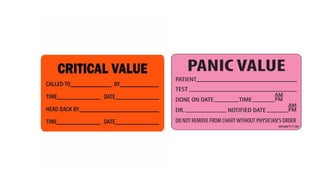
“Values that are outside normal range to a degree that may contribute on immediate health
risk to individual or require immediate action on part of ordering physician”
•Alert value:
These are results that deviate from their reference ranges less
significantly than critical values.
Why is it so Important??
• To prevent imminent life threatening situation
• Help clinicians redefining treatment plans
• Failure to report poses a threat to patient safety and hospital quality
• critical values communication is now an integral part of many accreditation
procedures for medical laboratories like ISO,NABL
• endorsed as one of the leading quality indicators of the post-analytical phase by
International Federation of Clinical Chemistry and Laboratory Medicine (IFCC).
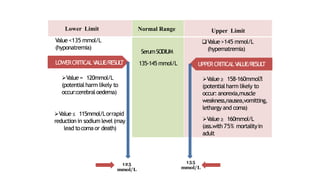
Upper Limit
Lower Limit Normal Range
Value= 120mmol/L
(potentialharm likely to
occur:cerebraloedema)
Value≤ 115mmol/Lorrapid
reductionin sodium level (may
lead tocomaor death)
SerumSODIUM
135-145 mmol/L
Value>145 mmol/L
(hypernatremia)
Value<135 mmol/L
(hyponatremia)
LOWERCRITICALV
ALUE/RESUL
T UPPERCRITICALV
ALUE/RESUL
T
125
mmol/L
155
mmol/L
Value≥ 158-160mmol?l
(potentialharm likely to
occur:anorexia,muscle
weakness,nausea,vomitting,
lethargy and coma)
Value≥ 160mmol/L
(ass.with 75% mortalityin
adult
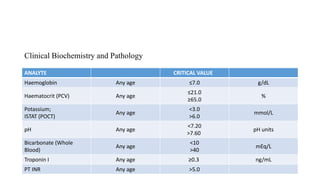
ANALYTE CRITICAL VALUE
Haemoglobin Any age ≤7.0 g/dL
Haematocrit (PCV) Any age
≤21.0
≥65.0
%
Potassium;
ISTAT (POCT)
Any age
<3.0
>6.0
mmol/L
pH Any age
<7.20
>7.60
pH units
Bicarbonate (Whole
Blood)
Any age
<10
>40
mEq/L
Troponin I Any age ≥0.3 ng/mL
PT INR Any age >5.0
Clinical Biochemistry and Pathology
Microbiology:
Any Assay with positive bioterrorism agent.
Serology.
Any Clinically Important Positive Culture.
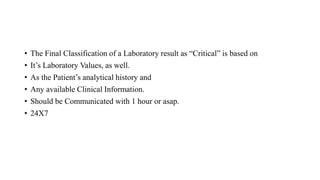
• The Final Classification of a Laboratory result as “Critical” is based on
• It’s Laboratory Values, as well.
• As the Patient’s analytical history and
• Any available Clinical Information.
• Should be Communicated with 1 hour or asap.
• 24X7
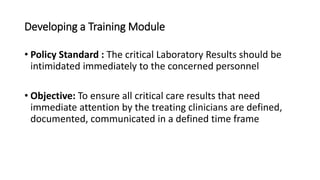
Developing a Training Module
• Policy Standard : The critical Laboratory Results should be
intimidated immediately to the concerned personnel
• Objective: To ensure all critical care results that need
immediate attention by the treating clinicians are defined,
documented, communicated in a defined time frame
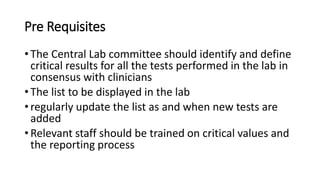
Pre Requisites
• The Central Lab committee should identify and define
critical results for all the tests performed in the lab in
consensus with clinicians
• The list to be displayed in the lab
• regularly update the list as and when new tests are
added
• Relevant staff should be trained on critical values and
the reporting process
•Implementation Guidelines/Requirements:
Target Personnel:
Qualified lab personnel,
Nursing staff, Doctors
Training frequency: To be part of induction program and
updated during on going training
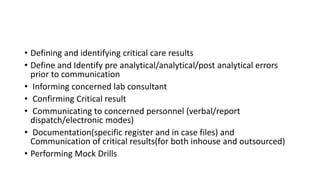
• Defining and identifying critical care results
• Define and Identify pre analytical/analytical/post analytical errors
prior to communication
• Informing concerned lab consultant
• Confirming Critical result
• Communicating to concerned personnel (verbal/report
dispatch/electronic modes)
• Documentation(specific register and in case files) and
Communication of critical results(for both inhouse and outsourced)
• Performing Mock Drills
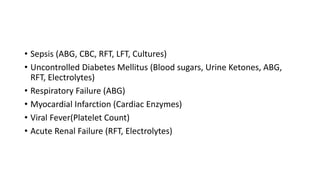
• Sepsis (ABG, CBC, RFT, LFT, Cultures)
• Uncontrolled Diabetes Mellitus (Blood sugars, Urine Ketones, ABG,
RFT, Electrolytes)
• Respiratory Failure (ABG)
• Myocardial Infarction (Cardiac Enzymes)
• Viral Fever(Platelet Count)
• Acute Renal Failure (RFT, Electrolytes)
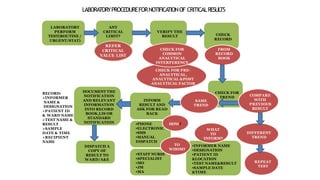
LABORA
TORYPROCEDUREFORNOTIFICA
TIONOF CRITICALRESUL
TS
LABORATORY
PERFORM
TEST(ROUTINE /
URGENT/STAT)
VERIFY THE
RESULT CHECK
RECORD
ANY
CRITICAL
LIMIT?
REFER
CRITICAL
VALUE LIST
DISPATCH A
COPY OF
RESULT TO
WARD/A&E
CHECK FOR
TREND
PHONE
ELECTRONIC
SMS
MANUAL
DISPATCH
DOCUMENT THE
NOTIFICATION
AND RELEVANT
INFORMATION
INTO RECORD
BOOK,LIS OR
STANDARD
NOTIFICATION
STAFF NURSE
SPECIALIST
MO
JM
MA
INFORM
RESULT AND
ASK FOR READ
BACK
FROM
RECORD
BOOK
COMPARE
WITH
PREVIOUS
RESULT
WHAT
TO
INFORM?
INFORMER NAME
DESIGNATION
PATIENT ID
&LOCATION
TEST NAME&RESULT
SAMPLE DATE
&TIME
DIFFERENT
TREND
TO
WHOM?
HOW?
SAME
TREND
REPEAT
TEST
CHECK FOR
COMMON
ANALYTICAL
INTERFERENCE
CHECK FOR PRE-
ANALYTICAL,
ANALYTICAL &POST
ANALYTICAL FACTOR
RECORD:
INFORMER
NAME &
DESIGNATION
PATIENT ID
& WARD NAME
TEST NAME &
RESULT
SAMPLE
DATE & TIME
RECIPIENT
NAME
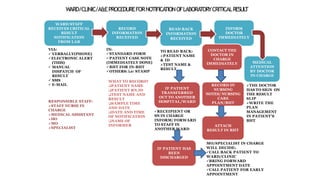
WARD/CLINIC/A&EPROCEDUREFORNOTIFICA
TIONOFLABORA
TORYCRITICALRESUL
T
IF PATIENT HAS
BEEN
DISCHARGED
RECORD IN
NURSING
NOTES/NURSING
CARE
PLAN/BHT
MEDICAL
ATTENTION
BY DOCTOR
IN-CHARGE
READ BACK
INFORMATION
RECEIVED
RECORD
INFORMATION
RECEIVED
INFORM
DOCTOR
IMMEDIATELY
CONTACT THE
DOCTOR IN
CHARGE
IMMEDIATELY
ATTACH
RESULT IN BHT
IF PATIENT
TRANSFERRED
OUT TO ANOTHER
HOSPITAL/WARD
TO READ BACK:
PATIENT NAME
& ID
TEST NAME &
RESULT
RECEIPIENT OR
SN IN CHARGE
INFORM/FORWARD
TO STAFF IN
ANOTHER WARD
MO/SPECIALIST IN CHARGE
WILL DECIDE:
CALL BACK PATIENT TO
WARD/CLINIC
BRING FORWARD
APPOINTMENT DATE
CALL PATIENT FOR EARLY
APPOINTMENT
THE DOCTOR
HAS TO SIGN ON
THE RESULT
SLIP
WRITE THE
PLAN
MANAGEMENT
IN PATIENT’S
BHT
IN:
STANDARD FORM
PATIENT CASE NOTE
(IMMEDIATELY DONE)
BHT FOR IN-BHT
OTHERS: i.e: STAMP
WHAT TO RECORD?
PATIENT NAME
PATIENT RN,ID
TEST NAME AND
RESULT
SAMPLE TIME
AND DATE
DATE AND TIME
OF NOTIFICATION
NAME OF
INFORMER
WARD STAFF
RECEIVES CRITICAL
RESULT
NOTIFICATION
FROM LAB
VIA:
 VERBALLY(PHONE)
ELECTRONIC ALERT
(THIS)
 MANUAL
DISPATCH OF
RESULT
 SMS
 E-MAIL
RESPONSIBLE STAFF:
STAFF NURSE IN
CHARGE
MEDICAL ASSISTANT
HO
MO
SPECIALIST
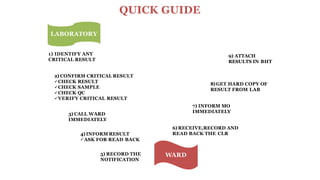
QUICK GUIDE
LABORATORY
1) IDENTIFY ANY
CRITICAL RESULT
2) CONFIRM CRITICAL RESULT
CHECK RESULT
CHECK SAMPLE
CHECK QC
VERIFY CRITICAL RESULT
3) CALL WARD
IMMEDIATELY
4) INFORM RESULT
ASK FOR READ BACK
5) RECORD THE
NOTIFICATION
WARD
6) RECEIVE,RECORD AND
READ BACK THE CLR
7) INFORM MO
IMMEDIATELY
8)GET HARD COPY OF
RESULT FROM LAB
9) ATTACH
RESULTS IN BHT
Monitoring
• HCO to define schedule for assessing quality implementation of
guidelines
• Quality standards of the lab
• Regular updating of the tests list
• Can have mock drills and performance indicators to the staff
• Trained staff can be asked to train other untrained personnel
Evidences
• HCO to have an Apex Manual with
1. the list of tests  their standard reference intervals and critical
result values
2. instructions to the concerned personnel on communication and
reporting
Thank you

Critical Alert.-2.pdf

  • 1.
    Critical Alerts inLaboratory Group :1 Dr. Pallavi Shukla Reviewed By : Dr. Sujith H. Dr. Lallu Joseph Mr. Govardan Dr. Uma Shankar Mr. Shankar Hiremat Ms. Jyothi Ramesh
  • 2.
    Defining Critical Value “Valuesthat are outside normal range to a degree that may contribute on immediate health risk to individual or require immediate action on part of ordering physician”
  • 3.
    •Alert value: These areresults that deviate from their reference ranges less significantly than critical values.
  • 4.
    Why is itso Important?? • To prevent imminent life threatening situation • Help clinicians redefining treatment plans • Failure to report poses a threat to patient safety and hospital quality • critical values communication is now an integral part of many accreditation procedures for medical laboratories like ISO,NABL • endorsed as one of the leading quality indicators of the post-analytical phase by International Federation of Clinical Chemistry and Laboratory Medicine (IFCC).
  • 5.
    Upper Limit Lower LimitNormal Range Value= 120mmol/L (potentialharm likely to occur:cerebraloedema) Value≤ 115mmol/Lorrapid reductionin sodium level (may lead tocomaor death) SerumSODIUM 135-145 mmol/L Value>145 mmol/L (hypernatremia) Value<135 mmol/L (hyponatremia) LOWERCRITICALV ALUE/RESUL T UPPERCRITICALV ALUE/RESUL T 125 mmol/L 155 mmol/L Value≥ 158-160mmol?l (potentialharm likely to occur:anorexia,muscle weakness,nausea,vomitting, lethargy and coma) Value≥ 160mmol/L (ass.with 75% mortalityin adult
  • 6.
    ANALYTE CRITICAL VALUE HaemoglobinAny age ≤7.0 g/dL Haematocrit (PCV) Any age ≤21.0 ≥65.0 % Potassium; ISTAT (POCT) Any age <3.0 >6.0 mmol/L pH Any age <7.20 >7.60 pH units Bicarbonate (Whole Blood) Any age <10 >40 mEq/L Troponin I Any age ≥0.3 ng/mL PT INR Any age >5.0 Clinical Biochemistry and Pathology
  • 7.
    Microbiology: Any Assay withpositive bioterrorism agent. Serology. Any Clinically Important Positive Culture.
  • 8.
    • The FinalClassification of a Laboratory result as “Critical” is based on • It’s Laboratory Values, as well. • As the Patient’s analytical history and • Any available Clinical Information. • Should be Communicated with 1 hour or asap. • 24X7
  • 9.
    Developing a TrainingModule • Policy Standard : The critical Laboratory Results should be intimidated immediately to the concerned personnel • Objective: To ensure all critical care results that need immediate attention by the treating clinicians are defined, documented, communicated in a defined time frame
  • 10.
    Pre Requisites • TheCentral Lab committee should identify and define critical results for all the tests performed in the lab in consensus with clinicians • The list to be displayed in the lab • regularly update the list as and when new tests are added • Relevant staff should be trained on critical values and the reporting process
  • 11.
    •Implementation Guidelines/Requirements: Target Personnel: Qualifiedlab personnel, Nursing staff, Doctors Training frequency: To be part of induction program and updated during on going training
  • 12.
    • Defining andidentifying critical care results • Define and Identify pre analytical/analytical/post analytical errors prior to communication • Informing concerned lab consultant • Confirming Critical result • Communicating to concerned personnel (verbal/report dispatch/electronic modes) • Documentation(specific register and in case files) and Communication of critical results(for both inhouse and outsourced) • Performing Mock Drills
  • 13.
    • Sepsis (ABG,CBC, RFT, LFT, Cultures) • Uncontrolled Diabetes Mellitus (Blood sugars, Urine Ketones, ABG, RFT, Electrolytes) • Respiratory Failure (ABG) • Myocardial Infarction (Cardiac Enzymes) • Viral Fever(Platelet Count) • Acute Renal Failure (RFT, Electrolytes)
  • 14.
    LABORA TORYPROCEDUREFORNOTIFICA TIONOF CRITICALRESUL TS LABORATORY PERFORM TEST(ROUTINE / URGENT/STAT) VERIFYTHE RESULT CHECK RECORD ANY CRITICAL LIMIT? REFER CRITICAL VALUE LIST DISPATCH A COPY OF RESULT TO WARD/A&E CHECK FOR TREND PHONE ELECTRONIC SMS MANUAL DISPATCH DOCUMENT THE NOTIFICATION AND RELEVANT INFORMATION INTO RECORD BOOK,LIS OR STANDARD NOTIFICATION STAFF NURSE SPECIALIST MO JM MA INFORM RESULT AND ASK FOR READ BACK FROM RECORD BOOK COMPARE WITH PREVIOUS RESULT WHAT TO INFORM? INFORMER NAME DESIGNATION PATIENT ID &LOCATION TEST NAME&RESULT SAMPLE DATE &TIME DIFFERENT TREND TO WHOM? HOW? SAME TREND REPEAT TEST CHECK FOR COMMON ANALYTICAL INTERFERENCE CHECK FOR PRE- ANALYTICAL, ANALYTICAL &POST ANALYTICAL FACTOR RECORD: INFORMER NAME & DESIGNATION PATIENT ID & WARD NAME TEST NAME & RESULT SAMPLE DATE & TIME RECIPIENT NAME
  • 17.
    WARD/CLINIC/A&EPROCEDUREFORNOTIFICA TIONOFLABORA TORYCRITICALRESUL T IF PATIENT HAS BEEN DISCHARGED RECORDIN NURSING NOTES/NURSING CARE PLAN/BHT MEDICAL ATTENTION BY DOCTOR IN-CHARGE READ BACK INFORMATION RECEIVED RECORD INFORMATION RECEIVED INFORM DOCTOR IMMEDIATELY CONTACT THE DOCTOR IN CHARGE IMMEDIATELY ATTACH RESULT IN BHT IF PATIENT TRANSFERRED OUT TO ANOTHER HOSPITAL/WARD TO READ BACK: PATIENT NAME & ID TEST NAME & RESULT RECEIPIENT OR SN IN CHARGE INFORM/FORWARD TO STAFF IN ANOTHER WARD MO/SPECIALIST IN CHARGE WILL DECIDE: CALL BACK PATIENT TO WARD/CLINIC BRING FORWARD APPOINTMENT DATE CALL PATIENT FOR EARLY APPOINTMENT THE DOCTOR HAS TO SIGN ON THE RESULT SLIP WRITE THE PLAN MANAGEMENT IN PATIENT’S BHT IN: STANDARD FORM PATIENT CASE NOTE (IMMEDIATELY DONE) BHT FOR IN-BHT OTHERS: i.e: STAMP WHAT TO RECORD? PATIENT NAME PATIENT RN,ID TEST NAME AND RESULT SAMPLE TIME AND DATE DATE AND TIME OF NOTIFICATION NAME OF INFORMER WARD STAFF RECEIVES CRITICAL RESULT NOTIFICATION FROM LAB VIA:  VERBALLY(PHONE) ELECTRONIC ALERT (THIS)  MANUAL DISPATCH OF RESULT  SMS  E-MAIL RESPONSIBLE STAFF: STAFF NURSE IN CHARGE MEDICAL ASSISTANT HO MO SPECIALIST
  • 18.
    QUICK GUIDE LABORATORY 1) IDENTIFYANY CRITICAL RESULT 2) CONFIRM CRITICAL RESULT CHECK RESULT CHECK SAMPLE CHECK QC VERIFY CRITICAL RESULT 3) CALL WARD IMMEDIATELY 4) INFORM RESULT ASK FOR READ BACK 5) RECORD THE NOTIFICATION WARD 6) RECEIVE,RECORD AND READ BACK THE CLR 7) INFORM MO IMMEDIATELY 8)GET HARD COPY OF RESULT FROM LAB 9) ATTACH RESULTS IN BHT
  • 19.
    Monitoring • HCO todefine schedule for assessing quality implementation of guidelines • Quality standards of the lab • Regular updating of the tests list • Can have mock drills and performance indicators to the staff • Trained staff can be asked to train other untrained personnel
  • 20.
    Evidences • HCO tohave an Apex Manual with 1. the list of tests  their standard reference intervals and critical result values 2. instructions to the concerned personnel on communication and reporting
  • 21.