The Interest Rate Parity states that the interest rate difference between two countries is equal to the percentage difference between the forward exchange rate and the spot exchange rate.
It plays essential role in foreign exchange markets.  The difference between the interest rates in any two countries is the same as the difference between the forward and the spot rates of their respective currencies.
Interest rate parity A currency is worth  what it can earn. The return on a currency is the interest rate on that currency plus the expected rate of appreciation over a given period. When the returns on two currencies are equal, interest rate parity prevails.
The relationship can be seen when you follow the two methods an investor may take to convert foreign currency into U.S. dollars.  Option A would be to invest the foreign currency locally at the risk-free rate for a specific time period. Then convert the proceeds from the investment into U.S. dollars at the maturity. Option B would be to invest the same dollars in the (U.S.) market for the same time period. When no arbitrage opportunities exist, the cash flows from both options are equal.
Rate of return in local Currency(say $) Rate of return in foreign Currency(say £) =
In equilibrium, returns on both the currencies will be the same i. e.  No profit will be realized and interest rate parity exists which can be written (1  + r h )   =  F   (1  + r f )  S  where  r h is the interest rate in home currency r f   is the interest rate in  foreign currency F   is the forward rate between the 2 currencies and S  is the spot rate
If interest rate parity is violated, then an arbitrage opportunity exists. The simplest example of this is what would happen if the forward rate was the same as the spot rate but the interest rates were different, then investors would:  borrow in the currency with the lower rate  convert the cash at spot rates  enter into a forward contract to convert the cash plus the expected  interest at the same rate  invest the money at the higher rate  convert back through the forward contract  repay the principal and the interest, knowing the latter will be less than the interest received.
If domestic interest rates are less than foreign interest rates, you will invest in foreign country at higher interest rates. Domestic investors can benefit by investing in the foreign market
If domestic interest rates are more than foreign interest rates, you will invest in domestic market at higher interest rates Foreign investors can benefit by investing in the domestic market Implications of IRP
Factors that influence the level of market interest rates include: Expected levels of inflation General economic conditions Monetary policy Foreign exchange market activity Foreign investor Levels of sovereign debt outstanding Financial and political stability
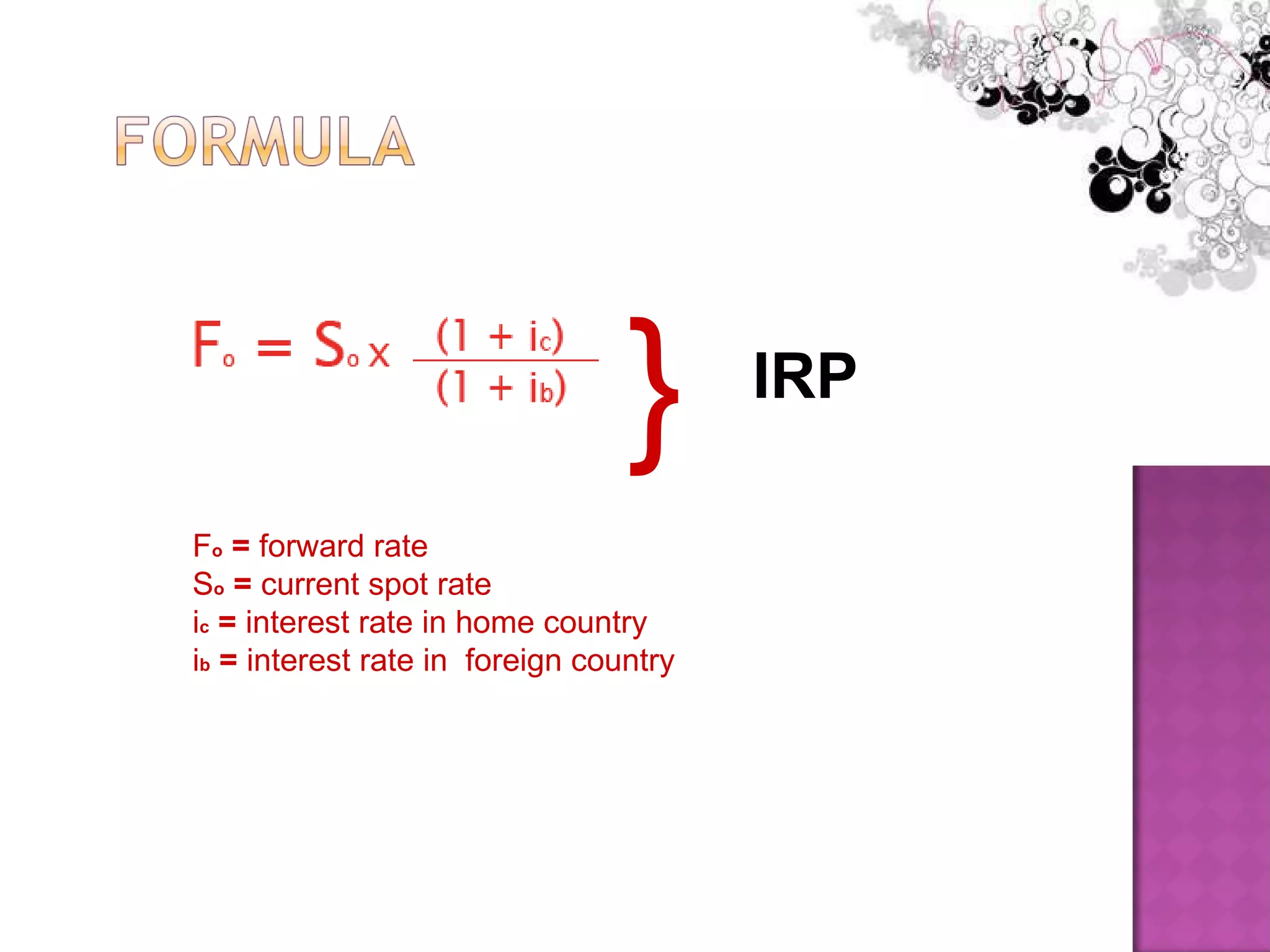
F o  =  forward rate S o  =  current spot rate i c  =  interest rate in home country  i b  =  interest rate in  foreign country  } IRP
A Canadian company is expected to receive Kuwaiti dinars in 1 years time. The spot rate is CAD/Dinar 5.4670. The company could borrow in dinars at 9% or in Canadian dollars at 14%. There is no forward rate for one year’s time. Predict what the exchange rate is likely to be in one year
S o  =  5.4670 i c   =  14% or 0.14 i b   =  9% or 0.09 F = 5.4670 x  (1 + 0.14) (1 + 0.09) F = 5.7178
 
Exchange Rate Forecasts  Differences in Interest Rates  International Fischer Effect Differences in  Inflation Rates Forward Rate Premium or Discount Interest Rate Parity Fisher Effect Purchasing  Power  Parity Unbiased  Forward Rate
 

Interest rate parity 1

  • 1.
  • 2.
    The Interest RateParity states that the interest rate difference between two countries is equal to the percentage difference between the forward exchange rate and the spot exchange rate.
  • 3.
    It plays essentialrole in foreign exchange markets. The difference between the interest rates in any two countries is the same as the difference between the forward and the spot rates of their respective currencies.
  • 4.
    Interest rate parityA currency is worth what it can earn. The return on a currency is the interest rate on that currency plus the expected rate of appreciation over a given period. When the returns on two currencies are equal, interest rate parity prevails.
  • 5.
    The relationship canbe seen when you follow the two methods an investor may take to convert foreign currency into U.S. dollars. Option A would be to invest the foreign currency locally at the risk-free rate for a specific time period. Then convert the proceeds from the investment into U.S. dollars at the maturity. Option B would be to invest the same dollars in the (U.S.) market for the same time period. When no arbitrage opportunities exist, the cash flows from both options are equal.
  • 6.
    Rate of returnin local Currency(say $) Rate of return in foreign Currency(say £) =
  • 7.
    In equilibrium, returnson both the currencies will be the same i. e. No profit will be realized and interest rate parity exists which can be written (1 + r h ) = F (1 + r f ) S where r h is the interest rate in home currency r f is the interest rate in foreign currency F is the forward rate between the 2 currencies and S is the spot rate
  • 8.
    If interest rateparity is violated, then an arbitrage opportunity exists. The simplest example of this is what would happen if the forward rate was the same as the spot rate but the interest rates were different, then investors would: borrow in the currency with the lower rate convert the cash at spot rates enter into a forward contract to convert the cash plus the expected interest at the same rate invest the money at the higher rate convert back through the forward contract repay the principal and the interest, knowing the latter will be less than the interest received.
  • 9.
    If domestic interestrates are less than foreign interest rates, you will invest in foreign country at higher interest rates. Domestic investors can benefit by investing in the foreign market
  • 10.
    If domestic interestrates are more than foreign interest rates, you will invest in domestic market at higher interest rates Foreign investors can benefit by investing in the domestic market Implications of IRP
  • 11.
    Factors that influencethe level of market interest rates include: Expected levels of inflation General economic conditions Monetary policy Foreign exchange market activity Foreign investor Levels of sovereign debt outstanding Financial and political stability
  • 12.
    F o = forward rate S o = current spot rate i c = interest rate in home country i b = interest rate in foreign country } IRP
  • 13.
    A Canadian companyis expected to receive Kuwaiti dinars in 1 years time. The spot rate is CAD/Dinar 5.4670. The company could borrow in dinars at 9% or in Canadian dollars at 14%. There is no forward rate for one year’s time. Predict what the exchange rate is likely to be in one year
  • 14.
    S o = 5.4670 i c = 14% or 0.14 i b = 9% or 0.09 F = 5.4670 x (1 + 0.14) (1 + 0.09) F = 5.7178
  • 15.
  • 16.
    Exchange Rate Forecasts Differences in Interest Rates International Fischer Effect Differences in Inflation Rates Forward Rate Premium or Discount Interest Rate Parity Fisher Effect Purchasing Power Parity Unbiased Forward Rate
  • 17.