Interest Rate Parity & Purchasing power parity Presented by Danish Hasan Ramiz Junaid Zamir
Interest Rate Parity (IRP)
Interest Rate Parity The Interest Rate Parity states that the interest rate difference between two countries is equal to the percentage difference between the forward exchange rate and the spot exchange rate.
It plays essential role in foreign exchange markets.  The difference between the interest rates in any two countries is the same as the difference between the forward and the spot rates of their respective currencies.
Interest rate parity A currency is worth  what it can earn. The return on a currency is the interest rate on that currency plus the expected rate of appreciation over a given period. When the returns on two currencies are equal, interest rate parity prevails.
Explanation The relationship can be seen when you follow the two methods an investor may take to convert foreign currency into U.S. dollars.  Option A would be to invest the foreign currency locally at the risk-free rate for a specific time period. Then convert the proceeds from the investment into U.S. dollars at the maturity. Option B would be to invest the same dollars in the (U.S.) market for the same time period. When no arbitrage opportunities exist, the cash flows from both options are equal.
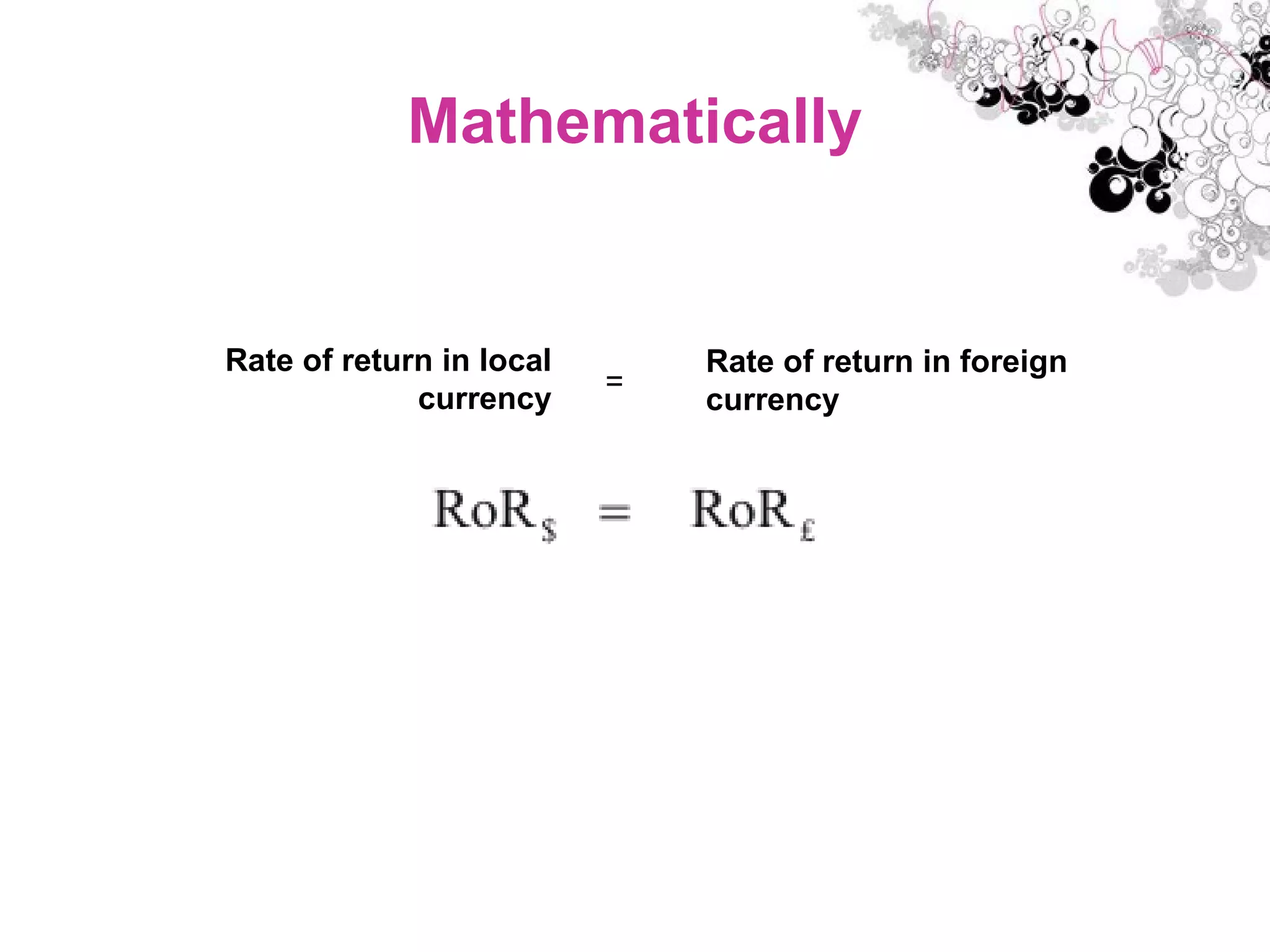
Mathematically Rate of return in local currency Rate of return in foreign currency =
In equilibrium, returns on currencies will be the same i. e.  No profit will be realized  and interest rate parity    exits which can be written (1  + r h )   =  F   (1  + r f )  S
Violation of IRP If interest rate parity is violated, then an arbitrage opportunity exists. The simplest example of this is what would happen if the forward rate was the same as the spot rate but the interest rates were different, then investors would:  borrow in the currency with the lower rate  convert the cash at spot rates  enter into a forward contract to convert the cash plus the expected interest at the same rate  invest the money at the higher rate  convert back through the forward contract  repay the principal and the interest, knowing the latter will be less than the interest received.
Implications of IRP If domestic interest rates are less than foreign interest rates, you will invest in foreign country at higher interest rates. Domestic investors can benefit by investing in the foreign market
If domestic interest rates are more than foreign interest rates, you will invest in domestic market at higher interest rates Foreign investors can benefit by investing in the domestic market Implications of IRP
Purchasing power parity (PPP)
Purchasing power parity  ( PPP )  The purchasing power of a country’s currency. The number of units of currency required to purchase a basket of goods in Pakistan and the same basket of goods and services that a USD would buy in United states.
Need for PPP  Because the exchange rates only reflects when goods are traded. Also, currencies are traded for purposes other than trade in goods and services,  e.g. , to buy capital assets. Also, different interest rates, speculation or interventions by central banks can influence the foreign-exchange market.
Purpose Differences in living standards between nations because PPP takes into account the relative cost of living and the inflation rates of the countries,
Assumption In the absence of transportation and other transaction costs, competitive markets will equalize the price of an identical good in two countries when the prices are expressed in the same currency.
Example For example, a TV set that sells for 750 Canadian Dollars [CAD] in Vancouver should cost 500 US Dollars [USD] in Seattle when the exchange rate between Canada and the US is 1.50 CAD/USD. If the price of the TV in Vancouver was only 700 CAD, consumers in Seattle would prefer buying the TV set in Vancouver due to which the US consumers buying Canadian goods will bid up the value of the Canadian Dollar, thus making Canadian goods more costly to them. This process continues until the goods have again the same price.
Fluctuations  PPP rate fluctuations are mostly due to different rates of inflation in the two economies which would result in the difference in prices at home and abroad
Reasons for different measures The main reasons why different measures  do not perfectly reflect standards of living  are: PPP numbers can vary with the specific basket of goods used, making it a rough estimate. Differences in quality of goods are hard to measure and thereby reflect in PPP.
Range and quality of goods Local, non-tradable goods and services (like electric power) that are produced and sold domestically.  Tradable goods such as non-perishable commodities that can be sold on the international market
List by the International Monetary Fund (2008) 439,558  Pakistan  27 2,260,907  Russia 6 2,910,490  Germany 5 3,288,345  India 4 4,354,368  Japan 3 7,916,429  China  2 14,264,600  United States 1 GDP (PPP) $M  Country  Rank
Factors effecting IRP and PPP
Factors of PPP Technology  Luxury goods  Raw materials  Energy prices
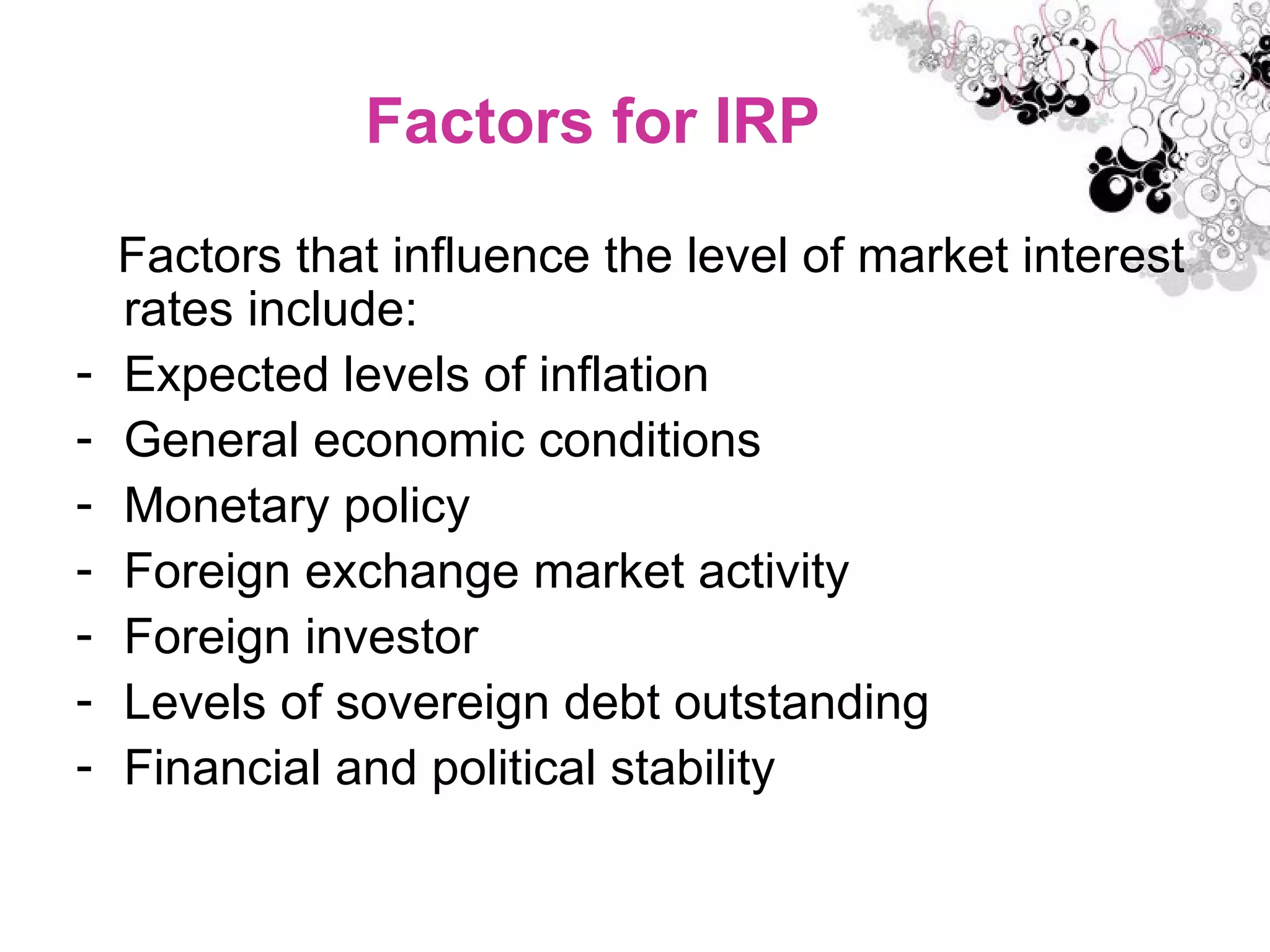
Factors for IRP Factors that influence the level of market interest rates include: Expected levels of inflation General economic conditions Monetary policy Foreign exchange market activity Foreign investor Levels of sovereign debt outstanding Financial and political stability
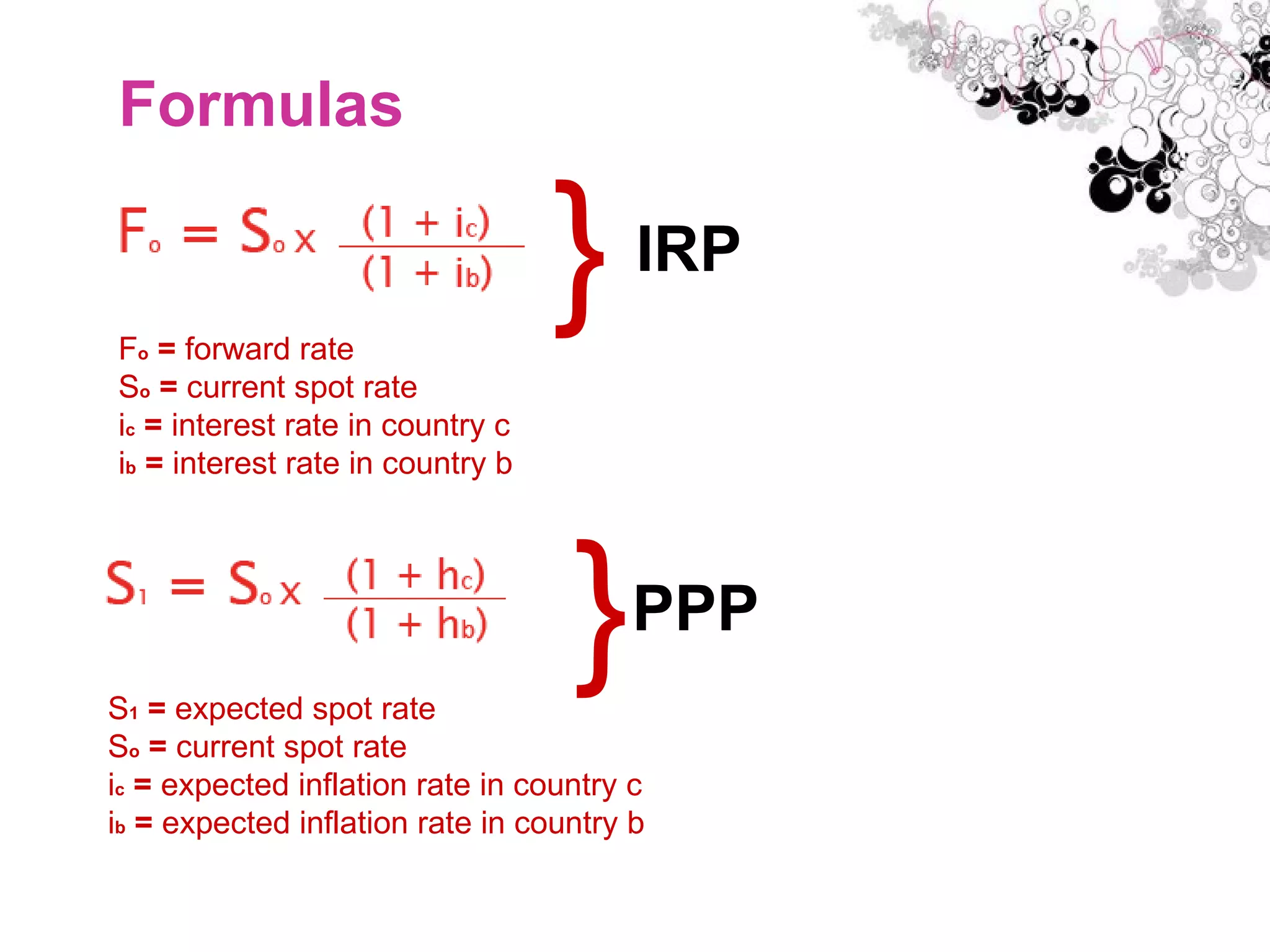
Formulas F o  =  forward rate S o  =  current spot rate i c  =  interest rate in country c   i b  =  interest rate in country b S 1  =  expected spot rate S o  =  current spot rate i c  =  expected inflation rate in country c   i b  =  expected inflation   rate in country b } } PPP IRP
Question IRP A Canadian company is expected to receive Kuwaiti dinars in 1 years time. The spot rate is CAD/Dinar 5.4670. The company could borrow in dinars at 9% or in Canadian dollars at 14%. There is no forward rate for one year’s time. Predict what the exchange rate is likely to be in one year
Solution S o  =  5.4670 i c   =  14% or 0.14 i b   =  9% or 0.09 F = 5.4670 x  (1 + 0.14) (1 + 0.09) F = 5.7178
Question PPP The spot exchange rate between UK sterling and Danish kroner is £1 = 8 kroners. Assuming that there is now purchasing parity an amount of commodity costing £110 in UK will cost 880 kroners in Denmark. Over the next year price inflation in denmark is expected to be 5% while in UK it is expected to be 8%. What is the expected spot exchange rate at the end of the year?
Solution S o  =  8 i c   =  5% or 0.05 i b   =  8% or 0.08 S 1  = 8 x  (1 + 0.05) (1 + 0.08) S 1  = 7.78
UK price = £110 x 1.08= £118.80 Danish price = 880 x 1.05= 924 Kroner =   924  =  7.78 118.80
Thank you

Interest Rate Parity and Purchasing Power Parity

  • 1.
    Interest Rate Parity& Purchasing power parity Presented by Danish Hasan Ramiz Junaid Zamir
  • 2.
  • 3.
    Interest Rate ParityThe Interest Rate Parity states that the interest rate difference between two countries is equal to the percentage difference between the forward exchange rate and the spot exchange rate.
  • 4.
    It plays essentialrole in foreign exchange markets. The difference between the interest rates in any two countries is the same as the difference between the forward and the spot rates of their respective currencies.
  • 5.
    Interest rate parityA currency is worth what it can earn. The return on a currency is the interest rate on that currency plus the expected rate of appreciation over a given period. When the returns on two currencies are equal, interest rate parity prevails.
  • 6.
    Explanation The relationshipcan be seen when you follow the two methods an investor may take to convert foreign currency into U.S. dollars. Option A would be to invest the foreign currency locally at the risk-free rate for a specific time period. Then convert the proceeds from the investment into U.S. dollars at the maturity. Option B would be to invest the same dollars in the (U.S.) market for the same time period. When no arbitrage opportunities exist, the cash flows from both options are equal.
  • 7.
    Mathematically Rate ofreturn in local currency Rate of return in foreign currency =
  • 8.
    In equilibrium, returnson currencies will be the same i. e. No profit will be realized and interest rate parity exits which can be written (1 + r h ) = F (1 + r f ) S
  • 9.
    Violation of IRPIf interest rate parity is violated, then an arbitrage opportunity exists. The simplest example of this is what would happen if the forward rate was the same as the spot rate but the interest rates were different, then investors would: borrow in the currency with the lower rate convert the cash at spot rates enter into a forward contract to convert the cash plus the expected interest at the same rate invest the money at the higher rate convert back through the forward contract repay the principal and the interest, knowing the latter will be less than the interest received.
  • 10.
    Implications of IRPIf domestic interest rates are less than foreign interest rates, you will invest in foreign country at higher interest rates. Domestic investors can benefit by investing in the foreign market
  • 11.
    If domestic interestrates are more than foreign interest rates, you will invest in domestic market at higher interest rates Foreign investors can benefit by investing in the domestic market Implications of IRP
  • 12.
  • 13.
    Purchasing power parity ( PPP ) The purchasing power of a country’s currency. The number of units of currency required to purchase a basket of goods in Pakistan and the same basket of goods and services that a USD would buy in United states.
  • 14.
    Need for PPP Because the exchange rates only reflects when goods are traded. Also, currencies are traded for purposes other than trade in goods and services, e.g. , to buy capital assets. Also, different interest rates, speculation or interventions by central banks can influence the foreign-exchange market.
  • 15.
    Purpose Differences inliving standards between nations because PPP takes into account the relative cost of living and the inflation rates of the countries,
  • 16.
    Assumption In theabsence of transportation and other transaction costs, competitive markets will equalize the price of an identical good in two countries when the prices are expressed in the same currency.
  • 17.
    Example For example,a TV set that sells for 750 Canadian Dollars [CAD] in Vancouver should cost 500 US Dollars [USD] in Seattle when the exchange rate between Canada and the US is 1.50 CAD/USD. If the price of the TV in Vancouver was only 700 CAD, consumers in Seattle would prefer buying the TV set in Vancouver due to which the US consumers buying Canadian goods will bid up the value of the Canadian Dollar, thus making Canadian goods more costly to them. This process continues until the goods have again the same price.
  • 18.
    Fluctuations PPPrate fluctuations are mostly due to different rates of inflation in the two economies which would result in the difference in prices at home and abroad
  • 19.
    Reasons for differentmeasures The main reasons why different measures do not perfectly reflect standards of living are: PPP numbers can vary with the specific basket of goods used, making it a rough estimate. Differences in quality of goods are hard to measure and thereby reflect in PPP.
  • 20.
    Range and qualityof goods Local, non-tradable goods and services (like electric power) that are produced and sold domestically. Tradable goods such as non-perishable commodities that can be sold on the international market
  • 21.
    List by theInternational Monetary Fund (2008) 439,558 Pakistan 27 2,260,907 Russia 6 2,910,490 Germany 5 3,288,345 India 4 4,354,368 Japan 3 7,916,429 China 2 14,264,600 United States 1 GDP (PPP) $M Country Rank
  • 22.
  • 23.
    Factors of PPPTechnology Luxury goods Raw materials Energy prices
  • 24.
    Factors for IRPFactors that influence the level of market interest rates include: Expected levels of inflation General economic conditions Monetary policy Foreign exchange market activity Foreign investor Levels of sovereign debt outstanding Financial and political stability
  • 25.
    Formulas F o = forward rate S o = current spot rate i c = interest rate in country c i b = interest rate in country b S 1 = expected spot rate S o = current spot rate i c = expected inflation rate in country c i b = expected inflation rate in country b } } PPP IRP
  • 26.
    Question IRP ACanadian company is expected to receive Kuwaiti dinars in 1 years time. The spot rate is CAD/Dinar 5.4670. The company could borrow in dinars at 9% or in Canadian dollars at 14%. There is no forward rate for one year’s time. Predict what the exchange rate is likely to be in one year
  • 27.
    Solution S o = 5.4670 i c = 14% or 0.14 i b = 9% or 0.09 F = 5.4670 x (1 + 0.14) (1 + 0.09) F = 5.7178
  • 28.
    Question PPP Thespot exchange rate between UK sterling and Danish kroner is £1 = 8 kroners. Assuming that there is now purchasing parity an amount of commodity costing £110 in UK will cost 880 kroners in Denmark. Over the next year price inflation in denmark is expected to be 5% while in UK it is expected to be 8%. What is the expected spot exchange rate at the end of the year?
  • 29.
    Solution S o = 8 i c = 5% or 0.05 i b = 8% or 0.08 S 1 = 8 x (1 + 0.05) (1 + 0.08) S 1 = 7.78
  • 30.
    UK price =£110 x 1.08= £118.80 Danish price = 880 x 1.05= 924 Kroner = 924 = 7.78 118.80
  • 31.