MORE THAN JUST COMPLIANCE..
INTERNAL FINANCIAL CONTROLS
1
INTERNAL
FINANCIAL
CONTROL
MORE THAN JUST COMPLIANCE..
REQUIREMENTS AS PER THE COMPANIES
ACT, 2013
The Companies Act, 2013 has introduced many new reporting
requirements. One eminent requirement introduced is ‘Board to
confirm that internal financial controls are adequate and operating
effectively for the statutory auditors of companies. (Rule 8(5)(viii) of the
Companies (Accounts) Rules, 2014 )
Further, the Statutory Auditor to state in his audit report whether the
company has adequate internal financial controls system in place and
the operating effectiveness of such controls (Section 143(3)(i) of the
Act).
The scope for reporting on Internal Financial Controls is significantly
larger and wider than the reporting on internal controls under the
Companies (Auditor’s Report) Order, 2015 (“CARO”) for Auditors.
Under CARO, the reporting on internal controls is limited to the
adequacy of controls over purchase of inventory and fixed assets and
sale of goods and services. As such, The Board directors’ and Auditors
responsibility has increased as earlier Directors Reports and CARO,
did not require reporting on all controls relating to financial reporting
and also does not require reporting on the “adequacy and operating
effectiveness” of such controls.
To whom does this apply?
The guidance note clarifies that reporting on IFC by auditors will be
applicable to both listed and unlisted companies, including
small and one person companies.
MORE THAN
JUST
COMPLIANCE..
Well documented
SOPs and Control
Frameworks helps in
review and monitoring
the business processes
for revenue
opportunities, leakages
and Cost cutting
opportunities.
IFC shall result in
better management
resulting from review of
various automated and
manual controls
IFC shall help in
identification of
loopholes, if any in
SOPs. Standardization
of SOPs for Multi
location businesses.
Better Business
performance through
the Review and
Monitoring of IFCs
2
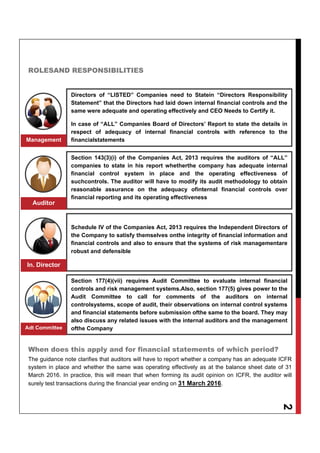
ROLESAND RESPONSIBILITIES
When does this apply and for financial statements of which period?
The guidance note clarifies that auditors will have to report whether a company has an adequate ICFR
system in place and whether the same was operating effectively as at the balance sheet date of 31
March 2016. In practice, this will mean that when forming its audit opinion on ICFR, the auditor will
surely test transactions during the financial year ending on 31 March 2016.
Directors of “LISTED” Companies need to Statein “Directors Responsibility
Statement” that the Directors had laid down internal financial controls and the
same were adequate and operating effectively and CEO Needs to Certify it.
In case of “ALL” Companies Board of Directors’ Report to state the details in
respect of adequacy of internal financial controls with reference to the
financialstatementsManagement
Section 143(3)(i) of the Companies Act, 2013 requires the auditors of “ALL”
companies to state in his report whetherthe company has adequate internal
financial control system in place and the operating effectiveness of
suchcontrols. The auditor will have to modify its audit methodology to obtain
reasonable assurance on the adequacy ofinternal financial controls over
financial reporting and its operating effectiveness
Auditor
Schedule IV of the Companies Act, 2013 requires the Independent Directors of
the Company to satisfy themselves onthe integrity of financial information and
financial controls and also to ensure that the systems of risk managementare
robust and defensible
In. Director
Section 177(4)(vii) requires Audit Committee to evaluate internal financial
controls and risk management systems.Also, section 177(5) gives power to the
Audit Committee to call for comments of the auditors on internal
controlsystems, scope of audit, their observations on internal control systems
and financial statements before submission ofthe same to the board. They may
also discuss any related issues with the internal auditors and the management
ofthe CompanyAdt Committee
WHERE
The First S
(SOPs) inc
framework.
YES, WE
No doubt it
Identify and
better Unde
Financial R
With a team
comply the
functioning
TO BEG
Step in imple
cluding rel
E CAN A
t requires lo
d Assess o
erstanding a
Reporting tha
m consistin
Mandatory
of Busines
GIN … AN
ementing IF
evant polic
ASSIST Y
ots of expe
or design bo
and knowle
an A CHAR
g Young an
y Legal Com
s.
ND HOW
FCs would
cies and g
YOU !!
ertise and th
oth Entity L
edge of inte
RTERED AC
nd Experien
mpliances,
W?
be to docum
guidelines
horough kn
Level Contro
erworking of
CCOUNTAN
nced charte
but also in
HAS
Organ
HAS
Variou
HOW
system
within
WHAT
mana
Busin
ment the cu
along with
owledge of
ols and Pro
f Processes
NT.
ered accoun
improving e
organizat
nization Ch
managem
us Busines
the bus
ms are ar
n the organ
T are the
gement
ess Risks?
urrent stand
h comprehe
f business p
ocess Contr
s, Systems
ntants, we c
existing des
tion doc
hart?
ment ide
ss Risks?
siness pro
re network
nization?
e Controls
to cov
?
dard operat
ensive risk
processes
rols. And w
and Contro
can assist y
signs to ach
umented
entified
ocesses
ked intern
s placed
ver Vari
ting procedu
k managem
and control
who would h
ols Surroun
you not onl
hieve smoo
3
its
the
and
nally
by
ious
ures
ment
ls to
have
ding
ly to
other
4
How can WE assist you in your IFC implementation/identification?
 Identify and document the current a comprehensive Risk Management Framework
 Identify and document the current standard operating procedures (SOPs) including relevant
policies and guidelines
 Identify and document current internal controls framework covering both Entity Level Controls
and Process Controls for finance and accounts, business processes, compliance and IT
 Benchmark current controls against leading practices; IT controls, prevent v. detect, manual v.
automated
 Identification, documentation and review of current controls to reduce overall cost of control
while improving effectiveness
 Design and assist in implementation of new controls and delegation of authority, segregation of
duties etc.
GET ready, Get Started
For any queries on how can we assist you please contact us at:
CA Pritesh Ostwal
+91-95-03-390009
CA Rahul Mehta
+91-90-21-311803
CA Vaibhav Phatak
+91-86-98-877339
Email-
startup.ifc@gmail.com

Internal financial control

  • 1.
    MORE THAN JUSTCOMPLIANCE.. INTERNAL FINANCIAL CONTROLS
  • 2.
    1 INTERNAL FINANCIAL CONTROL MORE THAN JUSTCOMPLIANCE.. REQUIREMENTS AS PER THE COMPANIES ACT, 2013 The Companies Act, 2013 has introduced many new reporting requirements. One eminent requirement introduced is ‘Board to confirm that internal financial controls are adequate and operating effectively for the statutory auditors of companies. (Rule 8(5)(viii) of the Companies (Accounts) Rules, 2014 ) Further, the Statutory Auditor to state in his audit report whether the company has adequate internal financial controls system in place and the operating effectiveness of such controls (Section 143(3)(i) of the Act). The scope for reporting on Internal Financial Controls is significantly larger and wider than the reporting on internal controls under the Companies (Auditor’s Report) Order, 2015 (“CARO”) for Auditors. Under CARO, the reporting on internal controls is limited to the adequacy of controls over purchase of inventory and fixed assets and sale of goods and services. As such, The Board directors’ and Auditors responsibility has increased as earlier Directors Reports and CARO, did not require reporting on all controls relating to financial reporting and also does not require reporting on the “adequacy and operating effectiveness” of such controls. To whom does this apply? The guidance note clarifies that reporting on IFC by auditors will be applicable to both listed and unlisted companies, including small and one person companies. MORE THAN JUST COMPLIANCE.. Well documented SOPs and Control Frameworks helps in review and monitoring the business processes for revenue opportunities, leakages and Cost cutting opportunities. IFC shall result in better management resulting from review of various automated and manual controls IFC shall help in identification of loopholes, if any in SOPs. Standardization of SOPs for Multi location businesses. Better Business performance through the Review and Monitoring of IFCs
  • 3.
    2 ROLESAND RESPONSIBILITIES When doesthis apply and for financial statements of which period? The guidance note clarifies that auditors will have to report whether a company has an adequate ICFR system in place and whether the same was operating effectively as at the balance sheet date of 31 March 2016. In practice, this will mean that when forming its audit opinion on ICFR, the auditor will surely test transactions during the financial year ending on 31 March 2016. Directors of “LISTED” Companies need to Statein “Directors Responsibility Statement” that the Directors had laid down internal financial controls and the same were adequate and operating effectively and CEO Needs to Certify it. In case of “ALL” Companies Board of Directors’ Report to state the details in respect of adequacy of internal financial controls with reference to the financialstatementsManagement Section 143(3)(i) of the Companies Act, 2013 requires the auditors of “ALL” companies to state in his report whetherthe company has adequate internal financial control system in place and the operating effectiveness of suchcontrols. The auditor will have to modify its audit methodology to obtain reasonable assurance on the adequacy ofinternal financial controls over financial reporting and its operating effectiveness Auditor Schedule IV of the Companies Act, 2013 requires the Independent Directors of the Company to satisfy themselves onthe integrity of financial information and financial controls and also to ensure that the systems of risk managementare robust and defensible In. Director Section 177(4)(vii) requires Audit Committee to evaluate internal financial controls and risk management systems.Also, section 177(5) gives power to the Audit Committee to call for comments of the auditors on internal controlsystems, scope of audit, their observations on internal control systems and financial statements before submission ofthe same to the board. They may also discuss any related issues with the internal auditors and the management ofthe CompanyAdt Committee
  • 4.
    WHERE The First S (SOPs)inc framework. YES, WE No doubt it Identify and better Unde Financial R With a team comply the functioning TO BEG Step in imple cluding rel E CAN A t requires lo d Assess o erstanding a Reporting tha m consistin Mandatory of Busines GIN … AN ementing IF evant polic ASSIST Y ots of expe or design bo and knowle an A CHAR g Young an y Legal Com s. ND HOW FCs would cies and g YOU !! ertise and th oth Entity L edge of inte RTERED AC nd Experien mpliances, W? be to docum guidelines horough kn Level Contro erworking of CCOUNTAN nced charte but also in HAS Organ HAS Variou HOW system within WHAT mana Busin ment the cu along with owledge of ols and Pro f Processes NT. ered accoun improving e organizat nization Ch managem us Busines the bus ms are ar n the organ T are the gement ess Risks? urrent stand h comprehe f business p ocess Contr s, Systems ntants, we c existing des tion doc hart? ment ide ss Risks? siness pro re network nization? e Controls to cov ? dard operat ensive risk processes rols. And w and Contro can assist y signs to ach umented entified ocesses ked intern s placed ver Vari ting procedu k managem and control who would h ols Surroun you not onl hieve smoo 3 its the and nally by ious ures ment ls to have ding ly to other
  • 5.
    4 How can WEassist you in your IFC implementation/identification?  Identify and document the current a comprehensive Risk Management Framework  Identify and document the current standard operating procedures (SOPs) including relevant policies and guidelines  Identify and document current internal controls framework covering both Entity Level Controls and Process Controls for finance and accounts, business processes, compliance and IT  Benchmark current controls against leading practices; IT controls, prevent v. detect, manual v. automated  Identification, documentation and review of current controls to reduce overall cost of control while improving effectiveness  Design and assist in implementation of new controls and delegation of authority, segregation of duties etc. GET ready, Get Started For any queries on how can we assist you please contact us at: CA Pritesh Ostwal +91-95-03-390009 CA Rahul Mehta +91-90-21-311803 CA Vaibhav Phatak +91-86-98-877339 Email- startup.ifc@gmail.com