Internal Controls Over
Financial Reporting (ICFR)
Ensuring Reliability and Integrity in
Financial Reporting
-Piyush Kumar Jain
-Aavya Sidhu
Internal Audit & Corporate
Governance
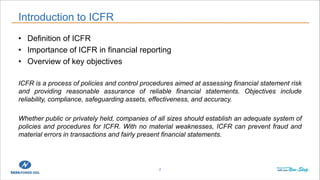
Introduction to ICFR
• Definition of ICFR
• Importance of ICFR in financial reporting
• Overview of key objectives
ICFR is a process of policies and control procedures aimed at assessing financial statement risk
and providing reasonable assurance of reliable financial statements. Objectives include
reliability, compliance, safeguarding assets, effectiveness, and accuracy.
Whether public or privately held, companies of all sizes should establish an adequate system of
policies and procedures for ICFR. With no material weaknesses, ICFR can prevent fraud and
material errors in transactions and fairly present financial statements.
2
Regulatory Framework
• Brief overview of relevant regulations (e.g., Sarbanes-Oxley Act)
• Legal requirements and compliance obligations
ICFR is required by the SEC for public companies to comply with the Sarbanes-Oxley Act of
2002, emphasizing its role in establishing public trust in the capital markets and issuers of
financial statements.
3
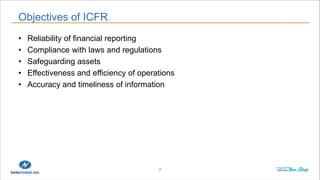
Objectives of ICFR
• Reliability of financial reporting
• Compliance with laws and regulations
• Safeguarding assets
• Effectiveness and efficiency of operations
• Accuracy and timeliness of information
4
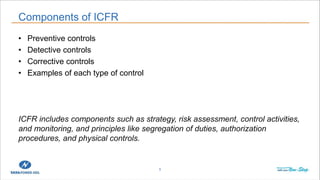
Components of ICFR
• Preventive controls
• Detective controls
• Corrective controls
• Examples of each type of control
ICFR includes components such as strategy, risk assessment, control activities,
and monitoring, and principles like segregation of duties, authorization
procedures, and physical controls.
5
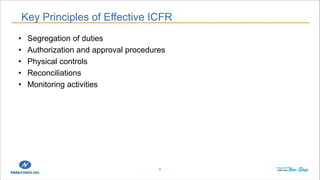
Key Principles of Effective ICFR
• Segregation of duties
• Authorization and approval procedures
• Physical controls
• Reconciliations
• Monitoring activities
6
Implementation of ICFR
• Steps to establish effective ICFR
• Role of management, board of directors, and internal auditors
• Role of Companies and Auditors: Companies set up ICFR strategies,
establish policies, monitor transactions, and issue ICFR report certifications.
Auditors assess their client’s system of internal controls, perform testing, and
issue reports on internal control matters.
• SEC Requirements: SEC regulations mandate management's assessment
of ICFR's effectiveness, reporting any material weaknesses, and including
management's report on ICFR in Form 10-K. Auditors of public companies
perform separate attestation engagements for ICFR.
7
Challenges and Risks
• Common challenges in implementing ICFR
• Lack of resources
• Complexity of business operations
• Resistance to change
• Limited understanding of regulatory requirements
• Inadequate communication and training
• Risks associated with ineffective controls
• Increased fraud and errors
• Compliance violations
• Damage to reputation
• Financial losses
• Impaired decision-making
8
Monitoring and Evaluation
• Importance of Ongoing Monitoring:
– Ensures ongoing effectiveness
– Prompts timely issue identification
– Facilitates adaptability to changes
• Regular Evaluation and Testing of Controls:
– Validates effectiveness and compliance
– Identifies weaknesses promptly
– Provides evidence of adherence
• Continuous Improvement of ICFR Processes:
– Enhances efficiency and effectiveness
– Addresses emerging risks
– Cultivates a culture of compliance
9
Case Study
• Real-world example illustrating the impact of effective ICFR:
• Enron Corporation Scandal:
– Enron Corporation, once a leading energy company, collapsed in 2001 due to massive
accounting fraud and mismanagement.
– The scandal revealed significant weaknesses in Enron's internal controls over financial
reporting, including lack of transparency and accountability.
– Enron's executives manipulated financial statements to conceal debt and inflate profits,
leading to substantial losses for investors and employees.
– The collapse of Enron resulted in widespread public outrage, investor distrust, and
regulatory reforms, including the enactment of the Sarbanes-Oxley Act (SOX) in 2002.
– SOX mandated stricter regulations and requirements for internal controls, aiming to
prevent similar accounting scandals and restore confidence in financial markets.
10
Conclusion
• Recap of key points
• Emphasis on the importance of ICFR for financial integrity
• Call to action for ensuring effective ICFR implementation
11
12
Questions & Answers
Internal Control over Financial Reporting.pptx

Internal Control over Financial Reporting.pptx

  • 1.
    Internal Controls Over FinancialReporting (ICFR) Ensuring Reliability and Integrity in Financial Reporting -Piyush Kumar Jain -Aavya Sidhu Internal Audit & Corporate Governance
  • 2.
    Introduction to ICFR •Definition of ICFR • Importance of ICFR in financial reporting • Overview of key objectives ICFR is a process of policies and control procedures aimed at assessing financial statement risk and providing reasonable assurance of reliable financial statements. Objectives include reliability, compliance, safeguarding assets, effectiveness, and accuracy. Whether public or privately held, companies of all sizes should establish an adequate system of policies and procedures for ICFR. With no material weaknesses, ICFR can prevent fraud and material errors in transactions and fairly present financial statements. 2
  • 3.
    Regulatory Framework • Briefoverview of relevant regulations (e.g., Sarbanes-Oxley Act) • Legal requirements and compliance obligations ICFR is required by the SEC for public companies to comply with the Sarbanes-Oxley Act of 2002, emphasizing its role in establishing public trust in the capital markets and issuers of financial statements. 3
  • 4.
    Objectives of ICFR •Reliability of financial reporting • Compliance with laws and regulations • Safeguarding assets • Effectiveness and efficiency of operations • Accuracy and timeliness of information 4
  • 5.
    Components of ICFR •Preventive controls • Detective controls • Corrective controls • Examples of each type of control ICFR includes components such as strategy, risk assessment, control activities, and monitoring, and principles like segregation of duties, authorization procedures, and physical controls. 5
  • 6.
    Key Principles ofEffective ICFR • Segregation of duties • Authorization and approval procedures • Physical controls • Reconciliations • Monitoring activities 6
  • 7.
    Implementation of ICFR •Steps to establish effective ICFR • Role of management, board of directors, and internal auditors • Role of Companies and Auditors: Companies set up ICFR strategies, establish policies, monitor transactions, and issue ICFR report certifications. Auditors assess their client’s system of internal controls, perform testing, and issue reports on internal control matters. • SEC Requirements: SEC regulations mandate management's assessment of ICFR's effectiveness, reporting any material weaknesses, and including management's report on ICFR in Form 10-K. Auditors of public companies perform separate attestation engagements for ICFR. 7
  • 8.
    Challenges and Risks •Common challenges in implementing ICFR • Lack of resources • Complexity of business operations • Resistance to change • Limited understanding of regulatory requirements • Inadequate communication and training • Risks associated with ineffective controls • Increased fraud and errors • Compliance violations • Damage to reputation • Financial losses • Impaired decision-making 8
  • 9.
    Monitoring and Evaluation •Importance of Ongoing Monitoring: – Ensures ongoing effectiveness – Prompts timely issue identification – Facilitates adaptability to changes • Regular Evaluation and Testing of Controls: – Validates effectiveness and compliance – Identifies weaknesses promptly – Provides evidence of adherence • Continuous Improvement of ICFR Processes: – Enhances efficiency and effectiveness – Addresses emerging risks – Cultivates a culture of compliance 9
  • 10.
    Case Study • Real-worldexample illustrating the impact of effective ICFR: • Enron Corporation Scandal: – Enron Corporation, once a leading energy company, collapsed in 2001 due to massive accounting fraud and mismanagement. – The scandal revealed significant weaknesses in Enron's internal controls over financial reporting, including lack of transparency and accountability. – Enron's executives manipulated financial statements to conceal debt and inflate profits, leading to substantial losses for investors and employees. – The collapse of Enron resulted in widespread public outrage, investor distrust, and regulatory reforms, including the enactment of the Sarbanes-Oxley Act (SOX) in 2002. – SOX mandated stricter regulations and requirements for internal controls, aiming to prevent similar accounting scandals and restore confidence in financial markets. 10
  • 11.
    Conclusion • Recap ofkey points • Emphasis on the importance of ICFR for financial integrity • Call to action for ensuring effective ICFR implementation 11
  • 12.