Overview of Internal Control
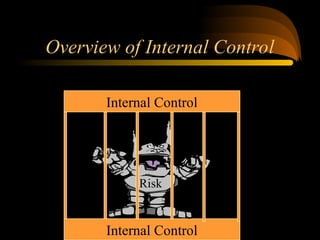
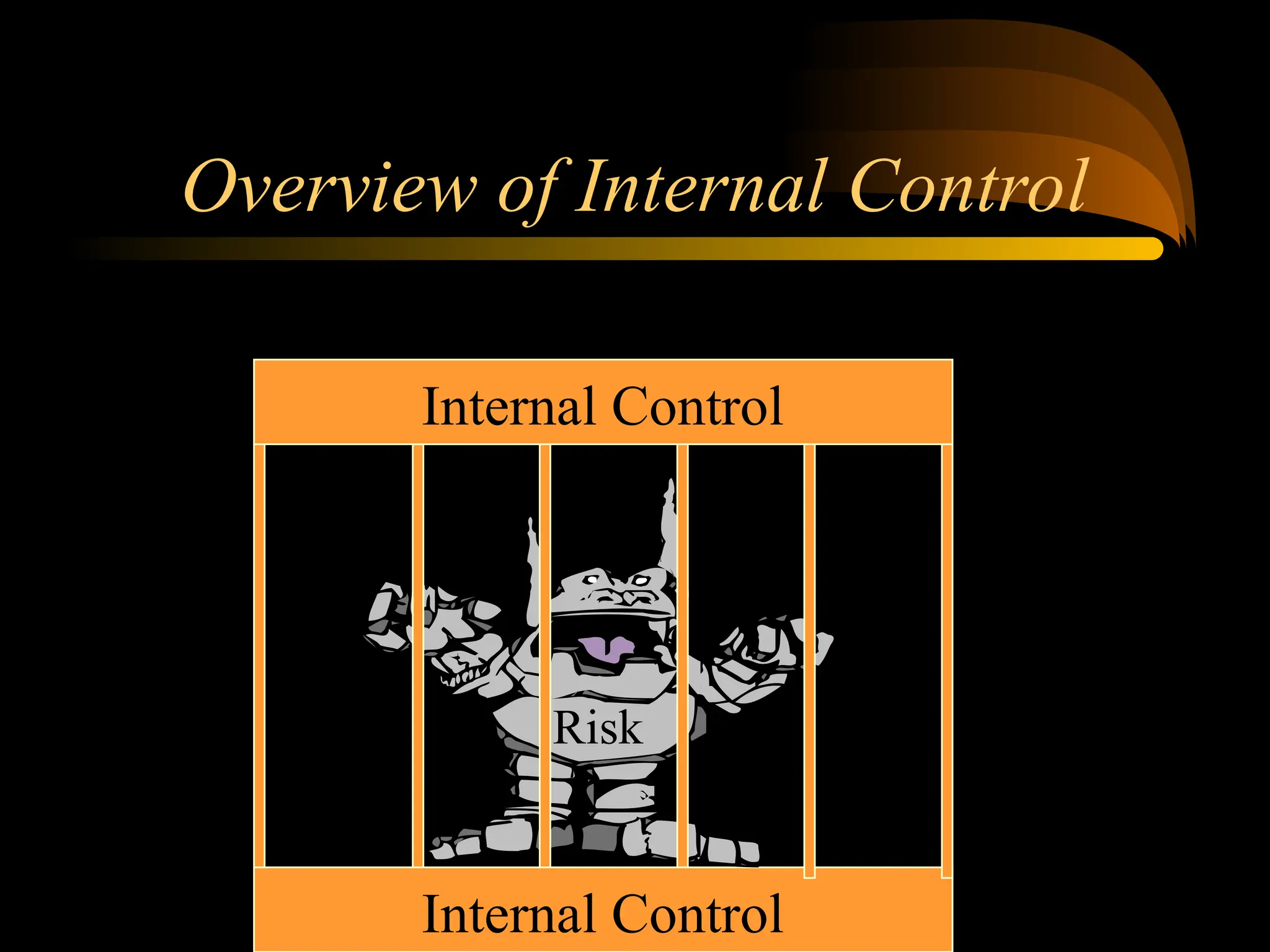
Internal Control
Internal Control
Risk
.
Presentation Outline
I. An Overview of Internal Control
II. The Components of Internal Control
I. An Overview of Internal
Control
A. Internal Control Defined
B. Reasonable Assurance
C. Reporting Requirements for Management
D. Key Components of Managements’
Assessment of Internal Control
E. Auditor Responsibilities for
Understanding Internal Control
A. Internal Control Defined
• Reliability of financial reporting
• Compliance with applicable laws and regulations
• Effectiveness and efficiency of operations
An entity’s system of internal control consists of
policies and procedures designed to provide
management with reasonable assurance that the
company achieves its objectives and goals
including:
A. Internal Control Defined
Internal Control -policies and procedures adopted by the
management of entity to assist in achieving management’s
objective.
other purposes of internal control systems are:
•adherence to management policies.
•safeguarding of assets
•prevention and detection of fraud and error
•accuracy and completeness of the accounting records
•timely preparation of reliable financial information.
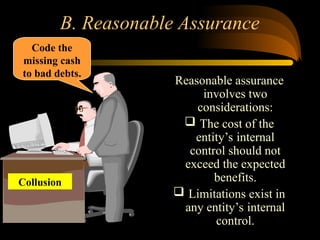
B. Reasonable Assurance
Reasonable assurance
involves two
considerations:
 The cost of the
entity’s internal
control should not
exceed the expected
benefits.
 Limitations exist in
any entity’s internal
control.
Code the
missing cash
to bad debts.
Collusion
C. Reporting Requirements for Management
Section 404 of Sarbanes-Oxley requires the management of
public companies to issue an internal control report that
includes:
A statement that management is responsible for establishing
and maintaining an adequate internal control structure and
procedures for financial reporting.
An assessment of the effectiveness of the internal control
structure and procedures for financial reporting as of the
end of the company’s fiscal year.
D. Key Components of Managements’ Assessment
of Internal Control
Management must
evaluate the design of
internal control over
financial reporting.
Management must test
the operating
effectiveness of those
controls.
E. Auditor Responsibilities for
Understanding Internal Control
 Public and private companies – A sufficient understanding of internal
control is to be obtained to plan the audit and to determine the nature,
timing, and extent of tests to be performed.
 Public companies – Section 404 requires effort beyond that stated
above so that the auditor can provide a report on internal controls that
contains the following two opinions:
 Whether management’s assessment of the effectiveness of internal control over
financial reporting as of the end of the fiscal period is fairly stated in all material
respects.
 Whether the company maintained, in all material respects, effective internal
control over financial reporting as of the specified date.
II. The Components of Internal
Control
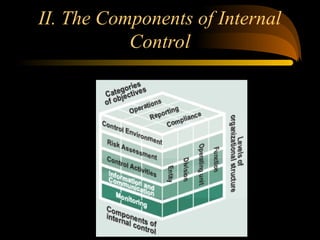
A. The Control Environment
B. Risk Assessment
C. Control Activities
D. Information and Communication
E. Monitoring
The internal control framework for most companies is the
Committee of Sponsoring Organizations of the Treadway
Commission (COSO) Internal Control—Integrated
Framework, issued in 1992.
II. The Components of Internal
Control
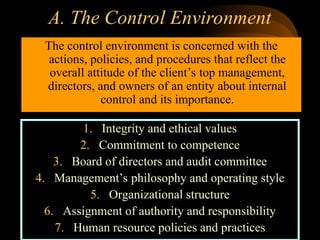
A. The Control Environment
The control environment is concerned with the
actions, policies, and procedures that reflect the
overall attitude of the client’s top management,
directors, and owners of an entity about internal
control and its importance.
1. Integrity and ethical values
2. Commitment to competence
3. Board of directors and audit committee
4. Management’s philosophy and operating style
5. Organizational structure
6. Assignment of authority and responsibility
7. Human resource policies and practices
1. Integrity and Ethical Values
Management actions
to remove incentives
that prompt a person
to behave improperly.
Communication of
behavioral standards
by codes of conduct
and example.
2. Commitment to Competence
Management’s
consideration of the
competence levels for
specific jobs and how
those translate into
requisite skills and
knowledge.
3. Board of Directors and Audit
Committee
Board delegates responsibility
for internal control to
management and is charged
with regular independent
assessments of management-
established internal control.
The major stock exchanges
require listed companies to have
an audit committee composed of
entirely independent directors
who are financially literate.
4. Management’s Philosophy and
Operating Style
Management, through its activities, provides clear
signals to employees about the importance of internal
control. For example, are sales and earnings targets
unrealistic, and are employees encouraged to take
aggressive actions to meet those targets.
5. Organizational Structure
Understanding the
client’s organizational
structure provides the
auditor with an
understanding of how
the client’s business
functions and
implements controls.
6. Assignment of Authority and
Responsibility
Formal methods of
communication including:
 Top management
memoranda concerning
internal control
 Organizational operating
plans
 Employee job
descriptions
Em
ployee
Job
Descriptions
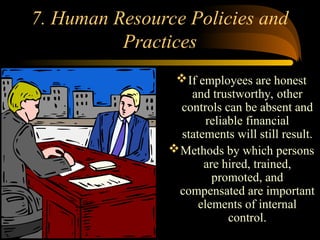
7. Human Resource Policies and
Practices
If employees are honest
and trustworthy, other
controls can be absent and
reliable financial
statements will still result.
Methods by which persons
are hired, trained,
promoted, and
compensated are important
elements of internal
control.
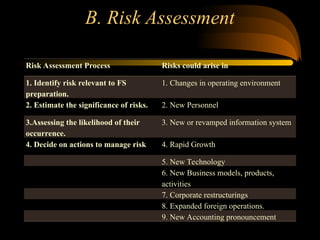
B. Risk Assessment
Client management’s identification and analysis of
risks relevant to the preparation of the financial
statements in accordance with GAAP.
1. Client Management’s Risk Assessment
2. Auditor Risk Assessment
B. Risk Assessment
Risk Assessment Process Risks could arise in
1. Identify risk relevant to FS
preparation.
1. Changes in operating environment
2. Estimate the significance of risks. 2. New Personnel
3.Assessing the likelihood of their
occurrence.
3. New or revamped information system
4. Decide on actions to manage risk 4. Rapid Growth
5. New Technology
6. New Business models, products,
activities
7. Corporate restructurings
8. Expanded foreign operations.
9. New Accounting pronouncement
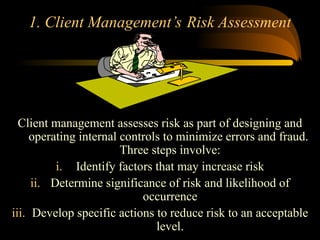
1. Client Management’s Risk Assessment
Client management assesses risk as part of designing and
operating internal controls to minimize errors and fraud.
Three steps involve:
i. Identify factors that may increase risk
ii. Determine significance of risk and likelihood of
occurrence
iii. Develop specific actions to reduce risk to an acceptable
level.
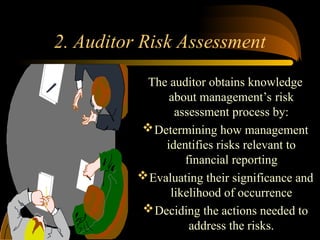
2. Auditor Risk Assessment
The auditor obtains knowledge
about management’s risk
assessment process by:
Determining how management
identifies risks relevant to
financial reporting
Evaluating their significance and
likelihood of occurrence
Deciding the actions needed to
address the risks.
C. Information and Communication
Methods used to initiate, record, process, and report an
entity’s transactions and to maintain accountability
for related assets.
 For a small company with active involvement by the
owner, a simple computerized accounting system that
involves one honest, competent accountant may
provide an adequate accounting system.
 A larger company requires a more complex system
that includes carefully defined responsibilities and
written procedures.
D. Control Activities
Policies and procedures that client management has
established to meet its objectives for financial
reporting.
1. Adequate segregation of duties
2. Proper authorization of transactions and activities
3. Adequate documents and records
4. Physical control over assets and records
5. Independent checks on performance
1. Adequate Segregation of
Duties
Separation of the
functions of
authorization,
recordkeeping, and
custody.
Separating IT duties
from User
Departments
2. Proper Authorization of
Transactions and Activities
General authorization
is permissible for
routine events for
which there are
policies to follow.
For some transactions
specific authorization
is needed on a case-
by-case basis.
3. Adequate Documents and
Records
Prenumbered
consecutive
documents so missing
items are noticed
Prepared as near to
transaction time as
possible
Good design with
instructions and
appropriate spaces
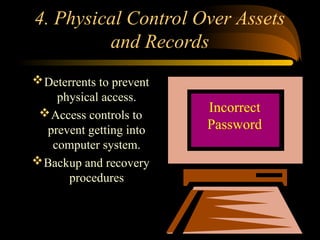
4. Physical Control Over Assets
and Records
Deterrents to prevent
physical access.
Access controls to
prevent getting into
computer system.
Backup and recovery
procedures
Incorrect
Password
5. Independent Checks on
Performance
Personnel are likely to
forget or intentionally
fail to follow
procedures, or they
may become careless
unless someone
observes and evaluates
their performance.
The three major categories are
A. Performance Review.
B. Information Processing Controls
C. Physical Controls
E. Monitoring
Client management’s ongoing and periodic assessment
of the quality of internal control performance to
determine whether controls are operating as intended
and modified when needed.
 For many companies, especially larger ones, an
internal audit department is essential for effective
monitoring.
 To maintain internal audit independence, it is
imperative that they be independent of operating and
accounting departments; and that they report to a high
level of authority, preferably the audit committee of
the board of directors.

Powerpoint.ppt on intrnal cntrol overview

  • 1.
    Overview of InternalControl Internal Control Internal Control Risk .
  • 2.
    Presentation Outline I. AnOverview of Internal Control II. The Components of Internal Control
  • 3.
    I. An Overviewof Internal Control A. Internal Control Defined B. Reasonable Assurance C. Reporting Requirements for Management D. Key Components of Managements’ Assessment of Internal Control E. Auditor Responsibilities for Understanding Internal Control
  • 4.
    A. Internal ControlDefined • Reliability of financial reporting • Compliance with applicable laws and regulations • Effectiveness and efficiency of operations An entity’s system of internal control consists of policies and procedures designed to provide management with reasonable assurance that the company achieves its objectives and goals including:
  • 5.
    A. Internal ControlDefined Internal Control -policies and procedures adopted by the management of entity to assist in achieving management’s objective. other purposes of internal control systems are: •adherence to management policies. •safeguarding of assets •prevention and detection of fraud and error •accuracy and completeness of the accounting records •timely preparation of reliable financial information.
  • 6.
    B. Reasonable Assurance Reasonableassurance involves two considerations:  The cost of the entity’s internal control should not exceed the expected benefits.  Limitations exist in any entity’s internal control. Code the missing cash to bad debts. Collusion
  • 7.
    C. Reporting Requirementsfor Management Section 404 of Sarbanes-Oxley requires the management of public companies to issue an internal control report that includes: A statement that management is responsible for establishing and maintaining an adequate internal control structure and procedures for financial reporting. An assessment of the effectiveness of the internal control structure and procedures for financial reporting as of the end of the company’s fiscal year.
  • 8.
    D. Key Componentsof Managements’ Assessment of Internal Control Management must evaluate the design of internal control over financial reporting. Management must test the operating effectiveness of those controls.
  • 9.
    E. Auditor Responsibilitiesfor Understanding Internal Control  Public and private companies – A sufficient understanding of internal control is to be obtained to plan the audit and to determine the nature, timing, and extent of tests to be performed.  Public companies – Section 404 requires effort beyond that stated above so that the auditor can provide a report on internal controls that contains the following two opinions:  Whether management’s assessment of the effectiveness of internal control over financial reporting as of the end of the fiscal period is fairly stated in all material respects.  Whether the company maintained, in all material respects, effective internal control over financial reporting as of the specified date.
  • 10.
    II. The Componentsof Internal Control A. The Control Environment B. Risk Assessment C. Control Activities D. Information and Communication E. Monitoring The internal control framework for most companies is the Committee of Sponsoring Organizations of the Treadway Commission (COSO) Internal Control—Integrated Framework, issued in 1992.
  • 11.
    II. The Componentsof Internal Control
  • 12.
    A. The ControlEnvironment The control environment is concerned with the actions, policies, and procedures that reflect the overall attitude of the client’s top management, directors, and owners of an entity about internal control and its importance. 1. Integrity and ethical values 2. Commitment to competence 3. Board of directors and audit committee 4. Management’s philosophy and operating style 5. Organizational structure 6. Assignment of authority and responsibility 7. Human resource policies and practices
  • 13.
    1. Integrity andEthical Values Management actions to remove incentives that prompt a person to behave improperly. Communication of behavioral standards by codes of conduct and example.
  • 14.
    2. Commitment toCompetence Management’s consideration of the competence levels for specific jobs and how those translate into requisite skills and knowledge.
  • 15.
    3. Board ofDirectors and Audit Committee Board delegates responsibility for internal control to management and is charged with regular independent assessments of management- established internal control. The major stock exchanges require listed companies to have an audit committee composed of entirely independent directors who are financially literate.
  • 16.
    4. Management’s Philosophyand Operating Style Management, through its activities, provides clear signals to employees about the importance of internal control. For example, are sales and earnings targets unrealistic, and are employees encouraged to take aggressive actions to meet those targets.
  • 17.
    5. Organizational Structure Understandingthe client’s organizational structure provides the auditor with an understanding of how the client’s business functions and implements controls.
  • 18.
    6. Assignment ofAuthority and Responsibility Formal methods of communication including:  Top management memoranda concerning internal control  Organizational operating plans  Employee job descriptions Em ployee Job Descriptions
  • 19.
    7. Human ResourcePolicies and Practices If employees are honest and trustworthy, other controls can be absent and reliable financial statements will still result. Methods by which persons are hired, trained, promoted, and compensated are important elements of internal control.
  • 20.
    B. Risk Assessment Clientmanagement’s identification and analysis of risks relevant to the preparation of the financial statements in accordance with GAAP. 1. Client Management’s Risk Assessment 2. Auditor Risk Assessment
  • 21.
    B. Risk Assessment RiskAssessment Process Risks could arise in 1. Identify risk relevant to FS preparation. 1. Changes in operating environment 2. Estimate the significance of risks. 2. New Personnel 3.Assessing the likelihood of their occurrence. 3. New or revamped information system 4. Decide on actions to manage risk 4. Rapid Growth 5. New Technology 6. New Business models, products, activities 7. Corporate restructurings 8. Expanded foreign operations. 9. New Accounting pronouncement
  • 22.
    1. Client Management’sRisk Assessment Client management assesses risk as part of designing and operating internal controls to minimize errors and fraud. Three steps involve: i. Identify factors that may increase risk ii. Determine significance of risk and likelihood of occurrence iii. Develop specific actions to reduce risk to an acceptable level.
  • 23.
    2. Auditor RiskAssessment The auditor obtains knowledge about management’s risk assessment process by: Determining how management identifies risks relevant to financial reporting Evaluating their significance and likelihood of occurrence Deciding the actions needed to address the risks.
  • 24.
    C. Information andCommunication Methods used to initiate, record, process, and report an entity’s transactions and to maintain accountability for related assets.  For a small company with active involvement by the owner, a simple computerized accounting system that involves one honest, competent accountant may provide an adequate accounting system.  A larger company requires a more complex system that includes carefully defined responsibilities and written procedures.
  • 25.
    D. Control Activities Policiesand procedures that client management has established to meet its objectives for financial reporting. 1. Adequate segregation of duties 2. Proper authorization of transactions and activities 3. Adequate documents and records 4. Physical control over assets and records 5. Independent checks on performance
  • 26.
    1. Adequate Segregationof Duties Separation of the functions of authorization, recordkeeping, and custody. Separating IT duties from User Departments
  • 27.
    2. Proper Authorizationof Transactions and Activities General authorization is permissible for routine events for which there are policies to follow. For some transactions specific authorization is needed on a case- by-case basis.
  • 28.
    3. Adequate Documentsand Records Prenumbered consecutive documents so missing items are noticed Prepared as near to transaction time as possible Good design with instructions and appropriate spaces
  • 29.
    4. Physical ControlOver Assets and Records Deterrents to prevent physical access. Access controls to prevent getting into computer system. Backup and recovery procedures Incorrect Password
  • 30.
    5. Independent Checkson Performance Personnel are likely to forget or intentionally fail to follow procedures, or they may become careless unless someone observes and evaluates their performance.
  • 31.
    The three majorcategories are A. Performance Review. B. Information Processing Controls C. Physical Controls
  • 32.
    E. Monitoring Client management’songoing and periodic assessment of the quality of internal control performance to determine whether controls are operating as intended and modified when needed.  For many companies, especially larger ones, an internal audit department is essential for effective monitoring.  To maintain internal audit independence, it is imperative that they be independent of operating and accounting departments; and that they report to a high level of authority, preferably the audit committee of the board of directors.