AUD 390
INTERNAL CONTROL
Prepared by:
•Mohd Hisyamuddin bin Mohd Ismail
•Mohamad Shahrin bin Mohd Jaafar
What is Internal Control?
Definition:
By SAS (Statement of Auditing Standard):
Integrated framework publish by COSO (
Committee of Sponsoring Organisation) .
Definition (cont):
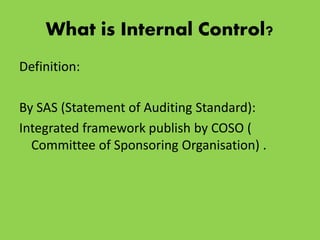
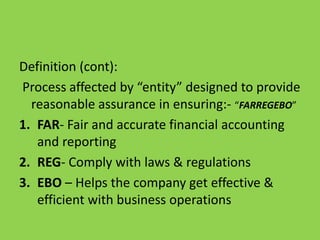
Process affected by “entity” designed to provide
reasonable assurance in ensuring:- “FARREGEBO”
1. FAR- Fair and accurate financial accounting
and reporting
2. REG- Comply with laws & regulations
3. EBO – Helps the company get effective &
efficient with business operations
Objectives of Internal control
Objectives:
1. FAR- Fair and accurate financial accounting
and reporting
2. REG- Comply with laws & regulations
3. EBO – Helps the company got effective &
efficient with business operations
Side objectives:
• To safeguard the assets – ensure they are
optimally utilised and protected from misuse,
fraud or theft.
• To prevent and detect fraud – controls are
necessary to show up any operational or
financial disagreement that might be result of
the theft or fraud.
Characteristics/ components of
Internal Control
“CRIME” to management not to have proper
internal control
• Control environment
• Risk Assessment
• Information & communication
• Monitoring
• Existing control activities
Limitations of Internal Control
• A good internal control system cannot turn a
poor manager into a good one
• Controls are only designed to cope with
routine transactions and events.
• The system can only provide reasonable
assurance regarding the achievement of
objectives
Inherent Limitation of Internal Control
- Human error; mistakes in judgement
- Management may override the control set
up by them
- Cost constraints (cost > benefits)
- Lack of personal quality of staff i.e. integrity
& independent
- Inadequate/ inefficient of ICS due to
changes in company size or activities
Importance of Internal control
• Control – reduce the risk of assets loss, help
& ensure that plan information is complete &
accurate
• To minimize opportunity for unintentional
errors or intentional errors that may harm the
plan (Preventive control)
• To discover small errors before they become
big problem (Detective control)
Relationship of IC & Audit
evidence
Audit evidence – “information” used by the
auditor to determine which audit opinion to
issue.
• To ensure that management has provide
reasonable assurance with are met reliability
of financial reporting, the effectiveness &
efficiency of operation & compliance with
laws & regulations. So that enable the auditor
to give opinion on the audit evidence.
Review & Documentation of IC
Documentation of the computer software programs
is crucial to both the audit client and the auditor.
This software includes the system & controls of:
• Input of information
• Information processing
• Output of information
• Report processing
• Logic of the software program
• Operator instructions
IC’s compliance test in
transaction cycle
• Auditors could obtain evidence about the
effectiveness of a control at an interim date &
not test its operation at year end.
• Auditors must evaluate the operating
effectiveness of control involving all relevant
significant accounts & disclosure each year.
• Auditors can use the work of others (Internal
auditors, other company personnel) to
evaluate/test internal control.
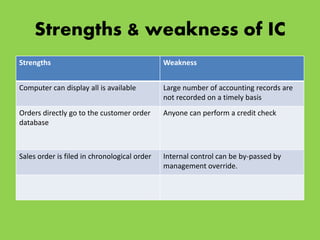
Strengths & weakness of IC
Strengths Weakness
Computer can display all is available Large number of accounting records are
not recorded on a timely basis
Orders directly go to the customer order
database
Anyone can perform a credit check
Sales order is filed in chronological order Internal control can be by-passed by
management override.
Management Letter
Def : Management letter includes suggestions to improve the
effectiveness or efficiency of the client’s operations & the
internal control procedures.
• Acknowledge management’s responsibility for establishing
& maintaining effective internal control over financial
reporting
• State that management has assessed the effectiveness of
internal control over financial reporting & specify the
control criteria used
• State management’s conclusion about the effectiveness of
internal control over financial reporting based on the
control criteria as of a specific date
Thank you…

Brief overview on Internal control (Audit)

  • 1.
    AUD 390 INTERNAL CONTROL Preparedby: •Mohd Hisyamuddin bin Mohd Ismail •Mohamad Shahrin bin Mohd Jaafar
  • 2.
    What is InternalControl? Definition: By SAS (Statement of Auditing Standard): Integrated framework publish by COSO ( Committee of Sponsoring Organisation) .
  • 3.
    Definition (cont): Process affectedby “entity” designed to provide reasonable assurance in ensuring:- “FARREGEBO” 1. FAR- Fair and accurate financial accounting and reporting 2. REG- Comply with laws & regulations 3. EBO – Helps the company get effective & efficient with business operations
  • 4.
    Objectives of Internalcontrol Objectives: 1. FAR- Fair and accurate financial accounting and reporting 2. REG- Comply with laws & regulations 3. EBO – Helps the company got effective & efficient with business operations
  • 5.
    Side objectives: • Tosafeguard the assets – ensure they are optimally utilised and protected from misuse, fraud or theft. • To prevent and detect fraud – controls are necessary to show up any operational or financial disagreement that might be result of the theft or fraud.
  • 6.
    Characteristics/ components of InternalControl “CRIME” to management not to have proper internal control • Control environment • Risk Assessment • Information & communication • Monitoring • Existing control activities
  • 7.
    Limitations of InternalControl • A good internal control system cannot turn a poor manager into a good one • Controls are only designed to cope with routine transactions and events. • The system can only provide reasonable assurance regarding the achievement of objectives
  • 8.
    Inherent Limitation ofInternal Control - Human error; mistakes in judgement - Management may override the control set up by them - Cost constraints (cost > benefits) - Lack of personal quality of staff i.e. integrity & independent - Inadequate/ inefficient of ICS due to changes in company size or activities
  • 9.
    Importance of Internalcontrol • Control – reduce the risk of assets loss, help & ensure that plan information is complete & accurate • To minimize opportunity for unintentional errors or intentional errors that may harm the plan (Preventive control) • To discover small errors before they become big problem (Detective control)
  • 10.
    Relationship of IC& Audit evidence Audit evidence – “information” used by the auditor to determine which audit opinion to issue. • To ensure that management has provide reasonable assurance with are met reliability of financial reporting, the effectiveness & efficiency of operation & compliance with laws & regulations. So that enable the auditor to give opinion on the audit evidence.
  • 11.
    Review & Documentationof IC Documentation of the computer software programs is crucial to both the audit client and the auditor. This software includes the system & controls of: • Input of information • Information processing • Output of information • Report processing • Logic of the software program • Operator instructions
  • 12.
    IC’s compliance testin transaction cycle • Auditors could obtain evidence about the effectiveness of a control at an interim date & not test its operation at year end. • Auditors must evaluate the operating effectiveness of control involving all relevant significant accounts & disclosure each year. • Auditors can use the work of others (Internal auditors, other company personnel) to evaluate/test internal control.
  • 13.
    Strengths & weaknessof IC Strengths Weakness Computer can display all is available Large number of accounting records are not recorded on a timely basis Orders directly go to the customer order database Anyone can perform a credit check Sales order is filed in chronological order Internal control can be by-passed by management override.
  • 14.
    Management Letter Def :Management letter includes suggestions to improve the effectiveness or efficiency of the client’s operations & the internal control procedures. • Acknowledge management’s responsibility for establishing & maintaining effective internal control over financial reporting • State that management has assessed the effectiveness of internal control over financial reporting & specify the control criteria used • State management’s conclusion about the effectiveness of internal control over financial reporting based on the control criteria as of a specific date
  • 15.