Selective Hardening
Processes
1
Why Selective Hardening
 1. Parts to be heat-treated are so large
 2. Only a small segment, section, or area of the
part needs to be heattreated
 3. Better dimensional accuracy of a heat-treated
part
 4. Overall cost savings
2
Methods of selective hardening
 Flame Hardening
 Induction Hardening
 Laser Hardening
 Electron Beam Hardening
3
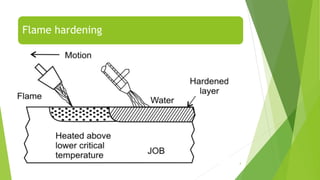
Flame hardening
4
Features of Flame Hardening
1. Oxy acetylene torch is used
2. Torch is adjusted so that temp. is above critical range but
below 850°C
3. Torch is moved so that part is heated uniformly followed
by quenching
4. Tempering is done to reveal stresses
5. For good results carbon content should be between 0.3-
0.6%
5
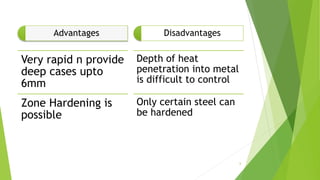
Advantages
Very rapid n provide
deep cases upto
6mm
Zone Hardening is
possible
Disadvantages
Depth of heat
penetration into metal
is difficult to control
Only certain steel can
be hardened
6
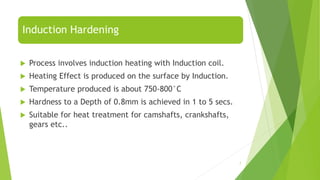
Induction Hardening
 Process involves induction heating with Induction coil.
 Heating Effect is produced on the surface by Induction.
 Temperature produced is about 750-800°C
 Hardness to a Depth of 0.8mm is achieved in 1 to 5 secs.
 Suitable for heat treatment for camshafts, crankshafts,
gears etc..
7
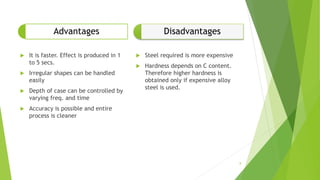
Advantages
 It is faster. Effect is produced in 1
to 5 secs.
 Irregular shapes can be handled
easily
 Depth of case can be controlled by
varying freq. and time
 Accuracy is possible and entire
process is cleaner
Disadvantages
 Steel required is more expensive
 Hardness depends on C content.
Therefore higher hardness is
obtained only if expensive alloy
steel is used.
8
Applications
 Hardening of Irregular shaped surfaces such cams chain links, piston rods…
9
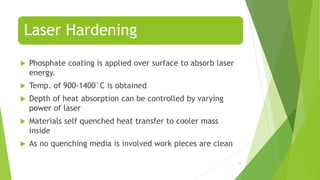
Laser Hardening
 Phosphate coating is applied over surface to absorb laser
energy.
 Temp. of 900-1400°C is obtained
 Depth of heat absorption can be controlled by varying
power of laser
 Materials self quenched heat transfer to cooler mass
inside
 As no quenching media is involved work pieces are clean
10
Electron Beam Hardening
 In this heat source is a beam of high energy electrons
 Beam is manipulated using electromagnetic coils
 Process is self quenched
 Depth of case varies from 0.1 to 1.5mm
 It is a conventional option due to less energy consumption
11

Selective hardening processes

  • 1.
  • 2.
    Why Selective Hardening 1. Parts to be heat-treated are so large  2. Only a small segment, section, or area of the part needs to be heattreated  3. Better dimensional accuracy of a heat-treated part  4. Overall cost savings 2
  • 3.
    Methods of selectivehardening  Flame Hardening  Induction Hardening  Laser Hardening  Electron Beam Hardening 3
  • 4.
  • 5.
    Features of FlameHardening 1. Oxy acetylene torch is used 2. Torch is adjusted so that temp. is above critical range but below 850°C 3. Torch is moved so that part is heated uniformly followed by quenching 4. Tempering is done to reveal stresses 5. For good results carbon content should be between 0.3- 0.6% 5
  • 6.
    Advantages Very rapid nprovide deep cases upto 6mm Zone Hardening is possible Disadvantages Depth of heat penetration into metal is difficult to control Only certain steel can be hardened 6
  • 7.
    Induction Hardening  Processinvolves induction heating with Induction coil.  Heating Effect is produced on the surface by Induction.  Temperature produced is about 750-800°C  Hardness to a Depth of 0.8mm is achieved in 1 to 5 secs.  Suitable for heat treatment for camshafts, crankshafts, gears etc.. 7
  • 8.
    Advantages  It isfaster. Effect is produced in 1 to 5 secs.  Irregular shapes can be handled easily  Depth of case can be controlled by varying freq. and time  Accuracy is possible and entire process is cleaner Disadvantages  Steel required is more expensive  Hardness depends on C content. Therefore higher hardness is obtained only if expensive alloy steel is used. 8
  • 9.
    Applications  Hardening ofIrregular shaped surfaces such cams chain links, piston rods… 9
  • 10.
    Laser Hardening  Phosphatecoating is applied over surface to absorb laser energy.  Temp. of 900-1400°C is obtained  Depth of heat absorption can be controlled by varying power of laser  Materials self quenched heat transfer to cooler mass inside  As no quenching media is involved work pieces are clean 10
  • 11.
    Electron Beam Hardening In this heat source is a beam of high energy electrons  Beam is manipulated using electromagnetic coils  Process is self quenched  Depth of case varies from 0.1 to 1.5mm  It is a conventional option due to less energy consumption 11