Understanding End Grain Corrosion in Austenitic Stainless Steels
Dr Shagufta Khan
Organized by
Eventagious Conference & Exhibition (ConEx)
virtual summit on
“ALL ABOUT CORROSION”
27th November, 2020
Dr Shagufta Khan
Present Company: AMCO Integrity Pty Ltd
Name & : Dr Shagufta Khan
Designation: Director Asset Integrity and Corrosion
Academic
Qualification: Ph.D. Corrosion engineering
Specialized Knowledge: Asset Integrity and Corrosion
Achievements: 18 Publications in international journals and conference proceedings
Guest editor for [Sustainability] Special Issue - Sustainable Materials,
Manufacturing and Design.
Key points of the Paper
Introduction
• Austenitic stainless steels (SS) are routinely specified for nitric acid (HNO3)
duty in nuclear reprocessing plants, owing to their passivity.
• However, in sufficiently oxidizing conditions generated either by high
temperatures or the presence of dissolved species such as oxydising ions,
passivity is lost and high corrosion rates can result.
• Such trans passive corrosion is morphologically characterized as
intergranular corrosion.
Operating parameters in the plant
Process parameters
• Nitric acid of varying concentration
• Temperatures up to boiling point (110
oC)
• Oxidizing ions
Material parameters
• Material used
(mainly SS 304L & SS 304L
(NAG))
• Sensitization
• Exposed surface
• Cold working
• Element segregation
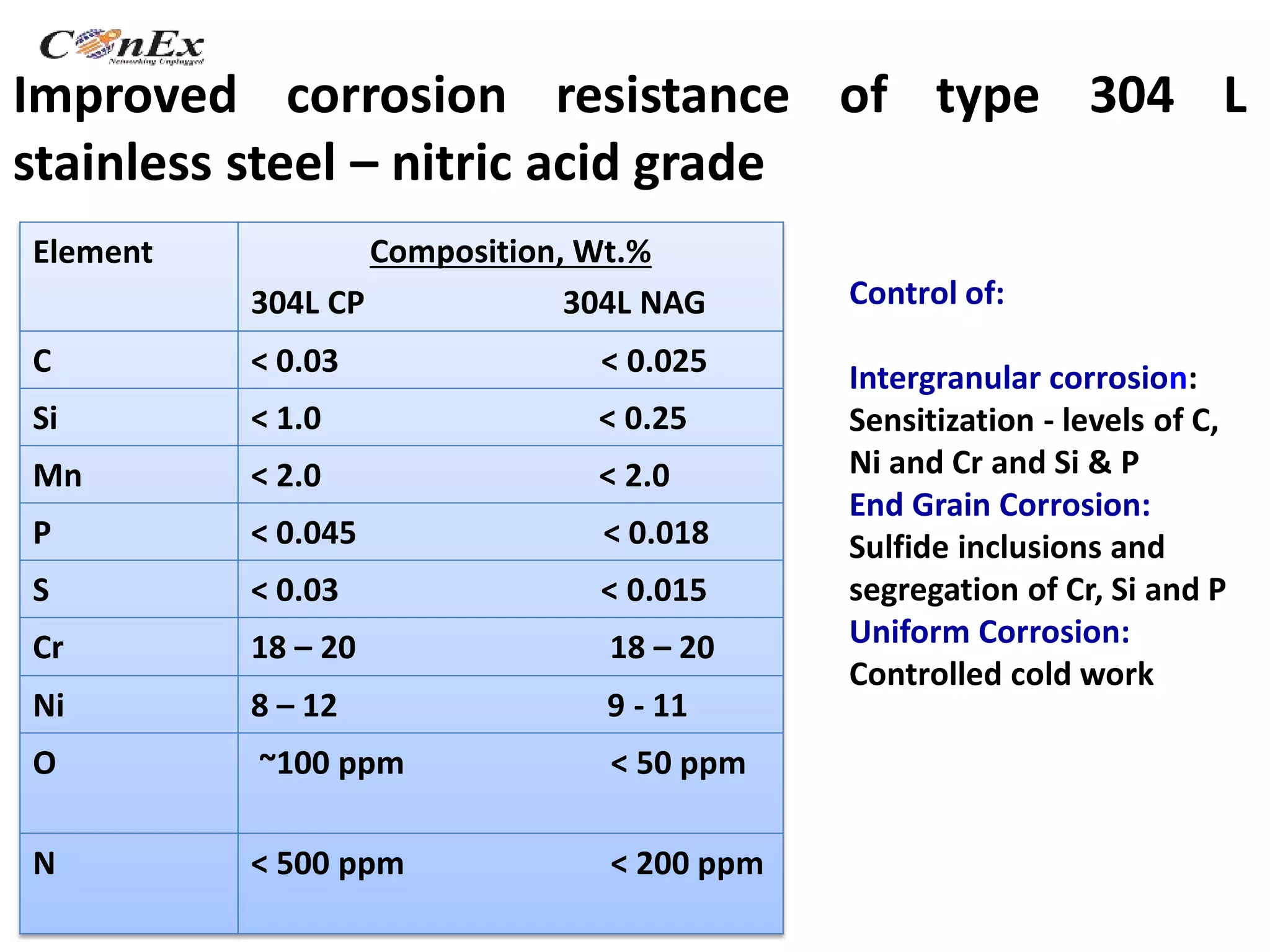
Improved corrosion resistance of type 304 L
stainless steel – nitric acid grade
Element Composition, Wt.%
304L CP 304L NAG
C < 0.03 < 0.025
Si < 1.0 < 0.25
Mn < 2.0 < 2.0
P < 0.045 < 0.018
S < 0.03 < 0.015
Cr 18 – 20 18 – 20
Ni 8 – 12 9 - 11
O ~100 ppm < 50 ppm
N < 500 ppm < 200 ppm
Control of:
Intergranular corrosion:
Sensitization - levels of C,
Ni and Cr and Si & P
End Grain Corrosion:
Sulfide inclusions and
segregation of Cr, Si and P
Uniform Corrosion:
Controlled cold work
General electrochemical behavior of stainless steel
in nitric acid medium
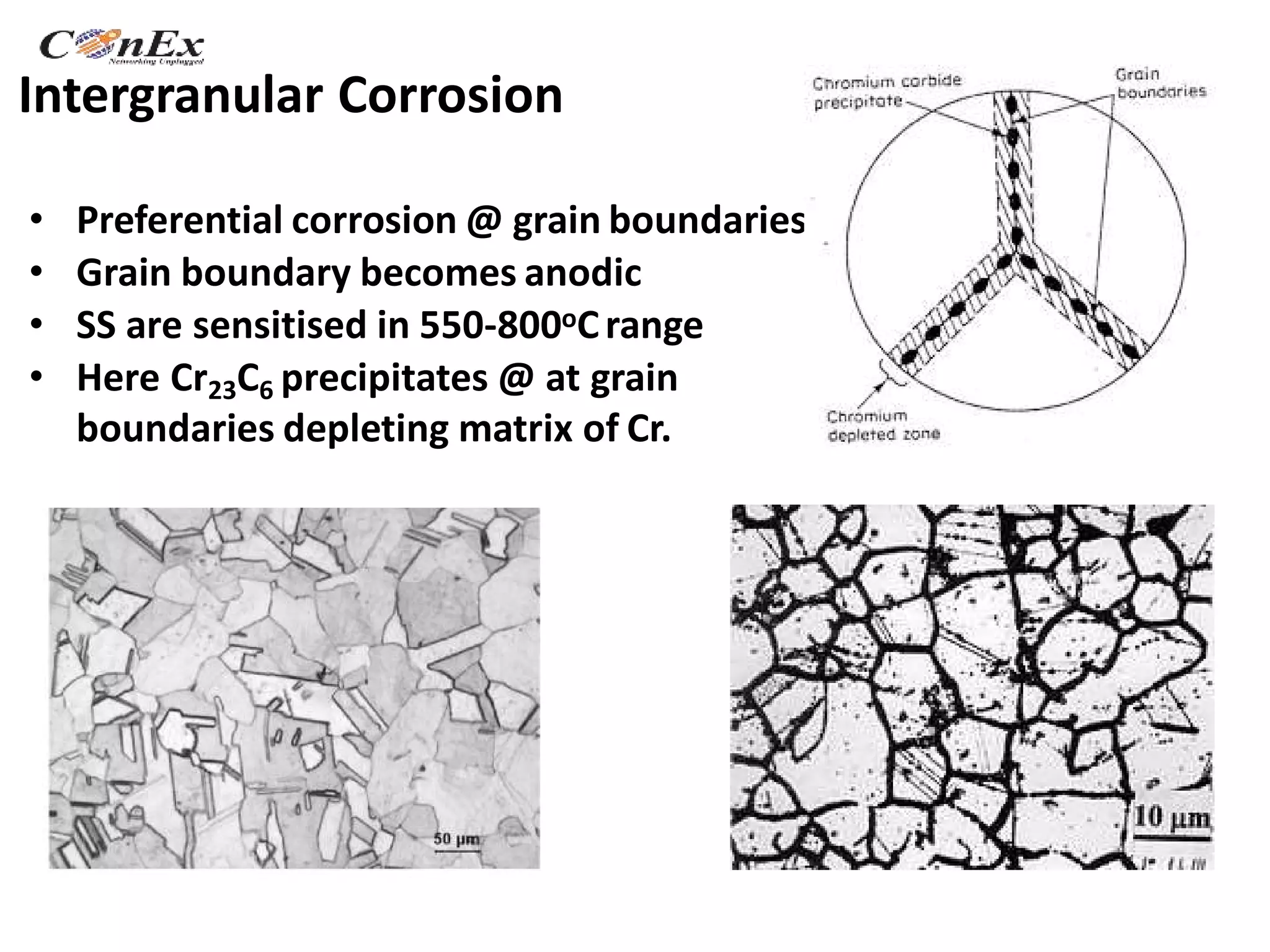
Intergranular Corrosion
• Preferential corrosion @ grain boundaries
• Grain boundary becomes anodic
• SS are sensitised in 550-800oCrange
• Here Cr23C6 precipitates @ at grain
boundaries depleting matrix of Cr.
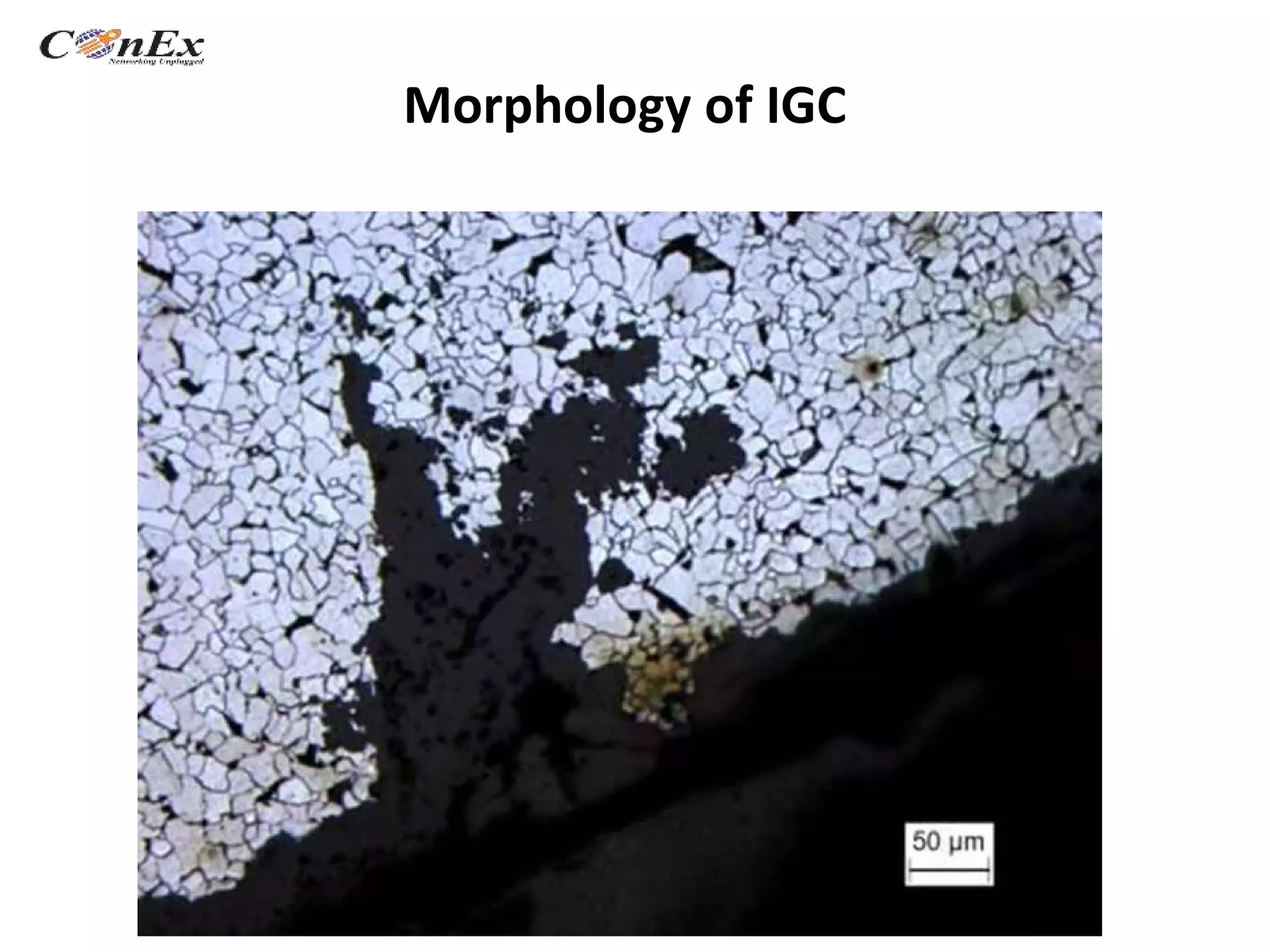
Morphology of IGC
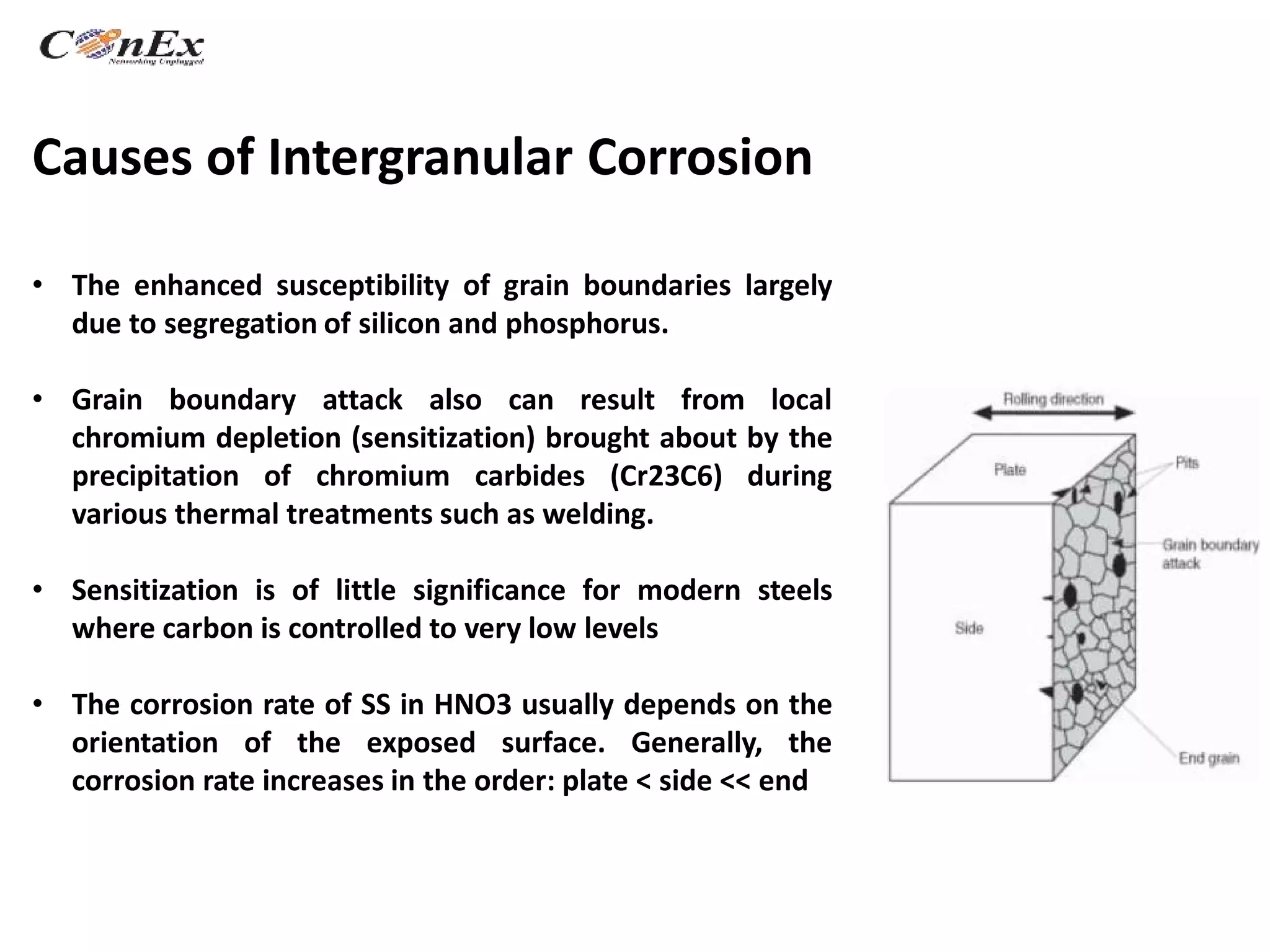
Causes of Intergranular Corrosion
• The enhanced susceptibility of grain boundaries largely
due to segregation of silicon and phosphorus.
• Grain boundary attack also can result from local
chromium depletion (sensitization) brought about by the
precipitation of chromium carbides (Cr23C6) during
various thermal treatments such as welding.
• Sensitization is of little significance for modern steels
where carbon is controlled to very low levels
• The corrosion rate of SS in HNO3 usually depends on the
orientation of the exposed surface. Generally, the
corrosion rate increases in the order: plate < side << end
How to prevent intergranular corrosion?
• Use low carbon (e.g. 304L, 316L) grade of stainless steels
• Use stabilized grades alloyed with titanium (for example type 321) or
niobium (for example type 347). Titanium and niobium are strong
carbide- formers. They react with the carbon to form the corresponding
carbides thereby preventing chromium depletion.
• Use post-weld heat treatment.
• Chemical composition based parameter Cr effective ( = % Cr - 0.18 (% Ni)
- 100 (% C)) with values greater than 14.0 indicating resistance to
intergranular corrosion of austenitic stainless steels in its welded
condition.
• Refinement in grain size
In reprocessing plants instrument tubing,
tube to tube sheet welds, Forgings and set
in pipe branches are reported to be most
affected by end grain corrosion.
Exposure studies done in a dissolver in a
reprocessing plant (in vapor phase) showed
very heavy corrosion rates of 0.6 – 2 mm/y
even for NAG grade of stainless steel and
was attributed mainly to end grain
corrosion.
End grain corrosion is specifically related
to highly oxidizing nitric acid environments.
End Grain Corrosion
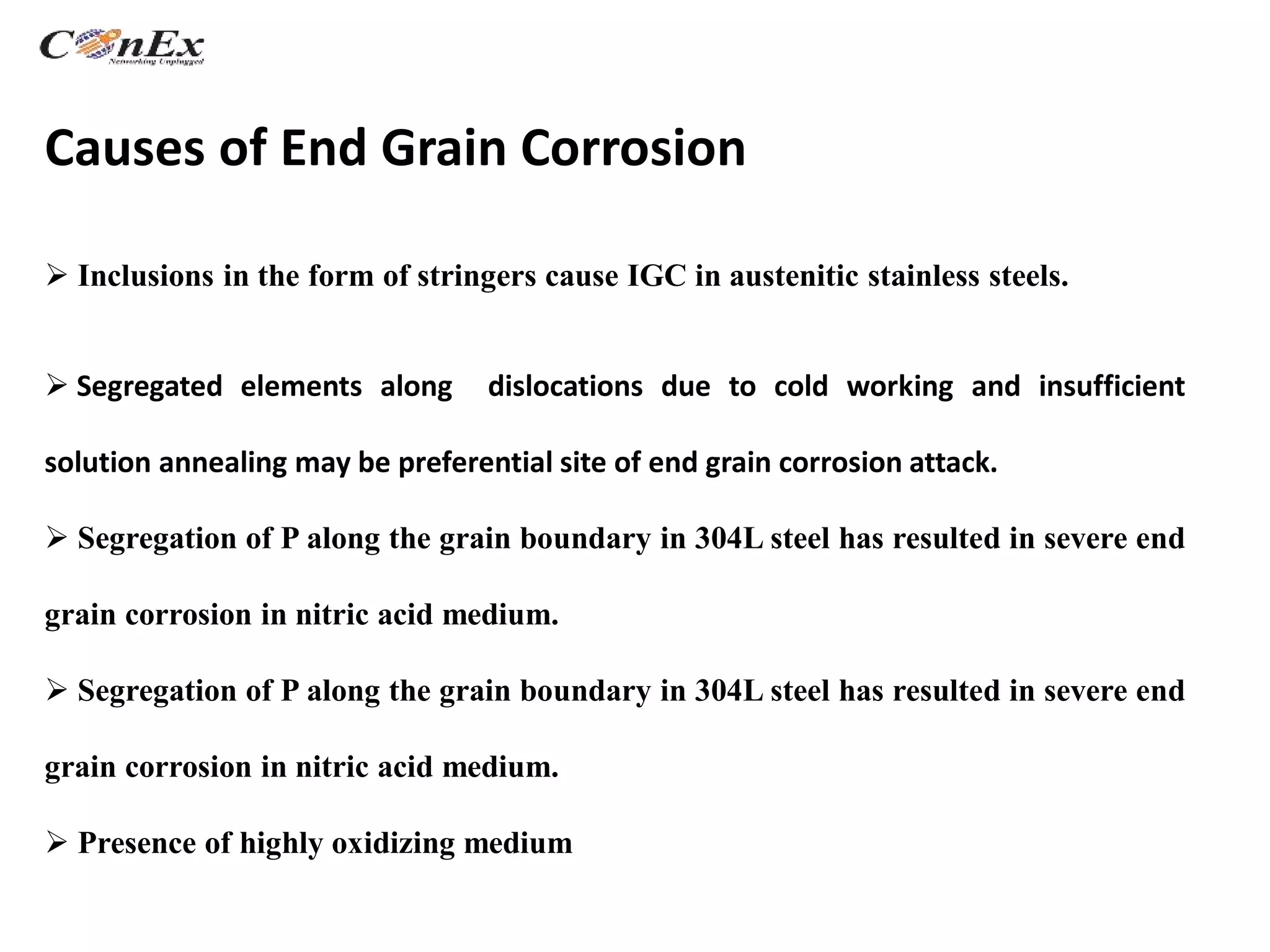
Morphology of End Grain Corrosion
End grain corrosion in 304L stainless steel after exposure to practice C, A262, ASTM
(a) From the longitudinal direction (b) From the cross section.
(a) (b)
Causes of End Grain Corrosion
Inclusions in the form of stringers cause IGC in austenitic stainless steels.
Segregated elements along dislocations due to cold working and insufficient
solution annealing may be preferential site of end grain corrosion attack.
Segregation of P along the grain boundary in 304L steel has resulted in severe end
grain corrosion in nitric acid medium.
Segregation of P along the grain boundary in 304L steel has resulted in severe end
grain corrosion in nitric acid medium.
Presence of highly oxidizing medium
End grain corrosion rate as a function of time at two
different concentration of Cr (VI) in 9 M HNO3
Corrosion
rate
(mm/y)
Potential variation with time in 9 M boiling solution of
nitric acid containing different concentration of Cr +6.
• Modification of
microstructure of the
end faces after laser
remelting.
• The elongated
inclusions and
segregation of Cr, Si,
and P along the flow
lines get eliminated.
• Presence of delta
ferrite in the melt
pool
Control of End Grain Corrosion by laser surface remelting
Control of end grain corrosion
• Weld deposition on
the end faces masks
the susceptible
material (to end-grain
corrosion) with a more
corrosion resistant
material.
• This helps in increasing
the corrosion
resistance of the
component.
Control of End Grain Corrosion by weld overlay on
the exposed end faces.
Control of end grain corrosion
• Solution annealing is known to homogenize the structure of the
material. Therefore, it should minimize the end-grain corrosion of
the material occurring due to chemical inhomogenity.
• The temperature and time for the heat treatment is selected to
minimize grain growth while permitting elemental diffusion to take
place for homogenization of elemental segregation at flow lines.
• Solution annealing at 950 0C for 90 minutes has been shown to be
effective in 304 L.
shagufta@amco-consulting.com.au
iamshagufta@gmail.com

Intergranular corrosion in SS tubes

  • 1.
    Understanding End GrainCorrosion in Austenitic Stainless Steels Dr Shagufta Khan Organized by Eventagious Conference & Exhibition (ConEx) virtual summit on “ALL ABOUT CORROSION” 27th November, 2020
  • 2.
    Dr Shagufta Khan PresentCompany: AMCO Integrity Pty Ltd Name & : Dr Shagufta Khan Designation: Director Asset Integrity and Corrosion Academic Qualification: Ph.D. Corrosion engineering Specialized Knowledge: Asset Integrity and Corrosion Achievements: 18 Publications in international journals and conference proceedings Guest editor for [Sustainability] Special Issue - Sustainable Materials, Manufacturing and Design. Key points of the Paper
  • 3.
    Introduction • Austenitic stainlesssteels (SS) are routinely specified for nitric acid (HNO3) duty in nuclear reprocessing plants, owing to their passivity. • However, in sufficiently oxidizing conditions generated either by high temperatures or the presence of dissolved species such as oxydising ions, passivity is lost and high corrosion rates can result. • Such trans passive corrosion is morphologically characterized as intergranular corrosion.
  • 4.
    Operating parameters inthe plant Process parameters • Nitric acid of varying concentration • Temperatures up to boiling point (110 oC) • Oxidizing ions Material parameters • Material used (mainly SS 304L & SS 304L (NAG)) • Sensitization • Exposed surface • Cold working • Element segregation
  • 5.
    Improved corrosion resistanceof type 304 L stainless steel – nitric acid grade Element Composition, Wt.% 304L CP 304L NAG C < 0.03 < 0.025 Si < 1.0 < 0.25 Mn < 2.0 < 2.0 P < 0.045 < 0.018 S < 0.03 < 0.015 Cr 18 – 20 18 – 20 Ni 8 – 12 9 - 11 O ~100 ppm < 50 ppm N < 500 ppm < 200 ppm Control of: Intergranular corrosion: Sensitization - levels of C, Ni and Cr and Si & P End Grain Corrosion: Sulfide inclusions and segregation of Cr, Si and P Uniform Corrosion: Controlled cold work
  • 6.
    General electrochemical behaviorof stainless steel in nitric acid medium
  • 7.
    Intergranular Corrosion • Preferentialcorrosion @ grain boundaries • Grain boundary becomes anodic • SS are sensitised in 550-800oCrange • Here Cr23C6 precipitates @ at grain boundaries depleting matrix of Cr.
  • 8.
  • 9.
    Causes of IntergranularCorrosion • The enhanced susceptibility of grain boundaries largely due to segregation of silicon and phosphorus. • Grain boundary attack also can result from local chromium depletion (sensitization) brought about by the precipitation of chromium carbides (Cr23C6) during various thermal treatments such as welding. • Sensitization is of little significance for modern steels where carbon is controlled to very low levels • The corrosion rate of SS in HNO3 usually depends on the orientation of the exposed surface. Generally, the corrosion rate increases in the order: plate < side << end
  • 10.
    How to preventintergranular corrosion? • Use low carbon (e.g. 304L, 316L) grade of stainless steels • Use stabilized grades alloyed with titanium (for example type 321) or niobium (for example type 347). Titanium and niobium are strong carbide- formers. They react with the carbon to form the corresponding carbides thereby preventing chromium depletion. • Use post-weld heat treatment. • Chemical composition based parameter Cr effective ( = % Cr - 0.18 (% Ni) - 100 (% C)) with values greater than 14.0 indicating resistance to intergranular corrosion of austenitic stainless steels in its welded condition. • Refinement in grain size
  • 11.
    In reprocessing plantsinstrument tubing, tube to tube sheet welds, Forgings and set in pipe branches are reported to be most affected by end grain corrosion. Exposure studies done in a dissolver in a reprocessing plant (in vapor phase) showed very heavy corrosion rates of 0.6 – 2 mm/y even for NAG grade of stainless steel and was attributed mainly to end grain corrosion. End grain corrosion is specifically related to highly oxidizing nitric acid environments. End Grain Corrosion
  • 12.
    Morphology of EndGrain Corrosion End grain corrosion in 304L stainless steel after exposure to practice C, A262, ASTM (a) From the longitudinal direction (b) From the cross section. (a) (b)
  • 13.
    Causes of EndGrain Corrosion Inclusions in the form of stringers cause IGC in austenitic stainless steels. Segregated elements along dislocations due to cold working and insufficient solution annealing may be preferential site of end grain corrosion attack. Segregation of P along the grain boundary in 304L steel has resulted in severe end grain corrosion in nitric acid medium. Segregation of P along the grain boundary in 304L steel has resulted in severe end grain corrosion in nitric acid medium. Presence of highly oxidizing medium
  • 14.
    End grain corrosionrate as a function of time at two different concentration of Cr (VI) in 9 M HNO3 Corrosion rate (mm/y)
  • 15.
    Potential variation withtime in 9 M boiling solution of nitric acid containing different concentration of Cr +6.
  • 16.
    • Modification of microstructureof the end faces after laser remelting. • The elongated inclusions and segregation of Cr, Si, and P along the flow lines get eliminated. • Presence of delta ferrite in the melt pool Control of End Grain Corrosion by laser surface remelting Control of end grain corrosion
  • 17.
    • Weld depositionon the end faces masks the susceptible material (to end-grain corrosion) with a more corrosion resistant material. • This helps in increasing the corrosion resistance of the component. Control of End Grain Corrosion by weld overlay on the exposed end faces. Control of end grain corrosion
  • 18.
    Control of endgrain corrosion • Solution annealing is known to homogenize the structure of the material. Therefore, it should minimize the end-grain corrosion of the material occurring due to chemical inhomogenity. • The temperature and time for the heat treatment is selected to minimize grain growth while permitting elemental diffusion to take place for homogenization of elemental segregation at flow lines. • Solution annealing at 950 0C for 90 minutes has been shown to be effective in 304 L.
  • 19.