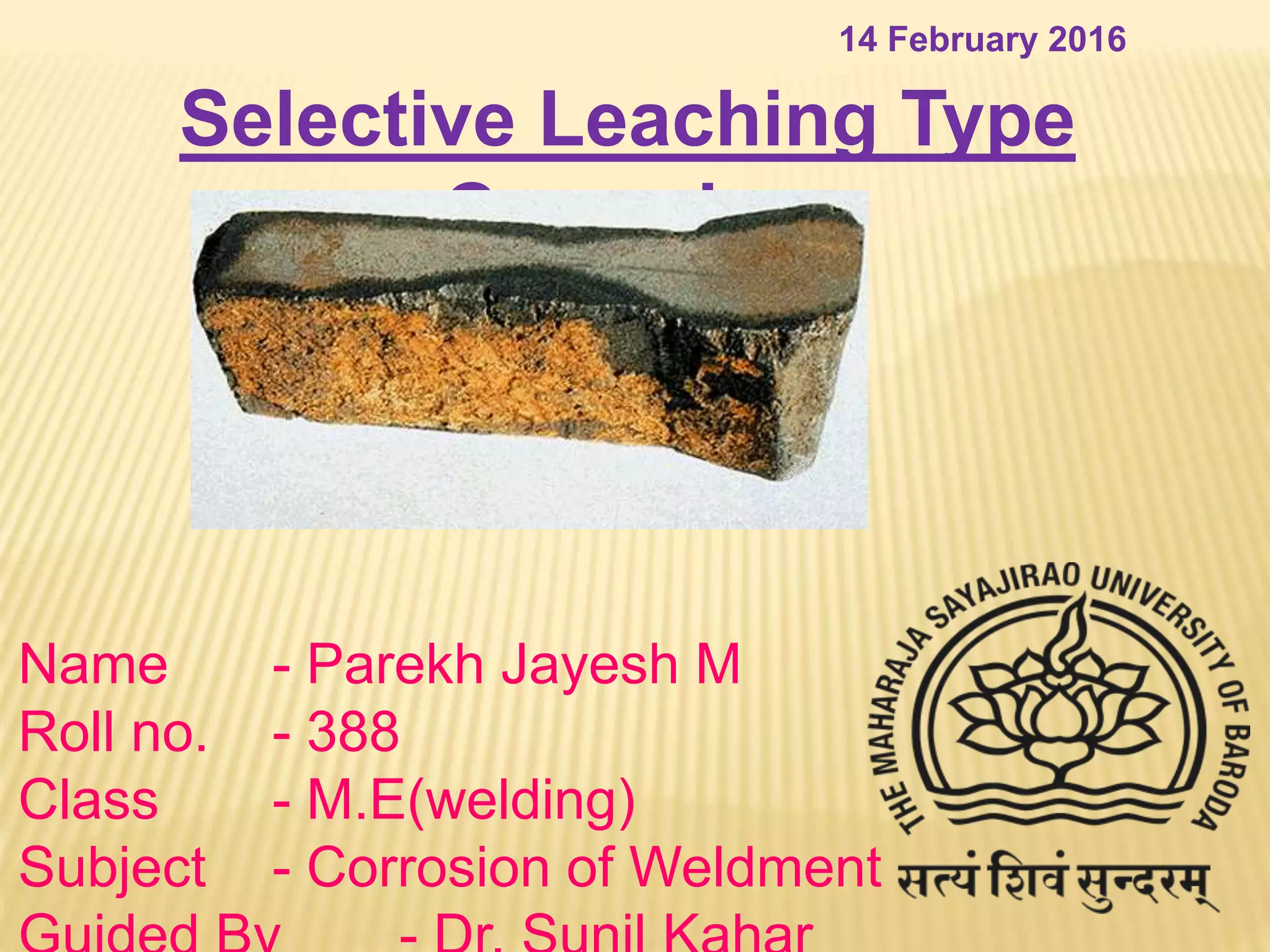
Selective Leaching Type
Corrosion
Name - Parekh Jayesh M
Roll no. - 388
Class - M.E(welding)
Subject - Corrosion of Weldment
14 February 2016
Introduction
 Corrosion is defined as the destruction or deterioration of a
material because of reaction with environment. Corrosion is a
natural process which converts a refined metal to a more
stable form, such as its oxide or hydroxide.
• Types of Corrosion
1) Galvanic Corrosion
2) Crevice Corrosion
3) Pitting
4) Intergrainnular Corrosion
5) Selective leaching
6) Erosion Corrosion
7) Stress corrosion
8) Hydrogen Damage
Selective leaching
 De-alloying or selective leaching refers to the selective
removal of one element from an alloy by corrosion
processes.
 A common example is the dezincification of brass, whereby
a weakened, porous copper structure is produced, without
modification of overall part dimensions.
 Selective leaching is also called de-alloying, de-
metalification, parting, and selective corrosion.
 The selective removal of one element can proceed in
uniform manner or localize (plug type) scale.
Mechanism
There are three steps of mechanism for dezincification.
1) First entire brass alloy is dissolved.
2) The Nobel metal is replated (e.g. Cu in Brass)
3) Active metal is leached away. (e.g. Zn in Brass)
 Zinc is quite reactive to corrosive environment while copper is
more Nobel metal.
 Zinc can corrode slowly in corrosive environment and
leaching of zinc occurs in brass which makes porous
structure of copper. This mechanism is called dezincification.
 The analysis of dezincified area shows 90 to 95% copper
with present as copper oxide.
 When oxygen is present then it also enters into cathodic
reaction and increase rate of attack.
 The material remaining is a copper-rich sponge with poor
mechanical properties, and a color changed from yellow to
red.
 Dezincification can be caused by water containing sulfur,
carbon dioxide, and oxygen. Stagnant or low velocity waters
tend to promote dezincification.
Characteristics of dezincification
 Common yellow brass consists of approximately 30% zinc
and 70% copper.
 Dezincification is readily observed with the naked eye
because the alloy color visible in red color.
There are two types of dezincification
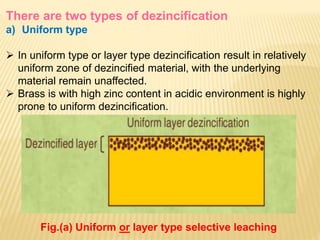
a) Uniform type
 In uniform type or layer type dezincification result in relatively
uniform zone of dezincified material, with the underlying
material remain unaffected.
 Brass is with high zinc content in acidic environment is highly
prone to uniform dezincification.
Fig.(a) Uniform or layer type selective leaching
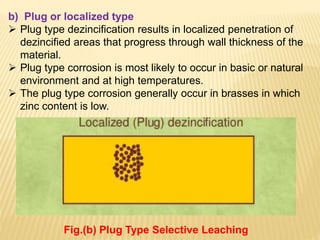
b) Plug or localized type
 Plug type dezincification results in localized penetration of
dezincified areas that progress through wall thickness of the
material.
 Plug type corrosion is most likely to occur in basic or natural
environment and at high temperatures.
 The plug type corrosion generally occur in brasses in which
zinc content is low.
Fig.(b) Plug Type Selective Leaching
Prevention
 Dezincification can be minimized by reducing aggressiveness
of the environment.
 Usually less susceptible material is used
 Addition of 1%Sn in 70-30 brass which improve resistance
towards dezincification.
 Addition of small amount of arsenic, antimony and
phosphorous as inhibitors.
 Cupronickel (70%-90% Cu, 30%-10% Ni) is used in severely
corrosive environment.
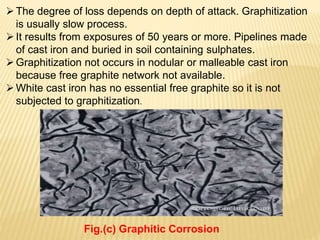
2.Graphitic Corrosion
 Grey cast iron shows the effect of selective leaching
particularly in mild environments.
 In graphitization selective leaching of iron from grey cast iron.
Affected surfaces develop a layer of graphite, rust, and
metallurgical impurities.
The degree of loss depends on depth of attack. Graphitization
is usually slow process.
It results from exposures of 50 years or more. Pipelines made
of cast iron and buried in soil containing sulphates.
Graphitization not occurs in nodular or malleable cast iron
because free graphite network not available.
White cast iron has no essential free graphite so it is not
subjected to graphitization.
Fig.(c) Graphitic Corrosion
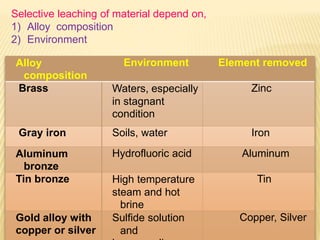
Selective leaching of material depend on,
1) Alloy composition
2) Environment
Alloy
composition
Environment Element removed
Brass Waters, especially
in stagnant
condition
Zinc
Gray iron Soils, water Iron
Aluminum
bronze
Hydrofluoric acid Aluminum
Tin bronze High temperature
steam and hot
brine
Tin
Gold alloy with
copper or silver
Sulfide solution
and
Copper, Silver
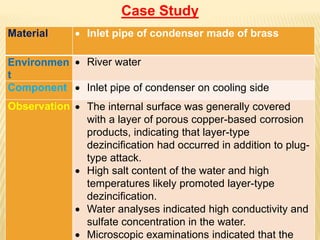
Material  Inlet pipe of condenser made of brass
Environmen
t
 River water
Component  Inlet pipe of condenser on cooling side
Observation  The internal surface was generally covered
with a layer of porous copper-based corrosion
products, indicating that layer-type
dezincification had occurred in addition to plug-
type attack.
 High salt content of the water and high
temperatures likely promoted layer-type
dezincification.
 Water analyses indicated high conductivity and
sulfate concentration in the water.
 Microscopic examinations indicated that the
Case Study
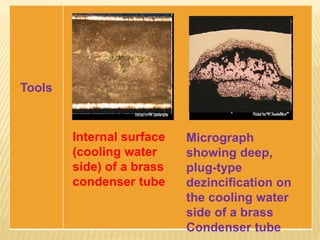
Tools
Internal surface
(cooling water
side) of a brass
condenser tube
Micrograph
showing deep,
plug-type
dezincification on
the cooling water
side of a brass
Condenser tube.
Prevention
 The addition of an adequate concentration
of a corrosion-inhibiting element may have
prevented the plug-type dezincification
and limited layer-type dezincification.
 It was recommended that tube surfaces be
kept clean to minimize the possibility of
concentration of aggressive species
beneath occlusive material.
Thank You…

selective leaching type corrosion

  • 1.
    Selective Leaching Type Corrosion Name- Parekh Jayesh M Roll no. - 388 Class - M.E(welding) Subject - Corrosion of Weldment 14 February 2016
  • 2.
    Introduction  Corrosion isdefined as the destruction or deterioration of a material because of reaction with environment. Corrosion is a natural process which converts a refined metal to a more stable form, such as its oxide or hydroxide. • Types of Corrosion 1) Galvanic Corrosion 2) Crevice Corrosion 3) Pitting 4) Intergrainnular Corrosion 5) Selective leaching 6) Erosion Corrosion 7) Stress corrosion 8) Hydrogen Damage
  • 3.
    Selective leaching  De-alloyingor selective leaching refers to the selective removal of one element from an alloy by corrosion processes.  A common example is the dezincification of brass, whereby a weakened, porous copper structure is produced, without modification of overall part dimensions.  Selective leaching is also called de-alloying, de- metalification, parting, and selective corrosion.  The selective removal of one element can proceed in uniform manner or localize (plug type) scale.
  • 4.
    Mechanism There are threesteps of mechanism for dezincification. 1) First entire brass alloy is dissolved. 2) The Nobel metal is replated (e.g. Cu in Brass) 3) Active metal is leached away. (e.g. Zn in Brass)  Zinc is quite reactive to corrosive environment while copper is more Nobel metal.  Zinc can corrode slowly in corrosive environment and leaching of zinc occurs in brass which makes porous structure of copper. This mechanism is called dezincification.  The analysis of dezincified area shows 90 to 95% copper with present as copper oxide.  When oxygen is present then it also enters into cathodic reaction and increase rate of attack.
  • 5.
     The materialremaining is a copper-rich sponge with poor mechanical properties, and a color changed from yellow to red.  Dezincification can be caused by water containing sulfur, carbon dioxide, and oxygen. Stagnant or low velocity waters tend to promote dezincification. Characteristics of dezincification  Common yellow brass consists of approximately 30% zinc and 70% copper.  Dezincification is readily observed with the naked eye because the alloy color visible in red color.
  • 6.
    There are twotypes of dezincification a) Uniform type  In uniform type or layer type dezincification result in relatively uniform zone of dezincified material, with the underlying material remain unaffected.  Brass is with high zinc content in acidic environment is highly prone to uniform dezincification. Fig.(a) Uniform or layer type selective leaching
  • 7.
    b) Plug orlocalized type  Plug type dezincification results in localized penetration of dezincified areas that progress through wall thickness of the material.  Plug type corrosion is most likely to occur in basic or natural environment and at high temperatures.  The plug type corrosion generally occur in brasses in which zinc content is low. Fig.(b) Plug Type Selective Leaching
  • 8.
    Prevention  Dezincification canbe minimized by reducing aggressiveness of the environment.  Usually less susceptible material is used  Addition of 1%Sn in 70-30 brass which improve resistance towards dezincification.  Addition of small amount of arsenic, antimony and phosphorous as inhibitors.  Cupronickel (70%-90% Cu, 30%-10% Ni) is used in severely corrosive environment. 2.Graphitic Corrosion  Grey cast iron shows the effect of selective leaching particularly in mild environments.  In graphitization selective leaching of iron from grey cast iron. Affected surfaces develop a layer of graphite, rust, and metallurgical impurities.
  • 9.
    The degree ofloss depends on depth of attack. Graphitization is usually slow process. It results from exposures of 50 years or more. Pipelines made of cast iron and buried in soil containing sulphates. Graphitization not occurs in nodular or malleable cast iron because free graphite network not available. White cast iron has no essential free graphite so it is not subjected to graphitization. Fig.(c) Graphitic Corrosion
  • 10.
    Selective leaching ofmaterial depend on, 1) Alloy composition 2) Environment Alloy composition Environment Element removed Brass Waters, especially in stagnant condition Zinc Gray iron Soils, water Iron Aluminum bronze Hydrofluoric acid Aluminum Tin bronze High temperature steam and hot brine Tin Gold alloy with copper or silver Sulfide solution and Copper, Silver
  • 11.
    Material  Inletpipe of condenser made of brass Environmen t  River water Component  Inlet pipe of condenser on cooling side Observation  The internal surface was generally covered with a layer of porous copper-based corrosion products, indicating that layer-type dezincification had occurred in addition to plug- type attack.  High salt content of the water and high temperatures likely promoted layer-type dezincification.  Water analyses indicated high conductivity and sulfate concentration in the water.  Microscopic examinations indicated that the Case Study
  • 12.
    Tools Internal surface (cooling water side)of a brass condenser tube Micrograph showing deep, plug-type dezincification on the cooling water side of a brass Condenser tube.
  • 13.
    Prevention  The additionof an adequate concentration of a corrosion-inhibiting element may have prevented the plug-type dezincification and limited layer-type dezincification.  It was recommended that tube surfaces be kept clean to minimize the possibility of concentration of aggressive species beneath occlusive material.
  • 14.