Smarajit Sarkar
Department of Metallurgical and Materials Engineering
                                        NIT Rourkela
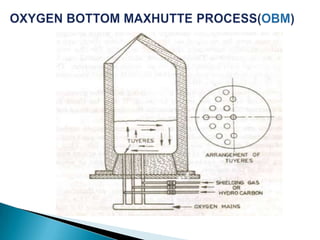
 The OBM vessel is essentially a Bessemer-like
  converter fitted with a special bottom .
 The tuyeres are inserted from the bottom in such a
  way that the oxygen would be surrounded by a
  protective hydrocarbon gas like propane.
 On entry propane cracks down in an endothermic
  reaction and takes up some of the heat-gene-rated by
  the entry of oxygen.
 The relative feed rates of these two fluids are adjusted
  to obtain optimum temperatures at the tuyere tip and
  thereby ensure its reasonable life as well as speed of
  refining.
 The deposition of carbon, which is a product of
  cracking, also helps to protect the bottom from heat
  generated due to the refining reactions at the tips of
  tuyeres.
 Inorder to promote turbulence in the bath and thereby
 ensure good slag-metal contact, the tuyeres are
 arranged only on half the converter bottom.
 Experience dictated that provision of a few bigger
 tuyeres is better than large number of fine tuyeres.
 Maintenance problems are minimised without loosing
 in terms of metallurgical requirements of turbulence.
 By this arrangement, it is ensured that the direction of
 metal circulation is upwards in the tuyere half of the
 vessel, and downwards in the other half.
 This arrangement is also helpful in minimising the
 damage to tuyeres while charging scrap, since it can
 now be charged on that part where there are no
 tuyeres.
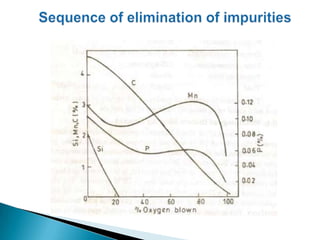
Oxidation of carbon : Bottom blowing increases sharply the
    intensity of bath stirring and increases the area of gas-metal
    boundaries (10-20 times the values typical of top blowing) .
   Since the hydrocarbons supplied into the bath together with
    oxygen dissociate into H2, H2O and CO2 gas bubbles in the
    bath have a lower partial pressure of carbon monoxide (Pco )
   All these factors facilitate substantially the formation and
    evolution of carbon monoxide, which leads to a higher rate of
    decarburization in bottom blowing
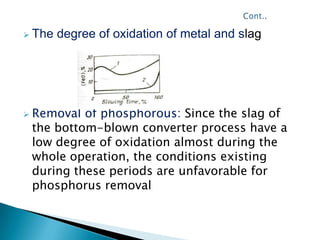
 The   degree of oxidation of metal and slag


   Removal of phosphorous: Since the slag of
    the bottom-blown converter process have a
    low degree of oxidation almost during the
    whole operation, the conditions existing
    during these periods are unfavorable for
    phosphorus removal
   Almost 98% oxygen being reacted with metal in OBM and
    hence that much scrap rate is lower in the OBM. If scrap is
    cheaper the top blowing can offer some cost advantage in
    this respect.
   The iron losses in top blown are nearly 5% more than
    those in OBM. Very low carbon steers are achievable in
    top blowing only at the expense of extra iron loss in slag.
    But this is readily achievable in OBM.

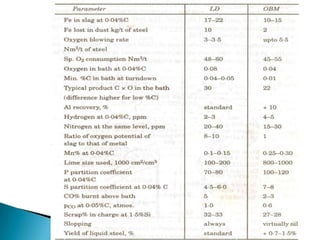
   This also, leads to situation wherein higher carbon levels
    can be obtained by 'catch carbon techniques' easily in
    LD than in OBM, at low P contents.
   The stirring intensity, which is estimated to be nearly ten
    times more in OBM than in LD gives better partition of
    phosphorus and sulphur, higher manganese and lower
    oxygen at turndown result-ing in better ferroalloy
    recovery.
Since the slag of the bottom-blown converter process have a low

degree of oxidation almost during the whole operation, the

conditions existing during these periods are unfavorable for

phosphorus removal. Only at the end of blowing, when the bath is

low in carbon, the oxidation degree of the slag increases

sharply, thus favouring dephosphorization. At that

moment, phosphorus passes intensively to slag. When using lumpy

lime in the charge, it is difficult to make medium or high carbon

steels with a low content of phosphorus. The metal must be blown

to a low carbon content, so as to form an oxidizing slag at the end

of heat, and then carburized in the ladle.
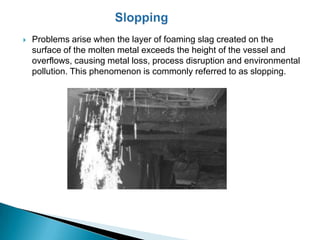
   Problems arise when the layer of foaming slag created on the
    surface of the molten metal exceeds the height of the vessel and
    overflows, causing metal loss, process disruption and environmental
    pollution. This phenomenon is commonly referred to as slopping.
Better mixing and homogeneity in the bath offer the following
    advantages:
   Less slopping, since non-homogeneity causes formation of
    regions with high supersaturation and consequent violent
    reactions and ejections.
   Better mixing and mass transfer in the metal bath with closer
    approach to equilibrium for [C]-[O]-CO reaction, and
    consequently, lower bath oxygen content at the same carbon
    content
   Better slag-metal mixing and mass transfer and
    consequently, closer approach to slag-- metal
    equilibrium, leading to:
    o lower FeO in slag and hence higher Fe yield
    o transfer of more phosphorus from the metal to the slag (i.e.
      better bath dephosphorisation)
    o transfer of more Mn from the slag to the metal, and thus
      better Mn recovery
    o lower nitrogen and hydrogen contents of the bath.
   More reliable temperature measurement and sampling of
    metal and slag, and thus better process control
   Faster dissolution of the scrap added into the metal bath
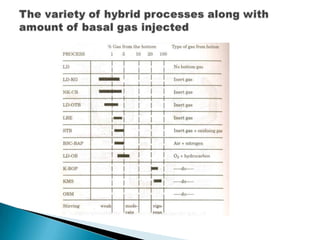
•A small amount of inert gas, about 3% of the volume of oxygen
blown from top, introduced from bottom, agitates the bath so
effectively that slopping is almost eliminated.
•However for obtaining near equilibrium state of the system
inside the vessel a substantial amount of gas has to be
introduced from the bottom.
•If 20-30% of the total oxygen, if blown from bottom, can cause
adequate stirring for the system to achieve near equilibrium
conditions. The increase beyond 30% therefore contributes
negligible addition of benefits.
•   The more the oxygen fraction blown from bottom the
    less is the post combustion of CO gas and
    consequently less is the scrap consumption in the
    charge under identical conditions of processing.
•   Blowing of inert gas from bottom has a chilling effect
    on bath and hence should be minimum. On the
    contrary the more is the gas blown the more is the
    stirring effect and resultant better metallurgical results.
    A optimum choice therefore has to be made
    judiciously.
As compared to top blowing, the hybrid blowing
eliminates the temperature and concentration
gradients and effects improved blowing control, less
slopping and higher blowing rates. It also reduces over
oxidation and improves the yield. It leads the process
to near equilibrium with resultant effective
dephosphorisation and desulphurisation and ability to
make very low carbon steels.
 What   is blown from the bottom, inert gas or oxygen?
 How much inert gas is blown from the bottom?
 At what stage of the blow the inert gas is
  blown, although the blow, at the end of the blow, after
  the blow ends and so on?
 What inert gas is blown, argon, nitrogen or their
  combination?
 How the inert gas is blown, permeable
  plug, tuyere, etc.?
 What oxidising media is blown from bottom, oxygen or
  air?
 If oxygen is blown from bottom as well then how much
  of the total oxygen is blown from bottom ?
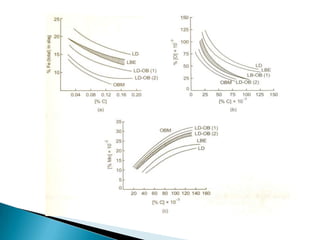
   The processes have been developed to obtain the combined ad-vantages
    of both LD and OBM to the extent possible. Therefore the metallurgical
    performance of a hybrid process has to be evaluated in relation to these
    two extremes, namely the LD and the OBM. The parameters on which this
    can be done are :

   Iron content of the slag as a function of carbon content of bath

   Oxidation levels in slag and metal

   Manganese content of the bath at the turndown

   Desulphurisation efficiency in terms of partition coefficient

   Dephosphorisation efficiency in terms of partition coefficient

   Hydrogen and nitrogen contents of the bath at turndown

   Yield of liquid steel
The oxidizing conditions of a heat in a steelmaking plant, the
presence of oxidizing slag, and the interaction of the metal with the
surrounding atmosphere at tapping and teeming - all these factors
are responsible for the fact that the dissolved oxygen in steel has a
definite, often elevated, activity at the moment of steel tapping. The
procedure by which the activity of oxygen can be lowered to the
required limit is called deoxidation. Steel subjected to deoxidation is
termed 'deoxidized'. If deoxidized steel is 'quiet during solidification
in moulds, with almost no gases evolving from it, it is called 'killed
steel'.
   If the metal is tapped and teemed without being deoxidized, the reaction
    [O] + [C] = COg will take place between the dissolved oxygen and
    carbon as the metal is cooled slowly in the mould. Bubbles of carbon
    monoxide evolve from the solidifying metal, agitate the metal in the
    mould vigorously, and the metal surface is seen to 'boil'. Such steel is
    called 'wild'; when solidified, it will be termed 'rimming steel' .
   In some cases, only partial deoxidation is carried out, i.e. oxygen is only
    partially removed from the metal. The remaining dissolved oxygen
    causes the metal to boil for a short time. This type of steel is termed
    'semi-killed'.
   Thus, practically all steels are deoxidized to some or other extent so as
    to lower the activity of dissolved oxygen to the specified limit.
   The activity of oxygen in the metal can be lowered by two methods: (I)
    by lowering the oxygen concentration, or
    (2) by combining oxygen into stable compounds.
   There are the following main practical methods for deoxidation of steel:
    (a) precipitation deoxidation, or deoxidation in the bulk;
    (b) diffusion deoxidation;
    (c) treatment with synthetic slags; and
    (d) vacuum treatment.
The advantages of continuous casting (over ingot
    casting) are:
   It is directly possible to cast blooms, slabs and
    billets, thus eliminating blooming, slabbing mills
    completely, and billet mills to a large extent.
   Better quality of the cast product.
   Higher crude-to-finished steel yield (about 10 to
    20% more than ingot casting).
   Higher extent of automation and process control.
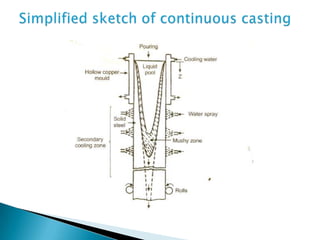
   Solidification must be completed before the withdrawal
    rolls.

   The liquid core should be bowl-shaped as shown in the
    Figure and not pointed at the bottom (as indicated by the
    dotted lines), since the latter increases the tendency for
    undesirable centerline (i.e. axial) macro-segregation and
    porosity

   The solidified shell of metal should be strong enough at
    the exit region of the mould so that it does not crack or
    breakout under pressure of the liquid.
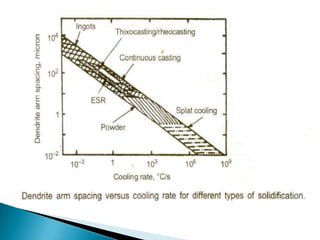
   The surface area-to-volume ratio per unit length of
    continuously cast ingot is larger than that for ingot
    casting. As a consequence, the linear rate of
    solidification (dx/dt) is an order of magnitude
    higher than that in ingot casting.

   The dendrite arm spacing in continuously cast
    products is smaller compared with that in ingot
    casting.
   Macro-segregation is less, and is restricted to the
    centreline zone only.
   Endogenous inclusions are smaller in size, since they
    get less time to grow. For the same reason, the blow
    holes are, on an average, smaller in size.
   Inclusions get less time to float-up. Therefore, any
    non-metallic particle coming into the melt at the later
    stages tends to remain entrapped in the cast product.
In addition to more rapid freezing, continuous casting
    differs from ingot casting in several ways. These are
    noted below.

   Mathematically speaking, continuously cast ingot is
    infinitely long. Hence, the heat flow is essentially in the
    transverse direction, and there is no end-effect as is the
    case in ingot casting (e.g. bottom cone of negative
    segregation, pipe at the top, etc.).
   The depth of the liquid metal pool is several metres long.
    Hence, the ferrostatic pressure of the liquid is high
    during the latter stages of solidification, resulting in
    significant difficulties of blow-hole formation.

   Since the ingot is withdrawn continuously from the mould, the frozen
    layer of steel is subjected to stresses. This is aggravated by the
    stresses arising out of thermal expansion/ contraction and phase
    transformations.
   Such stresses are the highest at the surface. Moreover, when the
    ingot comes out of the mould, the thickness of the frozen steel shell
    is not very appreciable. Furthermore, it is at around 1100-
    1200 C, and is therefore, weak. All these factors tend to cause
    cracks at the surface of the ingot leading to rejections.
   Use of a tundish between the ladle and the mould results in extra
    temperature loss. Therefore, better refractory lining in the
    ladles, tundish, etc. are required in order to minimise corrosion and
    erosion by molten metal.
Smarajit Sarkar
Department of Metallurgical and Materials Engineering
                                        NIT Rourkela
Primary steelmaking is aimed at fast melting
and rapid refining. It is capable of refining at
a macro level to arrive at broad steel
specifications, but is not designed to meet
the stringent demands on steel quality, and
consistency of composition and temperature
that is required for very sophisticated grades
of steel. In order to achieve such
requirements, liquid steel from primary
steelmaking units has to be further refined in
the ladle after tapping. This is known as
Secondary Steelmaking.
 improvement    in quality
 improvement in production rate
 decrease in energy consumption
 use of relatively cheaper grade or
  alternative raw materials
 use of alternate sources of energy
 higher recovery of alloying elements.
 Lower impurity contents .
 Better cleanliness. (i.e. lower inclusion
  contents)
 Stringent quality control. (i.e. less variation
  from heat-to-heat)
 Microalloying to impart superior properties.
 Better surface quality and homogeneity in
  the cast product.
 The term clean steel should mean a steel
  free of inclusions. However, no steel can
  be free from all inclusions.
 Macro-inclusions are the primary harmful
  ones. Hence, a clean steel means a
  cleaner steel, i.e., one containing a much
  lower level of harmful macro-inclusions.)
    In practice, it is customary to divide
    inclusions by size into macro inclusions and
    micro inclusions. Macro inclusions ought to
    be eliminated because of their harmful
    effects. However, the presence of micro
    inclusions can be tolerated, since they do
    not necessarily have a harmful effect on the
    properties of steel and can even be
    beneficial. They can, for example, restrict
    grain growth, increase yield strength and
    hardness, and act as nuclei for the
    precipitation of carbides, nitrides, etc.
 The  critical inclusion size is not fixed but
  depends on many factors, including service
  requirements.
 Broadly speaking, it is in the range of 5 to 500
  µm (5 X 10⁻³ to 0.5 mm). It decreases with an
  increase in yield stress. In high-strength
  steels, its size will be very small.
 Scientists advocated the use of fracture
  mechanics concepts for theoretical estimation of
  the critical size for a specific situation.
   Precipitation due to reaction from molten steel or during
    freezing because of reaction between dissolved oxygen
    and the deoxidisers, with consequent formation of
    oxides (also reaction with dissolved sulphur as well).
    These are known as endogenous inclusions.
   Mechanical and chemical erosion of the refractory lining
   Entrapment of slag particles in steel
   Oxygen pick up from the atmosphere, especially during
    teeming, and consequent oxide formation.
   Inclusions originating from contact with external sources
    as listed in items 2 to 4 above, are called exogenous
    inclusions.
With a lower wettability (higher value of σMe   – inc

), an inclusion can be retained in contact with the
metal by lower forces, and therefore, can break
off more easily and float up in the metal. On the
contrary, inclusion which are wetted readily by the
metal, cannot break off from it as easily.
   Carryover slag from the furnace into the ladle
    should be minimised, since it contains high
    percentage of FeO + MnO and makes efficient
    deoxidation fairly difficult.

   Deoxidation products should be chemically
    stable. Otherwise, they would tend to
    decompose and transfer oxygen back into liquid
    steel. Si02 and Al203 are preferred to MnO.
    Moreover the products should preferably be
    liquid for faster growth by agglomeration and
    hence faster removal by floatation. Complex
    deoxidation gives this advantage.

   Stirring of the melt in the ladle by argon flowing through
    bottom tuyeres is a must for mixing and
    homogenisation, faster growth, and floatation of the
    deoxidation products. However, very high gas flow rates
    are not desirable from the cleanliness point of
    view, since it has the following adverse effects:
o   Too vigorous stirring of the metal can cause
    disintegration of earlier formed inclusion conglomerates.
o   Re-entrainment of slag particles into molten steel.
o   Increased erosion of refractories and consequent
    generation of exogenous inclusions.
o   More ejection of metal droplets into the atmosphere with
    consequent oxide formation.
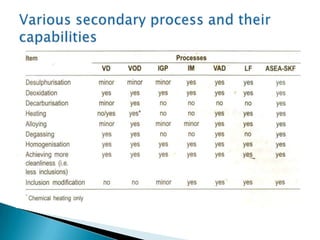
The varieties of secondary steelmaking
  processes that have proved to be of
  commercial value can broadly be categorised
  as under:
 Stirring treatments
 Synthetic slag refining with stirring
 Vacuum treatments
 Decarburisation techniques
 Injection metallurgy
 Plunging techniques
 Post-solidification treatments.
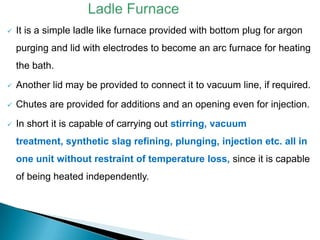
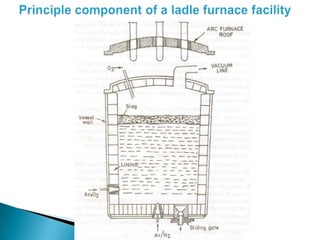
   It is a simple ladle like furnace provided with bottom plug for argon
    purging and lid with electrodes to become an arc furnace for heating
    the bath.
   Another lid may be provided to connect it to vacuum line, if required.
   Chutes are provided for additions and an opening even for injection.
   In short it is capable of carrying out stirring, vacuum
    treatment, synthetic slag refining, plunging, injection etc. all in
    one unit without restraint of temperature loss, since it is capable
    of being heated independently.
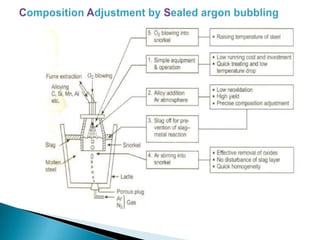
Every ladle furnace need not be equipped with
all these arrangements. As per the requirements
of refining the ladle furnace may be provided
with the necessary facilities. For example if gas
content is no consideration, vacuum attachment
may be eliminated. The principal component of
the facilities are shown in next slide
schematically.
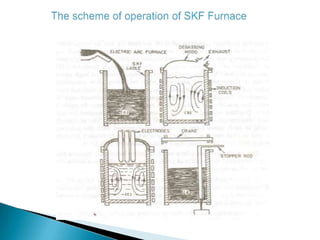
   The ASEA-SKF furnace is a special variety of LF furnace only.
   The SKF furnace is essentially a teeming ladle for which additional
    fittings are provided.
   The metal in the ladle is stirred by an electromagnetic stirrer
    provided from outside.
   The ladle shell is made of austenitic stainless steel for this reason.
   Two ladle covers are employed. One of these fits tightly on to the
    ladle forming a vacuum seal, and is connected to a steam ejector
    unit for evacuation of the ladle chamber.
   For vacuum decarburisation oxygen lance is introduced through a
    vacuum sealed port located in the cover.
 When the decarburisation and vacuum degassing is over
    the first cover is replaced by the second cover which contains
    three electrodes. Final alloying and temperature adjustments
    are then made.
   Steel can also be desulphurised by preparing a reducing
    basic slag under the electrode cover.
   The process is schematically shown in next slide. The nearly
    re-fined steel in only one of the primary steelmaking
    processes can be treated in this furnace by carrying out the
    following operations :
   Tapping primary furnace into the SKF ladle directly .
   Controlled stirring during the entire secondary processing
   Vacuum treatment including minor decarburisation
   Extensive decarburisation for stainless steelmaking.
    Deoxidation.
   Desulphurisation and deslagging. Alloying to desired
    extent.
   Temperature adjustment.
   Teeming from the same SKF ladle.
   Quality improvement of steel can also be brought about after
    steel is refined and cast into ingots from the primary refining
    furnace, by remelting and casting once again. Typical examples
    of this type is zone refining which is adopted to produce purer
    metals.
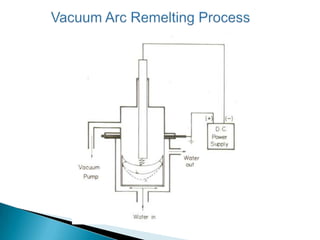
   The other two techniques that have been developed are meant
    for the production of, not pure metals, but alloy steels of better
    cleanliness and low sulphur contents. The vacuum arc
    remelting, VAR(750kWh/ton) for short and the electro slag
    refining, ESR (900-1300kWh/ton) for short, are commercially
    used for further refining of steels after these are cast into ingots.
 In both of these processes the steel ingot
  produced by the primary refining forms the
  electrode to be drip-melted into a water cooled
  copper mould.
 In VAR melting is carried out under vacuum and in
  ESR it is in open atmosphere.
 In VAR arc is struck between the electrode and
  the mould and it generates the heat required for
  melting the electrode.
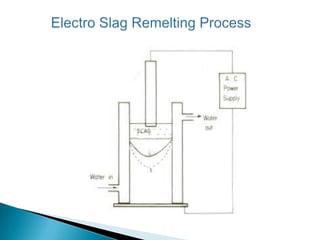
 In ESR a slag layer is used to act as a resistor
  between the electrode and the mould and which is
  responsible for melting the electrode. The slag
  also acts as a refining agent.
In both of these processes the electrode melts
 progressively and is resolidified on the
 mould, nearly unidirectionally.
 Because of the high temperature, small pool of
 molten metal and almost unidirectional
 solidification, both of these processes can produce
 sound ingots of high density. The composition
 of the product is nearly the same as that of the
 original material but with improved
 cleanliness, decreased segregation and with
 practically no cavities. The ingot size ranges
 from about 200 to 1500mm on industrial level
 The product of both of these processes is
  exceptionally suited for the production of forgings of
  high alloy steels. But because of high cost of such a
  process, applications are limited to specialty products
  like turbo rotor shafts and so on.
 In VAR the hydrogen and oxygen contents are very
  low but in ESR they are like ordinary steels. In ESR
  the choice of the slag composition is fairly critical since
  it has to act as a resistor as well as a refin-ing agent.
  These are essentially oxy-fluoride type reducing slag
  like CaO-CaF2·


The ESR however has some advantages over VAR
  and these are given below:
 Multiple electrode can be melted into a single
  electrode.
 Spacing between the mould wall and the electrode is
  not critical.
 Surface quality is superior requiring little or no
  conditioning.
 Steel can be desulphurised to as low as 0·002%
  sulphur.
 Round, square, hollow and rectangular shapes of
  ingots can be produced.
 Ingots of much larger weight can be produced.
 Ladle   degassing processes (VD, VOD, VAD)
 Stream   degassing processes
 Circulation   degassing processes (DH and RH).
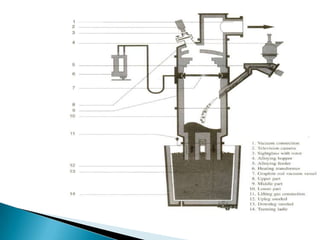
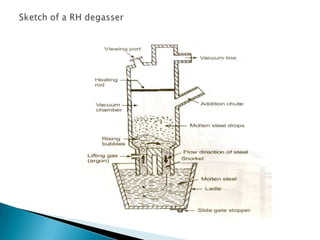
   Molten steel is contained in the ladle. The two legs of the vacuum
    chamber (known as Snorkels) are immersed into the melt. Argon is
    injected into the up leg.

   Rising and expanding argon bubbles provide pumping action and lift
    the liquid into the vacuum chamber, where it disintegrates into fine
    droplets, gets degassed and comes down through the down leg
    snorkel, causing melt circulation.

   The entire vacuum chamber is refractory lined. There is provision for
    argon injection from the bottom, heating, alloy additions, sampling and
    sighting as well as video display of the interior of the vacuum chamber.

Why RH-OB Process?
To meet increasing demand for cold-rolled steel sheets with improved
mechanical properties, and to cope with the change from batch-type to
continuous annealing, the production of ULC steel (C < 20 ppm) is
increasing.
 A major problem in the conventional RH process is that the time
required to achieve such low carbon is so long that carbon content at
BOF tapping should be lowered. However, this is accompanied by
excessive oxidation of molten steel and loss of iron oxide in the slag.
 It adversely affects surface the quality of sheet as well.
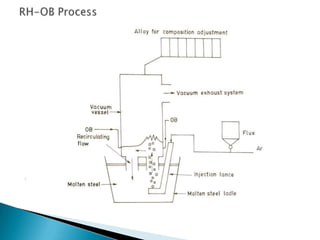
   Hence, decarburization in RH degasser is to be
    speeded up. This is achieved by some oxygen
    blowing (OB) during degassing.

    The RH-OB process, which uses an oxygen
    blowing facility during degassing, was originally
    developed for decarburization of stainless steel by
    Nippon Steel Corp., Japan, in 1972.

   Subsequently, it was employed for the manufacture
    of ULC steels.

   The present thrust is to decrease carbon content
    from something like 300 ppm to 10 or 20 ppm
    within 10 min.                               Cont…



Ferrochrome, which contains about 55 to 70% chromium is
    the principal source of Chromium. This ferroalloy can be
    classified into various grades, based primarily on their carbon
    :ontent, such as:
   Low carbon ferrochrome (about 0.1 % C).
   Intermediate carbon ferrochrome (about 2% C).
   High carbon ferrochrome (around 7% C).

   Amongst these grades, the high carbon variety has the
    drawback that though it is the least expensive, it raises the
    carbon content of the melt. This is undesirable, since all SS
    grades demand carbon contents less than 0.03%.
    Chromium forms stable oxides. Hence, the removal of
    carbon from the bath by oxidation to CO is associated with
    the problem of simultaneous oxidation of chromium in
    molten steel.
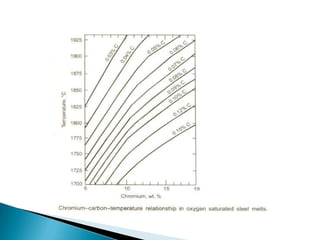
   The higher the temperature, the greater is the tendency for preferential

    oxidation of carbon rather than chromium. From this point of view, higher bath

    temperatures are desirable; however, too high a temperature in the bath gives rise to

    other process problems.

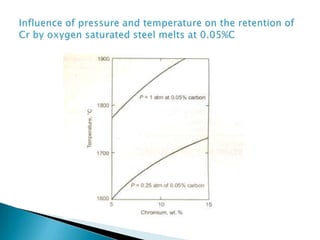
   The dilution of oxygen with argon lowers the partial pressure of CO, which

    helps in preferential removal of CO without oxidising bath chromium. Attempts

    were made to use this in the EAF, but the efforts did not succeed. Hence, as is the

    case with the production of plain carbon steels, the EAF is now basically a melting

    unit for stainless steel production as well. Decarburisation is carried out partially in

    the EAF, and the rest of the carbon is removed in a separate refining vessel. In this

    context, the development of the AOD process was a major breakthrough in stainless

    steelmaking.
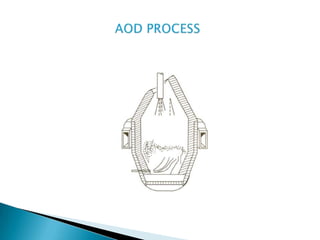
   AOD is the acronym for Argon-Oxygen
    Decarburisation. The process was patented by the
    Industrial Gases Division of the Union Carbide
    Corporation In an AOD converter, argon is used to
    dilute the other gaseous species (02, CO, etc.).
    Hence, in some literature, it is designated as
    Dilution Refining Process. After AOD, some other
    dilution refining processes have been developed.
    Lowering of the partial pressures, such as the
    partial pressure of carbon monoxide, is achieved
    either by argon or by employing vacuum
   The combination of EAF and AOD is sufficient for producing ordinary grades

    of stainless steels and this combination is referred to as a Duplex Process.

    Subsequent minor refining, temperature and composition adjustments, if

    required, can be undertaken in a ladle furnace. Triplex refining, where electric

    arc furnace melting and converter refining are followed by refining in a

    vacuum system, is often desirable when the final product requires very low

    carbon and nitrogen levels.

   About 65-70% of the world's total production of stainless steel is in the

    austenitic variety, made by the duplex EAF-AOD route. If the use of AOD

    converters even in the triplex route is included, the share of AOD in world

    production would become as high as 75-80%.
   Conventional AOD, no top blowing is involved. Only a
    mixture of argon and oxygen is blown through the
    immersed side tuyeres. However, the present AOD
    converters are mostly fitted with concurrent facilities for
    top blowing of either only oxygen, or oxygen plus inert
    gas mixtures using a supersonic lance as in BOF
    steelmaking.
   Initially, when the carbon content of the melt is high, blowing
    through the top lance is predominant though the gas mixture
    introduced through the side tuyeres also contains a high
    percentage of oxygen.
   However, as decarburisation proceeds, oxygen blowing from
    the top is reduced in stages and argon blowing increased. As
    stated earlier, some stainless steel grades contain nitrogen as
    a part of the specifications, in which case, nitrogen is
    employed in place of argon in the final stages.

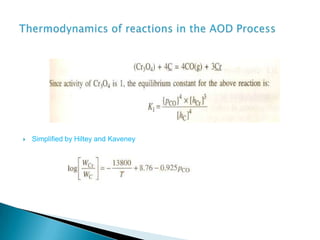
   Simplified by Hiltey and Kaveney
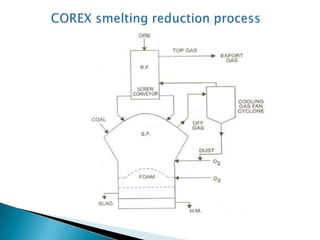
   This process produces molten iron in a two-step reduction melting
    operation. One reactor is melter-gasifier and the other is pre-
    reducer. In the pre-reducer, iron oxide is reduced in counter-flow
    principle. The hot sponge is discharged by screw conveyors into the
    melting reactor.
   Coal is introduced in the melting-gassifying zone along with
    oxygen gas at the rate of 500-600 Nm3/thm. The flow velocity is
    chosen such that temperature in the range of 1500-1800 C is
    main-tained. The reducing gas containing nearly 85% CO is hot
    dedusted and cooled to 800-900 C before leading it into the pre-
    reducer
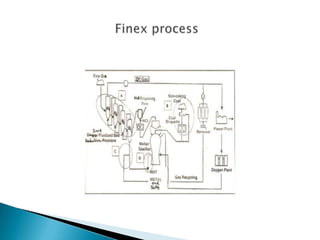
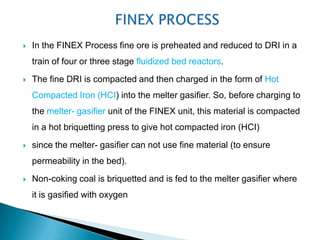
   In the FINEX Process fine ore is preheated and reduced to DRI in a
    train of four or three stage fluidized bed reactors.
   The fine DRI is compacted and then charged in the form of Hot
    Compacted Iron (HCI) into the melter gasifier. So, before charging to
    the melter- gasifier unit of the FINEX unit, this material is compacted
    in a hot briquetting press to give hot compacted iron (HCI)

   since the melter- gasifier can not use fine material (to ensure
    permeability in the bed).
   Non-coking coal is briquetted and is fed to the melter gasifier where
    it is gasified with oxygen
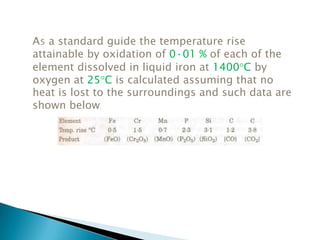
As a standard guide the temperature rise
attainable by oxidation of 0·01 % of each of the
element dissolved in liquid iron at 1400°C by
oxygen at 25°C is calculated assuming that no
heat is lost to the surroundings and such data are
shown below .
   Ahindra Ghosh and Amit Chatterjee: Ironmaking and Steelmaking Theory and Practice, Prentice-
    Hall of India Private Limited, 2008
   Anil K. Biswas: Principles of Blast Furnace Ironmaking, SBA Publication,1999
   R.H.Tupkary and V.R.Tupkary: An Introduction to Modern Iron Making, Khanna Publishers.
   R.H.Tupkary and V.R.Tupkary: An Introduction to Modern Steel Making, Khanna Publishers.
   David H. Wakelin (ed.): The Making, Shaping and Treating of Steel (Ironmaking Volume), The
    AISE Steel Foundation, 2004.
   Richard J.Fruehan (ed.): The Making, Shaping and Treating of Steel (Steeelmaking Volume), The
    AISE Steel Foundation, 2004.
   A.Ghosh, Secondary Steel Making – Principle & Applications, CRC Press – 2001.
    R.G.Ward: Physical Chemistry of iron & steel making, ELBS and Edward Arnold, 1962.
    F.P.Edneral: Electrometallurgy of Steel and Ferro-Alloys, Vol.1 Mir Publishers,1979
    B. Ozturk and R. J. Fruehan,: "Kinetics of the Reaction of SiO(g) with Carbon Saturated Iron":
    Metall. Trans. B, Vol. 16B, 1985, p. 121.
   B. Ozturk and R. J. Fruehan: "The Reaction of SiO(g) with Liquid Slags,” Metall.
    Trans.B, Volume 17B, 1986, p. 397.
   B. Ozturk and R. J. Fruehan:”.Transfer of Silicon in Blast Furnace": , Proceedings of the fifth
    International Iron and Steel Congress, Washington D.C., 1986, p. 959.
   P. F. Nogueira and R. J. Fruehan:” Blast Furnace Softening and Melting Phenomena - Melting
    Onset in Acid and Basic Pellets", , ISS-AIME lronmaking Conference, 2002, pp. 585.
   Paulo Nogueira, Richard Fruehan: "Blast Furnace Burden Softening and Melting
    Phenomena-Part I Pellet Bulk Interaction Observation", , Metallurgical and Materials
    Transactions B, Volume 35B, 2004, pp. 829.
   P.F. Nogueira, Richard J. Fruehan: 'Fundamental Studies on Blast Furnace Burden
    Softening and Melting", Proceedings of 2nd International Meeting on
    lronmaking, September 2004, Vitoria, Brazil.
   Paulo F. Nogueira, Richard J. Fruehan, "Blast Furnace Softening and Melting
    Phenomena - Part III: Melt Onset and Initial Microstructal Transformation in
    Pellets", submitted to Materials and Metallurgical Transactions B.
   Paulo F. Nogueira, Richard J. Fruehan :Blast Furnace Burden Softening and Melting
    Phenomena-Part II Evolution of the Structure of the Pellets", Metallurgical and
    Materials Transactions, Volume 36B, 2005, pp. 583-
    MA Jitang: “Injecuion of flux into Blast Furnace via Tuyeres for optimizing slag
    formation” ISIJ International, Volume 39, No7 1999,pp697
    Y.S.Lee, J.R.Kim, S.H.Yi and D.J.Min: “Viscous behavior of CaO-SiO2-Al2O3-MgO-
    FeO Slag”, Proceedings of VIIInternational Conferenceon -Molten slags,fluxes and
    salts, The South African Institute of Minig and Metallurgy, 2004,pp225

Smarajit Sarkar
Department of Metallurgical and Materials Engineering
                                        NIT Rourkela

Ainsm

  • 1.
    Smarajit Sarkar Department ofMetallurgical and Materials Engineering NIT Rourkela
  • 3.
     The OBMvessel is essentially a Bessemer-like converter fitted with a special bottom .  The tuyeres are inserted from the bottom in such a way that the oxygen would be surrounded by a protective hydrocarbon gas like propane.  On entry propane cracks down in an endothermic reaction and takes up some of the heat-gene-rated by the entry of oxygen.  The relative feed rates of these two fluids are adjusted to obtain optimum temperatures at the tuyere tip and thereby ensure its reasonable life as well as speed of refining.  The deposition of carbon, which is a product of cracking, also helps to protect the bottom from heat generated due to the refining reactions at the tips of tuyeres.
  • 4.
     Inorder topromote turbulence in the bath and thereby ensure good slag-metal contact, the tuyeres are arranged only on half the converter bottom.  Experience dictated that provision of a few bigger tuyeres is better than large number of fine tuyeres. Maintenance problems are minimised without loosing in terms of metallurgical requirements of turbulence. By this arrangement, it is ensured that the direction of metal circulation is upwards in the tuyere half of the vessel, and downwards in the other half.  This arrangement is also helpful in minimising the damage to tuyeres while charging scrap, since it can now be charged on that part where there are no tuyeres.
  • 6.
    Oxidation of carbon: Bottom blowing increases sharply the intensity of bath stirring and increases the area of gas-metal boundaries (10-20 times the values typical of top blowing) .  Since the hydrocarbons supplied into the bath together with oxygen dissociate into H2, H2O and CO2 gas bubbles in the bath have a lower partial pressure of carbon monoxide (Pco )  All these factors facilitate substantially the formation and evolution of carbon monoxide, which leads to a higher rate of decarburization in bottom blowing
  • 7.
     The degree of oxidation of metal and slag  Removal of phosphorous: Since the slag of the bottom-blown converter process have a low degree of oxidation almost during the whole operation, the conditions existing during these periods are unfavorable for phosphorus removal
  • 8.
    Almost 98% oxygen being reacted with metal in OBM and hence that much scrap rate is lower in the OBM. If scrap is cheaper the top blowing can offer some cost advantage in this respect.  The iron losses in top blown are nearly 5% more than those in OBM. Very low carbon steers are achievable in top blowing only at the expense of extra iron loss in slag. But this is readily achievable in OBM. 
  • 9.
    This also, leads to situation wherein higher carbon levels can be obtained by 'catch carbon techniques' easily in LD than in OBM, at low P contents.  The stirring intensity, which is estimated to be nearly ten times more in OBM than in LD gives better partition of phosphorus and sulphur, higher manganese and lower oxygen at turndown result-ing in better ferroalloy recovery.
  • 10.
    Since the slagof the bottom-blown converter process have a low degree of oxidation almost during the whole operation, the conditions existing during these periods are unfavorable for phosphorus removal. Only at the end of blowing, when the bath is low in carbon, the oxidation degree of the slag increases sharply, thus favouring dephosphorization. At that moment, phosphorus passes intensively to slag. When using lumpy lime in the charge, it is difficult to make medium or high carbon steels with a low content of phosphorus. The metal must be blown to a low carbon content, so as to form an oxidizing slag at the end of heat, and then carburized in the ladle.
  • 12.
    Problems arise when the layer of foaming slag created on the surface of the molten metal exceeds the height of the vessel and overflows, causing metal loss, process disruption and environmental pollution. This phenomenon is commonly referred to as slopping.
  • 13.
    Better mixing andhomogeneity in the bath offer the following advantages:  Less slopping, since non-homogeneity causes formation of regions with high supersaturation and consequent violent reactions and ejections.  Better mixing and mass transfer in the metal bath with closer approach to equilibrium for [C]-[O]-CO reaction, and consequently, lower bath oxygen content at the same carbon content
  • 14.
    Better slag-metal mixing and mass transfer and consequently, closer approach to slag-- metal equilibrium, leading to: o lower FeO in slag and hence higher Fe yield o transfer of more phosphorus from the metal to the slag (i.e. better bath dephosphorisation) o transfer of more Mn from the slag to the metal, and thus better Mn recovery o lower nitrogen and hydrogen contents of the bath.  More reliable temperature measurement and sampling of metal and slag, and thus better process control  Faster dissolution of the scrap added into the metal bath
  • 15.
    •A small amountof inert gas, about 3% of the volume of oxygen blown from top, introduced from bottom, agitates the bath so effectively that slopping is almost eliminated. •However for obtaining near equilibrium state of the system inside the vessel a substantial amount of gas has to be introduced from the bottom. •If 20-30% of the total oxygen, if blown from bottom, can cause adequate stirring for the system to achieve near equilibrium conditions. The increase beyond 30% therefore contributes negligible addition of benefits.
  • 16.
    The more the oxygen fraction blown from bottom the less is the post combustion of CO gas and consequently less is the scrap consumption in the charge under identical conditions of processing. • Blowing of inert gas from bottom has a chilling effect on bath and hence should be minimum. On the contrary the more is the gas blown the more is the stirring effect and resultant better metallurgical results. A optimum choice therefore has to be made judiciously.
  • 18.
    As compared totop blowing, the hybrid blowing eliminates the temperature and concentration gradients and effects improved blowing control, less slopping and higher blowing rates. It also reduces over oxidation and improves the yield. It leads the process to near equilibrium with resultant effective dephosphorisation and desulphurisation and ability to make very low carbon steels.
  • 19.
     What is blown from the bottom, inert gas or oxygen?  How much inert gas is blown from the bottom?  At what stage of the blow the inert gas is blown, although the blow, at the end of the blow, after the blow ends and so on?  What inert gas is blown, argon, nitrogen or their combination?  How the inert gas is blown, permeable plug, tuyere, etc.?  What oxidising media is blown from bottom, oxygen or air?  If oxygen is blown from bottom as well then how much of the total oxygen is blown from bottom ?
  • 21.
    The processes have been developed to obtain the combined ad-vantages of both LD and OBM to the extent possible. Therefore the metallurgical performance of a hybrid process has to be evaluated in relation to these two extremes, namely the LD and the OBM. The parameters on which this can be done are :  Iron content of the slag as a function of carbon content of bath  Oxidation levels in slag and metal  Manganese content of the bath at the turndown  Desulphurisation efficiency in terms of partition coefficient  Dephosphorisation efficiency in terms of partition coefficient  Hydrogen and nitrogen contents of the bath at turndown  Yield of liquid steel
  • 23.
    The oxidizing conditionsof a heat in a steelmaking plant, the presence of oxidizing slag, and the interaction of the metal with the surrounding atmosphere at tapping and teeming - all these factors are responsible for the fact that the dissolved oxygen in steel has a definite, often elevated, activity at the moment of steel tapping. The procedure by which the activity of oxygen can be lowered to the required limit is called deoxidation. Steel subjected to deoxidation is termed 'deoxidized'. If deoxidized steel is 'quiet during solidification in moulds, with almost no gases evolving from it, it is called 'killed steel'.
  • 24.
    If the metal is tapped and teemed without being deoxidized, the reaction [O] + [C] = COg will take place between the dissolved oxygen and carbon as the metal is cooled slowly in the mould. Bubbles of carbon monoxide evolve from the solidifying metal, agitate the metal in the mould vigorously, and the metal surface is seen to 'boil'. Such steel is called 'wild'; when solidified, it will be termed 'rimming steel' .  In some cases, only partial deoxidation is carried out, i.e. oxygen is only partially removed from the metal. The remaining dissolved oxygen causes the metal to boil for a short time. This type of steel is termed 'semi-killed'.
  • 25.
    Thus, practically all steels are deoxidized to some or other extent so as to lower the activity of dissolved oxygen to the specified limit.  The activity of oxygen in the metal can be lowered by two methods: (I) by lowering the oxygen concentration, or (2) by combining oxygen into stable compounds.  There are the following main practical methods for deoxidation of steel: (a) precipitation deoxidation, or deoxidation in the bulk; (b) diffusion deoxidation; (c) treatment with synthetic slags; and (d) vacuum treatment.
  • 26.
    The advantages ofcontinuous casting (over ingot casting) are:  It is directly possible to cast blooms, slabs and billets, thus eliminating blooming, slabbing mills completely, and billet mills to a large extent.  Better quality of the cast product.  Higher crude-to-finished steel yield (about 10 to 20% more than ingot casting).  Higher extent of automation and process control.
  • 28.
    Solidification must be completed before the withdrawal rolls.  The liquid core should be bowl-shaped as shown in the Figure and not pointed at the bottom (as indicated by the dotted lines), since the latter increases the tendency for undesirable centerline (i.e. axial) macro-segregation and porosity  The solidified shell of metal should be strong enough at the exit region of the mould so that it does not crack or breakout under pressure of the liquid.
  • 29.
    The surface area-to-volume ratio per unit length of continuously cast ingot is larger than that for ingot casting. As a consequence, the linear rate of solidification (dx/dt) is an order of magnitude higher than that in ingot casting.  The dendrite arm spacing in continuously cast products is smaller compared with that in ingot casting.
  • 31.
    Macro-segregation is less, and is restricted to the centreline zone only.  Endogenous inclusions are smaller in size, since they get less time to grow. For the same reason, the blow holes are, on an average, smaller in size.  Inclusions get less time to float-up. Therefore, any non-metallic particle coming into the melt at the later stages tends to remain entrapped in the cast product.
  • 32.
    In addition tomore rapid freezing, continuous casting differs from ingot casting in several ways. These are noted below.  Mathematically speaking, continuously cast ingot is infinitely long. Hence, the heat flow is essentially in the transverse direction, and there is no end-effect as is the case in ingot casting (e.g. bottom cone of negative segregation, pipe at the top, etc.).  The depth of the liquid metal pool is several metres long. Hence, the ferrostatic pressure of the liquid is high during the latter stages of solidification, resulting in significant difficulties of blow-hole formation. 
  • 33.
    Since the ingot is withdrawn continuously from the mould, the frozen layer of steel is subjected to stresses. This is aggravated by the stresses arising out of thermal expansion/ contraction and phase transformations.  Such stresses are the highest at the surface. Moreover, when the ingot comes out of the mould, the thickness of the frozen steel shell is not very appreciable. Furthermore, it is at around 1100- 1200 C, and is therefore, weak. All these factors tend to cause cracks at the surface of the ingot leading to rejections.  Use of a tundish between the ladle and the mould results in extra temperature loss. Therefore, better refractory lining in the ladles, tundish, etc. are required in order to minimise corrosion and erosion by molten metal.
  • 34.
    Smarajit Sarkar Department ofMetallurgical and Materials Engineering NIT Rourkela
  • 35.
    Primary steelmaking isaimed at fast melting and rapid refining. It is capable of refining at a macro level to arrive at broad steel specifications, but is not designed to meet the stringent demands on steel quality, and consistency of composition and temperature that is required for very sophisticated grades of steel. In order to achieve such requirements, liquid steel from primary steelmaking units has to be further refined in the ladle after tapping. This is known as Secondary Steelmaking.
  • 36.
     improvement in quality  improvement in production rate  decrease in energy consumption  use of relatively cheaper grade or alternative raw materials  use of alternate sources of energy  higher recovery of alloying elements.
  • 37.
     Lower impuritycontents .  Better cleanliness. (i.e. lower inclusion contents)  Stringent quality control. (i.e. less variation from heat-to-heat)  Microalloying to impart superior properties.  Better surface quality and homogeneity in the cast product.
  • 38.
     The termclean steel should mean a steel free of inclusions. However, no steel can be free from all inclusions.  Macro-inclusions are the primary harmful ones. Hence, a clean steel means a cleaner steel, i.e., one containing a much lower level of harmful macro-inclusions.)
  • 39.
    In practice, it is customary to divide inclusions by size into macro inclusions and micro inclusions. Macro inclusions ought to be eliminated because of their harmful effects. However, the presence of micro inclusions can be tolerated, since they do not necessarily have a harmful effect on the properties of steel and can even be beneficial. They can, for example, restrict grain growth, increase yield strength and hardness, and act as nuclei for the precipitation of carbides, nitrides, etc.
  • 40.
     The critical inclusion size is not fixed but depends on many factors, including service requirements.  Broadly speaking, it is in the range of 5 to 500 µm (5 X 10⁻³ to 0.5 mm). It decreases with an increase in yield stress. In high-strength steels, its size will be very small.  Scientists advocated the use of fracture mechanics concepts for theoretical estimation of the critical size for a specific situation.
  • 41.
    Precipitation due to reaction from molten steel or during freezing because of reaction between dissolved oxygen and the deoxidisers, with consequent formation of oxides (also reaction with dissolved sulphur as well). These are known as endogenous inclusions.  Mechanical and chemical erosion of the refractory lining  Entrapment of slag particles in steel  Oxygen pick up from the atmosphere, especially during teeming, and consequent oxide formation.  Inclusions originating from contact with external sources as listed in items 2 to 4 above, are called exogenous inclusions.
  • 42.
    With a lowerwettability (higher value of σMe – inc ), an inclusion can be retained in contact with the metal by lower forces, and therefore, can break off more easily and float up in the metal. On the contrary, inclusion which are wetted readily by the metal, cannot break off from it as easily.
  • 43.
    Carryover slag from the furnace into the ladle should be minimised, since it contains high percentage of FeO + MnO and makes efficient deoxidation fairly difficult.  Deoxidation products should be chemically stable. Otherwise, they would tend to decompose and transfer oxygen back into liquid steel. Si02 and Al203 are preferred to MnO. Moreover the products should preferably be liquid for faster growth by agglomeration and hence faster removal by floatation. Complex deoxidation gives this advantage. 
  • 44.
    Stirring of the melt in the ladle by argon flowing through bottom tuyeres is a must for mixing and homogenisation, faster growth, and floatation of the deoxidation products. However, very high gas flow rates are not desirable from the cleanliness point of view, since it has the following adverse effects: o Too vigorous stirring of the metal can cause disintegration of earlier formed inclusion conglomerates. o Re-entrainment of slag particles into molten steel. o Increased erosion of refractories and consequent generation of exogenous inclusions. o More ejection of metal droplets into the atmosphere with consequent oxide formation.
  • 46.
    The varieties ofsecondary steelmaking processes that have proved to be of commercial value can broadly be categorised as under:  Stirring treatments  Synthetic slag refining with stirring  Vacuum treatments  Decarburisation techniques  Injection metallurgy  Plunging techniques  Post-solidification treatments.
  • 49.
    It is a simple ladle like furnace provided with bottom plug for argon purging and lid with electrodes to become an arc furnace for heating the bath.  Another lid may be provided to connect it to vacuum line, if required.  Chutes are provided for additions and an opening even for injection.  In short it is capable of carrying out stirring, vacuum treatment, synthetic slag refining, plunging, injection etc. all in one unit without restraint of temperature loss, since it is capable of being heated independently.
  • 50.
    Every ladle furnaceneed not be equipped with all these arrangements. As per the requirements of refining the ladle furnace may be provided with the necessary facilities. For example if gas content is no consideration, vacuum attachment may be eliminated. The principal component of the facilities are shown in next slide schematically.
  • 52.
    The ASEA-SKF furnace is a special variety of LF furnace only.  The SKF furnace is essentially a teeming ladle for which additional fittings are provided.  The metal in the ladle is stirred by an electromagnetic stirrer provided from outside.  The ladle shell is made of austenitic stainless steel for this reason.  Two ladle covers are employed. One of these fits tightly on to the ladle forming a vacuum seal, and is connected to a steam ejector unit for evacuation of the ladle chamber.  For vacuum decarburisation oxygen lance is introduced through a vacuum sealed port located in the cover.
  • 53.
     When thedecarburisation and vacuum degassing is over the first cover is replaced by the second cover which contains three electrodes. Final alloying and temperature adjustments are then made.  Steel can also be desulphurised by preparing a reducing basic slag under the electrode cover.  The process is schematically shown in next slide. The nearly re-fined steel in only one of the primary steelmaking processes can be treated in this furnace by carrying out the following operations :
  • 54.
    Tapping primary furnace into the SKF ladle directly .  Controlled stirring during the entire secondary processing  Vacuum treatment including minor decarburisation  Extensive decarburisation for stainless steelmaking. Deoxidation.  Desulphurisation and deslagging. Alloying to desired extent.  Temperature adjustment.  Teeming from the same SKF ladle.
  • 56.
    Quality improvement of steel can also be brought about after steel is refined and cast into ingots from the primary refining furnace, by remelting and casting once again. Typical examples of this type is zone refining which is adopted to produce purer metals.  The other two techniques that have been developed are meant for the production of, not pure metals, but alloy steels of better cleanliness and low sulphur contents. The vacuum arc remelting, VAR(750kWh/ton) for short and the electro slag refining, ESR (900-1300kWh/ton) for short, are commercially used for further refining of steels after these are cast into ingots.
  • 57.
     In bothof these processes the steel ingot produced by the primary refining forms the electrode to be drip-melted into a water cooled copper mould.  In VAR melting is carried out under vacuum and in ESR it is in open atmosphere.  In VAR arc is struck between the electrode and the mould and it generates the heat required for melting the electrode.  In ESR a slag layer is used to act as a resistor between the electrode and the mould and which is responsible for melting the electrode. The slag also acts as a refining agent.
  • 58.
    In both ofthese processes the electrode melts progressively and is resolidified on the mould, nearly unidirectionally.  Because of the high temperature, small pool of molten metal and almost unidirectional solidification, both of these processes can produce sound ingots of high density. The composition of the product is nearly the same as that of the original material but with improved cleanliness, decreased segregation and with practically no cavities. The ingot size ranges from about 200 to 1500mm on industrial level
  • 59.
     The productof both of these processes is exceptionally suited for the production of forgings of high alloy steels. But because of high cost of such a process, applications are limited to specialty products like turbo rotor shafts and so on.  In VAR the hydrogen and oxygen contents are very low but in ESR they are like ordinary steels. In ESR the choice of the slag composition is fairly critical since it has to act as a resistor as well as a refin-ing agent. These are essentially oxy-fluoride type reducing slag like CaO-CaF2· 
  • 60.
    The ESR howeverhas some advantages over VAR and these are given below:  Multiple electrode can be melted into a single electrode.  Spacing between the mould wall and the electrode is not critical.  Surface quality is superior requiring little or no conditioning.  Steel can be desulphurised to as low as 0·002% sulphur.  Round, square, hollow and rectangular shapes of ingots can be produced.  Ingots of much larger weight can be produced.
  • 63.
     Ladle degassing processes (VD, VOD, VAD)  Stream degassing processes  Circulation degassing processes (DH and RH).
  • 66.
    Molten steel is contained in the ladle. The two legs of the vacuum chamber (known as Snorkels) are immersed into the melt. Argon is injected into the up leg.  Rising and expanding argon bubbles provide pumping action and lift the liquid into the vacuum chamber, where it disintegrates into fine droplets, gets degassed and comes down through the down leg snorkel, causing melt circulation.  The entire vacuum chamber is refractory lined. There is provision for argon injection from the bottom, heating, alloy additions, sampling and sighting as well as video display of the interior of the vacuum chamber. 
  • 68.
    Why RH-OB Process? Tomeet increasing demand for cold-rolled steel sheets with improved mechanical properties, and to cope with the change from batch-type to continuous annealing, the production of ULC steel (C < 20 ppm) is increasing.  A major problem in the conventional RH process is that the time required to achieve such low carbon is so long that carbon content at BOF tapping should be lowered. However, this is accompanied by excessive oxidation of molten steel and loss of iron oxide in the slag.  It adversely affects surface the quality of sheet as well.
  • 69.
    Hence, decarburization in RH degasser is to be speeded up. This is achieved by some oxygen blowing (OB) during degassing.  The RH-OB process, which uses an oxygen blowing facility during degassing, was originally developed for decarburization of stainless steel by Nippon Steel Corp., Japan, in 1972.  Subsequently, it was employed for the manufacture of ULC steels.  The present thrust is to decrease carbon content from something like 300 ppm to 10 or 20 ppm within 10 min. Cont… 
  • 70.
    Ferrochrome, which containsabout 55 to 70% chromium is the principal source of Chromium. This ferroalloy can be classified into various grades, based primarily on their carbon :ontent, such as:  Low carbon ferrochrome (about 0.1 % C).  Intermediate carbon ferrochrome (about 2% C).  High carbon ferrochrome (around 7% C).  Amongst these grades, the high carbon variety has the drawback that though it is the least expensive, it raises the carbon content of the melt. This is undesirable, since all SS grades demand carbon contents less than 0.03%.  Chromium forms stable oxides. Hence, the removal of carbon from the bath by oxidation to CO is associated with the problem of simultaneous oxidation of chromium in molten steel.
  • 71.
    The higher the temperature, the greater is the tendency for preferential oxidation of carbon rather than chromium. From this point of view, higher bath temperatures are desirable; however, too high a temperature in the bath gives rise to other process problems.  The dilution of oxygen with argon lowers the partial pressure of CO, which helps in preferential removal of CO without oxidising bath chromium. Attempts were made to use this in the EAF, but the efforts did not succeed. Hence, as is the case with the production of plain carbon steels, the EAF is now basically a melting unit for stainless steel production as well. Decarburisation is carried out partially in the EAF, and the rest of the carbon is removed in a separate refining vessel. In this context, the development of the AOD process was a major breakthrough in stainless steelmaking.
  • 72.
    AOD is the acronym for Argon-Oxygen Decarburisation. The process was patented by the Industrial Gases Division of the Union Carbide Corporation In an AOD converter, argon is used to dilute the other gaseous species (02, CO, etc.). Hence, in some literature, it is designated as Dilution Refining Process. After AOD, some other dilution refining processes have been developed. Lowering of the partial pressures, such as the partial pressure of carbon monoxide, is achieved either by argon or by employing vacuum
  • 73.
    The combination of EAF and AOD is sufficient for producing ordinary grades of stainless steels and this combination is referred to as a Duplex Process. Subsequent minor refining, temperature and composition adjustments, if required, can be undertaken in a ladle furnace. Triplex refining, where electric arc furnace melting and converter refining are followed by refining in a vacuum system, is often desirable when the final product requires very low carbon and nitrogen levels.  About 65-70% of the world's total production of stainless steel is in the austenitic variety, made by the duplex EAF-AOD route. If the use of AOD converters even in the triplex route is included, the share of AOD in world production would become as high as 75-80%.
  • 75.
    Conventional AOD, no top blowing is involved. Only a mixture of argon and oxygen is blown through the immersed side tuyeres. However, the present AOD converters are mostly fitted with concurrent facilities for top blowing of either only oxygen, or oxygen plus inert gas mixtures using a supersonic lance as in BOF steelmaking.
  • 76.
    Initially, when the carbon content of the melt is high, blowing through the top lance is predominant though the gas mixture introduced through the side tuyeres also contains a high percentage of oxygen.  However, as decarburisation proceeds, oxygen blowing from the top is reduced in stages and argon blowing increased. As stated earlier, some stainless steel grades contain nitrogen as a part of the specifications, in which case, nitrogen is employed in place of argon in the final stages. 
  • 77.
    Simplified by Hiltey and Kaveney
  • 81.
    This process produces molten iron in a two-step reduction melting operation. One reactor is melter-gasifier and the other is pre- reducer. In the pre-reducer, iron oxide is reduced in counter-flow principle. The hot sponge is discharged by screw conveyors into the melting reactor.  Coal is introduced in the melting-gassifying zone along with oxygen gas at the rate of 500-600 Nm3/thm. The flow velocity is chosen such that temperature in the range of 1500-1800 C is main-tained. The reducing gas containing nearly 85% CO is hot dedusted and cooled to 800-900 C before leading it into the pre- reducer
  • 83.
    In the FINEX Process fine ore is preheated and reduced to DRI in a train of four or three stage fluidized bed reactors.  The fine DRI is compacted and then charged in the form of Hot Compacted Iron (HCI) into the melter gasifier. So, before charging to the melter- gasifier unit of the FINEX unit, this material is compacted in a hot briquetting press to give hot compacted iron (HCI)  since the melter- gasifier can not use fine material (to ensure permeability in the bed).  Non-coking coal is briquetted and is fed to the melter gasifier where it is gasified with oxygen
  • 84.
    As a standardguide the temperature rise attainable by oxidation of 0·01 % of each of the element dissolved in liquid iron at 1400°C by oxygen at 25°C is calculated assuming that no heat is lost to the surroundings and such data are shown below .
  • 85.
    Ahindra Ghosh and Amit Chatterjee: Ironmaking and Steelmaking Theory and Practice, Prentice- Hall of India Private Limited, 2008  Anil K. Biswas: Principles of Blast Furnace Ironmaking, SBA Publication,1999  R.H.Tupkary and V.R.Tupkary: An Introduction to Modern Iron Making, Khanna Publishers.  R.H.Tupkary and V.R.Tupkary: An Introduction to Modern Steel Making, Khanna Publishers.  David H. Wakelin (ed.): The Making, Shaping and Treating of Steel (Ironmaking Volume), The AISE Steel Foundation, 2004.  Richard J.Fruehan (ed.): The Making, Shaping and Treating of Steel (Steeelmaking Volume), The AISE Steel Foundation, 2004.  A.Ghosh, Secondary Steel Making – Principle & Applications, CRC Press – 2001.  R.G.Ward: Physical Chemistry of iron & steel making, ELBS and Edward Arnold, 1962.  F.P.Edneral: Electrometallurgy of Steel and Ferro-Alloys, Vol.1 Mir Publishers,1979  B. Ozturk and R. J. Fruehan,: "Kinetics of the Reaction of SiO(g) with Carbon Saturated Iron": Metall. Trans. B, Vol. 16B, 1985, p. 121.  B. Ozturk and R. J. Fruehan: "The Reaction of SiO(g) with Liquid Slags,” Metall. Trans.B, Volume 17B, 1986, p. 397.  B. Ozturk and R. J. Fruehan:”.Transfer of Silicon in Blast Furnace": , Proceedings of the fifth International Iron and Steel Congress, Washington D.C., 1986, p. 959.  P. F. Nogueira and R. J. Fruehan:” Blast Furnace Softening and Melting Phenomena - Melting Onset in Acid and Basic Pellets", , ISS-AIME lronmaking Conference, 2002, pp. 585.
  • 86.
    Paulo Nogueira, Richard Fruehan: "Blast Furnace Burden Softening and Melting Phenomena-Part I Pellet Bulk Interaction Observation", , Metallurgical and Materials Transactions B, Volume 35B, 2004, pp. 829.  P.F. Nogueira, Richard J. Fruehan: 'Fundamental Studies on Blast Furnace Burden Softening and Melting", Proceedings of 2nd International Meeting on lronmaking, September 2004, Vitoria, Brazil.  Paulo F. Nogueira, Richard J. Fruehan, "Blast Furnace Softening and Melting Phenomena - Part III: Melt Onset and Initial Microstructal Transformation in Pellets", submitted to Materials and Metallurgical Transactions B.  Paulo F. Nogueira, Richard J. Fruehan :Blast Furnace Burden Softening and Melting Phenomena-Part II Evolution of the Structure of the Pellets", Metallurgical and Materials Transactions, Volume 36B, 2005, pp. 583-  MA Jitang: “Injecuion of flux into Blast Furnace via Tuyeres for optimizing slag formation” ISIJ International, Volume 39, No7 1999,pp697  Y.S.Lee, J.R.Kim, S.H.Yi and D.J.Min: “Viscous behavior of CaO-SiO2-Al2O3-MgO- FeO Slag”, Proceedings of VIIInternational Conferenceon -Molten slags,fluxes and salts, The South African Institute of Minig and Metallurgy, 2004,pp225 
  • 88.
    Smarajit Sarkar Department ofMetallurgical and Materials Engineering NIT Rourkela