Material Science
Metal Corrosion and its Prevention
By
Sandip Thorat
Mechanical Engg. Department
SRES, Sanjivani College of Engineering,
Kopargaon. (MS) 423603
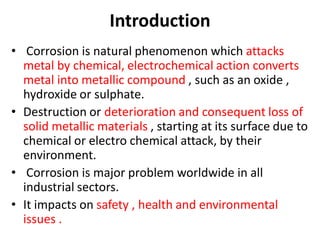
Introduction
• Corrosion is natural phenomenon which attacks
metal by chemical, electrochemical action converts
metal into metallic compound , such as an oxide ,
hydroxide or sulphate.
• Destruction or deterioration and consequent loss of
solid metallic materials , starting at its surface due to
chemical or electro chemical attack, by their
environment.
• Corrosion is major problem worldwide in all
industrial sectors.
• It impacts on safety , health and environmental
issues .
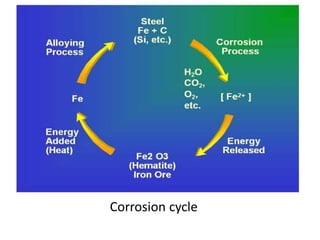
Corrosion cycle
Causes of Corrosion
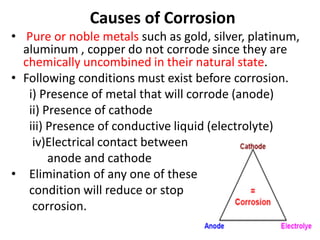
• Pure or noble metals such as gold, silver, platinum,
aluminum , copper do not corrode since they are
chemically uncombined in their natural state.
• Following conditions must exist before corrosion.
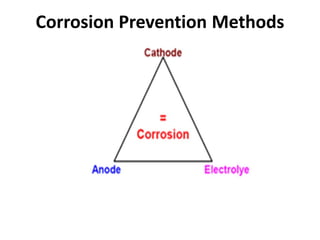
i) Presence of metal that will corrode (anode)
ii) Presence of cathode
iii) Presence of conductive liquid (electrolyte)
iv)Electrical contact between
anode and cathode
• Elimination of any one of these
condition will reduce or stop
corrosion.
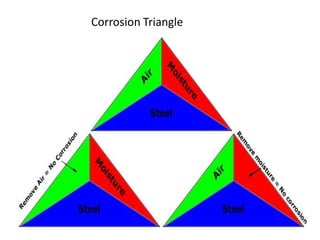
Corrosion Triangle
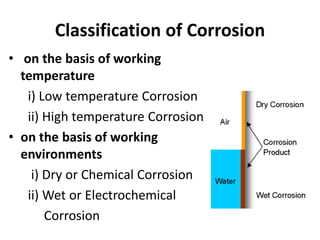
Classification of Corrosion
• on the basis of working
temperature
i) Low temperature Corrosion
ii) High temperature Corrosion
• on the basis of working
environments
i) Dry or Chemical Corrosion
ii) Wet or Electrochemical
Corrosion
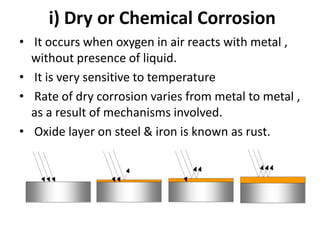
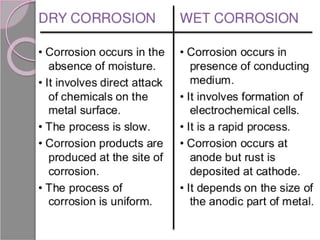
i) Dry or Chemical Corrosion
• It occurs when oxygen in air reacts with metal ,
without presence of liquid.
• It is very sensitive to temperature
• Rate of dry corrosion varies from metal to metal ,
as a result of mechanisms involved.
• Oxide layer on steel & iron is known as rust.
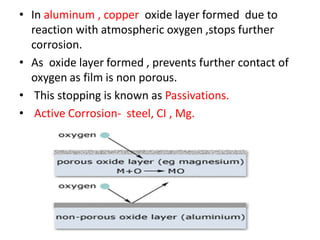
• In aluminum , copper oxide layer formed due to
reaction with atmospheric oxygen ,stops further
corrosion.
• As oxide layer formed , prevents further contact of
oxygen as film is non porous.
• This stopping is known as Passivations.
• Active Corrosion- steel, CI , Mg.
ii) Wet or Electrochemical Corrosion
• It is electrochemical phenomenon , which occurs
in galvanic cell.
• Particularly when two metals are in contact with
a liquid , liquid containing salt and electric
potential is formed between the metals.
• in some cases in single metal , when comes in
contact with liquid or electrolyte , a anode and
cathode areas are created.
• When anode area starts corroding with respect
to cathode areas , is termed as wet corrosion.
Mechanism of Corrosion
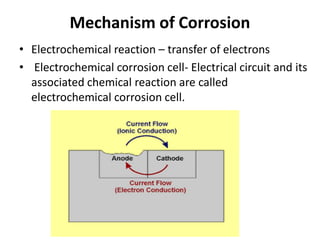
• Electrochemical reaction – transfer of electrons
• Electrochemical corrosion cell- Electrical circuit and its
associated chemical reaction are called
electrochemical corrosion cell.
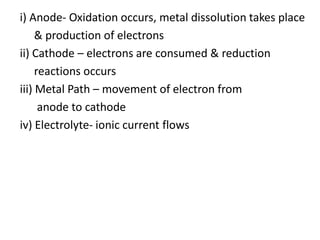
i) Anode- Oxidation occurs, metal dissolution takes place
& production of electrons
ii) Cathode – electrons are consumed & reduction
reactions occurs
iii) Metal Path – movement of electron from
anode to cathode
iv) Electrolyte- ionic current flows
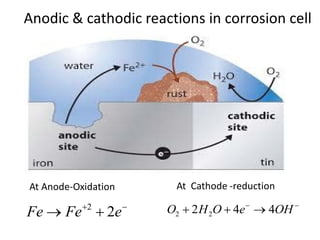
Anodic & cathodic reactions in corrosion cell
2
2Fe Fe e+ −
→ + 2 22 4 4O H O e OH− −
+ + →
At Anode-Oxidation At Cathode -reduction
• Type of Metal
• Heat treatment & Grain direction
• Presence of dissimilar metal
• Anode & cathode surface area
• Temperature
• presence of electrolyte
• Availability of oxygen
• time of exposure to corrosive environment
Factors Influencing Corrosion
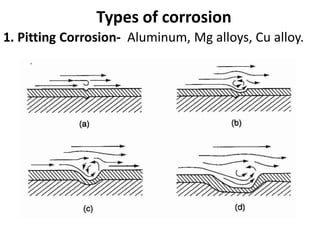
Types of corrosion
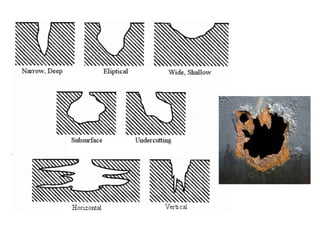
1. Pitting Corrosion- Aluminum, Mg alloys, Cu alloy.
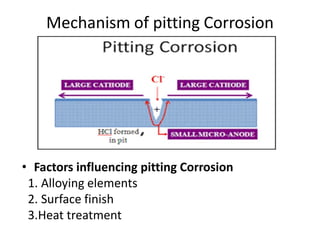
Mechanism of pitting Corrosion
• Factors influencing pitting Corrosion
1. Alloying elements
2. Surface finish
3.Heat treatment
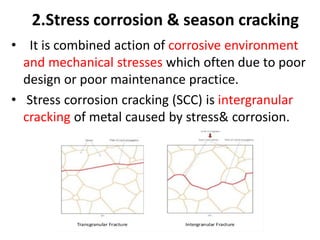
2.Stress corrosion & season cracking
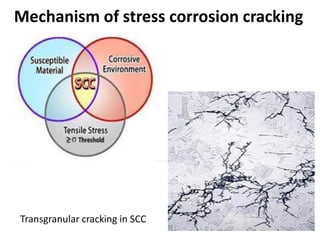
• It is combined action of corrosive environment
and mechanical stresses which often due to poor
design or poor maintenance practice.
• Stress corrosion cracking (SCC) is intergranular
cracking of metal caused by stress& corrosion.
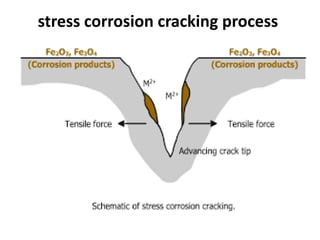
stress corrosion cracking process
Mechanism of stress corrosion cracking
Transgranular cracking in SCC
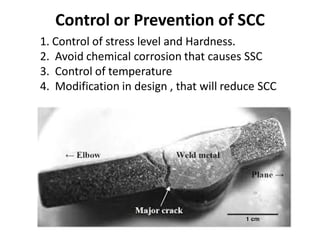
Control or Prevention of SCC
1. Control of stress level and Hardness.
2. Avoid chemical corrosion that causes SSC
3. Control of temperature
4. Modification in design , that will reduce SCC
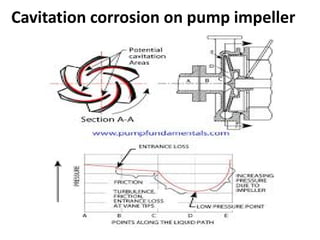
3. Cavitation Corrosion
• Protective films are removed from metal
surface during fluid flow.
• Low pressure development due to
discontinuity in flow path , causes vapour
bubbles to form in fluid steam.
• Due to collapsing of bubbles shock
waves produced and removes protective
film from metal surface
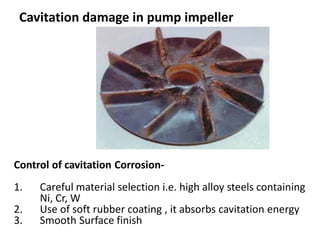
Cavitation corrosion on pump impeller
Cavitation damage in pump impeller
Control of cavitation Corrosion-
1. Careful material selection i.e. high alloy steels containing
Ni, Cr, W
2. Use of soft rubber coating , it absorbs cavitation energy
3. Smooth Surface finish
4. Hydrogen Embrittlement
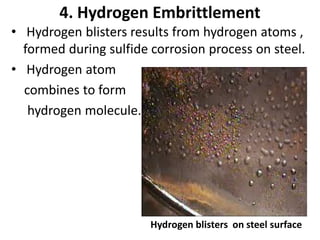
• Hydrogen blisters results from hydrogen atoms ,
formed during sulfide corrosion process on steel.
• Hydrogen atom
combines to form
hydrogen molecule.
Hydrogen blisters on steel surface
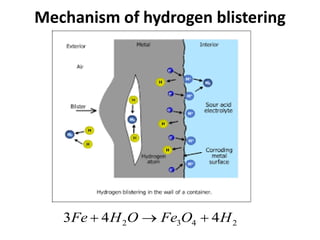
Mechanism of hydrogen blistering
2 3 4 23 4 4Fe H O Fe O H+ → +
5. Inter Granular Corrosion
• Form of corrosion where boundaries of grain of
metal are more susceptible to corrosion than
inside grain.
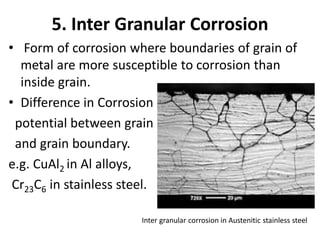
• Difference in Corrosion
potential between grain
and grain boundary.
e.g. CuAl2 in Al alloys,
Cr23C6 in stainless steel.
Inter granular corrosion in Austenitic stainless steel
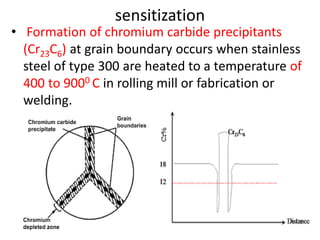
sensitization
• Formation of chromium carbide precipitants
(Cr23C6) at grain boundary occurs when stainless
steel of type 300 are heated to a temperature of
400 to 9000 C in rolling mill or fabrication or
welding.
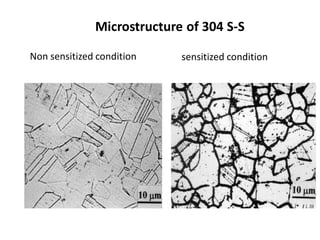
Non sensitized condition sensitized condition
Microstructure of 304 S-S
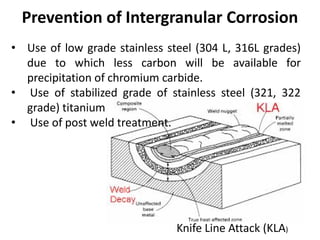
Prevention of Intergranular Corrosion
Knife Line Attack (KLA)
• Use of low grade stainless steel (304 L, 316L grades)
due to which less carbon will be available for
precipitation of chromium carbide.
• Use of stabilized grade of stainless steel (321, 322
grade) titanium
• Use of post weld treatment.
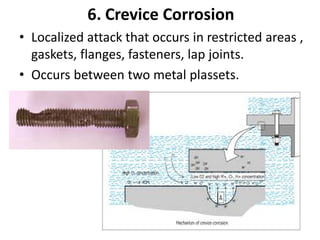
6. Crevice Corrosion
• Localized attack that occurs in restricted areas ,
gaskets, flanges, fasteners, lap joints.
• Occurs between two metal plassets.
Prevention of crevice corrosion
• Avoid crevice during fabrication i.e. smooth
weld.
• avoid solution get into crevice i.e. apply
grease to nuts and bolts.
• routine cleaning
• Apply external coating.
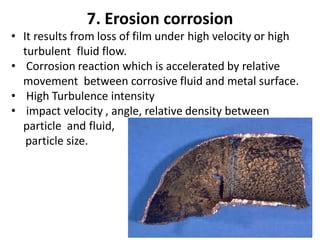
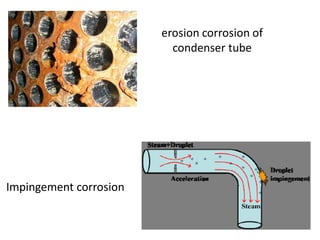
7. Erosion corrosion
• It results from loss of film under high velocity or high
turbulent fluid flow.
• Corrosion reaction which is accelerated by relative
movement between corrosive fluid and metal surface.
• High Turbulence intensity
• impact velocity , angle, relative density between
particle and fluid,
particle size.
Impingement corrosion
erosion corrosion of
condenser tube
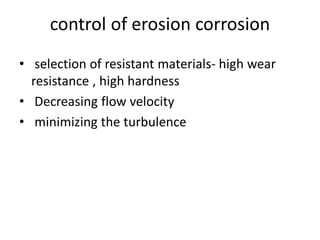
control of erosion corrosion
• selection of resistant materials- high wear
resistance , high hardness
• Decreasing flow velocity
• minimizing the turbulence
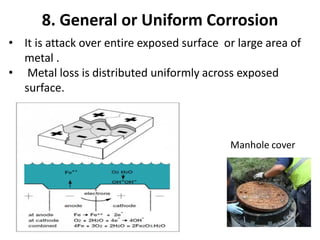
8. General or Uniform Corrosion
• It is attack over entire exposed surface or large area of
metal .
• Metal loss is distributed uniformly across exposed
surface.
Manhole cover
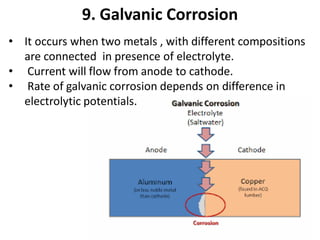
9. Galvanic Corrosion
• It occurs when two metals , with different compositions
are connected in presence of electrolyte.
• Current will flow from anode to cathode.
• Rate of galvanic corrosion depends on difference in
electrolytic potentials.
control of Galvanic corrosion
• selection of metals that are close together in
galvanic series.
• Insulate metal from each other
• Painting of both metals
Corrosion Prevention Methods
1. Active corrosion protection
• To influence reactions which proceed during
corrosion.
• e.g. Addition of inhibitors to aggressive medium.
• By mechanically isolating package contents from
aggressive corrosive agents by using protective
layers , films, coatings.
• This method neither changes ability of package
contents to corrode nor aggressiveness of
corrosive agent.
2. Passive corrosion protection
3.Permanent corrosion protection
• To provide protection at the place of use.
• e.g. stable oxide layer (nonporous film)forming
metals
• Stresses occurring during transport, handling,
storage are much greater than those occuring at
place of use.
• e.g. extreme variation in temperature which
results in condensation during transportation.
4. Temporary Corrosion protection
5.Corrosion Inhibitors
• Chemicals that react with metallic surface &
gives certain level of protection.
• inhibitors has chemical bonding with base
metal , it is more adherent to base metal , due
to which corrosion reaction stopped.
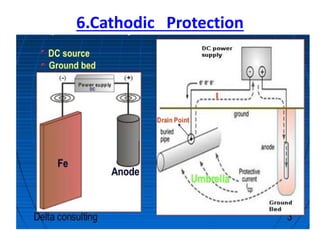
6.Cathodic Protection
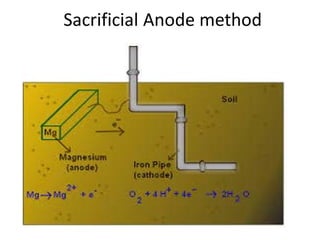
Sacrificial Anode method
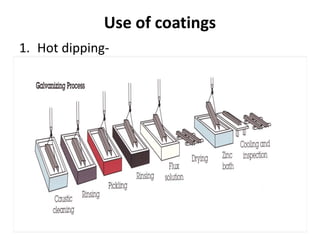
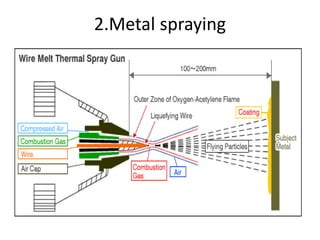
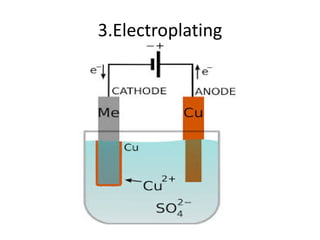
Use of coatings
1. Hot dipping-
2.Metal spraying
3.Electroplating
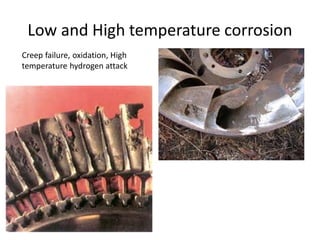
Low and High temperature corrosion
Creep failure, oxidation, High
temperature hydrogen attack
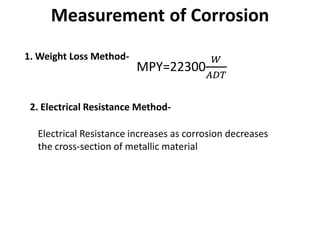
Measurement of Corrosion
1. Weight Loss Method-
MPY=22300
𝑊
𝐴𝐴𝐴
2. Electrical Resistance Method-
Electrical Resistance increases as corrosion decreases
the cross-section of metallic material

Metal corrosion and its prevention

  • 1.
    Material Science Metal Corrosionand its Prevention By Sandip Thorat Mechanical Engg. Department SRES, Sanjivani College of Engineering, Kopargaon. (MS) 423603
  • 2.
    Introduction • Corrosion isnatural phenomenon which attacks metal by chemical, electrochemical action converts metal into metallic compound , such as an oxide , hydroxide or sulphate. • Destruction or deterioration and consequent loss of solid metallic materials , starting at its surface due to chemical or electro chemical attack, by their environment. • Corrosion is major problem worldwide in all industrial sectors. • It impacts on safety , health and environmental issues .
  • 3.
  • 4.
    Causes of Corrosion •Pure or noble metals such as gold, silver, platinum, aluminum , copper do not corrode since they are chemically uncombined in their natural state. • Following conditions must exist before corrosion. i) Presence of metal that will corrode (anode) ii) Presence of cathode iii) Presence of conductive liquid (electrolyte) iv)Electrical contact between anode and cathode • Elimination of any one of these condition will reduce or stop corrosion.
  • 5.
  • 6.
    Classification of Corrosion •on the basis of working temperature i) Low temperature Corrosion ii) High temperature Corrosion • on the basis of working environments i) Dry or Chemical Corrosion ii) Wet or Electrochemical Corrosion
  • 7.
    i) Dry orChemical Corrosion • It occurs when oxygen in air reacts with metal , without presence of liquid. • It is very sensitive to temperature • Rate of dry corrosion varies from metal to metal , as a result of mechanisms involved. • Oxide layer on steel & iron is known as rust.
  • 8.
    • In aluminum, copper oxide layer formed due to reaction with atmospheric oxygen ,stops further corrosion. • As oxide layer formed , prevents further contact of oxygen as film is non porous. • This stopping is known as Passivations. • Active Corrosion- steel, CI , Mg.
  • 9.
    ii) Wet orElectrochemical Corrosion • It is electrochemical phenomenon , which occurs in galvanic cell. • Particularly when two metals are in contact with a liquid , liquid containing salt and electric potential is formed between the metals. • in some cases in single metal , when comes in contact with liquid or electrolyte , a anode and cathode areas are created. • When anode area starts corroding with respect to cathode areas , is termed as wet corrosion.
  • 11.
    Mechanism of Corrosion •Electrochemical reaction – transfer of electrons • Electrochemical corrosion cell- Electrical circuit and its associated chemical reaction are called electrochemical corrosion cell.
  • 12.
    i) Anode- Oxidationoccurs, metal dissolution takes place & production of electrons ii) Cathode – electrons are consumed & reduction reactions occurs iii) Metal Path – movement of electron from anode to cathode iv) Electrolyte- ionic current flows
  • 13.
    Anodic & cathodicreactions in corrosion cell 2 2Fe Fe e+ − → + 2 22 4 4O H O e OH− − + + → At Anode-Oxidation At Cathode -reduction
  • 14.
    • Type ofMetal • Heat treatment & Grain direction • Presence of dissimilar metal • Anode & cathode surface area • Temperature • presence of electrolyte • Availability of oxygen • time of exposure to corrosive environment Factors Influencing Corrosion
  • 15.
    Types of corrosion 1.Pitting Corrosion- Aluminum, Mg alloys, Cu alloy.
  • 17.
    Mechanism of pittingCorrosion • Factors influencing pitting Corrosion 1. Alloying elements 2. Surface finish 3.Heat treatment
  • 18.
    2.Stress corrosion &season cracking • It is combined action of corrosive environment and mechanical stresses which often due to poor design or poor maintenance practice. • Stress corrosion cracking (SCC) is intergranular cracking of metal caused by stress& corrosion.
  • 19.
  • 20.
    Mechanism of stresscorrosion cracking Transgranular cracking in SCC
  • 21.
    Control or Preventionof SCC 1. Control of stress level and Hardness. 2. Avoid chemical corrosion that causes SSC 3. Control of temperature 4. Modification in design , that will reduce SCC
  • 22.
    3. Cavitation Corrosion •Protective films are removed from metal surface during fluid flow. • Low pressure development due to discontinuity in flow path , causes vapour bubbles to form in fluid steam. • Due to collapsing of bubbles shock waves produced and removes protective film from metal surface
  • 23.
  • 24.
    Cavitation damage inpump impeller Control of cavitation Corrosion- 1. Careful material selection i.e. high alloy steels containing Ni, Cr, W 2. Use of soft rubber coating , it absorbs cavitation energy 3. Smooth Surface finish
  • 25.
    4. Hydrogen Embrittlement •Hydrogen blisters results from hydrogen atoms , formed during sulfide corrosion process on steel. • Hydrogen atom combines to form hydrogen molecule. Hydrogen blisters on steel surface
  • 26.
    Mechanism of hydrogenblistering 2 3 4 23 4 4Fe H O Fe O H+ → +
  • 27.
    5. Inter GranularCorrosion • Form of corrosion where boundaries of grain of metal are more susceptible to corrosion than inside grain. • Difference in Corrosion potential between grain and grain boundary. e.g. CuAl2 in Al alloys, Cr23C6 in stainless steel. Inter granular corrosion in Austenitic stainless steel
  • 28.
    sensitization • Formation ofchromium carbide precipitants (Cr23C6) at grain boundary occurs when stainless steel of type 300 are heated to a temperature of 400 to 9000 C in rolling mill or fabrication or welding.
  • 29.
    Non sensitized conditionsensitized condition Microstructure of 304 S-S
  • 30.
    Prevention of IntergranularCorrosion Knife Line Attack (KLA) • Use of low grade stainless steel (304 L, 316L grades) due to which less carbon will be available for precipitation of chromium carbide. • Use of stabilized grade of stainless steel (321, 322 grade) titanium • Use of post weld treatment.
  • 31.
    6. Crevice Corrosion •Localized attack that occurs in restricted areas , gaskets, flanges, fasteners, lap joints. • Occurs between two metal plassets.
  • 32.
    Prevention of crevicecorrosion • Avoid crevice during fabrication i.e. smooth weld. • avoid solution get into crevice i.e. apply grease to nuts and bolts. • routine cleaning • Apply external coating.
  • 33.
    7. Erosion corrosion •It results from loss of film under high velocity or high turbulent fluid flow. • Corrosion reaction which is accelerated by relative movement between corrosive fluid and metal surface. • High Turbulence intensity • impact velocity , angle, relative density between particle and fluid, particle size.
  • 34.
  • 35.
    control of erosioncorrosion • selection of resistant materials- high wear resistance , high hardness • Decreasing flow velocity • minimizing the turbulence
  • 36.
    8. General orUniform Corrosion • It is attack over entire exposed surface or large area of metal . • Metal loss is distributed uniformly across exposed surface. Manhole cover
  • 37.
    9. Galvanic Corrosion •It occurs when two metals , with different compositions are connected in presence of electrolyte. • Current will flow from anode to cathode. • Rate of galvanic corrosion depends on difference in electrolytic potentials.
  • 38.
    control of Galvaniccorrosion • selection of metals that are close together in galvanic series. • Insulate metal from each other • Painting of both metals
  • 39.
  • 40.
    1. Active corrosionprotection • To influence reactions which proceed during corrosion. • e.g. Addition of inhibitors to aggressive medium. • By mechanically isolating package contents from aggressive corrosive agents by using protective layers , films, coatings. • This method neither changes ability of package contents to corrode nor aggressiveness of corrosive agent. 2. Passive corrosion protection
  • 41.
    3.Permanent corrosion protection •To provide protection at the place of use. • e.g. stable oxide layer (nonporous film)forming metals • Stresses occurring during transport, handling, storage are much greater than those occuring at place of use. • e.g. extreme variation in temperature which results in condensation during transportation. 4. Temporary Corrosion protection
  • 42.
    5.Corrosion Inhibitors • Chemicalsthat react with metallic surface & gives certain level of protection. • inhibitors has chemical bonding with base metal , it is more adherent to base metal , due to which corrosion reaction stopped.
  • 43.
  • 44.
  • 45.
    Use of coatings 1.Hot dipping-
  • 46.
  • 47.
  • 48.
    Low and Hightemperature corrosion Creep failure, oxidation, High temperature hydrogen attack
  • 49.
    Measurement of Corrosion 1.Weight Loss Method- MPY=22300 𝑊 𝐴𝐴𝐴 2. Electrical Resistance Method- Electrical Resistance increases as corrosion decreases the cross-section of metallic material