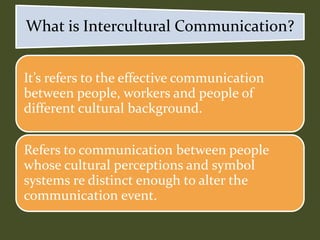
It’s refers to the effective communication
between people, workers and people of
different cultural background.
Refers to communication between people
whose cultural perceptions and symbol
systems re distinct enough to alter the
communication event.
What is Intercultural Communication?
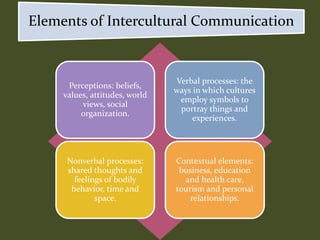
Perceptions: beliefs,
values, attitudes, world
views, social
organization.
Verbal processes: the
ways in which cultures
employ symbols to
portray things and
experiences.
Nonverbal processes:
shared thoughts and
feelings of bodily
behavior, time and
space.
Contextual elements:
business, education
and health care,
tourism and personal
relationships.
Elements of Intercultural Communication
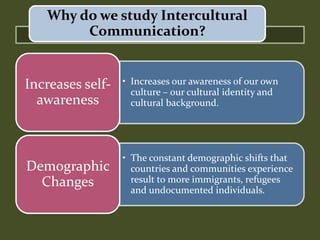
• Increases our awareness of our own
culture – our cultural identity and
cultural background.
Increases self-
awareness
• The constant demographic shifts that
countries and communities experience
result to more immigrants, refugees
and undocumented individuals.
Demographic
Changes
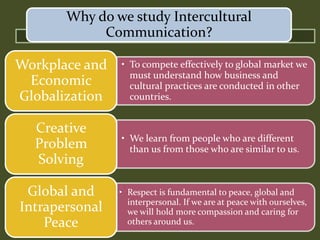
Why do we study Intercultural
Communication?
• To compete effectively to global market we
must understand how business and
cultural practices are conducted in other
countries.
Workplace and
Economic
Globalization
• We learn from people who are different
than us from those who are similar to us.
Creative
Problem
Solving
• Respect is fundamental to peace, global and
interpersonal. If we are at peace with ourselves,
we will hold more compassion and caring for
others around us.
Global and
Intrapersonal
Peace
Why do we study Intercultural
Communication?
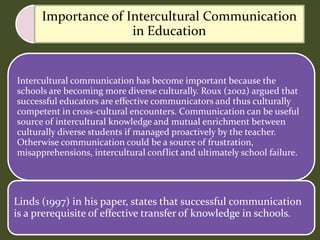
Intercultural communication has become important because the
schools are becoming more diverse culturally. Roux (2002) argued that
successful educators are effective communicators and thus culturally
competent in cross-cultural encounters. Communication can be useful
source of intercultural knowledge and mutual enrichment between
culturally diverse students if managed proactively by the teacher.
Otherwise communication could be a source of frustration,
misapprehensions, intercultural conflict and ultimately school failure.
Linds (1997) in his paper, states that successful communication
is a prerequisite of effective transfer of knowledge in schools.
Importance of Intercultural Communication
in Education
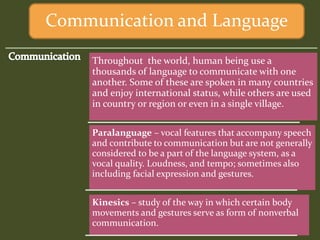
Throughout the world, human being use a
thousands of language to communicate with one
another. Some of these are spoken in many countries
and enjoy international status, while others are used
in country or region or even in a single village.
Paralanguage – vocal features that accompany speech
and contribute to communication but are not generally
considered to be a part of the language system, as a
vocal quality. Loudness, and tempo; sometimes also
including facial expression and gestures.
Kinesics – study of the way in which certain body
movements and gestures serve as form of nonverbal
communication.
Communication and Language
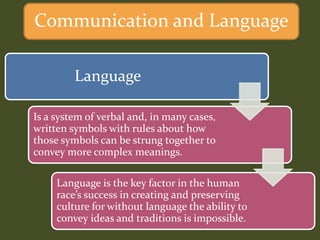
Language
Is a system of verbal and, in many cases,
written symbols with rules about how
those symbols can be strung together to
convey more complex meanings.
Language is the key factor in the human
race’s success in creating and preserving
culture for without language the ability to
convey ideas and traditions is impossible.
Communication and Language
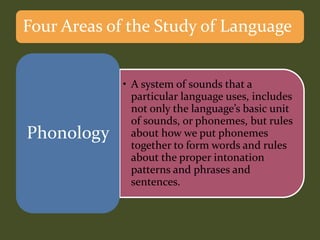
Four Areas of the Study of Language
• A system of sounds that a
particular language uses, includes
not only the language’s basic unit
of sounds, or phonemes, but rules
about how we put phonemes
together to form words and rules
about the proper intonation
patterns and phrases and
sentences.
Phonology
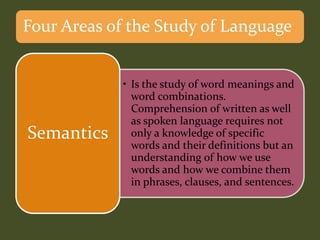
• Is the study of word meanings and
word combinations.
Comprehension of written as well
as spoken language requires not
only a knowledge of specific
words and their definitions but an
understanding of how we use
words and how we combine them
in phrases, clauses, and sentences.
Semantics
Four Areas of the Study of Language
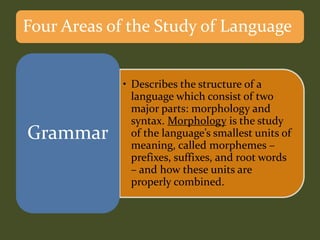
• Describes the structure of a
language which consist of two
major parts: morphology and
syntax. Morphology is the study
of the language’s smallest units of
meaning, called morphemes –
prefixes, suffixes, and root words
– and how these units are
properly combined.
Grammar
Four Areas of the Study of Language
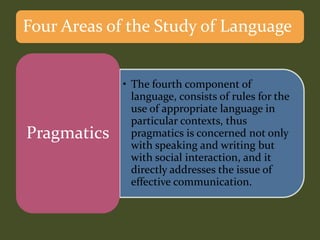
• The fourth component of
language, consists of rules for the
use of appropriate language in
particular contexts, thus
pragmatics is concerned not only
with speaking and writing but
with social interaction, and it
directly addresses the issue of
effective communication.
Pragmatics
Four Areas of the Study of Language
Language and Culture
Is an integral part of culture and
human culture cannot exist
without it.
Through the use of language, wide
vistas of reality have been opened.
Language
• A linguist.
• Acknowledged the close
relationship between
language and culture.
Edward
Sapir
The linguistic-relativity hypothesis
• Asserts that language actually determines the
possibilities for a culture’s norms, beliefs and
values.
The set of learned behaviours, beliefs, attitudes, values, and
ideals that are characteristics of a particular society or
population. (Ember, 1999)
The learned norms, values, knowledge, arti-facts, language,
and symbols that are constantly communicated among
people who share a common way of life. (Calhoun, 1994)
The sum total of symbols, ideas, forms of expressions, and
material products associated with a system. (Allan Johnson,
1996).
Culture
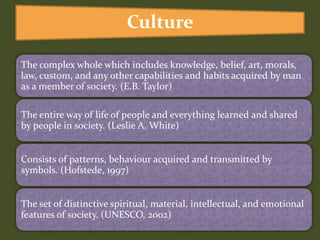
The complex whole which includes knowledge, belief, art, morals,
law, custom, and any other capabilities and habits acquired by man
as a member of society. (E.B. Taylor)
The entire way of life of people and everything learned and shared
by people in society. (Leslie A. White)
Consists of patterns, behaviour acquired and transmitted by
symbols. (Hofstede, 1997)
The set of distinctive spiritual, material, intellectual, and emotional
features of society. (UNESCO, 2002)
Culture
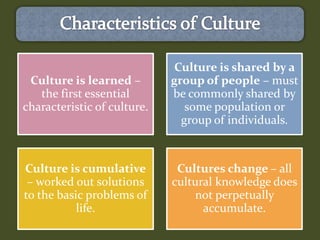
Culture is learned –
the first essential
characteristic of culture.
Culture is shared by a
group of people – must
be commonly shared by
some population or
group of individuals.
Culture is cumulative
– worked out solutions
to the basic problems of
life.
Cultures change – all
cultural knowledge does
not perpetually
accumulate.
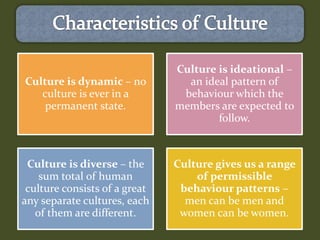
Culture is dynamic – no
culture is ever in a
permanent state.
Culture is ideational –
an ideal pattern of
behaviour which the
members are expected to
follow.
Culture is diverse – the
sum total of human
culture consists of a great
any separate cultures, each
of them are different.
Culture gives us a range
of permissible
behaviour patterns –
men can be men and
women can be women.
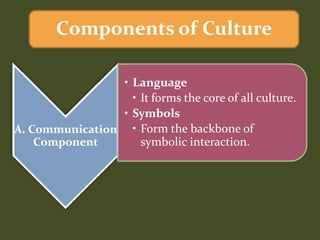
A. Communication
Component
• Language
• It forms the core of all culture.
• Symbols
• Form the backbone of
symbolic interaction.
Components of Culture
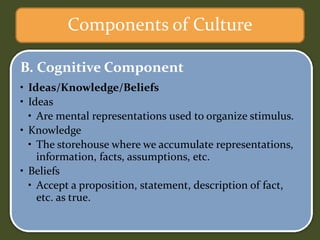
B. Cognitive Component
• Ideas/Knowledge/Beliefs
• Ideas
• Are mental representations used to organize stimulus.
• Knowledge
• The storehouse where we accumulate representations,
information, facts, assumptions, etc.
• Beliefs
• Accept a proposition, statement, description of fact,
etc. as true.
Components of Culture
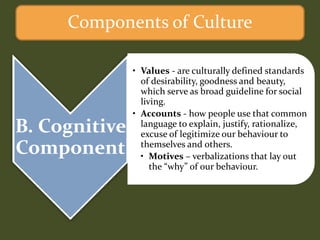
B. Cognitive
Component
• Values - are culturally defined standards
of desirability, goodness and beauty,
which serve as broad guideline for social
living.
• Accounts - how people use that common
language to explain, justify, rationalize,
excuse of legitimize our behaviour to
themselves and others.
• Motives – verbalizations that lay out
the “why” of our behaviour.
Components of Culture
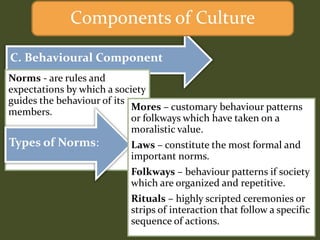
C. Behavioural Component
Norms - are rules and
expectations by which a society
guides the behaviour of its
members.
Types of Norms:
Mores – customary behaviour patterns
or folkways which have taken on a
moralistic value.
Laws – constitute the most formal and
important norms.
Folkways – behaviour patterns if society
which are organized and repetitive.
Rituals – highly scripted ceremonies or
strips of interaction that follow a specific
sequence of actions.
Components of Culture
D. Material
Component
Is an expression of
culture and
culturally-defined
behaviour often
depends on the
presence of specific
objects.
Components of Culture
Enculturation - the process of learning culture of one’s
own group.
Acculturation - the process of learning some new traits
from another culture.
Assimilation - a process in which an individual entirely
loses any awareness of his/her previous group identity
and takes on the culture and attitudes if another group.
How is Culture Transmitted
Culture helps
the individual
fulfil his
potential as a
human being.
Through the
development of
culture man can
overcome his
physical
disadvantages
and allows us to
provide
ourselves with
fire, clothing,
food and shelter.
Culture provides
rules of proper
conduct for
living in a
society.
Culture also
provides the
individual his
concepts of
family, nation,
and class.
Importance and Functions of Culture
Presented
by:
Cyrealin
Mallari
Jenny Rose
Velasco

Intercultural communication

  • 2.
    It’s refers tothe effective communication between people, workers and people of different cultural background. Refers to communication between people whose cultural perceptions and symbol systems re distinct enough to alter the communication event. What is Intercultural Communication?
  • 3.
    Perceptions: beliefs, values, attitudes,world views, social organization. Verbal processes: the ways in which cultures employ symbols to portray things and experiences. Nonverbal processes: shared thoughts and feelings of bodily behavior, time and space. Contextual elements: business, education and health care, tourism and personal relationships. Elements of Intercultural Communication
  • 4.
    • Increases ourawareness of our own culture – our cultural identity and cultural background. Increases self- awareness • The constant demographic shifts that countries and communities experience result to more immigrants, refugees and undocumented individuals. Demographic Changes Why do we study Intercultural Communication?
  • 5.
    • To competeeffectively to global market we must understand how business and cultural practices are conducted in other countries. Workplace and Economic Globalization • We learn from people who are different than us from those who are similar to us. Creative Problem Solving • Respect is fundamental to peace, global and interpersonal. If we are at peace with ourselves, we will hold more compassion and caring for others around us. Global and Intrapersonal Peace Why do we study Intercultural Communication?
  • 6.
    Intercultural communication hasbecome important because the schools are becoming more diverse culturally. Roux (2002) argued that successful educators are effective communicators and thus culturally competent in cross-cultural encounters. Communication can be useful source of intercultural knowledge and mutual enrichment between culturally diverse students if managed proactively by the teacher. Otherwise communication could be a source of frustration, misapprehensions, intercultural conflict and ultimately school failure. Linds (1997) in his paper, states that successful communication is a prerequisite of effective transfer of knowledge in schools. Importance of Intercultural Communication in Education
  • 7.
    Throughout the world,human being use a thousands of language to communicate with one another. Some of these are spoken in many countries and enjoy international status, while others are used in country or region or even in a single village. Paralanguage – vocal features that accompany speech and contribute to communication but are not generally considered to be a part of the language system, as a vocal quality. Loudness, and tempo; sometimes also including facial expression and gestures. Kinesics – study of the way in which certain body movements and gestures serve as form of nonverbal communication. Communication and Language
  • 8.
    Language Is a systemof verbal and, in many cases, written symbols with rules about how those symbols can be strung together to convey more complex meanings. Language is the key factor in the human race’s success in creating and preserving culture for without language the ability to convey ideas and traditions is impossible. Communication and Language
  • 9.
    Four Areas ofthe Study of Language • A system of sounds that a particular language uses, includes not only the language’s basic unit of sounds, or phonemes, but rules about how we put phonemes together to form words and rules about the proper intonation patterns and phrases and sentences. Phonology
  • 10.
    • Is thestudy of word meanings and word combinations. Comprehension of written as well as spoken language requires not only a knowledge of specific words and their definitions but an understanding of how we use words and how we combine them in phrases, clauses, and sentences. Semantics Four Areas of the Study of Language
  • 11.
    • Describes thestructure of a language which consist of two major parts: morphology and syntax. Morphology is the study of the language’s smallest units of meaning, called morphemes – prefixes, suffixes, and root words – and how these units are properly combined. Grammar Four Areas of the Study of Language
  • 12.
    • The fourthcomponent of language, consists of rules for the use of appropriate language in particular contexts, thus pragmatics is concerned not only with speaking and writing but with social interaction, and it directly addresses the issue of effective communication. Pragmatics Four Areas of the Study of Language
  • 13.
  • 14.
    Is an integralpart of culture and human culture cannot exist without it. Through the use of language, wide vistas of reality have been opened. Language
  • 15.
    • A linguist. •Acknowledged the close relationship between language and culture. Edward Sapir The linguistic-relativity hypothesis • Asserts that language actually determines the possibilities for a culture’s norms, beliefs and values.
  • 16.
    The set oflearned behaviours, beliefs, attitudes, values, and ideals that are characteristics of a particular society or population. (Ember, 1999) The learned norms, values, knowledge, arti-facts, language, and symbols that are constantly communicated among people who share a common way of life. (Calhoun, 1994) The sum total of symbols, ideas, forms of expressions, and material products associated with a system. (Allan Johnson, 1996). Culture
  • 17.
    The complex wholewhich includes knowledge, belief, art, morals, law, custom, and any other capabilities and habits acquired by man as a member of society. (E.B. Taylor) The entire way of life of people and everything learned and shared by people in society. (Leslie A. White) Consists of patterns, behaviour acquired and transmitted by symbols. (Hofstede, 1997) The set of distinctive spiritual, material, intellectual, and emotional features of society. (UNESCO, 2002) Culture
  • 18.
    Culture is learned– the first essential characteristic of culture. Culture is shared by a group of people – must be commonly shared by some population or group of individuals. Culture is cumulative – worked out solutions to the basic problems of life. Cultures change – all cultural knowledge does not perpetually accumulate.
  • 19.
    Culture is dynamic– no culture is ever in a permanent state. Culture is ideational – an ideal pattern of behaviour which the members are expected to follow. Culture is diverse – the sum total of human culture consists of a great any separate cultures, each of them are different. Culture gives us a range of permissible behaviour patterns – men can be men and women can be women.
  • 20.
    A. Communication Component • Language •It forms the core of all culture. • Symbols • Form the backbone of symbolic interaction. Components of Culture
  • 21.
    B. Cognitive Component •Ideas/Knowledge/Beliefs • Ideas • Are mental representations used to organize stimulus. • Knowledge • The storehouse where we accumulate representations, information, facts, assumptions, etc. • Beliefs • Accept a proposition, statement, description of fact, etc. as true. Components of Culture
  • 22.
    B. Cognitive Component • Values- are culturally defined standards of desirability, goodness and beauty, which serve as broad guideline for social living. • Accounts - how people use that common language to explain, justify, rationalize, excuse of legitimize our behaviour to themselves and others. • Motives – verbalizations that lay out the “why” of our behaviour. Components of Culture
  • 23.
    C. Behavioural Component Norms- are rules and expectations by which a society guides the behaviour of its members. Types of Norms: Mores – customary behaviour patterns or folkways which have taken on a moralistic value. Laws – constitute the most formal and important norms. Folkways – behaviour patterns if society which are organized and repetitive. Rituals – highly scripted ceremonies or strips of interaction that follow a specific sequence of actions. Components of Culture
  • 24.
    D. Material Component Is anexpression of culture and culturally-defined behaviour often depends on the presence of specific objects. Components of Culture
  • 25.
    Enculturation - theprocess of learning culture of one’s own group. Acculturation - the process of learning some new traits from another culture. Assimilation - a process in which an individual entirely loses any awareness of his/her previous group identity and takes on the culture and attitudes if another group. How is Culture Transmitted
  • 26.
    Culture helps the individual fulfilhis potential as a human being. Through the development of culture man can overcome his physical disadvantages and allows us to provide ourselves with fire, clothing, food and shelter. Culture provides rules of proper conduct for living in a society. Culture also provides the individual his concepts of family, nation, and class. Importance and Functions of Culture
  • 27.