


KIRSTINA N. MANALO, MIT, LPT
Intercultural Communication (KNM)
Identify what intercultural communication is, its elements and
importance to education
Explain the role of language
Describe the relationship between language and culture
Intercultural Communication (KNM)
Communication is the exchange of information
between people, such as by means of speaking,
writing, or using a common system of signs or
behavior
Types of communication:
 Verbal refers to the use of language
 Non-verbal refers to the use of gestures, facial
expression, and other body movements
Intercultural Communication (KNM)
Refers to the effective communication between people,
workers and people of different cultural backgrounds
Refers to the communication between people whose cultural
perceptions and symbol systems are distinct enough to alter
the communication event.
Intercultural Communication (KNM)
Academic field of study which seeks to understand hoe
people from different countries and culture behave and
communicate and perceive the world around them
(intercultural.org)
Interpersonal interaction between members of different
groups which differ from each other in respect of the
knowledge shared by other members and in respect of their
linguistic forms of symbolic behavior (Karlfried Knapp).
Intercultural Communication (KNM)
o Perceptions
o Verbal Processes
o Nonverbal Processes
o Contextual Elements
Beliefs
Values
Attitudes
World views
Social organizations
Intercultural Communication (KNM)
The ways in which cultures employ
symbols to portray things and experiences
Intercultural Communication (KNM)
Shared thoughts and feelings of bodily
behavior, time and space
Intercultural Communication (KNM)
Business, education and health care, and
personal relationships
Intercultural Communication (KNM)
Increase awareness of own culture – our cultural identity and
cultural background.
Helps avoid ethnocentrism
Ethnocentrism is the tendency to think that our culture
is superior to other cultures
Intercultural Communication (KNM)
Constant demographic shifts that countries and communities
experience result to more immigrants, refugees and
undocumented individuals.
Intercultural Communication (KNM)
To compete effectively in a global market we must
understand how businesses and cultural practices are
conducted in other countries
Intercultural Communication (KNM)
According to research, we learn form people who are
different than us from those who are similar to us (Sternberg
as cited in Ting-Toomey & Chung, 2005)
Intercultural Communication (KNM)
Respect is fundamental to peace, global and interpersonal. If
we are at peace with our elves, we will not hold more
compassion and caring for others around us (Ting-Toommey
&Chung, 2005)
Intercultural Communication (KNM)
For effective interaction between teachers and learners especially in
cross –cultural encounters
Communication can be a useful source of intellectual knowledge and
mutual enrichment between culturally diverse students if managed
proactively by the teacher.
Can lead to frustration, misapprehensions, intercultural conflict and
ultimately school failure if communication is not managed
For effective transfer of knowledge
Intercultural Communication (KNM)
Not just speech and writing
Gestures, glances, slight changes in the tone of voice and
other auxiliary communication devices to alter or emphasize
what we say or do.
Intercultural Communication (KNM)
Abstract system of word meaning and symbols for all aspects
of culture
Includes speech, written characters, numerals, symbols, and
gestures and expressions of non-verbal communication
Linguists refers to all auxiliary communication devices as
paralanguage.
Intercultural Communication (KNM)
Referred as the language of gestures, expressions and
postures
Part of redundancy in communication that helps prevent
ineffective communication
Said to be more important in communication than what is
actually said orally
 70% of what we communicate while talking
Kinesics or body language is the most obvious form of
paralanguage.
Intercultural Communication (KNM)
Indirectly, we communicate through signs and symbols such
as:
 Writing algebraic expressions
 Musical scores
 Painting
 Road signs
Intercultural Communication (KNM)
A language is a system of verbal and, in many cases, written
symbols with rules about how those symbols can be strung
together to convey more complex meanings.
Language enables people to store meaning and experiences
to pass this heritage to new generations.
Language enables us to transcend the here and now,
preserving the past and imagining the future
Intercultural Communication (KNM)
Language is cultural and universal
Without the ability to communicate accumulated wisdom
cannot be pass to succeeding generations
Man’s language is a reflection of the
kind of person he is
the family where he comes from
Level of education he attained
An index to the behavior that is expected from him
Intercultural Communication (KNM)
1. Phonology
2. Semantics
3. Grammar
4. Pragmatics
Intercultural Communication (KNM)
Refers to the system of sounds that a particular language
uses
study of speech sounds: the study of the system or pattern
of speech sounds used in a particular language or in
language in general
sound system of language: the system or pattern of speech
sounds used in a particular
Intercultural Communication (KNM)
Study of word meaning and word combinations
study of meaning in language: the study of how meaning in
language is created by the use and interrelationships of
words, phrases, and sentences
study of symbols: the study of the relationship between
symbols and what they represent
Intercultural Communication (KNM)
Refers to the structure of language through its morphology
and syntax
rules for language: the system of rules by which words are
formed and put together to make sentences
particular set of language rules: the rules for speaking or
writing a particular language, or an analysis of the rules of a
particular aspect of language
Intercultural Communication (KNM)
Concerned with the rules for the use of appropriate language
particular context
the branch of linguistics that studies language use rather than
language structure
Intercultural Communication (KNM)
Learning of culture takes place through language
Collective memory (myths, fables, sayings, ballad, etc), writing,
art, and all other media
Culture can affect the structure and content of its language
then it follows that linguistic diversity derives in part from
cultural diversity
Intercultural Communication (KNM)
The relationship between culture is that the structure for the
language determines the way in which speakers of the
language view the world
The linguistic- relativity hypothesis asserts that language
determines thought and therefore culture. In reality language
and culture influence each other
–Edward Sapir
Intercultural Communication (KNM)
Every society has culture, no matter how simple
the culture may be, and every human being is
cultured in the sense of participating in some
culture of or other.
Intercultural Communication (KNM)
Refers to the attitudes, values, customs, and
behavior patterns that characterize a social
group.
Refers to defined standards of desirability,
goodness and beauty which serve as broad
guideline for social wellbeing
Intercultural Communication (KNM)
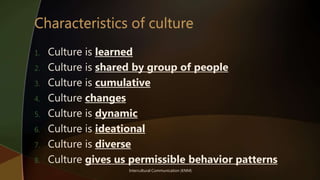
1. Culture is learned
2. Culture is shared by group of people
3. Culture is cumulative
4. Culture changes
5. Culture is dynamic
6. Culture is ideational
7. Culture is diverse
8. Culture gives us permissible behavior patterns
Intercultural Communication (KNM)
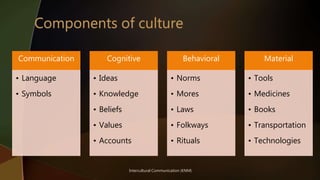
Communication
• Language
• Symbols
Cognitive
• Ideas
• Knowledge
• Beliefs
• Values
• Accounts
Behavioral
• Norms
• Mores
• Laws
• Folkways
• Rituals
Material
• Tools
• Medicines
• Books
• Transportation
• Technologies
Intercultural Communication (KNM)
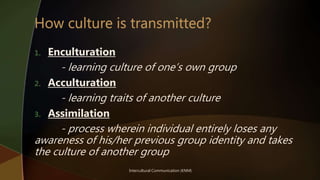
1. Enculturation
- learning culture of one’s own group
2. Acculturation
- learning traits of another culture
3. Assimilation
- process wherein individual entirely loses any
awareness of his/her previous group identity and takes
the culture of another group
Intercultural Communication (KNM)
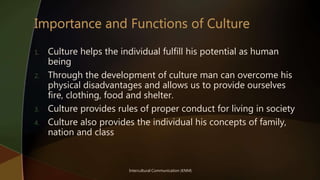
1. Culture helps the individual fulfill his potential as human
being
2. Through the development of culture man can overcome his
physical disadvantages and allows us to provide ourselves
fire, clothing, food and shelter.
3. Culture provides rules of proper conduct for living in society
4. Culture also provides the individual his concepts of family,
nation and class
Intercultural Communication (KNM)
“The central point of cultural relativism
is that in a particular setting certain
traits are right because they work in
that setting while other traits are wrong
because they clash painfully with parts
of culture”
-Hunt, et. Al. 1998
Intercultural Communication (KNM)
Find a partner, observe and describe how your
culture differ from each other such as in the
way you talk, act, behave and others. Discuss in
class the difference in your culture and how it
affects your daily lives.
Intercultural Communication (KNM)
Vega, Violeta A. 2015. Social Dimensions of Education. Adriana
Printing Co. Inc., Cubao, Quezon City

Intercultural communication

  • 1.
    KIRSTINA N. MANALO,MIT, LPT Intercultural Communication (KNM)
  • 2.
    Identify what interculturalcommunication is, its elements and importance to education Explain the role of language Describe the relationship between language and culture Intercultural Communication (KNM)
  • 3.
    Communication is theexchange of information between people, such as by means of speaking, writing, or using a common system of signs or behavior Types of communication:  Verbal refers to the use of language  Non-verbal refers to the use of gestures, facial expression, and other body movements Intercultural Communication (KNM)
  • 4.
    Refers to theeffective communication between people, workers and people of different cultural backgrounds Refers to the communication between people whose cultural perceptions and symbol systems are distinct enough to alter the communication event. Intercultural Communication (KNM)
  • 5.
    Academic field ofstudy which seeks to understand hoe people from different countries and culture behave and communicate and perceive the world around them (intercultural.org) Interpersonal interaction between members of different groups which differ from each other in respect of the knowledge shared by other members and in respect of their linguistic forms of symbolic behavior (Karlfried Knapp). Intercultural Communication (KNM)
  • 6.
    Intercultural Communication (KNM) oPerceptions o Verbal Processes o Nonverbal Processes o Contextual Elements
  • 7.
  • 8.
    Intercultural Communication (KNM) Theways in which cultures employ symbols to portray things and experiences
  • 9.
    Intercultural Communication (KNM) Sharedthoughts and feelings of bodily behavior, time and space
  • 10.
    Intercultural Communication (KNM) Business,education and health care, and personal relationships
  • 11.
  • 12.
    Intercultural Communication (KNM) Increaseawareness of own culture – our cultural identity and cultural background. Helps avoid ethnocentrism Ethnocentrism is the tendency to think that our culture is superior to other cultures
  • 13.
    Intercultural Communication (KNM) Constantdemographic shifts that countries and communities experience result to more immigrants, refugees and undocumented individuals.
  • 14.
    Intercultural Communication (KNM) Tocompete effectively in a global market we must understand how businesses and cultural practices are conducted in other countries
  • 15.
    Intercultural Communication (KNM) Accordingto research, we learn form people who are different than us from those who are similar to us (Sternberg as cited in Ting-Toomey & Chung, 2005)
  • 16.
    Intercultural Communication (KNM) Respectis fundamental to peace, global and interpersonal. If we are at peace with our elves, we will not hold more compassion and caring for others around us (Ting-Toommey &Chung, 2005)
  • 17.
    Intercultural Communication (KNM) Foreffective interaction between teachers and learners especially in cross –cultural encounters Communication can be a useful source of intellectual knowledge and mutual enrichment between culturally diverse students if managed proactively by the teacher. Can lead to frustration, misapprehensions, intercultural conflict and ultimately school failure if communication is not managed For effective transfer of knowledge
  • 18.
  • 19.
    Intercultural Communication (KNM) Notjust speech and writing Gestures, glances, slight changes in the tone of voice and other auxiliary communication devices to alter or emphasize what we say or do.
  • 20.
    Intercultural Communication (KNM) Abstractsystem of word meaning and symbols for all aspects of culture Includes speech, written characters, numerals, symbols, and gestures and expressions of non-verbal communication Linguists refers to all auxiliary communication devices as paralanguage.
  • 21.
    Intercultural Communication (KNM) Referredas the language of gestures, expressions and postures Part of redundancy in communication that helps prevent ineffective communication Said to be more important in communication than what is actually said orally  70% of what we communicate while talking Kinesics or body language is the most obvious form of paralanguage.
  • 22.
    Intercultural Communication (KNM) Indirectly,we communicate through signs and symbols such as:  Writing algebraic expressions  Musical scores  Painting  Road signs
  • 23.
    Intercultural Communication (KNM) Alanguage is a system of verbal and, in many cases, written symbols with rules about how those symbols can be strung together to convey more complex meanings. Language enables people to store meaning and experiences to pass this heritage to new generations. Language enables us to transcend the here and now, preserving the past and imagining the future
  • 24.
    Intercultural Communication (KNM) Languageis cultural and universal Without the ability to communicate accumulated wisdom cannot be pass to succeeding generations Man’s language is a reflection of the kind of person he is the family where he comes from Level of education he attained An index to the behavior that is expected from him
  • 25.
  • 26.
    Intercultural Communication (KNM) 1.Phonology 2. Semantics 3. Grammar 4. Pragmatics
  • 27.
    Intercultural Communication (KNM) Refersto the system of sounds that a particular language uses study of speech sounds: the study of the system or pattern of speech sounds used in a particular language or in language in general sound system of language: the system or pattern of speech sounds used in a particular
  • 28.
    Intercultural Communication (KNM) Studyof word meaning and word combinations study of meaning in language: the study of how meaning in language is created by the use and interrelationships of words, phrases, and sentences study of symbols: the study of the relationship between symbols and what they represent
  • 29.
    Intercultural Communication (KNM) Refersto the structure of language through its morphology and syntax rules for language: the system of rules by which words are formed and put together to make sentences particular set of language rules: the rules for speaking or writing a particular language, or an analysis of the rules of a particular aspect of language
  • 30.
    Intercultural Communication (KNM) Concernedwith the rules for the use of appropriate language particular context the branch of linguistics that studies language use rather than language structure
  • 31.
    Intercultural Communication (KNM) Learningof culture takes place through language Collective memory (myths, fables, sayings, ballad, etc), writing, art, and all other media Culture can affect the structure and content of its language then it follows that linguistic diversity derives in part from cultural diversity
  • 32.
    Intercultural Communication (KNM) Therelationship between culture is that the structure for the language determines the way in which speakers of the language view the world The linguistic- relativity hypothesis asserts that language determines thought and therefore culture. In reality language and culture influence each other –Edward Sapir
  • 33.
    Intercultural Communication (KNM) Everysociety has culture, no matter how simple the culture may be, and every human being is cultured in the sense of participating in some culture of or other.
  • 34.
    Intercultural Communication (KNM) Refersto the attitudes, values, customs, and behavior patterns that characterize a social group. Refers to defined standards of desirability, goodness and beauty which serve as broad guideline for social wellbeing
  • 35.
    Intercultural Communication (KNM) 1.Culture is learned 2. Culture is shared by group of people 3. Culture is cumulative 4. Culture changes 5. Culture is dynamic 6. Culture is ideational 7. Culture is diverse 8. Culture gives us permissible behavior patterns
  • 36.
    Intercultural Communication (KNM) Communication •Language • Symbols Cognitive • Ideas • Knowledge • Beliefs • Values • Accounts Behavioral • Norms • Mores • Laws • Folkways • Rituals Material • Tools • Medicines • Books • Transportation • Technologies
  • 37.
    Intercultural Communication (KNM) 1.Enculturation - learning culture of one’s own group 2. Acculturation - learning traits of another culture 3. Assimilation - process wherein individual entirely loses any awareness of his/her previous group identity and takes the culture of another group
  • 38.
    Intercultural Communication (KNM) 1.Culture helps the individual fulfill his potential as human being 2. Through the development of culture man can overcome his physical disadvantages and allows us to provide ourselves fire, clothing, food and shelter. 3. Culture provides rules of proper conduct for living in society 4. Culture also provides the individual his concepts of family, nation and class
  • 39.
    Intercultural Communication (KNM) “Thecentral point of cultural relativism is that in a particular setting certain traits are right because they work in that setting while other traits are wrong because they clash painfully with parts of culture” -Hunt, et. Al. 1998
  • 40.
    Intercultural Communication (KNM) Finda partner, observe and describe how your culture differ from each other such as in the way you talk, act, behave and others. Discuss in class the difference in your culture and how it affects your daily lives.
  • 41.
    Intercultural Communication (KNM) Vega,Violeta A. 2015. Social Dimensions of Education. Adriana Printing Co. Inc., Cubao, Quezon City