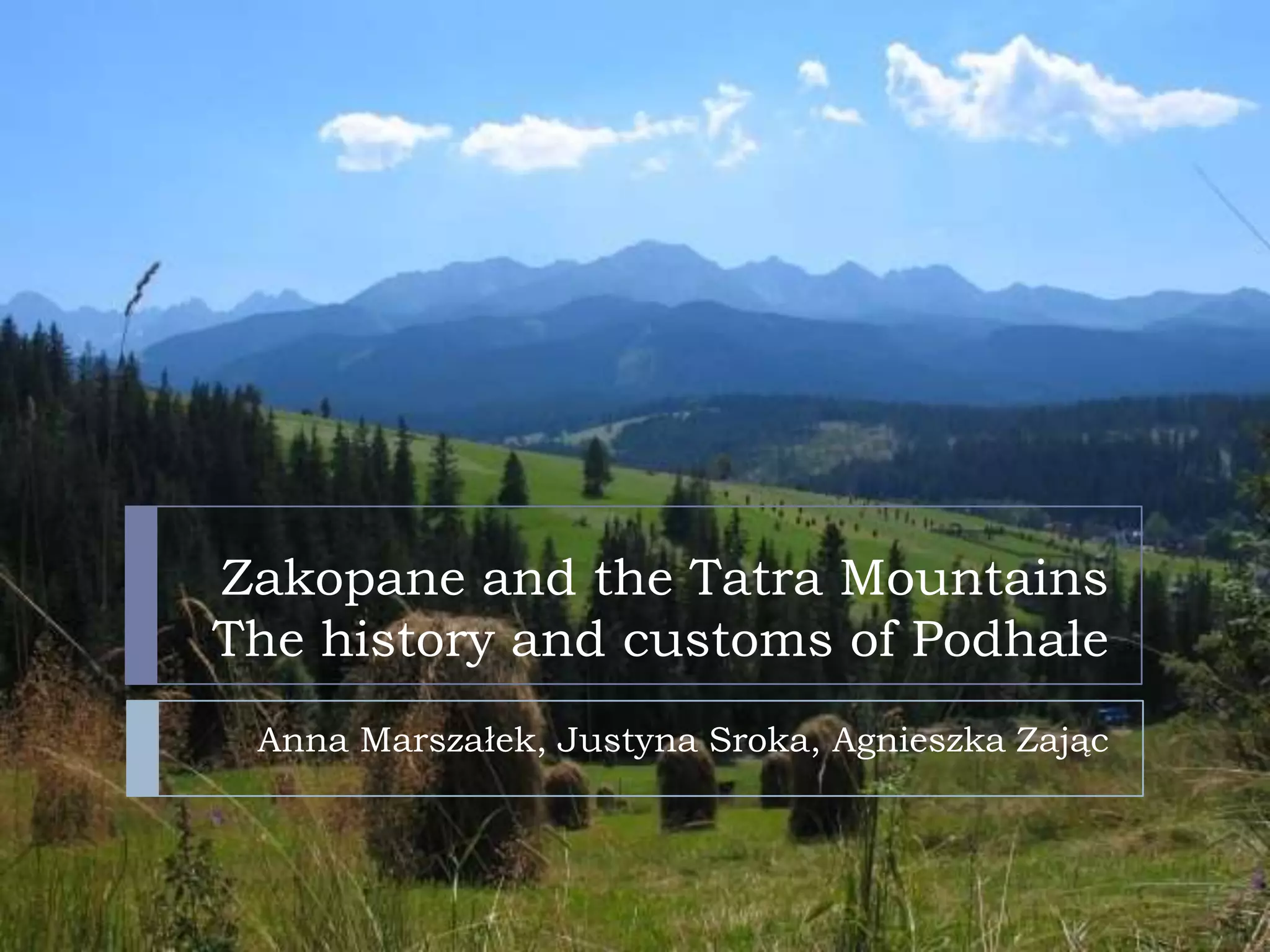
Zakopane and the Tatra Mountains
The history and customs of Podhale
 Anna Marszałek, Justyna Sroka, Agnieszka Zając
Introduction

 The project shows pictures of the
 winter capital of Poland, Zakopane,
 the Tatra mountain region of Podhale
 and its inhabitants górals. It focuses
 on the culture of the Tatra mountain
 region and presents its customs and
 legends.
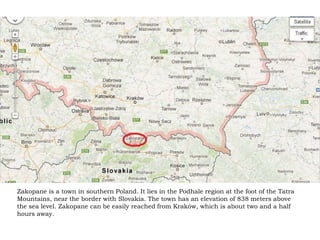
Zakopane is a town in southern Poland. It lies in the Podhale region at the foot of the Tatra
Mountains, near the border with Slovakia. The town has an elevation of 838 meters above
the sea level. Zakopane can be easily reached from Kraków, which is about two and a half
hours away.
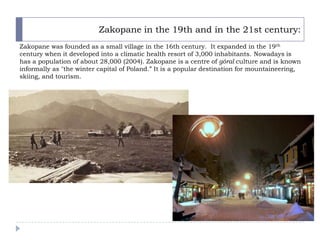
Zakopane in the 19th and in the 21st century:
Zakopane was founded as a small village in the 16th century. It expanded in the 19th
century when it developed into a climatic health resort of 3,000 inhabitants. Nowadays is
has a population of about 28,000 (2004). Zakopane is a centre of góral culture and is known
informally as "the winter capital of Poland.” It is a popular destination for mountaineering,
skiing, and tourism.
Fashion for Zakopane

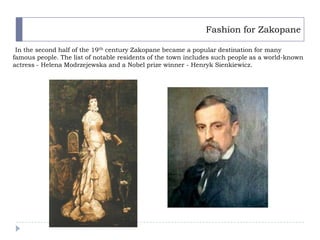
 In the second half of the 19th century Zakopane became a popular destination for many
  Helena Modrzejewska
famous people. The list of notable residents of the town includes such people as a world-known
actress - Helena Modrzejewska and a Nobel prize winner - Henryk Sienkiewicz.
The beauty of the mountains in paintings

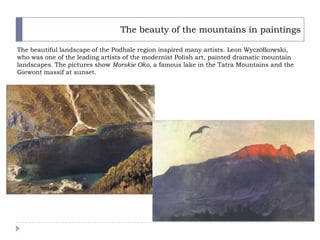
The beautiful landscape of the Podhale region inspired many artists. Leon Wyczółkowski,
who was one of the leading artists of the modernist Polish art, painted dramatic mountain
landscapes. The pictures show Morskie Oko, a famous lake in the Tatra Mountains and the
Giewont massif at sunset.
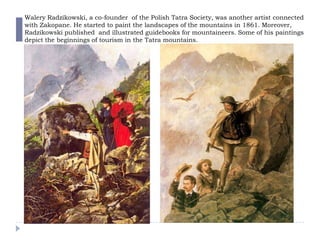
Walery Radzikowski, a co-founder of the Polish Tatra Society, was another artist connected
with Zakopane. He started to paint the landscapes of the mountains in 1861. Moreover,
Radzikowski published and illustrated guidebooks for mountaineers. Some of his paintings
depict the beginnings of tourism in the Tatra mountains.
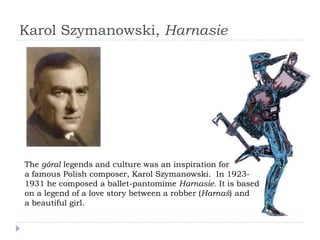
Karol Szymanowski, Harnasie


The góral legends and culture was an inspiration for
a famous Polish composer, Karol Szymanowski. In 1923-
1931 he composed a ballet-pantomime Harnasie. It is based
on a legend of a love story between a robber (Harnaś) and
a beautiful girl.
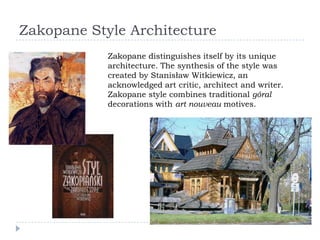
Zakopane Style Architecture
            Zakopane distinguishes itself by its unique
            architecture. The synthesis of the style was
            created by Stanisław Witkiewicz, an
            acknowledged art critic, architect and writer.
            Zakopane style combines traditional góral
            decorations with art nouveau motives.
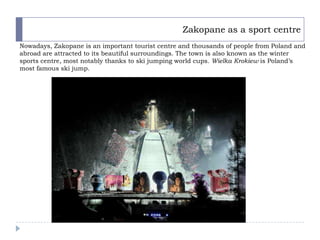
Zakopane as a sport centre
Nowadays, Zakopane is an important tourist centre and thousands of people from Poland and
abroad are attracted to its beautiful surroundings. The town is also known as the winter
sports centre, most notably thanks to ski jumping world cups. Wielka Krokiew is Poland’s
most famous ski jump.
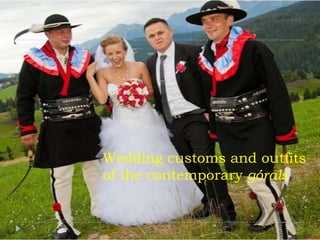
Wedding customs and outfits
of the contemporary górals
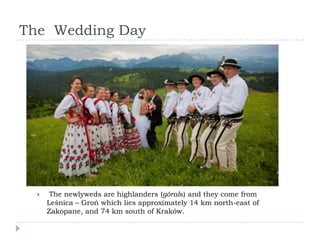
The Wedding Day


      The newlyweds are highlanders (górals) and they come from
      Leśnica – Groń which lies approximately 14 km north-east of
      Zakopane, and 74 km south of Kraków.
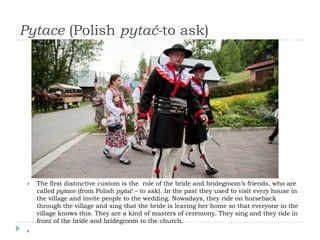
Pytace (Polish pytać-to ask)


    The first distinctive custom is the role of the bride and bridegroom’s friends, who are
     called pytace (from Polish pytać – to ask). In the past they used to visit every house in
     the village and invite people to the wedding. Nowadays, they ride on horseback
     through the village and sing that the bride is leaving her home so that everyone in the
     village knows this. They are a kind of masters of ceremony. They sing and they ride in
     front of the bride and bridegroom to the church.
 
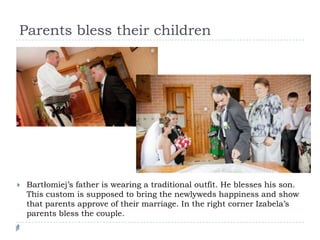
Parents bless their children


   Bartłomiej’s father is wearing a traditional outfit. He blesses his son.
    This custom is supposed to bring the newlyweds happiness and show
    that parents approve of their marriage. In the right corner Izabela’s
    parents bless the couple.

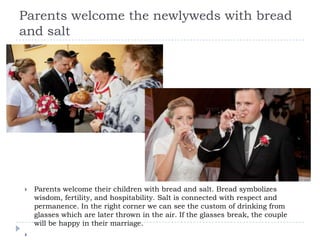
Parents welcome the newlyweds with bread
and salt


   Parents welcome their children with bread and salt. Bread symbolizes
    wisdom, fertility, and hospitability. Salt is connected with respect and
    permanence. In the right corner we can see the custom of drinking from
    glasses which are later thrown in the air. If the glasses break, the couple
    will be happy in their marriage.

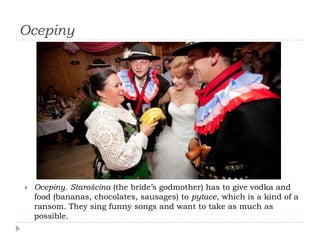
Ocepiny


   Ocepiny. Starościna (the bride’s godmother) has to give vodka and
    food (bananas, chocolates, sausages) to pytace, which is a kind of a
    ransom. They sing funny songs and want to take as much as
    possible.
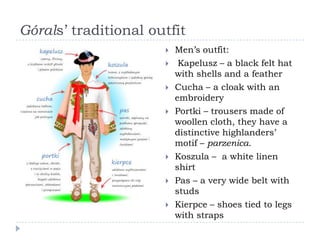
Górals’ traditional outfit
                         Men’s outfit:
                          Kapelusz – a black felt hat
                          with shells and a feather
                         Cucha – a cloak with an
                          embroidery
                         Portki – trousers made of
                          woollen cloth, they have a
                          distinctive highlanders’
                          motif – parzenica.
                         Koszula – a white linen
                          shirt
                         Pas – a very wide belt with
                          studs
                         Kierpce – shoes tied to legs
                          with straps
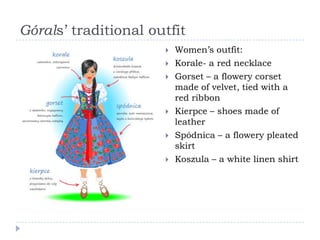
Górals’ traditional outfit
                         Women’s outfit:
                         Korale- a red necklace
                         Gorset – a flowery corset
                          made of velvet, tied with a
                          red ribbon
                         Kierpce – shoes made of
                          leather
                         Spódnica – a flowery pleated
                          skirt
                         Koszula – a white linen shirt
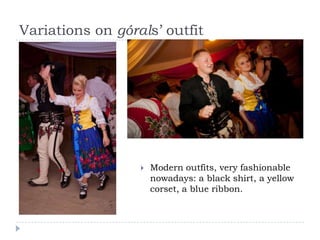
Variations on górals’ outfit


                     Modern outfits, very fashionable
                      nowadays: a black shirt, a yellow
                      corset, a blue ribbon.
Variations on górals’ outfit


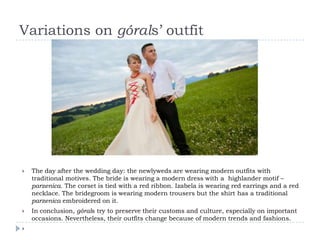
   The day after the wedding day: the newlyweds are wearing modern outfits with
    traditional motives. The bride is wearing a modern dress with a highlander motif –
    parzenica. The corset is tied with a red ribbon. Izabela is wearing red earrings and a red
    necklace. The bridegroom is wearing modern trousers but the shirt has a traditional
    parzenica embroidered on it.
   In conclusion, górals try to preserve their customs and culture, especially on important
    occasions. Nevertheless, their outfits change because of modern trends and fashions.

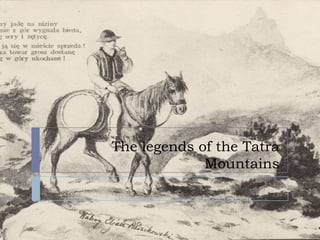
The legends of the Tatra
             Mountains
Janosik, the Polish Robin Hood

                        Janosik was a robber, who with a group of
                        friends plundered, robbed and burnt the
                        houses of the rich. He was said to operate on
                        both sides of the Tatra Mountains, Polish and
                        Slovak and hide out in the forests at the foot of
                        the Tatra Mountains. However, according to the
                        legend, he never harmed the poor in any way;
                        on the contrary, he gave them money and gifts.
                       Folk tales present Janosik as a hero who had
                        supernatural powers given to him by three
                        witches whom he had met when he was young.
                        Once seeing his extraordinary courage, they
                        decided to make him the most famous robber
                        in the whole history, and they gave him magical
                        objects: an alpenstock , a shirt and a belt.
                        Janosik always had the three gifts with him, for
                        this reason he escaped many traps. However,
                        he was betrayed by a girl whom he often
                        visited and was captured. She craftily destroyed
                        the witches’ gifts and then denounced the
                        helpless Janosik to the soldiers.
The legend of Bolesław and his knights
                       When King Boleslaw the Brave (Chrobry) died
                        (11th century), Poland lost a very able and
                        brave ruler, one who had united its lands and
                        created a really great and powerful country.
                        But is Boleslaw dead for ever? Some say ‘no’
                        and they tell a legend about Boleslaw and his
                        Knights.
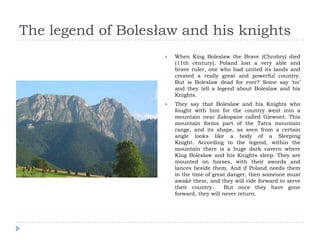
                       They say that Boleslaw and his Knights who
                        fought with him for the country went into a
                        mountain near Zakopane called Giewont. This
                        mountain forms part of the Tatra mountain
                        range, and its shape, as seen from a certain
                        angle looks like a body of a Sleeping
                        Knight. According to the legend, within the
                        mountain there is a huge dark cavern where
                        King Boleslaw and his Knights sleep. They are
                        mounted on horses, with their swords and
                        lances beside them. And if Poland needs them
                        in the time of great danger, then someone must
                        awake them, and they will ride forward to serve
                        their country.      But once they have gone
                        forward, they will never return.
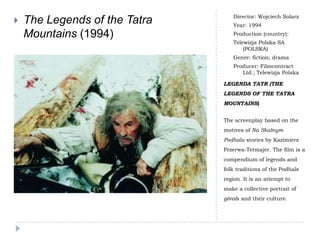
Director: Wojciech Solarz
   The Legends of the Tatra      Year: 1994
    Mountains (1994)              Production (country):
                                  Telewizja Polska SA
                                      (POLSKA)
                                  Genre: fiction; drama
                                  Producer: Filmcontract
                                     Ltd.; Telewizja Polska

                               LEGENDA TATR (THE
                               LEGENDS OF THE TATRA
                               MOUNTAINS)


                               The screenplay based on the
                               motives of Na Skalnym
                               Podhalu stories by Kazimierz
                               Przerwa-Tetmajer. The film is a
                               compendium of legends and
                               folk traditions of the Podhale
                               region. It is an attempt to
                               make a collective portrait of
                               górals and their culture.
Discussion
   1. Describe a region of your country which has its
    own specific culture?

   2. Are the wedding customs shown in the
    presentation similar to those in your country? What
    are the differences?

   3. Do you know any legends or folk tales connected
    with some region of your country?
Sources:
   http://en.wikipedia.org/wiki/Zakopane
   http://www.dobreschronisko.pl/zakopane-historia-i-rozwoj-miasta,d36,a26
   http://z-ne.pl/s,menu,1760,historia_-_zakopane.html
   http://z-ne.pl/s,doc,21549,2,1760,,,.html
   http://www.turystyka.ezakopane.pl/historia.html
   http://www.pinakoteka.zascianek.pl/Wyczolkowski/Wyczolkowski_5.htm
   http://en.wikipedia.org/wiki/Leon_Wycz%C3%B3%C5%82kowski
   http://www.pinakoteka.zascianek.pl/Eljasz_Radzikowski/Eljasz_Radzikowski_bio.htm
   http://www.culture.pl/baza-muzyka-pelna-tresc/-/eo_event_asset_publisher/eAN5/content/karol-szymanowski-harnasie-
    op-55
   http://www.lifebeyondtourism.org/blog/cultural-heritage/regional-architecture-in-poland-zakopane-style-otherwise-
    witkiewicz-style/
   http://en.wikipedia.org/wiki/Zakopane_Style_architecture
   http://www.krykiet.com/janosik_robin_hood.htm
   http://www.summitpost.org/giewont/153793
   http://sales.tvp.pl/en/katalog/fabula/film-kinowy/legenda-tatr

Zakopane and the Tatra Mountains

  • 1.
    Zakopane and theTatra Mountains The history and customs of Podhale Anna Marszałek, Justyna Sroka, Agnieszka Zając
  • 2.
    Introduction  The projectshows pictures of the winter capital of Poland, Zakopane, the Tatra mountain region of Podhale and its inhabitants górals. It focuses on the culture of the Tatra mountain region and presents its customs and legends.
  • 3.
    Zakopane is atown in southern Poland. It lies in the Podhale region at the foot of the Tatra Mountains, near the border with Slovakia. The town has an elevation of 838 meters above the sea level. Zakopane can be easily reached from Kraków, which is about two and a half hours away.
  • 4.
    Zakopane in the19th and in the 21st century: Zakopane was founded as a small village in the 16th century. It expanded in the 19th century when it developed into a climatic health resort of 3,000 inhabitants. Nowadays is has a population of about 28,000 (2004). Zakopane is a centre of góral culture and is known informally as "the winter capital of Poland.” It is a popular destination for mountaineering, skiing, and tourism.
  • 5.
    Fashion for Zakopane In the second half of the 19th century Zakopane became a popular destination for many Helena Modrzejewska famous people. The list of notable residents of the town includes such people as a world-known actress - Helena Modrzejewska and a Nobel prize winner - Henryk Sienkiewicz.
  • 6.
    The beauty ofthe mountains in paintings The beautiful landscape of the Podhale region inspired many artists. Leon Wyczółkowski, who was one of the leading artists of the modernist Polish art, painted dramatic mountain landscapes. The pictures show Morskie Oko, a famous lake in the Tatra Mountains and the Giewont massif at sunset.
  • 7.
    Walery Radzikowski, aco-founder of the Polish Tatra Society, was another artist connected with Zakopane. He started to paint the landscapes of the mountains in 1861. Moreover, Radzikowski published and illustrated guidebooks for mountaineers. Some of his paintings depict the beginnings of tourism in the Tatra mountains.
  • 8.
    Karol Szymanowski, Harnasie Thegóral legends and culture was an inspiration for a famous Polish composer, Karol Szymanowski. In 1923- 1931 he composed a ballet-pantomime Harnasie. It is based on a legend of a love story between a robber (Harnaś) and a beautiful girl.
  • 9.
    Zakopane Style Architecture Zakopane distinguishes itself by its unique architecture. The synthesis of the style was created by Stanisław Witkiewicz, an acknowledged art critic, architect and writer. Zakopane style combines traditional góral decorations with art nouveau motives.
  • 10.
    Zakopane as asport centre Nowadays, Zakopane is an important tourist centre and thousands of people from Poland and abroad are attracted to its beautiful surroundings. The town is also known as the winter sports centre, most notably thanks to ski jumping world cups. Wielka Krokiew is Poland’s most famous ski jump.
  • 11.
    Wedding customs andoutfits of the contemporary górals
  • 12.
    The Wedding Day  The newlyweds are highlanders (górals) and they come from Leśnica – Groń which lies approximately 14 km north-east of Zakopane, and 74 km south of Kraków.
  • 13.
    Pytace (Polish pytać-toask)  The first distinctive custom is the role of the bride and bridegroom’s friends, who are called pytace (from Polish pytać – to ask). In the past they used to visit every house in the village and invite people to the wedding. Nowadays, they ride on horseback through the village and sing that the bride is leaving her home so that everyone in the village knows this. They are a kind of masters of ceremony. They sing and they ride in front of the bride and bridegroom to the church. 
  • 14.
    Parents bless theirchildren  Bartłomiej’s father is wearing a traditional outfit. He blesses his son. This custom is supposed to bring the newlyweds happiness and show that parents approve of their marriage. In the right corner Izabela’s parents bless the couple. 
  • 15.
    Parents welcome thenewlyweds with bread and salt  Parents welcome their children with bread and salt. Bread symbolizes wisdom, fertility, and hospitability. Salt is connected with respect and permanence. In the right corner we can see the custom of drinking from glasses which are later thrown in the air. If the glasses break, the couple will be happy in their marriage. 
  • 16.
    Ocepiny  Ocepiny. Starościna (the bride’s godmother) has to give vodka and food (bananas, chocolates, sausages) to pytace, which is a kind of a ransom. They sing funny songs and want to take as much as possible.
  • 17.
    Górals’ traditional outfit  Men’s outfit:  Kapelusz – a black felt hat with shells and a feather  Cucha – a cloak with an embroidery  Portki – trousers made of woollen cloth, they have a distinctive highlanders’ motif – parzenica.  Koszula – a white linen shirt  Pas – a very wide belt with studs  Kierpce – shoes tied to legs with straps
  • 18.
    Górals’ traditional outfit  Women’s outfit:  Korale- a red necklace  Gorset – a flowery corset made of velvet, tied with a red ribbon  Kierpce – shoes made of leather  Spódnica – a flowery pleated skirt  Koszula – a white linen shirt
  • 19.
    Variations on górals’outfit  Modern outfits, very fashionable nowadays: a black shirt, a yellow corset, a blue ribbon.
  • 20.
    Variations on górals’outfit  The day after the wedding day: the newlyweds are wearing modern outfits with traditional motives. The bride is wearing a modern dress with a highlander motif – parzenica. The corset is tied with a red ribbon. Izabela is wearing red earrings and a red necklace. The bridegroom is wearing modern trousers but the shirt has a traditional parzenica embroidered on it.  In conclusion, górals try to preserve their customs and culture, especially on important occasions. Nevertheless, their outfits change because of modern trends and fashions. 
  • 21.
    The legends ofthe Tatra Mountains
  • 22.
    Janosik, the PolishRobin Hood Janosik was a robber, who with a group of friends plundered, robbed and burnt the houses of the rich. He was said to operate on both sides of the Tatra Mountains, Polish and Slovak and hide out in the forests at the foot of the Tatra Mountains. However, according to the legend, he never harmed the poor in any way; on the contrary, he gave them money and gifts.  Folk tales present Janosik as a hero who had supernatural powers given to him by three witches whom he had met when he was young. Once seeing his extraordinary courage, they decided to make him the most famous robber in the whole history, and they gave him magical objects: an alpenstock , a shirt and a belt. Janosik always had the three gifts with him, for this reason he escaped many traps. However, he was betrayed by a girl whom he often visited and was captured. She craftily destroyed the witches’ gifts and then denounced the helpless Janosik to the soldiers.
  • 23.
    The legend ofBolesław and his knights  When King Boleslaw the Brave (Chrobry) died (11th century), Poland lost a very able and brave ruler, one who had united its lands and created a really great and powerful country. But is Boleslaw dead for ever? Some say ‘no’ and they tell a legend about Boleslaw and his Knights.  They say that Boleslaw and his Knights who fought with him for the country went into a mountain near Zakopane called Giewont. This mountain forms part of the Tatra mountain range, and its shape, as seen from a certain angle looks like a body of a Sleeping Knight. According to the legend, within the mountain there is a huge dark cavern where King Boleslaw and his Knights sleep. They are mounted on horses, with their swords and lances beside them. And if Poland needs them in the time of great danger, then someone must awake them, and they will ride forward to serve their country. But once they have gone forward, they will never return.
  • 24.
    Director: Wojciech Solarz  The Legends of the Tatra Year: 1994 Mountains (1994) Production (country): Telewizja Polska SA (POLSKA) Genre: fiction; drama Producer: Filmcontract Ltd.; Telewizja Polska LEGENDA TATR (THE LEGENDS OF THE TATRA MOUNTAINS) The screenplay based on the motives of Na Skalnym Podhalu stories by Kazimierz Przerwa-Tetmajer. The film is a compendium of legends and folk traditions of the Podhale region. It is an attempt to make a collective portrait of górals and their culture.
  • 25.
    Discussion  1. Describe a region of your country which has its own specific culture?  2. Are the wedding customs shown in the presentation similar to those in your country? What are the differences?  3. Do you know any legends or folk tales connected with some region of your country?
  • 26.
    Sources:  http://en.wikipedia.org/wiki/Zakopane  http://www.dobreschronisko.pl/zakopane-historia-i-rozwoj-miasta,d36,a26  http://z-ne.pl/s,menu,1760,historia_-_zakopane.html  http://z-ne.pl/s,doc,21549,2,1760,,,.html  http://www.turystyka.ezakopane.pl/historia.html  http://www.pinakoteka.zascianek.pl/Wyczolkowski/Wyczolkowski_5.htm  http://en.wikipedia.org/wiki/Leon_Wycz%C3%B3%C5%82kowski  http://www.pinakoteka.zascianek.pl/Eljasz_Radzikowski/Eljasz_Radzikowski_bio.htm  http://www.culture.pl/baza-muzyka-pelna-tresc/-/eo_event_asset_publisher/eAN5/content/karol-szymanowski-harnasie- op-55  http://www.lifebeyondtourism.org/blog/cultural-heritage/regional-architecture-in-poland-zakopane-style-otherwise- witkiewicz-style/  http://en.wikipedia.org/wiki/Zakopane_Style_architecture  http://www.krykiet.com/janosik_robin_hood.htm  http://www.summitpost.org/giewont/153793  http://sales.tvp.pl/en/katalog/fabula/film-kinowy/legenda-tatr