Intercultural Communication
Intercultural communication is a form of global communication.It is used to describe the wide range of communication problems that naturally appear within an organization made up of individuals from different religious, social, ethnic, and educational backgrounds
Intercultural communication  =cross-cultural communicationIt seeks to understand how people from different countries and cultures act, communicate and perceive the world around them.
Cross-cultural communication As a separate notion, it studies situations where people from different cultural backgrounds interact.
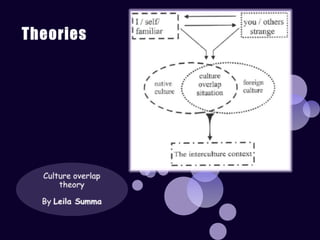
TheoriesCulture overlap theory By Leila Summa
focus on effective outcomes
on accommodation or adaption
on identity negotiation and management
on communication networks
on acculturation and adjustment.Theories focusing on effective outcomes
In a relatively closed social system in which communication among members is unrestricted, the system as a whole will tend to converge over time toward a state of greater cultural uniformity. The system will tend to diverge toward diversity when communication is restrictedTheories focusing on effective outcomesCultural Convergence
Theories focusing on accommodation or adaptionCommunication Accommodation TheoryThis theory focuses on linguistic strategies to decrease or increase communicative distances.Intercultural Adaption This theory is designed to explain how communicators adapt to each other in "purpose-related encounters", at which cultural factors need to be incorporate
Co-cultural Theory
Co-cultural theory looks at the strategic ways in which co-cultural group members communicate with others.Theories focusing on identity negotiation or managementIdentity Management TheoryIdentity NegotiationCultural Identity TheoryDouble-swing model
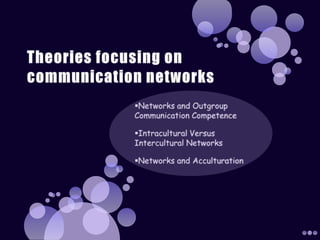
Theories focusing on communication networksNetworks and Outgroup Communication Competence

Intercultural communication shpresa

  • 1.
  • 2.
    Intercultural communication isa form of global communication.It is used to describe the wide range of communication problems that naturally appear within an organization made up of individuals from different religious, social, ethnic, and educational backgrounds
  • 3.
    Intercultural communication =cross-cultural communicationIt seeks to understand how people from different countries and cultures act, communicate and perceive the world around them.
  • 4.
    Cross-cultural communication Asa separate notion, it studies situations where people from different cultural backgrounds interact.
  • 5.
  • 6.
  • 7.
  • 8.
  • 9.
  • 10.
    on acculturation andadjustment.Theories focusing on effective outcomes
  • 11.
    In a relativelyclosed social system in which communication among members is unrestricted, the system as a whole will tend to converge over time toward a state of greater cultural uniformity. The system will tend to diverge toward diversity when communication is restrictedTheories focusing on effective outcomesCultural Convergence
  • 12.
    Theories focusing onaccommodation or adaptionCommunication Accommodation TheoryThis theory focuses on linguistic strategies to decrease or increase communicative distances.Intercultural Adaption This theory is designed to explain how communicators adapt to each other in "purpose-related encounters", at which cultural factors need to be incorporate
  • 13.
  • 14.
    Co-cultural theory looksat the strategic ways in which co-cultural group members communicate with others.Theories focusing on identity negotiation or managementIdentity Management TheoryIdentity NegotiationCultural Identity TheoryDouble-swing model
  • 15.
    Theories focusing oncommunication networksNetworks and Outgroup Communication Competence