Stereotypes about Poland


                    Natalia Biel
                 Tomasz Szydło
                 Katarzyna Wąż
Introduction
The aim of this presentation is to make the
audience acquainted with the very term and,
using the example of our own culture, show them
how differently it is seen by its natives and
immigrants.
What are stereotypes?
Stereotypes are grossly oversimplified and
overgeneralized abstractions about groups of
people and are usually highly inaccurate although
they may contain a grain of truth.
(Pennington 1986: 90)

A stereotype refers to those folk beliefs about the
attributes characterising a social category on
which     there    is   substantial     agreement.
(Mackie 1973: 435; cited by Schneider 2004: 16)
Stereotypes are qualities perceived to be associated
with particular groups or categories of people.
(Schneider 2004: 24)

Stereotypes can be conceived of as processes which
have the function of simplifying judgement and
which occur in situations characterised by little
information, high complexity and pressure of time.
[...] They are thus tools for the management of
one’s environment with more or less distorting
                       effects.
(Schäfer 1994: 461; translated by Franklin)
Common stereotypes about
        Poland
Historical background

- First opinions about Poles: late Middle
  Ages

- After the defeat of the Teutonic Order in
  the battle of Grunwald

- Poles viewed as valiant
- A very numerous social stratum of aristocratic
  knights emerges, the so-called nobility

- They were characterised mainly by great
  patriotism, fighting for the motherland

-   associations: freedom, equality, democracy of
    nobility, honour, courage, manhood, loyalty,
    hospitality

- But also: quarrelsomeness, litigiousness, religious
  intolerance, dissipated lifestyle, rowdiness
- The proclamation of the Martial Law in
  December 1981: large emigration of Poles in
  the 1980’s

- Then, after the decay of Communism: borders
  lifted, more emigrants from Poland

- The beginning of jokes about the Poles being
  notorious for stealing cars
The latest great wave of emigration occurred
after the Polish accession to the European
Union in 2004


And so the story begins…
Poles do not speak
foreign languages.

 Watch the video here:

 http://youtu.be/_JIoyj6JrKc
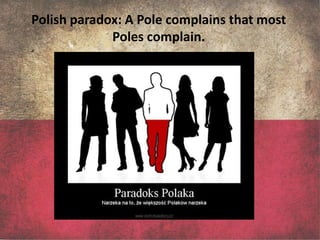
Polish paradox: A Pole complains that most
             Poles complain.
Poles are intolerant and full of anti-Semitism


                                   You slob,
                                You Romanian,
                                     You…
                                  You Jew!!
The Poles abuse alcohol.


Drunk as a Pole (French: Ivre comme un Polonais)
            – a typical French saying
Organised crime and car theft
are part of everyday life in Poland.
A German on   A Russian on   A Pole on
  vacation      vacation     vacation
What does Google suggest?
Let’s make fun of Poles!
Polish roads
A man walked into a bar and asked the
bartender, "Hey, have you heard the latest
Polack joke?" The bartender replied coldly,
"No. And I'm Polish." That's O.K.," said the
man, "I'll talk slow."


How do you sink a Polish battleship?
Put it in water.
- How many Polacks does it take to kidnap a
child?
- Twelve. One to kidnap the child and the
remaining eleven to write a ransom letter.

 The first prize in a certain contest was a
 week in Poland. The second prize was two
 weeks in Poland.

- Why wasn't Christ born in Poland?
- Because they couldn't find three wisemen
and a virgin.
How do we perceive
  Polishness???
Readability of Polish signs…
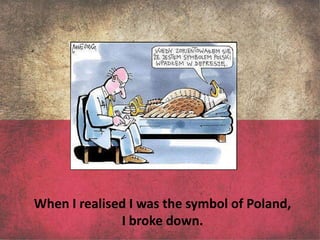
When I realised I was the symbol of Poland,
              I broke down.
- Who are you?
- I’m your little Polish friend, socks and sandals
              I always keep at hand!
Jesus turned water into wine.
Mr Józek turned 30 decagrams of meat
        into one kilo of ham!
UEFA has finally decided what to do with our
National Stadium: it’s ready for rice cultivation
Discussion
1. Try to see your own country with the eyes
   of a foreigner. What stereotypes are they
   likely to create?

2. What are the ways to change a negative
   image of one’s country? What should be
   done to eliminate stereotypes? What can
   you do?

Stereotypes

  • 1.
    Stereotypes about Poland Natalia Biel Tomasz Szydło Katarzyna Wąż
  • 2.
    Introduction The aim ofthis presentation is to make the audience acquainted with the very term and, using the example of our own culture, show them how differently it is seen by its natives and immigrants.
  • 3.
    What are stereotypes? Stereotypesare grossly oversimplified and overgeneralized abstractions about groups of people and are usually highly inaccurate although they may contain a grain of truth. (Pennington 1986: 90) A stereotype refers to those folk beliefs about the attributes characterising a social category on which there is substantial agreement. (Mackie 1973: 435; cited by Schneider 2004: 16)
  • 4.
    Stereotypes are qualitiesperceived to be associated with particular groups or categories of people. (Schneider 2004: 24) Stereotypes can be conceived of as processes which have the function of simplifying judgement and which occur in situations characterised by little information, high complexity and pressure of time. [...] They are thus tools for the management of one’s environment with more or less distorting effects. (Schäfer 1994: 461; translated by Franklin)
  • 5.
  • 6.
    Historical background - Firstopinions about Poles: late Middle Ages - After the defeat of the Teutonic Order in the battle of Grunwald - Poles viewed as valiant
  • 7.
    - A verynumerous social stratum of aristocratic knights emerges, the so-called nobility - They were characterised mainly by great patriotism, fighting for the motherland - associations: freedom, equality, democracy of nobility, honour, courage, manhood, loyalty, hospitality - But also: quarrelsomeness, litigiousness, religious intolerance, dissipated lifestyle, rowdiness
  • 8.
    - The proclamationof the Martial Law in December 1981: large emigration of Poles in the 1980’s - Then, after the decay of Communism: borders lifted, more emigrants from Poland - The beginning of jokes about the Poles being notorious for stealing cars
  • 9.
    The latest greatwave of emigration occurred after the Polish accession to the European Union in 2004 And so the story begins…
  • 10.
    Poles do notspeak foreign languages. Watch the video here: http://youtu.be/_JIoyj6JrKc
  • 11.
    Polish paradox: APole complains that most Poles complain.
  • 12.
    Poles are intolerantand full of anti-Semitism You slob, You Romanian, You… You Jew!!
  • 13.
    The Poles abusealcohol. Drunk as a Pole (French: Ivre comme un Polonais) – a typical French saying
  • 14.
    Organised crime andcar theft are part of everyday life in Poland.
  • 15.
    A German on A Russian on A Pole on vacation vacation vacation
  • 16.
  • 17.
  • 18.
  • 19.
    A man walkedinto a bar and asked the bartender, "Hey, have you heard the latest Polack joke?" The bartender replied coldly, "No. And I'm Polish." That's O.K.," said the man, "I'll talk slow." How do you sink a Polish battleship? Put it in water.
  • 20.
    - How manyPolacks does it take to kidnap a child? - Twelve. One to kidnap the child and the remaining eleven to write a ransom letter. The first prize in a certain contest was a week in Poland. The second prize was two weeks in Poland. - Why wasn't Christ born in Poland? - Because they couldn't find three wisemen and a virgin.
  • 21.
    How do weperceive Polishness???
  • 23.
  • 24.
    When I realisedI was the symbol of Poland, I broke down.
  • 25.
    - Who areyou? - I’m your little Polish friend, socks and sandals I always keep at hand!
  • 26.
    Jesus turned waterinto wine. Mr Józek turned 30 decagrams of meat into one kilo of ham!
  • 27.
    UEFA has finallydecided what to do with our National Stadium: it’s ready for rice cultivation
  • 28.
    Discussion 1. Try tosee your own country with the eyes of a foreigner. What stereotypes are they likely to create? 2. What are the ways to change a negative image of one’s country? What should be done to eliminate stereotypes? What can you do?