Students Learn Differently-Understanding the Three Learning Styles-
3 Learning StylesVisualTactile/KinestheticAuditory/Verbal
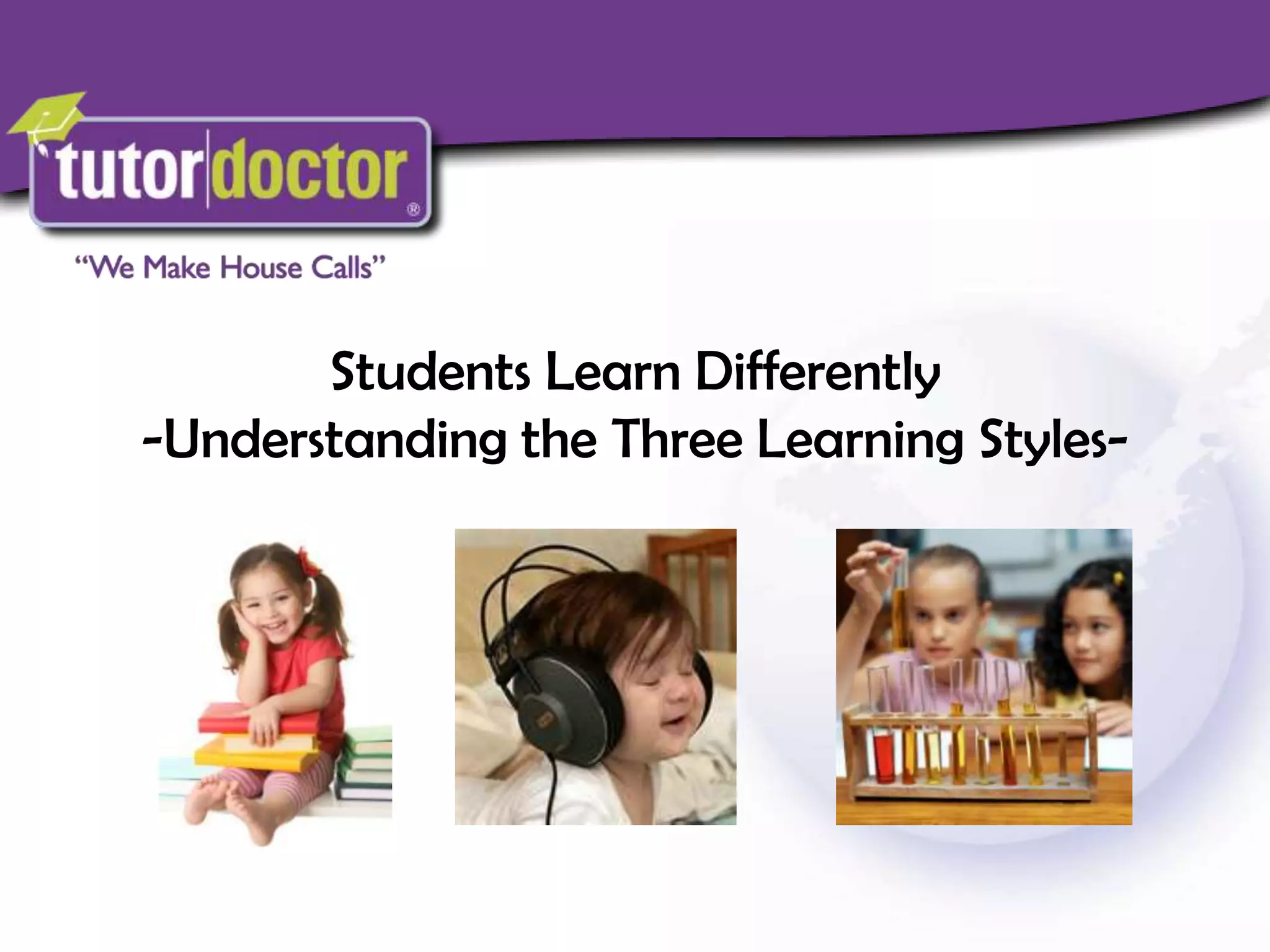
3 Learning StylesVisualLearn best from…viewing both visually and in a written formatvisually gathering and comprehending information blackboard or an overhead projectorHow you study best…textbook information and class notes color coding – highlighters, colored pensFlashcards, diagrams, illustrations & printoutsNot study groups
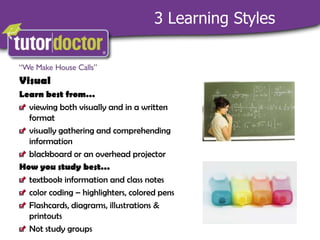
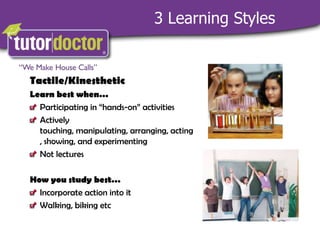
3 Learning StylesTactile/KinestheticLearn best when…Participating in “hands-on” activitiesActively touching, manipulating, arranging, acting, showing, and experimenting Not lecturesHow you study best…Incorporate action into itWalking, biking etc
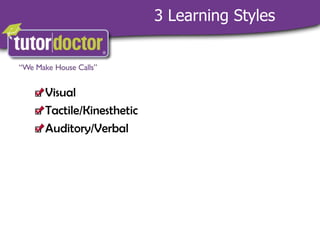
3 Learning StylesAuditory/VerbalLearn best when…Information is given in an oral formatPreference for listening, understanding spoken directions, logic that is explained verballyLectures and group discussionsListening to audio tapeHow you study best…Study with friends Read information out loud
3 Learning StylesWhich of these is your learning style?What about your children?VisualTactile/KinestheticAuditory/Verbal
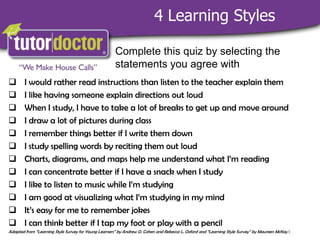
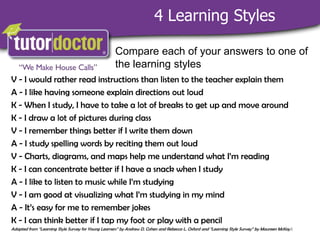
4 Learning StylesComplete this quiz by selecting the statements you agree withI would rather read instructions than listen to the teacher explain them
I like having someone explain directions out loud
When I study, I have to take a lot of breaks to get up and move around
I draw a lot of pictures during class
I remember things better if I write them down

Learning Style Presentation

Editor's Notes

  • #2 Thank you for the opportunity to visit with you this morning!My name is…. And I’m the local owner of Tutor Doctor I’d like to take 10 minutes of your time to share with you the importance of understanding how students learn differently and how this is such an important factor in their academic success.Before we get started could I ask each of you to share your name and your role in the group
  • #3 There are three learning styles that represent how most people learnVisualTactile/KinestheticAuditoryEach student has a dominant learning style.Two students may process the very same information very differently depending on how its presentedAteacher depending on their learning style may spend more time focused in one or more learning styles. Imagine you’re a tactile learning and the course is taught by reading from a book for 30 minutes each day. Imagine what a challenge it is for a teacher to balance teaching styles to meet the personal learning style of 26 kids + and growing
  • #4 Taking a closer look at each of the three learning styles:Raise your hand if you didn’t make every lecture in college but still managed to get good grades? You probably didn’t need to hear the lecture you read the text books.The Visual learning style learns the best from:Viewing information both visually and in a written format. It works best for a VLwhen a teacher uses the blackboard or an overhead projector. If the most important parts of a lecture are put into a bulletin format or used in an outline, a visual learner will find it much easier to follow along. Textbook information and class notes will be a great way for a VL to study and when trying to retain information or remember something, a VL can "see" it or picture it in their mind. If you are a visual learner think about how important taking good notes might be!Of the four learning styles, the VL will want to use color coding to help them retain information from books or notes. Summarizing important information from your notes or textbook using a Highlighter or colored pens is a great way for the VL to absorb information. A VL might also try flashcards, diagrams, illustrations and print-outs to aid in studying.
  • #5 The second learning styles is tactile/kinesthetic.Raise your hand if your favorite class was science labs, woodshop or PE?This learner enjoys "hands on" activities in the classroom. Actively touching, manipulating, arranging, acting, showing, and experimenting with various physical approaches by experiencing first-handAny type of lab setting or field work will help this type of learner to understand the information given. Instructor's that provide their students with demonstrations, presentations or student learning experiences will be helping the tactile/kinesthetic person learn. Lectures might be hard for this person to sit through, and that's why it's important for them to sit in the front and take notes. Spelling shouldn't be a concern when you're writing notes and you should write down important words you here or draw pictures to depict them. When you're studying, try incorporating action into it- read when you're on the exercise bike or walking back and forth while reciting information.
  • #6 The last of the three learning styles is auditory/verbalRaise your hand if you did your best when you attended every lecture and studied for tests with other friends or in a study group?The auditory/verbal learner works best when information is given to them in an oral formatTheir preference is listening, understanding spoken directions and following logic that is explained verbally.Lectures and group discussions work wellListening to audio tape information is a good idea too. To study more efficiently, you might want to join a study group or find a person to work with every day for a few hours on certain material. Read information out loud and tape record if possible.
  • #8 Let’s have some fun with a short quiz!Complete this quiz by selecting the statements you agree with
  • #9 Now let’s self evaluate.
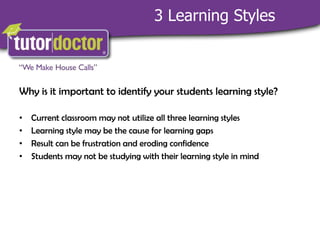
  • #10 So in closing “why is it important to identify your students learning style?Their current classroom may not utilize all three learning stylesDepending on their style a teacher may spend more time in verbal than kinesthetic. If your child is a tactile learning which many kids today are they may not pick up on important pieces of foundational learning.Learning GAPs may exist simply because the teacher spent more time in the student’s least dominant styleHave you ever witnessed your child throw up their arms and say I can’t do that. I had no idea what the teacher was talking about. Once a student understands their learning style they can study in a manner that supports it. Visual learners most effective studying is done with textbook information and class notes color coding – highlighters, colored pensFlashcards, diagrams, illustrations & printoutsVerbal Learners study best withStudy with friends Read information out loudTactile Learners study most effectively byIncorporating action into itWalking, biking etc
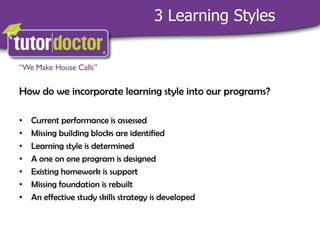
  • #11 How do we incorporate learning style into our programs?The first step in our process is to identify current performance.This can be accomplished by an assessment we conduct or by reviewing existing work from schoolMissing building blocks are identifiedIf a student is struggling with division, what is their proficiency with multiplicationAfter working with a student for one or two sessions their learning style is determinedOur tutors design their session plans based on each student’s learning styleOur first goal is to support each child’s existing homework. With students who are behind missing foundation can make homework very frustrating which over time erodes confidence. Many times students spend 2-3 times longer completing homework than they shouldWhile supporting existing homework we rebuild Missing foundation Lastly, we work with many students who take the time to study but don’t do well on tests. Often its because they are not studying in a manner that is consistent with their learning style. Our tutors work with each student to develop a study skills strategy that works for them.