Sarvajanik Education society
Sarvajanik College of Engineering and Technology
TOWN & COUNTRY PLANNING
M. E. (TCP) - 1, Semester – I
Infrastructure and Transportation Planning (2714803)
Graduation Report on
“PRINCIPLES AND APPROACHES OF
TRAFFIC MANAGEMENT – ITS
(INTELLIGENT TRANSPORTATION
SYSTEM)”
Presented By:-
SHAH YASH S
190420748027
Faculty Incharge:-
Prof.Zarna Gandhi
Prof.Palak Shah
Contents
INTRODUCTION OF TRAFFIC MANAGEMENT
TRAFFIC MANAGEMENT AS PART OF ROAD MANAGEMENT
PURPOSE OF TRAFFIC MANAGEMENT
OBJECTIVES OF TRAFFIC MANAGEMENT
PRINCIPLES OF TRAFFIC MANAGEMENT
INTELLIGENT TRANSPORTATION SYSTEM
NEED OF INTELLIGENT TRANSPORTATION SYSTEM
ITS APPLICATIONS
ELEMENTS OF ITS
CHALLENGES FACED TOWARDS IMPLEMENTING ITS IN
INDIA
MUMBAI URBAN TRANSPORT PROJECT (MUTP)
CONCLUSION
INTRODUCTION OF TRAFFIC
MANAGEMENT
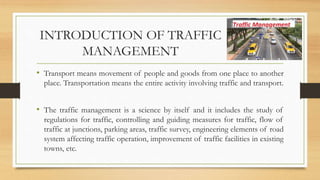
• Transport means movement of people and goods from one place to another
place. Transportation means the entire activity involving traffic and transport.
• The traffic management is a science by itself and it includes the study of
regulations for traffic, controlling and guiding measures for traffic, flow of
traffic at junctions, parking areas, traffic survey, engineering elements of road
system affecting traffic operation, improvement of traffic facilities in existing
towns, etc.
TRAFFIC MANAGEMENT AS PART OF
ROAD MANAGEMENT
• Traffic management measures are aimed at improving the safety and flow of
traffic, reducing traffic emissions and utilizing traffic artery capacity more
effectively.
• Traffic is controlled per intersection, road section or the entire road network.
Traffic control is divided into fixed and variable traffic control.
• Monitoring systems include automatic speed and intersection control,
monitoring transports of hazardous materials and automatic lane-use
monitoring.
PURPOSE OF TRAFFIC MANAGEMENT
• Traffic management plans are used to manage the safety of the public and workers on site.
• All Traffic management plans must be prepared by a qualified person and must include following details:
 The start date and end date of works
 The extent of the proposed work area
 Any TCDs, including temporary devices, that are to be installed, removed or altered
 The license number of the person who prepared the plan.
 Work approval – for any occasion when work will occur on public unleased land including the
implementation of measures included within the Traffic management Plan.
 Approval to temporarily close a public road or use a closed public road.
OBJECTIVES OF TRAFFIC
MANAGEMENT
 To achieve smooth and easy flow of the traffic at intersections:
 To develop the methods for improvement in general and for solving specific problems in particular,
 To have safe, convenient, rapid and economic transport of persons and goods,
 To improve the speeds of vehicles;
 To increase the traffic carrying capacity of roads;
 To make the streets safe for the movements of both, pedestrians and vehicles;
 To reduce the delays in road journeys;
 To reduce the chances of road accidents to a minimum;
 To remove the traffic congestion; etc.
PRINCIPLES OF TRAFFIC
MANAGEMENT
• Safety – Traffic Management plans must control the risks, for both workers and the general
public, associated with work on or adjacent to the public road. These plans need to be mindful
that any feature placed within the road environment has the potential to be a hazard for road
users.
• Accessibility – Traffic Management plans should ensure access to the public road and essential
goods and services is maintained for all road users.
• Amenity – Traffic Management plans should minimize delays to traffic (including pedestrians
and cyclists) and, where practical, maintain the most direct and convenient route between
destinations. There is an expectation that traffic lanes, footpaths, cycle paths, cycle lanes and
shared paths should remain open for use.
• Asset – Traffic Management plans should minimize damage and the risk of damage to the road
asset including natural features such as landscaping and trees.
INTELLIGENT
TRANSPORTATION SYSTEM
• Intelligent Transportation Systems (ITS) is the application of computer,
electronics, and communication technologies and management strategies in
an integrated manner to provide traveler information to increase the safety
and efficiency of the road transportation systems.
• Application of advanced sensors, computers, electronics, and
communications technologies and management strategies in an integrated
manner providing travel information to increase the safety, efficiency,
reliability and sustainability of the transportation system.
INTELLIGENT TRANSPORTATION
SYSTEM USER SERVICES
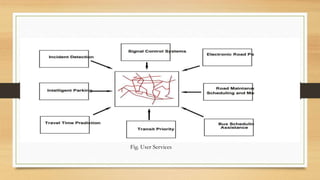
• In order to deploy ITS, a framework is developed highlighting various services the ITS can offer to the users.
• The eight groups are described as follows:
 1. Travel and traffic management
 2. Public transportation operations
 3. Electronic payment
 4. Commercial vehicle operations
 5. Advance vehicle control and safety systems
 6. Emergency management
 7. Information management
 8. Maintenance and construction management
Fig. User Services
NEED OF INTELLIGENT
TRANSPORTATION SYSTEM
• The need of ITS standards can be explained by five aspects:
Product behavior.
Interface.
Performance.
Co-ordination and interaction.
 Benefits to vendors, manufacturers and government.
ITS APPLICATIONS
• Indian traffic can benefit from several possible ITS applications. One set of applications is for traffic
management.
 Incident detection
 Vehicle classification
 Monitoring
 Historical traffic data
 Congestion maps and travel time estimates
 Public transport information
 Accident handling
ELEMENTS OF ITS
1. Traffic Management Center (TMC)
2. Advanced Traffic Management System (ATMS)
3. Variable Message Signs (VMS)
4. Traffic Cameras
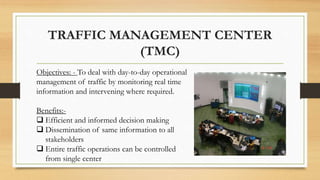
TRAFFIC MANAGEMENT CENTER
(TMC)
Objectives: - To deal with day-to-day operational
management of traffic by monitoring real time
information and intervening where required.
Benefits:-
 Efficient and informed decision making
 Dissemination of same information to all
stakeholders
 Entire traffic operations can be controlled
from single center
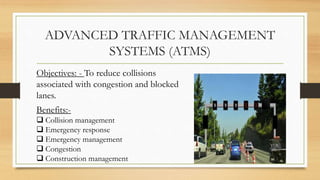
ADVANCED TRAFFIC MANAGEMENT
SYSTEMS (ATMS)
Objectives: - To reduce collisions
associated with congestion and blocked
lanes.
Benefits:-
 Collision management
 Emergency response
 Emergency management
 Congestion
 Construction management
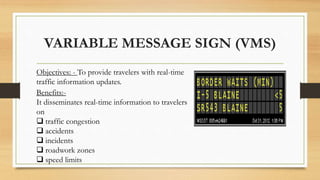
VARIABLE MESSAGE SIGN (VMS)
Objectives: - To provide travelers with real-time
traffic information updates.
Benefits:-
It disseminates real-time information to travelers
on
 traffic congestion
 accidents
 incidents
 roadwork zones
 speed limits
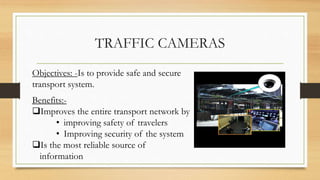
TRAFFIC CAMERAS
Objectives: -Is to provide safe and secure
transport system.
Benefits:-
Improves the entire transport network by
• improving safety of travelers
• Improving security of the system
Is the most reliable source of
information
CHALLENGES FACED TOWARDS
IMPLEMENTING ITS IN INDIA
The foremost challenges/solutions are:
Awareness is needed, but understanding is critical
Sound transportation policy framework and institutional base
Setting up comprehensive interoperability standards
Integration is essential
Budgeting and procurement
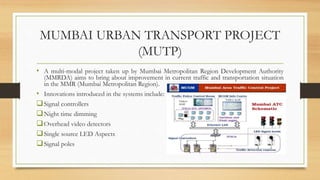
MUMBAI URBAN TRANSPORT PROJECT
(MUTP)
• A multi-modal project taken up by Mumbai Metropolitan Region Development Authority
(MMRDA) aims to bring about improvement in current traffic and transportation situation
in the MMR (Mumbai Metropolitan Region).
• Innovations introduced in the systems include:
Signal controllers
Night time dimming
Overhead video detectors
Single source LED Aspects
Signal poles
CONCLUSION
• Traffic congestion is an important problem in Indian cities. The
characteristics of Indian roads and traffic make the problem interesting to
solve.
• There is scope for evaluating existing ideas in different and challenging traffic
scenarios, innovate new solutions and empirically evaluate ideas in
collaboration with public and private sectors.
• ITS techniques have to undergo adaptation and innovation to suit the
contrasting traffic characteristics of Indian roads.
Thank You

Intelligent Transportation Systems (ITS)

  • 1.
    Sarvajanik Education society SarvajanikCollege of Engineering and Technology TOWN & COUNTRY PLANNING M. E. (TCP) - 1, Semester – I Infrastructure and Transportation Planning (2714803) Graduation Report on “PRINCIPLES AND APPROACHES OF TRAFFIC MANAGEMENT – ITS (INTELLIGENT TRANSPORTATION SYSTEM)” Presented By:- SHAH YASH S 190420748027 Faculty Incharge:- Prof.Zarna Gandhi Prof.Palak Shah
  • 2.
    Contents INTRODUCTION OF TRAFFICMANAGEMENT TRAFFIC MANAGEMENT AS PART OF ROAD MANAGEMENT PURPOSE OF TRAFFIC MANAGEMENT OBJECTIVES OF TRAFFIC MANAGEMENT PRINCIPLES OF TRAFFIC MANAGEMENT INTELLIGENT TRANSPORTATION SYSTEM NEED OF INTELLIGENT TRANSPORTATION SYSTEM ITS APPLICATIONS ELEMENTS OF ITS CHALLENGES FACED TOWARDS IMPLEMENTING ITS IN INDIA MUMBAI URBAN TRANSPORT PROJECT (MUTP) CONCLUSION
  • 3.
    INTRODUCTION OF TRAFFIC MANAGEMENT •Transport means movement of people and goods from one place to another place. Transportation means the entire activity involving traffic and transport. • The traffic management is a science by itself and it includes the study of regulations for traffic, controlling and guiding measures for traffic, flow of traffic at junctions, parking areas, traffic survey, engineering elements of road system affecting traffic operation, improvement of traffic facilities in existing towns, etc.
  • 4.
    TRAFFIC MANAGEMENT ASPART OF ROAD MANAGEMENT • Traffic management measures are aimed at improving the safety and flow of traffic, reducing traffic emissions and utilizing traffic artery capacity more effectively. • Traffic is controlled per intersection, road section or the entire road network. Traffic control is divided into fixed and variable traffic control. • Monitoring systems include automatic speed and intersection control, monitoring transports of hazardous materials and automatic lane-use monitoring.
  • 5.
    PURPOSE OF TRAFFICMANAGEMENT • Traffic management plans are used to manage the safety of the public and workers on site. • All Traffic management plans must be prepared by a qualified person and must include following details:  The start date and end date of works  The extent of the proposed work area  Any TCDs, including temporary devices, that are to be installed, removed or altered  The license number of the person who prepared the plan.  Work approval – for any occasion when work will occur on public unleased land including the implementation of measures included within the Traffic management Plan.  Approval to temporarily close a public road or use a closed public road.
  • 6.
    OBJECTIVES OF TRAFFIC MANAGEMENT To achieve smooth and easy flow of the traffic at intersections:  To develop the methods for improvement in general and for solving specific problems in particular,  To have safe, convenient, rapid and economic transport of persons and goods,  To improve the speeds of vehicles;  To increase the traffic carrying capacity of roads;  To make the streets safe for the movements of both, pedestrians and vehicles;  To reduce the delays in road journeys;  To reduce the chances of road accidents to a minimum;  To remove the traffic congestion; etc.
  • 7.
    PRINCIPLES OF TRAFFIC MANAGEMENT •Safety – Traffic Management plans must control the risks, for both workers and the general public, associated with work on or adjacent to the public road. These plans need to be mindful that any feature placed within the road environment has the potential to be a hazard for road users. • Accessibility – Traffic Management plans should ensure access to the public road and essential goods and services is maintained for all road users. • Amenity – Traffic Management plans should minimize delays to traffic (including pedestrians and cyclists) and, where practical, maintain the most direct and convenient route between destinations. There is an expectation that traffic lanes, footpaths, cycle paths, cycle lanes and shared paths should remain open for use. • Asset – Traffic Management plans should minimize damage and the risk of damage to the road asset including natural features such as landscaping and trees.
  • 8.
    INTELLIGENT TRANSPORTATION SYSTEM • IntelligentTransportation Systems (ITS) is the application of computer, electronics, and communication technologies and management strategies in an integrated manner to provide traveler information to increase the safety and efficiency of the road transportation systems. • Application of advanced sensors, computers, electronics, and communications technologies and management strategies in an integrated manner providing travel information to increase the safety, efficiency, reliability and sustainability of the transportation system.
  • 9.
    INTELLIGENT TRANSPORTATION SYSTEM USERSERVICES • In order to deploy ITS, a framework is developed highlighting various services the ITS can offer to the users. • The eight groups are described as follows:  1. Travel and traffic management  2. Public transportation operations  3. Electronic payment  4. Commercial vehicle operations  5. Advance vehicle control and safety systems  6. Emergency management  7. Information management  8. Maintenance and construction management
  • 10.
  • 11.
    NEED OF INTELLIGENT TRANSPORTATIONSYSTEM • The need of ITS standards can be explained by five aspects: Product behavior. Interface. Performance. Co-ordination and interaction.  Benefits to vendors, manufacturers and government.
  • 12.
    ITS APPLICATIONS • Indiantraffic can benefit from several possible ITS applications. One set of applications is for traffic management.  Incident detection  Vehicle classification  Monitoring  Historical traffic data  Congestion maps and travel time estimates  Public transport information  Accident handling
  • 13.
    ELEMENTS OF ITS 1.Traffic Management Center (TMC) 2. Advanced Traffic Management System (ATMS) 3. Variable Message Signs (VMS) 4. Traffic Cameras
  • 14.
    TRAFFIC MANAGEMENT CENTER (TMC) Objectives:- To deal with day-to-day operational management of traffic by monitoring real time information and intervening where required. Benefits:-  Efficient and informed decision making  Dissemination of same information to all stakeholders  Entire traffic operations can be controlled from single center
  • 15.
    ADVANCED TRAFFIC MANAGEMENT SYSTEMS(ATMS) Objectives: - To reduce collisions associated with congestion and blocked lanes. Benefits:-  Collision management  Emergency response  Emergency management  Congestion  Construction management
  • 16.
    VARIABLE MESSAGE SIGN(VMS) Objectives: - To provide travelers with real-time traffic information updates. Benefits:- It disseminates real-time information to travelers on  traffic congestion  accidents  incidents  roadwork zones  speed limits
  • 17.
    TRAFFIC CAMERAS Objectives: -Isto provide safe and secure transport system. Benefits:- Improves the entire transport network by • improving safety of travelers • Improving security of the system Is the most reliable source of information
  • 18.
    CHALLENGES FACED TOWARDS IMPLEMENTINGITS IN INDIA The foremost challenges/solutions are: Awareness is needed, but understanding is critical Sound transportation policy framework and institutional base Setting up comprehensive interoperability standards Integration is essential Budgeting and procurement
  • 19.
    MUMBAI URBAN TRANSPORTPROJECT (MUTP) • A multi-modal project taken up by Mumbai Metropolitan Region Development Authority (MMRDA) aims to bring about improvement in current traffic and transportation situation in the MMR (Mumbai Metropolitan Region). • Innovations introduced in the systems include: Signal controllers Night time dimming Overhead video detectors Single source LED Aspects Signal poles
  • 20.
    CONCLUSION • Traffic congestionis an important problem in Indian cities. The characteristics of Indian roads and traffic make the problem interesting to solve. • There is scope for evaluating existing ideas in different and challenging traffic scenarios, innovate new solutions and empirically evaluate ideas in collaboration with public and private sectors. • ITS techniques have to undergo adaptation and innovation to suit the contrasting traffic characteristics of Indian roads.
  • 21.