PAVEMENT DETERIORATION: CAUSES AND REHABILITATION REG565 - CONSTRUCTION TECHNOLOGY AND INFRASTRUCTURE AMRAN ABD RAHIM - MOHD NASURUDIN HASBULLAH - MOHD NAJIB ABD RASHID AZIRA IBRAHIM - FADZILAH ABU BAKAR PREPARED BY:- PREPARED FOR:- DR HASNIZAM AWANG
Pavement  are designed in many different  types of texture and pattern . The differences between pavements determine the different  location  of implementation such as  road, street, walkway, pathway rural area and urban area.  Some pavements are designed to  cater human need  but some of it designed as an  art and attraction . The role of pavement is to be known as the convenient hardscape of the users for walking and provide spaces for human outdoor activities.  INTRODUCTION There are different  types of pavements  designed according to the  factors and function  of the place itself. Each of it obtains the  material’s quality  that is needed to be considered in construction which is  physical, mechanical, thermal and electrical of materials . It is essential as it contribute to the  legibility and durability  of the pavement.  PAVEMENT DETERIORATION
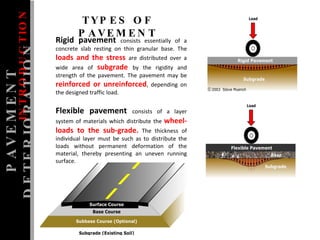
Flexible pavement   consists of a layer system of materials which distribute the  wheel-loads to the sub-grade.  The thickness of individual layer must be such as to distribute the loads without permanent deformation of the material, thereby presenting an uneven running surface.  INTRODUCTION Rigid pavement   consists essentially of a concrete slab resting on thin granular base. The  loads and the stress  are distributed over a wide area of  subgrade  by the rigidity and strength of the pavement. The pavement may be  reinforced or unreinforced , depending on the designed traffic load.  PAVEMENT DETERIORATION TYPES OF PAVEMENT
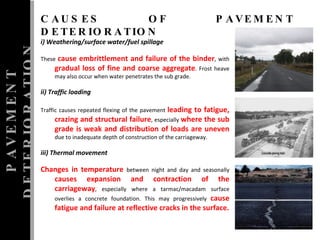
PAVEMENT DETERIORATION CAUSES OF PAVEMENT DETERIORATION i) Weathering/surface water/fuel spillage  These  cause embrittlement and failure of the binder , with  gradual loss of fine and coarse aggregate . Frost heave may also occur when water penetrates the sub grade.    ii) Traffic loading    Traffic causes repeated flexing of the pavement  leading to fatigue, crazing and structural failure , especially  where the sub grade is weak and distribution of loads are uneven  due to inadequate depth of construction of the carriageway.    iii) Thermal movement    Changes in temperature  between night and day and seasonally  causes expansion and contraction of the carriageway , especially where a tarmac/macadam surface overlies a concrete foundation. This may progressively  cause fatigue and failure at reflective cracks in the surface.
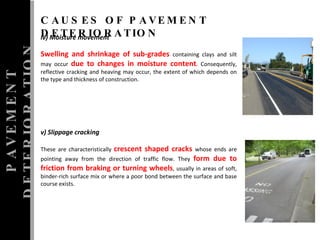
PAVEMENT DETERIORATION CAUSES OF PAVEMENT DETERIORATION iv) Moisture movement  Swelling and shrinkage of sub-grades  containing clays and silt may occur  due to changes in moisture content . Consequently, reflective cracking and heaving may occur, the extent of which depends on the type and thickness of construction.  v) Slippage cracking  These are characteristically  crescent shaped cracks  whose ends are pointing away from the direction of traffic flow. They  form due to friction from braking or turning wheels , usually in areas of soft, binder-rich surface mix or where a poor bond between the surface and base course exists.
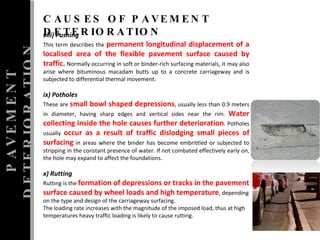
vi) Differential movement flexure  This problem  occurs at boundaries of different construction  which gives rise to adverse stresses.  vii) Reflective joint cracking  This  occurs with composite pavement construction . Thermal or moisture induced movement of a rigid slab foundation causes cracking to develop in the more flexible surfacing over joints and shrinkage cracks. Spalling, which is fragmentation of the pavement either side of the crack, may then occur due to fatigue caused by traffic loading. PAVEMENT DETERIORATION CAUSES OF PAVEMENT DETERIORATION
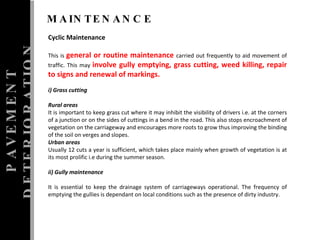
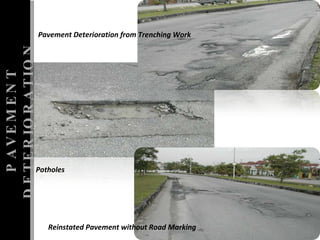
PAVEMENT DETERIORATION CAUSES OF PAVEMENT DETERIORATION viii) Pushing  This term describes the  permanent longitudinal displacement of a localised area of the flexible pavement surface caused by traffic.  Normally occurring in soft or binder-rich surfacing materials, it may also arise where bituminous macadam butts up to a concrete carriageway and is subjected to differential thermal movement.  ix) Potholes  These are  small bowl shaped depressions , usually less than 0.9 meters in diameter, having sharp edges and vertical sides near the rim.  Water collecting inside the hole causes further deterioration . Potholes usually  occur as a result of traffic dislodging small pieces of surfacing  in areas where the binder has become embrittled or subjected to stripping in the constant presence of water.  If not combated effectively early on, the hole may expand to affect the foundations.  x) Rutting  Rutting is the  formation of depressions or tracks in the pavement surface caused by wheel loads and high temperature , depending on the type and design of the carriageway surfacing.  The loading rate increases with the magnitude of the imposed load, thus at high temperatures heavy traffic loading is likely to cause rutting.
PAVEMENT DETERIORATION MAINTENANCE Cyclic Maintenance This is  general or routine maintenance  carried out frequently to aid movement of traffic. This may  involve gully emptying, grass cutting, weed killing, repair to signs and renewal of markings.  i) Grass cutting  Rural areas  It is important to keep grass cut where it may inhibit the visibility of drivers i.e. at the corners of a junction or on the sides of cuttings in a bend in the road. This also stops encroachment of vegetation on the carriageway and encourages more roots to grow thus improving the binding of the soil on verges and slopes.  Urban areas  Usually 12 cuts a year is sufficient, which takes place mainly when growth of vegetation is at its most prolific i.e during the summer season. ii) Gully maintenance  It is essential to keep the drainage system of carriageways operational. The frequency of emptying the gullies is dependant on local conditions such as the presence of dirty industry.
PAVEMENT DETERIORATION MAINTENANCE Structural Maintenance  Structural maintenance is programmed when  required for correcting specific faults according to an identified need.  i) Patching  This includes  repairs to potholes or trench  subsidence in carriageways and footways.  ii) Renewal of Traffic Signs  Signs which have been  damaged by vandalism or traffic accidents , or are merely too old should be replaced.  iii) Renewal of Carriageway Markings  Carriageway markings that have been worn away by traffic must be  reinstated for the safety of road users . This activity may be included as part of a Cyclic maintenance regime. iv) Surface Dressing  Porous surfaces must be  sealed against entry of water,  to prevent the onset of further deterioration or to restore the skidding resistance.  v) Resurfacing of the carriageway  Resurfacing is performed to correct general deterioration of the surface,  deformation, structural failure, surface irregularity, unsatisfactory camber or crossfall.
PAVEMENT DETERIORATION Reinstated Pavement without Road Marking Potholes  Pavement Deterioration from Trenching Work
The pavement physical plays an important role in providing convenience, warning and direction. Therefore, there should be  better management from time to time to keep the pavements in good condition.  Global warming has taken deep impact in nowadays country. Thus phenomenon also influences the pavement performance in term of stiffness. Instead of self consideration toward global issues, designing of pavement should be upgrade for better climate resistance. CONCLUSION CONCLUSION
William D.O. Patterson 1987,  Road Deterioration and Maintenance Effects, The John Hopkin University Press  1990,  Roadwork Standard:-Technical Report, Austroads  2002,  Guidelines For Works Related To Public Utility Installations Within The Road Reserve, Road Engineering Association of Malaysia, Shah Alam  Nicholas J. Garber 1997,  Traffic and Highway Engineering, PWS Publishing Company, Massachusetts  Paul H. Wright 1987,  Highway Engineering – Fifth Edition, John Wiley & Sons Inc, Canada  1995,  Longman Dictionary of Contemporary English, Longman Group Ltd, England  Transport ~ The Road, viewed 14 April 2004,  http://www.abcmalaysia.com/tour_malaysia/trnprt_road.htm  Road Network, viewed 14 April 2004,  http://www.jkr.gov.my/jln/hari-jkr/Road8.htm  110 Leong Weng Wah University of Southern Queensland Research Project 0050012473 ENG 4111/4112  Roads Administration and Maintenance, viewed 14 April 2004,  http://www.jkr.gov.my/jln/hari-jkr/Road12.htm  REFERENCES REFERENCES

Pavement Deterioration

  • 1.
    PAVEMENT DETERIORATION: CAUSESAND REHABILITATION REG565 - CONSTRUCTION TECHNOLOGY AND INFRASTRUCTURE AMRAN ABD RAHIM - MOHD NASURUDIN HASBULLAH - MOHD NAJIB ABD RASHID AZIRA IBRAHIM - FADZILAH ABU BAKAR PREPARED BY:- PREPARED FOR:- DR HASNIZAM AWANG
  • 2.
    Pavement aredesigned in many different types of texture and pattern . The differences between pavements determine the different location of implementation such as road, street, walkway, pathway rural area and urban area. Some pavements are designed to cater human need but some of it designed as an art and attraction . The role of pavement is to be known as the convenient hardscape of the users for walking and provide spaces for human outdoor activities. INTRODUCTION There are different types of pavements designed according to the factors and function of the place itself. Each of it obtains the material’s quality that is needed to be considered in construction which is physical, mechanical, thermal and electrical of materials . It is essential as it contribute to the legibility and durability of the pavement. PAVEMENT DETERIORATION
  • 3.
    Flexible pavement consists of a layer system of materials which distribute the wheel-loads to the sub-grade. The thickness of individual layer must be such as to distribute the loads without permanent deformation of the material, thereby presenting an uneven running surface. INTRODUCTION Rigid pavement consists essentially of a concrete slab resting on thin granular base. The loads and the stress are distributed over a wide area of subgrade by the rigidity and strength of the pavement. The pavement may be reinforced or unreinforced , depending on the designed traffic load. PAVEMENT DETERIORATION TYPES OF PAVEMENT
  • 4.
    PAVEMENT DETERIORATION CAUSESOF PAVEMENT DETERIORATION i) Weathering/surface water/fuel spillage These cause embrittlement and failure of the binder , with gradual loss of fine and coarse aggregate . Frost heave may also occur when water penetrates the sub grade.   ii) Traffic loading   Traffic causes repeated flexing of the pavement leading to fatigue, crazing and structural failure , especially where the sub grade is weak and distribution of loads are uneven due to inadequate depth of construction of the carriageway.   iii) Thermal movement   Changes in temperature between night and day and seasonally causes expansion and contraction of the carriageway , especially where a tarmac/macadam surface overlies a concrete foundation. This may progressively cause fatigue and failure at reflective cracks in the surface.
  • 5.
    PAVEMENT DETERIORATION CAUSESOF PAVEMENT DETERIORATION iv) Moisture movement Swelling and shrinkage of sub-grades containing clays and silt may occur due to changes in moisture content . Consequently, reflective cracking and heaving may occur, the extent of which depends on the type and thickness of construction. v) Slippage cracking These are characteristically crescent shaped cracks whose ends are pointing away from the direction of traffic flow. They form due to friction from braking or turning wheels , usually in areas of soft, binder-rich surface mix or where a poor bond between the surface and base course exists.
  • 6.
    vi) Differential movementflexure This problem occurs at boundaries of different construction which gives rise to adverse stresses. vii) Reflective joint cracking This occurs with composite pavement construction . Thermal or moisture induced movement of a rigid slab foundation causes cracking to develop in the more flexible surfacing over joints and shrinkage cracks. Spalling, which is fragmentation of the pavement either side of the crack, may then occur due to fatigue caused by traffic loading. PAVEMENT DETERIORATION CAUSES OF PAVEMENT DETERIORATION
  • 7.
    PAVEMENT DETERIORATION CAUSESOF PAVEMENT DETERIORATION viii) Pushing This term describes the permanent longitudinal displacement of a localised area of the flexible pavement surface caused by traffic. Normally occurring in soft or binder-rich surfacing materials, it may also arise where bituminous macadam butts up to a concrete carriageway and is subjected to differential thermal movement. ix) Potholes These are small bowl shaped depressions , usually less than 0.9 meters in diameter, having sharp edges and vertical sides near the rim. Water collecting inside the hole causes further deterioration . Potholes usually occur as a result of traffic dislodging small pieces of surfacing in areas where the binder has become embrittled or subjected to stripping in the constant presence of water. If not combated effectively early on, the hole may expand to affect the foundations. x) Rutting Rutting is the formation of depressions or tracks in the pavement surface caused by wheel loads and high temperature , depending on the type and design of the carriageway surfacing. The loading rate increases with the magnitude of the imposed load, thus at high temperatures heavy traffic loading is likely to cause rutting.
  • 8.
    PAVEMENT DETERIORATION MAINTENANCECyclic Maintenance This is general or routine maintenance carried out frequently to aid movement of traffic. This may involve gully emptying, grass cutting, weed killing, repair to signs and renewal of markings. i) Grass cutting Rural areas It is important to keep grass cut where it may inhibit the visibility of drivers i.e. at the corners of a junction or on the sides of cuttings in a bend in the road. This also stops encroachment of vegetation on the carriageway and encourages more roots to grow thus improving the binding of the soil on verges and slopes. Urban areas Usually 12 cuts a year is sufficient, which takes place mainly when growth of vegetation is at its most prolific i.e during the summer season. ii) Gully maintenance It is essential to keep the drainage system of carriageways operational. The frequency of emptying the gullies is dependant on local conditions such as the presence of dirty industry.
  • 9.
    PAVEMENT DETERIORATION MAINTENANCEStructural Maintenance Structural maintenance is programmed when required for correcting specific faults according to an identified need. i) Patching This includes repairs to potholes or trench subsidence in carriageways and footways. ii) Renewal of Traffic Signs Signs which have been damaged by vandalism or traffic accidents , or are merely too old should be replaced. iii) Renewal of Carriageway Markings Carriageway markings that have been worn away by traffic must be reinstated for the safety of road users . This activity may be included as part of a Cyclic maintenance regime. iv) Surface Dressing Porous surfaces must be sealed against entry of water, to prevent the onset of further deterioration or to restore the skidding resistance. v) Resurfacing of the carriageway Resurfacing is performed to correct general deterioration of the surface, deformation, structural failure, surface irregularity, unsatisfactory camber or crossfall.
  • 10.
    PAVEMENT DETERIORATION ReinstatedPavement without Road Marking Potholes Pavement Deterioration from Trenching Work
  • 11.
    The pavement physicalplays an important role in providing convenience, warning and direction. Therefore, there should be better management from time to time to keep the pavements in good condition. Global warming has taken deep impact in nowadays country. Thus phenomenon also influences the pavement performance in term of stiffness. Instead of self consideration toward global issues, designing of pavement should be upgrade for better climate resistance. CONCLUSION CONCLUSION
  • 12.
    William D.O. Patterson1987, Road Deterioration and Maintenance Effects, The John Hopkin University Press 1990, Roadwork Standard:-Technical Report, Austroads 2002, Guidelines For Works Related To Public Utility Installations Within The Road Reserve, Road Engineering Association of Malaysia, Shah Alam Nicholas J. Garber 1997, Traffic and Highway Engineering, PWS Publishing Company, Massachusetts Paul H. Wright 1987, Highway Engineering – Fifth Edition, John Wiley & Sons Inc, Canada 1995, Longman Dictionary of Contemporary English, Longman Group Ltd, England Transport ~ The Road, viewed 14 April 2004, http://www.abcmalaysia.com/tour_malaysia/trnprt_road.htm Road Network, viewed 14 April 2004, http://www.jkr.gov.my/jln/hari-jkr/Road8.htm 110 Leong Weng Wah University of Southern Queensland Research Project 0050012473 ENG 4111/4112 Roads Administration and Maintenance, viewed 14 April 2004, http://www.jkr.gov.my/jln/hari-jkr/Road12.htm REFERENCES REFERENCES