Established as per the Section 2(f) of the UGC Act, 1956
Approved by AICTE, COA and BCI, New Delhi
Intelligent Transport System:B20EDS723
UNIT.4: ITS Applications
SREENATHA M
3/12/2024
School of Civil Engineering
Established as per the Section 2(f) of the UGC Act, 1956
Approved by AICTE, COA and BCI, New Delhi
ITS Applications
School of Civil Engineering
AY: 2024-2025
Mr.Sreenatha M
sreenatha.m@reva.edu.in
Established as per the Section 2(f) of the UGC Act, 1956
Approved by AICTE, COA and BCI, New Delhi
Intelligent Transport System:B20EDS723
7th
Semester: Academic Year: 2024-2025
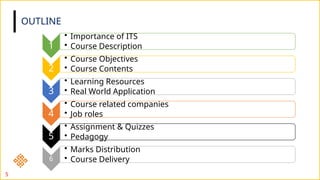
OUTLINE
1
• Importance of ITS
• Course Description
2
• Course Objectives
• Course Contents
3
• Learning Resources
• Real World Application
4
• Course related companies
• Job roles
5
• Assignment & Quizzes
• Pedagogy
6
• Marks Distribution
• Course Delivery
5
Established as per the Section 2(f) of the UGC Act, 1956
Approved by AICTE, COA and BCI, New Delhi
Introduction Class: Importance of ITS
6
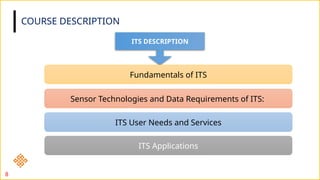
COURSE DESCRIPTION
ITS DESCRIPTION
Fundamentals of ITS
Sensor Technologies and Data Requirements of ITS:
ITS User Needs and Services
ITS Applications
8
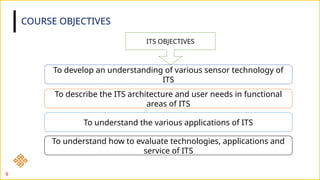
COURSE OBJECTIVES
ITS OBJECTIVES
To develop an understanding of various sensor technology of
ITS
To describe the ITS architecture and user needs in functional
areas of ITS
To understand the various applications of ITS
To understand how to evaluate technologies, applications and
service of ITS
9
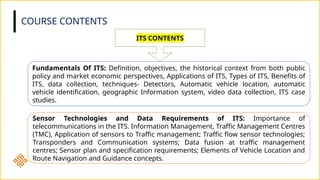
COURSE CONTENTS
ITS CONTENTS
Fundamentals Of ITS: Definition, objectives, the historical context from both public
policy and market economic perspectives, Applications of ITS, Types of ITS, Benefits of
ITS, data collection, techniques- Detectors, Automatic vehicle location, automatic
vehicle identification, geographic Information system, video data collection, ITS case
studies.
Sensor Technologies and Data Requirements of ITS: Importance of
telecommunications in the ITS. Information Management, Traffic Management Centres
(TMC), Application of sensors to Traffic management; Traffic flow sensor technologies;
Transponders and Communication systems; Data fusion at traffic management
centres; Sensor plan and specification requirements; Elements of Vehicle Location and
Route Navigation and Guidance concepts.
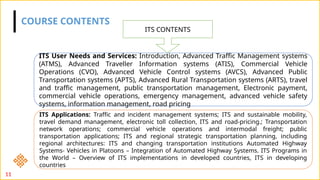
COURSE CONTENTS
ITS CONTENTS
ITS User Needs and Services: Introduction, Advanced Traffic Management systems
(ATMS), Advanced Traveller Information systems (ATIS), Commercial Vehicle
Operations (CVO), Advanced Vehicle Control systems (AVCS), Advanced Public
Transportation systems (APTS), Advanced Rural Transportation systems (ARTS), travel
and traffic management, public transportation management, Electronic payment,
commercial vehicle operations, emergency management, advanced vehicle safety
systems, information management, road pricing
ITS Applications: Traffic and incident management systems; ITS and sustainable mobility,
travel demand management, electronic toll collection, ITS and road-pricing.; Transportation
network operations; commercial vehicle operations and intermodal freight; public
transportation applications; ITS and regional strategic transportation planning, including
regional architectures: ITS and changing transportation institutions Automated Highway
Systems- Vehicles in Platoons – Integration of Automated Highway Systems. ITS Programs in
the World – Overview of ITS implementations in developed countries, ITS in developing
countries
11
UNIT 4: ITS APPLICATIONS
• Traffic and incident management systems;
• ITS and sustainable mobility,
• travel demand management,
• electronic toll collection,
• ITS and road-pricing.;
• Transportation network operations;
• commercial vehicle operations and intermodal freight;
• public transportation applications;
• ITS and regional strategic transportation planning, including regional architectures:
• ITS and changing transportation institutions
• Automated Highway Systems- Vehicles in Platoons – Integration of Automated Highway Systems.
• ITS Programs in the World – Overview of ITS implementations in developed countries,
• ITS in developing countries
12
11
City roads are succumbing to the pressure of a growing urban population. One of the
main application of an intelligent transportation system is smart traffic management.
Some of the other applications are:
• Real-time parking management
• Electronic toll collection
• Emergency vehicle notification systems
• Automated road speed enforcement
• Speed alerts
• RFID in freight transportation
• Variable speed limits
• Dynamic traffic light sequence
• Collision avoidance systems
INTRODUCTION
12
• Traffic Incident Management (TIM) is the response to traffic accidents, incidents and other
unplanned events that occur on the road network, often in potentially dangerous
situations.
• The objective is to handle incidents safely and quickly, to prevent further accidents and
restore traffic conditions back to normal as quickly as possible.
• It requires the deployment of a systematic, planned and coordinated set of response
actions and resources.
• Traffic Incident Management proceeds through a cycle of phases starting with immediate
notice of possible dangers or problems ahead – as soon as an incident occurs – in order to
forewarn drivers and prevent accidents.
TRAFFIC AND INCIDENT MANAGEMENT SYSTEMS
https://www.youtube.com/watch?v=7IUD2k9YKTg
13
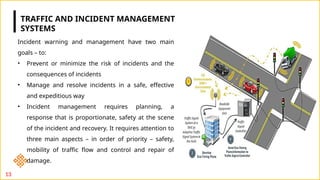
Incident warning and management have two main
goals – to:
• Prevent or minimize the risk of incidents and the
consequences of incidents
• Manage and resolve incidents in a safe, effective
and expeditious way
• Incident management requires planning, a
response that is proportionate, safety at the scene
of the incident and recovery. It requires attention to
three main aspects – in order of priority – safety,
mobility of traffic flow and control and repair of
damage.
TRAFFIC AND INCIDENT MANAGEMENT
SYSTEMS
14
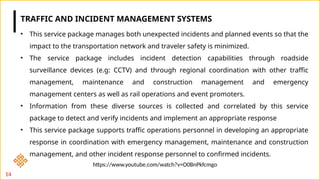
• This service package manages both unexpected incidents and planned events so that the
impact to the transportation network and traveler safety is minimized.
• The service package includes incident detection capabilities through roadside
surveillance devices (e.g: CCTV) and through regional coordination with other traffic
management, maintenance and construction management and emergency
management centers as well as rail operations and event promoters.
• Information from these diverse sources is collected and correlated by this service
package to detect and verify incidents and implement an appropriate response
• This service package supports traffic operations personnel in developing an appropriate
response in coordination with emergency management, maintenance and construction
management, and other incident response personnel to confirmed incidents.
TRAFFIC AND INCIDENT MANAGEMENT SYSTEMS
https://www.youtube.com/watch?v=O0BnPkfcmgo
15
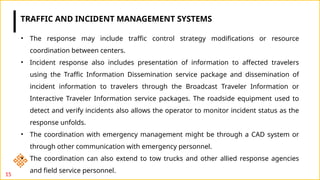
• The response may include traffic control strategy modifications or resource
coordination between centers.
• Incident response also includes presentation of information to affected travelers
using the Traffic Information Dissemination service package and dissemination of
incident information to travelers through the Broadcast Traveler Information or
Interactive Traveler Information service packages. The roadside equipment used to
detect and verify incidents also allows the operator to monitor incident status as the
response unfolds.
• The coordination with emergency management might be through a CAD system or
through other communication with emergency personnel.
• The coordination can also extend to tow trucks and other allied response agencies
and field service personnel.
TRAFFIC AND INCIDENT MANAGEMENT SYSTEMS
16
• Traffic and Incident Management System (TIMS) aims to enhance the efficiency and
effectiveness in managing traffic and transport incidents, and in disseminating traffic
and transport information to the public.
• TIMS has several functions including automatic incident detection, consolidation of
traffic and transport contingency plans, provision of traffic information to
stakeholders, dissemination of traffic and transport information to the public, and
coordination of existing and future traffic control and surveillance systems.
TRAFFIC AND INCIDENT MANAGEMENT SYSTEMS
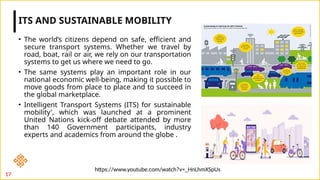
• The world’s citizens depend on safe, efficient and
secure transport systems. Whether we travel by
road, boat, rail or air, we rely on our transportation
systems to get us where we need to go.
• The same systems play an important role in our
national economic well-being, making it possible to
move goods from place to place and to succeed in
the global marketplace.
• Intelligent Transport Systems (ITS) for sustainable
mobility', which was launched at a prominent
United Nations kick-off debate attended by more
than 140 Government participants, industry
experts and academics from around the globe .
ITS AND SUSTAINABLE MOBILITY
17
https://www.youtube.com/watch?v=_HnLhmXSpUs
• “Intelligent Transport Systems play an important role in shaping the future
ways of mobility and the transport sector. We expect that using ITS applications
transport will become more efficient, safer and greener.
• The huge potential and benefits, however, can only be reaped if ITS solutions
are put in place - internationally harmonized as much as possible.
• One of the greatest environmental challenges we face today lies in mobility.
People need a seemingly infinite network of vehicles and transportation
systems to uphold societies and economies. Cars. Busses. Trains. Trucks. And
other modes of transport each leaving their indelible mark on the
environment.
ITS AND SUSTAINABLE MOBILITY
18
https://www.youtube.com/watch?v=x6VyJd9LVpI
• The transport sector has the potential to improve the lives and livelihoods of
billions of people—their health, their environment, their quality of life—and
stabilize climate change.
• But today it is stuck going in the wrong direction, with transport contributing
to gross inequalities in access to economic and social opportunities, rising
numbers of deaths resulting from transport-related accidents, intensive fossil
fuel use, massive emissions of greenhouse gasses, as well as air and noise
pollution.
ITS AND SUSTAINABLE MOBILITY
19
https://www.youtube.com/watch?v=T9j42-V5cr0
• By 2030, passenger traffic will exceed 80,000 billion passenger-kilometers - a
fifty percent increase—and freight volume will grow by 70 percent globally.
• Globally, the number of vehicles on the road is expected to double by 2050.
• In fast-growing places like India, China, sub-Saharan Africa, and Southeast
Asia, billions of people will have higher lifestyle expectations, and new
mobility aspirations.
ITS AND SUSTAINABLE MOBILITY
20
https://www.youtube.com/watch?v=hmS-BbJQ7EU
• Demand management for road transport is one way of reducing congestion.
This can involve relatively straightforward access control techniques or
categorising vehicles (for example by their number plates) to restrict flows
entering a given area.
• More intensive measures include charging for use of the road during
congested periods, or the introduction of special high-occupancy vehicle
(HOV) lanes.
• There seems to be no fixed condition for the use of demand management.
In most cities and regions that suffer from traffic congestion some method
of demand management is undertaken.
• In general terms the severity and directness of the methods taken are
proportional to the congestion problem that the area is facing.
DEMAND MANAGEMENT
21
https://www.youtube.com/watch?v=qd8xy0ozSXI
• Demand management covers all the measures that aim to limit the consequences
of increased congestion and a decreasing level of service on a route.
• This is carried out through actions related to the local mobility policy, such as
improving traffic distribution through time or encouraging users to modal transfer.
• Demand management is close to some traffic management actions that are
mutually complementary. Operational tasks related to demand management will be
integrated with a more global and multi-modal mobility policy with the road being
part of it.
DEMAND MANAGEMENT
22
https://www.youtube.com/watch?v=BYUMYmxU0hk
• A few strategies exist for reducing traffic demand by encouraging changes in
traveler behaviour. Some examples are:
• programmes that promote alternative travel modes, such as using public
transport, ride sharing and associated Active Traffic and Demand
Management (ATDM) services, as well as encouraging non-motorised travel
encouraging flexible work times, telecommuting and the use of satellite
workplaces
• real-time travel information that encourages drivers to use alternate routes,
change journey times or effect other behavioural changes
DEMAND MANAGEMENT
23
• Managing demand can be a cost-effective alternative to increasing capacity, and has the
potential to deliver better environmental outcomes, improved public health and more live
able and attractive cities. A major tool to implement TDM is the Travel Plan, which may be
site-based, organisation-based or area-based.
• Whilst many of the techniques of transportation demand management, and therefore of
travel plans, involve non-technical approaches such as personal coaching and the design
and production of printed material, ITS applications can play a major role in three areas:
• Ride-Sharing and Matching
• Shared-Ownership Vehicle-Sharing
• Demand Responsive Transport
DEMAND MANAGEMENT
24
• In this model the public passenger service is advertised for a set area, set
destination or set origin, and for a particular time window.
• So, it is in some ways more flexible, but also more public, than the Ride-
Sharing and Matching model above. A dispatching system assigns vehicles
to travellers according to the demand.
• The fleet may include buses, minibuses (vans) and taxis, and may serve a
given area with a fixed or variable pattern of routes.
• Vehicles and service patterns can be tailored to the special needs of groups
such as elderly and disabled people: an example service is para-transit fleet
dispatch.
DEMAND MANAGEMENT: DEMAND RESPONSIVE TRANSPORT
25
https://www.youtube.com/watch?v=1faG9jaONVk
26
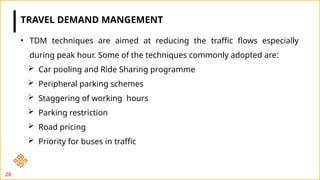
• TDM techniques are aimed at reducing the traffic flows especially
during peak hour. Some of the techniques commonly adopted are:
 Car pooling and Ride Sharing programme
 Peripheral parking schemes
 Staggering of working hours
 Parking restriction
 Road pricing
 Priority for buses in traffic
TRAVEL DEMAND MANGEMENT
27
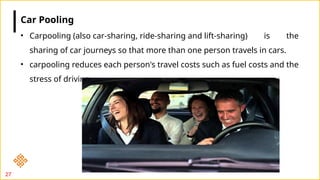
• Carpooling (also car-sharing, ride-sharing and lift-sharing) is the
sharing of car journeys so that more than one person travels in cars.
• carpooling reduces each person's travel costs such as fuel costs and the
stress of driving.
Car Pooling
28
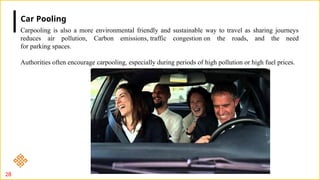
Carpooling is also a more environmental friendly and sustainable way to travel as sharing journeys
reduces air pollution, Carbon emissions, traffic congestion on the roads, and the need
for parking spaces.
Authorities often encourage carpooling, especially during periods of high pollution or high fuel prices.
Car Pooling
29
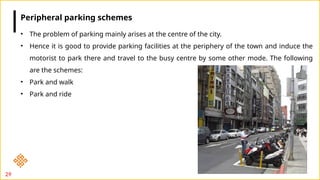
• The problem of parking mainly arises at the centre of the city.
• Hence it is good to provide parking facilities at the periphery of the town and induce the
motorist to park there and travel to the busy centre by some other mode. The following
are the schemes:
• Park and walk
• Park and ride
Peripheral parking schemes
30
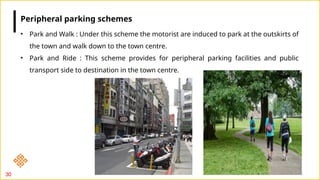
• Park and Walk : Under this scheme the motorist are induced to park at the outskirts of
the town and walk down to the town centre.
• Park and Ride : This scheme provides for peripheral parking facilities and public
transport side to destination in the town centre.
Peripheral parking schemes
31
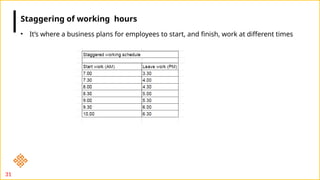
• It’s where a business plans for employees to start, and finish, work at different times
Staggering of working hours
32
• Road Pricing: Road Pricing means that motorists pay directly for driving on a
particular roadway or in a particular area.
• Economists have long advocated Road Pricing as an efficient and equitable way to
pay roadway costs, fund Transportation Programs, and encourage more efficient
transportation.
• Road Pricing has two general objectives:
• Congestion management
• Revenue generation
Road Pricing
33
• Parking Restriction: To prohibit the parking at certain locations and for a period to
ensure safety and convenience. Such locations are:
• Near Intersection
• Narrow streets
• Pedestrian crossings
• Structures like tunnel, bridges.
Parking Restriction
34
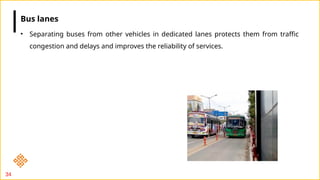
• Separating buses from other vehicles in dedicated lanes protects them from traffic
congestion and delays and improves the reliability of services.
Bus lanes
35
• Traffic and Incident Management System (TIMS) aims to enhance the efficiency and
effectiveness in managing traffic and transport incidents, and in disseminating traffic
and transport information to the public.
• TIMS has several functions including automatic incident detection, consolidation of
traffic and transport contingency plans, provision of traffic information to
stakeholders, dissemination of traffic and transport information to the public, and
coordination of existing and future traffic control and surveillance systems.
TRAFFIC AND INCIDENT MANAGEMENT SYSTEMS
36
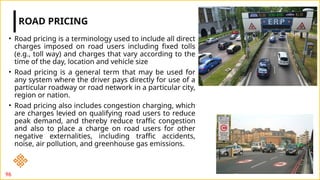
• The general aim of TMM is to reorient the traffic pattern on the existing streets so
that the conflicts between vehicles and pedestrians is reduced.
Some well known traffic management measures are:
• Restrictions on turning movement
• One way streets
• Tidal flow operations
• Exclusive bus lanes
• Closing side- streets
TRAFFIC MANAGEMENT SYSTEMS
37
• At the junction, turning traffic includes left turners and right turners.
• Left turning traffic usually doesn’t obstruct traffic flow through the junctions, but right
turning traffic can cause serious loss of capacity.
• One way of dealing with heavy right turning traffic is to provide separate phase for
right turn in signal system or to provide early cut off or late start arrangement.
Restrictions on turning movement
38
One-way streets
Advantages
• Reduction in the points of conflicts
• Increased capacity
• Increased speed
• Improvement in parking facilities
• Elimination of head on collision
One-way streets
39
One-way streets
Disadvantages
• The actual distances to be covered by drivers get increases.
• The excessive speeds as a result of one-way operation may be hazard to residential
areas.
One-way streets
40
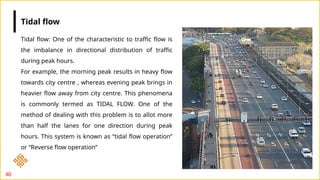
Tidal flow: One of the characteristic to traffic flow is
the imbalance in directional distribution of traffic
during peak hours.
For example, the morning peak results in heavy flow
towards city centre , whereas evening peak brings in
heavier flow away from city centre. This phenomena
is commonly termed as TIDAL FLOW. One of the
method of dealing with this problem is to allot more
than half the lanes for one direction during peak
hours. This system is known as “tidal flow operation”
or “Reverse flow operation”
Tidal flow
41
Advantages
Since the interference from side streets are eliminated, speed increases and journey
time decreases.
Number of accidents get reduced.
In case of too many streets at close by area, it is difficult to formulate signal system.
The side streets can be used as parking of vehicles.
Closing Side Streets
42
Electronic toll collection (ETC) systems charge a toll to users without requiring any action or stopping
by the driver. The system debits the accounts of registered car owners or identifies the license plate for
later billing, without requiring vehicles to stop. ETC lanes improve the speed and efficiency of traffic
flow and save drivers time.
Electronic toll collection (ETC)
43
ETC can be added to any facility through technologies such as a bar code label affixed to the vehicle, a
proximity card, a radio-frequency transponder mounted in the vehicle, license plate recognition, and
global positioning systems (GPS).
Smartphones have opened up new ETC methods by using apps that allow drivers to designate
occupancy/toll eligibility for express lanes or to pay for tolls through PayPal or a bank card account.
Electronic toll collection (ETC)
44
Increases throughput. An open road tolling ETC lane offers a significant increase in capacity over a
manual lane and an automatic coin machine lane.
• Decreases emissions. Researchers have modeled the impact on emissions of using ETC lanes. ETC
lanes reduced hydrocarbons, carbon monoxide, and nitrogen oxide in the study area.
• Is cost effective. ETC lanes are less expensive to build and operate than manual or automatic lanes.
Electronic toll collection (ETC)
45
Objective of the concept
The main objective of this paper ELECTRONIC TOLL COLLECTION SYSTEM is to ease the collecting toll
and reduce traffic and improve service.
The RFID card will be given to the user which contains the digital code, which has the corresponding
details stored in the centralized database system which can be accessed in the relevant office as and
when required.
Electronic toll collection (ETC)
• Electronic toll collection (ETC) is a wireless system to automatically collect the
usage fee or toll charged to vehicles using toll roads, HOV lanes, toll bridges,
and toll tunnels.
• It is a faster alternative which is replacing toll booths, where vehicles must
stop and the driver manually pays the toll with cash or a card.
• In most systems, vehicles using the system are equipped with an automated
radio transponder device.
• When the vehicle passes a roadside toll reader device, a radio signal from
the reader triggers the transponder, which transmits back an identifying
number which registers the vehicle's use of the road, and an electronic
payment system charges the user the toll.
ELECTRONIC TOLL COLLECTION
46
https://www.youtube.com/watch?v=IX0rFjPuNV4
https://www.youtube.com/watch?v=eT0Te0fiYzE
• Typically, the technologies for ETC include vehicle detection, classification
and some form of account identification such as:
• a Radio Frequency (RF) tag
• b Dedicated Short Range Communication (DSRC) tag
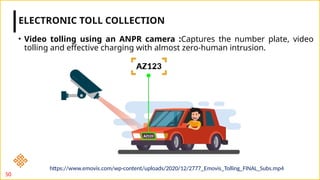
• video tolling using an ANPR camera to read a vehicle number plate with
back-office support to identify the vehicle and its owner)
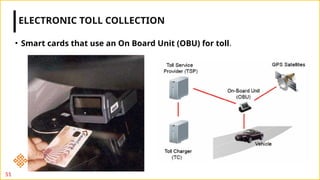
• some ETC systems depend on smart cards that use an On Board Unit (OBU) –
which is a transponder, possibly with a card reader and display – to
communicate with the roadside
ELECTRONIC TOLL COLLECTION
47
https://www.youtube.com/watch?v=NgTJ1IBYTKI
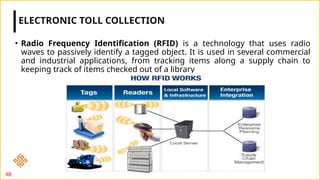
• Radio Frequency Identification (RFID) is a technology that uses radio
waves to passively identify a tagged object. It is used in several commercial
and industrial applications, from tracking items along a supply chain to
keeping track of items checked out of a library
ELECTRONIC TOLL COLLECTION
48
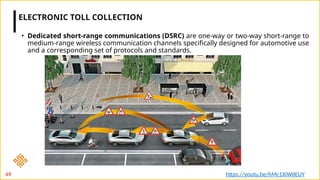
• Dedicated short-range communications (DSRC) are one-way or two-way short-range to
medium-range wireless communication channels specifically designed for automotive use
and a corresponding set of protocols and standards.
ELECTRONIC TOLL COLLECTION
49 https://youtu.be/hMc1XiWdEUY
• Video tolling using an ANPR camera :Captures the number plate, video
tolling and effective charging with almost zero-human intrusion.
ELECTRONIC TOLL COLLECTION
50
https://www.emovis.com/wp-content/uploads/2020/12/2777_Emovis_Tolling_FINAL_Subs.mp4
• Smart cards that use an On Board Unit (OBU) for toll.
ELECTRONIC TOLL COLLECTION
51
52
Automatic Toll Collection: The RFID Readers mounted at toll booth will read the prepaid RFID tags fixed
on vehicles’ windshield and automatically respective amount will be deducted.
If the tag is removed from the windshield then cameras fixed at two sites at toll plaza take snaps of the
front and back number plate.
Since every vehicle registration ID is linked to users account, toll can be deducted from the account
bank directly.
Electronic toll collection (ETC)
53
Japan leads the world in Intelligent Transportation System based on the importance of acceptance of
ITS in Japan, citizens get benefits of deployed ITS applications and maturity of those applications. The
goal of ITS is to provide the real time information about the traffic conditions. Real time information
can be collected using two techniques.
ITS in developing countries
54
South Korea The strength of South Korea in the ITS application makes the world leader in Intelligent
Transportation System. The strengths include the real time traffic information, advanced public
transportation and electronic fare payment. The South Korean’s Expressway Management Systems
collects the traffic information via Vehicle Detection Systems, which is installed on the roadside at 1km
of intervals. Second is Closed Circuit Camera deployed every 2-3 km. and last through probe vehicles.
The data is collected and stored at South Korean’s National Transport Information Center where the
data is disseminated to other users via various communication means.
ITS in developed countries-South Korea
55
Singapore is a world leader in Intelligent Transportation Systems based on the use of probe vehicles to
collect the real time traffic information, road pricing, and deployment of computerized traffic signals
national wide and the use of ITS applications. Singapore’s ITS will deliver the services like location
based and traffic information to the commuters through in-vehicle devices or advances congestion
management systems which will target the pedestrian and variable user on the roads.
ITS in developed countries- Singapore
56
United States Department of Transportation coordinates the ITS through Research and
Innovative Technology Administration (RITA) wing. US-ITS specially focus on Telephonic
Data Dissemination, IntelliDrive, Next Generation 9-1-1, Cooperative Intersection
Collision Avoidance Systems, Congestion Initiative, Integrated Corridor Management
Systems, Clarus Initiative, Emergency Transportation Operations,
ITS in developed countries- United States
57
Australia [13] also leads in the field of Intelligent Transportation System. The main
motive of Australian’s ITS is to improve the traffic scenarios and enhancing the public
safety. The project team of Australian’s ITS recommended to adopt FRAME as its
architecture basis so that future enhancements and additions can be easily adopted
both in Australia and FRAME.
ITS in developed countries- Australia
58
Australia [13] also leads in the field of Intelligent Transportation System. The main motive of
Australian’s ITS is to improve the traffic scenarios and enhancing the public safety. The project team of
Australian’s ITS recommended to adopt FRAME as its architecture basis so that future enhancements
and additions can be easily adopted both in Australia and FRAME.
ITS in developed countries- Australia
• A system architecture for ITS is an “overall framework for ITS” that shows
the major ITS components and their interconnections. A very important
part of the system architecture is the identification and description of the
interfaces between major ITS components.
• These interfaces allow the major components of an overall intelligent
transportation system to communicate with one another and to work
together.
• An ITS system architecture provides a framework for planning, defining,
deploying, and integrating intelligent transportation systems.
• An architecture defines: The user services that ITS systems and
applications are expected to perform.
• The entities where these functions exist.
• Information flows and data flows that connect functions and entities.
WHAT IS AN ITS SYSTEM ARCHITECTURE?
59
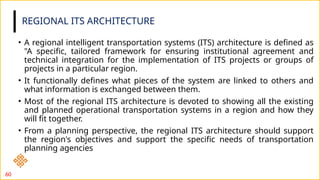
• A regional intelligent transportation systems (ITS) architecture is defined as
"A specific, tailored framework for ensuring institutional agreement and
technical integration for the implementation of ITS projects or groups of
projects in a particular region.
• It functionally defines what pieces of the system are linked to others and
what information is exchanged between them.
• Most of the regional ITS architecture is devoted to showing all the existing
and planned operational transportation systems in a region and how they
will fit together.
• From a planning perspective, the regional ITS architecture should support
the region's objectives and support the specific needs of transportation
planning agencies
REGIONAL ITS ARCHITECTURE
60
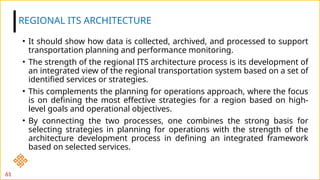
• It should show how data is collected, archived, and processed to support
transportation planning and performance monitoring.
• The strength of the regional ITS architecture process is its development of
an integrated view of the regional transportation system based on a set of
identified services or strategies.
• This complements the planning for operations approach, where the focus
is on defining the most effective strategies for a region based on high-
level goals and operational objectives.
• By connecting the two processes, one combines the strong basis for
selecting strategies in planning for operations with the strength of the
architecture development process in defining an integrated framework
based on selected services.
REGIONAL ITS ARCHITECTURE
61
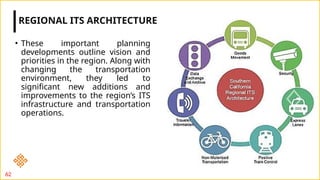
• These important planning
developments outline vision and
priorities in the region. Along with
changing the transportation
environment, they led to
significant new additions and
improvements to the region’s ITS
infrastructure and transportation
operations.
REGIONAL ITS ARCHITECTURE
62
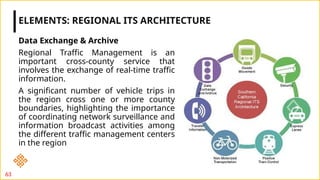
Data Exchange & Archive
Regional Traffic Management is an
important cross-county service that
involves the exchange of real-time traffic
information.
A significant number of vehicle trips in
the region cross one or more county
boundaries, highlighting the importance
of coordinating network surveillance and
information broadcast activities among
the different traffic management centers
in the region
ELEMENTS: REGIONAL ITS ARCHITECTURE
63
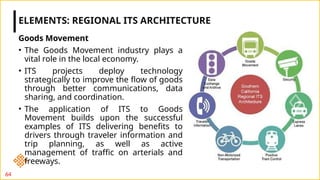
Goods Movement
• The Goods Movement industry plays a
vital role in the local economy.
• ITS projects deploy technology
strategically to improve the flow of goods
through better communications, data
sharing, and coordination.
• The application of ITS to Goods
Movement builds upon the successful
examples of ITS delivering benefits to
drivers through traveler information and
trip planning, as well as active
management of traffic on arterials and
freeways.
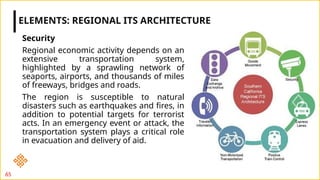
ELEMENTS: REGIONAL ITS ARCHITECTURE
64
Security
Regional economic activity depends on an
extensive transportation system,
highlighted by a sprawling network of
seaports, airports, and thousands of miles
of freeways, bridges and roads.
The region is susceptible to natural
disasters such as earthquakes and fires, in
addition to potential targets for terrorist
acts. In an emergency event or attack, the
transportation system plays a critical role
in evacuation and delivery of aid.
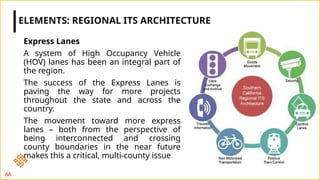
ELEMENTS: REGIONAL ITS ARCHITECTURE
65
Express Lanes
A system of High Occupancy Vehicle
(HOV) lanes has been an integral part of
the region.
The success of the Express Lanes is
paving the way for more projects
throughout the state and across the
country.
The movement toward more express
lanes – both from the perspective of
being interconnected and crossing
county boundaries in the near future
makes this a critical, multi-county issue
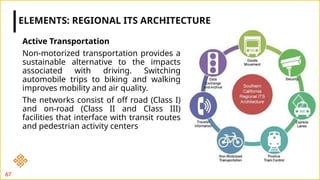
ELEMENTS: REGIONAL ITS ARCHITECTURE
66
Active Transportation
Non-motorized transportation provides a
sustainable alternative to the impacts
associated with driving. Switching
automobile trips to biking and walking
improves mobility and air quality.
The networks consist of off road (Class I)
and on-road (Class II and Class III)
facilities that interface with transit routes
and pedestrian activity centers
ELEMENTS: REGIONAL ITS ARCHITECTURE
67
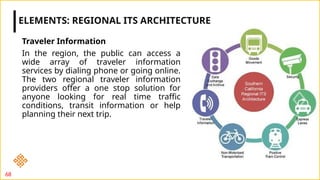
Traveler Information
In the region, the public can access a
wide array of traveler information
services by dialing phone or going online.
The two regional traveler information
providers offer a one stop solution for
anyone looking for real time traffic
conditions, transit information or help
planning their next trip.
ELEMENTS: REGIONAL ITS ARCHITECTURE
68
AUTOMATED HIGHWAY SYSTEMS
69
• The Automated Highway System (AHS) concept defines a new
relationship between vehicles and the highway infrastructure.
• AHS refers to a set of designated lanes on a limited access
roadway where specially equipped vehicles are operated under
completely automatic control.
• AHS uses vehicle and highway control technologies that shift
driving functions from the driver/operator to the vehicle.
• Throttle, steering, and braking are automatically controlled to
provide safer and more convenient travel.
AUTOMATED HIGHWAY SYSTEMS
70
• Throttle, steering, and braking are automatically controlled to provide safer and more
convenient travel.
• AHS also uses communication, sensor and obstacle-detection technologies to recognize
and react to external infrastructure conditions.
• The vehicles and highway cooperate to coordinate vehicle movement, avoid obstacles
and improve traffic flow, improving safety and reducing congestion. In sum, the AHS
concept combines on-board vehicle intelligence with a range of intelligent technologies
installed onto existing highway infrastructure and communication technologies that
connect vehicles to highway infrastructure.
AHS BENEFITS
71
• Research has proven that the benefits of AHS on the performance of the
existing transportation system will, over time, be enormous and far-
reaching. Over the long term, traffic congestion will be reduced; safety
will be enhanced to produce a virtually collision-free environment; driving
will be predictable and reliable.
https://www.youtube.com/watch?v=NVxuY5rBvQg
AHS BENEFITS
72
• More vehicles can be accommodated on the highway. The number of vehicles per
hour per lane can be significantly increased as traffic speeds are standardized and
increased and headway distances are decreased.
• Driving safety will be significantly greater than at present. The human error factor
will be removed.
• High-performance driving can be conducted without regard to weather and
environmental conditions. Fog, haze, blowing dirt, low sun angle, rain, snow,
darkness, and other conditions affecting driver visibility (and thus, safety and traffic
flow) will no longer impede progress.
• All drivers using AHS can be safe, efficient drivers. AHS offers enhanced mobility for
people with disabilities, the elderly, and less experienced drivers.
AHS BENEFITS
73
• Fuel consumption and emissions can be reduced. In the short term, these reductions
will be accomplished because start-and-stop driving will be minimized and because
on-board sensors will be monitored to ensure that the vehicle is operating at top
performance. In the long term, the AHS can support future vehicle propulsion/fuel
designs.
• Land can be used more efficiently. Roads will not need to take up as much room, since
AHS facilities should allow for more effective use of the right of way.
• More efficient commercial operations. Commercial trucking can realize better trip
reliability to support "just-in-time" delivery.
• More efficient transit operations. Transit operations can be automated, extending the
flexibility and convenience of the transit option to increase ridership and service.
MAJOR AHS GOALS
74
• The AHS program is designed to influence how and when vehicle-highway
automation will be introduced.
• AHS deployments will be tailored to meet the needs of public, commercial,
transit, and individual travellers in rural and urban communities.
AUTOMATED HIGHWAY SYSTEMS-MAJOR AHS GOALS
75
• Improve safety – reducing fatality, personal injury, pain & suffering, driving stress.
• Save money and optimize investment – max efficiency, integration of services ->
smoother flow, reduction of costs, public – private partnerships.
• Improving accessibility & mobility – smoother traffic flow, better access & outreach to
everyone, more just-in time deliveries.
• Improve environmental efficiencies – reducing emissions, solid base for reliable &
lower cost transit, alternate powered vehicles.
• Create Jobs – stronger national economy, increased research on ITS development,
technology transfer.
MAJOR AHS GOALS
THE MAJOR GOALS ARE TO
1. Improve safety by significantly reducing:
• Fatalities.
• Personal injury.
• Pain and suffering.
• Anxiety and stress of driving
18
THE MAJOR GOALS ARE TO
2. Save money and optimize investment by:
• Maximizing efficiency of the existing infrastructure investment.
• Integrating other ITS services and architecture to achieve smooth traffic flow.
• Using available and near-term applied technology to avoid costs of conventional
highway build-out.
• Developing affordable equipment, vehicles, infrastructure, operations, maintenance,
and user fees.
• Closing the gap on predicted infrastructure needs.
• Using public/private partnerships for shared risk; using the National AHS Consortium
as a global focal point to influence foreign deployment efforts.
• Reducing fuel consumption and costs, maintenance, wear-and-tear, labor costs,
insurance costs, and property damage.
18
THE MAJOR GOALS ARE TO
3. Improve accessibility and mobility by:
• Improving employee on-time performance, resulting in a more effective
work force.
• Facilitating "just-in-time" deliveries.
• Improving public transportation service, increasing customer access, and
expanding service levels, resulting in increased revenue, reduced costs,
and reduced accidents.
• Achieving a smooth traffic flow, reducing delays, travel times, travel time
variability, and driver stress.
• Making driving more accessible to less able drivers.
18
THE MAJOR GOALS ARE TO
4. Improve environmental efficiencies by:
• Reducing emissions per vehicle-mile travelled.
• Providing a solid base for reliable, lower cost transit.
• Providing an efficient base for electric-powered vehicles and alternative
fuel vehicles.
18
THE MAJOR GOALS ARE TO
5. Create jobs by:
• Providing a stronger national economy and increasing global competitiveness.
• Increasing jobs in research and development and in early ITS deployment.
• Facilitating technology transfer (e.g., from military to civilian use).
• Creating new automotive products and new technology-based industry to
compete in the international marketplace.
80
THE FIVE CONCEPT
1. Independent Vehicle Concept:
This concept puts a smart vehicle in the existing infrastructure. In-vehicle technology lets
the vehicle operate automatically with on-board sensors and computers. The vehicle can
use data from roadside systems but does not depend on infrastructure support.
2. Cooperative Concept:
This concept lets smart vehicles communicate with each other, although not with the
infrastructure. With on-board radar, vision, and other sensors, these AHS-equipped vehicles
will be able to communicate with each other and coordinate their driving operations,
thereby achieving best throughput and safety.
3. Infrastructure-Supported Concept:
smart infrastructure can greatly improve the quality of AHS services and better integrate
AHS with local transportation networks. This concept envisions automated vehicles in
dedicated lanes using global information and two-way communication with the smart
infrastructure to support vehicle decision-making and operation.
81
THE FIVE CONCEPT
4.Infrastructure-Assisted Concept:
In this concept, the automated roadside system provides inter-vehicle
coordination during entry, exit, merging, and emergencies. This concept
may provide the greatest throughput benefit; it also may require the
greatest civil infrastructure investment.
5. Adaptable Concept:
his concept acknowledges the fact that AHS implementation will vary by
locality. It envisions the development of a wide range of compatible
standards that leave as many of the specific architecture decisions,
solutions, and deployment progressions as possible to area stakeholders.
82
PLATOONING
83
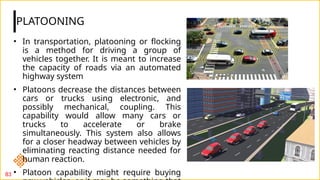
• In transportation, platooning or flocking
is a method for driving a group of
vehicles together. It is meant to increase
the capacity of roads via an automated
highway system
• Platoons decrease the distances between
cars or trucks using electronic, and
possibly mechanical, coupling. This
capability would allow many cars or
trucks to accelerate or brake
simultaneously. This system also allows
for a closer headway between vehicles by
eliminating reacting distance needed for
human reaction.
• Platoon capability might require buying
POTENTIAL BENEFITS
• Greater fuel economy due to reduced air resistance and by
reducing the need for acceleration, deceleration, and stopping
to maintain traffic flow.
• Reduced congestion.
• Substantially shorter commutes during peak periods.
• On longer highway trips, vehicles could be mostly unattended
whilst in following mode.
• Fewer traffic collisions.
84
https://youtu.be/2-WoV8nKQUE
POTENTIAL DISADVANTAGES
85
• Some systems have failed in traffic, as they have been hacked by remote
computers, creating a hazardous situation.
• Drivers would feel less in control of their own driving, being at the hands of
computer software or the lead driver.
• Drivers may be less attentive than usual, and they may not be able to react as
quickly to adverse situations if the software or hardware were to fail.
ITS PROGRAMS IN THE WORLD – OVERVIEW OF ITS
IMPLEMENTATIONS IN DEVELOPED COUNTRIES
86
• In the city of Glasgow, Scotland, Intelligent Transport System gives regular
information to the daily commuters about public buses, timings, seat
availability, the current location of the bus, the time taken to reach a
particular destination, next location of the bus and the density of
passengers inside the bus.
• The Seoul government has designed the routes of its new night bus services
based on an analysis of night-time mobile phone location data. The city
worked with private telecoms companies to analyse calls made between
midnight and 5 am, and matched this data, anonymously and in aggregate,
with billing addresses to determine which routes would experience greater
demand for overnight services.
ITS PROGRAMS IN THE WORLD – OVERVIEW OF ITS
IMPLEMENTATIONS IN DEVELOPED COUNTRIES
87
• The city of New Orleans has optimised the locations of its ambulances on
standby, based on patterns of emergency calls.
• The highly anticipated Sydney Metro, Australia’s biggest public transport
project, will feature a driverless mass-transit system that is anticipated to
nearly double the city’s existing transit capacity. Operations of the 36-km
Northwest line are expected to start in 2019.
ITS PROGRAMS IN THE WORLD – OVERVIEW OF ITS
IMPLEMENTATIONS IN DEVELOPED COUNTRIES
88
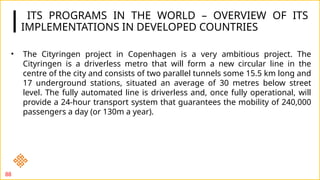
• The Cityringen project in Copenhagen is a very ambitious project. The
Cityringen is a driverless metro that will form a new circular line in the
centre of the city and consists of two parallel tunnels some 15.5 km long and
17 underground stations, situated an average of 30 metres below street
level. The fully automated line is driverless and, once fully operational, will
provide a 24-hour transport system that guarantees the mobility of 240,000
passengers a day (or 130m a year).
ITS SYSTEM ARCHITECTURES FOR DEVELOPING
COUNTRIES
89
• Often in developing economies, development of infrastructure is a higher
priority than traffic management to promote economic development and
the movement of people and goods.
• Road network operations become essential when traffic levels increase to
the point where they have negative impacts – such as congestion, accidents
and vehicle overloading.
• The focus shifts towards making best use of available road capacity in all
conditions, at all times.
• Before embarking on ITS, countries need to have in place some
basic traffic management measures – such as lane markings and
designed junction layouts. It will help to learn from neighbouring
countries’ experience of ITS to identify proven solutions.
ITS SYSTEM ARCHITECTURES FOR DEVELOPING
COUNTRIES
90
• Several common trends affect transport in developing economies which will
have an impact on the scale of Road Network Operations activities and the
scope for ITS deployment:.
• HIGH LEVEL OF ROAD ACCIDENTS
• IMBALANCED TRANSPORT MODE UTILISATION
• INSTITUTIONAL WEAKNESS AND FRAGMENTATION
• INADEQUATE FINANCIAL ARRANGEMENTS
• AVAILABILITY OF ICT RESOURCES
ITS SYSTEM ARCHITECTURES FOR DEVELOPING
COUNTRIES
91
HIGH LEVEL OF ROAD ACCIDENTS
• In many developing economies, road accidents are significantly
higher in relation to traffic volumes, compared to high-income
countries. For example, in 2002, the World Health Organisation
(WHO) reported that 90% of all road traffic deaths occurred in low
and middle-income countries – despite their share of world
vehicle ownership being less than 50%. There are various
contributory factors, including:
• high numbers of vulnerable road users – such as pedestrians,
cyclists, scooters and animal transport – sharing road space with
motor vehicles
• low level of traffic enforcement
ITS SYSTEM ARCHITECTURES FOR DEVELOPING
COUNTRIES
92
IMBALANCED TRANSPORT MODE UTILISATION
In many developing economies, passenger transport is provided as
much by mini buses, taxis and auto-rickshaws – as it is by more
conventional public transport modes, such as buses and rail. For
example, in Egypt:
more than 55% of public transport trips in Cairo are carried by
shared taxis and minibuses compared with the underground metro
and public buses (40%)
trucks transport most freight flows – with little carried by rail, water
or air
ITS SYSTEM ARCHITECTURES FOR DEVELOPING
COUNTRIES
93
INADEQUATE FINANCIAL ARRANGEMENTS
Many developing countries have insufficient funds and are unable to
access satisfactory financing arrangements resulting in lack of
investment in transport facilities, poor cost recovery, and low levels
of private sector investment in transport infrastructure and services.
Governments in some countries also highly subsidise gasoline and
diesel fuels which tends to encourage growth in car ownerships and
personal transport at the expense of higher capacity collective
transport – such as buses.
ITS SYSTEM ARCHITECTURES FOR DEVELOPING
COUNTRIES
94
AVAILABILITY OF ICT RESOURCES
Countries differ in their level of uptake of Information and
Communication Technology (ICT) resources which impacts directly
on deployment of ITS. Low cost telecommunications with wide
geographical coverage for fast and reliable data transmission is a
pre-requisite for ITS –forming part of its basic info-structure.
In some countries, such as Egypt, the ICT infrastructure needs to be
significantly improved and expanded to accommodate large-scale
ITS deployments. In contrast, in a high-growth, high-investment
country, such as China, the level of ITS deployment is enabled by
large investments in transport and ICT resources.
ITS SYSTEM ARCHITECTURES FOR DEVELOPING
COUNTRIES
95
INSTITUTIONAL WEAKNESS AND FRAGMENTATION
Many developing economies are characterised by weak and
fragmented institutions for tackling urban and national transport
problems. Development of ITS will be difficult without putting in
place strong institutional coordination mechanisms to:
• establish transport policies
• resolve organisational issues
• set investment priorities
• identify funding resources for major transportation investments
including ITS measures
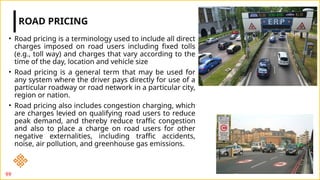
• Road pricing is a terminology used to include all direct
charges imposed on road users including fixed tolls
(e.g., toll way) and charges that vary according to the
time of the day, location and vehicle size
• Road pricing is a general term that may be used for
any system where the driver pays directly for use of a
particular roadway or road network in a particular city,
region or nation.
• Road pricing also includes congestion charging, which
are charges levied on qualifying road users to reduce
peak demand, and thereby reduce traffic congestion
and also to place a charge on road users for other
negative externalities, including traffic accidents,
noise, air pollution, and greenhouse gas emissions.
ROAD PRICING
96
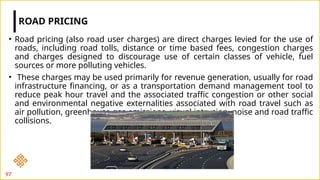
• Road pricing (also road user charges) are direct charges levied for the use of
roads, including road tolls, distance or time based fees, congestion charges
and charges designed to discourage use of certain classes of vehicle, fuel
sources or more polluting vehicles.
• These charges may be used primarily for revenue generation, usually for road
infrastructure financing, or as a transportation demand management tool to
reduce peak hour travel and the associated traffic congestion or other social
and environmental negative externalities associated with road travel such as
air pollution, greenhouse gas emissions, visual intrusion, noise and road traffic
collisions.
ROAD PRICING
97
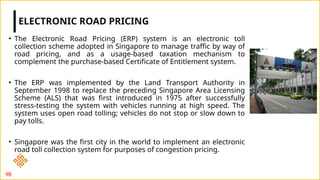
• The Electronic Road Pricing (ERP) system is an electronic toll
collection scheme adopted in Singapore to manage traffic by way of
road pricing, and as a usage-based taxation mechanism to
complement the purchase-based Certificate of Entitlement system.
• The ERP was implemented by the Land Transport Authority in
September 1998 to replace the preceding Singapore Area Licensing
Scheme (ALS) that was first introduced in 1975 after successfully
stress-testing the system with vehicles running at high speed. The
system uses open road tolling; vehicles do not stop or slow down to
pay tolls.
• Singapore was the first city in the world to implement an electronic
road toll collection system for purposes of congestion pricing.
ELECTRONIC ROAD PRICING
98
• Road pricing is a terminology used to include all direct
charges imposed on road users including fixed tolls
(e.g., toll way) and charges that vary according to the
time of the day, location and vehicle size
• Road pricing is a general term that may be used for
any system where the driver pays directly for use of a
particular roadway or road network in a particular city,
region or nation.
• Road pricing also includes congestion charging, which
are charges levied on qualifying road users to reduce
peak demand, and thereby reduce traffic congestion
and also to place a charge on road users for other
negative externalities, including traffic accidents,
noise, air pollution, and greenhouse gas emissions.
ROAD PRICING
99
100

ITS-4.1 Intelligent transportation System

  • 1.
    Established as perthe Section 2(f) of the UGC Act, 1956 Approved by AICTE, COA and BCI, New Delhi Intelligent Transport System:B20EDS723 UNIT.4: ITS Applications SREENATHA M 3/12/2024 School of Civil Engineering
  • 2.
    Established as perthe Section 2(f) of the UGC Act, 1956 Approved by AICTE, COA and BCI, New Delhi ITS Applications School of Civil Engineering AY: 2024-2025 Mr.Sreenatha M sreenatha.m@reva.edu.in
  • 3.
    Established as perthe Section 2(f) of the UGC Act, 1956 Approved by AICTE, COA and BCI, New Delhi Intelligent Transport System:B20EDS723 7th Semester: Academic Year: 2024-2025
  • 4.
    OUTLINE 1 • Importance ofITS • Course Description 2 • Course Objectives • Course Contents 3 • Learning Resources • Real World Application 4 • Course related companies • Job roles 5 • Assignment & Quizzes • Pedagogy 6 • Marks Distribution • Course Delivery 5
  • 5.
    Established as perthe Section 2(f) of the UGC Act, 1956 Approved by AICTE, COA and BCI, New Delhi Introduction Class: Importance of ITS 6
  • 6.
    COURSE DESCRIPTION ITS DESCRIPTION Fundamentalsof ITS Sensor Technologies and Data Requirements of ITS: ITS User Needs and Services ITS Applications 8
  • 7.
    COURSE OBJECTIVES ITS OBJECTIVES Todevelop an understanding of various sensor technology of ITS To describe the ITS architecture and user needs in functional areas of ITS To understand the various applications of ITS To understand how to evaluate technologies, applications and service of ITS 9
  • 8.
    COURSE CONTENTS ITS CONTENTS FundamentalsOf ITS: Definition, objectives, the historical context from both public policy and market economic perspectives, Applications of ITS, Types of ITS, Benefits of ITS, data collection, techniques- Detectors, Automatic vehicle location, automatic vehicle identification, geographic Information system, video data collection, ITS case studies. Sensor Technologies and Data Requirements of ITS: Importance of telecommunications in the ITS. Information Management, Traffic Management Centres (TMC), Application of sensors to Traffic management; Traffic flow sensor technologies; Transponders and Communication systems; Data fusion at traffic management centres; Sensor plan and specification requirements; Elements of Vehicle Location and Route Navigation and Guidance concepts.
  • 9.
    COURSE CONTENTS ITS CONTENTS ITSUser Needs and Services: Introduction, Advanced Traffic Management systems (ATMS), Advanced Traveller Information systems (ATIS), Commercial Vehicle Operations (CVO), Advanced Vehicle Control systems (AVCS), Advanced Public Transportation systems (APTS), Advanced Rural Transportation systems (ARTS), travel and traffic management, public transportation management, Electronic payment, commercial vehicle operations, emergency management, advanced vehicle safety systems, information management, road pricing ITS Applications: Traffic and incident management systems; ITS and sustainable mobility, travel demand management, electronic toll collection, ITS and road-pricing.; Transportation network operations; commercial vehicle operations and intermodal freight; public transportation applications; ITS and regional strategic transportation planning, including regional architectures: ITS and changing transportation institutions Automated Highway Systems- Vehicles in Platoons – Integration of Automated Highway Systems. ITS Programs in the World – Overview of ITS implementations in developed countries, ITS in developing countries 11
  • 10.
    UNIT 4: ITSAPPLICATIONS • Traffic and incident management systems; • ITS and sustainable mobility, • travel demand management, • electronic toll collection, • ITS and road-pricing.; • Transportation network operations; • commercial vehicle operations and intermodal freight; • public transportation applications; • ITS and regional strategic transportation planning, including regional architectures: • ITS and changing transportation institutions • Automated Highway Systems- Vehicles in Platoons – Integration of Automated Highway Systems. • ITS Programs in the World – Overview of ITS implementations in developed countries, • ITS in developing countries 12
  • 11.
    11 City roads aresuccumbing to the pressure of a growing urban population. One of the main application of an intelligent transportation system is smart traffic management. Some of the other applications are: • Real-time parking management • Electronic toll collection • Emergency vehicle notification systems • Automated road speed enforcement • Speed alerts • RFID in freight transportation • Variable speed limits • Dynamic traffic light sequence • Collision avoidance systems INTRODUCTION
  • 12.
    12 • Traffic IncidentManagement (TIM) is the response to traffic accidents, incidents and other unplanned events that occur on the road network, often in potentially dangerous situations. • The objective is to handle incidents safely and quickly, to prevent further accidents and restore traffic conditions back to normal as quickly as possible. • It requires the deployment of a systematic, planned and coordinated set of response actions and resources. • Traffic Incident Management proceeds through a cycle of phases starting with immediate notice of possible dangers or problems ahead – as soon as an incident occurs – in order to forewarn drivers and prevent accidents. TRAFFIC AND INCIDENT MANAGEMENT SYSTEMS https://www.youtube.com/watch?v=7IUD2k9YKTg
  • 13.
    13 Incident warning andmanagement have two main goals – to: • Prevent or minimize the risk of incidents and the consequences of incidents • Manage and resolve incidents in a safe, effective and expeditious way • Incident management requires planning, a response that is proportionate, safety at the scene of the incident and recovery. It requires attention to three main aspects – in order of priority – safety, mobility of traffic flow and control and repair of damage. TRAFFIC AND INCIDENT MANAGEMENT SYSTEMS
  • 14.
    14 • This servicepackage manages both unexpected incidents and planned events so that the impact to the transportation network and traveler safety is minimized. • The service package includes incident detection capabilities through roadside surveillance devices (e.g: CCTV) and through regional coordination with other traffic management, maintenance and construction management and emergency management centers as well as rail operations and event promoters. • Information from these diverse sources is collected and correlated by this service package to detect and verify incidents and implement an appropriate response • This service package supports traffic operations personnel in developing an appropriate response in coordination with emergency management, maintenance and construction management, and other incident response personnel to confirmed incidents. TRAFFIC AND INCIDENT MANAGEMENT SYSTEMS https://www.youtube.com/watch?v=O0BnPkfcmgo
  • 15.
    15 • The responsemay include traffic control strategy modifications or resource coordination between centers. • Incident response also includes presentation of information to affected travelers using the Traffic Information Dissemination service package and dissemination of incident information to travelers through the Broadcast Traveler Information or Interactive Traveler Information service packages. The roadside equipment used to detect and verify incidents also allows the operator to monitor incident status as the response unfolds. • The coordination with emergency management might be through a CAD system or through other communication with emergency personnel. • The coordination can also extend to tow trucks and other allied response agencies and field service personnel. TRAFFIC AND INCIDENT MANAGEMENT SYSTEMS
  • 16.
    16 • Traffic andIncident Management System (TIMS) aims to enhance the efficiency and effectiveness in managing traffic and transport incidents, and in disseminating traffic and transport information to the public. • TIMS has several functions including automatic incident detection, consolidation of traffic and transport contingency plans, provision of traffic information to stakeholders, dissemination of traffic and transport information to the public, and coordination of existing and future traffic control and surveillance systems. TRAFFIC AND INCIDENT MANAGEMENT SYSTEMS
  • 17.
    • The world’scitizens depend on safe, efficient and secure transport systems. Whether we travel by road, boat, rail or air, we rely on our transportation systems to get us where we need to go. • The same systems play an important role in our national economic well-being, making it possible to move goods from place to place and to succeed in the global marketplace. • Intelligent Transport Systems (ITS) for sustainable mobility', which was launched at a prominent United Nations kick-off debate attended by more than 140 Government participants, industry experts and academics from around the globe . ITS AND SUSTAINABLE MOBILITY 17 https://www.youtube.com/watch?v=_HnLhmXSpUs
  • 18.
    • “Intelligent TransportSystems play an important role in shaping the future ways of mobility and the transport sector. We expect that using ITS applications transport will become more efficient, safer and greener. • The huge potential and benefits, however, can only be reaped if ITS solutions are put in place - internationally harmonized as much as possible. • One of the greatest environmental challenges we face today lies in mobility. People need a seemingly infinite network of vehicles and transportation systems to uphold societies and economies. Cars. Busses. Trains. Trucks. And other modes of transport each leaving their indelible mark on the environment. ITS AND SUSTAINABLE MOBILITY 18 https://www.youtube.com/watch?v=x6VyJd9LVpI
  • 19.
    • The transportsector has the potential to improve the lives and livelihoods of billions of people—their health, their environment, their quality of life—and stabilize climate change. • But today it is stuck going in the wrong direction, with transport contributing to gross inequalities in access to economic and social opportunities, rising numbers of deaths resulting from transport-related accidents, intensive fossil fuel use, massive emissions of greenhouse gasses, as well as air and noise pollution. ITS AND SUSTAINABLE MOBILITY 19 https://www.youtube.com/watch?v=T9j42-V5cr0
  • 20.
    • By 2030,passenger traffic will exceed 80,000 billion passenger-kilometers - a fifty percent increase—and freight volume will grow by 70 percent globally. • Globally, the number of vehicles on the road is expected to double by 2050. • In fast-growing places like India, China, sub-Saharan Africa, and Southeast Asia, billions of people will have higher lifestyle expectations, and new mobility aspirations. ITS AND SUSTAINABLE MOBILITY 20 https://www.youtube.com/watch?v=hmS-BbJQ7EU
  • 21.
    • Demand managementfor road transport is one way of reducing congestion. This can involve relatively straightforward access control techniques or categorising vehicles (for example by their number plates) to restrict flows entering a given area. • More intensive measures include charging for use of the road during congested periods, or the introduction of special high-occupancy vehicle (HOV) lanes. • There seems to be no fixed condition for the use of demand management. In most cities and regions that suffer from traffic congestion some method of demand management is undertaken. • In general terms the severity and directness of the methods taken are proportional to the congestion problem that the area is facing. DEMAND MANAGEMENT 21 https://www.youtube.com/watch?v=qd8xy0ozSXI
  • 22.
    • Demand managementcovers all the measures that aim to limit the consequences of increased congestion and a decreasing level of service on a route. • This is carried out through actions related to the local mobility policy, such as improving traffic distribution through time or encouraging users to modal transfer. • Demand management is close to some traffic management actions that are mutually complementary. Operational tasks related to demand management will be integrated with a more global and multi-modal mobility policy with the road being part of it. DEMAND MANAGEMENT 22 https://www.youtube.com/watch?v=BYUMYmxU0hk
  • 23.
    • A fewstrategies exist for reducing traffic demand by encouraging changes in traveler behaviour. Some examples are: • programmes that promote alternative travel modes, such as using public transport, ride sharing and associated Active Traffic and Demand Management (ATDM) services, as well as encouraging non-motorised travel encouraging flexible work times, telecommuting and the use of satellite workplaces • real-time travel information that encourages drivers to use alternate routes, change journey times or effect other behavioural changes DEMAND MANAGEMENT 23
  • 24.
    • Managing demandcan be a cost-effective alternative to increasing capacity, and has the potential to deliver better environmental outcomes, improved public health and more live able and attractive cities. A major tool to implement TDM is the Travel Plan, which may be site-based, organisation-based or area-based. • Whilst many of the techniques of transportation demand management, and therefore of travel plans, involve non-technical approaches such as personal coaching and the design and production of printed material, ITS applications can play a major role in three areas: • Ride-Sharing and Matching • Shared-Ownership Vehicle-Sharing • Demand Responsive Transport DEMAND MANAGEMENT 24
  • 25.
    • In thismodel the public passenger service is advertised for a set area, set destination or set origin, and for a particular time window. • So, it is in some ways more flexible, but also more public, than the Ride- Sharing and Matching model above. A dispatching system assigns vehicles to travellers according to the demand. • The fleet may include buses, minibuses (vans) and taxis, and may serve a given area with a fixed or variable pattern of routes. • Vehicles and service patterns can be tailored to the special needs of groups such as elderly and disabled people: an example service is para-transit fleet dispatch. DEMAND MANAGEMENT: DEMAND RESPONSIVE TRANSPORT 25 https://www.youtube.com/watch?v=1faG9jaONVk
  • 26.
    26 • TDM techniquesare aimed at reducing the traffic flows especially during peak hour. Some of the techniques commonly adopted are:  Car pooling and Ride Sharing programme  Peripheral parking schemes  Staggering of working hours  Parking restriction  Road pricing  Priority for buses in traffic TRAVEL DEMAND MANGEMENT
  • 27.
    27 • Carpooling (alsocar-sharing, ride-sharing and lift-sharing) is the sharing of car journeys so that more than one person travels in cars. • carpooling reduces each person's travel costs such as fuel costs and the stress of driving. Car Pooling
  • 28.
    28 Carpooling is alsoa more environmental friendly and sustainable way to travel as sharing journeys reduces air pollution, Carbon emissions, traffic congestion on the roads, and the need for parking spaces. Authorities often encourage carpooling, especially during periods of high pollution or high fuel prices. Car Pooling
  • 29.
    29 • The problemof parking mainly arises at the centre of the city. • Hence it is good to provide parking facilities at the periphery of the town and induce the motorist to park there and travel to the busy centre by some other mode. The following are the schemes: • Park and walk • Park and ride Peripheral parking schemes
  • 30.
    30 • Park andWalk : Under this scheme the motorist are induced to park at the outskirts of the town and walk down to the town centre. • Park and Ride : This scheme provides for peripheral parking facilities and public transport side to destination in the town centre. Peripheral parking schemes
  • 31.
    31 • It’s wherea business plans for employees to start, and finish, work at different times Staggering of working hours
  • 32.
    32 • Road Pricing:Road Pricing means that motorists pay directly for driving on a particular roadway or in a particular area. • Economists have long advocated Road Pricing as an efficient and equitable way to pay roadway costs, fund Transportation Programs, and encourage more efficient transportation. • Road Pricing has two general objectives: • Congestion management • Revenue generation Road Pricing
  • 33.
    33 • Parking Restriction:To prohibit the parking at certain locations and for a period to ensure safety and convenience. Such locations are: • Near Intersection • Narrow streets • Pedestrian crossings • Structures like tunnel, bridges. Parking Restriction
  • 34.
    34 • Separating busesfrom other vehicles in dedicated lanes protects them from traffic congestion and delays and improves the reliability of services. Bus lanes
  • 35.
    35 • Traffic andIncident Management System (TIMS) aims to enhance the efficiency and effectiveness in managing traffic and transport incidents, and in disseminating traffic and transport information to the public. • TIMS has several functions including automatic incident detection, consolidation of traffic and transport contingency plans, provision of traffic information to stakeholders, dissemination of traffic and transport information to the public, and coordination of existing and future traffic control and surveillance systems. TRAFFIC AND INCIDENT MANAGEMENT SYSTEMS
  • 36.
    36 • The generalaim of TMM is to reorient the traffic pattern on the existing streets so that the conflicts between vehicles and pedestrians is reduced. Some well known traffic management measures are: • Restrictions on turning movement • One way streets • Tidal flow operations • Exclusive bus lanes • Closing side- streets TRAFFIC MANAGEMENT SYSTEMS
  • 37.
    37 • At thejunction, turning traffic includes left turners and right turners. • Left turning traffic usually doesn’t obstruct traffic flow through the junctions, but right turning traffic can cause serious loss of capacity. • One way of dealing with heavy right turning traffic is to provide separate phase for right turn in signal system or to provide early cut off or late start arrangement. Restrictions on turning movement
  • 38.
    38 One-way streets Advantages • Reductionin the points of conflicts • Increased capacity • Increased speed • Improvement in parking facilities • Elimination of head on collision One-way streets
  • 39.
    39 One-way streets Disadvantages • Theactual distances to be covered by drivers get increases. • The excessive speeds as a result of one-way operation may be hazard to residential areas. One-way streets
  • 40.
    40 Tidal flow: Oneof the characteristic to traffic flow is the imbalance in directional distribution of traffic during peak hours. For example, the morning peak results in heavy flow towards city centre , whereas evening peak brings in heavier flow away from city centre. This phenomena is commonly termed as TIDAL FLOW. One of the method of dealing with this problem is to allot more than half the lanes for one direction during peak hours. This system is known as “tidal flow operation” or “Reverse flow operation” Tidal flow
  • 41.
    41 Advantages Since the interferencefrom side streets are eliminated, speed increases and journey time decreases. Number of accidents get reduced. In case of too many streets at close by area, it is difficult to formulate signal system. The side streets can be used as parking of vehicles. Closing Side Streets
  • 42.
    42 Electronic toll collection(ETC) systems charge a toll to users without requiring any action or stopping by the driver. The system debits the accounts of registered car owners or identifies the license plate for later billing, without requiring vehicles to stop. ETC lanes improve the speed and efficiency of traffic flow and save drivers time. Electronic toll collection (ETC)
  • 43.
    43 ETC can beadded to any facility through technologies such as a bar code label affixed to the vehicle, a proximity card, a radio-frequency transponder mounted in the vehicle, license plate recognition, and global positioning systems (GPS). Smartphones have opened up new ETC methods by using apps that allow drivers to designate occupancy/toll eligibility for express lanes or to pay for tolls through PayPal or a bank card account. Electronic toll collection (ETC)
  • 44.
    44 Increases throughput. Anopen road tolling ETC lane offers a significant increase in capacity over a manual lane and an automatic coin machine lane. • Decreases emissions. Researchers have modeled the impact on emissions of using ETC lanes. ETC lanes reduced hydrocarbons, carbon monoxide, and nitrogen oxide in the study area. • Is cost effective. ETC lanes are less expensive to build and operate than manual or automatic lanes. Electronic toll collection (ETC)
  • 45.
    45 Objective of theconcept The main objective of this paper ELECTRONIC TOLL COLLECTION SYSTEM is to ease the collecting toll and reduce traffic and improve service. The RFID card will be given to the user which contains the digital code, which has the corresponding details stored in the centralized database system which can be accessed in the relevant office as and when required. Electronic toll collection (ETC)
  • 46.
    • Electronic tollcollection (ETC) is a wireless system to automatically collect the usage fee or toll charged to vehicles using toll roads, HOV lanes, toll bridges, and toll tunnels. • It is a faster alternative which is replacing toll booths, where vehicles must stop and the driver manually pays the toll with cash or a card. • In most systems, vehicles using the system are equipped with an automated radio transponder device. • When the vehicle passes a roadside toll reader device, a radio signal from the reader triggers the transponder, which transmits back an identifying number which registers the vehicle's use of the road, and an electronic payment system charges the user the toll. ELECTRONIC TOLL COLLECTION 46 https://www.youtube.com/watch?v=IX0rFjPuNV4 https://www.youtube.com/watch?v=eT0Te0fiYzE
  • 47.
    • Typically, thetechnologies for ETC include vehicle detection, classification and some form of account identification such as: • a Radio Frequency (RF) tag • b Dedicated Short Range Communication (DSRC) tag • video tolling using an ANPR camera to read a vehicle number plate with back-office support to identify the vehicle and its owner) • some ETC systems depend on smart cards that use an On Board Unit (OBU) – which is a transponder, possibly with a card reader and display – to communicate with the roadside ELECTRONIC TOLL COLLECTION 47 https://www.youtube.com/watch?v=NgTJ1IBYTKI
  • 48.
    • Radio FrequencyIdentification (RFID) is a technology that uses radio waves to passively identify a tagged object. It is used in several commercial and industrial applications, from tracking items along a supply chain to keeping track of items checked out of a library ELECTRONIC TOLL COLLECTION 48
  • 49.
    • Dedicated short-rangecommunications (DSRC) are one-way or two-way short-range to medium-range wireless communication channels specifically designed for automotive use and a corresponding set of protocols and standards. ELECTRONIC TOLL COLLECTION 49 https://youtu.be/hMc1XiWdEUY
  • 50.
    • Video tollingusing an ANPR camera :Captures the number plate, video tolling and effective charging with almost zero-human intrusion. ELECTRONIC TOLL COLLECTION 50 https://www.emovis.com/wp-content/uploads/2020/12/2777_Emovis_Tolling_FINAL_Subs.mp4
  • 51.
    • Smart cardsthat use an On Board Unit (OBU) for toll. ELECTRONIC TOLL COLLECTION 51
  • 52.
    52 Automatic Toll Collection:The RFID Readers mounted at toll booth will read the prepaid RFID tags fixed on vehicles’ windshield and automatically respective amount will be deducted. If the tag is removed from the windshield then cameras fixed at two sites at toll plaza take snaps of the front and back number plate. Since every vehicle registration ID is linked to users account, toll can be deducted from the account bank directly. Electronic toll collection (ETC)
  • 53.
    53 Japan leads theworld in Intelligent Transportation System based on the importance of acceptance of ITS in Japan, citizens get benefits of deployed ITS applications and maturity of those applications. The goal of ITS is to provide the real time information about the traffic conditions. Real time information can be collected using two techniques. ITS in developing countries
  • 54.
    54 South Korea Thestrength of South Korea in the ITS application makes the world leader in Intelligent Transportation System. The strengths include the real time traffic information, advanced public transportation and electronic fare payment. The South Korean’s Expressway Management Systems collects the traffic information via Vehicle Detection Systems, which is installed on the roadside at 1km of intervals. Second is Closed Circuit Camera deployed every 2-3 km. and last through probe vehicles. The data is collected and stored at South Korean’s National Transport Information Center where the data is disseminated to other users via various communication means. ITS in developed countries-South Korea
  • 55.
    55 Singapore is aworld leader in Intelligent Transportation Systems based on the use of probe vehicles to collect the real time traffic information, road pricing, and deployment of computerized traffic signals national wide and the use of ITS applications. Singapore’s ITS will deliver the services like location based and traffic information to the commuters through in-vehicle devices or advances congestion management systems which will target the pedestrian and variable user on the roads. ITS in developed countries- Singapore
  • 56.
    56 United States Departmentof Transportation coordinates the ITS through Research and Innovative Technology Administration (RITA) wing. US-ITS specially focus on Telephonic Data Dissemination, IntelliDrive, Next Generation 9-1-1, Cooperative Intersection Collision Avoidance Systems, Congestion Initiative, Integrated Corridor Management Systems, Clarus Initiative, Emergency Transportation Operations, ITS in developed countries- United States
  • 57.
    57 Australia [13] alsoleads in the field of Intelligent Transportation System. The main motive of Australian’s ITS is to improve the traffic scenarios and enhancing the public safety. The project team of Australian’s ITS recommended to adopt FRAME as its architecture basis so that future enhancements and additions can be easily adopted both in Australia and FRAME. ITS in developed countries- Australia
  • 58.
    58 Australia [13] alsoleads in the field of Intelligent Transportation System. The main motive of Australian’s ITS is to improve the traffic scenarios and enhancing the public safety. The project team of Australian’s ITS recommended to adopt FRAME as its architecture basis so that future enhancements and additions can be easily adopted both in Australia and FRAME. ITS in developed countries- Australia
  • 59.
    • A systemarchitecture for ITS is an “overall framework for ITS” that shows the major ITS components and their interconnections. A very important part of the system architecture is the identification and description of the interfaces between major ITS components. • These interfaces allow the major components of an overall intelligent transportation system to communicate with one another and to work together. • An ITS system architecture provides a framework for planning, defining, deploying, and integrating intelligent transportation systems. • An architecture defines: The user services that ITS systems and applications are expected to perform. • The entities where these functions exist. • Information flows and data flows that connect functions and entities. WHAT IS AN ITS SYSTEM ARCHITECTURE? 59
  • 60.
    • A regionalintelligent transportation systems (ITS) architecture is defined as "A specific, tailored framework for ensuring institutional agreement and technical integration for the implementation of ITS projects or groups of projects in a particular region. • It functionally defines what pieces of the system are linked to others and what information is exchanged between them. • Most of the regional ITS architecture is devoted to showing all the existing and planned operational transportation systems in a region and how they will fit together. • From a planning perspective, the regional ITS architecture should support the region's objectives and support the specific needs of transportation planning agencies REGIONAL ITS ARCHITECTURE 60
  • 61.
    • It shouldshow how data is collected, archived, and processed to support transportation planning and performance monitoring. • The strength of the regional ITS architecture process is its development of an integrated view of the regional transportation system based on a set of identified services or strategies. • This complements the planning for operations approach, where the focus is on defining the most effective strategies for a region based on high- level goals and operational objectives. • By connecting the two processes, one combines the strong basis for selecting strategies in planning for operations with the strength of the architecture development process in defining an integrated framework based on selected services. REGIONAL ITS ARCHITECTURE 61
  • 62.
    • These importantplanning developments outline vision and priorities in the region. Along with changing the transportation environment, they led to significant new additions and improvements to the region’s ITS infrastructure and transportation operations. REGIONAL ITS ARCHITECTURE 62
  • 63.
    Data Exchange &Archive Regional Traffic Management is an important cross-county service that involves the exchange of real-time traffic information. A significant number of vehicle trips in the region cross one or more county boundaries, highlighting the importance of coordinating network surveillance and information broadcast activities among the different traffic management centers in the region ELEMENTS: REGIONAL ITS ARCHITECTURE 63
  • 64.
    Goods Movement • TheGoods Movement industry plays a vital role in the local economy. • ITS projects deploy technology strategically to improve the flow of goods through better communications, data sharing, and coordination. • The application of ITS to Goods Movement builds upon the successful examples of ITS delivering benefits to drivers through traveler information and trip planning, as well as active management of traffic on arterials and freeways. ELEMENTS: REGIONAL ITS ARCHITECTURE 64
  • 65.
    Security Regional economic activitydepends on an extensive transportation system, highlighted by a sprawling network of seaports, airports, and thousands of miles of freeways, bridges and roads. The region is susceptible to natural disasters such as earthquakes and fires, in addition to potential targets for terrorist acts. In an emergency event or attack, the transportation system plays a critical role in evacuation and delivery of aid. ELEMENTS: REGIONAL ITS ARCHITECTURE 65
  • 66.
    Express Lanes A systemof High Occupancy Vehicle (HOV) lanes has been an integral part of the region. The success of the Express Lanes is paving the way for more projects throughout the state and across the country. The movement toward more express lanes – both from the perspective of being interconnected and crossing county boundaries in the near future makes this a critical, multi-county issue ELEMENTS: REGIONAL ITS ARCHITECTURE 66
  • 67.
    Active Transportation Non-motorized transportationprovides a sustainable alternative to the impacts associated with driving. Switching automobile trips to biking and walking improves mobility and air quality. The networks consist of off road (Class I) and on-road (Class II and Class III) facilities that interface with transit routes and pedestrian activity centers ELEMENTS: REGIONAL ITS ARCHITECTURE 67
  • 68.
    Traveler Information In theregion, the public can access a wide array of traveler information services by dialing phone or going online. The two regional traveler information providers offer a one stop solution for anyone looking for real time traffic conditions, transit information or help planning their next trip. ELEMENTS: REGIONAL ITS ARCHITECTURE 68
  • 69.
    AUTOMATED HIGHWAY SYSTEMS 69 •The Automated Highway System (AHS) concept defines a new relationship between vehicles and the highway infrastructure. • AHS refers to a set of designated lanes on a limited access roadway where specially equipped vehicles are operated under completely automatic control. • AHS uses vehicle and highway control technologies that shift driving functions from the driver/operator to the vehicle. • Throttle, steering, and braking are automatically controlled to provide safer and more convenient travel.
  • 70.
    AUTOMATED HIGHWAY SYSTEMS 70 •Throttle, steering, and braking are automatically controlled to provide safer and more convenient travel. • AHS also uses communication, sensor and obstacle-detection technologies to recognize and react to external infrastructure conditions. • The vehicles and highway cooperate to coordinate vehicle movement, avoid obstacles and improve traffic flow, improving safety and reducing congestion. In sum, the AHS concept combines on-board vehicle intelligence with a range of intelligent technologies installed onto existing highway infrastructure and communication technologies that connect vehicles to highway infrastructure.
  • 71.
    AHS BENEFITS 71 • Researchhas proven that the benefits of AHS on the performance of the existing transportation system will, over time, be enormous and far- reaching. Over the long term, traffic congestion will be reduced; safety will be enhanced to produce a virtually collision-free environment; driving will be predictable and reliable. https://www.youtube.com/watch?v=NVxuY5rBvQg
  • 72.
    AHS BENEFITS 72 • Morevehicles can be accommodated on the highway. The number of vehicles per hour per lane can be significantly increased as traffic speeds are standardized and increased and headway distances are decreased. • Driving safety will be significantly greater than at present. The human error factor will be removed. • High-performance driving can be conducted without regard to weather and environmental conditions. Fog, haze, blowing dirt, low sun angle, rain, snow, darkness, and other conditions affecting driver visibility (and thus, safety and traffic flow) will no longer impede progress. • All drivers using AHS can be safe, efficient drivers. AHS offers enhanced mobility for people with disabilities, the elderly, and less experienced drivers.
  • 73.
    AHS BENEFITS 73 • Fuelconsumption and emissions can be reduced. In the short term, these reductions will be accomplished because start-and-stop driving will be minimized and because on-board sensors will be monitored to ensure that the vehicle is operating at top performance. In the long term, the AHS can support future vehicle propulsion/fuel designs. • Land can be used more efficiently. Roads will not need to take up as much room, since AHS facilities should allow for more effective use of the right of way. • More efficient commercial operations. Commercial trucking can realize better trip reliability to support "just-in-time" delivery. • More efficient transit operations. Transit operations can be automated, extending the flexibility and convenience of the transit option to increase ridership and service.
  • 74.
    MAJOR AHS GOALS 74 •The AHS program is designed to influence how and when vehicle-highway automation will be introduced. • AHS deployments will be tailored to meet the needs of public, commercial, transit, and individual travellers in rural and urban communities.
  • 75.
    AUTOMATED HIGHWAY SYSTEMS-MAJORAHS GOALS 75 • Improve safety – reducing fatality, personal injury, pain & suffering, driving stress. • Save money and optimize investment – max efficiency, integration of services -> smoother flow, reduction of costs, public – private partnerships. • Improving accessibility & mobility – smoother traffic flow, better access & outreach to everyone, more just-in time deliveries. • Improve environmental efficiencies – reducing emissions, solid base for reliable & lower cost transit, alternate powered vehicles. • Create Jobs – stronger national economy, increased research on ITS development, technology transfer. MAJOR AHS GOALS
  • 76.
    THE MAJOR GOALSARE TO 1. Improve safety by significantly reducing: • Fatalities. • Personal injury. • Pain and suffering. • Anxiety and stress of driving 18
  • 77.
    THE MAJOR GOALSARE TO 2. Save money and optimize investment by: • Maximizing efficiency of the existing infrastructure investment. • Integrating other ITS services and architecture to achieve smooth traffic flow. • Using available and near-term applied technology to avoid costs of conventional highway build-out. • Developing affordable equipment, vehicles, infrastructure, operations, maintenance, and user fees. • Closing the gap on predicted infrastructure needs. • Using public/private partnerships for shared risk; using the National AHS Consortium as a global focal point to influence foreign deployment efforts. • Reducing fuel consumption and costs, maintenance, wear-and-tear, labor costs, insurance costs, and property damage. 18
  • 78.
    THE MAJOR GOALSARE TO 3. Improve accessibility and mobility by: • Improving employee on-time performance, resulting in a more effective work force. • Facilitating "just-in-time" deliveries. • Improving public transportation service, increasing customer access, and expanding service levels, resulting in increased revenue, reduced costs, and reduced accidents. • Achieving a smooth traffic flow, reducing delays, travel times, travel time variability, and driver stress. • Making driving more accessible to less able drivers. 18
  • 79.
    THE MAJOR GOALSARE TO 4. Improve environmental efficiencies by: • Reducing emissions per vehicle-mile travelled. • Providing a solid base for reliable, lower cost transit. • Providing an efficient base for electric-powered vehicles and alternative fuel vehicles. 18
  • 80.
    THE MAJOR GOALSARE TO 5. Create jobs by: • Providing a stronger national economy and increasing global competitiveness. • Increasing jobs in research and development and in early ITS deployment. • Facilitating technology transfer (e.g., from military to civilian use). • Creating new automotive products and new technology-based industry to compete in the international marketplace. 80
  • 81.
    THE FIVE CONCEPT 1.Independent Vehicle Concept: This concept puts a smart vehicle in the existing infrastructure. In-vehicle technology lets the vehicle operate automatically with on-board sensors and computers. The vehicle can use data from roadside systems but does not depend on infrastructure support. 2. Cooperative Concept: This concept lets smart vehicles communicate with each other, although not with the infrastructure. With on-board radar, vision, and other sensors, these AHS-equipped vehicles will be able to communicate with each other and coordinate their driving operations, thereby achieving best throughput and safety. 3. Infrastructure-Supported Concept: smart infrastructure can greatly improve the quality of AHS services and better integrate AHS with local transportation networks. This concept envisions automated vehicles in dedicated lanes using global information and two-way communication with the smart infrastructure to support vehicle decision-making and operation. 81
  • 82.
    THE FIVE CONCEPT 4.Infrastructure-AssistedConcept: In this concept, the automated roadside system provides inter-vehicle coordination during entry, exit, merging, and emergencies. This concept may provide the greatest throughput benefit; it also may require the greatest civil infrastructure investment. 5. Adaptable Concept: his concept acknowledges the fact that AHS implementation will vary by locality. It envisions the development of a wide range of compatible standards that leave as many of the specific architecture decisions, solutions, and deployment progressions as possible to area stakeholders. 82
  • 83.
    PLATOONING 83 • In transportation,platooning or flocking is a method for driving a group of vehicles together. It is meant to increase the capacity of roads via an automated highway system • Platoons decrease the distances between cars or trucks using electronic, and possibly mechanical, coupling. This capability would allow many cars or trucks to accelerate or brake simultaneously. This system also allows for a closer headway between vehicles by eliminating reacting distance needed for human reaction. • Platoon capability might require buying
  • 84.
    POTENTIAL BENEFITS • Greaterfuel economy due to reduced air resistance and by reducing the need for acceleration, deceleration, and stopping to maintain traffic flow. • Reduced congestion. • Substantially shorter commutes during peak periods. • On longer highway trips, vehicles could be mostly unattended whilst in following mode. • Fewer traffic collisions. 84 https://youtu.be/2-WoV8nKQUE
  • 85.
    POTENTIAL DISADVANTAGES 85 • Somesystems have failed in traffic, as they have been hacked by remote computers, creating a hazardous situation. • Drivers would feel less in control of their own driving, being at the hands of computer software or the lead driver. • Drivers may be less attentive than usual, and they may not be able to react as quickly to adverse situations if the software or hardware were to fail.
  • 86.
    ITS PROGRAMS INTHE WORLD – OVERVIEW OF ITS IMPLEMENTATIONS IN DEVELOPED COUNTRIES 86 • In the city of Glasgow, Scotland, Intelligent Transport System gives regular information to the daily commuters about public buses, timings, seat availability, the current location of the bus, the time taken to reach a particular destination, next location of the bus and the density of passengers inside the bus. • The Seoul government has designed the routes of its new night bus services based on an analysis of night-time mobile phone location data. The city worked with private telecoms companies to analyse calls made between midnight and 5 am, and matched this data, anonymously and in aggregate, with billing addresses to determine which routes would experience greater demand for overnight services.
  • 87.
    ITS PROGRAMS INTHE WORLD – OVERVIEW OF ITS IMPLEMENTATIONS IN DEVELOPED COUNTRIES 87 • The city of New Orleans has optimised the locations of its ambulances on standby, based on patterns of emergency calls. • The highly anticipated Sydney Metro, Australia’s biggest public transport project, will feature a driverless mass-transit system that is anticipated to nearly double the city’s existing transit capacity. Operations of the 36-km Northwest line are expected to start in 2019.
  • 88.
    ITS PROGRAMS INTHE WORLD – OVERVIEW OF ITS IMPLEMENTATIONS IN DEVELOPED COUNTRIES 88 • The Cityringen project in Copenhagen is a very ambitious project. The Cityringen is a driverless metro that will form a new circular line in the centre of the city and consists of two parallel tunnels some 15.5 km long and 17 underground stations, situated an average of 30 metres below street level. The fully automated line is driverless and, once fully operational, will provide a 24-hour transport system that guarantees the mobility of 240,000 passengers a day (or 130m a year).
  • 89.
    ITS SYSTEM ARCHITECTURESFOR DEVELOPING COUNTRIES 89 • Often in developing economies, development of infrastructure is a higher priority than traffic management to promote economic development and the movement of people and goods. • Road network operations become essential when traffic levels increase to the point where they have negative impacts – such as congestion, accidents and vehicle overloading. • The focus shifts towards making best use of available road capacity in all conditions, at all times. • Before embarking on ITS, countries need to have in place some basic traffic management measures – such as lane markings and designed junction layouts. It will help to learn from neighbouring countries’ experience of ITS to identify proven solutions.
  • 90.
    ITS SYSTEM ARCHITECTURESFOR DEVELOPING COUNTRIES 90 • Several common trends affect transport in developing economies which will have an impact on the scale of Road Network Operations activities and the scope for ITS deployment:. • HIGH LEVEL OF ROAD ACCIDENTS • IMBALANCED TRANSPORT MODE UTILISATION • INSTITUTIONAL WEAKNESS AND FRAGMENTATION • INADEQUATE FINANCIAL ARRANGEMENTS • AVAILABILITY OF ICT RESOURCES
  • 91.
    ITS SYSTEM ARCHITECTURESFOR DEVELOPING COUNTRIES 91 HIGH LEVEL OF ROAD ACCIDENTS • In many developing economies, road accidents are significantly higher in relation to traffic volumes, compared to high-income countries. For example, in 2002, the World Health Organisation (WHO) reported that 90% of all road traffic deaths occurred in low and middle-income countries – despite their share of world vehicle ownership being less than 50%. There are various contributory factors, including: • high numbers of vulnerable road users – such as pedestrians, cyclists, scooters and animal transport – sharing road space with motor vehicles • low level of traffic enforcement
  • 92.
    ITS SYSTEM ARCHITECTURESFOR DEVELOPING COUNTRIES 92 IMBALANCED TRANSPORT MODE UTILISATION In many developing economies, passenger transport is provided as much by mini buses, taxis and auto-rickshaws – as it is by more conventional public transport modes, such as buses and rail. For example, in Egypt: more than 55% of public transport trips in Cairo are carried by shared taxis and minibuses compared with the underground metro and public buses (40%) trucks transport most freight flows – with little carried by rail, water or air
  • 93.
    ITS SYSTEM ARCHITECTURESFOR DEVELOPING COUNTRIES 93 INADEQUATE FINANCIAL ARRANGEMENTS Many developing countries have insufficient funds and are unable to access satisfactory financing arrangements resulting in lack of investment in transport facilities, poor cost recovery, and low levels of private sector investment in transport infrastructure and services. Governments in some countries also highly subsidise gasoline and diesel fuels which tends to encourage growth in car ownerships and personal transport at the expense of higher capacity collective transport – such as buses.
  • 94.
    ITS SYSTEM ARCHITECTURESFOR DEVELOPING COUNTRIES 94 AVAILABILITY OF ICT RESOURCES Countries differ in their level of uptake of Information and Communication Technology (ICT) resources which impacts directly on deployment of ITS. Low cost telecommunications with wide geographical coverage for fast and reliable data transmission is a pre-requisite for ITS –forming part of its basic info-structure. In some countries, such as Egypt, the ICT infrastructure needs to be significantly improved and expanded to accommodate large-scale ITS deployments. In contrast, in a high-growth, high-investment country, such as China, the level of ITS deployment is enabled by large investments in transport and ICT resources.
  • 95.
    ITS SYSTEM ARCHITECTURESFOR DEVELOPING COUNTRIES 95 INSTITUTIONAL WEAKNESS AND FRAGMENTATION Many developing economies are characterised by weak and fragmented institutions for tackling urban and national transport problems. Development of ITS will be difficult without putting in place strong institutional coordination mechanisms to: • establish transport policies • resolve organisational issues • set investment priorities • identify funding resources for major transportation investments including ITS measures
  • 96.
    • Road pricingis a terminology used to include all direct charges imposed on road users including fixed tolls (e.g., toll way) and charges that vary according to the time of the day, location and vehicle size • Road pricing is a general term that may be used for any system where the driver pays directly for use of a particular roadway or road network in a particular city, region or nation. • Road pricing also includes congestion charging, which are charges levied on qualifying road users to reduce peak demand, and thereby reduce traffic congestion and also to place a charge on road users for other negative externalities, including traffic accidents, noise, air pollution, and greenhouse gas emissions. ROAD PRICING 96
  • 97.
    • Road pricing(also road user charges) are direct charges levied for the use of roads, including road tolls, distance or time based fees, congestion charges and charges designed to discourage use of certain classes of vehicle, fuel sources or more polluting vehicles. • These charges may be used primarily for revenue generation, usually for road infrastructure financing, or as a transportation demand management tool to reduce peak hour travel and the associated traffic congestion or other social and environmental negative externalities associated with road travel such as air pollution, greenhouse gas emissions, visual intrusion, noise and road traffic collisions. ROAD PRICING 97
  • 98.
    • The ElectronicRoad Pricing (ERP) system is an electronic toll collection scheme adopted in Singapore to manage traffic by way of road pricing, and as a usage-based taxation mechanism to complement the purchase-based Certificate of Entitlement system. • The ERP was implemented by the Land Transport Authority in September 1998 to replace the preceding Singapore Area Licensing Scheme (ALS) that was first introduced in 1975 after successfully stress-testing the system with vehicles running at high speed. The system uses open road tolling; vehicles do not stop or slow down to pay tolls. • Singapore was the first city in the world to implement an electronic road toll collection system for purposes of congestion pricing. ELECTRONIC ROAD PRICING 98
  • 99.
    • Road pricingis a terminology used to include all direct charges imposed on road users including fixed tolls (e.g., toll way) and charges that vary according to the time of the day, location and vehicle size • Road pricing is a general term that may be used for any system where the driver pays directly for use of a particular roadway or road network in a particular city, region or nation. • Road pricing also includes congestion charging, which are charges levied on qualifying road users to reduce peak demand, and thereby reduce traffic congestion and also to place a charge on road users for other negative externalities, including traffic accidents, noise, air pollution, and greenhouse gas emissions. ROAD PRICING 99
  • 100.