Sarvajanik Education society
Sarvajanik College of Engineering and Technology
TOWN & COUNTRY PLANNING
M. E. (TCP) - 1, Semester – I
Socio Economic Planning (3714810)
Graduation Report on
“URBAN POVERTY ALLEVIATION”
Presented By:-
SHAH YASH S
190420748027
Faculty Incharge:-
Prof.Himanshu J Padhya
Contents
• Introduction
• Urban Poverty Alleviation
• Urban Poverty Alleviation Schemes through
Government Programmes
• Major Urban Poverty Alleviation Programmes
• State-Level Initiatives For removal of Urban
Poverty
• Concluding remark
• References
Introduction of Urban Poverty
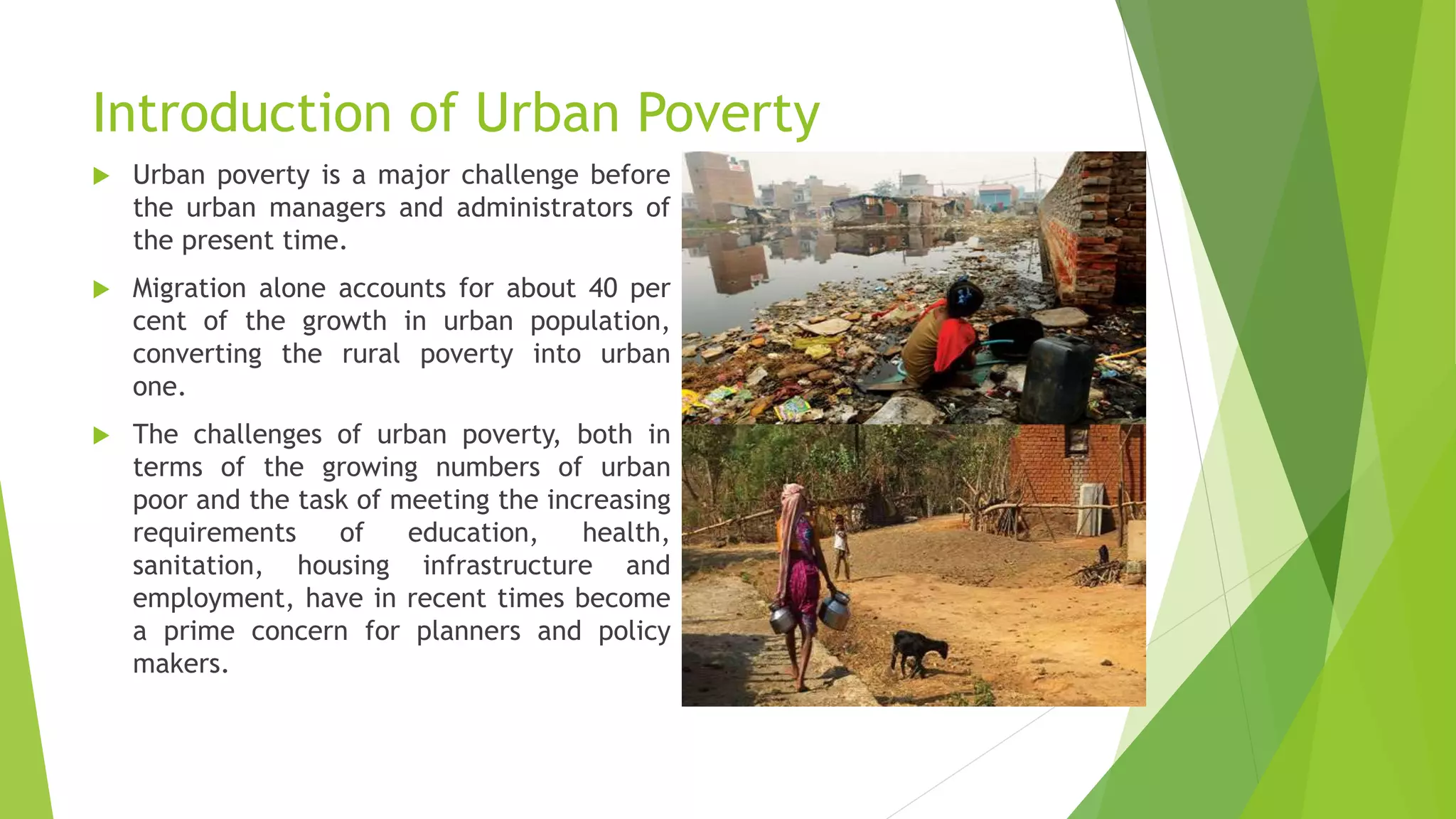
 Urban poverty is a major challenge before
the urban managers and administrators of
the present time.
 Migration alone accounts for about 40 per
cent of the growth in urban population,
converting the rural poverty into urban
one.
 The challenges of urban poverty, both in
terms of the growing numbers of urban
poor and the task of meeting the increasing
requirements of education, health,
sanitation, housing infrastructure and
employment, have in recent times become
a prime concern for planners and policy
makers.
Urban Poverty Alleviation
 The Ministry of Housing and Urban Poverty
Alleviation is an agency of the Government of India
responsible for urban poverty, housing, and
employment programs.
 The Ministry was created in 2004 after splitting it
from the Ministry of Urban Development.
 The government, in 2017, merged the urban
development and housing and urban poverty
alleviation ministries as the Ministry of Housing and
Urban Affairs (MoHUA).
 The Government of India has launched various
programs since its independence, such as some of
the five year plans, to alleviate poverty and address
the widening income gap, both, amongst the upper
and lower classes of society, and amongst the rural
and urban parts of the country.
Urban Poverty Alleviation Schemes
through Government Programmes:-
 The Government of India has been forming and implementing various Poverty
Alleviation and Social Security Programmes since the early years of Indian
independence. The poverty alleviation programmes in India can be
categorized according to their targets and formations.
 The programmes can be mainly grouped into:
 1) Employment Generation Programmes (Self-Employment and Wage-
Employment Programmes)
 2) Target Specific Programmes (Social Security and Food Security Programmes)
 3) Area Development Programmes (Tribal/Hilly/Drought Prone Area
Development Programmes)
 4) Twenty Point Programmes.
Major Urban Poverty Alleviation
Programmes:-
 Some of Major Urban Poverty Alleviation Programmes are as Follows:-
 1. Housing For All
 2. Jawahar Rozgar Yojana/ Jawahar Gram Samriddhi Yojana
 3. Annapurna.
 4. Integrated Rural Development Program(IRDP)
 5. Pradhan Mantri Gramin Awaas Yojana.
 6. National Social Assistance Programme (NSAP)
 7. Sampoorna Gramin Rozgar Yojana (SGRY)
 8. Jawaharlal Nehru National Urban Renewal Mission (JNNURM):
 9. Mahatma Gandhi National Rural Employment Guarantee Act (MGNREGA)
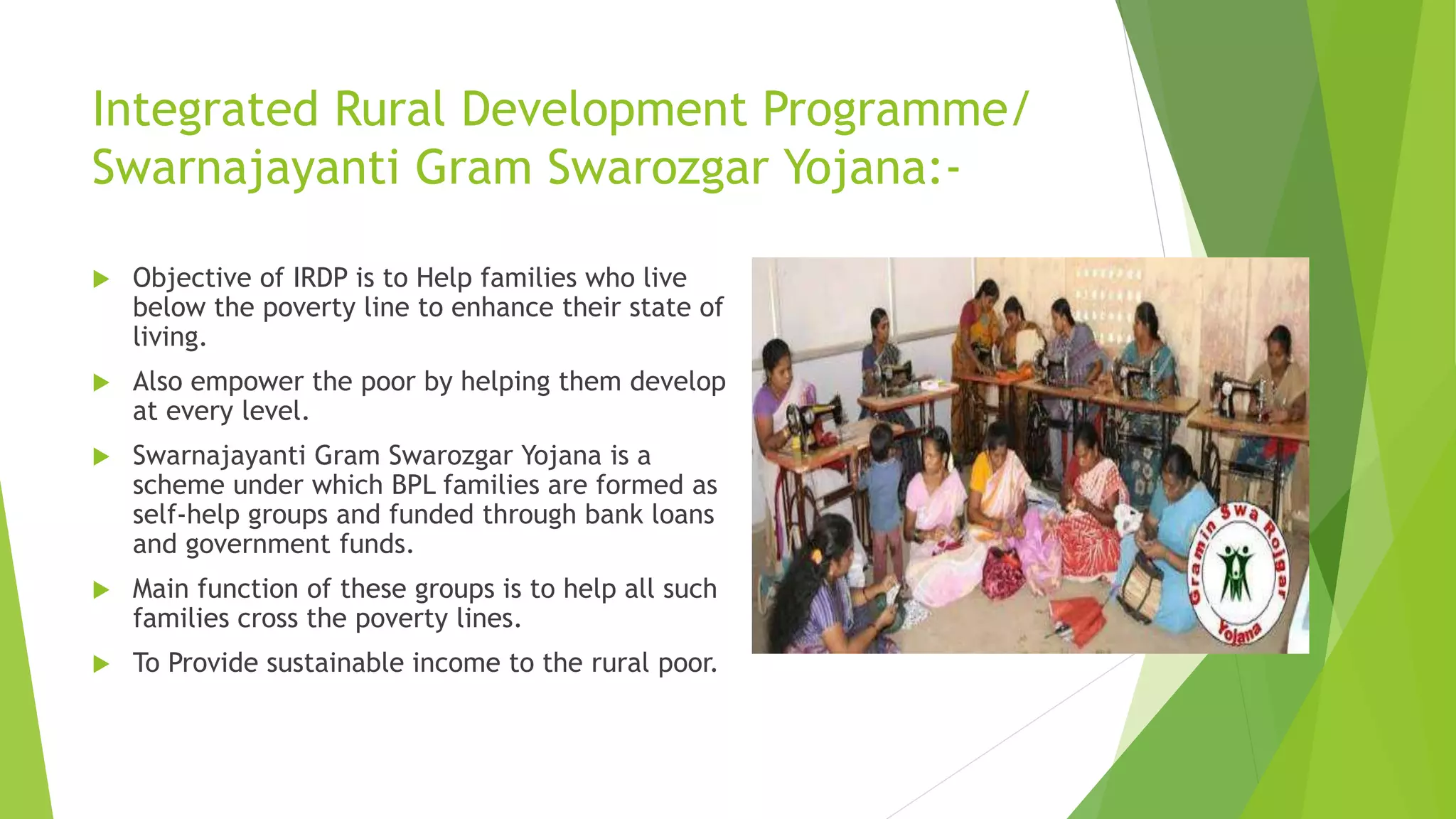
Integrated Rural Development Programme/
Swarnajayanti Gram Swarozgar Yojana:-
 Objective of IRDP is to Help families who live
below the poverty line to enhance their state of
living.
 Also empower the poor by helping them develop
at every level.
 Swarnajayanti Gram Swarozgar Yojana is a
scheme under which BPL families are formed as
self-help groups and funded through bank loans
and government funds.
 Main function of these groups is to help all such
families cross the poverty lines.
 To Provide sustainable income to the rural poor.
National Social Assistance Programme
(NSAP):-
 Objective of NSAP To provide financial assistance to
the elderly, widows and persona with disabilities in
the form of social pensions.
 The scheme is administered by the Ministry of Rural
Development, Governments of India.
 The NSAP has three components:
♦ National Old Age Pension Scheme (NOAPS)
♦ National Family Benefit Scheme (NFBS)
♦ National Maternity Benefit Scheme (NMBS)
 The NOAPS provides a monthly pension of Rs. 75 to destitute BPL persons
above 65 years.
 The NFBS is a scheme for BPL families who are given Rs. 10,000 in the event
of the death of the breadwinner.
 The NMBS provides Rs. 500 to support nutritional intake for pregnant women.
Jawahar Rozgar Yojana/ Jawahar Gram
Samriddhi Yojana:-
 Introduced in April 1999 by restructuring the Jawahar Rojgar Yojana.
 Ratio of 75:25 between center and states.
 Implemented by Gram Panchayats in creation of durable productive
community assets.
 Secondary objective is generation of wage employment for rural
unemployment poor.
 The programme is implemented by village panchayats and provides for
specific benefits to SC/STs, the disabled and provides for the maintenance of
community assets created in the past.
 A major proportion of JRY funds were spent on roads and buildings.
 Over 47 per cent of the employment generated benefited SC/STs.
Sampoorna Gramin Rozgar Yojana
(SGRY):-
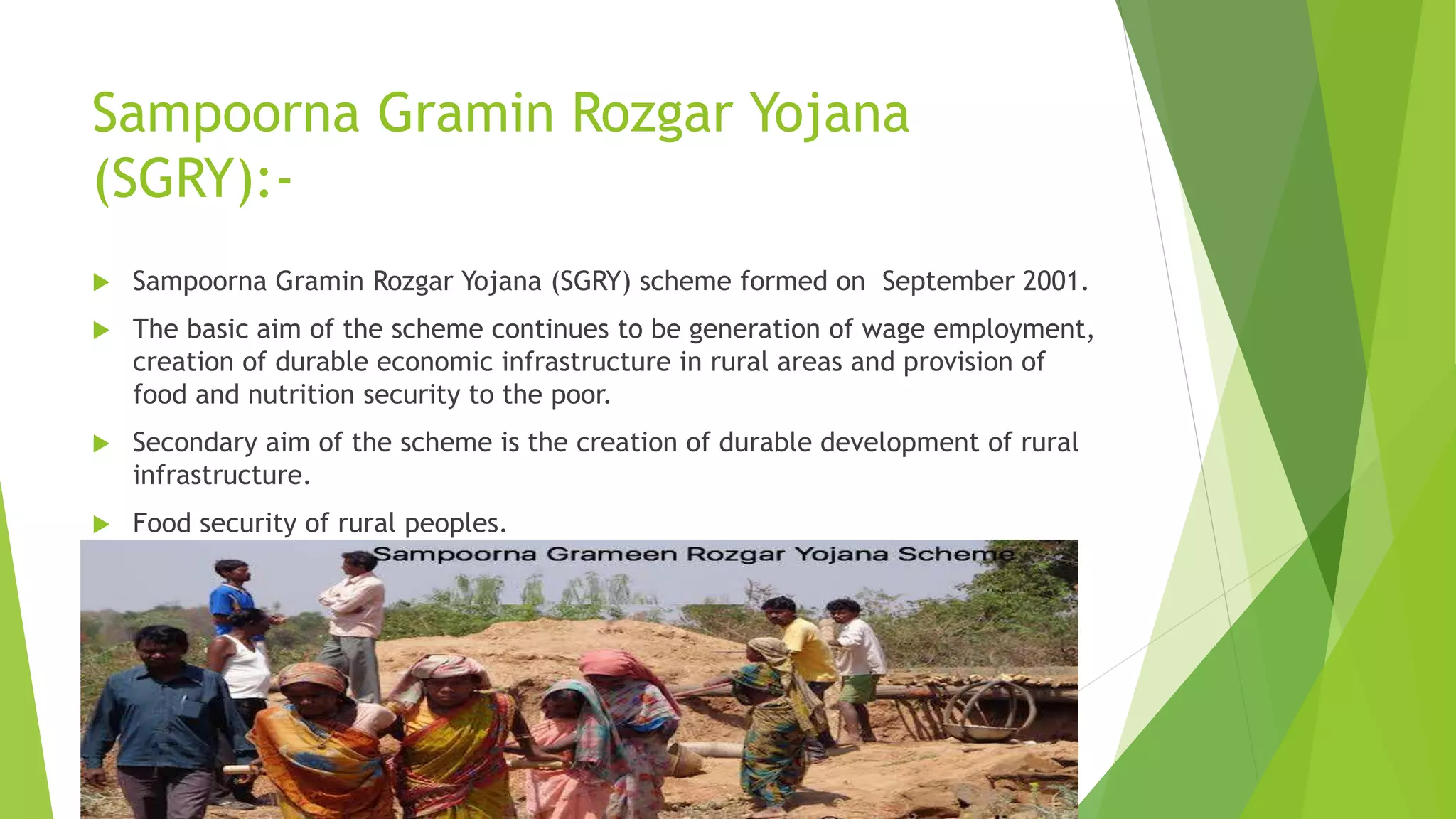
 Sampoorna Gramin Rozgar Yojana (SGRY) scheme formed on September 2001.
 The basic aim of the scheme continues to be generation of wage employment,
creation of durable economic infrastructure in rural areas and provision of
food and nutrition security to the poor.
 Secondary aim of the scheme is the creation of durable development of rural
infrastructure.
 Food security of rural peoples.
Jawaharlal Nehru National Urban
Renewal Mission (JNNURM):-
 Initiated in December 2005 as a mission under Ministry of
Urban development.
 JnNURM aims at creating economicaly,productive,efficient,equitable and
responsive cities by a strategy of upgrading the social and economic
infrastructure in cities, provision of basic service to urban Poor(BSUP).
 The Sub-Mission for Basic Services to the Urban Poor (BSUP)[ administered by
the Ministry of Housing and Urban Poverty Alleviation with a focus on
integrated development of slums.
 To Scale up delivery of civic amenities and provision of utilities with emphasis
on universal access to urban poor.
 Provision of basic services to the urban poor including security of tenure at
affordable prices, improved housing, water supply and sanitation, and
ensuring delivery of other existing universal services of the government for
education, health and social security
Housing For All
 The Pradhan Mantri Awas Yojana (Urban) Programme launched by the Ministry
of Housing and Urban Poverty Alleviation (MoHUPA), in Mission mode envisions
provision of Housing for All by 2022, when the Nation completes 75 years of
its Independence .
 “Housing for All” Mission for urban area is being implemented during 2015-
2022 and this Mission will provide central assistance to implementing agencies
through States and UTs for providing houses to all eligible
families/beneficiaries by 2022.
State-Level Initiatives For removal of
Urban Poverty:-
 The State Governments are better placed to understand the felt needs of the
local people and can respond more effectively. It has also been seen that
where such State level initiatives have strong political backing, the
performance has been laudable. The table below enumerates some sample
State initiatives.
Namakku Name
Thittam
1997-98
Village level development such as construction of
buildings, creation and improvement of minor irrigation
works, and construction of bridges, culverts and road
Tamilnadu Gokul Gram
Yojana
1995-96
Provides basic infrastructure to all villages within a time frame of
five years, such as all-weather approach roads, drinking water,
construction of village ponds with bathing ghats, construction of
primary school rooms, community halls, community worksheds
and village afforestation
Gujarat
State-Level
Initiatives For
removal of Urban
Poverty
Apna Gaon
Apna Kaam
1991
Promoting self dependence and encouraging participation of the local
community in planning and creation of public assets and their
maintenance; rural people/donors/NGO/Community groups contribute a
minimum of 30 per cent of the amount in the form of public contribution,.
Rajasthan Kudumbashree
1998
Self-Help Group (SHG) approach for housing for the poor, low
cost sanitation, community water supply, literacy centers,
training programme for skill
Upgradation, etc.
Keral
State-Level
Initiatives For
removal of
Urban Poverty
Concluding Remark:-
 Poverty is more of social marginalization of an individual,
household or group in the community/society rather than
inadequacy of income to fulfill the basic needs.
 The goal of poverty alleviation programme should aim
merely increasing the income level of individual,
household or group but mainstreaming marginalized in the
development process of the country .
 Poverty alleviation programmes should address the issue
of poverty from broader social and economic
perspectives.
References:-
• Housing for All, Ministry of Housing and Urban Poverty Alleviation, Government of
India. http://mhupa.gov.in/User_Panel/UserView.aspx?TypeID=1434
• Mehta J. Poverty in India 2004. Available from:
http://www.tammilehto.info%20files/articles.html, accessed on April 6, 2007.
• Poverty alleviation in rural India – Strategy and programmes, Available from
http:// planning
commission.nic.in/plans/planrel/fiveyr/10th/volume2/v2_ch3_2.pdf, accessed on
July 6, 2007
• Urban Poverty Alleviation in India, Ramanathan Foundation Report 2002,
Bangalore, India and www.mhupa.gov.in
• www.mhupa.gov.in
• Planning Commission, Tenth Five Year Plan (2002-07), 1, 2003.
• Planning Commission, Mid-Term Appraisal of the Ninth Five Year Plan.
• Amis P. (2009) Indian Urban Poverty: Where are the Levers for its Effective
Alleviation? Institute of Development Studies Bulletin, Vol. 28, Issue 2, pg. 94–
105.
• Dhar V. K. (2006), Urban Poverty Alleviation Initiatives & the JNNURM: A Critical
Assessment, National Institute of Urban Affairs, New Delhi.
Thank You

Urban Poverty Alleviation

  • 1.
    Sarvajanik Education society SarvajanikCollege of Engineering and Technology TOWN & COUNTRY PLANNING M. E. (TCP) - 1, Semester – I Socio Economic Planning (3714810) Graduation Report on “URBAN POVERTY ALLEVIATION” Presented By:- SHAH YASH S 190420748027 Faculty Incharge:- Prof.Himanshu J Padhya
  • 2.
    Contents • Introduction • UrbanPoverty Alleviation • Urban Poverty Alleviation Schemes through Government Programmes • Major Urban Poverty Alleviation Programmes • State-Level Initiatives For removal of Urban Poverty • Concluding remark • References
  • 3.
    Introduction of UrbanPoverty  Urban poverty is a major challenge before the urban managers and administrators of the present time.  Migration alone accounts for about 40 per cent of the growth in urban population, converting the rural poverty into urban one.  The challenges of urban poverty, both in terms of the growing numbers of urban poor and the task of meeting the increasing requirements of education, health, sanitation, housing infrastructure and employment, have in recent times become a prime concern for planners and policy makers.
  • 4.
    Urban Poverty Alleviation The Ministry of Housing and Urban Poverty Alleviation is an agency of the Government of India responsible for urban poverty, housing, and employment programs.  The Ministry was created in 2004 after splitting it from the Ministry of Urban Development.  The government, in 2017, merged the urban development and housing and urban poverty alleviation ministries as the Ministry of Housing and Urban Affairs (MoHUA).  The Government of India has launched various programs since its independence, such as some of the five year plans, to alleviate poverty and address the widening income gap, both, amongst the upper and lower classes of society, and amongst the rural and urban parts of the country.
  • 6.
    Urban Poverty AlleviationSchemes through Government Programmes:-  The Government of India has been forming and implementing various Poverty Alleviation and Social Security Programmes since the early years of Indian independence. The poverty alleviation programmes in India can be categorized according to their targets and formations.  The programmes can be mainly grouped into:  1) Employment Generation Programmes (Self-Employment and Wage- Employment Programmes)  2) Target Specific Programmes (Social Security and Food Security Programmes)  3) Area Development Programmes (Tribal/Hilly/Drought Prone Area Development Programmes)  4) Twenty Point Programmes.
  • 7.
    Major Urban PovertyAlleviation Programmes:-  Some of Major Urban Poverty Alleviation Programmes are as Follows:-  1. Housing For All  2. Jawahar Rozgar Yojana/ Jawahar Gram Samriddhi Yojana  3. Annapurna.  4. Integrated Rural Development Program(IRDP)  5. Pradhan Mantri Gramin Awaas Yojana.  6. National Social Assistance Programme (NSAP)  7. Sampoorna Gramin Rozgar Yojana (SGRY)  8. Jawaharlal Nehru National Urban Renewal Mission (JNNURM):  9. Mahatma Gandhi National Rural Employment Guarantee Act (MGNREGA)
  • 8.
    Integrated Rural DevelopmentProgramme/ Swarnajayanti Gram Swarozgar Yojana:-  Objective of IRDP is to Help families who live below the poverty line to enhance their state of living.  Also empower the poor by helping them develop at every level.  Swarnajayanti Gram Swarozgar Yojana is a scheme under which BPL families are formed as self-help groups and funded through bank loans and government funds.  Main function of these groups is to help all such families cross the poverty lines.  To Provide sustainable income to the rural poor.
  • 9.
    National Social AssistanceProgramme (NSAP):-  Objective of NSAP To provide financial assistance to the elderly, widows and persona with disabilities in the form of social pensions.  The scheme is administered by the Ministry of Rural Development, Governments of India.  The NSAP has three components: ♦ National Old Age Pension Scheme (NOAPS) ♦ National Family Benefit Scheme (NFBS) ♦ National Maternity Benefit Scheme (NMBS)  The NOAPS provides a monthly pension of Rs. 75 to destitute BPL persons above 65 years.  The NFBS is a scheme for BPL families who are given Rs. 10,000 in the event of the death of the breadwinner.  The NMBS provides Rs. 500 to support nutritional intake for pregnant women.
  • 10.
    Jawahar Rozgar Yojana/Jawahar Gram Samriddhi Yojana:-  Introduced in April 1999 by restructuring the Jawahar Rojgar Yojana.  Ratio of 75:25 between center and states.  Implemented by Gram Panchayats in creation of durable productive community assets.  Secondary objective is generation of wage employment for rural unemployment poor.  The programme is implemented by village panchayats and provides for specific benefits to SC/STs, the disabled and provides for the maintenance of community assets created in the past.  A major proportion of JRY funds were spent on roads and buildings.  Over 47 per cent of the employment generated benefited SC/STs.
  • 11.
    Sampoorna Gramin RozgarYojana (SGRY):-  Sampoorna Gramin Rozgar Yojana (SGRY) scheme formed on September 2001.  The basic aim of the scheme continues to be generation of wage employment, creation of durable economic infrastructure in rural areas and provision of food and nutrition security to the poor.  Secondary aim of the scheme is the creation of durable development of rural infrastructure.  Food security of rural peoples.
  • 12.
    Jawaharlal Nehru NationalUrban Renewal Mission (JNNURM):-  Initiated in December 2005 as a mission under Ministry of Urban development.  JnNURM aims at creating economicaly,productive,efficient,equitable and responsive cities by a strategy of upgrading the social and economic infrastructure in cities, provision of basic service to urban Poor(BSUP).  The Sub-Mission for Basic Services to the Urban Poor (BSUP)[ administered by the Ministry of Housing and Urban Poverty Alleviation with a focus on integrated development of slums.  To Scale up delivery of civic amenities and provision of utilities with emphasis on universal access to urban poor.  Provision of basic services to the urban poor including security of tenure at affordable prices, improved housing, water supply and sanitation, and ensuring delivery of other existing universal services of the government for education, health and social security
  • 13.
    Housing For All The Pradhan Mantri Awas Yojana (Urban) Programme launched by the Ministry of Housing and Urban Poverty Alleviation (MoHUPA), in Mission mode envisions provision of Housing for All by 2022, when the Nation completes 75 years of its Independence .  “Housing for All” Mission for urban area is being implemented during 2015- 2022 and this Mission will provide central assistance to implementing agencies through States and UTs for providing houses to all eligible families/beneficiaries by 2022.
  • 14.
    State-Level Initiatives Forremoval of Urban Poverty:-  The State Governments are better placed to understand the felt needs of the local people and can respond more effectively. It has also been seen that where such State level initiatives have strong political backing, the performance has been laudable. The table below enumerates some sample State initiatives.
  • 15.
    Namakku Name Thittam 1997-98 Village leveldevelopment such as construction of buildings, creation and improvement of minor irrigation works, and construction of bridges, culverts and road Tamilnadu Gokul Gram Yojana 1995-96 Provides basic infrastructure to all villages within a time frame of five years, such as all-weather approach roads, drinking water, construction of village ponds with bathing ghats, construction of primary school rooms, community halls, community worksheds and village afforestation Gujarat State-Level Initiatives For removal of Urban Poverty
  • 16.
    Apna Gaon Apna Kaam 1991 Promotingself dependence and encouraging participation of the local community in planning and creation of public assets and their maintenance; rural people/donors/NGO/Community groups contribute a minimum of 30 per cent of the amount in the form of public contribution,. Rajasthan Kudumbashree 1998 Self-Help Group (SHG) approach for housing for the poor, low cost sanitation, community water supply, literacy centers, training programme for skill Upgradation, etc. Keral State-Level Initiatives For removal of Urban Poverty
  • 17.
    Concluding Remark:-  Povertyis more of social marginalization of an individual, household or group in the community/society rather than inadequacy of income to fulfill the basic needs.  The goal of poverty alleviation programme should aim merely increasing the income level of individual, household or group but mainstreaming marginalized in the development process of the country .  Poverty alleviation programmes should address the issue of poverty from broader social and economic perspectives.
  • 18.
    References:- • Housing forAll, Ministry of Housing and Urban Poverty Alleviation, Government of India. http://mhupa.gov.in/User_Panel/UserView.aspx?TypeID=1434 • Mehta J. Poverty in India 2004. Available from: http://www.tammilehto.info%20files/articles.html, accessed on April 6, 2007. • Poverty alleviation in rural India – Strategy and programmes, Available from http:// planning commission.nic.in/plans/planrel/fiveyr/10th/volume2/v2_ch3_2.pdf, accessed on July 6, 2007 • Urban Poverty Alleviation in India, Ramanathan Foundation Report 2002, Bangalore, India and www.mhupa.gov.in • www.mhupa.gov.in • Planning Commission, Tenth Five Year Plan (2002-07), 1, 2003. • Planning Commission, Mid-Term Appraisal of the Ninth Five Year Plan. • Amis P. (2009) Indian Urban Poverty: Where are the Levers for its Effective Alleviation? Institute of Development Studies Bulletin, Vol. 28, Issue 2, pg. 94– 105. • Dhar V. K. (2006), Urban Poverty Alleviation Initiatives & the JNNURM: A Critical Assessment, National Institute of Urban Affairs, New Delhi.
  • 19.