Interfacing DeltaV to Motorized Actuators  Addressing Control Applications
Presenters Tom Pesek  Terry Blevins
Introduction DeltaV composite blocks have been developed that enable motorized actuators to be utilized in control applications. In this presentation we address: Background on need to support motorized actuators. DeltaV composites and IO interface for continuous control applications using motorized actuators. Simulation results and test conducted using DeltaV and an HL  series electric actuators in the flow lab at Fisher Controls. How to access these composites for use with DeltaV revision at  Emerson Application Exchange.  The DeltaV composites blocks make it easy to address control applications using electric actuators.
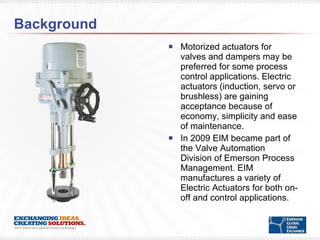
Background Motorized actuators for valves and dampers may be preferred for some process control applications. Electric actuators (induction, servo or brushless) are gaining acceptance because of economy, simplicity and ease of maintenance.  In 2009 EIM became part of the Valve Automation Division of Emerson Process Management. EIM manufactures a variety of Electric Actuators for both on-off and control applications.
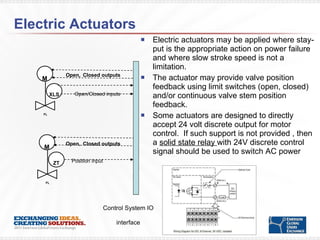
Electric Actuators Electric actuators may be applied where stay-put is the appropriate action on power failure and where slow stroke speed is not a limitation.  The actuator may provide valve position feedback using limit switches (open, closed) and/or continuous valve stem position feedback. Some actuators are designed to directly accept 24 volt discrete output for motor control.  If such support is not provided , then a  solid state relay  with 24V discrete control signal should be used to switch AC power FL M FL M Control System IO interface Open/Closed inputs Open,   Closed outputs Open,   Closed outputs Position input XLS ZT
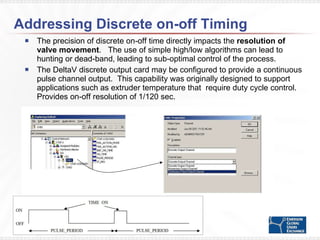
Addressing Discrete on-off Timing The precision of discrete on-off time directly impacts the  resolution of valve movement .  The use of simple high/low algorithms can lead to hunting or dead-band, leading to sub-optimal control of the process. The DeltaV discrete output card may be configured to provide a continuous pulse channel output.  This capability was originally designed to support applications such as extruder temperature that  require duty cycle control.  Provides on-off resolution of 1/120 sec.
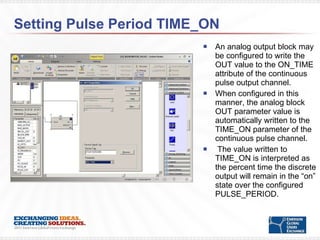
Setting Pulse Period TIME_ON An analog output block may be configured to write the OUT value to the ON_TIME attribute of the continuous pulse output channel. When configured in this manner, the analog block OUT parameter value is automatically written to the TIME_ON parameter of the continuous pulse channel.  The value written to TIME_ON is interpreted as the percent time the discrete output will remain in the “on” state over the configured PULSE_PERIOD.
Control Using Motorize Actuators Two composite blocks have been developed that provide the Increase/Decrease interface that is required for a motorized actuators. Motor Actuator with Stem Position Feedback Motor Actuator with Limit Switch Feedback These composite blocks are designed to utilize standard analog output blocks and the PID block to support control applications.
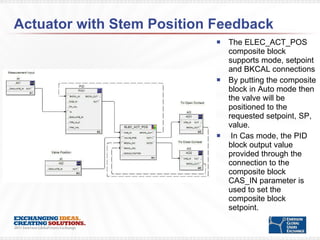
Actuator with Stem Position Feedback The ELEC_ACT_POS composite block supports mode, setpoint and BKCAL connections  By putting the composite block in Auto mode then the valve will be positioned to the requested setpoint, SP, value.  In Cas mode, the PID block output value provided through the connection to the composite block CAS_IN parameter is used to set the composite block setpoint.
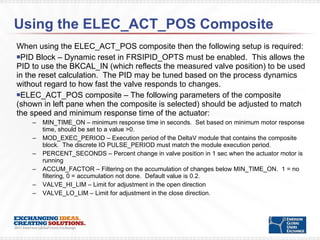
Using the ELEC_ACT_POS Composite  When using the ELEC_ACT_POS composite then the following setup is required: PID Block – Dynamic reset in FRSIPID_OPTS must be enabled.  This allows the PID to use the BKCAL_IN (which reflects the measured valve position) to be used in the reset calculation.  The PID may be tuned based on the process dynamics without regard to how fast the valve responds to changes. ELEC_ACT_POS composite – The following parameters of the composite (shown in left pane when the composite is selected) should be adjusted to match the speed and minimum response time of the actuator: MIN_TIME_ON – minimum response time in seconds.  Set based on minimum motor response time, should be set to a value >0. MOD_EXEC_PERIOD – Execution period of the DeltaV module that contains the composite block.  The discrete IO PULSE_PERIOD must match the module execution period. PERCENT_SECONDS – Percent change in valve position in 1 sec when the actuator motor is running ACCUM_FACTOR – Filtering on the accumulation of changes below MIN_TIME_ON.  1 = no filtering, 0 = accumulation not done.  Default value is 0.2. VALVE_HI_LIM – Limit for adjustment in the open direction VALVE_LO_LIM – Limit for adjustment in the close direction.
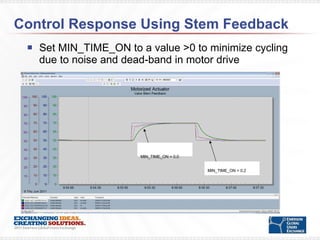
Control Response Using Stem Feedback Set MIN_TIME_ON to a value >0 to minimize cycling due to noise and dead-band in motor drive  MIN_TIME_ON = 0.0 MIN_TIME_ON = 0.2
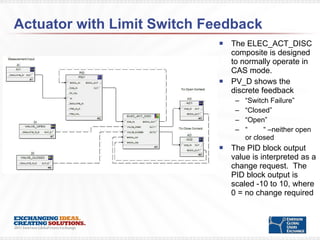
Actuator with Limit Switch Feedback The ELEC_ACT_DISC composite is designed to normally operate in CAS mode.  PV_D shows the discrete feedback “ Switch Failure” “ Closed” “ Open” “  “ – neither open or closed The PID block output value is interpreted as a change request.  The PID block output is scaled -10 to 10, where 0 = no change required
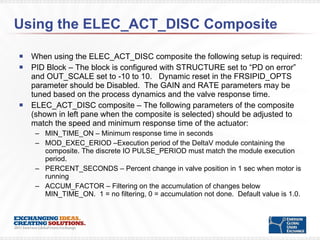
Using the ELEC_ACT_DISC Composite  When using the ELEC_ACT_DISC composite the following setup is required: PID Block – The block is configured with STRUCTURE set to “PD on error” and OUT_SCALE set to -10 to 10.  Dynamic reset in the FRSIPID_OPTS parameter should be Disabled.  The GAIN and RATE parameters may be tuned based on the process dynamics and the valve response time.  ELEC_ACT_DISC composite – The following parameters of the composite (shown in left pane when the composite is selected) should be adjusted to match the speed and minimum response time of the actuator:  MIN_TIME_ON – Minimum response time in seconds MOD_EXEC_ERIOD –Execution period of the DeltaV module containing the composite. The discrete IO PULSE_PERIOD must match the module execution period. PERCENT_SECONDS – Percent change in valve position in 1 sec when motor is running ACCUM_FACTOR – Filtering on the accumulation of changes below MIN_TIME_ON.  1 = no filtering, 0 = accumulation not done.  Default value is 1.0.
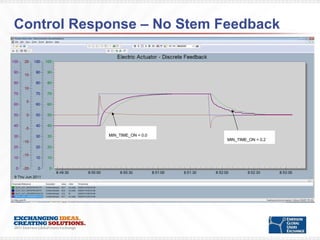
Control Response – No Stem Feedback MIN_TIME_ON = 0.0 MIN_TIME_ON = 0.2
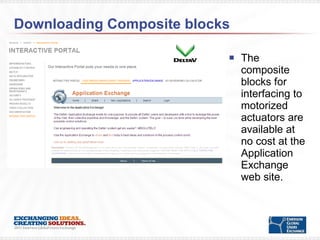
Downloading Composite blocks The composite blocks for interfacing to motorized actuators are available at no cost at the Application Exchange web site.
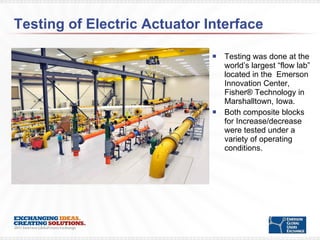
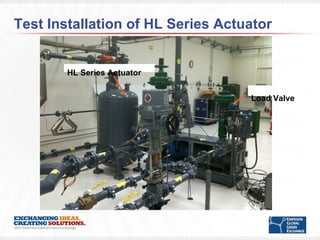
Testing of Electric Actuator Interface Testing was done at the world’s largest “flow lab” located in the  Emerson Innovation Center, Fisher® Technology in Marshalltown, Iowa. Both composite blocks for Increase/decrease were tested under a variety of operating conditions.
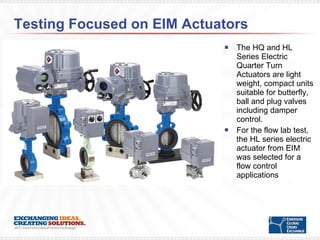
Testing Focused on EIM Actuators The HQ and HL Series Electric Quarter Turn Actuators are light weight, compact units suitable for butterfly, ball and plug valves including damper control. For the flow lab test, the HL series electric actuator from EIM was selected for a flow control applications
Test Installation of HL Series Actuator HL Series Actuator   Load Valve
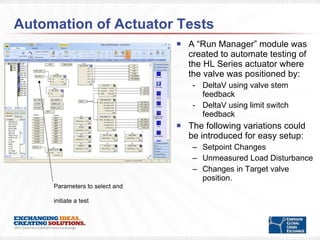
Automation of Actuator Tests A “Run Manager” module was created to automate testing of the HL Series actuator where the valve was positioned by: DeltaV using valve stem feedback DeltaV using limit switch feedback The following variations could be introduced for easy setup: Setpoint Changes Unmeasured Load Disturbance Changes in Target valve position. Parameters to select and initiate a test
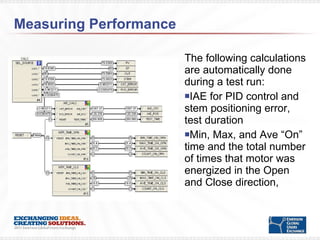
Measuring Performance The following calculations are automatically done during a test run: IAE for PID control and stem positioning error, test duration Min, Max, and Ave “On” time and the total number of times that motor was energized in the Open and Close direction,
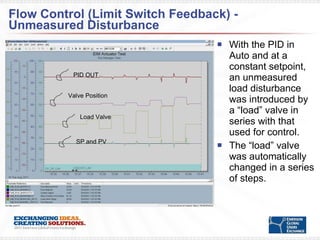
Flow Control (Limit Switch Feedback) - Unmeasured Disturbance With the PID in Auto and at a constant setpoint, an unmeasured load disturbance was introduced by a “load” valve in series with that used for control. The “load” valve was automatically changed in a series of steps. Load Valve SP and PV PID OUT  Valve Position
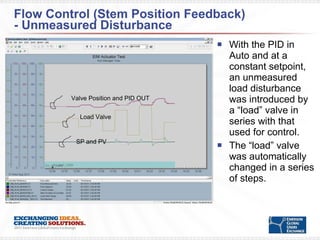
Flow Control (Stem Position Feedback)  - Unmeasured Disturbance With the PID in Auto and at a constant setpoint, an unmeasured load disturbance was introduced by a “load” valve in series with that used for control. The “load” valve was automatically changed in a series of steps. Load Valve SP and PV Valve Position and PID OUT
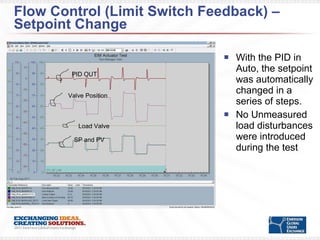
Flow Control (Limit Switch Feedback) – Setpoint Change With the PID in Auto, the setpoint was automatically changed in a series of steps. No Unmeasured load disturbances were introduced during the test Load Valve SP and PV PID OUT  Valve Position
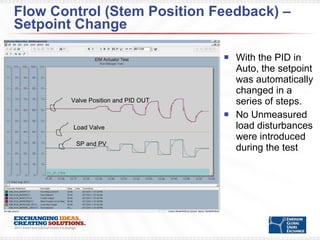
Flow Control (Stem Position Feedback) – Setpoint Change With the PID in Auto, the setpoint was automatically changed in a series of steps. No Unmeasured load disturbances were introduced during the test Load Valve SP and PV Valve Position and PID OUT
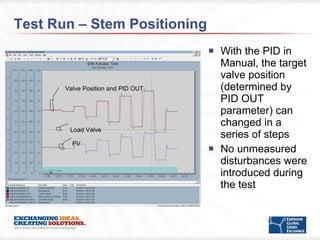
Test Run – Stem Positioning  With the PID in Manual, the target valve position (determined by PID OUT parameter) can changed in a series of steps No unmeasured disturbances were introduced during the test Load Valve PV Valve Position and PID OUT
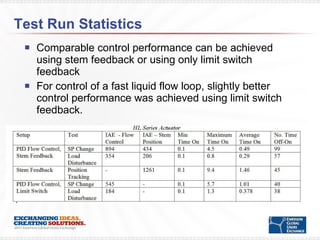
Test Run Statistics Comparable control performance can be achieved using stem feedback or using only limit switch feedback For control of a fast liquid flow loop, slightly better control performance was achieved using limit switch feedback.
Business Results Achieved Precise control may be achieved using the DeltaV composites and can reduce process variation when using motorized actuators in control. The time and cost to engineer control loops that use motorize actuators may be reduced by using the composite blocks. A standard means for engineering and maintaining an interface to motorized valves can be developed based on the composite blocks.
Acknowledgement Many thanks to Dan Carlson and Ron Hager, Fisher Controls, for their help in flow lab setup and operation during the actuator tests and for input and support provided by Gary Law, Arvid Borchers, and Mike Apel, DeltaV Technology, on the hardware interface.  We gratefully acknowledge the support of Fisher Controls and DeltaV technology management in the development and testing of this DeltaV interface to electric motor actuators.
Summary In this workshop we discussed the use of motorized actuators in closed loop control and provide information on composite blocks that allow motorized actuators to be used with DeltaV.  Flow lab test results using these DeltaV composites with an HL series actuator were shown.  The time and cost associated with engineering control using motorized actuators in a DeltaV installation can be reduced by using the composite blocks . The composites blocks are freely available at the Application Exchange web site.
Where To Get More Information The Emerson Exchange workshop “Does anyone share? - Online Tools for DeltaV Systems” provides more information on the Emerson Application Exchange web site where the composite blocks for motorize actuation interface can be accessed. HQ-Series Quarter Turn Electric Actuators,  HQ-SERIES  Product Catalog,  http://www2.emersonprocess.com/en-US/brands/EIM-Actuators/Products/Electric/Pages/HQ_Series_Electric_Actuators.aspx

Interfacing delta v to motorized actuators addressing control applications

  • 1.
    Interfacing DeltaV toMotorized Actuators Addressing Control Applications
  • 2.
    Presenters Tom Pesek Terry Blevins
  • 3.
    Introduction DeltaV compositeblocks have been developed that enable motorized actuators to be utilized in control applications. In this presentation we address: Background on need to support motorized actuators. DeltaV composites and IO interface for continuous control applications using motorized actuators. Simulation results and test conducted using DeltaV and an HL series electric actuators in the flow lab at Fisher Controls. How to access these composites for use with DeltaV revision at Emerson Application Exchange. The DeltaV composites blocks make it easy to address control applications using electric actuators.
  • 4.
    Background Motorized actuatorsfor valves and dampers may be preferred for some process control applications. Electric actuators (induction, servo or brushless) are gaining acceptance because of economy, simplicity and ease of maintenance. In 2009 EIM became part of the Valve Automation Division of Emerson Process Management. EIM manufactures a variety of Electric Actuators for both on-off and control applications.
  • 5.
    Electric Actuators Electricactuators may be applied where stay-put is the appropriate action on power failure and where slow stroke speed is not a limitation. The actuator may provide valve position feedback using limit switches (open, closed) and/or continuous valve stem position feedback. Some actuators are designed to directly accept 24 volt discrete output for motor control. If such support is not provided , then a solid state relay with 24V discrete control signal should be used to switch AC power FL M FL M Control System IO interface Open/Closed inputs Open, Closed outputs Open, Closed outputs Position input XLS ZT
  • 6.
    Addressing Discrete on-offTiming The precision of discrete on-off time directly impacts the resolution of valve movement . The use of simple high/low algorithms can lead to hunting or dead-band, leading to sub-optimal control of the process. The DeltaV discrete output card may be configured to provide a continuous pulse channel output. This capability was originally designed to support applications such as extruder temperature that require duty cycle control. Provides on-off resolution of 1/120 sec.
  • 7.
    Setting Pulse PeriodTIME_ON An analog output block may be configured to write the OUT value to the ON_TIME attribute of the continuous pulse output channel. When configured in this manner, the analog block OUT parameter value is automatically written to the TIME_ON parameter of the continuous pulse channel. The value written to TIME_ON is interpreted as the percent time the discrete output will remain in the “on” state over the configured PULSE_PERIOD.
  • 8.
    Control Using MotorizeActuators Two composite blocks have been developed that provide the Increase/Decrease interface that is required for a motorized actuators. Motor Actuator with Stem Position Feedback Motor Actuator with Limit Switch Feedback These composite blocks are designed to utilize standard analog output blocks and the PID block to support control applications.
  • 9.
    Actuator with StemPosition Feedback The ELEC_ACT_POS composite block supports mode, setpoint and BKCAL connections By putting the composite block in Auto mode then the valve will be positioned to the requested setpoint, SP, value. In Cas mode, the PID block output value provided through the connection to the composite block CAS_IN parameter is used to set the composite block setpoint.
  • 10.
    Using the ELEC_ACT_POSComposite When using the ELEC_ACT_POS composite then the following setup is required: PID Block – Dynamic reset in FRSIPID_OPTS must be enabled. This allows the PID to use the BKCAL_IN (which reflects the measured valve position) to be used in the reset calculation. The PID may be tuned based on the process dynamics without regard to how fast the valve responds to changes. ELEC_ACT_POS composite – The following parameters of the composite (shown in left pane when the composite is selected) should be adjusted to match the speed and minimum response time of the actuator: MIN_TIME_ON – minimum response time in seconds. Set based on minimum motor response time, should be set to a value >0. MOD_EXEC_PERIOD – Execution period of the DeltaV module that contains the composite block. The discrete IO PULSE_PERIOD must match the module execution period. PERCENT_SECONDS – Percent change in valve position in 1 sec when the actuator motor is running ACCUM_FACTOR – Filtering on the accumulation of changes below MIN_TIME_ON. 1 = no filtering, 0 = accumulation not done. Default value is 0.2. VALVE_HI_LIM – Limit for adjustment in the open direction VALVE_LO_LIM – Limit for adjustment in the close direction.
  • 11.
    Control Response UsingStem Feedback Set MIN_TIME_ON to a value >0 to minimize cycling due to noise and dead-band in motor drive MIN_TIME_ON = 0.0 MIN_TIME_ON = 0.2
  • 12.
    Actuator with LimitSwitch Feedback The ELEC_ACT_DISC composite is designed to normally operate in CAS mode. PV_D shows the discrete feedback “ Switch Failure” “ Closed” “ Open” “ “ – neither open or closed The PID block output value is interpreted as a change request. The PID block output is scaled -10 to 10, where 0 = no change required
  • 13.
    Using the ELEC_ACT_DISCComposite When using the ELEC_ACT_DISC composite the following setup is required: PID Block – The block is configured with STRUCTURE set to “PD on error” and OUT_SCALE set to -10 to 10. Dynamic reset in the FRSIPID_OPTS parameter should be Disabled. The GAIN and RATE parameters may be tuned based on the process dynamics and the valve response time.  ELEC_ACT_DISC composite – The following parameters of the composite (shown in left pane when the composite is selected) should be adjusted to match the speed and minimum response time of the actuator:  MIN_TIME_ON – Minimum response time in seconds MOD_EXEC_ERIOD –Execution period of the DeltaV module containing the composite. The discrete IO PULSE_PERIOD must match the module execution period. PERCENT_SECONDS – Percent change in valve position in 1 sec when motor is running ACCUM_FACTOR – Filtering on the accumulation of changes below MIN_TIME_ON. 1 = no filtering, 0 = accumulation not done. Default value is 1.0.
  • 14.
    Control Response –No Stem Feedback MIN_TIME_ON = 0.0 MIN_TIME_ON = 0.2
  • 15.
    Downloading Composite blocksThe composite blocks for interfacing to motorized actuators are available at no cost at the Application Exchange web site.
  • 16.
    Testing of ElectricActuator Interface Testing was done at the world’s largest “flow lab” located in the Emerson Innovation Center, Fisher® Technology in Marshalltown, Iowa. Both composite blocks for Increase/decrease were tested under a variety of operating conditions.
  • 17.
    Testing Focused onEIM Actuators The HQ and HL Series Electric Quarter Turn Actuators are light weight, compact units suitable for butterfly, ball and plug valves including damper control. For the flow lab test, the HL series electric actuator from EIM was selected for a flow control applications
  • 18.
    Test Installation ofHL Series Actuator HL Series Actuator Load Valve
  • 19.
    Automation of ActuatorTests A “Run Manager” module was created to automate testing of the HL Series actuator where the valve was positioned by: DeltaV using valve stem feedback DeltaV using limit switch feedback The following variations could be introduced for easy setup: Setpoint Changes Unmeasured Load Disturbance Changes in Target valve position. Parameters to select and initiate a test
  • 20.
    Measuring Performance Thefollowing calculations are automatically done during a test run: IAE for PID control and stem positioning error, test duration Min, Max, and Ave “On” time and the total number of times that motor was energized in the Open and Close direction,
  • 21.
    Flow Control (LimitSwitch Feedback) - Unmeasured Disturbance With the PID in Auto and at a constant setpoint, an unmeasured load disturbance was introduced by a “load” valve in series with that used for control. The “load” valve was automatically changed in a series of steps. Load Valve SP and PV PID OUT Valve Position
  • 22.
    Flow Control (StemPosition Feedback) - Unmeasured Disturbance With the PID in Auto and at a constant setpoint, an unmeasured load disturbance was introduced by a “load” valve in series with that used for control. The “load” valve was automatically changed in a series of steps. Load Valve SP and PV Valve Position and PID OUT
  • 23.
    Flow Control (LimitSwitch Feedback) – Setpoint Change With the PID in Auto, the setpoint was automatically changed in a series of steps. No Unmeasured load disturbances were introduced during the test Load Valve SP and PV PID OUT Valve Position
  • 24.
    Flow Control (StemPosition Feedback) – Setpoint Change With the PID in Auto, the setpoint was automatically changed in a series of steps. No Unmeasured load disturbances were introduced during the test Load Valve SP and PV Valve Position and PID OUT
  • 25.
    Test Run –Stem Positioning With the PID in Manual, the target valve position (determined by PID OUT parameter) can changed in a series of steps No unmeasured disturbances were introduced during the test Load Valve PV Valve Position and PID OUT
  • 26.
    Test Run StatisticsComparable control performance can be achieved using stem feedback or using only limit switch feedback For control of a fast liquid flow loop, slightly better control performance was achieved using limit switch feedback.
  • 27.
    Business Results AchievedPrecise control may be achieved using the DeltaV composites and can reduce process variation when using motorized actuators in control. The time and cost to engineer control loops that use motorize actuators may be reduced by using the composite blocks. A standard means for engineering and maintaining an interface to motorized valves can be developed based on the composite blocks.
  • 28.
    Acknowledgement Many thanksto Dan Carlson and Ron Hager, Fisher Controls, for their help in flow lab setup and operation during the actuator tests and for input and support provided by Gary Law, Arvid Borchers, and Mike Apel, DeltaV Technology, on the hardware interface. We gratefully acknowledge the support of Fisher Controls and DeltaV technology management in the development and testing of this DeltaV interface to electric motor actuators.
  • 29.
    Summary In thisworkshop we discussed the use of motorized actuators in closed loop control and provide information on composite blocks that allow motorized actuators to be used with DeltaV. Flow lab test results using these DeltaV composites with an HL series actuator were shown. The time and cost associated with engineering control using motorized actuators in a DeltaV installation can be reduced by using the composite blocks . The composites blocks are freely available at the Application Exchange web site.
  • 30.
    Where To GetMore Information The Emerson Exchange workshop “Does anyone share? - Online Tools for DeltaV Systems” provides more information on the Emerson Application Exchange web site where the composite blocks for motorize actuation interface can be accessed. HQ-Series Quarter Turn Electric Actuators, HQ-SERIES Product Catalog, http://www2.emersonprocess.com/en-US/brands/EIM-Actuators/Products/Electric/Pages/HQ_Series_Electric_Actuators.aspx