Various systems and instrumentation use auto tuning techniques in their operations. For example, audio
processors, designed to control pitch in vocal and instrumental operations. The main aim of auto tuning is
to conceal off-key errors, and allowing artists to perform genuinely despite slight deviation off-key. In this
paper two Auto tuning control strategies are proposed. These are Proportional, Integral and Derivative
(PID) control and Model Predictive Control (MPC). The PID and MPC controller’s algorithms
amalgamate the auto tuning method. These control strategies ascertains stability, effective and efficient
performance on a nonlinear system. The paper test and compare the efficacy of each control strategy. This
paper generously provides systematic tuning techniques for the PID controller than the MPC controller.
Therefore in essence the PID has to give effective and efficient performance compared to the MPC. The
PID depends mainly on three terms, the P ( ) gain, I ( ) gain and lastly D ( ) gain for control each
playing unique role while the MPC has more information used to predict and control a system.
![International Journal of Chaos, Control, Modelling and Simulation (IJCCMS) Vol.2, No.3, September 2013
18
We proposed Ziegler Nichols (Z – N), Cohen Coon (C – C), Integral Time of weighted Absolute
Error (ITAE) and Internal Model Control (IMC). these are systematic tuning techniques for the
undisputed PID controller. These techniques auto tune the PID controller based on the first order
plus time – delay (FOPTD) of the system. All three parameters of the PID tune simultaneously,
together with their time constants during simulations.
1.1 Proposed Nonlinear System
We propose the following dynamic nonlinear system for this study. Matlab Simulink tool box
enables to administer the nonlinearity to the system.
(1)
Corresponding discrete transfer function with sampling time of one second is expressed as:
(2)
Also can be expressed as
(3)
Represent the discrete time system
2. AUTO TUNING PID AND MPC
The main aim of this section is to design a feedback controller to automatically control
the system subjected to nonlinear adversity. Auto Tuning means any system controller
inherently exhibiting self-monitoring or tuning and adaptation characteristics. The controller self-
monitors and adjusts its parameters continuously to ascertain effective performance of the system
regardless of irregularities or any other unforeseen internal or external disturbances. The auto
tuned controller dictates system operations, for instance, in case of misfortune to the system the
controller can halt the operation. Thus, Auto tuning methodologies incorporates the aspect of
adaptation and power to dictate the operation success.
Various systems and instrumentation use Auto tuning method. For example, an audio processors,
designed to control pitch in vocal and instrumental operations. Its main aim was originally to
conceal off-key errors, and allowing artists to perform genuinely despite slight deviation off-key.
On unrelated example above, Fractional order calculus (FOC) is also an example of a controller
that utilizes Auto tuning principle [1].](https://image.slidesharecdn.com/2313ijccms02-250924121654-3e4a4c2d/85/PERFORMANCE-COMPARISON-OF-TWO-CONTROLLERS-ON-A-NONLINEAR-SYSTEM-2-320.jpg)
![International Journal of Chaos, Control, Modelling and Simulation (IJCCMS) Vol.2, No.3, September 2013
19
Figure 1. Overview of an Auto Tuning Controller
The block diagram in figure 1 holds performance criterion for the system and controller
parameters on an embedded software i.e. Matlab code. The controller presents the control law
implemented for the system i.e. we consider all control parameters and nonlinearity time varying.
3. TUNING THE PID CONTROLLER
The aim is to design PID controller that takes into account the system uncertainties, disturbances
and high frequencies. Firstly, the phase margin and gain cross over frequency has long been an
integral tool to measure robustness on the system. The robustness in the gain of the plant makes
the system to obtain desirable transient responses. We propose a modified PID controller which
handles high frequencies on the system well using the band limit frequency and when properly
tuned it provides efficient desirable transient responses and robust performance. Modified PID
control law;
(4)
Present the proportional gain, integral and derivative times respectively.
Incremental of the value causes the system to respond quicker with inherent oscillations,
while increasing yields a slower yet stable system (induces more damping), and decreasing
provides a faster response with possible oscillations therefore the decrement of the term has to be
monitored to avoid unintended oscillations. Let , represent the band limited
frequency. This derivative term with a time filter, , restrict the high frequency gain to a
specified value. A constant value could be any value ranging from 10 – 90% of the derivative
term. Because of its simplicity in the form of structure, it has prevailed to solve control problems
such as set – point regulation and disturbance attenuation.
The PID controller operates on three basic gains namely proportional gain ( ) integral gain
( ) and the derivative gain ( ). Each gain has a definite function on stabilizing the system.
Functions of each gain are outline below [2]
– Proportional to the error or change in measurement and it determines the settling time of the
system by increasing or reducing the process overshoot](https://image.slidesharecdn.com/2313ijccms02-250924121654-3e4a4c2d/85/PERFORMANCE-COMPARISON-OF-TWO-CONTROLLERS-ON-A-NONLINEAR-SYSTEM-3-320.jpg)
![International Journal of Chaos, Control, Modelling and Simulation (IJCCMS) Vol.2, No.3, September 2013
20
– This gain basically eliminates offset. It reduces steady state error to zero or keeps the error
margin within the acceptable range for linear and nonlinear processes
– Proportional to the rate of change of the measurement or deviation, therefore its function is
to anticipate future errors by linear extrapolation. This function inhibits more rapid changes of
the measurement than proportional action. It triggers the controller gain to move the unintended
way when the measurement gets closer to the set-point. Usually it is used to prevent overshoot by
stabilizing loops and adding phase lead there achieving more controller gain.
These terms are combined together to yield a control signal which then controls the system.
Higher – order dynamics of system prevent the use of high proportional gain and the derivative
gain provides damping hence slowing down the transient response [2].
4. EMPIRICAL TUNING RULES
T Industrial applications mainly use Empirical Tuning techniques/rules to adjust PID controller
parameters [3]. A simple model typically first order plus dead time (FOPTD) model (equation 16)
is commonly used as an initial benchmark to compute or estimate most of the empirical tuning
rules for the PID controller. To get the best desired response, the system is approximated to a
FOPTD or second order if the system is of higher order and the rules are obtained using this
FOPTD or second order. The FOPTD equation is expressed as follows:
(5)
where, , is the open loop gain of the system, , is the time constant and , is the dead time.
One common procedure used by various researchers to estimate the parameters of the FOPTD
model is called Reaction Curve procedure (PRC) [3]. PRC operates by imposing a step input on a
system without a controller and the resultant is that of a FOPTD model approximation. The
parameters of the FOPTD model can then be deduced from the step response plot as shown in
Figure 2.
Figure 2. Process Reaction Curve: Illustrates how FOPTD model parameters are determined adopted from
(Google text book) [4]](https://image.slidesharecdn.com/2313ijccms02-250924121654-3e4a4c2d/85/PERFORMANCE-COMPARISON-OF-TWO-CONTROLLERS-ON-A-NONLINEAR-SYSTEM-4-320.jpg)
![International Journal of Chaos, Control, Modelling and Simulation (IJCCMS) Vol.2, No.3, September 2013
21
The point where the response stops curving upwards is referred to as the inflexion point. From
this inflexion point a tangent line is drawn to a point where it crosses the step line, thereafter the
system time constant can be determined. Time delay starts from zero to a point where the system
response curves upwards.
Proposed empirical tuning rules in this report are Cohen Coon (C – C), Internal Model Control
(IMC) and Integral Time and Weighted – Absolute Error (ITAE). These proposed empirical rules
have been realized using the FOPTD model and the rules provide (mostly) desired performance
of the industrial systems. These empirical rules are already available and presented in various
control books and literature. The empirical tuning rules aims at determining the parameter gains
and time constant of the PID controller. These parameters are the ultimate gain, , the integral
time constant, , and the derivative time constant, . The empirical rules for each respective
technique are presented in Table 1 – 3.
4.1 Cohen – Coon Method
Ziegler Nichols tuning rules have been modified to form Cohen Coon rules. The main aim of the
modification by these researchers was to enhance system performance of which the Ziegler
Nichols rules could not meet. The response given by C – C technique is rather fast with slight
overshoot, small settling time, and zero error unlike the Ziegler Nichols sluggish response. The C
– C tuning rules also ensures an acceptable overshoot decay ratio until the system stabilizes [2].
Table 1 present C – C tuning rules.
Table 1. Cohen and Coon tuning Rules [5].
4.2 Integral of time – weighted Absolute Error (ITAE)
ITAE is an optimisation technique as well as the Integral of Absolute Error (IAE), Integral of
Squared Error (ISE) and Integral of Time Multiply Squared Error (ITSE). The purpose of these
integrals is to minimize the output error. The ITAE handles continuous errors occurring for
longer periods of time by gradually summing up the errors until a zero steady – state error is
achieved [6]. The mathematical expression of the ITAE performance index is given as
(6)
, is the time and, , represent the time varying error given as the difference between
reference signal and output. The ITAE essential optimises the variation in the output signal
(disturbance loads) and changes in the reference signal (set point loads). Table 2 present the
empirical rules for the ITAE set point and disturbance load.
Gain Terms
PID](https://image.slidesharecdn.com/2313ijccms02-250924121654-3e4a4c2d/85/PERFORMANCE-COMPARISON-OF-TWO-CONTROLLERS-ON-A-NONLINEAR-SYSTEM-5-320.jpg)
![International Journal of Chaos, Control, Modelling and Simulation (IJCCMS) Vol.2, No.3, September 2013
22
Table 2. ITAE Empirical Tuning Rules for Error Minimisation [7, 8]
4.3 Internal Model Control (IMC)
Modified IMC tuning rules have been well derived by different researchers and explicitly
publicised [9]. The approximations of these tuning rules are realized by using the FOPTD model.
Table 3 present the modified IMC rules.
Table 3. IMC – PID Tuning Rules [7]
5. TUNING MPC CONTROLLER
F Model Predictive Control is an umbrella name encapsulating a family of predictive control
algorithms developed in the early seventies by a French man called Richalet. Richalet‟s algorithm
incorporated the MAC (Model Algorithmic Control). Predictive control has received a wide
acceptance in different industries, as a results researchers such as Cutler, Ydstie, Clarke and so on
developed sophisticated yet simple predictive control algorithms such as Generalized Predictive
Control (GPC), Predictive Functional Control (PFC), Dynamic Model Control (DMC), IMC etc
[10]. These predictive control algorithms are used predominantly in different industrial
applications such as in automotive industries, control and automatic systems, chemical industries
as well as health equipments. Industrial applications operate automatically and at times they do
run for hours without any human interventions, therefore the excellent performance provided by
such systems gives an insight as to how good and robust is the MPC. MPC control like any other
controller it does have pros and cons on its overall performance. Though it does have few
drawbacks, the MPC strategy has proven to be worthwhile in handling constraints, noise and
other various perturbations hence providing efficient, robust and reliable control [10, 11].
5.1 MPC strategy
Unlike any other control scheme published in different literature such as PID which depends
mostly on current and past inputs to control the system, the MPC strategy involves using current,
past, future inputs as well as the optimizer. The optimizer in this case holds the weight which
penalizes the input/output signals (cost function) for improving stability of the system as well as
constraints handling mechanism. With these features the MPC control strategy is capable of
predicting and updates its command signals for best control. Based on various literatures
Gain Terms
Load Disturbance (Load)
PID
Set point (SP)
PID
Gain Terms
PID](https://image.slidesharecdn.com/2313ijccms02-250924121654-3e4a4c2d/85/PERFORMANCE-COMPARISON-OF-TWO-CONTROLLERS-ON-A-NONLINEAR-SYSTEM-6-320.jpg)
![International Journal of Chaos, Control, Modelling and Simulation (IJCCMS) Vol.2, No.3, September 2013
23
researchers including (J.A. Rossiter 2003) have well publicised that MPC control strategy is
analogous to human thinking and different real life examples such as crossing the road and
driving up/down the hill have been provided to show the similarities [10, 12]. This is true in the
sense that human brains constantly use new information and past inputs/outputs to update our
decision making as well as to make inferences whenever we are tasked or they is an objective to
accomplish. For the MPC strategy to be plausible, the following components are important
Control law/horizon
Output predictions horizon
Input and output weights
Receding horizon – every sampling time the output is updated.
Figure 3. MPC Control Strategy [10]
5.1.1. Receding horizon strategy
A For instance, consider crossing the road. Whether the road is clear or not the pedestrian
intending to cross the road is obliged to make some observations before crossing. Based on
observations made a decision (control action) is made as to cross the road or wait for the
oncoming traffic to pass then cross the road. As the pedestrian moves further away from the
starting point a fraction of the road diminishes from their minds while the other part of the road
continues to move with them on their mind (horizon), therefore the decisions (control actions) are
made relative to that part of the road visible from where the pedestrian is on the road – that‟s
receding. The part of the road visible (horizon) and traffic speeds dictates time one can take to
cross the road (optimal response). Say, for instance a bike is travelling at 60 mph and they is a
distance of 30 meters in between – chance of the pedestrian being hit is high if the pedestrian
decide to cross the road anyway. To avoid the collision the prediction horizon for crossing the
road has to be large to be able to account for all scenarios.
Researchers have published a number of control laws such as the DMC, LRPC, PFC but
commonly published control law of all times and its known to perform well on various industrial
applications is the GPC control law. Its implementation is simpler compared to its counterparts.
The PFC on the other hand yields similar system response characteristics as the GPC [12] and
several researchers have reached the same conclusion given by (J.A. Rossiter 2003). Therefore
the reader has to note that for the remainder of this chapter we focus solely on the GPC control
law. The aim is to minimize the cost function and compute the GPC law.](https://image.slidesharecdn.com/2313ijccms02-250924121654-3e4a4c2d/85/PERFORMANCE-COMPARISON-OF-TWO-CONTROLLERS-ON-A-NONLINEAR-SYSTEM-7-320.jpg)
![International Journal of Chaos, Control, Modelling and Simulation (IJCCMS) Vol.2, No.3, September 2013
24
5.1.2. Constraint handling
Apart from other parameters used for the MPC (GPC) controller, constraint handling is an
important and advantageous aspect which makes the MPC (GPC) controller stands out from other
control schemes by improving performance. The GPC is capable of optimising in the presence of
constraints for a given predictive horizon, , and appropriate control horizon, . More
importantly for better performance and constraint handling the prediction horizon has to be large
as well as the control horizon to give the controller flexibility in dealing with constraint as well as
the process dynamics. Constraint handling will not be explored in this report but the focus will be
directed towards optimisation of the offset while the process inputs and outputs are weighted.
Therefore the input and output responses of the system will not be bounded.
Optimisation is a procedure of reducing or minimizing the steady state error, therefore after
optimization the error has to be a steady zero [12]
The performance index of the GPC algorithm is optimised using the following cost function [12]:
(7)
The best minimisation of the offset will happen if the variables (above) to be optimised are equal
to each other. However in real process this is not the case. There are always mismatches of the
input or output signal therefore input and output weights are included on the GPC algorithm to
further illuminate/reduce the error, however the user/operator desires
5.2 GPC algorithm
A A standard GPC algorithm / law utilises the CARIMA representation [11]:
(8)
and are polynomials in the backward shift operator .
– Gaussian disturbance
Basically this CARIMA model formula presents the transfer function of a system or process in
the backward shift ( ). This model is important for computing the GPC control law.
Researchers have derived the GPC law in different literatures including the most recent literature
by (J.A. Rossiter 2003). His vantage point was based on „Model – Based Predictive Control
offering the practical approach‟ paradigms. For brevity the GPC law established in [12] will be
used.
(9)
An arrow, , represent past inputs while, , represent future inputs](https://image.slidesharecdn.com/2313ijccms02-250924121654-3e4a4c2d/85/PERFORMANCE-COMPARISON-OF-TWO-CONTROLLERS-ON-A-NONLINEAR-SYSTEM-8-320.jpg)
![International Journal of Chaos, Control, Modelling and Simulation (IJCCMS) Vol.2, No.3, September 2013
25
This control law is adopted directly from [12]. The above GPC control law is obtained by
minimising the cost function with an assumption that there are no constraints on the system. This
assumption is important for the GPC control law in the sense that one has to obtain the best
performance without constraints otherwise the law won‟t work for constrained systems. When
minimising the cost function an ideal process is assumed to allow the first derivative of the
quadratic cost function to be zero see below:
(10)
This formula is realised after several substitutions of the estimated inputs and outputs on the cost
function (7) before the first derivative can be taken.
We know that for the GPC law to be implemented, the first row of the matrix has to be extracted
to give the GPC control law in the form of equation (9), hence
Note [12]
(11)
(12)
(13)
Based on these equations (11, 12, 13) plus tuning factor (explained next) a Matlab was written to
be implemented together with a Simulink model.
5.2.1. Auto tuning rules for the GPC
R The main purpose of this subchapter is to clarify the effects of each tuning factor using the
nonlinear system proposed. Intuitively is well known that nonlinear system require high gains of
energy to be kept under control and they are also conditionally stable. Conditionally stable here
means the gains of the nonlinear system are bounded [12]. Basically these GPC tuning factors
are: Control horizon , Minimum Output Horizon, , Maximum Output Horizon,
and Weighting factor
Minimum output Horizon
The nonlinear system used in this report is single input and single output therefore becomes
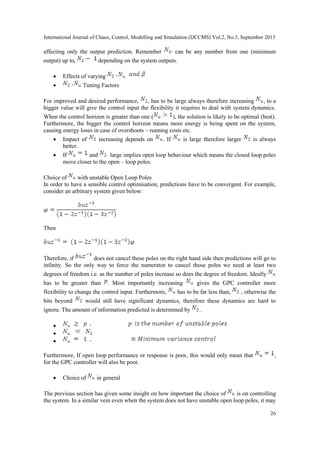
one for all of the simulations demonstrations. Furthermore, intervenes in the cost function](https://image.slidesharecdn.com/2313ijccms02-250924121654-3e4a4c2d/85/PERFORMANCE-COMPARISON-OF-TWO-CONTROLLERS-ON-A-NONLINEAR-SYSTEM-9-320.jpg)
![International Journal of Chaos, Control, Modelling and Simulation (IJCCMS) Vol.2, No.3, September 2013
27
have some underlying dynamics which are undesirable and the only way to eliminate or modify
these dynamics is by providing an input signal which is non – simple (not a step). Therefore for
system which have non – simple dynamics a larger is required in order to have flexibility in
the input trajectory to modify the dynamics. As a caution, the reader has to note that increasing
means increasing the energy to control the system.
The Control Weighting Sequence
These weighting of the input – output sequence is given in a form of range. For instance the
weighting factor may be chosen from the following range, . The weighting
factor “penalises the control signal and improves the condition of the matrix to be inverted as well
as bring the system response closer to desired closed loop performance [11, 12]”. Since the
nonlinear system used in this report is SISO system the weighting factors of the input and output
are equivalent.
6. TUNING MPC CONTROLLER
This section proposes the Auto Tuning algorithm for the PID and MPC. We simulated and
analysed different tuning and the best algorithm chosen for the PID as well as the effective GPC
control law. We auto tuned the PID controller using the Model – Based PID Auto tuning detailed
in [13], focussing on First Order Plus Dead Time (FOPDT), first-order lag and integrator plus
dead time (FOIPDT), and so on. We incorporated the ITAE (load) control on model based Auto
Tuning PID. The ITAE (load) is an optimisation technique which aims on minimising the system
output error using relations in Table 2. These relations in Table 2 provide the closed loop gain of
the system, integral time and the derivative times responsible for auto tuning the PID controller.
Table 4. PID Controller tuning and Auto tuned MPC Parameters with their respective parameter
values
Controller Parameter Values
PID
0.3745
0.3243
0.0954
MPC
20
3
0.25
1
These values are used in simulink models to auto tune the PID and MPC respectively. The
simulation results are shown in Figure 4 and 5 and the comparison of the simulation results are in
Table 5.](https://image.slidesharecdn.com/2313ijccms02-250924121654-3e4a4c2d/85/PERFORMANCE-COMPARISON-OF-TWO-CONTROLLERS-ON-A-NONLINEAR-SYSTEM-11-320.jpg)
![International Journal of Chaos, Control, Modelling and Simulation (IJCCMS) Vol.2, No.3, September 2013
28
0 10 20 30 40 50 60 70 80 90 100
0
0.2
0.4
0.6
0.8
1
1.2
1.4
1.6
1.8
2
ITAE(Load) PID Control
Time [seconds]
Step
/
target
Step input
ITAE(Load) PID
Velocity
Friction
Figure 4. Auto tuned PID: Nonlinear System Velocity Control
0 5 10 15 20 25 30 35 40 45 50
-0.4
-0.2
0
0.2
0.4
0.6
0.8
1
Time [seconds]
setpoint
or
target
speed
[m/s]
GPC Control: Ny = 20, Nu = 3, Wu = 0.25, Wy = 0.25, Sizey = 1
Reference Signal
Control Signal
System Response
Nonlinear Friction
Figure 5. Auto tuned MPC Velocity Control
Table 5. IMC – PID Tuning Rules [7]
Auto tuned PID Controller Auto tuned MPC Controller
Zero steady – state error
ITAE (Load) tuning technique provides good,
and desirable performance see Figure 4
Good for industrial applications with only little
information to rely on to yield the best
performance.
Good stability
Good system stability.
Zero steady – state error
Best for industrial applications
Relies on more information to make prediction
Fast, reliable and stable response see figure 5](https://image.slidesharecdn.com/2313ijccms02-250924121654-3e4a4c2d/85/PERFORMANCE-COMPARISON-OF-TWO-CONTROLLERS-ON-A-NONLINEAR-SYSTEM-12-320.jpg)
![International Journal of Chaos, Control, Modelling and Simulation (IJCCMS) Vol.2, No.3, September 2013
30
ACKNOWLEDGEMENTS
The authors would like to thank their families for the support!
REFERENCES
[1] Concepcion A. Monje, B.M.V., Vicente Feliu, YangQuan Chen, (2008) Tuning and auto-tuning of
fractional order controllers for industry applications,Vol. 16, No 7.
[2] Paz, R.A., (2001) The Design of the PID Controller. No 12.
[3] Prof. T.K. Ghoshal, P.S.S. (2010) Process Instrumentation and Control.
[4] Ltd, J.W.a.S.A.P., (2009) Process Identification and PID Control, Vol. 2, No (02 -01).
[5] Saeed Tavakoli, M.T., (2003) Optimal Tuning of PID controllers for First Order Plus Time Delay
models using Dimensional Analysis, Montreal, Canada: The Fourth International Conference on
Control and Automation (ICCA‟03).
[6] Yamada, K., (1999) Modified Internal Model Control for unstable systems. Proceedings of the 7th
Mediterranean Conference on Control and Automation, Vol. 99, No 7.
[7] Zalm, G.M.v.d., (2004) Tuning of PID – Type Controllers: Literature Overview, DAF, TU.
[8] Zollars, R.L., (2011) Tuning Rules: Quarter Decay Ratio (Cohen and Coon), Voiland School of
Chemical Engineering and Bioengineering, ChE 441 Process Control: Washington State
University.
[9] Wen Tan, J.L., Tongwen Chen, Horacio J. Marquez, (2006) Comparison of some well-known PID
tuning formulas, Publisher Computers and Chemical Engineering 30.
[10] Bordons, E.F.C.a.C., (2003) Model Predictive Control, Springer, Advanced Textbooks in Control
and Signal Processing.
[11] Mahfouf, P.M., (2011) Model – Based Predictive Control (MBPC), Sheffield: Advanced Control
Systems, ACS 406 Notes
[12] J.A. Rossiter, (2003) Model – Based Predictive Control, Sheffield, CRC Press control Series.
[13] Leva, A. and M. Maggio, (2012) Model-Based PI(D) Autotuning, in PID in the Third Millennium,
Springer-Verlag London.
Authors
Kenneth O.M. Mapoka is with the Department of Agricultural Engineering and Land Planning,
Botswana College of Agriculture, Gaborone, BOTSWANA. He received Master of Engineering in
Mechatronics from Sheffield University, United Kingdom in 2012. His special fields of interest include
predictive and robust control applications.
Dr Tranos Zuva is currently with Department of Computer Systems Engineering, Tshwane University,
Pretoria, South Africa.
Howard Masebu is a lecturer at Botswana College of Agriculture, Gaborone, Botswana in the
Department of Agricultural Engineering and Land Planning.
Keneilwe Zuva is currently a lecturer at the University of Botswana in the Department of Computer
Science. She received Masters of Engineering in Information Systems and Networking from the
University of Essex, UK in 2001. Her research interests are networking, image processing, and network
security.](https://image.slidesharecdn.com/2313ijccms02-250924121654-3e4a4c2d/85/PERFORMANCE-COMPARISON-OF-TWO-CONTROLLERS-ON-A-NONLINEAR-SYSTEM-14-320.jpg)


