“
“Clinical Supervision isa vehicle
Clinical Supervision is a vehicle
for developing professional
for developing professional
responsible teachers who were
responsible teachers who were
capable of analyzing their own
capable of analyzing their own
performance, who were open to
performance, who were open to
change and assistance from
change and assistance from
others, and self-directing”
others, and self-directing”
- Cogan-
- Cogan-
3.
CLINICAL SUPERVISION: Assumptions,
CLINICALSUPERVISION: Assumptions,
Ideas
Ideas
• It is a technology for improving
instruction
•It is a deliberate intervention into the
instructional process
•It is goal-oriented, combining the school’s
needs with the personal growth needs of
those who work within the school
4.
•It assumes aprofessional working
relationship between teacher/s and
supervisor/s
•It requires a high degree of mutual trust, as
reflected in understanding, support and
commitment to growth
•It is systematic, although it requires a
flexible and changing methodology
5.
1. Effective supervision
isabout engaging teachers in
reflective thinking and discussion,
based on insightful and useful
observation, not on evaluation.
TEN GUIDELINES OF OBSERVATION
6.
2. Supervision. ..
enhances teachers’ thought &
commitment to instructional
improvement;
relies on the use of observation
instrument,
to provide teachers with information
about their classrooms.
7.
3. Observation isa two-step process:
1. To describe what has occurred.
2. To interpret what it means.
8.
4. Too often,we jump into what
has been termed the
interpretation trap.
We jump to conclusions about a
particular behavior before
describing that behavior.
9.
When we interpretfirst, not only do
we lose description of that event,
but also
we create communication difficulties
that might result in teacher resistance.
10.
5. The preciseobservation tool or
technique should be chosen
collaboratively between teacher and
supervisor.
However, in most cases, the teacher
ultimately should determine the
instrument to be used.
11.
6. Observing theclassroom is not
necessarily an objective process.
Personal bias should be
acknowledged and discussed.
Although two or more individuals may
agree on what has occurred (during the
description stage), they might interpret its
meaning differently.
12.
Personal experience, beliefs,and prejudices
can lead to misinterpretations.
Awareness of the possibility of personal
bias is the first step toward interpreting
classroom behavior effectively and as
objectively as possible.
13.
7. Observing takesskill and
practice.
Quite often, we interpret as we observe.
If these tools of observation are to be
effective, then you must practice
separating interpretation from
description.
14.
No observer cansee or notice all
interactions. Attempts to do so lead only to
frustration and confusion.
Start observations in a limited setting with a
small group and observe one specific
behavior. E.g. quality of teacher questions.
8. Be aware of the limitation of
observation.
15.
9. Disclosure isan essential
element for successful
observation.
Prior to entering the classroom, the
observer should discuss arrangements
with the teacher:
- where to sit in the classroom,
- how to introduce the observer
to students, and so on.
16.
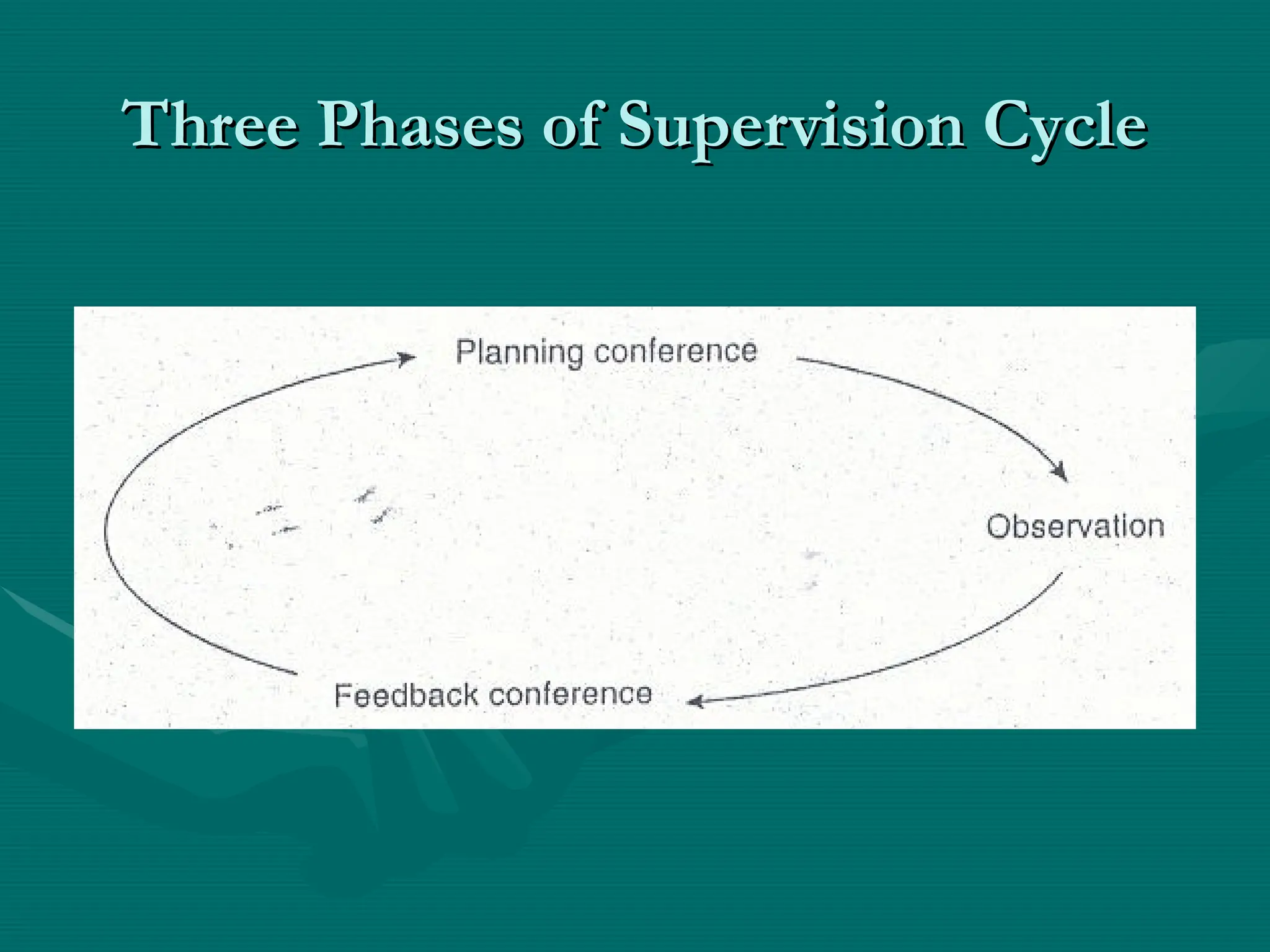
Three Phases ofSupervision Cycle
Three Phases of Supervision Cycle
17.
• We adda fourth phase to the three activities
We add a fourth phase to the three activities
of planning, observation, and analysis
of planning, observation, and analysis
through a feedback conference that includes
through a feedback conference that includes
a collaborative reflection and analysis of the
a collaborative reflection and analysis of the
process and its findings- PROFESSIONAL
process and its findings- PROFESSIONAL
DEVELOPMENT
DEVELOPMENT
18.
Goals of thePlanning Conference
Goals of the Planning Conference
• To identify teacher interests and concerns in an
To identify teacher interests and concerns in an
appropriate manner (directive informational,
appropriate manner (directive informational,
collaborative, or self-directed)
collaborative, or self-directed)
• To clarify that the primary purpose of the observation
To clarify that the primary purpose of the observation
is to improve teaching and learning.
is to improve teaching and learning.
• To reduce the stress and make the teacher feel
To reduce the stress and make the teacher feel
comfortable about the process.
comfortable about the process.
• To choose an observation tool and schedule the visit
To choose an observation tool and schedule the visit
and post conference.
and post conference.
19.
• Decide thefocus of the observation (choose a
Decide the focus of the observation (choose a
general approach: directive informational,
general approach: directive informational,
collaborative, self-directed)
collaborative, self-directed)
• Determine the method and form of observation.
Determine the method and form of observation.
• Set the time of the observation and the post-
Set the time of the observation and the post-
conference.
conference.
Three Steps in the Planning Conference
20.
KEY STEPS -The Observation
KEY STEPS - The Observation
• Finalize the choice of observation tool.
Finalize the choice of observation tool.
• Conduct the observation.
Conduct the observation.
• Verify the post-conference meeting time, and offer a
Verify the post-conference meeting time, and offer a
copy of the observation tool to the teacher .
copy of the observation tool to the teacher .
• Analyze facts of the observation and begin thinking of
Analyze facts of the observation and begin thinking of
interpretations.
interpretations.
• Choose a post-conference interpersonal approach.
Choose a post-conference interpersonal approach.
21.
III
III The Post-conference
ThePost-conference
Key Steps- Collaborative Approach
Key Steps- Collaborative Approach
• Identify the problem from the teacher’s perspective,
Identify the problem from the teacher’s perspective,
soliciting as much clarifying information as
soliciting as much clarifying information as
possible.
possible.
• Reflect back what you’ve heard for accuracy.
Reflect back what you’ve heard for accuracy.
• Begin collaborative brainstorming, asking the
Begin collaborative brainstorming, asking the
teacher for his or her ideas first.
teacher for his or her ideas first.
• Problem-solve through a sharing and discussing of
Problem-solve through a sharing and discussing of
options.
options.
• Agree on a plan and follow-up meeting.
Agree on a plan and follow-up meeting.
22.
III
III The Post-conference
ThePost-conference
Key Steps – Directive Informational Approach
Key Steps – Directive Informational Approach
• Identify the problem or goal and solicit clarifying
Identify the problem or goal and solicit clarifying
information.
information.
• Offer solutions. Ask for the teacher’s input into the
Offer solutions. Ask for the teacher’s input into the
alternatives offered and request additional ideas.
alternatives offered and request additional ideas.
• Summarize chosen alternatives, ask for confirmation,
Summarize chosen alternatives, ask for confirmation,
and request that the teacher restate final choices.
and request that the teacher restate final choices.
• Set a follow-up plan and meeting
Set a follow-up plan and meeting
23.
III
III The Post-conference
ThePost-conference
Key Steps- Self-Directed Approach
Key Steps- Self-Directed Approach
• Listen carefully to the teacher’s initial statement.
Listen carefully to the teacher’s initial statement.
• Reflect back your understanding of the problem.
Reflect back your understanding of the problem.
• Constantly clarify and reflect until the real problem is
Constantly clarify and reflect until the real problem is
identified.
identified.
• Have the teacher problem-solve and explore consequences
Have the teacher problem-solve and explore consequences
of various actions.
of various actions.
• The teacher commits to a decision and firms up a plan.
The teacher commits to a decision and firms up a plan.
• The supervisor restates the teacher’s plan and sets a follow-
The supervisor restates the teacher’s plan and sets a follow-
up meeting.
up meeting.
24.
IV
IV Collaborative Reflection
CollaborativeReflection
• The questions asked are simple; in fact, they are a
The questions asked are simple; in fact, they are a
variation of the reflector’s questions in the reflective
variation of the reflector’s questions in the reflective
practice guidelines presented earlier.
practice guidelines presented earlier.
What went well?
What went well?
What needs improvement?
What needs improvement?
What would you do differently?
What would you do differently?
Remember that the focus of the collaborative reflection
Remember that the focus of the collaborative reflection
is the process between the supervisor and the teacher,
is the process between the supervisor and the teacher,
not the teaching that took place in the observation.
not the teaching that took place in the observation.
25.
• What wasvaluable in what we have
What was valuable in what we have
been doing?
been doing?
• What was of little value?
What was of little value?
• What changes would you suggest for
What changes would you suggest for
the next cycle?
the next cycle?
REFLECTION QUESTIONS:
26.
IV
IV Collaborative Reflection
CollaborativeReflection
• The purpose of the collaborative reflection is to
The purpose of the collaborative reflection is to
think about the value of the supervision cycle
think about the value of the supervision cycle
just completed.
just completed.
• This discussion can take place toward the end
This discussion can take place toward the end
of the post-conference, at a scheduled time
of the post-conference, at a scheduled time
after the post-conference, informally soon after
after the post-conference, informally soon after
the post-conference, or, if schedules are really
the post-conference, or, if schedules are really
tight, as written feedback.
tight, as written feedback.
27.
Teachers have “bad”days and lessons
sometimes don’t work.
Students, too, may have “bad” days.
Multiple observations with different
foci are necessary.
10. Don’t draw conclusions based
on one observation.