Developmental Supervision


          Amber Forehand-Hughes
              Vicki Holden
              Alicia Ramey
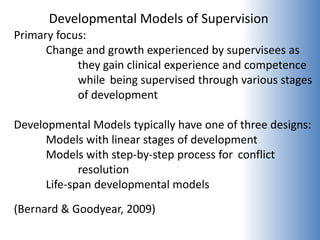
Developmental Models of Supervision
Primary focus:
      Change and growth experienced by supervisees as
            they gain clinical experience and competence
            while being supervised through various stages
            of development

Developmental Models typically have one of three designs:
      Models with linear stages of development
      Models with step-by-step process for conflict
             resolution
      Life-span developmental models
(Bernard & Goodyear, 2009)
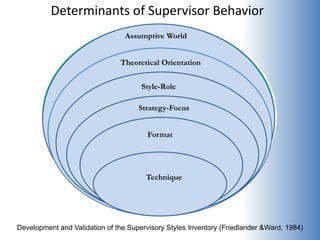
Determinants of Supervisor Behavior
                               Assumptive World
                             Theoretical Orientation

                               Theoretical Orientation


                                      Style-Role

                                     Strategy-Focus


                                        Format


                                       Technique


Development and Validation of the Supervisory Styles Inventory (Friedlander &Ward, 1984)
Assumptive World
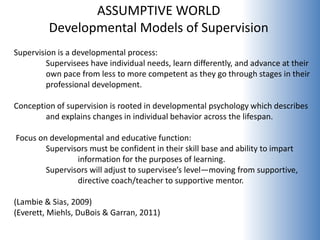
ASSUMPTIVE WORLD
         Developmental Models of Supervision
Supervision is a developmental process:
         Supervisees have individual needs, learn differently, and advance at their
         own pace from less to more competent as they go through stages in their
         professional development.

Conception of supervision is rooted in developmental psychology which describes
        and explains changes in individual behavior across the lifespan.

Focus on developmental and educative function:
        Supervisors must be confident in their skill base and ability to impart
                information for the purposes of learning.
        Supervisors will adjust to supervisee’s level—moving from supportive,
                directive coach/teacher to supportive mentor.

(Lambie & Sias, 2009)
(Everett, Miehls, DuBois & Garran, 2011)
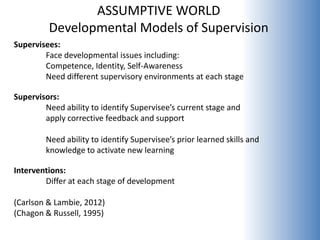
ASSUMPTIVE WORLD
         Developmental Models of Supervision
Supervisees:
        Face developmental issues including:
        Competence, Identity, Self-Awareness
        Need different supervisory environments at each stage

Supervisors:
        Need ability to identify Supervisee’s current stage and
        apply corrective feedback and support

        Need ability to identify Supervisee’s prior learned skills and
        knowledge to activate new learning

Interventions:
        Differ at each stage of development

(Carlson & Lambie, 2012)
(Chagon & Russell, 1995)
Theoretical Orientation
THEORETICAL ORIENTATION
   Developmental Models of Supervision

I. Cognitive Behavioral Orientation
       Cognitive Developmental Theory
       Earlier stages of Supervisee development
       More task-oriented supervision

II. Psychoanalytic Orientation
        Psychosocial Developmental Theory
        Later stages of Supervisee development
        More interpersonally sensitive supervision

(Friedlander & Ward, 1984)
THEORETICAL ORIENTATION
       Developmental Models of Supervision
III. Theoretical Eclecticism
        Uses combination of different theories
                (Humanistic and others)
        Allows for use of different techniques and
                interventions at different stages of the
                supervision process:

                       More cognitive at earlier stages of
                             supervisee development

                       More psychoanalytic at later stages
                             of supervisee development

(Friedlander & Ward, 1984)
Style-Role
STYLE-ROLE
         Developmental Models of Supervision
Examples of interventions (in IDM):
- Facilitative interventions
(enable the supervisee to retain some control in the relationship)
            - Cathartic: those that elicit affective reactions
            - Catalytic: open-ended questions intended to encourage self-exploration
            or problem-solving
            - Supportive: those that validate the supervisee
- Authoritative interventions
(provide more relational control to the supervisor)
            - Prescriptive: giving advice and making suggestions
            - Informative: providing information
            - Confronting: pointing out discrepancies the supervisor observes between
            or among supervisee (a) feelings, (b) attitudes, and/or (c) behaviors
- Conceptual interventions (help the supervisee link theory to practice)
            - Watch for the supervisee’s use of a particular strategy, then help him or
            her develop a conceptual from for what was just done
            - Present the model, then suggest an intervention based on it

(Bernard & Goodyear, 2009)
STYLE-ROLE
       Developmental Models of Supervision

Watch audio- or videotape of session > when trigger occurs,
supervisee stops tape > supervisor’s role is to ask questions to
guide supervisee’s reflections about the experience

Supervisor role is to assess supervisee on main issues (ex.
competence, emotional awareness, autonomy, theoretical
identity, etc.) and attempt to move supervisee to the next stage
of development (The Loganbill, Hardy, and Delworth Model)


(Bernard & Goodyear, 2009)
Strategy-Focus
STRATEGY-FOCUS
       Developmental Models of Supervision


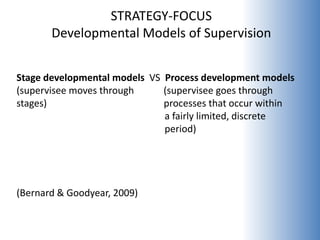
Stage developmental models VS Process development models
(supervisee moves through     (supervisee goes through
stages)                       processes that occur within
                              a fairly limited, discrete
                              period)


(Bernard & Goodyear, 2009)
STRATEGY-FOCUS
        Developmental Models of Supervision

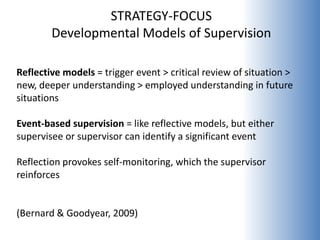
Reflective models = trigger event > critical review of situation >
new, deeper understanding > employed understanding in future
situations

Event-based supervision = like reflective models, but either
supervisee or supervisor can identify a significant event

Reflection provokes self-monitoring, which the supervisor
reinforces


(Bernard & Goodyear, 2009)
STRATEGY-FOCUS
          Developmental Models of Supervision
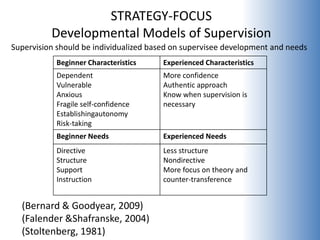
Supervision should be individualized based on supervisee development and needs
           Beginner Characteristics     Experienced Characteristics
           Dependent                    More confidence
           Vulnerable                   Authentic approach
           Anxious                      Know when supervision is
           Fragile self-confidence      necessary
           Establishingautonomy
           Risk-taking
           Beginner Needs               Experienced Needs
           Directive                    Less structure
           Structure                    Nondirective
           Support                      More focus on theory and
           Instruction                  counter-transference


  (Bernard & Goodyear, 2009)
  (Falender &Shafranske, 2004)
  (Stoltenberg, 1981)
Format and Techniques
FORMAT AND TECHNIQUES
       Developmental Models of Supervision

   Format and techniques are based on supervisee’s
   current stage of development and supervisee
   learning style

   A supervisor can appropriately provide feedback
   while simultaneously facilitating the supervisee’s
   progress to the next stage

   Based on notion that supervisees’ competence
   and needs change over time

(Bernard and Goodyear, 2009)
FORMAT AND TECHNIQUES
   Developmental Models of Supervision

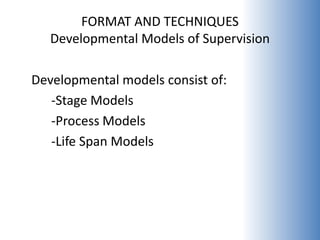
Developmental models consist of:
   -Stage Models
   -Process Models
   -Life Span Models
FORMAT AND TECHNIQUES
       Developmental Models of Supervision
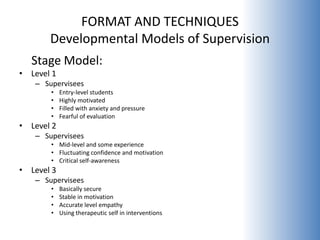
  Stage Model:
• Level 1
   – Supervisees
       •    Entry-level students
       •    Highly motivated
       •    Filled with anxiety and pressure
       •    Fearful of evaluation
• Level 2
   – Supervisees
       • Mid-level and some experience
       • Fluctuating confidence and motivation
       • Critical self-awareness
• Level 3
   – Supervisees
       •    Basically secure
       •    Stable in motivation
       •    Accurate level empathy
       •    Using therapeutic self in interventions
FORMAT AND TECHNIQUES
   Developmental Models of Supervision
Process Model:
Reflective Model Practice
– Use of reflective process through selection of
  therapeutic orientation
– Work-related reflections
   • Self-monitored
– Discovery Learning
   − Trigger Event             – Skills and strategy
   − Critical reevaluation     – Personhood Issues
   − Achieve new perspective   – Conceptualization
FORMAT AND TECHNIQUES
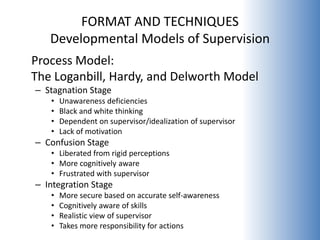
   Developmental Models of Supervision
Process Model:
The Loganbill, Hardy, and Delworth Model
– Stagnation Stage
   •   Unawareness deficiencies
   •   Black and white thinking
   •   Dependent on supervisor/idealization of supervisor
   •   Lack of motivation
– Confusion Stage
   • Liberated from rigid perceptions
   • More cognitively aware
   • Frustrated with supervisor
– Integration Stage
   •   More secure based on accurate self-awareness
   •   Cognitively aware of skills
   •   Realistic view of supervisor
   •   Takes more responsibility for actions
FORMAT AND TECHNIQUES
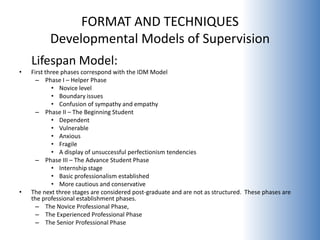
          Developmental Models of Supervision
    Lifespan Model:
•   First three phases correspond with the IDM Model
      – Phase I – Helper Phase
             • Novice level
             • Boundary issues
             • Confusion of sympathy and empathy
      – Phase II – The Beginning Student
             • Dependent
             • Vulnerable
             • Anxious
             • Fragile
             • A display of unsuccessful perfectionism tendencies
      – Phase III – The Advance Student Phase
             • Internship stage
             • Basic professionalism established
             • More cautious and conservative
•   The next three stages are considered post-graduate and are not as structured. These phases are
    the professional establishment phases.
      – The Novice Professional Phase,
      – The Experienced Professional Phase
      – The Senior Professional Phase
FORMAT AND TECHNIQUES
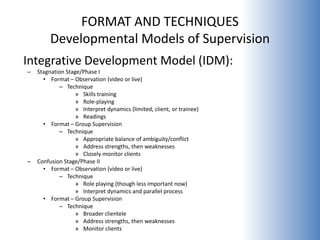
         Developmental Models of Supervision
Integrative Development Model (IDM):
–   Stagnation Stage/Phase I
      • Format – Observation (video or live)
            – Technique
                   » Skills training
                   » Role-playing
                   » Interpret dynamics (limited, client, or trainee)
                   » Readings
      • Format – Group Supervision
            – Technique
                   » Appropriate balance of ambiguity/conflict
                   » Address strengths, then weaknesses
                   » Closely monitor clients
–   Confusion Stage/Phase II
      • Format – Observation (video or live)
            – Technique
                   » Role playing (though less important now)
                   » Interpret dynamics and parallel process
      • Format – Group Supervision
            – Technique
                   » Broader clientele
                   » Address strengths, then weaknesses
                   » Monitor clients
FORMAT AND TECHNIQUES
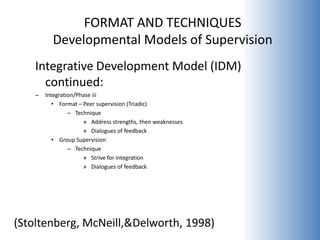
          Developmental Models of Supervision
    Integrative Development Model (IDM)
      continued:
    –   Integration/Phase iii
           • Format – Peer supervision (Triadic)
                 – Technique
                      » Address strengths, then weaknesses
                      » Dialogues of feedback
           • Group Supervision
                 – Technique
                      » Strive for integration
                      » Dialogues of feedback


(Stoltenberg, McNeill,&Delworth, 1998)
References
REFERENCES
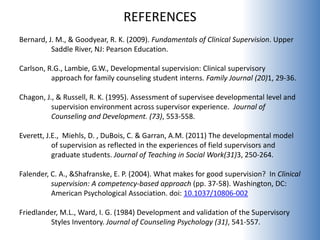
Bernard, J. M., & Goodyear, R. K. (2009). Fundamentals of Clinical Supervision. Upper
          Saddle River, NJ: Pearson Education.

Carlson, R.G., Lambie, G.W., Developmental supervision: Clinical supervisory
          approach for family counseling student interns. Family Journal (20)1, 29-36.

Chagon, J., & Russell, R. K. (1995). Assessment of supervisee developmental level and
          supervision environment across supervisor experience. Journal of
          Counseling and Development. (73), 553-558.

Everett, J.E., Miehls, D. , DuBois, C. & Garran, A.M. (2011) The developmental model
           of supervision as reflected in the experiences of field supervisors and
           graduate students. Journal of Teaching in Social Work(31)3, 250-264.

Falender, C. A., &Shafranske, E. P. (2004). What makes for good supervision? In Clinical
          supervision: A competency-based approach (pp. 37-58). Washington, DC:
          American Psychological Association. doi: 10.1037/10806-002

Friedlander, M.L., Ward, I. G. (1984) Development and validation of the Supervisory
         Styles Inventory. Journal of Counseling Psychology (31), 541-557.
REFERENCES (CONTINUED)
Haynes, R., Corey, G., & Moulton, P. (2003). Clinical supervision in the helping
         professions: A practical guide. Pacific Grove, CA: Brooks/Cole.

Lambie, G.W., Sias, S.M. (2009) An Integrative psychological developmental model of
         supervision for professional school counselors-in-training. Journal Of
         Counseling & Development, 87(3), 349-356.

Ronnestad, M. H., &Skovolt, T. M. (1993). Supervision of beginning and advanced
        graduate students of counseling and psychotherapy. Journal of Counseling
        and Development, 71, 396-405.

Stoltenberg, C. (1981). Approaching supervision from a developmental perspective:
         The counselor complexity model. Journal of Counseling Psychology, 28(1),
         59-65. doi:10.1037/0022-0167.28.1.59

Stoltenberg, C. D., McNeill, B. and Delworth, U. (1998) DM Supervision: An Integrated
         Developmental Model of Supervising Counselors and Therapists. The
         Counseling Psychologist 28 (5), 622-640.

Developmental Supervision

  • 1.
    Developmental Supervision Amber Forehand-Hughes Vicki Holden Alicia Ramey
  • 2.
    Developmental Models ofSupervision Primary focus: Change and growth experienced by supervisees as they gain clinical experience and competence while being supervised through various stages of development Developmental Models typically have one of three designs: Models with linear stages of development Models with step-by-step process for conflict resolution Life-span developmental models (Bernard & Goodyear, 2009)
  • 3.
    Determinants of SupervisorBehavior Assumptive World Theoretical Orientation Theoretical Orientation Style-Role Strategy-Focus Format Technique Development and Validation of the Supervisory Styles Inventory (Friedlander &Ward, 1984)
  • 4.
  • 5.
    ASSUMPTIVE WORLD Developmental Models of Supervision Supervision is a developmental process: Supervisees have individual needs, learn differently, and advance at their own pace from less to more competent as they go through stages in their professional development. Conception of supervision is rooted in developmental psychology which describes and explains changes in individual behavior across the lifespan. Focus on developmental and educative function: Supervisors must be confident in their skill base and ability to impart information for the purposes of learning. Supervisors will adjust to supervisee’s level—moving from supportive, directive coach/teacher to supportive mentor. (Lambie & Sias, 2009) (Everett, Miehls, DuBois & Garran, 2011)
  • 6.
    ASSUMPTIVE WORLD Developmental Models of Supervision Supervisees: Face developmental issues including: Competence, Identity, Self-Awareness Need different supervisory environments at each stage Supervisors: Need ability to identify Supervisee’s current stage and apply corrective feedback and support Need ability to identify Supervisee’s prior learned skills and knowledge to activate new learning Interventions: Differ at each stage of development (Carlson & Lambie, 2012) (Chagon & Russell, 1995)
  • 7.
  • 8.
    THEORETICAL ORIENTATION Developmental Models of Supervision I. Cognitive Behavioral Orientation Cognitive Developmental Theory Earlier stages of Supervisee development More task-oriented supervision II. Psychoanalytic Orientation Psychosocial Developmental Theory Later stages of Supervisee development More interpersonally sensitive supervision (Friedlander & Ward, 1984)
  • 9.
    THEORETICAL ORIENTATION Developmental Models of Supervision III. Theoretical Eclecticism Uses combination of different theories (Humanistic and others) Allows for use of different techniques and interventions at different stages of the supervision process: More cognitive at earlier stages of supervisee development More psychoanalytic at later stages of supervisee development (Friedlander & Ward, 1984)
  • 10.
  • 11.
    STYLE-ROLE Developmental Models of Supervision Examples of interventions (in IDM): - Facilitative interventions (enable the supervisee to retain some control in the relationship) - Cathartic: those that elicit affective reactions - Catalytic: open-ended questions intended to encourage self-exploration or problem-solving - Supportive: those that validate the supervisee - Authoritative interventions (provide more relational control to the supervisor) - Prescriptive: giving advice and making suggestions - Informative: providing information - Confronting: pointing out discrepancies the supervisor observes between or among supervisee (a) feelings, (b) attitudes, and/or (c) behaviors - Conceptual interventions (help the supervisee link theory to practice) - Watch for the supervisee’s use of a particular strategy, then help him or her develop a conceptual from for what was just done - Present the model, then suggest an intervention based on it (Bernard & Goodyear, 2009)
  • 12.
    STYLE-ROLE Developmental Models of Supervision Watch audio- or videotape of session > when trigger occurs, supervisee stops tape > supervisor’s role is to ask questions to guide supervisee’s reflections about the experience Supervisor role is to assess supervisee on main issues (ex. competence, emotional awareness, autonomy, theoretical identity, etc.) and attempt to move supervisee to the next stage of development (The Loganbill, Hardy, and Delworth Model) (Bernard & Goodyear, 2009)
  • 13.
  • 14.
    STRATEGY-FOCUS Developmental Models of Supervision Stage developmental models VS Process development models (supervisee moves through (supervisee goes through stages) processes that occur within a fairly limited, discrete period) (Bernard & Goodyear, 2009)
  • 15.
    STRATEGY-FOCUS Developmental Models of Supervision Reflective models = trigger event > critical review of situation > new, deeper understanding > employed understanding in future situations Event-based supervision = like reflective models, but either supervisee or supervisor can identify a significant event Reflection provokes self-monitoring, which the supervisor reinforces (Bernard & Goodyear, 2009)
  • 16.
    STRATEGY-FOCUS Developmental Models of Supervision Supervision should be individualized based on supervisee development and needs Beginner Characteristics Experienced Characteristics Dependent More confidence Vulnerable Authentic approach Anxious Know when supervision is Fragile self-confidence necessary Establishingautonomy Risk-taking Beginner Needs Experienced Needs Directive Less structure Structure Nondirective Support More focus on theory and Instruction counter-transference (Bernard & Goodyear, 2009) (Falender &Shafranske, 2004) (Stoltenberg, 1981)
  • 17.
  • 18.
    FORMAT AND TECHNIQUES Developmental Models of Supervision Format and techniques are based on supervisee’s current stage of development and supervisee learning style A supervisor can appropriately provide feedback while simultaneously facilitating the supervisee’s progress to the next stage Based on notion that supervisees’ competence and needs change over time (Bernard and Goodyear, 2009)
  • 19.
    FORMAT AND TECHNIQUES Developmental Models of Supervision Developmental models consist of: -Stage Models -Process Models -Life Span Models
  • 20.
    FORMAT AND TECHNIQUES Developmental Models of Supervision Stage Model: • Level 1 – Supervisees • Entry-level students • Highly motivated • Filled with anxiety and pressure • Fearful of evaluation • Level 2 – Supervisees • Mid-level and some experience • Fluctuating confidence and motivation • Critical self-awareness • Level 3 – Supervisees • Basically secure • Stable in motivation • Accurate level empathy • Using therapeutic self in interventions
  • 21.
    FORMAT AND TECHNIQUES Developmental Models of Supervision Process Model: Reflective Model Practice – Use of reflective process through selection of therapeutic orientation – Work-related reflections • Self-monitored – Discovery Learning − Trigger Event – Skills and strategy − Critical reevaluation – Personhood Issues − Achieve new perspective – Conceptualization
  • 22.
    FORMAT AND TECHNIQUES Developmental Models of Supervision Process Model: The Loganbill, Hardy, and Delworth Model – Stagnation Stage • Unawareness deficiencies • Black and white thinking • Dependent on supervisor/idealization of supervisor • Lack of motivation – Confusion Stage • Liberated from rigid perceptions • More cognitively aware • Frustrated with supervisor – Integration Stage • More secure based on accurate self-awareness • Cognitively aware of skills • Realistic view of supervisor • Takes more responsibility for actions
  • 23.
    FORMAT AND TECHNIQUES Developmental Models of Supervision Lifespan Model: • First three phases correspond with the IDM Model – Phase I – Helper Phase • Novice level • Boundary issues • Confusion of sympathy and empathy – Phase II – The Beginning Student • Dependent • Vulnerable • Anxious • Fragile • A display of unsuccessful perfectionism tendencies – Phase III – The Advance Student Phase • Internship stage • Basic professionalism established • More cautious and conservative • The next three stages are considered post-graduate and are not as structured. These phases are the professional establishment phases. – The Novice Professional Phase, – The Experienced Professional Phase – The Senior Professional Phase
  • 24.
    FORMAT AND TECHNIQUES Developmental Models of Supervision Integrative Development Model (IDM): – Stagnation Stage/Phase I • Format – Observation (video or live) – Technique » Skills training » Role-playing » Interpret dynamics (limited, client, or trainee) » Readings • Format – Group Supervision – Technique » Appropriate balance of ambiguity/conflict » Address strengths, then weaknesses » Closely monitor clients – Confusion Stage/Phase II • Format – Observation (video or live) – Technique » Role playing (though less important now) » Interpret dynamics and parallel process • Format – Group Supervision – Technique » Broader clientele » Address strengths, then weaknesses » Monitor clients
  • 25.
    FORMAT AND TECHNIQUES Developmental Models of Supervision Integrative Development Model (IDM) continued: – Integration/Phase iii • Format – Peer supervision (Triadic) – Technique » Address strengths, then weaknesses » Dialogues of feedback • Group Supervision – Technique » Strive for integration » Dialogues of feedback (Stoltenberg, McNeill,&Delworth, 1998)
  • 26.
  • 27.
    REFERENCES Bernard, J. M.,& Goodyear, R. K. (2009). Fundamentals of Clinical Supervision. Upper Saddle River, NJ: Pearson Education. Carlson, R.G., Lambie, G.W., Developmental supervision: Clinical supervisory approach for family counseling student interns. Family Journal (20)1, 29-36. Chagon, J., & Russell, R. K. (1995). Assessment of supervisee developmental level and supervision environment across supervisor experience. Journal of Counseling and Development. (73), 553-558. Everett, J.E., Miehls, D. , DuBois, C. & Garran, A.M. (2011) The developmental model of supervision as reflected in the experiences of field supervisors and graduate students. Journal of Teaching in Social Work(31)3, 250-264. Falender, C. A., &Shafranske, E. P. (2004). What makes for good supervision? In Clinical supervision: A competency-based approach (pp. 37-58). Washington, DC: American Psychological Association. doi: 10.1037/10806-002 Friedlander, M.L., Ward, I. G. (1984) Development and validation of the Supervisory Styles Inventory. Journal of Counseling Psychology (31), 541-557.
  • 28.
    REFERENCES (CONTINUED) Haynes, R.,Corey, G., & Moulton, P. (2003). Clinical supervision in the helping professions: A practical guide. Pacific Grove, CA: Brooks/Cole. Lambie, G.W., Sias, S.M. (2009) An Integrative psychological developmental model of supervision for professional school counselors-in-training. Journal Of Counseling & Development, 87(3), 349-356. Ronnestad, M. H., &Skovolt, T. M. (1993). Supervision of beginning and advanced graduate students of counseling and psychotherapy. Journal of Counseling and Development, 71, 396-405. Stoltenberg, C. (1981). Approaching supervision from a developmental perspective: The counselor complexity model. Journal of Counseling Psychology, 28(1), 59-65. doi:10.1037/0022-0167.28.1.59 Stoltenberg, C. D., McNeill, B. and Delworth, U. (1998) DM Supervision: An Integrated Developmental Model of Supervising Counselors and Therapists. The Counseling Psychologist 28 (5), 622-640.