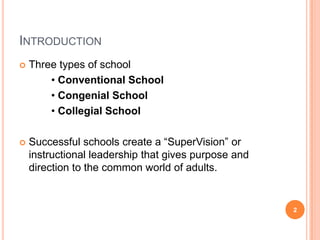
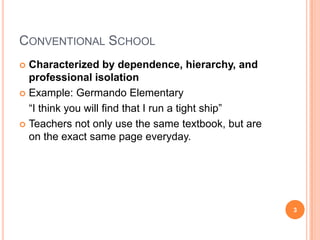
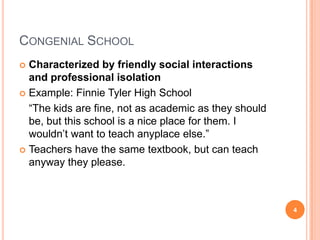
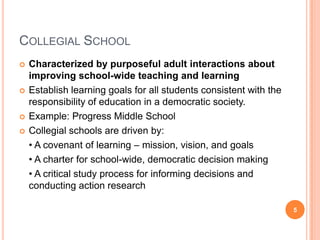
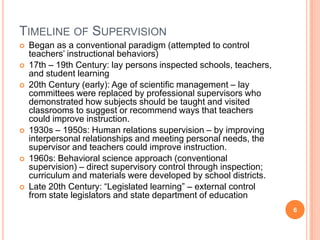
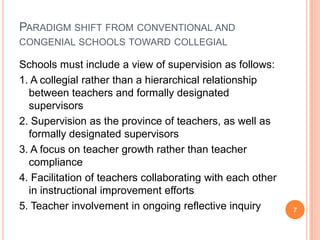
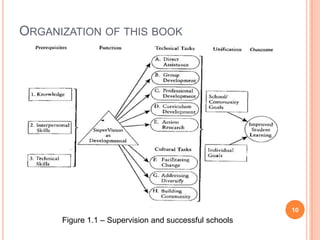
The document summarizes Carl Glickman's framework for instructional supervision. It outlines three types of schools: conventional (dependent and hierarchical), congenial (friendly but isolated), and collegial (focused on improving teaching and learning). Successful schools create "SuperVision" through instructional leadership focused on developing a shared mission and engaging teachers in decision-making. Effective supervision requires knowledge, interpersonal skills, and technical expertise to support teachers through tasks like professional development, curriculum planning, and action research. The goal is shifting from conventional control of teachers to a collaborative, growth-oriented approach focused on student achievement in a democratic society.