CHAPTER THREE
SUPERVISION OF INSTRUCTION
EM 205-TEACHER SUPERVISION AND
EVALUATION METHODS
PRESENTED BY:
MARIA ANGELA C. EROLES
MAED
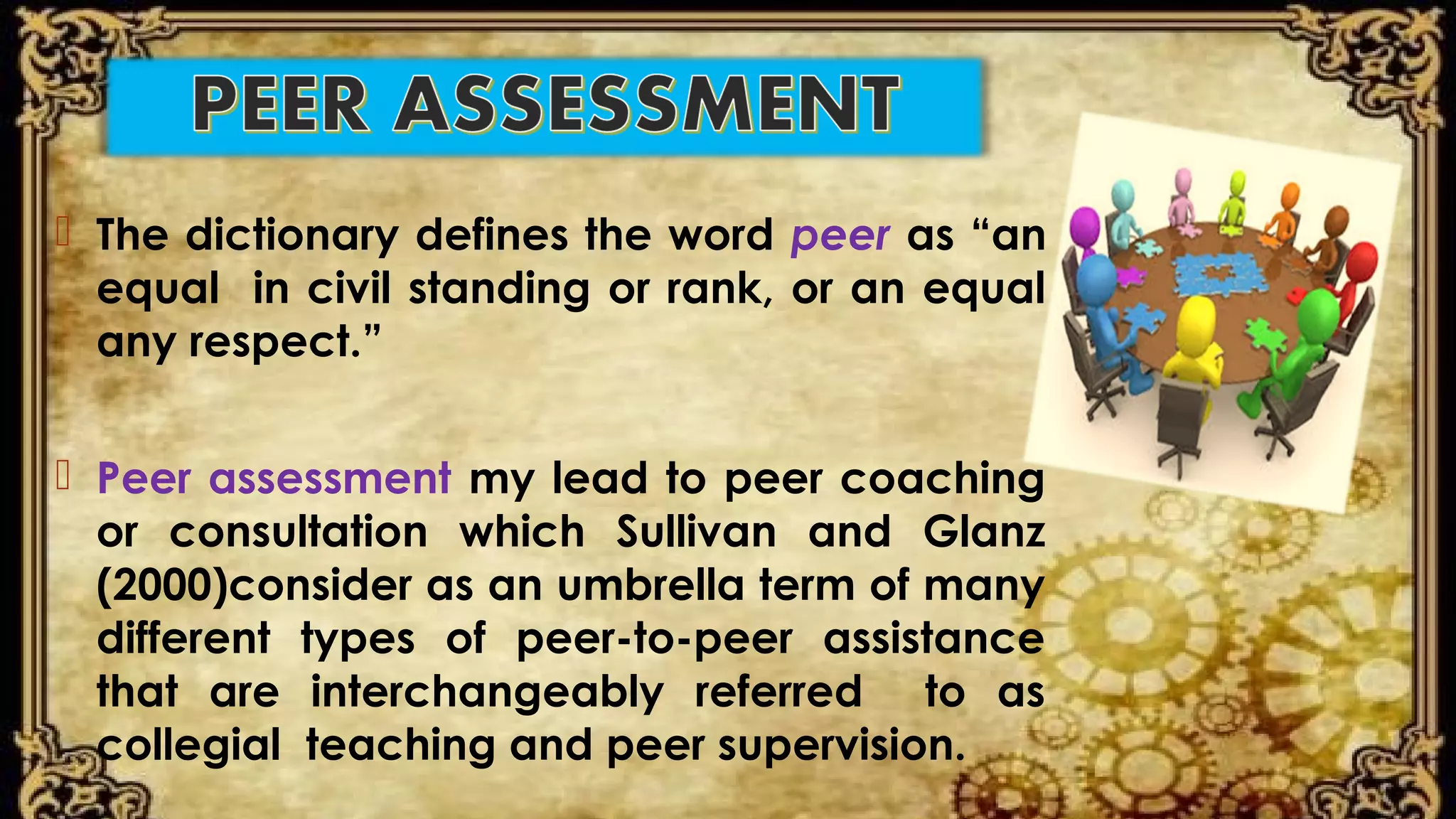
 The dictionary defines the word peer as “an
equal in civil standing or rank, or an equal
any respect.”
 Peer assessment my lead to peer coaching
or consultation which Sullivan and Glanz
(2000)consider as an umbrella term of many
different types of peer-to-peer assistance
that are interchangeably referred to as
collegial teaching and peer supervision.
PEER COACHING
 Peer coaching takes place when a fellow teacher, who
is knowledgeable about specific aspects of the
teaching-learning process, serves as a coach or
consultant to another seeking help.
 Based on Joyce and Showers model (in Sullivan and
Glanz, 2000), peer coaching involves regular meeting
between or among two or more teachers in order to
jointly solve problems using planning, feedback and
creative thinking for development of a specific skills.
 Refine teaching practices;
 Stimulate self-initiating, autonomous teacher thought;
 Improve school culture;
 Increase collegiality and professional dialogue; and
 Share in the implementation of new or common
instructional skills.
-According to Joyce and Showers p.133
 The ERIC Digests (n.d.) defines a teacher
portfolio as a collection of works, records, and
documents demonstrating and highlighting a
teacher’s knowledge and skills in teaching.
 It is also a documentation created by a teacher
that reveals and describes his/ her duties,
expertise and professional growth.
1. Teacher’s background
2. Class description: time, grade, and content
3. Licensure examinations
4. A personal statement of teaching philosophy
and goals.
5. Faculty development
6. Implemented lesson plans, handouts, and
notes
7. Graded student work
8. Video/ audiotape of classroom lessons
9. Colleague observation records
10.Written reflection on teaching
11.Photographs of bulletin boards, chalkboards,
or projects.
 A portfolio may be used as additional source
of information for assessing and evaluating
the effectiveness of teacher for
administrative decisions such as retention
and promotion (summative), or for providing
feedback so that teachers may improve
their teaching and level of
professionalism(formative).
1. Start slowly.
2. Gain acceptance.
3. Instill ownership.
4. Communicate implementation.
5. Use models.
6. Be selective.
7. Be realistic.
Action research is an inquiry that teachers
design and conduct in order to improve
teaching.
It promotes the concept of teacher-as-
researcher (ERIC Digests, n.d.) which
encourages teachers to be collaborators
not only in improving teaching behavior, but
also in revising curriculum, improving
working environment, professionalizing,
teaching, developing policy.
Action research is an inquiry that teachers
design and conduct in order to improve
teaching.
It promotes the concept of teacher-as-
researcher (ERIC Digests, n.d.) which
encourages teachers to be collaborators
not only in improving teaching behavior, but
also in revising curriculum, improving
working environment, professionalizing,
teaching, developing policy.
o The most important feature of action
research is the linking of “action ” and
“research” while involves trying out
practical ideas as means of increasing
knowledge about improving
curriculum, teaching, and learning
(Kemmis and McTaggarrt, 1982).
o The most important feature of action
research is the linking of “action ” and
“research” while involves trying out
practical ideas as means of increasing
knowledge about improving
curriculum, teaching, and learning
(Kemmis and McTaggarrt, 1982).
o Teacher-action research is solution-
oriented.
o It consists of spiraling cycles of problem
identification, systematic data collection,
analysis and reflection, data-driven, and
problem redefinition.
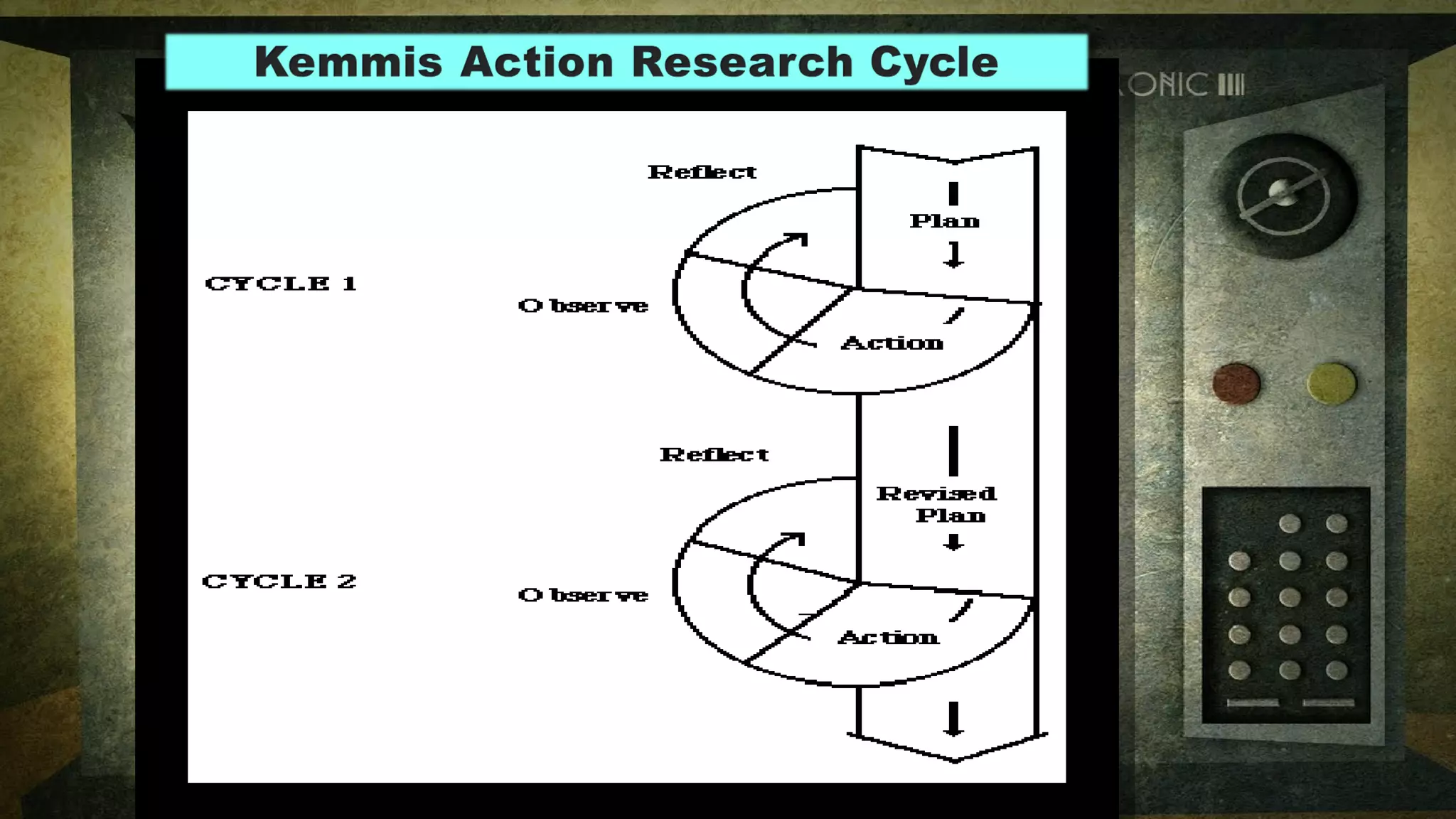
o Kemmis (O’brien,1998) developed a simple
model of the cyclical nature of the action
research process consisting of four steps:
plan, act, observe and reflect.
o Teacher-action research is solution-
oriented.
o It consists of spiraling cycles of problem
identification, systematic data collection,
analysis and reflection, data-driven, and
problem redefinition.
o Kemmis (O’brien,1998) developed a simple
model of the cyclical nature of the action
research process consisting of four steps:
plan, act, observe and reflect.
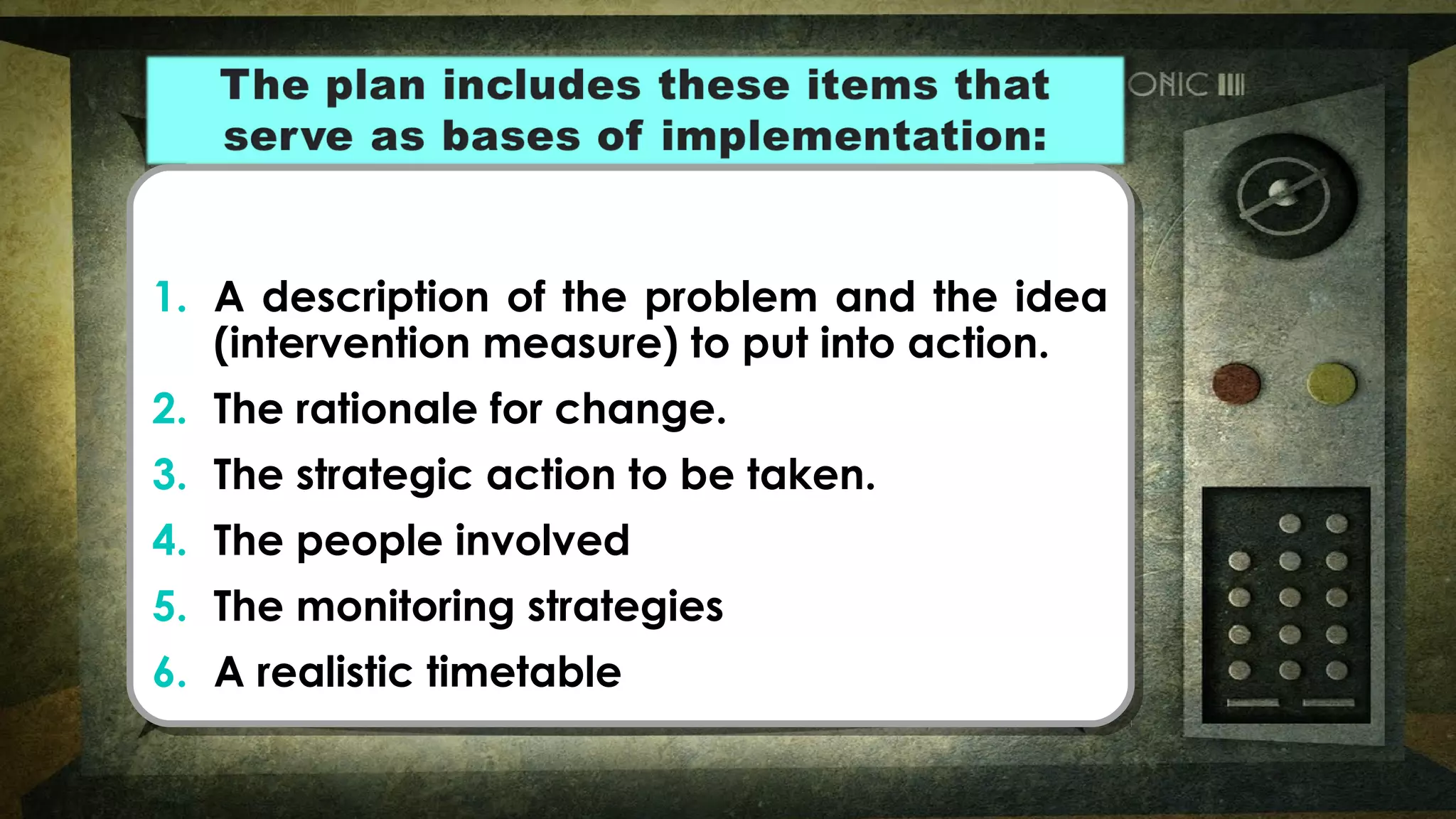
1. A description of the problem and the idea
(intervention measure) to put into action.
2. The rationale for change.
3. The strategic action to be taken.
4. The people involved
5. The monitoring strategies
6. A realistic timetable
1. A description of the problem and the idea
(intervention measure) to put into action.
2. The rationale for change.
3. The strategic action to be taken.
4. The people involved
5. The monitoring strategies
6. A realistic timetable
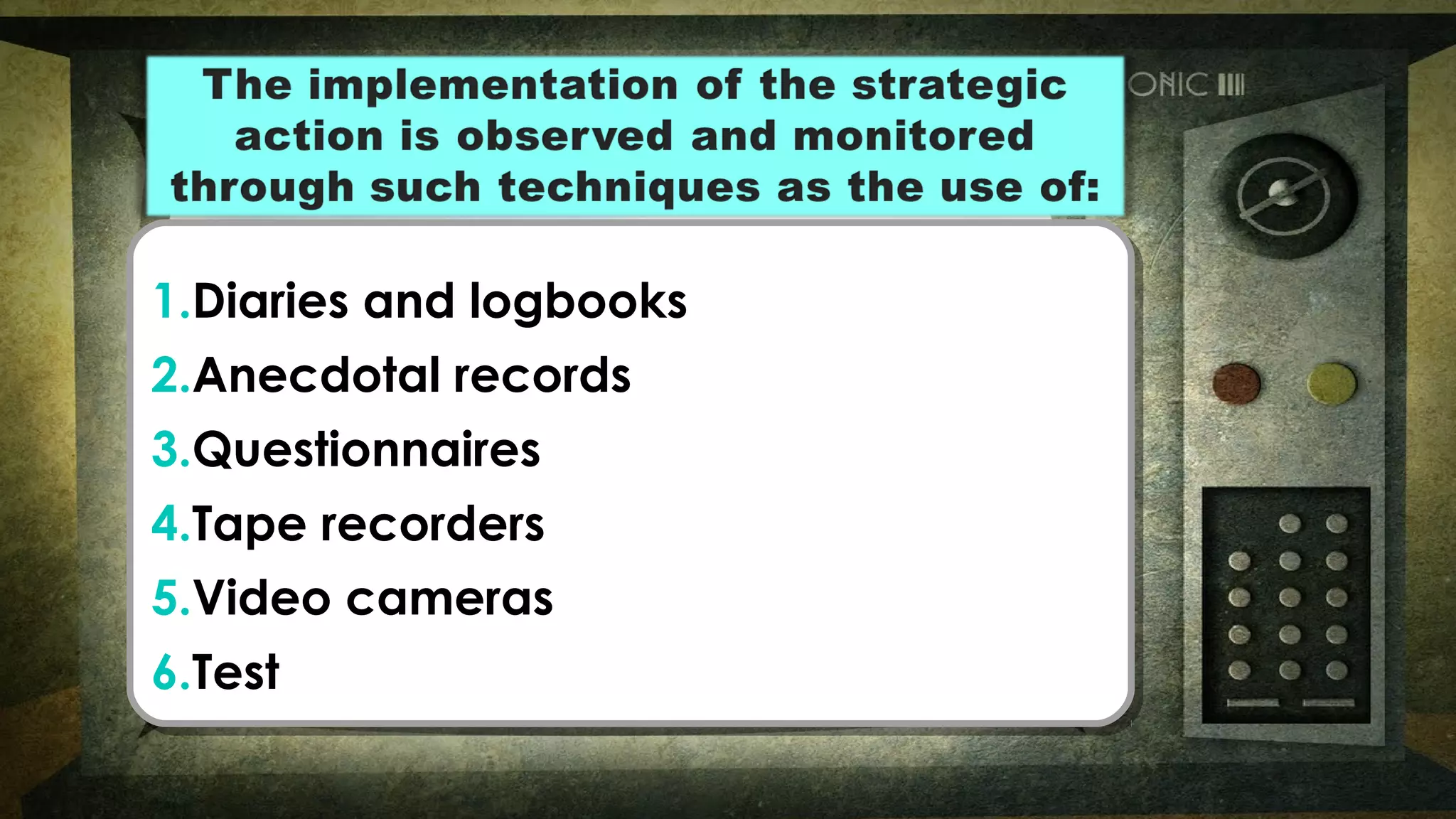
1.Diaries and logbooks
2.Anecdotal records
3.Questionnaires
4.Tape recorders
5.Video cameras
6.Test
1.Diaries and logbooks
2.Anecdotal records
3.Questionnaires
4.Tape recorders
5.Video cameras
6.Test
•Those who are hired without any
previous teaching experience
usually after the completion of
pre-service education, or those
who enter the teaching profession
after quitting a non-teaching job.
• The first category is composed of new graduates
with either a Bachelor of Secondary Education
(BSE) or a Bachelor of Elementary Education
(BEE) degree from Pre-service education
institutions.
• The second category usually comprises
graduates of other professions who have taken
18 units of pedagogy to qualify to teach.
Pre-service education is the
formal teacher education
program designed to help an
individual prepare for the
teaching profession.
• Under Philippine Law, both types of novice
teachers have to be certified by the Licensure
Board for Teachers after passing the
professional examination.
• According to Dukes, Cangelosi, and Knight (in
Cangelosi, 1991), pre-service teacher
education programs provide beginning
teachers with necessary, but still insufficient,
competencies to be successful in service
teachers.
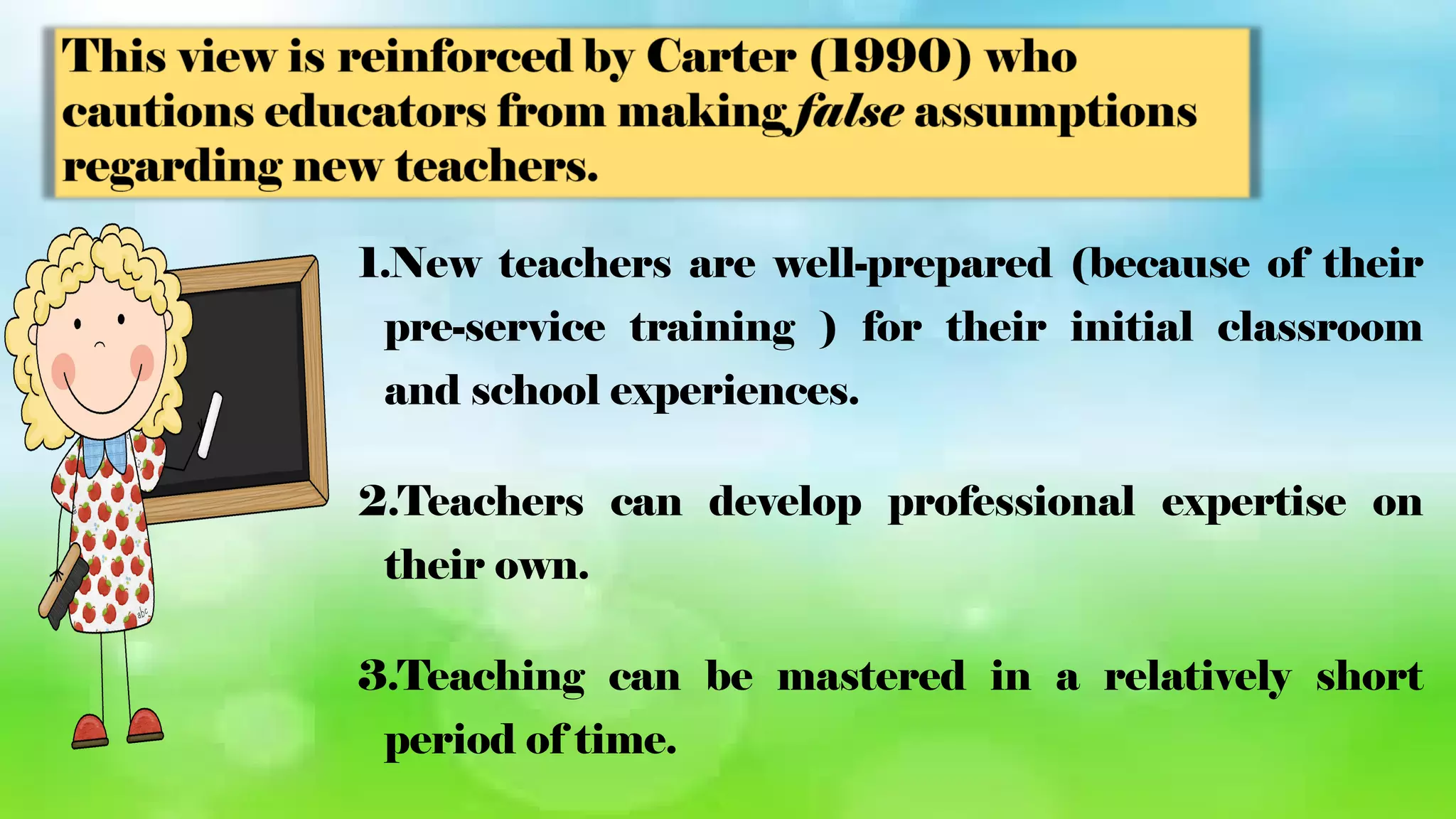
1.New teachers are well-prepared (because of their
pre-service training ) for their initial classroom
and school experiences.
2.Teachers can develop professional expertise on
their own.
3.Teaching can be mastered in a relatively short
period of time.
• To become consistently effective, especially in the
initial years of their teaching careers, beginning
teachers need assistance and feedback as they
perform their work. This is the function of
supervision.
• Gordon and Maxey(2000) report that many
educators believe that it takes three years to induct
a new teacher fully.
• This period according to Cangelosi (1991), is the
most critical and career threatening.
• Reyes(2003) conducted an investigation of 137
neophyte teachers in 15 private schools in the
National Capital region to fin out the major
problems they encountered in the workplace
during the probationary period (first three years).
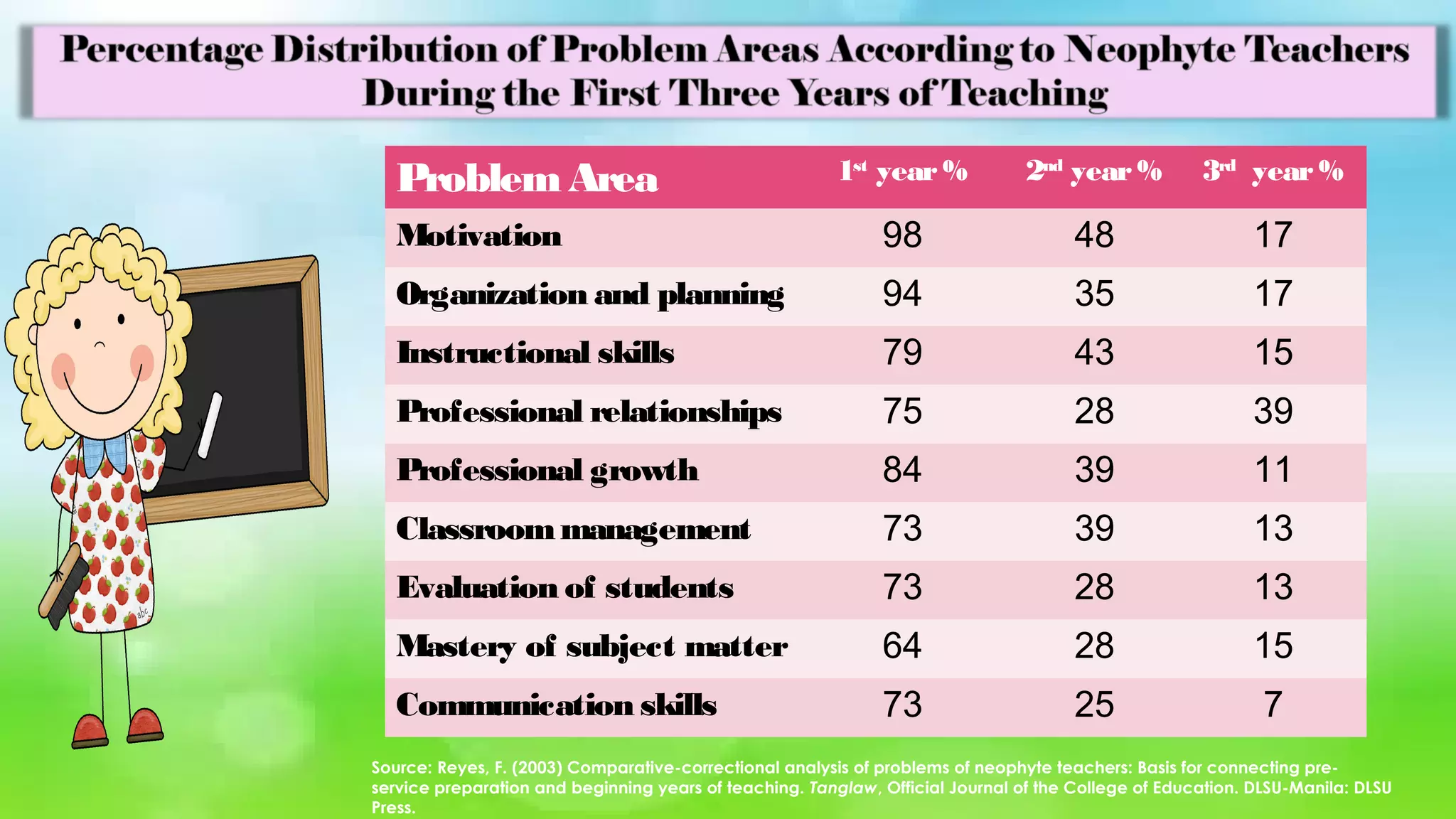
• The results of the study showed a gradual decrease
in the percentage of distribution of the problem
areas- except for professional relationships -during
the first three years of teaching.
ProblemArea 1st
year% 2nd
year% 3rd
year%
Motivation 98 48 17
Organization and planning 94 35 17
Instructional skills 79 43 15
Professional relationships 75 28 39
Professional growth 84 39 11
Classroommanagement 73 39 13
Evaluation of students 73 28 13
Mastery of subject matter 64 28 15
Communication skills 73 25 7
Source: Reyes, F. (2003) Comparative-correctional analysis of problems of neophyte teachers: Basis for connecting pre-
service preparation and beginning years of teaching. Tanglaw, Official Journal of the College of Education. DLSU-Manila: DLSU
Press.
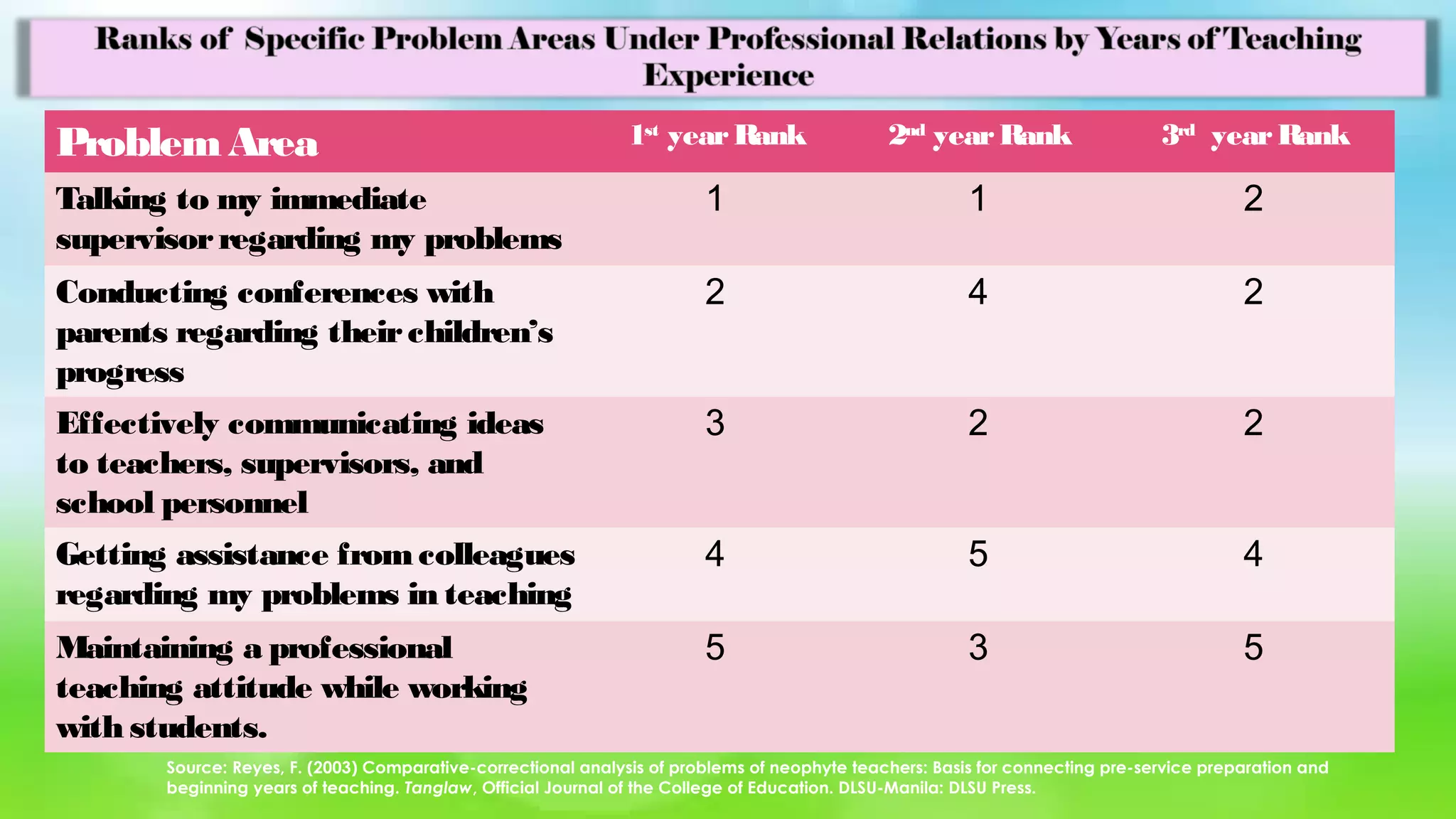
ProblemArea 1st
yearRank 2nd
yearRank 3rd
yearRank
Talking to my immediate
supervisorregarding my problems
1 1 2
Conducting conferences with
parents regarding theirchildren’s
progress
2 4 2
Effectively communicating ideas
to teachers, supervisors, and
school personnel
3 2 2
Getting assistance fromcolleagues
regarding my problems in teaching
4 5 4
Maintaining a professional
teaching attitude while working
with students.
5 3 5
Source: Reyes, F. (2003) Comparative-correctional analysis of problems of neophyte teachers: Basis for connecting pre-service preparation and
beginning years of teaching. Tanglaw, Official Journal of the College of Education. DLSU-Manila: DLSU Press.
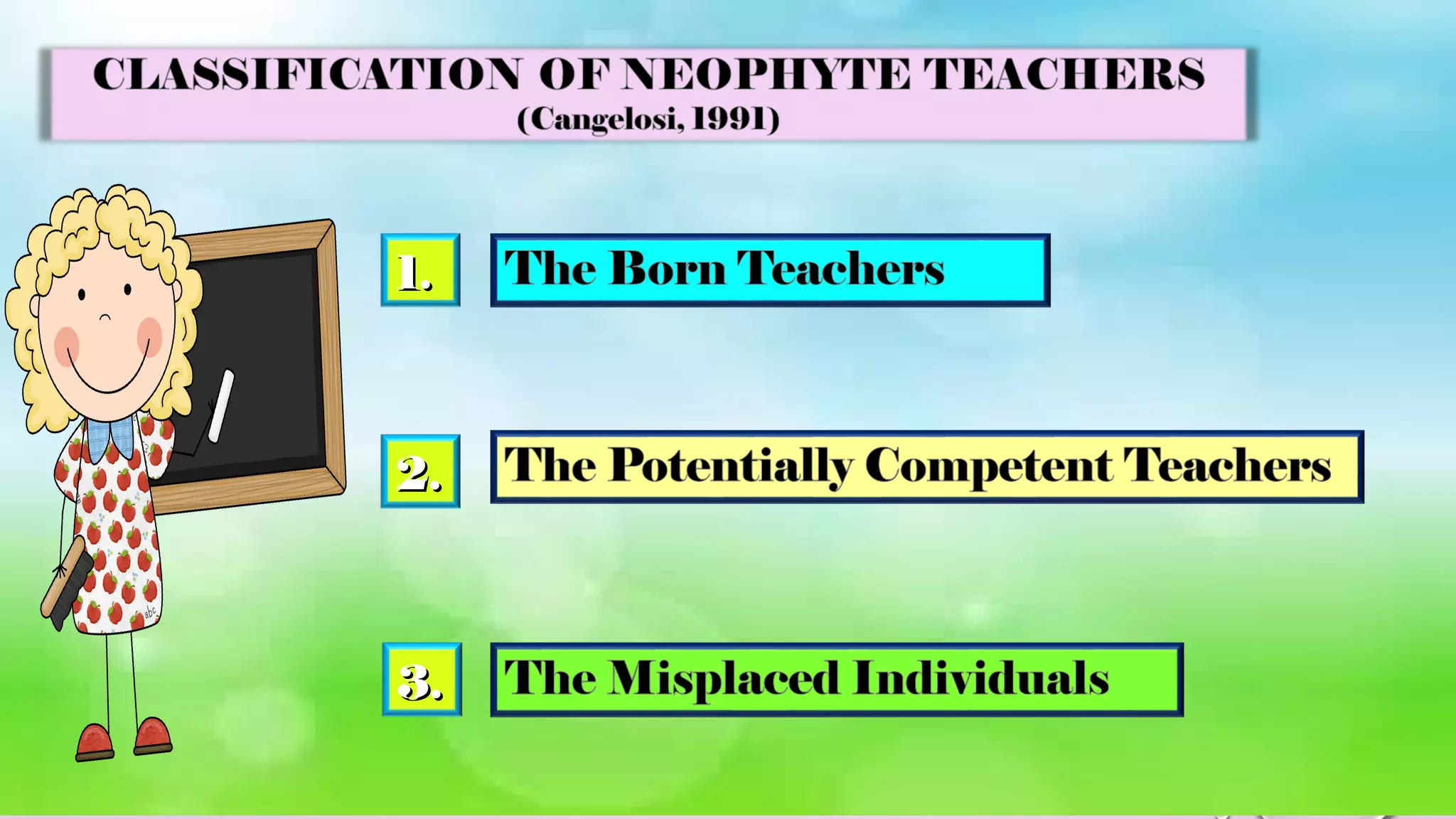
1.1.
2.2.
3.3.
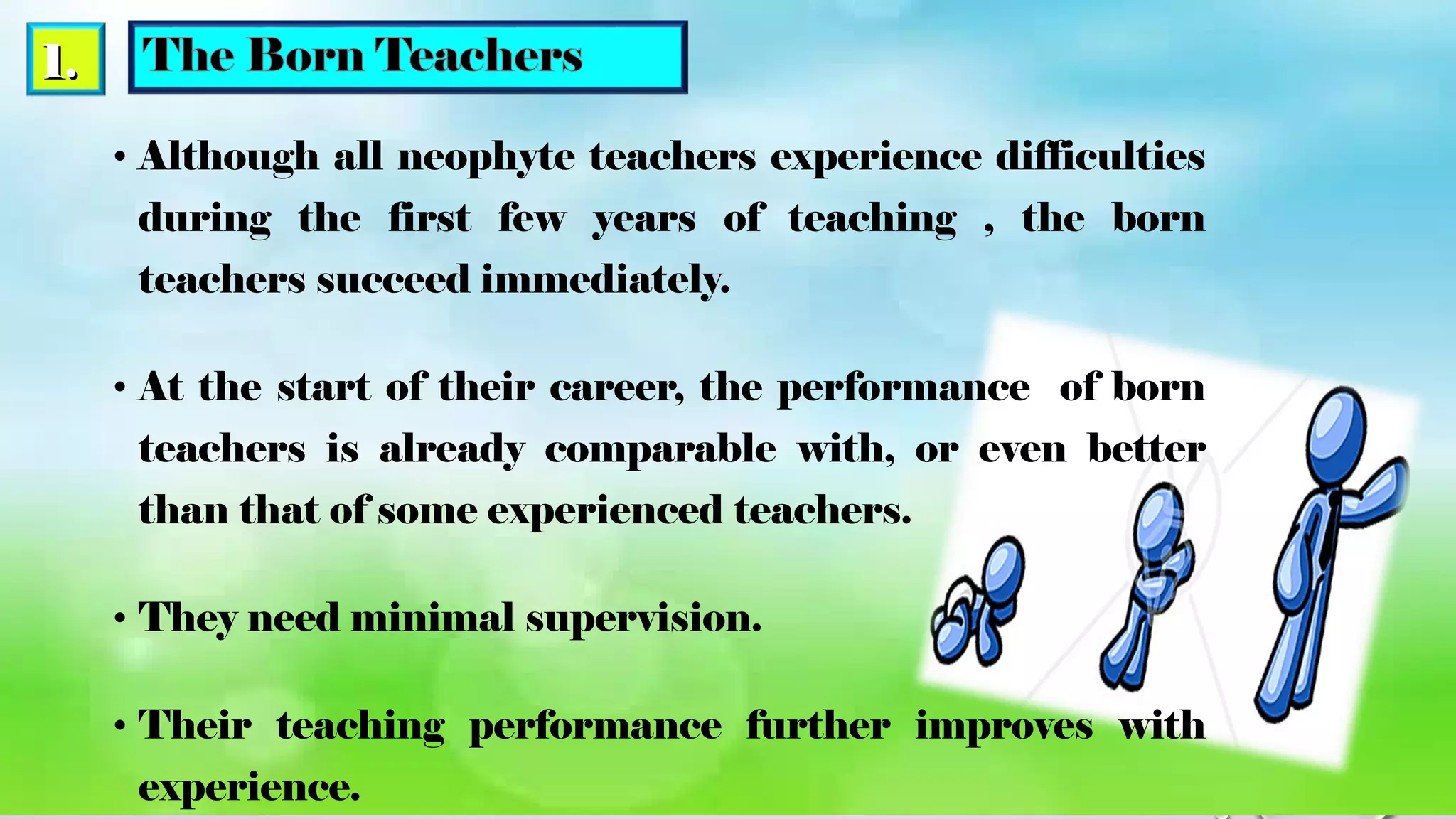
1.1.
• Although all neophyte teachers experience difficulties
during the first few years of teaching , the born
teachers succeed immediately.
• At the start of their career, the performance of born
teachers is already comparable with, or even better
than that of some experienced teachers.
• They need minimal supervision.
• Their teaching performance further improves with
experience.
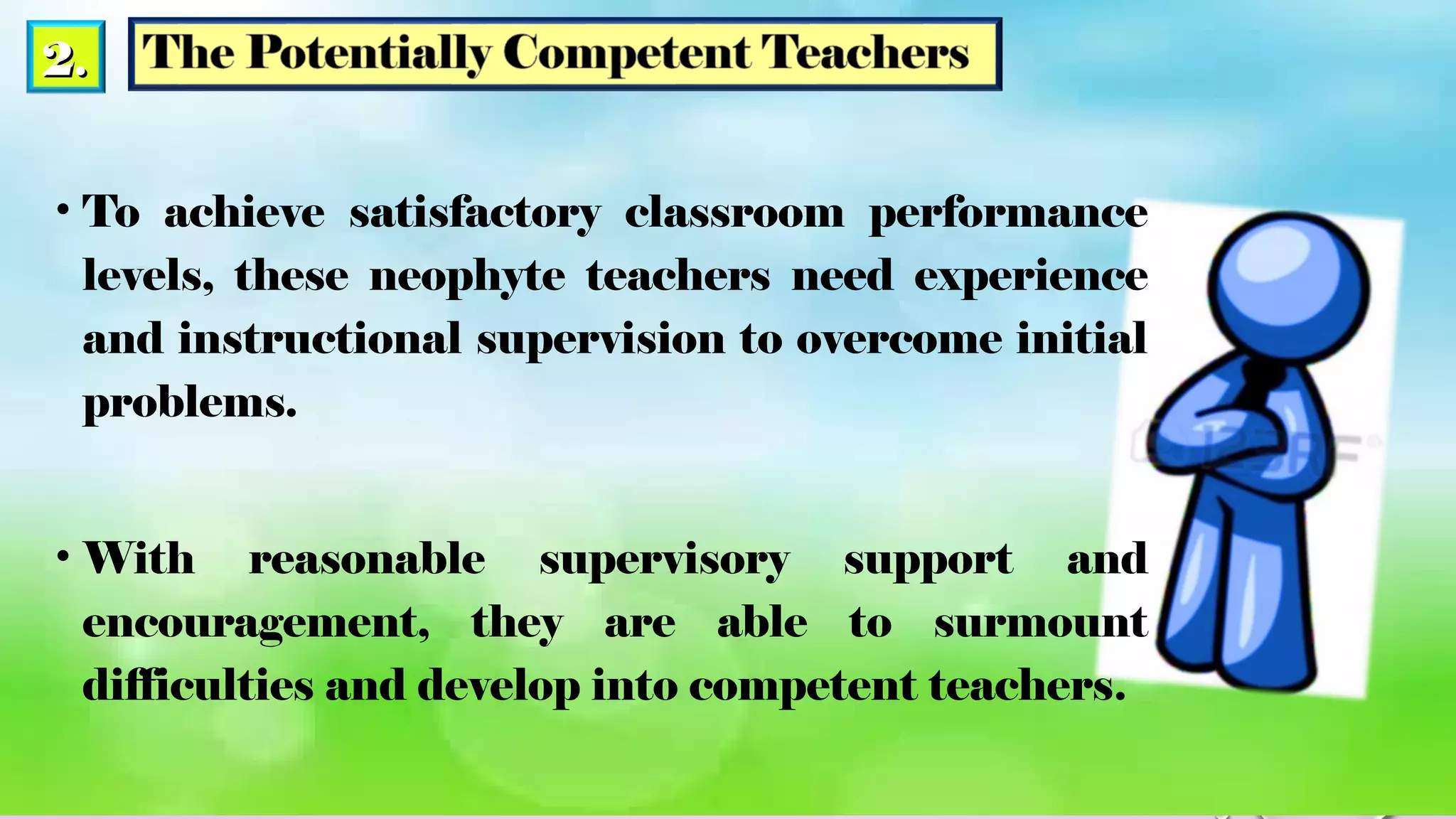
2.2.
• To achieve satisfactory classroom performance
levels, these neophyte teachers need experience
and instructional supervision to overcome initial
problems.
• With reasonable supervisory support and
encouragement, they are able to surmount
difficulties and develop into competent teachers.
3.3.
• These beginners require an unreasonable and
costly supervision in order to achieve
satisfactory classroom performance levels.
• The research findings of Reyes that were earlier
cited suggest that adequate support and
encouragement should be given to all types of
beginning teachers primarily by supervisors and
secondarily by experienced teachers and other
school personnel.
1.Assignment to difficult classes
2.Isolation of classrooms from colleagues and
supervisors
3.Poor physical facilities
4.Burdensome extra class assignments
5.Lack of understanding of school expectations
6.Inadequate supervision
7.Inadequate use of technology
In addition, beginning teacher fear:
1.Not living up to personally imposed standards
2.Meeting parents
3.Being evaluated
4.Being rejected by students and colleagues
5.Being embarrassed
A similar view is held by Gordon and Maxey
(2000) who propose that there are work-related
and person- related problems that confront
beginning teachers.
These concerns may be clustered as follows:
1.Curriculum concerns
2.Instructional concerns
3.Relationship concerns
4.School environment concerns
5.Personal concerns
6.Concerns about expectation
There are reasons to improve provisions for the
professional development of new teachers:
1.To make their job easier
2.To make them feel more confident inside and
outside the classroom
3.To reduce their feelings of isolation
4.To enhance quantity and quality of their
interaction with colleagues and
administration.
-(Lunenberg and Ornstein, , 2000)
supervision and instruction

supervision and instruction

  • 1.
    CHAPTER THREE SUPERVISION OFINSTRUCTION EM 205-TEACHER SUPERVISION AND EVALUATION METHODS PRESENTED BY: MARIA ANGELA C. EROLES MAED
  • 3.
     The dictionarydefines the word peer as “an equal in civil standing or rank, or an equal any respect.”  Peer assessment my lead to peer coaching or consultation which Sullivan and Glanz (2000)consider as an umbrella term of many different types of peer-to-peer assistance that are interchangeably referred to as collegial teaching and peer supervision.
  • 4.
    PEER COACHING  Peercoaching takes place when a fellow teacher, who is knowledgeable about specific aspects of the teaching-learning process, serves as a coach or consultant to another seeking help.  Based on Joyce and Showers model (in Sullivan and Glanz, 2000), peer coaching involves regular meeting between or among two or more teachers in order to jointly solve problems using planning, feedback and creative thinking for development of a specific skills.
  • 5.
     Refine teachingpractices;  Stimulate self-initiating, autonomous teacher thought;  Improve school culture;  Increase collegiality and professional dialogue; and  Share in the implementation of new or common instructional skills. -According to Joyce and Showers p.133
  • 6.
     The ERICDigests (n.d.) defines a teacher portfolio as a collection of works, records, and documents demonstrating and highlighting a teacher’s knowledge and skills in teaching.  It is also a documentation created by a teacher that reveals and describes his/ her duties, expertise and professional growth.
  • 7.
    1. Teacher’s background 2.Class description: time, grade, and content 3. Licensure examinations 4. A personal statement of teaching philosophy and goals. 5. Faculty development 6. Implemented lesson plans, handouts, and notes
  • 8.
    7. Graded studentwork 8. Video/ audiotape of classroom lessons 9. Colleague observation records 10.Written reflection on teaching 11.Photographs of bulletin boards, chalkboards, or projects.
  • 9.
     A portfoliomay be used as additional source of information for assessing and evaluating the effectiveness of teacher for administrative decisions such as retention and promotion (summative), or for providing feedback so that teachers may improve their teaching and level of professionalism(formative).
  • 10.
    1. Start slowly. 2.Gain acceptance. 3. Instill ownership. 4. Communicate implementation. 5. Use models. 6. Be selective. 7. Be realistic.
  • 11.
    Action research isan inquiry that teachers design and conduct in order to improve teaching. It promotes the concept of teacher-as- researcher (ERIC Digests, n.d.) which encourages teachers to be collaborators not only in improving teaching behavior, but also in revising curriculum, improving working environment, professionalizing, teaching, developing policy. Action research is an inquiry that teachers design and conduct in order to improve teaching. It promotes the concept of teacher-as- researcher (ERIC Digests, n.d.) which encourages teachers to be collaborators not only in improving teaching behavior, but also in revising curriculum, improving working environment, professionalizing, teaching, developing policy.
  • 12.
    o The mostimportant feature of action research is the linking of “action ” and “research” while involves trying out practical ideas as means of increasing knowledge about improving curriculum, teaching, and learning (Kemmis and McTaggarrt, 1982). o The most important feature of action research is the linking of “action ” and “research” while involves trying out practical ideas as means of increasing knowledge about improving curriculum, teaching, and learning (Kemmis and McTaggarrt, 1982).
  • 13.
    o Teacher-action researchis solution- oriented. o It consists of spiraling cycles of problem identification, systematic data collection, analysis and reflection, data-driven, and problem redefinition. o Kemmis (O’brien,1998) developed a simple model of the cyclical nature of the action research process consisting of four steps: plan, act, observe and reflect. o Teacher-action research is solution- oriented. o It consists of spiraling cycles of problem identification, systematic data collection, analysis and reflection, data-driven, and problem redefinition. o Kemmis (O’brien,1998) developed a simple model of the cyclical nature of the action research process consisting of four steps: plan, act, observe and reflect.
  • 15.
    1. A descriptionof the problem and the idea (intervention measure) to put into action. 2. The rationale for change. 3. The strategic action to be taken. 4. The people involved 5. The monitoring strategies 6. A realistic timetable 1. A description of the problem and the idea (intervention measure) to put into action. 2. The rationale for change. 3. The strategic action to be taken. 4. The people involved 5. The monitoring strategies 6. A realistic timetable
  • 16.
    1.Diaries and logbooks 2.Anecdotalrecords 3.Questionnaires 4.Tape recorders 5.Video cameras 6.Test 1.Diaries and logbooks 2.Anecdotal records 3.Questionnaires 4.Tape recorders 5.Video cameras 6.Test
  • 17.
    •Those who arehired without any previous teaching experience usually after the completion of pre-service education, or those who enter the teaching profession after quitting a non-teaching job.
  • 18.
    • The firstcategory is composed of new graduates with either a Bachelor of Secondary Education (BSE) or a Bachelor of Elementary Education (BEE) degree from Pre-service education institutions. • The second category usually comprises graduates of other professions who have taken 18 units of pedagogy to qualify to teach.
  • 19.
    Pre-service education isthe formal teacher education program designed to help an individual prepare for the teaching profession.
  • 20.
    • Under PhilippineLaw, both types of novice teachers have to be certified by the Licensure Board for Teachers after passing the professional examination. • According to Dukes, Cangelosi, and Knight (in Cangelosi, 1991), pre-service teacher education programs provide beginning teachers with necessary, but still insufficient, competencies to be successful in service teachers.
  • 21.
    1.New teachers arewell-prepared (because of their pre-service training ) for their initial classroom and school experiences. 2.Teachers can develop professional expertise on their own. 3.Teaching can be mastered in a relatively short period of time.
  • 22.
    • To becomeconsistently effective, especially in the initial years of their teaching careers, beginning teachers need assistance and feedback as they perform their work. This is the function of supervision. • Gordon and Maxey(2000) report that many educators believe that it takes three years to induct a new teacher fully. • This period according to Cangelosi (1991), is the most critical and career threatening.
  • 23.
    • Reyes(2003) conductedan investigation of 137 neophyte teachers in 15 private schools in the National Capital region to fin out the major problems they encountered in the workplace during the probationary period (first three years). • The results of the study showed a gradual decrease in the percentage of distribution of the problem areas- except for professional relationships -during the first three years of teaching.
  • 24.
    ProblemArea 1st year% 2nd year%3rd year% Motivation 98 48 17 Organization and planning 94 35 17 Instructional skills 79 43 15 Professional relationships 75 28 39 Professional growth 84 39 11 Classroommanagement 73 39 13 Evaluation of students 73 28 13 Mastery of subject matter 64 28 15 Communication skills 73 25 7 Source: Reyes, F. (2003) Comparative-correctional analysis of problems of neophyte teachers: Basis for connecting pre- service preparation and beginning years of teaching. Tanglaw, Official Journal of the College of Education. DLSU-Manila: DLSU Press.
  • 25.
    ProblemArea 1st yearRank 2nd yearRank3rd yearRank Talking to my immediate supervisorregarding my problems 1 1 2 Conducting conferences with parents regarding theirchildren’s progress 2 4 2 Effectively communicating ideas to teachers, supervisors, and school personnel 3 2 2 Getting assistance fromcolleagues regarding my problems in teaching 4 5 4 Maintaining a professional teaching attitude while working with students. 5 3 5 Source: Reyes, F. (2003) Comparative-correctional analysis of problems of neophyte teachers: Basis for connecting pre-service preparation and beginning years of teaching. Tanglaw, Official Journal of the College of Education. DLSU-Manila: DLSU Press.
  • 26.
  • 27.
    1.1. • Although allneophyte teachers experience difficulties during the first few years of teaching , the born teachers succeed immediately. • At the start of their career, the performance of born teachers is already comparable with, or even better than that of some experienced teachers. • They need minimal supervision. • Their teaching performance further improves with experience.
  • 28.
    2.2. • To achievesatisfactory classroom performance levels, these neophyte teachers need experience and instructional supervision to overcome initial problems. • With reasonable supervisory support and encouragement, they are able to surmount difficulties and develop into competent teachers.
  • 29.
    3.3. • These beginnersrequire an unreasonable and costly supervision in order to achieve satisfactory classroom performance levels. • The research findings of Reyes that were earlier cited suggest that adequate support and encouragement should be given to all types of beginning teachers primarily by supervisors and secondarily by experienced teachers and other school personnel.
  • 30.
    1.Assignment to difficultclasses 2.Isolation of classrooms from colleagues and supervisors 3.Poor physical facilities 4.Burdensome extra class assignments 5.Lack of understanding of school expectations 6.Inadequate supervision 7.Inadequate use of technology
  • 31.
    In addition, beginningteacher fear: 1.Not living up to personally imposed standards 2.Meeting parents 3.Being evaluated 4.Being rejected by students and colleagues 5.Being embarrassed A similar view is held by Gordon and Maxey (2000) who propose that there are work-related and person- related problems that confront beginning teachers.
  • 32.
    These concerns maybe clustered as follows: 1.Curriculum concerns 2.Instructional concerns 3.Relationship concerns 4.School environment concerns 5.Personal concerns 6.Concerns about expectation
  • 33.
    There are reasonsto improve provisions for the professional development of new teachers: 1.To make their job easier 2.To make them feel more confident inside and outside the classroom 3.To reduce their feelings of isolation 4.To enhance quantity and quality of their interaction with colleagues and administration. -(Lunenberg and Ornstein, , 2000)