Creating a 
Communit 
y of 
Learning 
Partners 
in School 
Marilu S. Bandolon 
Facilitator
School & Community Partnership 
“The problem of education is everybody’s problem. As 
building literacy is our collective responsibility, so too is 
improving of our schools, our collective responsibility. We must 
build bridges between the school and the community.” 
Former DepEd Secretary Florencio 
Abad
Session objectives: 
At the end of the session, the participants are able to: 
1. identify community resources as context of learning and 
teaching; 
2. identify and establish areas of linkages between the school 
and the community for mutual linkages; 
3. describe the various roles of teachers in the community 
where the school is situated; 
4. recognize the roles and elicit the support of the LSB, PTA and 
other organizations and institutions, both GO’s and 
NGO’S
SCHOOL
Let’s revisit the communities where our schools are located: 
Let’s do a resource mapping of the community where your 
school is located. Answer each questions orally: 
1. Give at least 5 resources in the community where your school is 
located. 
2. Where does the community gets its financial resources? 
3. Do you think the community has rich financial resources? Why? 
4. What are the rules/norms and traditions practiced by the 
community that help the school attain its objectives?
Below are community norms/traditions/practices that contribute to 
the attainment of specific goals of a school. Identify additional 
practices 
School 
Goals/Objectives 
Community 
Practices/norms/traditions that can 
held reach the objective 
To raise the 
academic 
achievement of the 
pupils 
Example: Honor graduates are looked up 
to in the community 
Your own example: ________________ 
To prepare school 
for the opening of 
classes 
Example: Bayanihan/Brigada Eskwela 
Example: ________________ 
To maintain school 
cleanliness 
throughout the SY 
Example: Clean and Green movement 
Your own example:______________ 
To provide security 
Example: Pagroronda ng mga Brgy tanod
Every community has resources that surround the school. These 
can be: 
 Human 
 Social 
 Material 
 Financial 
 Natural resources 
Human resources – refer to the skills, talents, qualities and attitudes 
of the people living in the community
Social assets – the relationships, rules, established course of action, 
and practices that can serve as instruments in attaining 
specific school goals in a given situation 
Material resources – man made things such as equipment, property, 
facilities, tools, and the like which can be used by the 
community anytime 
Financial assets – monetary, income or cash resources 
Natural resources – refer to the physical environment of the 
community 
Teachers who are skillful in tapping these resources have the 
power to break the cycle of financial difficulties of the school.
“Learning and the areas to be learned should not have 
boundaries. Education, as a public property, should belong everyone, 
not just the academically successful but also those who have wisdom 
outside the school.” 
Sayer and Williams, 1989
Tapping community resources 
Pupils learn through discussion, simulation, reading, writing, 
field trips, listening speakers, etc. These are common activities inside 
the classroom when a teacher is teaching a lesson. There are also 
lessons that can be effectively taught and learned by going to the 
community and observing, asking experts and actively participating in, 
or even initiating, community activities (Lardizabal, 1988).
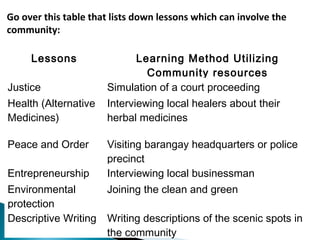
Go over this table that lists down lessons which can involve the 
community: 
Lessons Learning Method Utilizing 
Community resources 
Justice Simulation of a court proceeding 
Health (Alternative 
Medicines) 
Interviewing local healers about their 
herbal medicines 
Peace and Order Visiting barangay headquarters or police 
precinct 
Entrepreneurship Interviewing local businessman 
Environmental 
Joining the clean and green 
protection 
Descriptive Writing Writing descriptions of the scenic spots in 
the community
Think of some more lessons in your subject area. Tell whether 
they can be effectively learned in school or in the community. 
Identify a community resource that can be tapped to help you teach a 
lesson that you believe is best learned in a community, and how it will 
be done.
Tapping community members in teaching the pupils 
Community members maybe tapped in the education of our 
pupils. Lessons in history, geography, social studies, and values 
maybe learned from community members. Below are the suggested 
ways by which we can tap community members in teaching our pupils 
: 
a. Organizing field trips so students can learn from community 
members in their institutional setting 
b. Inviting community members to come to school to serve as 
resource persons/lecturers/demonstrators 
c. Involving parents directly or indirectly in the learning 
process
Community expectations of the teachers 
Teachers play various roles beyond the boundaries of the 
school. Local communities from the school turn o teachers for a lot of 
their needs. They expect teachers to perform other functions besides 
teaching. They act as: 
a. Agents of change (making people understand and observe 
policies, programs, and DepEd & govt programs) 
b. Legal counsel (informing/advising community of 
actions/decisions to make based on the country’s laws 
and that of DepEd 
c. Person in authority (knowing & exercising authority with 
regard to students’ discipline & working relationships 
with others based on existing laws and DepEd Orders) 
d. Source of knowledge (knowing current events/issues; ability 
to share information with others)
Analyze the caselets below. Answer the questions that 
follow. 
Caselet A 
Mrs. Guevara, a new teacher in Ma. Lopez ES noticed that one 
of her pupils was unusually quiet, and hardly recited in class. She 
would not participate in group activities and seldom interacted with 
her classmates. The teacher noticed also that she was untidy and 
shabbily dressed. She was habitually absent. So she talked to her and 
asked her if she had a problem. The pupil hesitated but after some 
prodding, she confided her problem which shocked the teacher – the 
girl was sexually harassed by her own father. 
1. In caselet A the teacher is expected to be____________.
Caselet B 
The Brgy Chairman of Brgy Poblacion 2 wanted to initiate an 
information campaign about illegal drugs. But he and his councilmen 
lacked the knowledge and resources to do the campaign. To help 
them, they asked one of the teachers in Brgy Poblacion 2 to help them 
do the information campaign. 
What role must the teacher assume in caselet B
Caselet C 
Mr. Buenafe was informed by one of his pupils that a fraternity 
initiation was being conducted at an abandoned building within the 
school vicinity. He hurriedly went to the alleged place and found that 
two of his pupils were being initiated. 
What role must the teacher in caselet C assume? 
Do you think you can do away with the roles that the 
community is expecting from you? Why?
The School Partners and Key Stakeholders 
Quality education is the responsibility of the school and the 
community, hence it is important that the school and the community 
must build a partnership in bringing about quality education to all 
children. 
The teachers have social partners and fellow stakeholders who 
work with them in attaining their goal of developing and improving 
the education process. These partners are: the parents, GO’s, NGO’s, 
and civic organizations.
Quality education is the responsibility of the school and the 
community, hence it is important that the school and the community 
must build a partnership in bringing about quality education to all 
children. 
The teachers have social partners and fellow stakeholders who 
work with them in attaining their goal of developing and improving 
the education process. These partners are: the parents, GO’s, NGO’s, 
and civic organizations.
How can the schools foster effective and sustainable 
partnership with the community? 
PRODED has enumerated the following areas that teachers 
must nurture in order to develop an effective and sustainable 
partnership with the community: 
1. develop intelligent public understanding of the school on all 
aspects of its operations 
2. help citizens feel more responsibly for the quality of 
education the school provides; 
3. earn the goodwill, respect and confidence of the public in 
the professional and personal services of the school 
4. involve the community in the work of the school and in 
solving educational problems
5. promote a genuine spirit of cooperation between the 
school and community for the improvement of the community 
6. secure community support for the school and its program 
7. keep the community informed of developments and 
educational trends 
8. secure an unofficial but honest evaluation of the school 
program in terms of educational needs as the 
community sees them
How can schools/teachers effectively coordinate with the 
community on the use of its resources? 
1. cultural sensitivity 
2. sincerity/gratitude 
3. integrity/honesty/humility 
4. follow up 
5. good public relations 
6. two way communications 
7. proper channeling
Harnessing school support from PTA 
`The PTA is a vital force in linking the school to its service area, 
the community. The PTA is founded on the spirit of volunteerism and 
serves as a means by which funds maybe generated and community 
support to the school maybe mobilized. If properly organized and 
directed, the PTA can be a strong partner in improving the welfare of 
the pupils.
Ways by which schools/teachers can use to effectively 
enlist the support of PTA 
1. Home visits 
-get to know them well. This is the rule of thumb in starting and 
nurturing relations with parents. Provide time to find out more 
about the pupils’ home conditions 
2. Parenthood seminars 
-invite parents to attend seminars on parenting, responsible 
parenthood, child development and proper guidance and 
connecting 
-seminars on helping parents help their better help their children in 
developing good study habits may also be conducted 
-organize PLAC to help parents develop the skill of guiding their 
children at home in developing study habits
3. Parent conferences 
-should focus on problems related to the child 
-know the parents very well 
-tips on conducting parent conferences 
a. Know the parents personally even before the problem arise 
b. Have all the relevant information about eh child before the 
conference 
c. Inform the parents the purpose of the conference 
d. Conduct your conference with the parents in a face to face, 
give and take, no hold barred manner. Create an 
atmosphere of an informal chat rather than that of a 
formal meeting
4. School- home projects 
-if parents are too busy/occupied to come to attend meetigns and 
conferences, an alternative is to send home printed maaterials 
about school/class programs 
-information should include a brief description of its’ learning areas 
and the materials the child needs that should be presented in a 
clear and understandable language
5. Establish a “Two-way communication “ with 
parents/community 
-occurs when teachers and parents dialogue together. 
Effective dialogue “develops out of a growing trust, a 
mutuality of concern, and an appreciation of 
contrasting perspectives” (Lawrence-Lightfoot,2004). A 
teacher may contact parents to celebrate a child’s 
successful school experience. 
-However, more frequently, the contact is to share a 
concern about the child, which can be a source of 
significant tension for both teachers and parents alike. 
Teachers should strive to make these interactions as 
productive as possible.
Tips in Dealing with Parents 
1. Use conversational tone 
2. Create an atmosphere of an informal chat rather that that of a 
confrontation 
3. Make more positive than negative comments and suggestions 
4. Involve parents in school programs and activities
Creating a community of learning partners in school 
recognizes that many public and private community institutions 
share responsibility for helping: 
• Children develop socially, emotionally, physically, and 
academically 
• Students become motivated and engaged in learning 
• Families and schools work effectively together 
• Communities become safer and more economically 
vibrant
What have you learned? 
1.List down the important learning points that you have 
gathered from the session. 
2.Why do you consider these learning points important to you?
Always remember………………. 
It takes a village to educate a 
child!

School community partnership

  • 1.
    Creating a Communit y of Learning Partners in School Marilu S. Bandolon Facilitator
  • 2.
    School & CommunityPartnership “The problem of education is everybody’s problem. As building literacy is our collective responsibility, so too is improving of our schools, our collective responsibility. We must build bridges between the school and the community.” Former DepEd Secretary Florencio Abad
  • 3.
    Session objectives: Atthe end of the session, the participants are able to: 1. identify community resources as context of learning and teaching; 2. identify and establish areas of linkages between the school and the community for mutual linkages; 3. describe the various roles of teachers in the community where the school is situated; 4. recognize the roles and elicit the support of the LSB, PTA and other organizations and institutions, both GO’s and NGO’S
  • 4.
  • 5.
    Let’s revisit thecommunities where our schools are located: Let’s do a resource mapping of the community where your school is located. Answer each questions orally: 1. Give at least 5 resources in the community where your school is located. 2. Where does the community gets its financial resources? 3. Do you think the community has rich financial resources? Why? 4. What are the rules/norms and traditions practiced by the community that help the school attain its objectives?
  • 6.
    Below are communitynorms/traditions/practices that contribute to the attainment of specific goals of a school. Identify additional practices School Goals/Objectives Community Practices/norms/traditions that can held reach the objective To raise the academic achievement of the pupils Example: Honor graduates are looked up to in the community Your own example: ________________ To prepare school for the opening of classes Example: Bayanihan/Brigada Eskwela Example: ________________ To maintain school cleanliness throughout the SY Example: Clean and Green movement Your own example:______________ To provide security Example: Pagroronda ng mga Brgy tanod
  • 7.
    Every community hasresources that surround the school. These can be:  Human  Social  Material  Financial  Natural resources Human resources – refer to the skills, talents, qualities and attitudes of the people living in the community
  • 8.
    Social assets –the relationships, rules, established course of action, and practices that can serve as instruments in attaining specific school goals in a given situation Material resources – man made things such as equipment, property, facilities, tools, and the like which can be used by the community anytime Financial assets – monetary, income or cash resources Natural resources – refer to the physical environment of the community Teachers who are skillful in tapping these resources have the power to break the cycle of financial difficulties of the school.
  • 9.
    “Learning and theareas to be learned should not have boundaries. Education, as a public property, should belong everyone, not just the academically successful but also those who have wisdom outside the school.” Sayer and Williams, 1989
  • 10.
    Tapping community resources Pupils learn through discussion, simulation, reading, writing, field trips, listening speakers, etc. These are common activities inside the classroom when a teacher is teaching a lesson. There are also lessons that can be effectively taught and learned by going to the community and observing, asking experts and actively participating in, or even initiating, community activities (Lardizabal, 1988).
  • 11.
    Go over thistable that lists down lessons which can involve the community: Lessons Learning Method Utilizing Community resources Justice Simulation of a court proceeding Health (Alternative Medicines) Interviewing local healers about their herbal medicines Peace and Order Visiting barangay headquarters or police precinct Entrepreneurship Interviewing local businessman Environmental Joining the clean and green protection Descriptive Writing Writing descriptions of the scenic spots in the community
  • 12.
    Think of somemore lessons in your subject area. Tell whether they can be effectively learned in school or in the community. Identify a community resource that can be tapped to help you teach a lesson that you believe is best learned in a community, and how it will be done.
  • 13.
    Tapping community membersin teaching the pupils Community members maybe tapped in the education of our pupils. Lessons in history, geography, social studies, and values maybe learned from community members. Below are the suggested ways by which we can tap community members in teaching our pupils : a. Organizing field trips so students can learn from community members in their institutional setting b. Inviting community members to come to school to serve as resource persons/lecturers/demonstrators c. Involving parents directly or indirectly in the learning process
  • 14.
    Community expectations ofthe teachers Teachers play various roles beyond the boundaries of the school. Local communities from the school turn o teachers for a lot of their needs. They expect teachers to perform other functions besides teaching. They act as: a. Agents of change (making people understand and observe policies, programs, and DepEd & govt programs) b. Legal counsel (informing/advising community of actions/decisions to make based on the country’s laws and that of DepEd c. Person in authority (knowing & exercising authority with regard to students’ discipline & working relationships with others based on existing laws and DepEd Orders) d. Source of knowledge (knowing current events/issues; ability to share information with others)
  • 15.
    Analyze the caseletsbelow. Answer the questions that follow. Caselet A Mrs. Guevara, a new teacher in Ma. Lopez ES noticed that one of her pupils was unusually quiet, and hardly recited in class. She would not participate in group activities and seldom interacted with her classmates. The teacher noticed also that she was untidy and shabbily dressed. She was habitually absent. So she talked to her and asked her if she had a problem. The pupil hesitated but after some prodding, she confided her problem which shocked the teacher – the girl was sexually harassed by her own father. 1. In caselet A the teacher is expected to be____________.
  • 16.
    Caselet B TheBrgy Chairman of Brgy Poblacion 2 wanted to initiate an information campaign about illegal drugs. But he and his councilmen lacked the knowledge and resources to do the campaign. To help them, they asked one of the teachers in Brgy Poblacion 2 to help them do the information campaign. What role must the teacher assume in caselet B
  • 17.
    Caselet C Mr.Buenafe was informed by one of his pupils that a fraternity initiation was being conducted at an abandoned building within the school vicinity. He hurriedly went to the alleged place and found that two of his pupils were being initiated. What role must the teacher in caselet C assume? Do you think you can do away with the roles that the community is expecting from you? Why?
  • 18.
    The School Partnersand Key Stakeholders Quality education is the responsibility of the school and the community, hence it is important that the school and the community must build a partnership in bringing about quality education to all children. The teachers have social partners and fellow stakeholders who work with them in attaining their goal of developing and improving the education process. These partners are: the parents, GO’s, NGO’s, and civic organizations.
  • 19.
    Quality education isthe responsibility of the school and the community, hence it is important that the school and the community must build a partnership in bringing about quality education to all children. The teachers have social partners and fellow stakeholders who work with them in attaining their goal of developing and improving the education process. These partners are: the parents, GO’s, NGO’s, and civic organizations.
  • 20.
    How can theschools foster effective and sustainable partnership with the community? PRODED has enumerated the following areas that teachers must nurture in order to develop an effective and sustainable partnership with the community: 1. develop intelligent public understanding of the school on all aspects of its operations 2. help citizens feel more responsibly for the quality of education the school provides; 3. earn the goodwill, respect and confidence of the public in the professional and personal services of the school 4. involve the community in the work of the school and in solving educational problems
  • 21.
    5. promote agenuine spirit of cooperation between the school and community for the improvement of the community 6. secure community support for the school and its program 7. keep the community informed of developments and educational trends 8. secure an unofficial but honest evaluation of the school program in terms of educational needs as the community sees them
  • 22.
    How can schools/teacherseffectively coordinate with the community on the use of its resources? 1. cultural sensitivity 2. sincerity/gratitude 3. integrity/honesty/humility 4. follow up 5. good public relations 6. two way communications 7. proper channeling
  • 23.
    Harnessing school supportfrom PTA `The PTA is a vital force in linking the school to its service area, the community. The PTA is founded on the spirit of volunteerism and serves as a means by which funds maybe generated and community support to the school maybe mobilized. If properly organized and directed, the PTA can be a strong partner in improving the welfare of the pupils.
  • 24.
    Ways by whichschools/teachers can use to effectively enlist the support of PTA 1. Home visits -get to know them well. This is the rule of thumb in starting and nurturing relations with parents. Provide time to find out more about the pupils’ home conditions 2. Parenthood seminars -invite parents to attend seminars on parenting, responsible parenthood, child development and proper guidance and connecting -seminars on helping parents help their better help their children in developing good study habits may also be conducted -organize PLAC to help parents develop the skill of guiding their children at home in developing study habits
  • 25.
    3. Parent conferences -should focus on problems related to the child -know the parents very well -tips on conducting parent conferences a. Know the parents personally even before the problem arise b. Have all the relevant information about eh child before the conference c. Inform the parents the purpose of the conference d. Conduct your conference with the parents in a face to face, give and take, no hold barred manner. Create an atmosphere of an informal chat rather than that of a formal meeting
  • 26.
    4. School- homeprojects -if parents are too busy/occupied to come to attend meetigns and conferences, an alternative is to send home printed maaterials about school/class programs -information should include a brief description of its’ learning areas and the materials the child needs that should be presented in a clear and understandable language
  • 27.
    5. Establish a“Two-way communication “ with parents/community -occurs when teachers and parents dialogue together. Effective dialogue “develops out of a growing trust, a mutuality of concern, and an appreciation of contrasting perspectives” (Lawrence-Lightfoot,2004). A teacher may contact parents to celebrate a child’s successful school experience. -However, more frequently, the contact is to share a concern about the child, which can be a source of significant tension for both teachers and parents alike. Teachers should strive to make these interactions as productive as possible.
  • 28.
    Tips in Dealingwith Parents 1. Use conversational tone 2. Create an atmosphere of an informal chat rather that that of a confrontation 3. Make more positive than negative comments and suggestions 4. Involve parents in school programs and activities
  • 29.
    Creating a communityof learning partners in school recognizes that many public and private community institutions share responsibility for helping: • Children develop socially, emotionally, physically, and academically • Students become motivated and engaged in learning • Families and schools work effectively together • Communities become safer and more economically vibrant
  • 30.
    What have youlearned? 1.List down the important learning points that you have gathered from the session. 2.Why do you consider these learning points important to you?
  • 31.
    Always remember………………. Ittakes a village to educate a child!