Paradigms of Teaching:
Instruction and Learning
GLENN MARTIN
JULY 2018
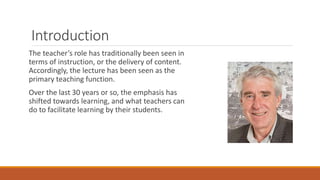
Introduction
The teacher’s role has traditionally been seen in
terms of instruction, or the delivery of content.
Accordingly, the lecture has been seen as the
primary teaching function.
Over the last 30 years or so, the emphasis has
shifted towards learning, and what teachers can
do to facilitate learning by their students.
Overview
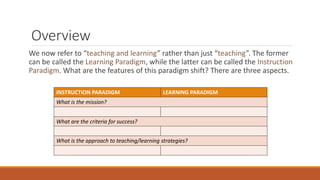
We now refer to “teaching and learning” rather than just “teaching”. The former
can be called the Learning Paradigm, while the latter can be called the Instruction
Paradigm. What are the features of this paradigm shift? There are three aspects.
INSTRUCTION PARADIGM LEARNING PARADIGM
What is the mission?
What are the criteria for success?
What is the approach to teaching/learning strategies?
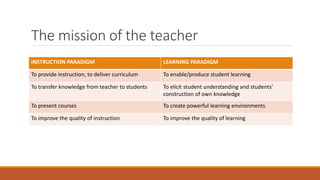
The mission of the teacher
INSTRUCTION PARADIGM LEARNING PARADIGM
To provide instruction; to deliver curriculum To enable/produce student learning
To transfer knowledge from teacher to students To elicit student understanding and students’
construction of own knowledge
To present courses To create powerful learning environments
To improve the quality of instruction To improve the quality of learning
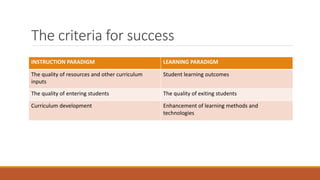
The criteria for success
INSTRUCTION PARADIGM LEARNING PARADIGM
The quality of resources and other curriculum
inputs
Student learning outcomes
The quality of entering students The quality of exiting students
Curriculum development Enhancement of learning methods and
technologies
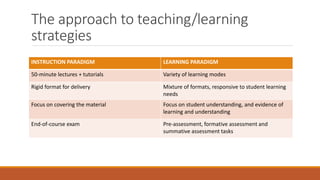
The approach to teaching/learning
strategies
INSTRUCTION PARADIGM LEARNING PARADIGM
50-minute lectures + tutorials Variety of learning modes
Rigid format for delivery Mixture of formats, responsive to student learning
needs
Focus on covering the material Focus on student understanding, and evidence of
learning and understanding
End-of-course exam Pre-assessment, formative assessment and
summative assessment tasks
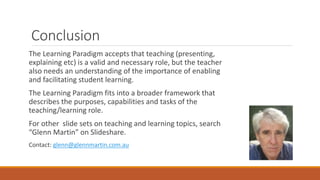
Conclusion
The Learning Paradigm accepts that teaching (presenting,
explaining etc) is a valid and necessary role, but the teacher
also needs an understanding of the importance of enabling
and facilitating student learning.
The Learning Paradigm fits into a broader framework that
describes the purposes, capabilities and tasks of the
teaching/learning role.
For other slide sets on teaching and learning topics, search
“Glenn Martin” on Slideshare.
Contact: glenn@glennmartin.com.au
References
There are many articles and books that discuss the distinctions between teaching and learning.
The article below provides a good account of the concepts involved.
Barr, RB and Tagg, J (1995), From teaching to learning: A new paradigm for undergraduate
education, Change, Nov/Dec, pp. 12-25.

Instruction and learning

  • 1.
    Paradigms of Teaching: Instructionand Learning GLENN MARTIN JULY 2018
  • 2.
    Introduction The teacher’s rolehas traditionally been seen in terms of instruction, or the delivery of content. Accordingly, the lecture has been seen as the primary teaching function. Over the last 30 years or so, the emphasis has shifted towards learning, and what teachers can do to facilitate learning by their students.
  • 3.
    Overview We now referto “teaching and learning” rather than just “teaching”. The former can be called the Learning Paradigm, while the latter can be called the Instruction Paradigm. What are the features of this paradigm shift? There are three aspects. INSTRUCTION PARADIGM LEARNING PARADIGM What is the mission? What are the criteria for success? What is the approach to teaching/learning strategies?
  • 4.
    The mission ofthe teacher INSTRUCTION PARADIGM LEARNING PARADIGM To provide instruction; to deliver curriculum To enable/produce student learning To transfer knowledge from teacher to students To elicit student understanding and students’ construction of own knowledge To present courses To create powerful learning environments To improve the quality of instruction To improve the quality of learning
  • 5.
    The criteria forsuccess INSTRUCTION PARADIGM LEARNING PARADIGM The quality of resources and other curriculum inputs Student learning outcomes The quality of entering students The quality of exiting students Curriculum development Enhancement of learning methods and technologies
  • 6.
    The approach toteaching/learning strategies INSTRUCTION PARADIGM LEARNING PARADIGM 50-minute lectures + tutorials Variety of learning modes Rigid format for delivery Mixture of formats, responsive to student learning needs Focus on covering the material Focus on student understanding, and evidence of learning and understanding End-of-course exam Pre-assessment, formative assessment and summative assessment tasks
  • 7.
    Conclusion The Learning Paradigmaccepts that teaching (presenting, explaining etc) is a valid and necessary role, but the teacher also needs an understanding of the importance of enabling and facilitating student learning. The Learning Paradigm fits into a broader framework that describes the purposes, capabilities and tasks of the teaching/learning role. For other slide sets on teaching and learning topics, search “Glenn Martin” on Slideshare. Contact: glenn@glennmartin.com.au
  • 8.
    References There are manyarticles and books that discuss the distinctions between teaching and learning. The article below provides a good account of the concepts involved. Barr, RB and Tagg, J (1995), From teaching to learning: A new paradigm for undergraduate education, Change, Nov/Dec, pp. 12-25.