Principle 2
Define terms
Glenn Martin
March 2017
 Define your terms, then use those terms
consistently throughout the course.
 Question:
 Does the material involve terms that:
• are likely to be unfamiliar to students? or
• will be used with a different meaning to the meaning
students are familiar with?
Example: in a Physics course, “force” has a particular
meaning – mass times acceleration.
[In general conversation, people use words in ways that
are consistent with the definitions found in common
dictionaries.]
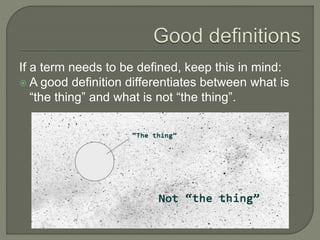
If a term needs to be defined, keep this in mind:
 A good definition differentiates between what is
“the thing” and what is not “the thing”.
 A good definition makes it as clear as possible
what is the thing that is being defined, and what
is not “the thing”.
 The importance of a good definition is that it
enables us to differentiate “the thing” from other
things with which it could be confused.
 Example: How would you define “power”?
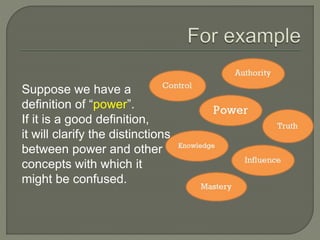
Suppose we have a
definition of “power”.
If it is a good definition,
it will clarify the distinctions
between power and other
concepts with which it
might be confused.
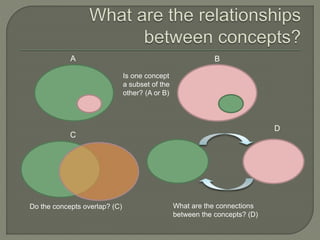
Is one concept
a subset of the
other? (A or B)
A B
C
Do the concepts overlap? (C)
D
What are the connections
between the concepts? (D)
If a term is used in a way that is different from what
would be found in a common dictionary, there must
be justification for the specialised use. This
includes:
 authority for the new meaning (e.g. academic
source)
 need for the new meaning (e.g. in order to
explain phenomena)
 proposed application of the new meaning.
 Having defined a term in a particular way, it must
be used with that meaning consistently
throughout the course.
 Care is needed not to, at any point, confuse the
ordinary sense in which a term is used with the
meaning it has been assigned in the course.

Principle 2 defining terms

  • 1.
  • 2.
     Define yourterms, then use those terms consistently throughout the course.
  • 3.
     Question:  Doesthe material involve terms that: • are likely to be unfamiliar to students? or • will be used with a different meaning to the meaning students are familiar with? Example: in a Physics course, “force” has a particular meaning – mass times acceleration. [In general conversation, people use words in ways that are consistent with the definitions found in common dictionaries.]
  • 4.
    If a termneeds to be defined, keep this in mind:  A good definition differentiates between what is “the thing” and what is not “the thing”.
  • 5.
     A gooddefinition makes it as clear as possible what is the thing that is being defined, and what is not “the thing”.  The importance of a good definition is that it enables us to differentiate “the thing” from other things with which it could be confused.  Example: How would you define “power”?
  • 6.
    Suppose we havea definition of “power”. If it is a good definition, it will clarify the distinctions between power and other concepts with which it might be confused.
  • 7.
    Is one concept asubset of the other? (A or B) A B C Do the concepts overlap? (C) D What are the connections between the concepts? (D)
  • 8.
    If a termis used in a way that is different from what would be found in a common dictionary, there must be justification for the specialised use. This includes:  authority for the new meaning (e.g. academic source)  need for the new meaning (e.g. in order to explain phenomena)  proposed application of the new meaning.
  • 9.
     Having defineda term in a particular way, it must be used with that meaning consistently throughout the course.  Care is needed not to, at any point, confuse the ordinary sense in which a term is used with the meaning it has been assigned in the course.