Class Insecta


                1
Subphylum Uniramia
Class Insecta (Hexapoda)


                           2
Most Abundant and Diverse
           Animal Class
• 1,000,000+ species
  identified
  – May be as many as
    30,000,000
• More than all other
  animals combined


                                 3
Distribution of Insects
            •   Air
            •   land
            •   In the soil
            •   Parasites
                – Plants
                – Animals
            • Freshwater
            • Not marine???

                              4
Characteristics of Insects
• Three body regions
  – Head
  – Thorax
  – Abdomen
• Three pair of legs
• Open circulatory
  system


                                  5
Characteristics (cont)
• Two pair of wings
  – One pair in flies
  – Absent in some
• Pair of compound
  eyes
• Spiracles for
  respiration


                                  6
Centipede and Symphyla


                         7
Insect Evolution


                   8
9
10
11
12
Chewing Mouthparts
Piercing Mouthparts

                      13
Siphoning Mouthparts

                       14
Sponging Mouthparts
                      15
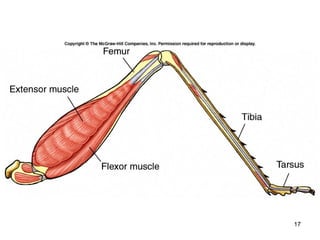
16
17
Insect abdomen
 Spiracle     Tergum

                       Cercus


                        Ovipositor


Pleural     Sternum
membrane


                                     18
19
20
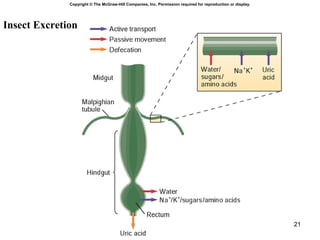
Copyright © The McGraw-Hill Companies, Inc. Permission required for reproduction or display.


Insect Excretion


                                                                                                             21
Internal Anatomy


                   22
23
24
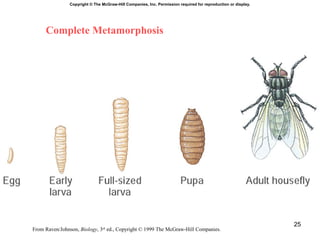
Copyright © The McGraw-Hill Companies, Inc. Permission required for reproduction or display.


     Complete Metamorphosis


                                                                                                               25
From Raven/Johnson, Biology, 3rd ed., Copyright © 1999 The McGraw-Hill Companies.
Copyright © The McGraw-Hill Companies, Inc. Permission required for reproduction or display.


         Incomplete Metamorphosis


                                                                                                                  26
From Hickman/Roberts/Larson, Integrated Principles of Zoology, 11th ed., Copyright © 2001 The McGraw-Hill Companies.
Digger Wasp


              27
Paralyzes Prey


                 28
29
30
31
Social Insects
       •   Live in colonies
       •   Queen
       •   King
       •   Soldiers
       •   Workers


                              32
Insect Societies


                   33
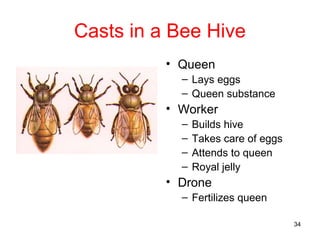
Casts in a Bee Hive
          • Queen
            – Lays eggs
            – Queen substance
          • Worker
            –   Builds hive
            –   Takes care of eggs
            –   Attends to queen
            –   Royal jelly
          • Drone
            – Fertilizes queen

                                     34
Become a Queen!


                  35
Swarm
• New queen
• Leaves with part
  of the hive to
  start a new
  colony


                             36
37
Honey


        38
Ant Colony


             39
Casts in an Ant Colony


                         40
Ant Pheremones
       • Alarm
       • Food trail


                      41
42
43
Beneficial Insects
         • Honey bee
           – Honey
           – Pollinates crops


                                44
Beneficial Insects
         • Lady bug
         • Eats harmful insects


                                  45
Beneficial Insects
         • Silkworm moth
         • Lava produces silk


                                46
Beneficial Insects
         • Breakdown dung


                            47
Beneficial Insects
• Blow fly
• Decompose dead bodies


                              48
Beneficial Insects
         • Ichneumonid wasps
         • Kill harmful insects


                                  49
Fruit Fly
     • Drosophila
     • Genetics research


                           50
Harmful Insects


• Tent catepillar
• Pest of many trees and shrubs


                                  51
Harmful Insects
        • Boll weevil
        • Destroys cotton


                            52
Harmful Insects
        • Mosquitos
        • Vector
          –   Malaria
          –   Yellow fever
          –   Encephalitis
          –   West Nile virus


                                53
Harmful Insects
        • Flea
        • Vector for
          – Plague


                       54
Xenopsylla cheopis
         • Rat flea
         • Vector for plague


                               55
Black Death
      • 1357-1350 killed
        25,000,000 in Europe
      • 1900’s killed
        20,000,000 in India


                           56
Bubos


        57
Plague Survivor


                  58
59
Alexandre Yersin
• Discovered bacterium
• Yersinia pestis


                              60
Insect Orders


                61
Order Collembela
•   Springtails
•   5mm long
•   Furcula for jumping
•   No wings


                                62
Order Thysanura
• Firebrats
• No wings


                                63
Order Odonota
• Dragon flies
• Damsel flies
• Two pair of large
  wings


                             64
Order Orthoptera
•   Grasshopper
•   Cockroach
•   Praying mantis
•   Cricket


                               65
Order Dermaptera
• Earwigs
• Forceps-like cerci
• Short wings


                              66
Order Isoptera
•   Termites
•   White
•   Broad waist
•   Winged and wingless


                               67
Order Homoptera
•   Cicada
•   Aphids
•   Leaf hoppers
•   Roof-like wings


                              68
Order Hemiptera
• True bugs
• Front wing
  – Basal portion is
    leathery
  – Apical portion of wing
    is membranous


                               69
Order Coleoptera
• Beetles
• 350,000+ species
• Hard front wings meet
  midline
• Back wings
  membranous


                              70
Order Lepidoptera
• Butterflies
   – Knobbed antennae
• Moths
• Scales on wings
• Larva are catepillars


                               71
Order Diptera
• Flies
• Mosquitoes
• One pair of wings


                              72
Order Hymenoptera
• Bees
• Wasps
• Ants
• Four membranous
  wings
• Narrow waist


                            73
Order Anoplura
•   Lice
•   No wings
•   Single claw
•   Sucking mouth parts
•   parasites


                               74
Order Siphonaptera
• Fleas
• Flattened laterally
• Spines on legs and
  body
• Parasites


                              75
The End


          76

Insects

Editor's Notes

  • #10 Fig. 20.8
  • #11 Fig. 20.4a
  • #13 Fig. 20.19a
  • #14 Fig. 20.19b
  • #15 Fig. 20.19d
  • #16 Fig. 20.19e
  • #17 Fig. 20.5
  • #18 Fig. 20.6
  • #20 Fig. 20.Fig. 20a
  • #21 Fig. 20.Fig. 20b
  • #24 Fig. 20.14
  • #25 Fig. 20.24
  • #34 Figure: FG31-18 Title: Honeybee society. Caption: Out of thousands of females in a honeybee colony, only one bee, the queen, is likely to bear offspring. Each colony is composed of numerous female worker bees, a small number of male drones—whose sole function is to mate with a queen—and the queen bee herself. Shown is a group of workers surrounding a queen in a North American hive.
  • #40 Figure: FG31-19 Title: Fire ant society. Caption: Like honeybees, fire ants live in societies that are organized around the care of the one breeding female, the queen, and the eggs she lays.