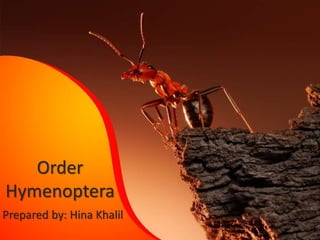
Order
Hymenoptera
Prepared by: Hina Khalil
The bees, ants, wasps and sawflies
• It ‘s the third largest order,
Over 150,000 species have
been described. Apart from
the extent, 2,000 extinct
species have also been
reported.
• It’s divided into two suborders
• Etymology: Hymen;
membranous – Terons; wings
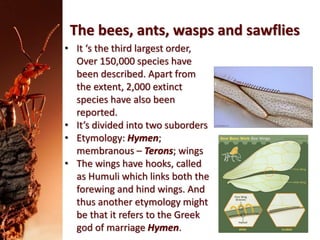
• The wings have hooks, called
as Humuli which links both the
forewing and hind wings. And
thus another etymology might
be that it refers to the Greek
god of marriage Hymen.
• Hymenopterans are considered the most beneficial insects.
• Bees, wasps and ants are most significant pollinating agents.
• Ants turn and aerate the soil, allowing water and oxygen to reach
the roots.
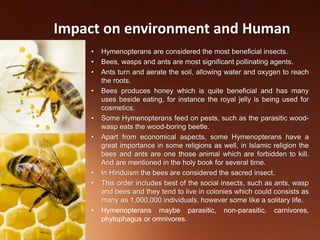
• Bees produces honey which is quite beneficial and has many
uses beside eating, for instance the royal jelly is being used for
cosmetics.
• Some Hymenopterans feed on pests, such as the parasitic wood-
wasp eats the wood-boring beetle.
• Apart from economical aspects, some Hymenopterans have a
great importance in some religions as well, in Islamic religion the
bees and ants are one those animal which are forbidden to kill.
And are mentioned in the holy book for several time.
• In Hinduism the bees are considered the sacred insect.
• This order includes best of the social insects, such as ants, wasp
and bees and they tend to live in colonies which could consists as
many as 1,000,000 individuals, however some like a solitary life.
• Hymenopterans maybe parasitic, non-parasitic, carnivores,
phytophagus or omnivores.
Impact on environment and Human
Habitat:
• The hymenopterans are found world wide except
for north pole, but they’re most abundant in
tropical and temperate regions.
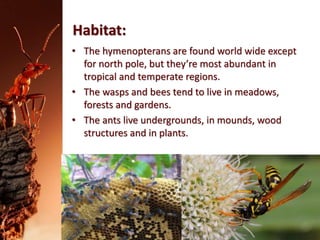
• The wasps and bees tend to live in meadows,
forests and gardens.
• The ants live undergrounds, in mounds, wood
structures and in plants.
Behavior
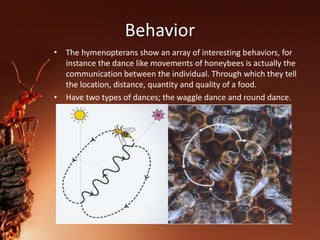
• The hymenopterans show an array of interesting behaviors, for
instance the dance like movements of honeybees is actually the
communication between the individual. Through which they tell
the location, distance, quantity and quality of a food.
• Have two types of dances; the waggle dance and round dance.
Fossils
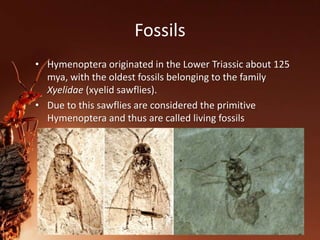
• Hymenoptera originated in the Lower Triassic about 125
mya, with the oldest fossils belonging to the family
Xyelidae (xyelid sawflies).
• Due to this sawflies are considered the primitive
Hymenoptera and thus are called living fossils
Colors
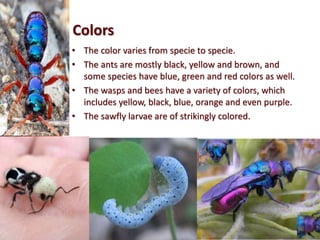
• The color varies from specie to specie.
• The ants are mostly black, yellow and brown, and
some species have blue, green and red colors as well.
• The wasps and bees have a variety of colors, which
includes yellow, black, blue, orange and even purple.
• The sawfly larvae are of strikingly colored.
Size
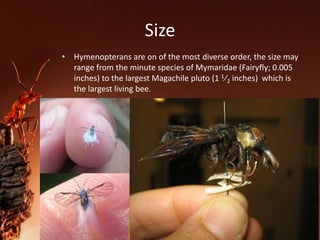
• Hymenopterans are on of the most diverse order, the size may
range from the minute species of Mymaridae (Fairyfly; 0.005
inches) to the largest Magachile pluto (1 1⁄2 inches) which is
the largest living bee.
Morphology
Eyes
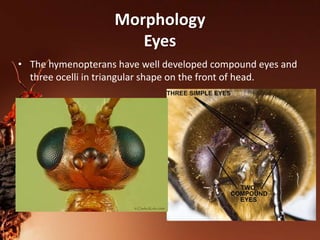
• The hymenopterans have well developed compound eyes and
three ocelli in triangular shape on the front of head.
Antennae
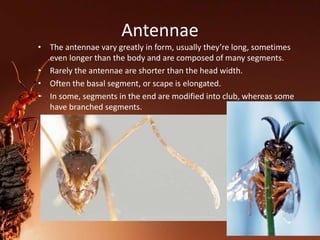
• The antennae vary greatly in form, usually they’re long, sometimes
even longer than the body and are composed of many segments.
• Rarely the antennae are shorter than the head width.
• Often the basal segment, or scape is elongated.
• In some, segments in the end are modified into club, whereas some
have branched segments.
Mouth
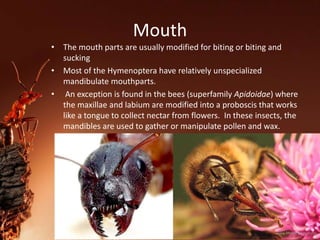
• The mouth parts are usually modified for biting or biting and
sucking
• Most of the Hymenoptera have relatively unspecialized
mandibulate mouthparts.
• An exception is found in the bees (superfamily Apidoidae) where
the maxillae and labium are modified into a proboscis that works
like a tongue to collect nectar from flowers. In these insects, the
mandibles are used to gather or manipulate pollen and wax.
Wings
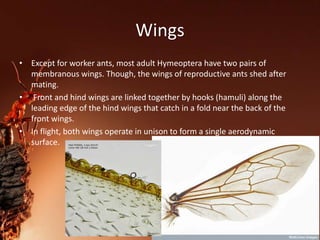
• Except for worker ants, most adult Hymeoptera have two pairs of
membranous wings. Though, the wings of reproductive ants shed after
mating.
• Front and hind wings are linked together by hooks (hamuli) along the
leading edge of the hind wings that catch in a fold near the back of the
front wings.
• In flight, both wings operate in unison to form a single aerodynamic
surface.
Thorax and abdomen
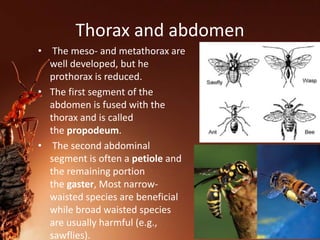
• The meso- and metathorax are
well developed, but he
prothorax is reduced.
• The first segment of the
abdomen is fused with the
thorax and is called
the propodeum.
• The second abdominal
segment is often a petiole and
the remaining portion
the gaster, Most narrow-
waisted species are beneficial
while broad waisted species
are usually harmful (e.g.,
sawflies).
Ovipositor
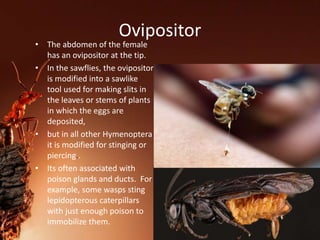
• The abdomen of the female
has an ovipositor at the tip.
• In the sawflies, the ovipositor
is modified into a sawlike
tool used for making slits in
the leaves or stems of plants
in which the eggs are
deposited,
• but in all other Hymenoptera
it is modified for stinging or
piercing..
• Its often associated with
poison glands and ducts. For
example, some wasps sting
lepidopterous caterpillars
with just enough poison to
immobilize them.
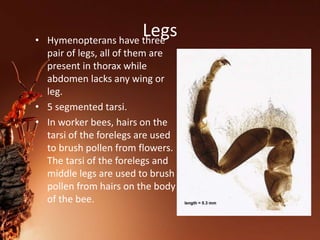
Legs• Hymenopterans have three
pair of legs, all of them are
present in thorax while
abdomen lacks any wing or
leg.
• 5 segmented tarsi.
• In worker bees, hairs on the
tarsi of the forelegs are used
to brush pollen from flowers.
The tarsi of the forelegs and
middle legs are used to brush
pollen from hairs on the body
of the bee.
Sexes
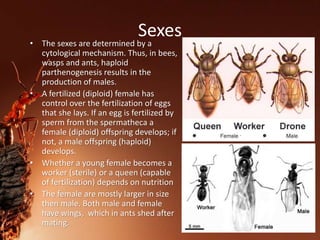
• The sexes are determined by a
cytological mechanism. Thus, in bees,
wasps and ants, haploid
parthenogenesis results in the
production of males.
• A fertilized (diploid) female has
control over the fertilization of eggs
that she lays. If an egg is fertilized by
sperm from the spermatheca a
female (diploid) offspring develops; if
not, a male offspring (haploid)
develops.
• Whether a young female becomes a
worker (sterile) or a queen (capable
of fertilization) depends on nutrition
• The female are mostly larger in size
then male. Both male and female
have wings, which in ants shed after
mating.
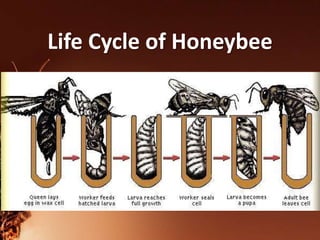
Life Cycle of Honeybee
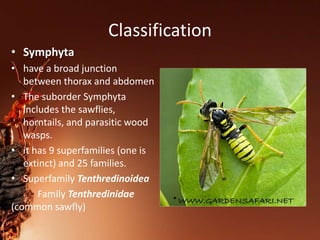
Classification
• Symphyta
• have a broad junction
between thorax and abdomen
• The suborder Symphyta
includes the sawflies,
horntails, and parasitic wood
wasps.
• it has 9 superfamilies (one is
extinct) and 25 families.
• Superfamily Tenthredinoidea
Family Tenthredinidae
(common sawfly)
•
Classification
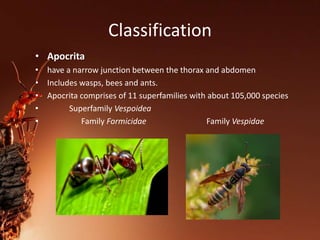
• Apocrita
• have a narrow junction between the thorax and abdomen
• Includes wasps, bees and ants.
• Apocrita comprises of 11 superfamilies with about 105,000 species
• Superfamily Vespoidea
• Family Formicidae Family Vespidae
Classification
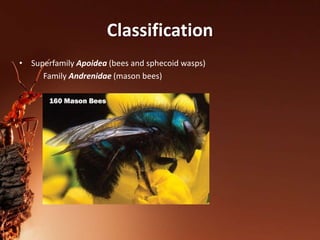
• Superfamily Apoidea (bees and sphecoid wasps)
Family Andrenidae (mason bees)
Thank you

Hymenoptera

  • 1.
  • 2.
    The bees, ants,wasps and sawflies • It ‘s the third largest order, Over 150,000 species have been described. Apart from the extent, 2,000 extinct species have also been reported. • It’s divided into two suborders • Etymology: Hymen; membranous – Terons; wings • The wings have hooks, called as Humuli which links both the forewing and hind wings. And thus another etymology might be that it refers to the Greek god of marriage Hymen.
  • 3.
    • Hymenopterans areconsidered the most beneficial insects. • Bees, wasps and ants are most significant pollinating agents. • Ants turn and aerate the soil, allowing water and oxygen to reach the roots. • Bees produces honey which is quite beneficial and has many uses beside eating, for instance the royal jelly is being used for cosmetics. • Some Hymenopterans feed on pests, such as the parasitic wood- wasp eats the wood-boring beetle. • Apart from economical aspects, some Hymenopterans have a great importance in some religions as well, in Islamic religion the bees and ants are one those animal which are forbidden to kill. And are mentioned in the holy book for several time. • In Hinduism the bees are considered the sacred insect. • This order includes best of the social insects, such as ants, wasp and bees and they tend to live in colonies which could consists as many as 1,000,000 individuals, however some like a solitary life. • Hymenopterans maybe parasitic, non-parasitic, carnivores, phytophagus or omnivores. Impact on environment and Human
  • 4.
    Habitat: • The hymenopteransare found world wide except for north pole, but they’re most abundant in tropical and temperate regions. • The wasps and bees tend to live in meadows, forests and gardens. • The ants live undergrounds, in mounds, wood structures and in plants.
  • 5.
    Behavior • The hymenopteransshow an array of interesting behaviors, for instance the dance like movements of honeybees is actually the communication between the individual. Through which they tell the location, distance, quantity and quality of a food. • Have two types of dances; the waggle dance and round dance.
  • 6.
    Fossils • Hymenoptera originatedin the Lower Triassic about 125 mya, with the oldest fossils belonging to the family Xyelidae (xyelid sawflies). • Due to this sawflies are considered the primitive Hymenoptera and thus are called living fossils
  • 7.
    Colors • The colorvaries from specie to specie. • The ants are mostly black, yellow and brown, and some species have blue, green and red colors as well. • The wasps and bees have a variety of colors, which includes yellow, black, blue, orange and even purple. • The sawfly larvae are of strikingly colored.
  • 8.
    Size • Hymenopterans areon of the most diverse order, the size may range from the minute species of Mymaridae (Fairyfly; 0.005 inches) to the largest Magachile pluto (1 1⁄2 inches) which is the largest living bee.
  • 9.
    Morphology Eyes • The hymenopteranshave well developed compound eyes and three ocelli in triangular shape on the front of head.
  • 10.
    Antennae • The antennaevary greatly in form, usually they’re long, sometimes even longer than the body and are composed of many segments. • Rarely the antennae are shorter than the head width. • Often the basal segment, or scape is elongated. • In some, segments in the end are modified into club, whereas some have branched segments.
  • 11.
    Mouth • The mouthparts are usually modified for biting or biting and sucking • Most of the Hymenoptera have relatively unspecialized mandibulate mouthparts. • An exception is found in the bees (superfamily Apidoidae) where the maxillae and labium are modified into a proboscis that works like a tongue to collect nectar from flowers. In these insects, the mandibles are used to gather or manipulate pollen and wax.
  • 12.
    Wings • Except forworker ants, most adult Hymeoptera have two pairs of membranous wings. Though, the wings of reproductive ants shed after mating. • Front and hind wings are linked together by hooks (hamuli) along the leading edge of the hind wings that catch in a fold near the back of the front wings. • In flight, both wings operate in unison to form a single aerodynamic surface.
  • 13.
    Thorax and abdomen •The meso- and metathorax are well developed, but he prothorax is reduced. • The first segment of the abdomen is fused with the thorax and is called the propodeum. • The second abdominal segment is often a petiole and the remaining portion the gaster, Most narrow- waisted species are beneficial while broad waisted species are usually harmful (e.g., sawflies).
  • 14.
    Ovipositor • The abdomenof the female has an ovipositor at the tip. • In the sawflies, the ovipositor is modified into a sawlike tool used for making slits in the leaves or stems of plants in which the eggs are deposited, • but in all other Hymenoptera it is modified for stinging or piercing.. • Its often associated with poison glands and ducts. For example, some wasps sting lepidopterous caterpillars with just enough poison to immobilize them.
  • 15.
    Legs• Hymenopterans havethree pair of legs, all of them are present in thorax while abdomen lacks any wing or leg. • 5 segmented tarsi. • In worker bees, hairs on the tarsi of the forelegs are used to brush pollen from flowers. The tarsi of the forelegs and middle legs are used to brush pollen from hairs on the body of the bee.
  • 16.
    Sexes • The sexesare determined by a cytological mechanism. Thus, in bees, wasps and ants, haploid parthenogenesis results in the production of males. • A fertilized (diploid) female has control over the fertilization of eggs that she lays. If an egg is fertilized by sperm from the spermatheca a female (diploid) offspring develops; if not, a male offspring (haploid) develops. • Whether a young female becomes a worker (sterile) or a queen (capable of fertilization) depends on nutrition • The female are mostly larger in size then male. Both male and female have wings, which in ants shed after mating.
  • 17.
    Life Cycle ofHoneybee
  • 18.
    Classification • Symphyta • havea broad junction between thorax and abdomen • The suborder Symphyta includes the sawflies, horntails, and parasitic wood wasps. • it has 9 superfamilies (one is extinct) and 25 families. • Superfamily Tenthredinoidea Family Tenthredinidae (common sawfly) •
  • 19.
    Classification • Apocrita • havea narrow junction between the thorax and abdomen • Includes wasps, bees and ants. • Apocrita comprises of 11 superfamilies with about 105,000 species • Superfamily Vespoidea • Family Formicidae Family Vespidae
  • 20.
    Classification • Superfamily Apoidea(bees and sphecoid wasps) Family Andrenidae (mason bees)
  • 21.