Entomopathogenic Viruses
Host range, use in biological control and current status
First year/M.Sc.
2018
Abdul Hamid Nazari
Roll No. 21045
Sub : Insect Pathology
and Immunology
Introduction
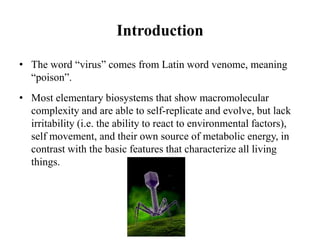
• The word “virus” comes from Latin word venome, meaning
“poison”.
• Most elementary biosystems that show macromolecular
complexity and are able to self-replicate and evolve, but lack
irritability (i.e. the ability to react to environmental factors),
self movement, and their own source of metabolic energy, in
contrast with the basic features that characterize all living
things.
• Once a viral particle gains entry into a permissive (susceptible)
cell, its nucleic acid takes charge of the cell’s metabolic system
and profusely replicates into new virus particles, until the cell
is normally depleted of all its content and dies.
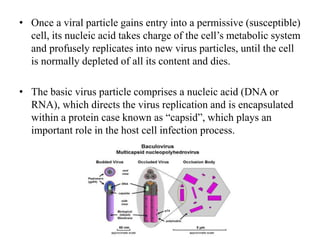
• The basic virus particle comprises a nucleic acid (DNA or
RNA), which directs the virus replication and is encapsulated
within a protein case known as “capsid”, which plays an
important role in the host cell infection process.
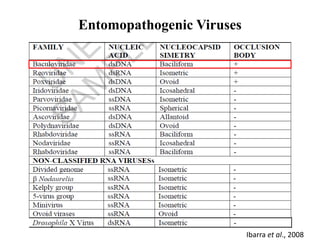
Entomopathogenic Viruses
Ibarra et al., 2008
Host range of EPV
Ascovirus: Ascoviridae
• (Lepidoptera: Noctuidae) spp.
Iridovirus: Iridoviridae
• The ICTV only recognizes 20 species of iridoviruses, in spite of reports
describing infections in 28 species of insects within the order Diptera, 12
from Lepidoptera, and four from Coleoptera.
Polydnavirus: Polydnaviridae
• Endoparasitic Hymenoptera, ICTV recognizes two genera within this
family: Ichneovirus, whose type species infects the ichneumonid wasp
Campoletis sonorensis; and Bracovirus, whose type species infects the
braconid wasp Cotesia melanocella
Ibarra et al., 2008
Baculovirus: Baculoviridae
• There have been more than 600 isolates reported from a
variety of insect species, the ICTV only recognizes 30 species
within two genera NPVs and GVs.
• The single nucleopolyhedroviruses SNPVand the multiple
nucleopolyhedroviruses MNPV type species (BmSNPV)
infects silkworms (B. mori), (AcMNPV) infects larvae of
Autographa californica (Lepidoptera: Noctuidae).
• On the other hand, GV type species infects codling moth
larvae (Cydia pomonella; Lepidoptera: Tortricidae).
Ibarra et al., 2008
Cypovirus: Reoviridae
• ICTV assemble all the insectspecific reoviruses within the
genus Cypovirus, and recognizes 70 species, all hosted by
lepidopteran species.
• The Bombyx mori cytoplasmic polyhedrosis virus or BmCPV is
the type species of the genus.
• However, there are more than 200 reports of isolates from
lepidopteran species, as well as 20 more from dipterans.
Ibarra et al., 2008
Entomopoxvirus: Poxviridae
• Entomopoxviruses have been isolated from 27 species of
orthopterans, lepidopterans, dipterans, and coleopterans.
• The subfamily Entomopoxvirinae includes three genera called
simply as Entomopoxvirus A, B and C
• The first one infects only coleopteran species and the type
species infects Melolontha melolontha; the second one infects
lepidotperan and coleopteran species and the type species
infects Amsacta moorei; and the third one infects only dipteran
species and the type species infects Chironomus luridus. A
fourth group (D) has been proposed to the ICTV which attacks
hymenopterans.
Ibarra et al., 2008
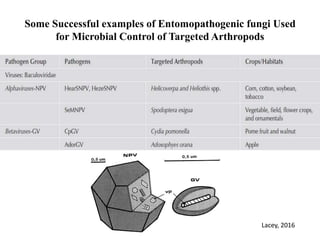
Some Successful examples of Entomopathogenic fungi Used
for Microbial Control of Targeted Arthropods
Lacey, 2016
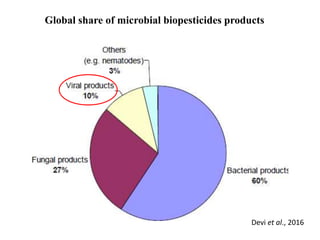
Global share of microbial biopesticides products
Devi et al., 2016
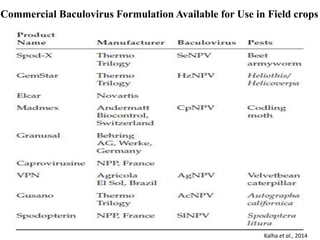
Commercial Baculovirus Formulation Available for Use in Field crops
Kalha et al., 2014
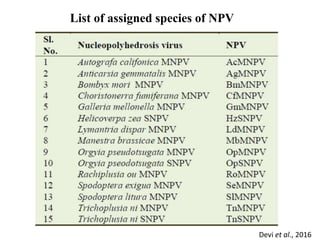
List of assigned species of NPV
Devi et al., 2016
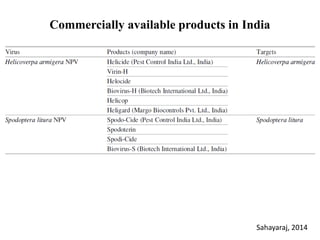
Commercially available products in India
Sahayaraj, 2014
Entomopathogenic viruses

Entomopathogenic viruses

  • 1.
    Entomopathogenic Viruses Host range,use in biological control and current status First year/M.Sc. 2018 Abdul Hamid Nazari Roll No. 21045 Sub : Insect Pathology and Immunology
  • 2.
    Introduction • The word“virus” comes from Latin word venome, meaning “poison”. • Most elementary biosystems that show macromolecular complexity and are able to self-replicate and evolve, but lack irritability (i.e. the ability to react to environmental factors), self movement, and their own source of metabolic energy, in contrast with the basic features that characterize all living things.
  • 3.
    • Once aviral particle gains entry into a permissive (susceptible) cell, its nucleic acid takes charge of the cell’s metabolic system and profusely replicates into new virus particles, until the cell is normally depleted of all its content and dies. • The basic virus particle comprises a nucleic acid (DNA or RNA), which directs the virus replication and is encapsulated within a protein case known as “capsid”, which plays an important role in the host cell infection process.
  • 4.
  • 5.
    Host range ofEPV Ascovirus: Ascoviridae • (Lepidoptera: Noctuidae) spp. Iridovirus: Iridoviridae • The ICTV only recognizes 20 species of iridoviruses, in spite of reports describing infections in 28 species of insects within the order Diptera, 12 from Lepidoptera, and four from Coleoptera. Polydnavirus: Polydnaviridae • Endoparasitic Hymenoptera, ICTV recognizes two genera within this family: Ichneovirus, whose type species infects the ichneumonid wasp Campoletis sonorensis; and Bracovirus, whose type species infects the braconid wasp Cotesia melanocella Ibarra et al., 2008
  • 6.
    Baculovirus: Baculoviridae • Therehave been more than 600 isolates reported from a variety of insect species, the ICTV only recognizes 30 species within two genera NPVs and GVs. • The single nucleopolyhedroviruses SNPVand the multiple nucleopolyhedroviruses MNPV type species (BmSNPV) infects silkworms (B. mori), (AcMNPV) infects larvae of Autographa californica (Lepidoptera: Noctuidae). • On the other hand, GV type species infects codling moth larvae (Cydia pomonella; Lepidoptera: Tortricidae). Ibarra et al., 2008
  • 7.
    Cypovirus: Reoviridae • ICTVassemble all the insectspecific reoviruses within the genus Cypovirus, and recognizes 70 species, all hosted by lepidopteran species. • The Bombyx mori cytoplasmic polyhedrosis virus or BmCPV is the type species of the genus. • However, there are more than 200 reports of isolates from lepidopteran species, as well as 20 more from dipterans. Ibarra et al., 2008
  • 8.
    Entomopoxvirus: Poxviridae • Entomopoxviruseshave been isolated from 27 species of orthopterans, lepidopterans, dipterans, and coleopterans. • The subfamily Entomopoxvirinae includes three genera called simply as Entomopoxvirus A, B and C • The first one infects only coleopteran species and the type species infects Melolontha melolontha; the second one infects lepidotperan and coleopteran species and the type species infects Amsacta moorei; and the third one infects only dipteran species and the type species infects Chironomus luridus. A fourth group (D) has been proposed to the ICTV which attacks hymenopterans. Ibarra et al., 2008
  • 9.
    Some Successful examplesof Entomopathogenic fungi Used for Microbial Control of Targeted Arthropods Lacey, 2016
  • 10.
    Global share ofmicrobial biopesticides products Devi et al., 2016
  • 11.
    Commercial Baculovirus FormulationAvailable for Use in Field crops Kalha et al., 2014
  • 12.
    List of assignedspecies of NPV Devi et al., 2016
  • 13.
    Commercially available productsin India Sahayaraj, 2014