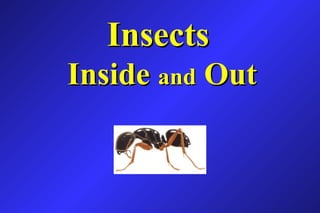
Insects
Inside and Out
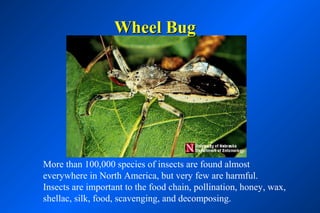
Wheel Bug


More than 100,000 species of insects are found almost
everywhere in North America, but very few are harmful.
Insects are important to the food chain, pollination, honey, wax,
shellac, silk, food, scavenging, and decomposing.
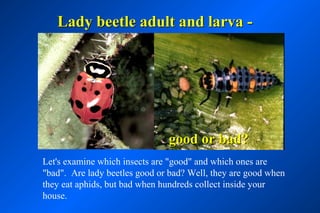
Lady beetle adult and larva -


                               good or bad?
Let's examine which insects are "good" and which ones are
"bad". Are lady beetles good or bad? Well, they are good when
they eat aphids, but bad when hundreds collect inside your
house.
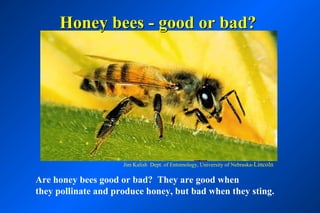
Honey bees - good or bad?


                     Jim Kalish Dept. of Entomology, University of Nebraska-Lincoln

Are honey bees good or bad? They are good when
they pollinate and produce honey, but bad when they sting.
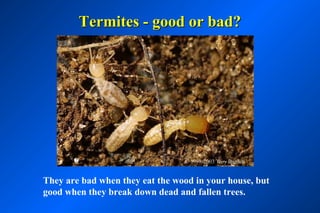
Termites - good or bad?


                                 © 1998-2003 Troy Bartlett


They are bad when they eat the wood in your house, but
good when they break down dead and fallen trees.
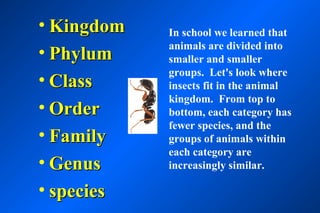
• Kingdom   In school we learned that
            animals are divided into
• Phylum    smaller and smaller
            groups. Let's look where
• Class     insects fit in the animal
            kingdom. From top to
• Order     bottom, each category has
            fewer species, and the
• Family    groups of animals within
            each category are
• Genus     increasingly similar.

• species
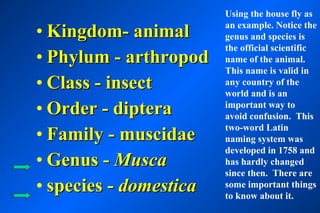
Using the house fly as
                        an example. Notice the
• Kingdom- animal       genus and species is
                        the official scientific
• Phylum - arthropod    name of the animal.
                        This name is valid in
• Class - insect        any country of the
                        world and is an
• Order - diptera       important way to
                        avoid confusion. This
                        two-word Latin
• Family - muscidae     naming system was
                        developed in 1758 and
• Genus - Musca         has hardly changed
                        since then. There are
• species - domestica   some important things
                        to know about it.
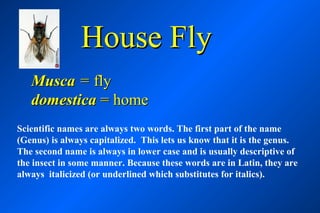
House Fly
   Musca = fly
   domestica = home
Scientific names are always two words. The first part of the name
(Genus) is always capitalized. This lets us know that it is the genus.
The second name is always in lower case and is usually descriptive of
the insect in some manner. Because these words are in Latin, they are
always italicized (or underlined which substitutes for italics).
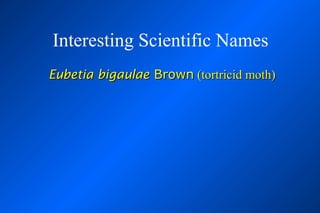
Interesting Scientific Names
Eubetia bigaulae Brown (tortricid moth)
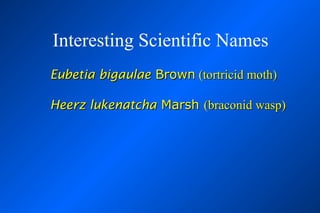
Interesting Scientific Names
Eubetia bigaulae Brown (tortricid moth)

Heerz lukenatcha Marsh (braconid wasp)
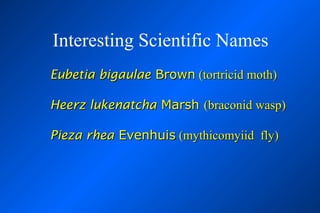
Interesting Scientific Names
Eubetia bigaulae Brown (tortricid moth)

Heerz lukenatcha Marsh (braconid wasp)

Pieza rhea Evenhuis (mythicomyiid fly)
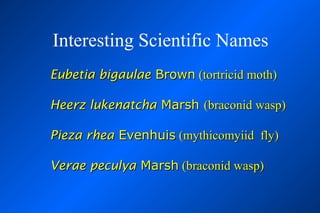
Interesting Scientific Names
Eubetia bigaulae Brown (tortricid moth)

Heerz lukenatcha Marsh (braconid wasp)

Pieza rhea Evenhuis (mythicomyiid fly)

Verae peculya Marsh (braconid wasp)
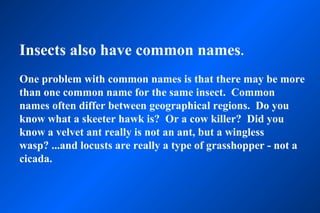
Insects also have common names.
One problem with common names is that there may be more
than one common name for the same insect. Common
names often differ between geographical regions. Do you
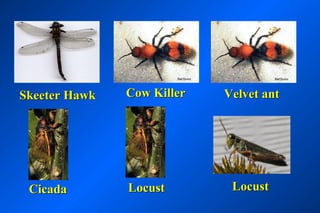
know what a skeeter hawk is? Or a cow killer? Did you
know a velvet ant really is not an ant, but a wingless
wasp? ...and locusts are really a type of grasshopper - not a
cicada.
Skeeter Hawk   Cow Killer   Velvet ant


 Cicada        Locust        Locust
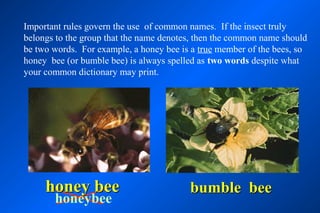
Important rules govern the use of common names. If the insect truly
belongs to the group that the name denotes, then the common name should
be two words. For example, a honey bee is a true member of the bees, so
honey bee (or bumble bee) is always spelled as two words despite what
your common dictionary may print.


     honey bee                           bumble bee
       honeybee
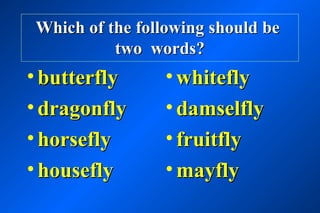
Which of the following should be
          two words?
• butterfly     • whitefly
• dragonfly     • damselfly
• horsefly      • fruitfly
• housefly      • mayfly
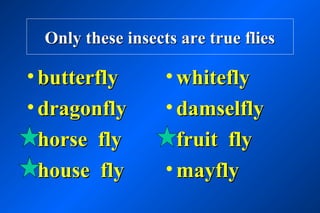
Only these insects are true flies

• butterfly       • whitefly
• dragonfly       • damselfly
• horse fly       • fruit fly
• house fly       • mayfly
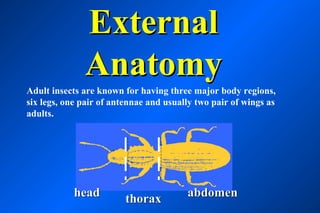
External
              Anatomy
Adult insects are known for having three major body regions,
six legs, one pair of antennae and usually two pair of wings as
adults.


           head          thorax         abdomen
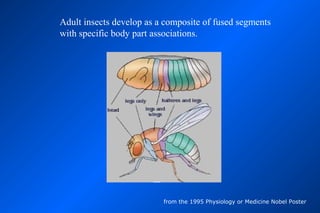
Adult insects develop as a composite of fused segments
with specific body part associations.


                          from the 1995 Physiology or Medicine Nobel Poster
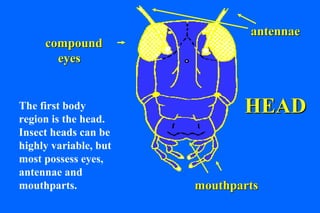
antennae
     compound
       eyes


The first body
region is the head.
                                     HEAD
                       head
Insect heads can be
highly variable, but
most possess eyes,
antennae and
mouthparts.                   mouthparts
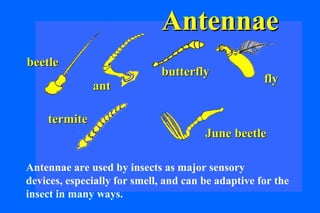
Antennae
beetle
                             butterfly
                                                    fly
              ant

    termite
                                       June beetle

Antennae are used by insects as major sensory
devices, especially for smell, and can be adaptive for the
insect in many ways.
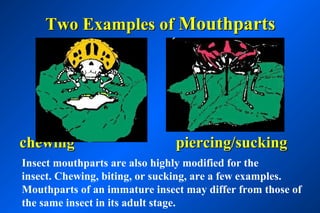
Two Examples of Mouthparts


chewing                        piercing/sucking
Insect mouthparts are also highly modified for the
insect. Chewing, biting, or sucking, are a few examples.
Mouthparts of an immature insect may differ from those of
the same insect in its adult stage.
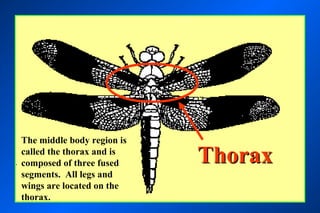
Picture of bodyparts


The middle body region is
called the thorax and is
composed of three fused             Thorax
segments. All legs and
wings are located on the
thorax.
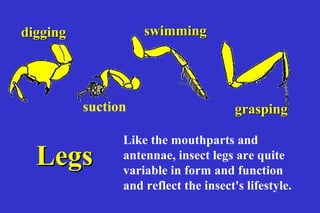
digging             swimming


          suction                      grasping

                Like the mouthparts and
  Legs          antennae, insect legs are quite
                variable in form and function
                and reflect the insect's lifestyle.
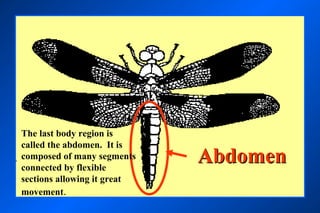
The last body region is
called the abdomen. It is
composed of many segments
connected by flexible
                             Abdomen
sections allowing it great
movement.
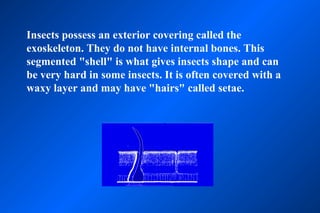
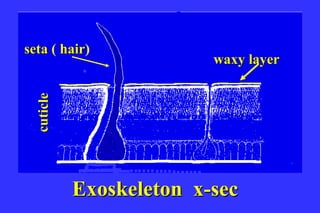
Insects possess an exterior covering called the
exoskeleton. They do not have internal bones. This
segmented "shell" is what gives insects shape and can
be very hard in some insects. It is often covered with a
waxy layer and may have "hairs" called setae.
seta ( hair)
       hair
                          waxy layer
  cuticle


            Exoskeleton x-sec
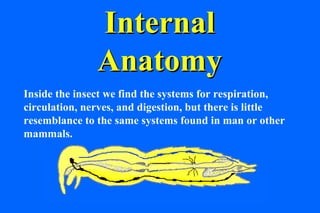
Internal
               Anatomy
Inside the insect we find the systems for respiration,
circulation, nerves, and digestion, but there is little
resemblance to the same systems found in man or other
mammals.
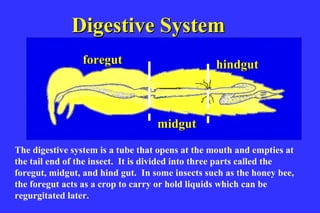
Digestive System
                foregut                          hindgut

              Digestive sys
                                   midgut

The digestive system is a tube that opens at the mouth and empties at
the tail end of the insect. It is divided into three parts called the
foregut, midgut, and hind gut. In some insects such as the honey bee,
the foregut acts as a crop to carry or hold liquids which can be
regurgitated later.
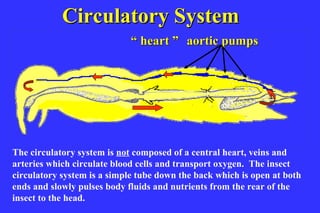
Circulatory System
                             “ heart ” aortic pumps


                              Circ system


The circulatory system is not composed of a central heart, veins and
arteries which circulate blood cells and transport oxygen. The insect
circulatory system is a simple tube down the back which is open at both
ends and slowly pulses body fluids and nutrients from the rear of the
insect to the head.
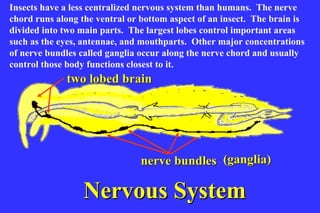
Insects have a less centralized nervous system than humans. The nerve
chord runs along the ventral or bottom aspect of an insect. The brain is
divided into two main parts. The largest lobes control important areas
such as the eyes, antennae, and mouthparts. Other major concentrations
of nerve bundles called ganglia occur along the nerve chord and usually
control those body functions closest to it.
             two lobed brain
                           Nervous system


                                nerve bundles (ganglia)

                  Nervous System
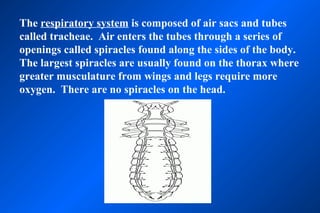
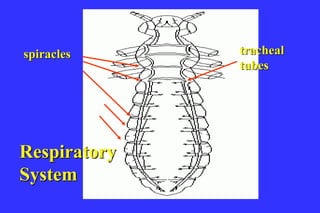
The respiratory system is composed of air sacs and tubes
called tracheae. Air enters the tubes through a series of
openings called spiracles found along the sides of the body.
The largest spiracles are usually found on the thorax where
greater musculature from wings and legs require more
oxygen. There are no spiracles on the head.
spiracles     tracheal
              tubes


Respiratory
System
Life
                          Cycles

The many diverse orders of insects have four different types of life cycles.
These life cycles are called "metamorphosis" because of the changes of
shape that the insects undergo during development.
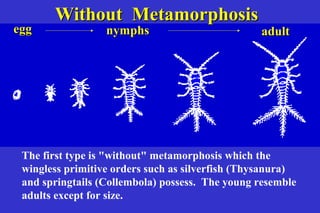
Without Metamorphosis
egg               nymphs                         adult


                       Without meta


 The first type is "without" metamorphosis which the
 wingless primitive orders such as silverfish (Thysanura)
 and springtails (Collembola) possess. The young resemble
 adults except for size.
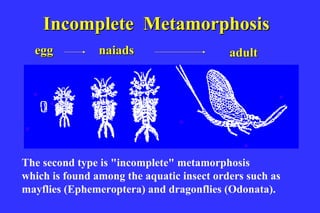
Incomplete Metamorphosis
  egg           naiads                     adult


                         Incomplete meta


The second type is "incomplete" metamorphosis
which is found among the aquatic insect orders such as
mayflies (Ephemeroptera) and dragonflies (Odonata).
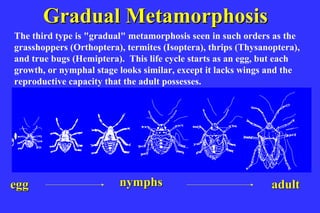
Gradual Metamorphosis
The third type is "gradual" metamorphosis seen in such orders as the
grasshoppers (Orthoptera), termites (Isoptera), thrips (Thysanoptera),
and true bugs (Hemiptera). This life cycle starts as an egg, but each
growth, or nymphal stage looks similar, except it lacks wings and the
reproductive capacity that the adult possesses.
                             Gradual meta


egg                      nymphs                                adult
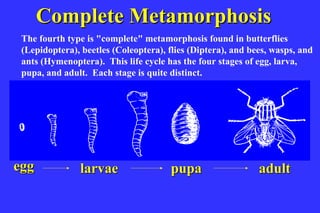
Complete Metamorphosis
 The fourth type is "complete" metamorphosis found in butterflies
 (Lepidoptera), beetles (Coleoptera), flies (Diptera), and bees, wasps, and
 ants (Hymenoptera). This life cycle has the four stages of egg, larva,
 pupa, and adult. Each stage is quite distinct.


egg            larvae                 pupa                   adult
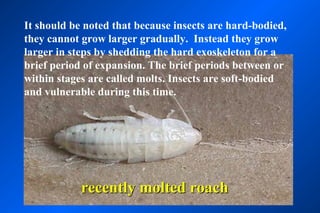
It should be noted that because insects are hard-bodied,
they cannot grow larger gradually. Instead they grow
larger in steps by shedding the hard exoskeleton for a
brief period of expansion. The brief periods between or
within stages are called molts. Insects are soft-bodied
and vulnerable during this time.


            recently molted roach
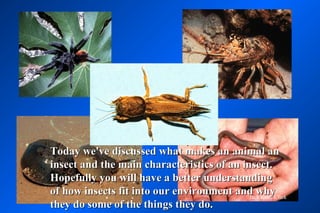
Today we've discussed what makes an animal an
insect and the main characteristics of an insect.
Hopefully you will have a better understanding
of how insects fit into our environment and whyClark
                                            Jack Kelly
they do some of the things they do.
Prepared by

         Stephen B. Bambara

        Extension Entomologist

             NC STATE UNIVERSITY

Copyright 2001

Insects in out

  • 1.
  • 2.
    Wheel Bug More than100,000 species of insects are found almost everywhere in North America, but very few are harmful. Insects are important to the food chain, pollination, honey, wax, shellac, silk, food, scavenging, and decomposing.
  • 3.
    Lady beetle adultand larva - good or bad? Let's examine which insects are "good" and which ones are "bad". Are lady beetles good or bad? Well, they are good when they eat aphids, but bad when hundreds collect inside your house.
  • 4.
    Honey bees -good or bad? Jim Kalish Dept. of Entomology, University of Nebraska-Lincoln Are honey bees good or bad? They are good when they pollinate and produce honey, but bad when they sting.
  • 5.
    Termites - goodor bad? © 1998-2003 Troy Bartlett They are bad when they eat the wood in your house, but good when they break down dead and fallen trees.
  • 6.
    • Kingdom In school we learned that animals are divided into • Phylum smaller and smaller groups. Let's look where • Class insects fit in the animal kingdom. From top to • Order bottom, each category has fewer species, and the • Family groups of animals within each category are • Genus increasingly similar. • species
  • 7.
    Using the housefly as an example. Notice the • Kingdom- animal genus and species is the official scientific • Phylum - arthropod name of the animal. This name is valid in • Class - insect any country of the world and is an • Order - diptera important way to avoid confusion. This two-word Latin • Family - muscidae naming system was developed in 1758 and • Genus - Musca has hardly changed since then. There are • species - domestica some important things to know about it.
  • 8.
    House Fly Musca = fly domestica = home Scientific names are always two words. The first part of the name (Genus) is always capitalized. This lets us know that it is the genus. The second name is always in lower case and is usually descriptive of the insect in some manner. Because these words are in Latin, they are always italicized (or underlined which substitutes for italics).
  • 9.
    Interesting Scientific Names Eubetiabigaulae Brown (tortricid moth)
  • 10.
    Interesting Scientific Names Eubetiabigaulae Brown (tortricid moth) Heerz lukenatcha Marsh (braconid wasp)
  • 11.
    Interesting Scientific Names Eubetiabigaulae Brown (tortricid moth) Heerz lukenatcha Marsh (braconid wasp) Pieza rhea Evenhuis (mythicomyiid fly)
  • 12.
    Interesting Scientific Names Eubetiabigaulae Brown (tortricid moth) Heerz lukenatcha Marsh (braconid wasp) Pieza rhea Evenhuis (mythicomyiid fly) Verae peculya Marsh (braconid wasp)
  • 13.
    Insects also havecommon names. One problem with common names is that there may be more than one common name for the same insect. Common names often differ between geographical regions. Do you know what a skeeter hawk is? Or a cow killer? Did you know a velvet ant really is not an ant, but a wingless wasp? ...and locusts are really a type of grasshopper - not a cicada.
  • 14.
    Skeeter Hawk Cow Killer Velvet ant Cicada Locust Locust
  • 15.
    Important rules governthe use of common names. If the insect truly belongs to the group that the name denotes, then the common name should be two words. For example, a honey bee is a true member of the bees, so honey bee (or bumble bee) is always spelled as two words despite what your common dictionary may print. honey bee bumble bee honeybee
  • 16.
    Which of thefollowing should be two words? • butterfly • whitefly • dragonfly • damselfly • horsefly • fruitfly • housefly • mayfly
  • 17.
    Only these insectsare true flies • butterfly • whitefly • dragonfly • damselfly • horse fly • fruit fly • house fly • mayfly
  • 18.
    External Anatomy Adult insects are known for having three major body regions, six legs, one pair of antennae and usually two pair of wings as adults. head thorax abdomen
  • 19.
    Adult insects developas a composite of fused segments with specific body part associations. from the 1995 Physiology or Medicine Nobel Poster
  • 20.
    antennae compound eyes The first body region is the head. HEAD head Insect heads can be highly variable, but most possess eyes, antennae and mouthparts. mouthparts
  • 21.
    Antennae beetle butterfly fly ant termite June beetle Antennae are used by insects as major sensory devices, especially for smell, and can be adaptive for the insect in many ways.
  • 22.
    Two Examples ofMouthparts chewing piercing/sucking Insect mouthparts are also highly modified for the insect. Chewing, biting, or sucking, are a few examples. Mouthparts of an immature insect may differ from those of the same insect in its adult stage.
  • 23.
    Picture of bodyparts Themiddle body region is called the thorax and is composed of three fused Thorax segments. All legs and wings are located on the thorax.
  • 24.
    digging swimming suction grasping Like the mouthparts and Legs antennae, insect legs are quite variable in form and function and reflect the insect's lifestyle.
  • 25.
    The last bodyregion is called the abdomen. It is composed of many segments connected by flexible Abdomen sections allowing it great movement.
  • 26.
    Insects possess anexterior covering called the exoskeleton. They do not have internal bones. This segmented "shell" is what gives insects shape and can be very hard in some insects. It is often covered with a waxy layer and may have "hairs" called setae.
  • 27.
    seta ( hair) hair waxy layer cuticle Exoskeleton x-sec
  • 28.
    Internal Anatomy Inside the insect we find the systems for respiration, circulation, nerves, and digestion, but there is little resemblance to the same systems found in man or other mammals.
  • 29.
    Digestive System foregut hindgut Digestive sys midgut The digestive system is a tube that opens at the mouth and empties at the tail end of the insect. It is divided into three parts called the foregut, midgut, and hind gut. In some insects such as the honey bee, the foregut acts as a crop to carry or hold liquids which can be regurgitated later.
  • 30.
    Circulatory System “ heart ” aortic pumps Circ system The circulatory system is not composed of a central heart, veins and arteries which circulate blood cells and transport oxygen. The insect circulatory system is a simple tube down the back which is open at both ends and slowly pulses body fluids and nutrients from the rear of the insect to the head.
  • 31.
    Insects have aless centralized nervous system than humans. The nerve chord runs along the ventral or bottom aspect of an insect. The brain is divided into two main parts. The largest lobes control important areas such as the eyes, antennae, and mouthparts. Other major concentrations of nerve bundles called ganglia occur along the nerve chord and usually control those body functions closest to it. two lobed brain Nervous system nerve bundles (ganglia) Nervous System
  • 32.
    The respiratory systemis composed of air sacs and tubes called tracheae. Air enters the tubes through a series of openings called spiracles found along the sides of the body. The largest spiracles are usually found on the thorax where greater musculature from wings and legs require more oxygen. There are no spiracles on the head.
  • 33.
    spiracles tracheal tubes Respiratory System
  • 34.
    Life Cycles The many diverse orders of insects have four different types of life cycles. These life cycles are called "metamorphosis" because of the changes of shape that the insects undergo during development.
  • 35.
    Without Metamorphosis egg nymphs adult Without meta The first type is "without" metamorphosis which the wingless primitive orders such as silverfish (Thysanura) and springtails (Collembola) possess. The young resemble adults except for size.
  • 36.
    Incomplete Metamorphosis egg naiads adult Incomplete meta The second type is "incomplete" metamorphosis which is found among the aquatic insect orders such as mayflies (Ephemeroptera) and dragonflies (Odonata).
  • 37.
    Gradual Metamorphosis The thirdtype is "gradual" metamorphosis seen in such orders as the grasshoppers (Orthoptera), termites (Isoptera), thrips (Thysanoptera), and true bugs (Hemiptera). This life cycle starts as an egg, but each growth, or nymphal stage looks similar, except it lacks wings and the reproductive capacity that the adult possesses. Gradual meta egg nymphs adult
  • 38.
    Complete Metamorphosis Thefourth type is "complete" metamorphosis found in butterflies (Lepidoptera), beetles (Coleoptera), flies (Diptera), and bees, wasps, and ants (Hymenoptera). This life cycle has the four stages of egg, larva, pupa, and adult. Each stage is quite distinct. egg larvae pupa adult
  • 39.
    It should benoted that because insects are hard-bodied, they cannot grow larger gradually. Instead they grow larger in steps by shedding the hard exoskeleton for a brief period of expansion. The brief periods between or within stages are called molts. Insects are soft-bodied and vulnerable during this time. recently molted roach
  • 40.
    Today we've discussedwhat makes an animal an insect and the main characteristics of an insect. Hopefully you will have a better understanding of how insects fit into our environment and whyClark Jack Kelly they do some of the things they do.
  • 41.
    Prepared by Stephen B. Bambara Extension Entomologist NC STATE UNIVERSITY Copyright 2001