INSECTS
Insects or Insecta (from Latin insectum) are hexapod
invertebrates and the largest group within the arthropod
phylum.
Insects have a chitinous exoskeleton, segmented bodies, and
jointed legs.
INSECTS
Insects are distinguished from other arthropods by their
body, which is divided into three major regions :
1) THE HEAD, which bears the mouthparts, eyes, and a pair
of antennae,
2) The three segmented THORAX, which usually has three
pairs of legs (hence “Hexapoda”) in adults and usually one
or two pairs of wings, and
3) The many segmented ABDOMEN, which contains
digestive, excretory, and reproductive organs.
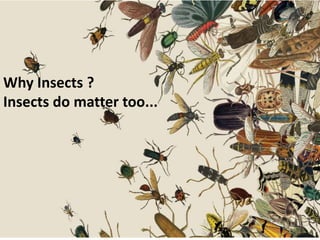
Why Insects ?
Insects do matter too...
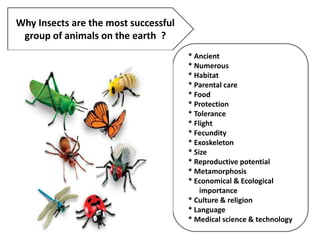
Why Insects are the most successful
group of animals on the earth ?
* Ancient
* Numerous
* Habitat
* Parental care
* Food
* Protection
* Tolerance
* Flight
* Fecundity
* Exoskeleton
* Size
* Reproductive potential
* Metamorphosis
* Economical & Ecological
importance
* Culture & religion
* Language
* Medical science & technology
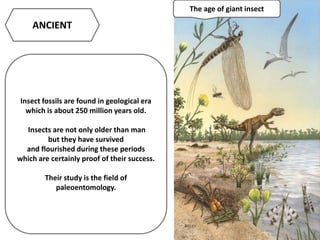
ANCIENT
Insect fossils are found in geological era
which is about 250 million years old.
Insects are not only older than man
but they have survived
and flourished during these periods
which are certainly proof of their success.
Their study is the field of
paleoentomology.
The age of giant insect
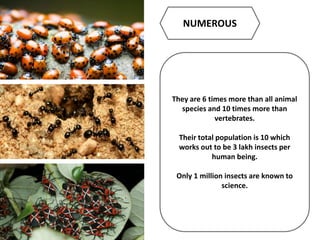
NUMEROUS
They are 6 times more than all animal
species and 10 times more than
vertebrates.
Their total population is 10 which
works out to be 3 lakh insects per
human being.
Only 1 million insects are known to
science.
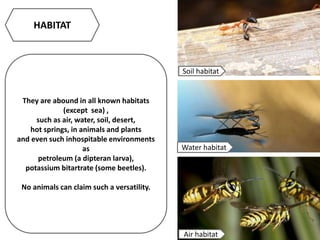
HABITAT
They are abound in all known habitats
(except sea) ,
such as air, water, soil, desert,
hot springs, in animals and plants
and even such inhospitable environments
as
petroleum (a dipteran larva),
potassium bitartrate (some beetles).
No animals can claim such a versatility.
Soil habitat
Water habitat
Air habitat
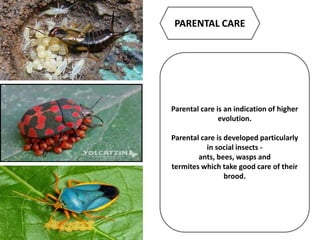
PARENTAL CARE
Parental care is an indication of higher
evolution.
Parental care is developed particularly
in social insects -
ants, bees, wasps and
termites which take good care of their
brood.
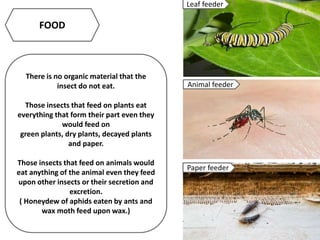
FOOD
There is no organic material that the
insect do not eat.
Those insects that feed on plants eat
everything that form their part even they
would feed on
green plants, dry plants, decayed plants
and paper.
Those insects that feed on animals would
eat anything of the animal even they feed
upon other insects or their secretion and
excretion.
( Honeydew of aphids eaten by ants and
wax moth feed upon wax.)
Leaf feeder
Animal feeder
Paper feeder
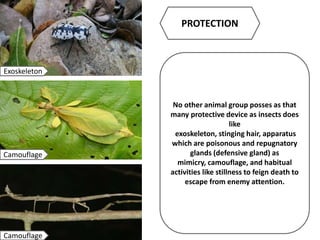
PROTECTION
No other animal group posses as that
many protective device as insects does
like
exoskeleton, stinging hair, apparatus
which are poisonous and repugnatory
glands (defensive gland) as
mimicry, camouflage, and habitual
activities like stillness to feign death to
escape from enemy attention.
Exoskeleton
Camouflage
Camouflage
TOLERANCE
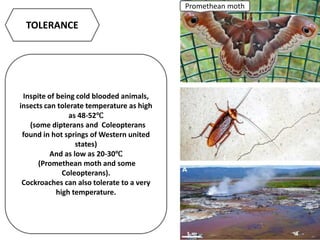
Inspite of being cold blooded animals,
insects can tolerate temperature as high
as 48-52℃
(some dipterans and Coleopterans
found in hot springs of Western united
states)
And as low as 20-30℃
(Promethean moth and some
Coleopterans).
Cockroaches can also tolerate to a very
high temperature.
Promethean moth
FLIGHT
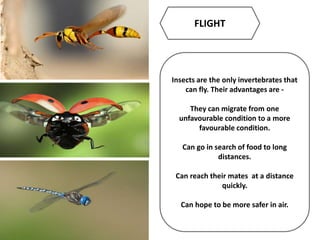
Insects are the only invertebrates that
can fly. Their advantages are -
They can migrate from one
unfavourable condition to a more
favourable condition.
Can go in search of food to long
distances.
Can reach their mates at a distance
quickly.
Can hope to be more safer in air.
FECUNDITY
They are prolific breeders.
They produce 100-150 eggs per female on
an average.
They are some like honeybee queen that
produce 2-3 thousand eggs per day and
termite queen 60 eggs per sec.
But survival rate of insect is very low (2
per 2000 larvae in case of housefly).
They adopt all methods of reproduction.
Honeybee eggs
Termite eggs
Housefly eggs
EXOSKELETON
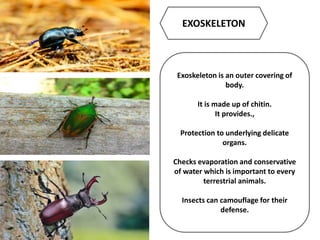
Exoskeleton is an outer covering of
body.
It is made up of chitin.
It provides.,
Protection to underlying delicate
organs.
Checks evaporation and conservative
of water which is important to every
terrestrial animals.
Insects can camouflage for their
defense.
SIZE
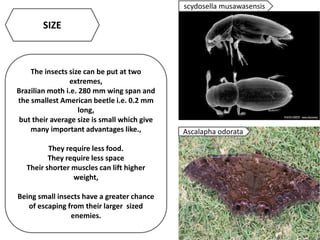
The insects size can be put at two
extremes,
Brazilian moth i.e. 280 mm wing span and
the smallest American beetle i.e. 0.2 mm
long,
but their average size is small which give
many important advantages like.,
They require less food.
They require less space
Their shorter muscles can lift higher
weight,
Being small insects have a greater chance
of escaping from their larger sized
enemies.
Ascalapha odorata
scydosella musawasensis
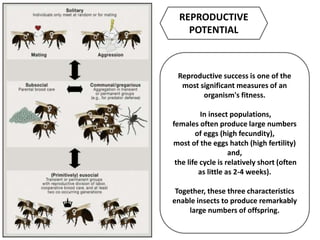
Reproductive success is one of the
most significant measures of an
organism's fitness.
In insect populations,
females often produce large numbers
of eggs (high fecundity),
most of the eggs hatch (high fertility)
and,
the life cycle is relatively short (often
as little as 2-4 weeks).
Together, these three characteristics
enable insects to produce remarkably
large numbers of offspring.
REPRODUCTIVE
POTENTIAL
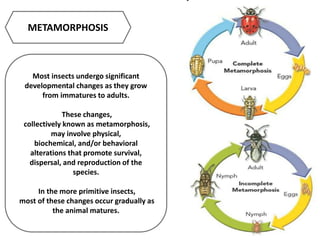
Most insects undergo significant
developmental changes as they grow
from immatures to adults.
These changes,
collectively known as metamorphosis,
may involve physical,
biochemical, and/or behavioral
alterations that promote survival,
dispersal, and reproduction of the
species.
In the more primitive insects,
most of these changes occur gradually as
the animal matures.
METAMORPHOSIS
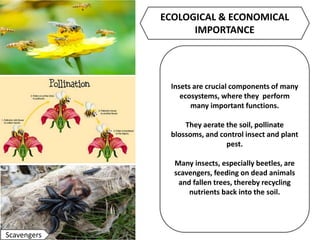
Insets are crucial components of many
ecosystems, where they perform
many important functions.
They aerate the soil, pollinate
blossoms, and control insect and plant
pest.
Many insects, especially beetles, are
scavengers, feeding on dead animals
and fallen trees, thereby recycling
nutrients back into the soil.
ECOLOGICAL & ECONOMICAL
IMPORTANCE
Scavengers
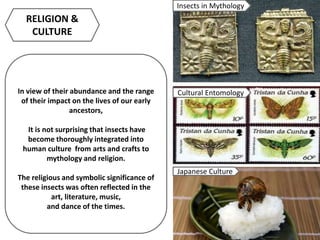
In view of their abundance and the range
of their impact on the lives of our early
ancestors,
It is not surprising that insects have
become thoroughly integrated into
human culture from arts and crafts to
mythology and religion.
The religious and symbolic significance of
these insects was often reflected in the
art, literature, music,
and dance of the times.
RELIGION &
CULTURE
Insects in Mythology
Cultural Entomology
Japanese Culture
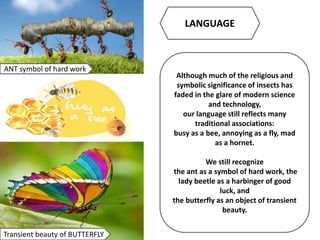
Although much of the religious and
symbolic significance of insects has
faded in the glare of modern science
and technology,
our language still reflects many
traditional associations:
busy as a bee, annoying as a fly, mad
as a hornet.
We still recognize
the ant as a symbol of hard work, the
lady beetle as a harbinger of good
luck, and
the butterfly as an object of transient
beauty.
LANGUAGE
ANT symbol of hard work
Transient beauty of BUTTERFLY
MEDICAL SCIENCE &
TECHNOLOGY
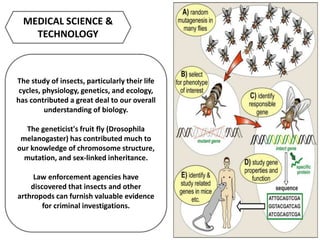
The study of insects, particularly their life
cycles, physiology, genetics, and ecology,
has contributed a great deal to our overall
understanding of biology.
The geneticist's fruit fly (Drosophila
melanogaster) has contributed much to
our knowledge of chromosome structure,
mutation, and sex-linked inheritance.
Law enforcement agencies have
discovered that insects and other
arthropods can furnish valuable evidence
for criminal investigations.
By ., Anjali Pramod Umredkar
M.Sc. Zoology ( Entomology )

Insects

  • 2.
    INSECTS Insects or Insecta(from Latin insectum) are hexapod invertebrates and the largest group within the arthropod phylum. Insects have a chitinous exoskeleton, segmented bodies, and jointed legs.
  • 3.
    INSECTS Insects are distinguishedfrom other arthropods by their body, which is divided into three major regions : 1) THE HEAD, which bears the mouthparts, eyes, and a pair of antennae, 2) The three segmented THORAX, which usually has three pairs of legs (hence “Hexapoda”) in adults and usually one or two pairs of wings, and 3) The many segmented ABDOMEN, which contains digestive, excretory, and reproductive organs.
  • 4.
    Why Insects ? Insectsdo matter too...
  • 6.
    Why Insects arethe most successful group of animals on the earth ? * Ancient * Numerous * Habitat * Parental care * Food * Protection * Tolerance * Flight * Fecundity * Exoskeleton * Size * Reproductive potential * Metamorphosis * Economical & Ecological importance * Culture & religion * Language * Medical science & technology
  • 7.
    ANCIENT Insect fossils arefound in geological era which is about 250 million years old. Insects are not only older than man but they have survived and flourished during these periods which are certainly proof of their success. Their study is the field of paleoentomology. The age of giant insect
  • 8.
    NUMEROUS They are 6times more than all animal species and 10 times more than vertebrates. Their total population is 10 which works out to be 3 lakh insects per human being. Only 1 million insects are known to science.
  • 9.
    HABITAT They are aboundin all known habitats (except sea) , such as air, water, soil, desert, hot springs, in animals and plants and even such inhospitable environments as petroleum (a dipteran larva), potassium bitartrate (some beetles). No animals can claim such a versatility. Soil habitat Water habitat Air habitat
  • 10.
    PARENTAL CARE Parental careis an indication of higher evolution. Parental care is developed particularly in social insects - ants, bees, wasps and termites which take good care of their brood.
  • 11.
    FOOD There is noorganic material that the insect do not eat. Those insects that feed on plants eat everything that form their part even they would feed on green plants, dry plants, decayed plants and paper. Those insects that feed on animals would eat anything of the animal even they feed upon other insects or their secretion and excretion. ( Honeydew of aphids eaten by ants and wax moth feed upon wax.) Leaf feeder Animal feeder Paper feeder
  • 12.
    PROTECTION No other animalgroup posses as that many protective device as insects does like exoskeleton, stinging hair, apparatus which are poisonous and repugnatory glands (defensive gland) as mimicry, camouflage, and habitual activities like stillness to feign death to escape from enemy attention. Exoskeleton Camouflage Camouflage
  • 13.
    TOLERANCE Inspite of beingcold blooded animals, insects can tolerate temperature as high as 48-52℃ (some dipterans and Coleopterans found in hot springs of Western united states) And as low as 20-30℃ (Promethean moth and some Coleopterans). Cockroaches can also tolerate to a very high temperature. Promethean moth
  • 14.
    FLIGHT Insects are theonly invertebrates that can fly. Their advantages are - They can migrate from one unfavourable condition to a more favourable condition. Can go in search of food to long distances. Can reach their mates at a distance quickly. Can hope to be more safer in air.
  • 15.
    FECUNDITY They are prolificbreeders. They produce 100-150 eggs per female on an average. They are some like honeybee queen that produce 2-3 thousand eggs per day and termite queen 60 eggs per sec. But survival rate of insect is very low (2 per 2000 larvae in case of housefly). They adopt all methods of reproduction. Honeybee eggs Termite eggs Housefly eggs
  • 16.
    EXOSKELETON Exoskeleton is anouter covering of body. It is made up of chitin. It provides., Protection to underlying delicate organs. Checks evaporation and conservative of water which is important to every terrestrial animals. Insects can camouflage for their defense.
  • 17.
    SIZE The insects sizecan be put at two extremes, Brazilian moth i.e. 280 mm wing span and the smallest American beetle i.e. 0.2 mm long, but their average size is small which give many important advantages like., They require less food. They require less space Their shorter muscles can lift higher weight, Being small insects have a greater chance of escaping from their larger sized enemies. Ascalapha odorata scydosella musawasensis
  • 18.
    Reproductive success isone of the most significant measures of an organism's fitness. In insect populations, females often produce large numbers of eggs (high fecundity), most of the eggs hatch (high fertility) and, the life cycle is relatively short (often as little as 2-4 weeks). Together, these three characteristics enable insects to produce remarkably large numbers of offspring. REPRODUCTIVE POTENTIAL
  • 19.
    Most insects undergosignificant developmental changes as they grow from immatures to adults. These changes, collectively known as metamorphosis, may involve physical, biochemical, and/or behavioral alterations that promote survival, dispersal, and reproduction of the species. In the more primitive insects, most of these changes occur gradually as the animal matures. METAMORPHOSIS
  • 20.
    Insets are crucialcomponents of many ecosystems, where they perform many important functions. They aerate the soil, pollinate blossoms, and control insect and plant pest. Many insects, especially beetles, are scavengers, feeding on dead animals and fallen trees, thereby recycling nutrients back into the soil. ECOLOGICAL & ECONOMICAL IMPORTANCE Scavengers
  • 21.
    In view oftheir abundance and the range of their impact on the lives of our early ancestors, It is not surprising that insects have become thoroughly integrated into human culture from arts and crafts to mythology and religion. The religious and symbolic significance of these insects was often reflected in the art, literature, music, and dance of the times. RELIGION & CULTURE Insects in Mythology Cultural Entomology Japanese Culture
  • 22.
    Although much ofthe religious and symbolic significance of insects has faded in the glare of modern science and technology, our language still reflects many traditional associations: busy as a bee, annoying as a fly, mad as a hornet. We still recognize the ant as a symbol of hard work, the lady beetle as a harbinger of good luck, and the butterfly as an object of transient beauty. LANGUAGE ANT symbol of hard work Transient beauty of BUTTERFLY
  • 23.
    MEDICAL SCIENCE & TECHNOLOGY Thestudy of insects, particularly their life cycles, physiology, genetics, and ecology, has contributed a great deal to our overall understanding of biology. The geneticist's fruit fly (Drosophila melanogaster) has contributed much to our knowledge of chromosome structure, mutation, and sex-linked inheritance. Law enforcement agencies have discovered that insects and other arthropods can furnish valuable evidence for criminal investigations.
  • 24.
    By ., AnjaliPramod Umredkar M.Sc. Zoology ( Entomology )