

Innovation through continuing
professional development in
English Language Education
Peter Beech
peter@peterbeech.com
Participant Profile
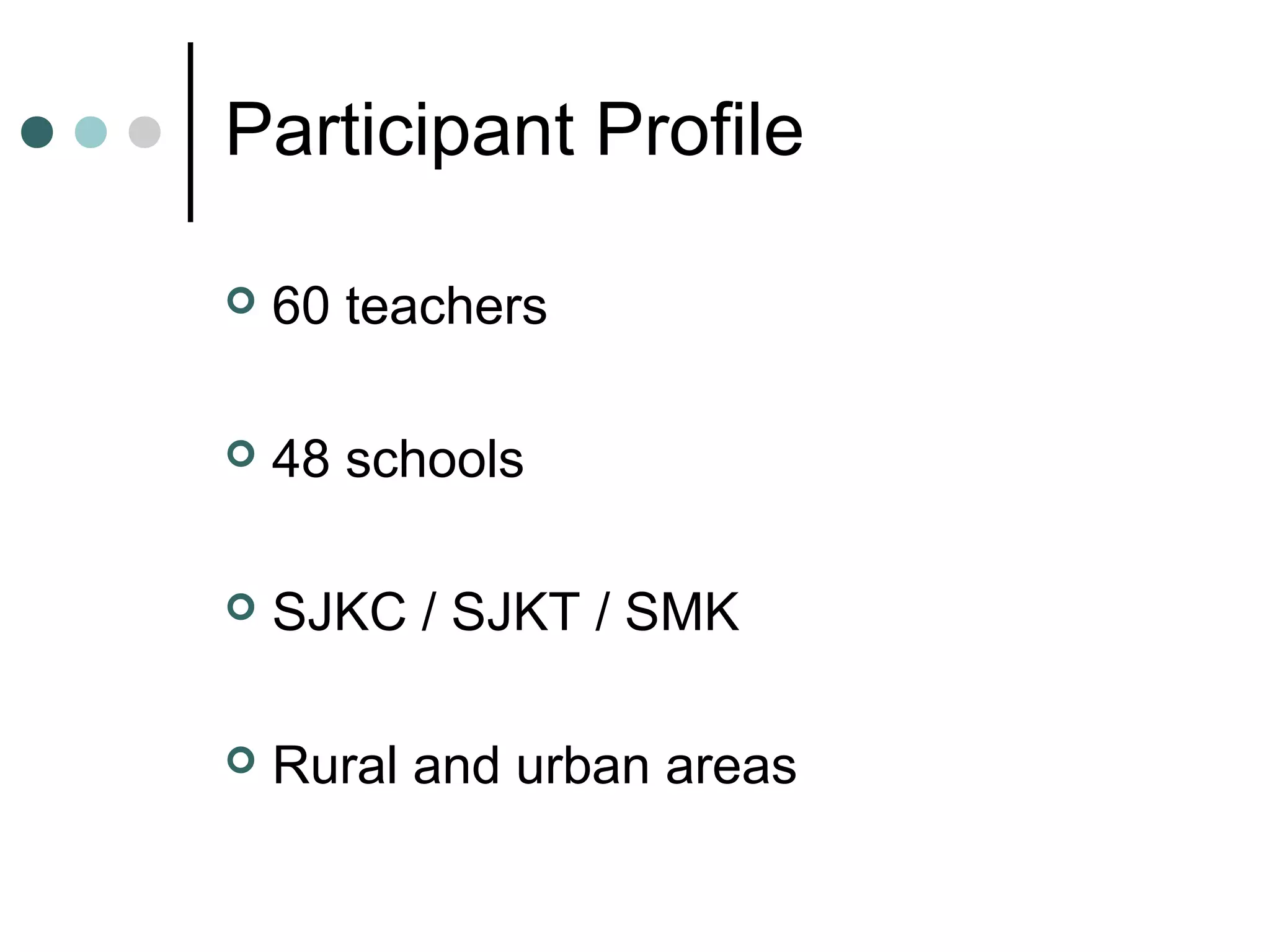
 60 teachers
 48 schools
 SJKC / SJKT / SMK
 Rural and urban areas
Participant Profile
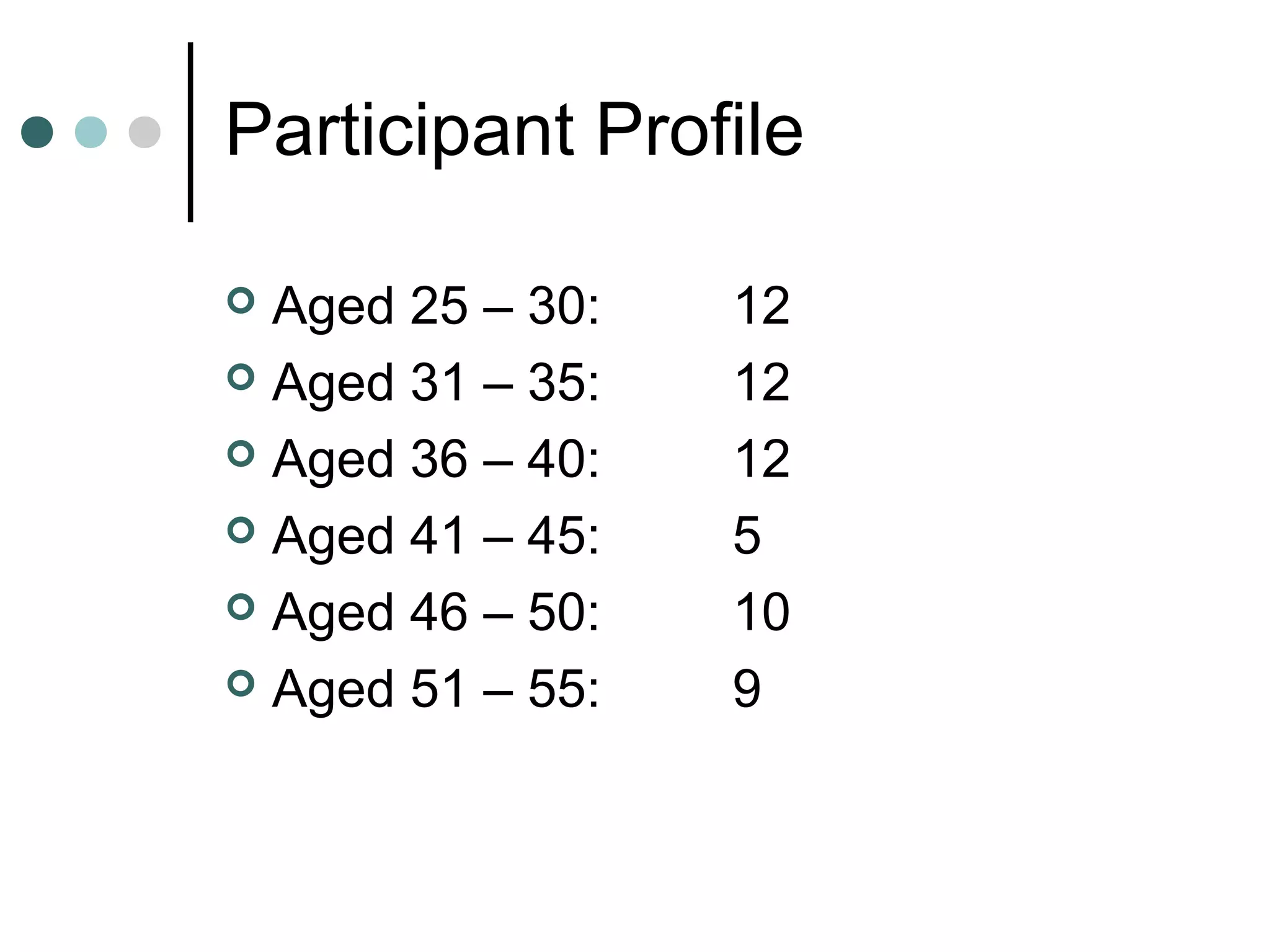
 Aged 25 – 30: 12
 Aged 31 – 35: 12
 Aged 36 – 40: 12
 Aged 41 – 45: 5
 Aged 46 – 50: 10
 Aged 51 – 55: 9
Participant Profile
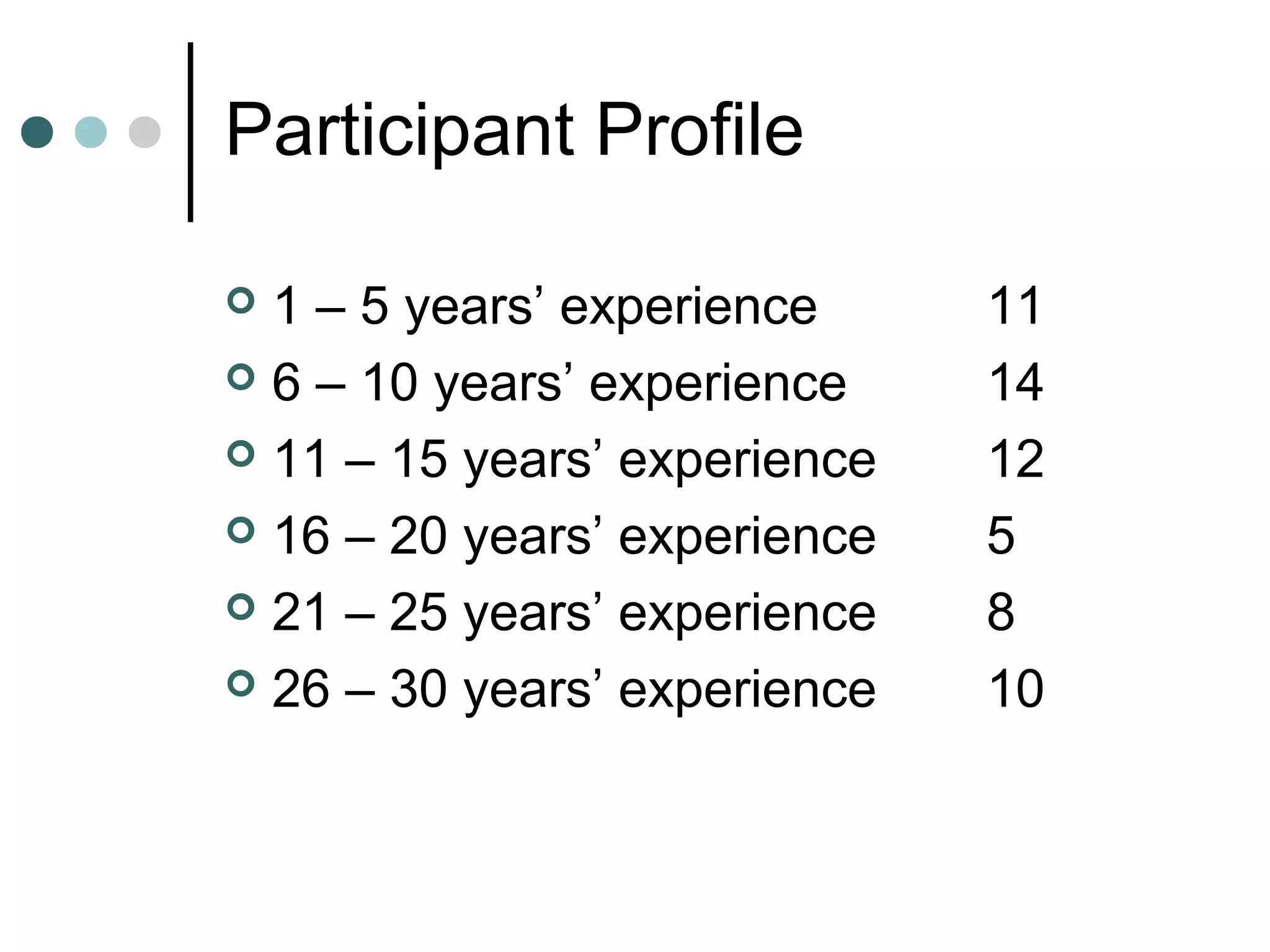
 1 – 5 years’ experience 11
 6 – 10 years’ experience 14
 11 – 15 years’ experience 12
 16 – 20 years’ experience 5
 21 – 25 years’ experience 8
 26 – 30 years’ experience 10
Participant Profile
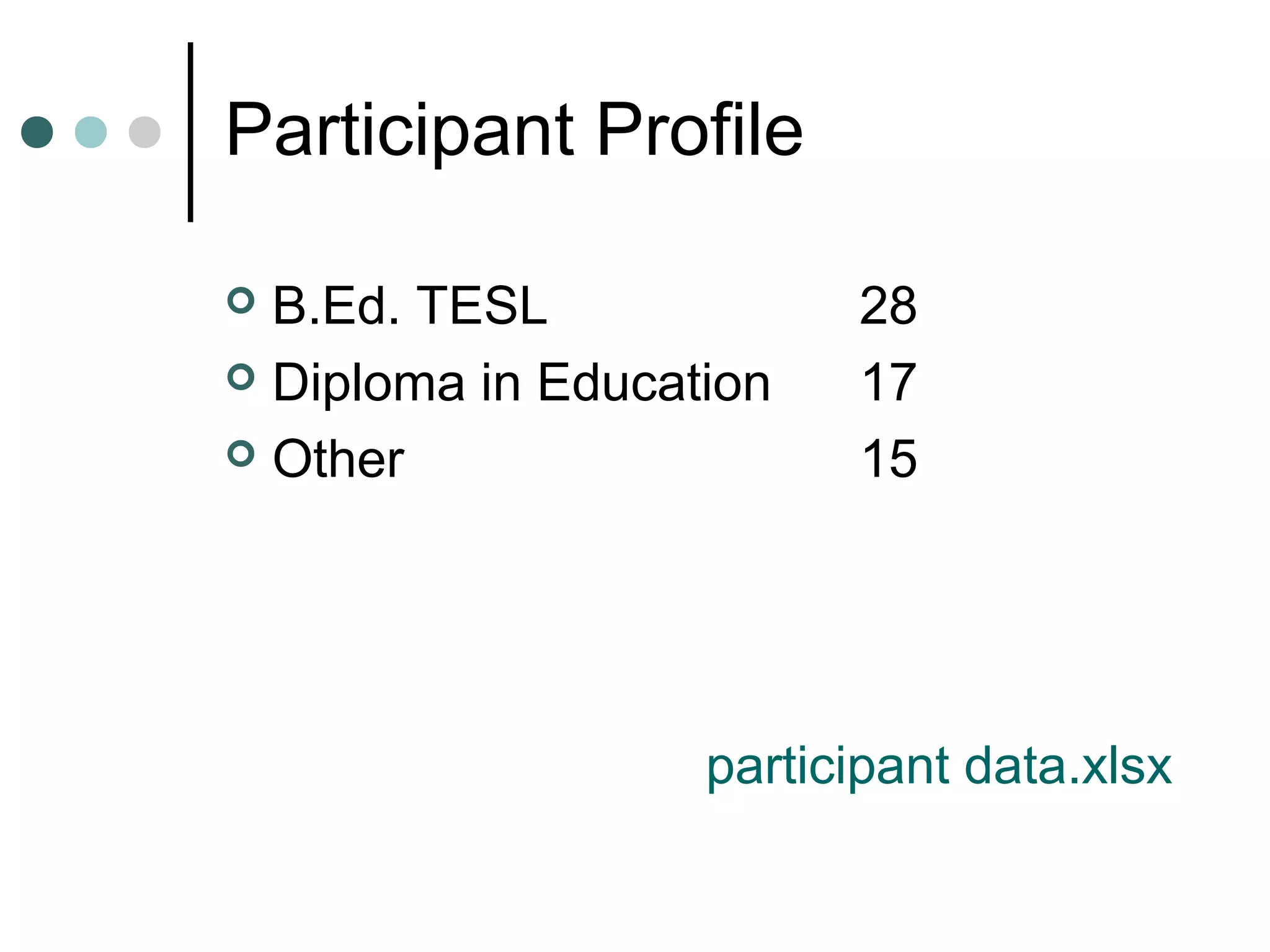
 B.Ed. TESL 28
 Diploma in Education 17
 Other 15
participant data.xlsx
Interview Questions
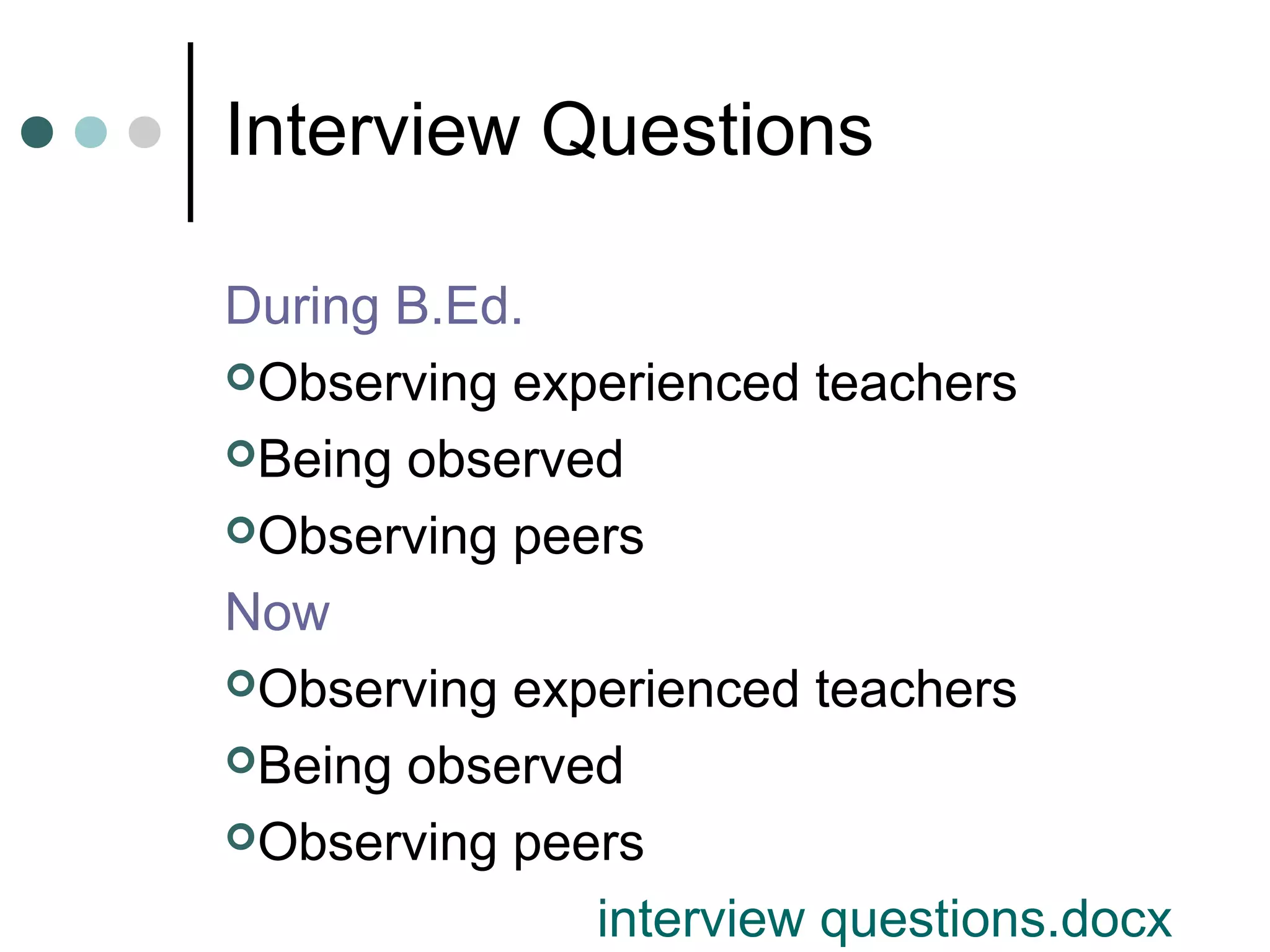
During B.Ed.
Observing experienced teachers
Being observed
Observing peers
Now
Observing experienced teachers
Being observed
Observing peers
interview questions.docx
Observing experienced
teachers
 School visits for observation
 Teachers didn’t want to be observed
 Most student teachers had no
opportunity to observe
Focus for observation
 Teaching approaches
 Classroom management
 Teacher language
Observation of Student
Teachers
 Six-month practicum
 Teaching every day
 Observed by:
Lecturer
Mentor-teacher at the school
 Observed only 2 – 4 times
Feedback to Student
Teachers
Feedback focused on:
Objectives
Materials
Activities
Steps and stages
Teaching techniques
Time allocation
Class control
Language use
Peer Observation as
Student Teachers
 Prepared and sometimes rehearsed
together
 Didn’t observe each other’s actual
lessons
Observation of Experienced
Teachers
 headmaster / senior teacher / head
of English panel
 PPD officer
Observation of Experienced
Teachers
 Lesson plans
 Teaching techniques
 Advice on how to teach better
 Improvement from one year to the
next.
Observation of Experienced
Teachers
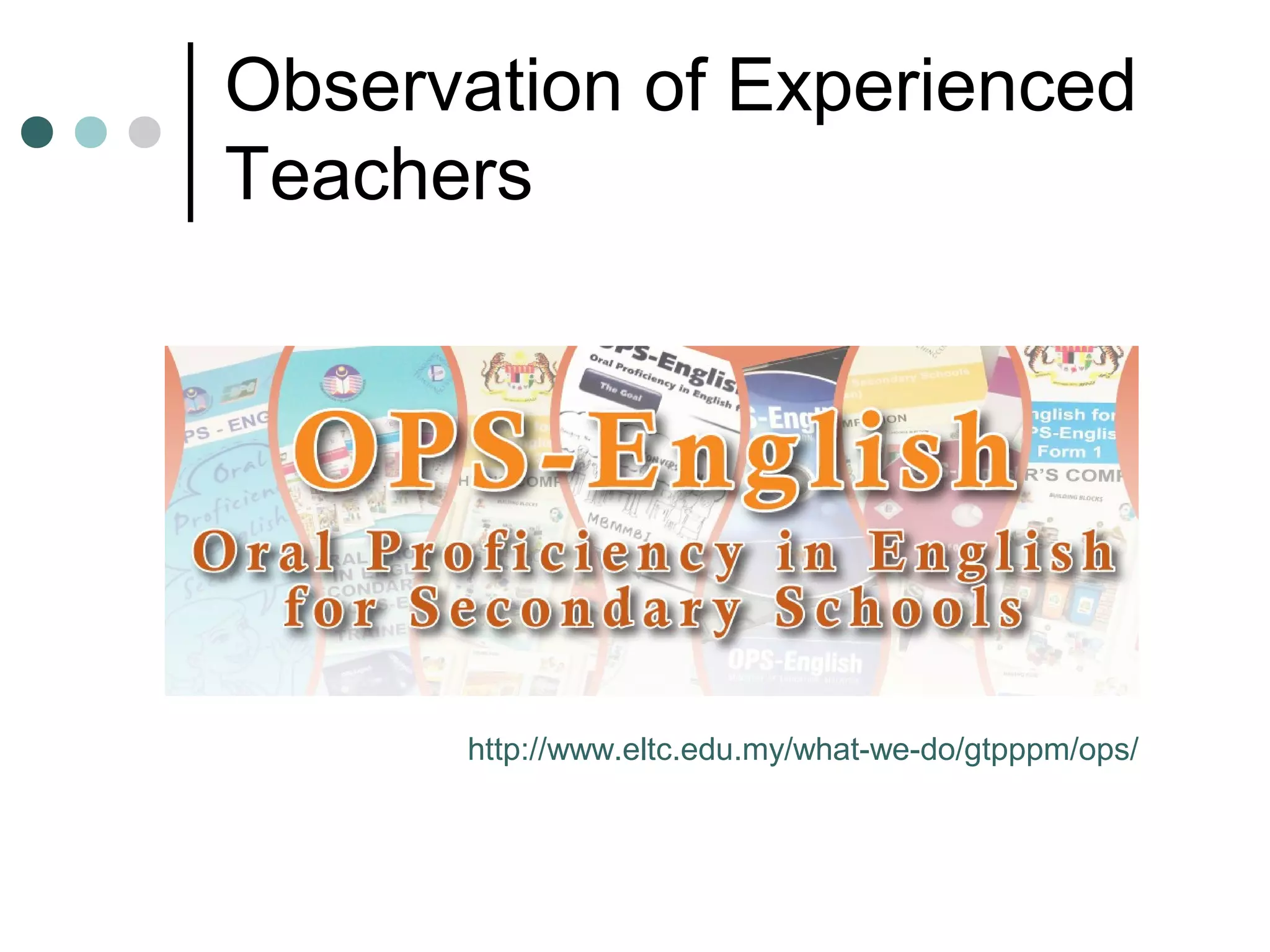
http://www.eltc.edu.my/what-we-do/gtpppm/ops/
Observation of Experienced
Teachers
 Stressful
 Not usually informed in advance
 Must get grade over 80%
Observation of Experienced
Teachers
 Feedback is often unhelpful
 Feedback is poorly received
 Feedback can cause distress
Observation of Experienced
Teachers
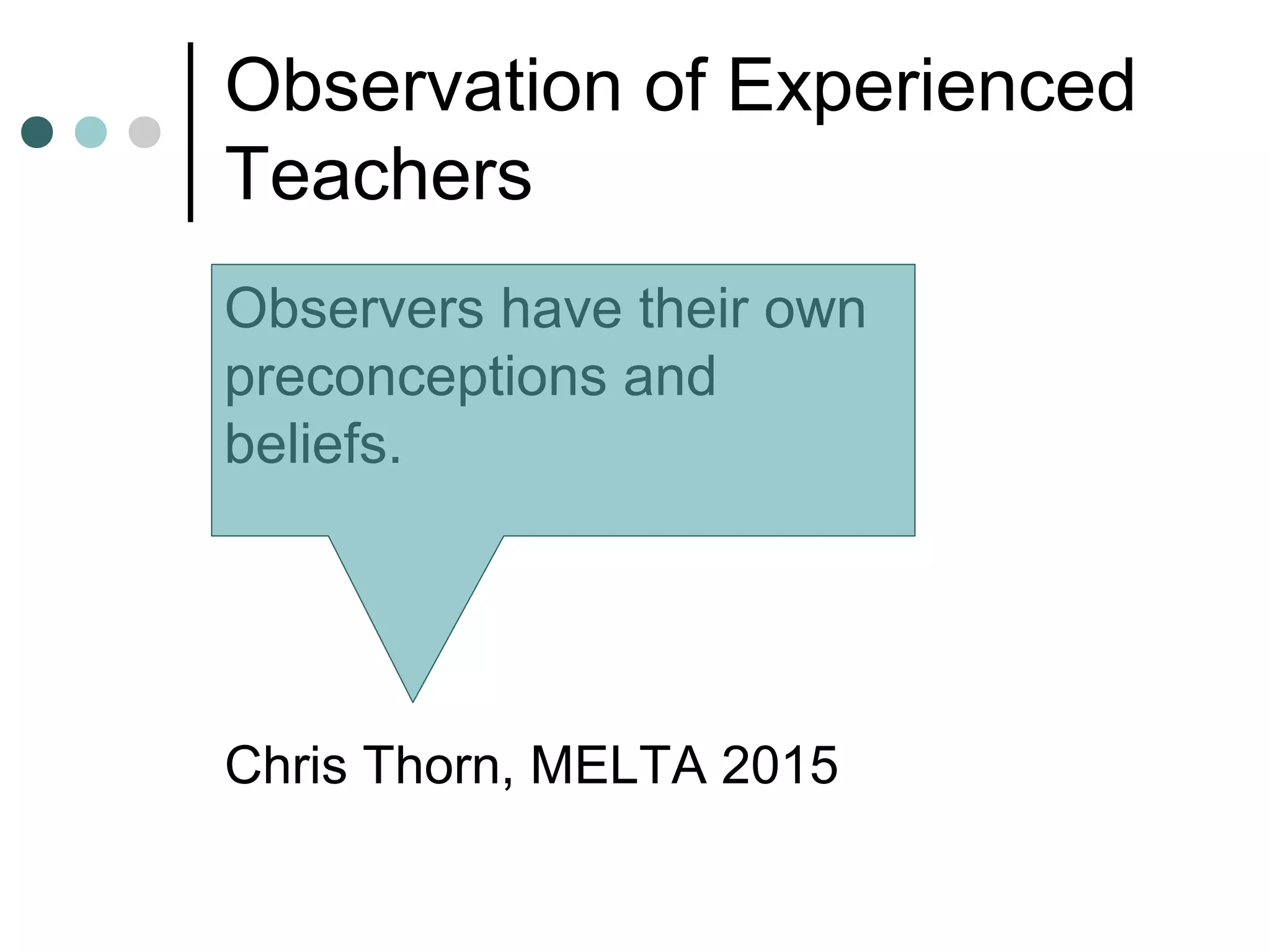
Chris Thorn, MELTA 2015
Observers have their own
preconceptions and
beliefs.
Observation of Experienced
Teachers
 Feedback can be positive and
motivating
 Feedback can be include useful
suggestions
 Feedback is sometimes unrealistic
Peer Observation by
Experienced Teachers
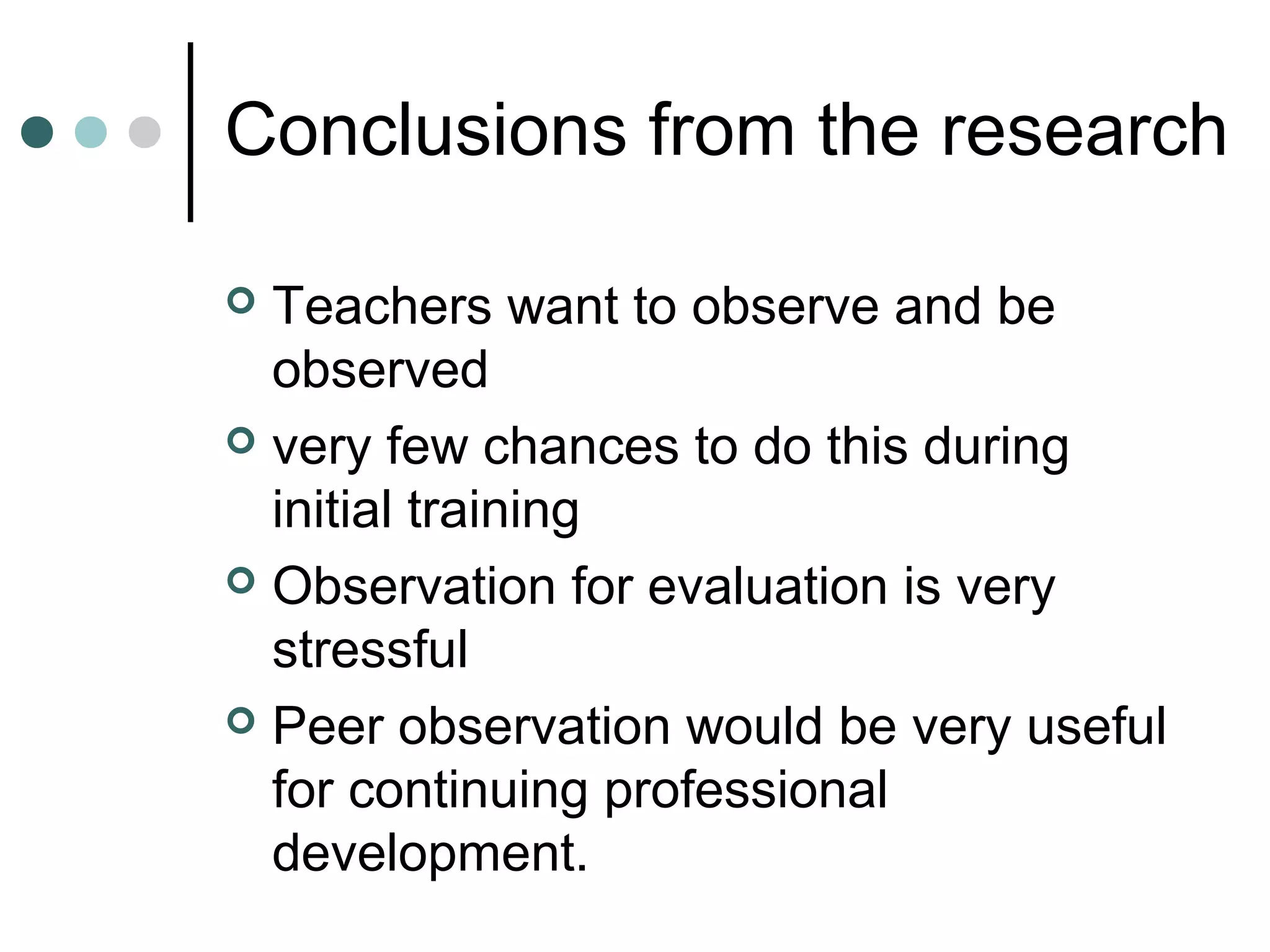
 Most teachers never observe their
peers
 They believe that it would be useful
to observe each other
Existing Initiatives
LET (Learn English Together)
http://www.moe.gov.my/en/peluang-
kerjaya-view?id=1104&
Existing Initiatives
Buddy Support
Conclusions from the research
 Teachers want to observe and be
observed
 very few chances to do this during
initial training
 Observation for evaluation is very
stressful
 Peer observation would be very useful
for continuing professional
development.
Development Needs
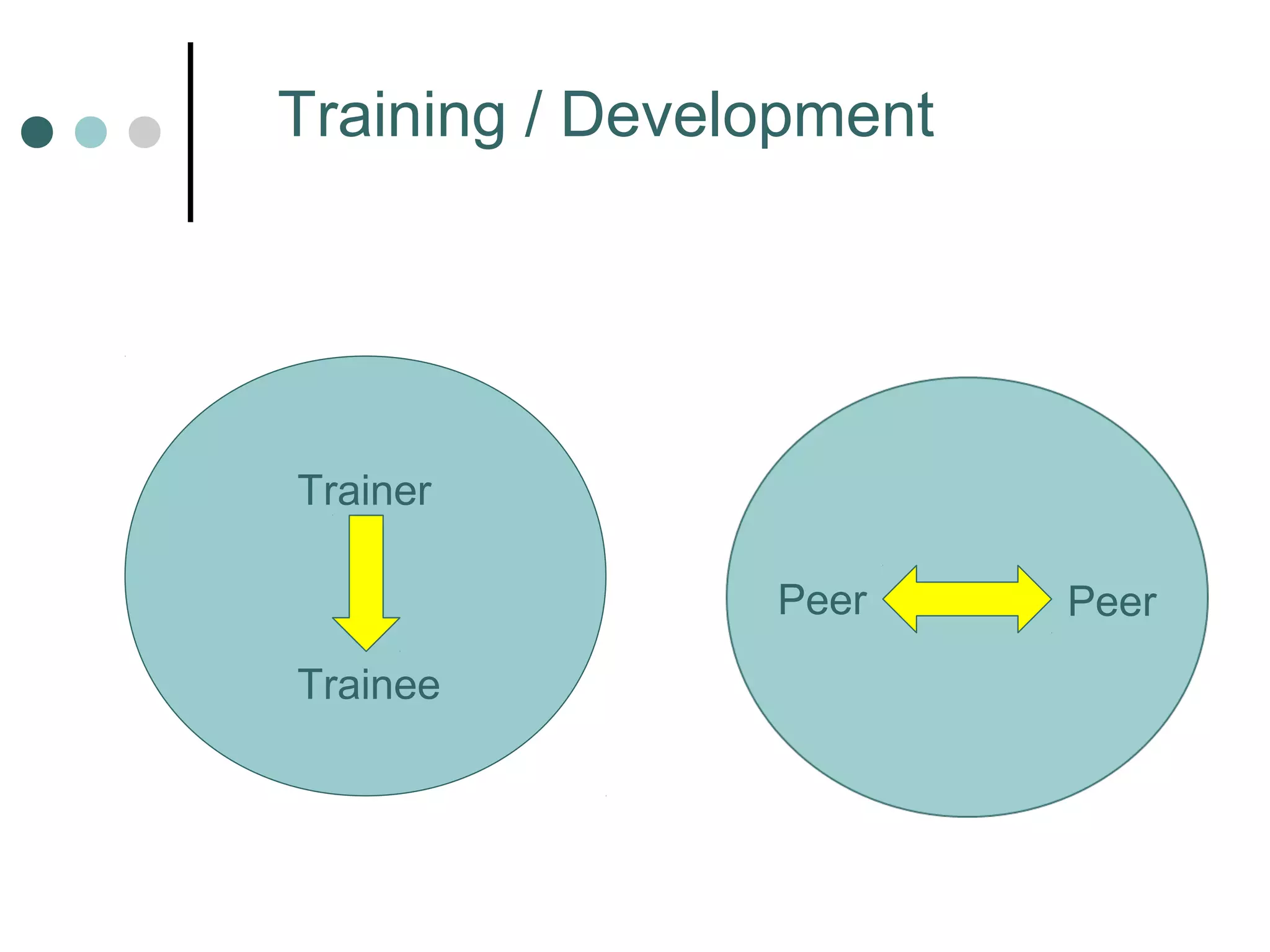
Training / Development
Peer Peer
Trainer
Trainee
Cooperative Development
Training / Development
Pradip Kumar Mishra, MELTA 2015
Teachers are
like gardeners.
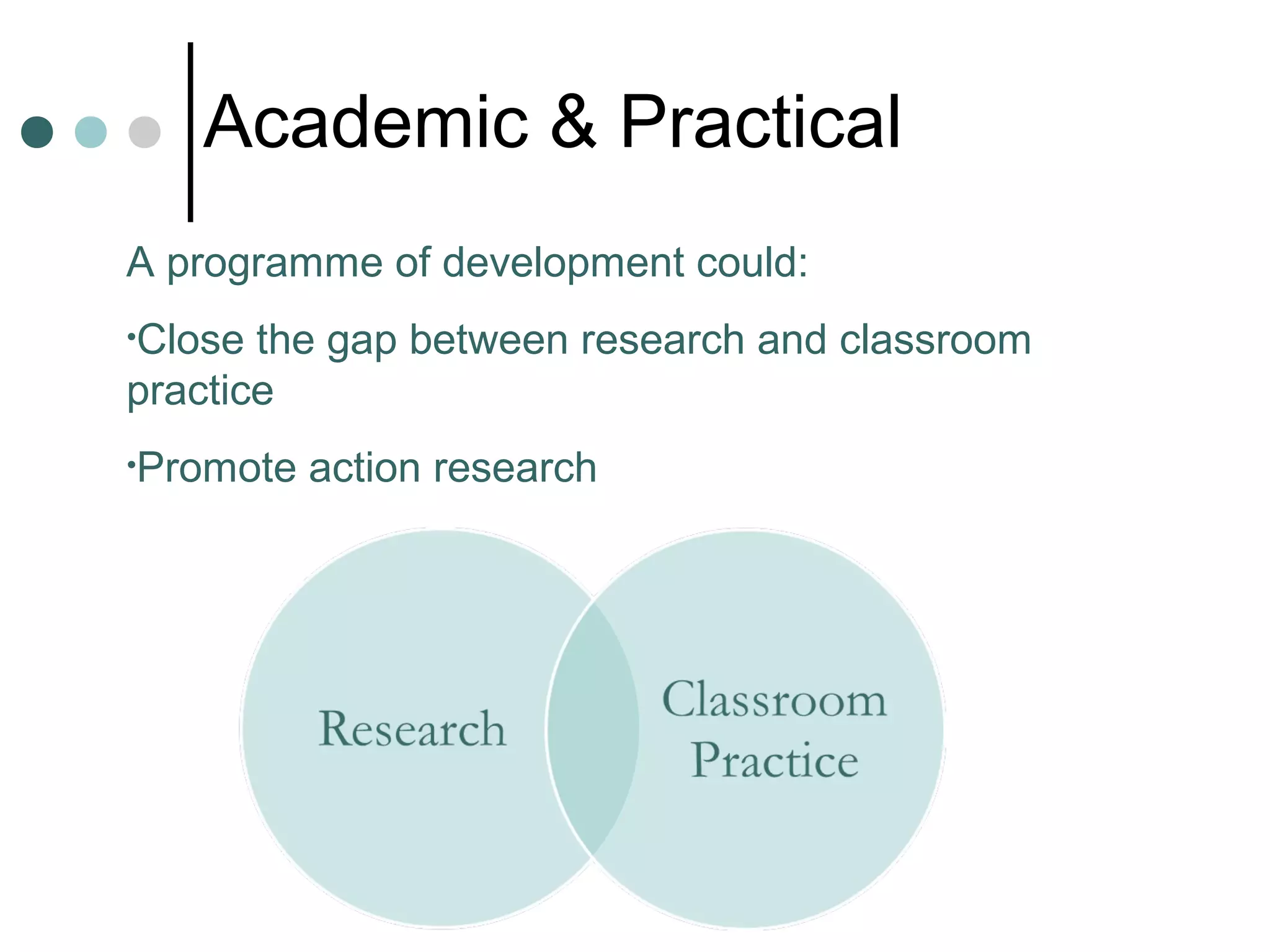
Academic & Practical
A programme of development could:
•Close the gap between research and classroom
practice
•Promote action research
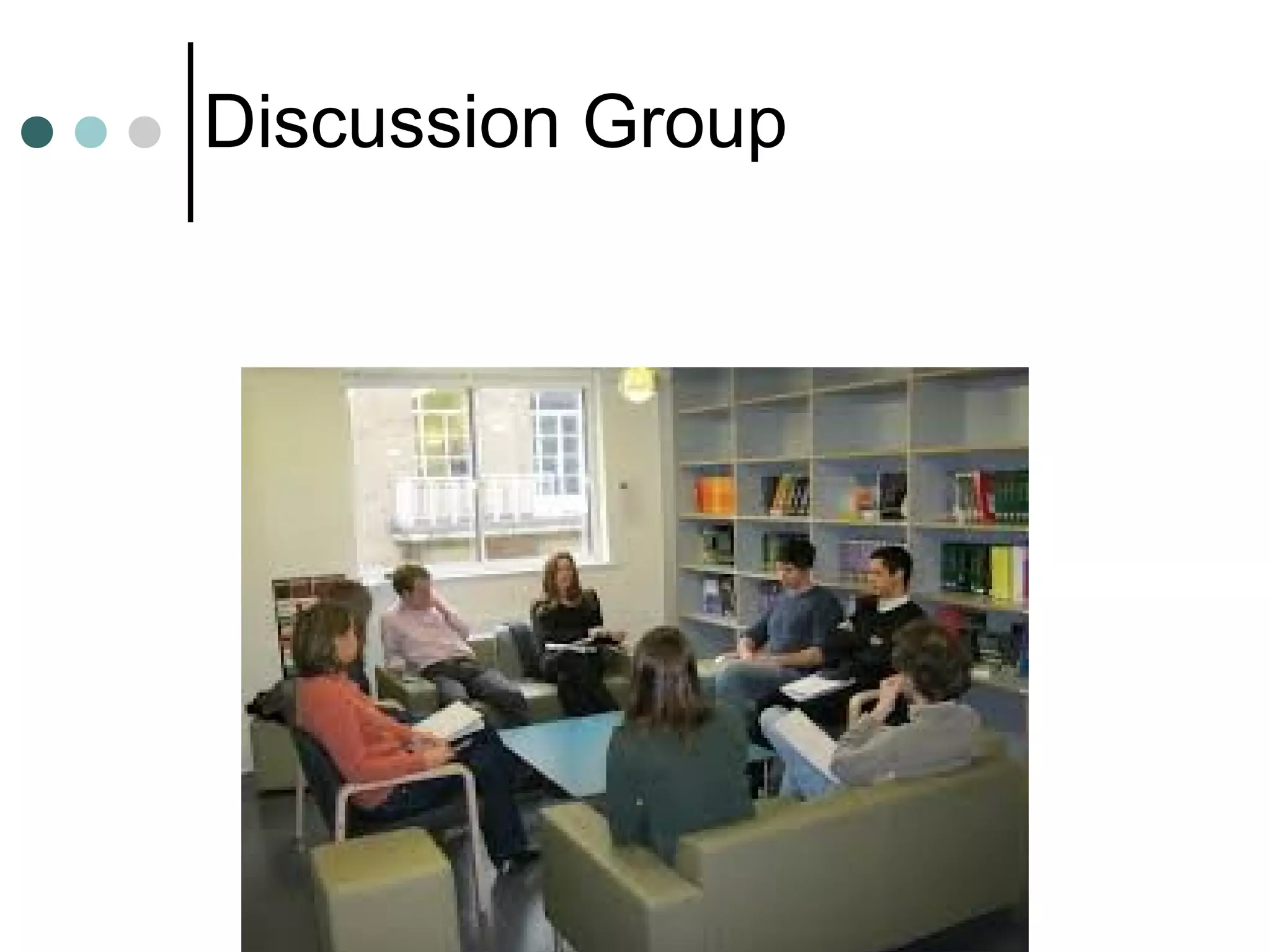
Discussion Group
ICT
Schedule
Theory into Practice
Sharing Best Practice
Teachers can:
 Conduct classroom research
 Examine their own teaching
 Explore ideas of best practice in their
own context
 Share experience with peers
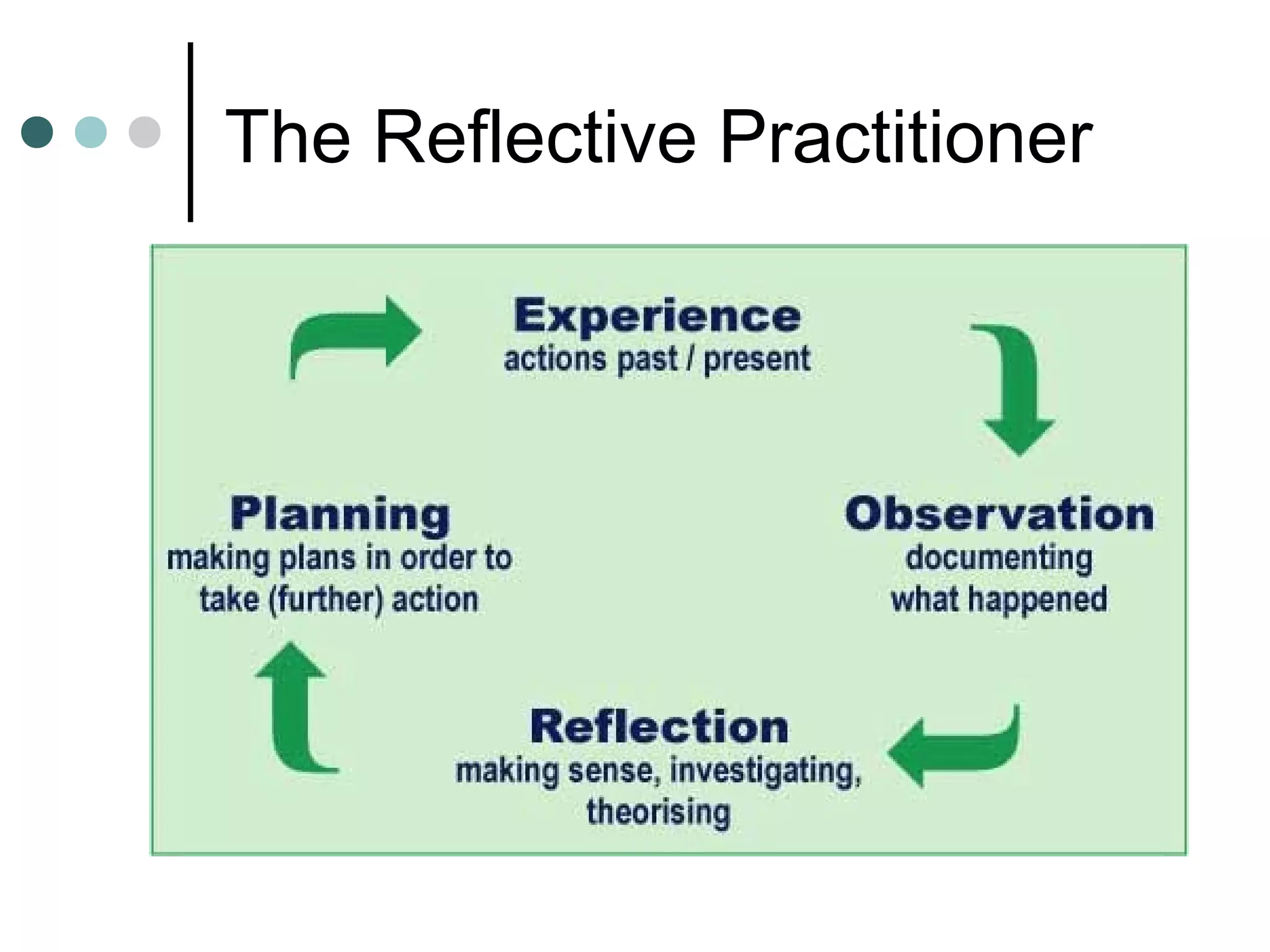
The Reflective Practitioner
The Reflective Journal
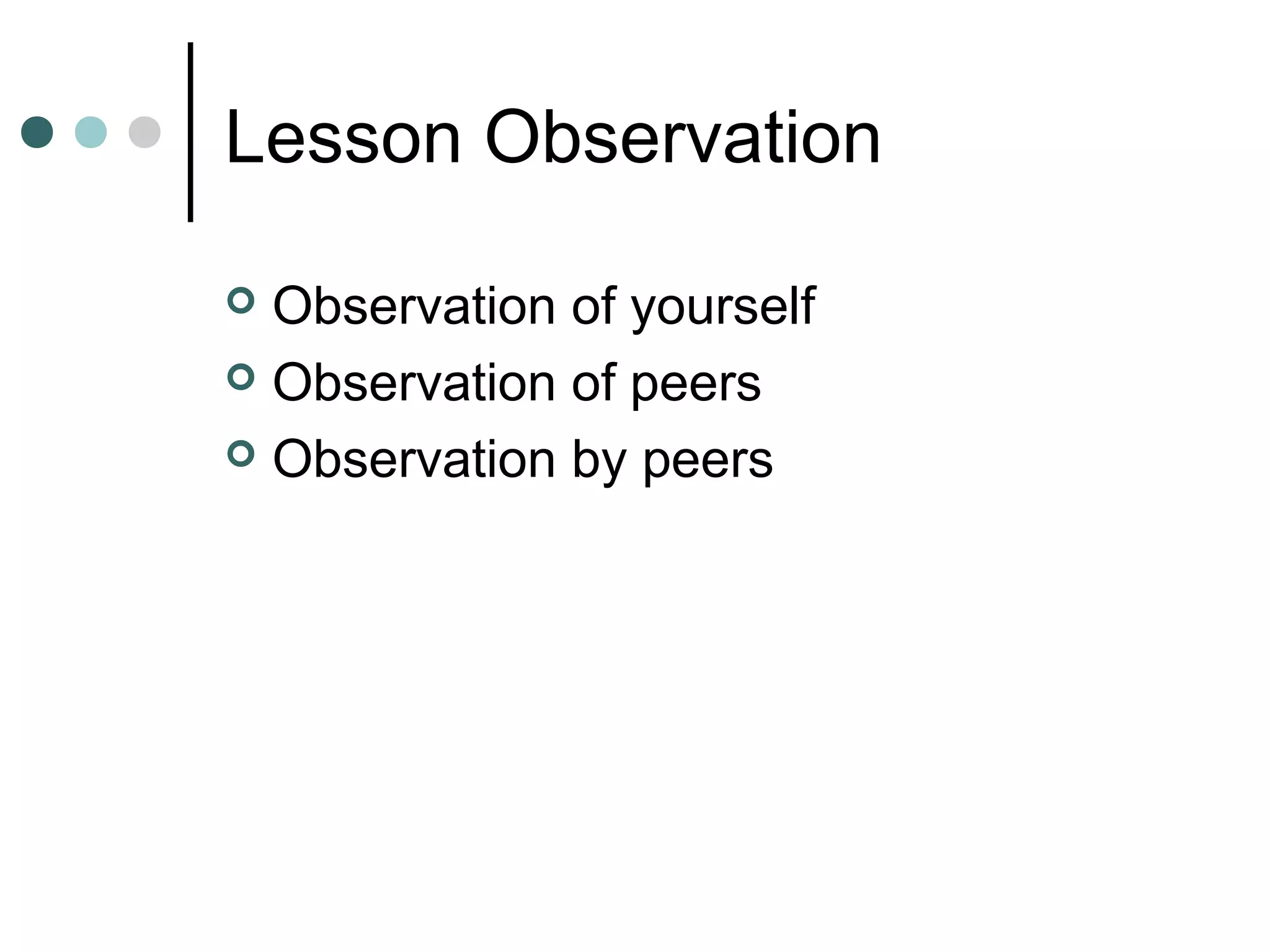
Lesson Observation
 Observation of yourself
 Observation of peers
 Observation by peers
Observation of yourself
“How can teachers move beyond the
level of automatic or routinised
responses to classroom situations and
achieve a higher level of awareness of
how they teach, of the kinds of
decisions they make as they teach, and
of the value and consequences of
particular instructional decisions?”
>>>
Observation of yourself
“One way of doing this is through
observing and reflecting on one’s own
teaching, and using observation and
reflection as a way of bringing about
change.”
Towards Reflective Teaching
Jack C. Richards
http://www.tttjournal.co.uk/back33.htm
Observing Peers
“Peer observation is the observation of
teachers by teachers, usually, though not
always, on a reciprocal basis.
[…]the objective is to provide opportunities for
experienced teachers to reflect on their
teaching in a calm and private environment.”
Peer observation
Graham White
http://www.teachingenglish.org.uk/think/methodology/peer_observation.shtml
Observing Peers
 Share varying methodological
approaches to the syllabus and
materials used in the institution.
Observing Peers
 Not aiming at an abstract ideal of the perfect
teacher.
 Observed teacher can choose to focus on
specific areas of weakness – and set
personal aims for next observed lesson
Observing Peers
“Peer observation can provide opportunities for
teachers to view each other’s teaching in order
to expose them to different teaching styles and
to provide opportunities for critical reflection on
their own teaching.”
Towards Reflective Teaching
Jack C. Richards
http://www.tttjournal.co.uk/back33.htm
Observation Feedback
 Avoid being judgmental
 Give objective statements of WHAT
happened
 Get teachers to consider the HOW
and the WHY
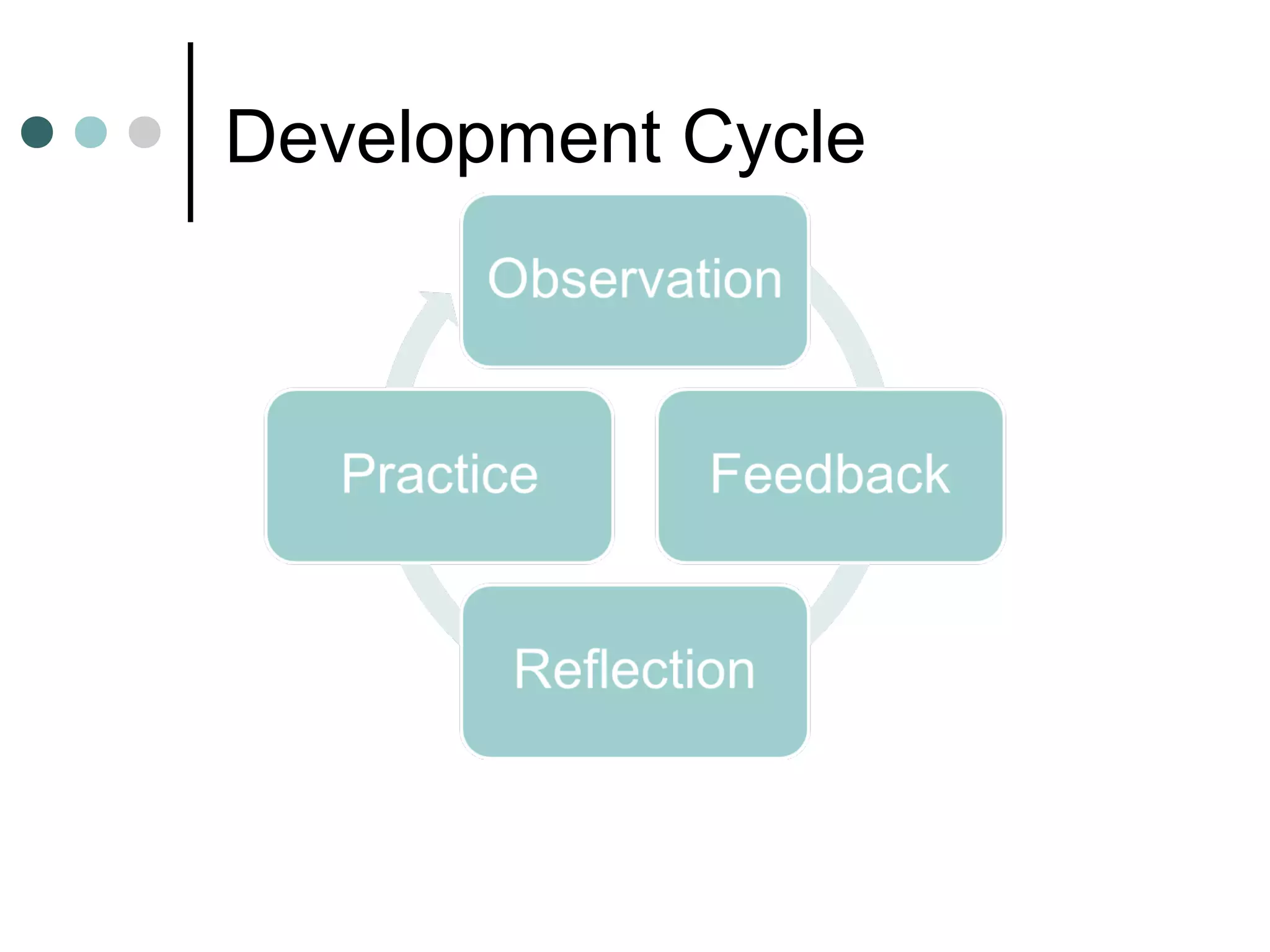
Development Cycle
Training / Development
The difference between the teachers
“with twenty years experience and those
with one year’s experience repeated
twenty times”
Ur, 1996, p. 317
Discussion
 How has your teaching changed over the
years?
 Is it still changing?
 In what ways?
Discussion
 What forms of continuing professional
development do you engage in?
Discussion
 What is your experience of observing and
being observed?
 Would peer observation be useful in your
context?
Discussion
Kevin Balchin, MELTA 2015
Reflection is often
descriptive, shallow, bland,
aimless, unguided.
Discussion
 How can we promote reflection that isn’t
“shallow and bland”?
Discussion
 What aspects of a lesson do observation and
feedback focus on?
Discussion
 Teacher language
Instructions
Explanations
Questions
Elicitation
Checking understanding
 Stages / timing
 Monitoring – feedback – error correction
Discussion
 What aspects would it be useful to focus on
for more experienced teachers?
Discussion
 Interaction patterns
 Engaging all learners
 Catering for MI / VAK
 Differentiated tasks for mixed abilities
Discussion
 What aspects of your teaching would you like
to focus on?

Innovation through continuing professional development

Editor's Notes

  • #2 In this presentation, I’m going to focus on the role of lesson observation in teacher training, and particularly the use of peer observation as a tool for continuing professional development.
  • #3 Data for this research project was obtained in interviews with sixty English Teachers from forty-eight different schools in Johor, Malaysia during May 2015. They taught in a range of different types of school including SJKC, SJKT and SMK, in both rural and urban areas.
  • #4 A few of the participants were newly-qualified and still in their twenties, but nearly half of them were in their thirties, and a significant number were in their fifties.
  • #5 A few of the participants were in their first year of teaching, while the ones aged between thirty and forty generally had between six and fifteen years’ teaching experience, and a significant proportion had been teaching for over twenty years.
  • #6 Twenty-eight had a B.Ed. TESL and seventeen had a Diploma in Education Very few had postgraduate degrees: just one MA and one PhD. They were nearly all English optionists, but a few were qualified in other subjects and were teaching English in small rural schools due to the shortage of English Teachers.
  • #7 Participants were asked a series of questions about their experience of observing and being observed during their training and now that they are qualified.
  • #8 In the initial stage of training, student teachers went to schools for two weeks to observe teachers, but this was never repeated. Some of the teachers that they were supposed to observe didn’t want them to come into the class. They’re not confident and don’t allow the student teachers to observe them as they feel they would be criticised. The overwhelming majority of participants reported that they had no opportunity to observe experienced teachers. The few who did observe were only able to do so two or three times, but found it very useful and felt they learned a lot.
  • #9 In some cases, there was no specific focus for the observation, it was just designed to give them a general experience of the school environment. In other cases, there were specific tasks about: •Teaching approaches •Classroom management •Teacher language
  • #10 In the third year of training, they had a six-month practicum during which they were observed. They were given grades, and suggestions for how to teach better. They were observed sometimes by their lecturer and sometimes by the mentor-teacher at the school. However, in many cases, the lecturer never did the observations, and they were only ever observed by the mentor. Many of the participants reported that during the whole of their three-year course, they were only observed 2 – 4 times in total, even though they taught every day for six months in the final year.
  • #11 When they were observed, they found the feedback they received very useful and constructive. Feedback focused on key aspects of their teaching. After a lesson that received a poor grade, they had to re-do the lesson plan based on the comments in order to improve their grade.
  • #12 As trainee teachers, they worked together on lesson planning, and exchanged materials. Most never observed each other’s actual lessons, but did sometimes rehearse together.
  • #13 Now they are observed twice a year by their headmaster or a senior teacher or head of the English panel, and by an officer from the PPD Inspectorate. The observers give a mark and fill in a report.
  • #14 The purpose of the observation is to check that the teachers write their lesson plans correctly and teach properly, and to advise them on how to teach better. Observers also want to see improvement from one year to the next.
  • #15 They also observe progress on specific projects like OPS (Oral Proficiency for Students).
  • #16   Being observed is a very stressful experience. Teachers are sometimes informed in advance that they will be observed, but not usually. They must get a grade of at least 80%, otherwise the observation is repeated.
  • #17   Some participants reported that the observers sometimes give some feedback, but they don’t really help the teachers to improve. The teachers don’t like the observers’ comments because the observers themselves aren’t sure about the methods and don’t teach well themselves. Instances were mentioned of teachers crying because of the poor feedback.
  • #19   Others said that the observers try to be positive and motivate the teachers, and mentioned that the feedback sometimes includes useful suggestions. Sometimes the feedback is unrealistic, as when the observers say that the class should be taught entirely in English. Observers also sometimes ask the teachers how they felt about the lesson.
  • #20   Some participants observe other teachers (their subordinates) now in their role as Head of Panel. In the context of the Professional Learning Community (PLC) Project, experienced teachers may be observed by non-optionists, who may also video the lesson for subsequent analysis. The great majority of the teachers surveyed never observe their peers. However, they believe that it would be useful to observe each other and share approaches.
  • #21 Even so, the LET (Learn English Together) programme, in which teachers from a cluster of schools get together to share ideas, seems to be very unpopular.
  • #22 One reason for the unpopularity of such programmes is that teachers are required to write a lot of reports.
  • #23 “Buddy support” seems to be viewed more positively because it is based in each individual school and doesn’t require teachers to travel.
  • #24 Teachers in Malaysia value the opportunity to observe and be observed but they get very few chances to do this during their initial training. During their careers, when they are observed by experienced teachers, the purpose of the observation is to evaluate and grade them, which makes the situation very stressful. Peer observation would therefore be a very useful tool for continuing professional development.
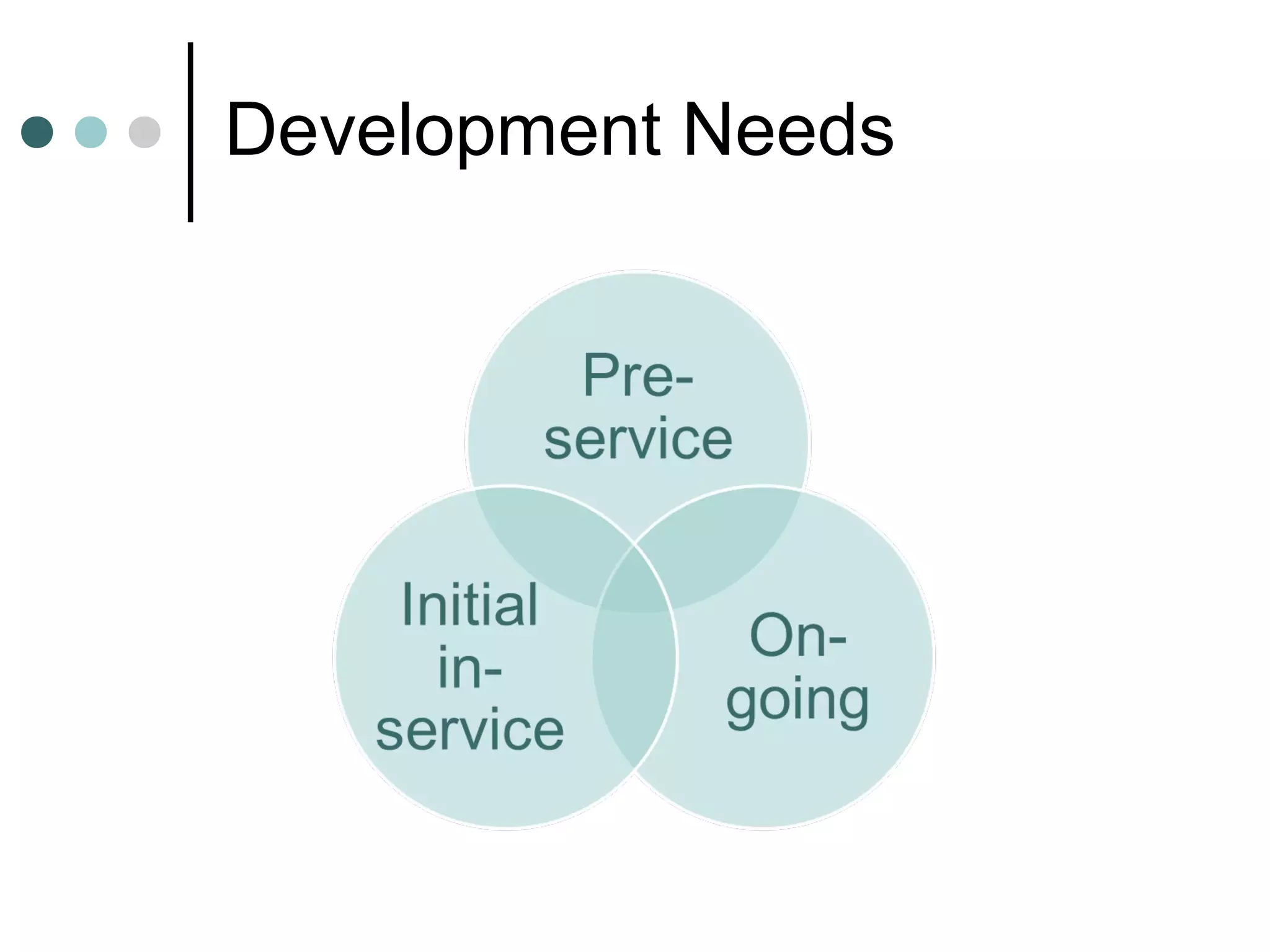
  • #25 To a limited extent, the needs of experienced teachers may overlap with the needs of novice teachers, but they are largely different.
  • #26 And the process of continuing development is quite different from the process of training. In a training situation, novice teachers are instructed by experts and then evaluated on their performance. Development is something which we can all do for ourselves, and which comes from within.
  • #27 So in a programme of teacher development, there is no developer, analogous to the trainer in a training programme. But we can benefit greatly from collaborating with our peers, either in pairs or small groups, to support each other’s development.
  • #28 As well as nurturing our students, we also need to nurture ourselves and each other.
  • #29 The two interwoven strands in a programme of teacher development are theoretical input and classroom practice. As we progress through our careers, it’s important to keep in touch with new research in order to avoid stagnating and to ensure that our teaching incorporates the latest research findings on second language acquisition. Too often, the researchers have no contact with classroom practice, and the classroom practitioners have no contact with research, but we can all undertake small-scale research projects in our own classrooms.
  • #30 Theoretical input could come in the form of journal articles, book chapters or conference presentations. Discussing these with small groups of colleagues provides an opportunity to engage with new ideas and share our responses with colleagues. Of course each person is free to choose what they read, as there is nobody directing the programme.
  • #31 This kind of group can also share ideas and experiment with new technologies to help us teach more effectively.
  • #32 It is helpful to agree on a regular schedule. For example, a group of colleagues might meet for one hour each week, and take it in turns to lead a discussion. That way, each person only needs to prepare a presentation once every few weeks.
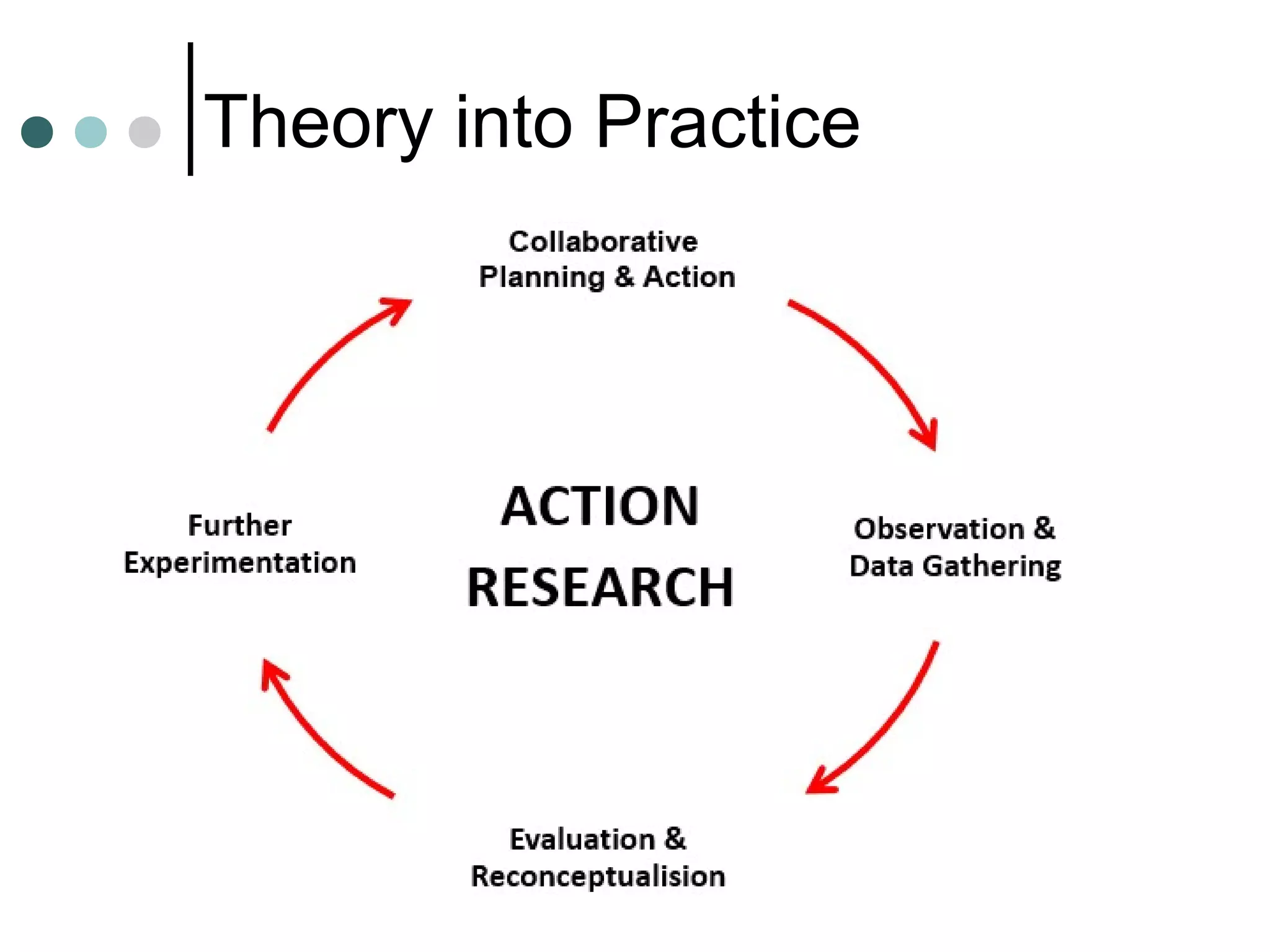
  • #33 New ideas can form the basis for small changes to our classroom practice. For example, we may read about some research into the relative effectiveness of different approaches to error correction. We decide to adopt one of these approaches, and as we implement it in our class, we observe how effective it is. Afterwards, we reflect on the experience, evaluate its effectiveness, and perhaps plan some adjustments before we continue to experiment in the next class. This can be done individually, or could also be designed by a group of colleagues as a collaborative project.
  • #34 Classroom research conducted in a context similar to our own is likely to be much more relevant and useful than research that we may read about that is conducted in a completely different context. So there is great value in sharing the results of our classroom research with colleagues locally.
  • #35 Particularly when we implement a cycle of action research, it’s essential to reflect on the effectiveness of the changes we make. But it’s also useful to pause to reflect on our lessons at the end of each day, so we can crystallise and clarify our thoughts on what went well and what went less well. This will enable us to improve continuously and work towards becoming the best teacher we can be.
  • #36 Recording these reflections in a journal is a useful means to clarify your ideas and impressions, and forms a record of your developing ideas which you can refer back to later.
  • #37 There are three forms of observation that can underpin our continuing professional development. When we’re busy teaching, it’s quite difficult to be aware of everything going on in the classroom. The best way to observe our own teaching is by video recording. We can also learn a lot, from observing, and being observed by, our colleagues.
  • #38 People who have been teaching for a long time naturally develop routines and tend to respond automatically to classroom situations. Sometimes it can be good to overcome that habit and try to think about things in a fresh way.
  • #39 Observing your own lessons through video recording them is a great way to break out of the routine and see things in a new light.
  • #40 Peer observation can be greatly beneficial for both the teacher being observed and the one observing.
  • #41 Peer observation can be much more helpful than observing expert teachers because of the similarity of your teaching context.
  • #42 When we observe our peers, it’s important to take as a starting point the stage of development they’re already at. Remember the process of development is different for each individual. It can be helpful for the teacher being observed to specify one or more aspects of teaching to focus your observation on.
  • #43 Although the person being observed is the one whose development is the focus at that time, the person observing can also gain useful insights from the experience.
  • #44 Unlike the observations designed to evaluate, feedback following peer observation should not judge, but simply stimulate the teacher’s own reflection on the lesson. This can be done by providing objective statements of WHAT happened, and encouraging the teacher to reflect on how it happened and why It happened that way.
  • #45 Lesson observation followed by feedback and reflection should lead to small changes in practice, which can then be the focus of subsequent cycles of observation and feedback. This kind of cycle is the basis for continuing professional development that enables each of us to become the best teacher we can be.
  • #46 The difference in development needs of teachers at different stages of our careers reflects the distinction made by Penny Ur between the teachers “with twenty years experience and those with one year’s experience repeated twenty times”